
- LOGBOOK Sailing New and Views from our Model Yachting Association Correspondent.

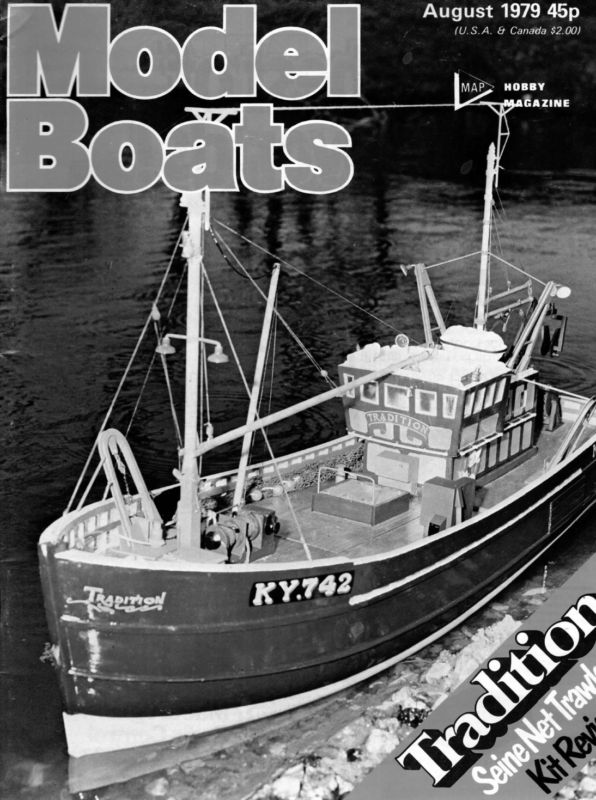
August 1979 45p (U.S.A. & Canada $2.00) MAPS HOBBY NV \ AGAZINE
co Sailing News and Views from our Model Yachting Association WOON ——— = OOH ATTA NNAAEANASS UNIS Correspondent 1 | 8 ae MULL Hifi AS DOAANT ANNAN SEN NAA ANNAN SENDE RS EE EAIERSSAAAAUEEEN RSERANSRN League Championships The 1979 League is off to a good start, though results of fixtures are in some instances late in reaching Peter Maskell. (His address is now 13 Bryan Street, Farsley, Pudsey, Yorks LS28 5JP, in case the secretarial files haven’t been updated?) Sometimes individuals send claims in for scores, but it obviously simplifies Peter’s job if secretaries send in full results. Positions by May 24th were: Radio 1. Club Entries Leicester Races 18 Points 5 282 126 2. Decoy 3. 5 Birmingham 1 4. Woodspring 7 4 4 124 1 72 5. Danson 6. Basildon 7. Clapham 8. Lincoln 9. London 7 1 3 41 1 2 31 1 16 1 1 1 12 1 5 Entries Races 6 Points 2 254 10. Northampton 2 1 2 (Races include Witton Buoys, Witton Aerial, Leicester Open, and Danson Frostbite — all RM — Nylet, and Midland District R10R.) Vane Club 1. Fleetwood 2. Bournville 3. 3 Leeds 1 233 4. Birkenhead 8 2 213 5. Uh Birmingham 2 10 170 2 134 6. Cleethorpes 7. Welwyn 8. Newcastle 2 1 1 57 1 2 31 1 7 (Races include National M, Builder Cup, M (Mid.), Parks Cup, A (N.).) Things should have hotted up a bit by the time this issue is published; results are bound to appear some weeks late, but secretaries can help by getting race lists to Peter promptly. Sailing Development Class David Boothroyd was encouraged to receive a number of letters following his thoughts on a special development class, but points out that the formula he quoted giving an equivalent to power/weight ratio got a little mangled. It should be the square root of the actual sail area (sq. ft.) divided by the cube root of displacement (Ibs.). With his Ashanti, for example, with about 6.25 sq. ft. of sail and 13.5ibs displacement, the formula gives 2.5/2.38=1. 05. Any factor over 1.00 is getting into the fast area; the world’s fastest sailing craft comes out at 1.8 and moved at around 33k at last year’s Portland Speed Trials, so there is room for development with models. More news later. Incidentally, switching subjects by mention of full-size, did you see the brief mentions of the Sail Symposium held in mid-June? Sailing cargo vessels as an answer to hydrocarbon fuel shortages look very much on the cards, but a projected huge square rigger had us puzzled. The last reasonably viable sailing cargo machines were multi-mast schooners (up to seven masts) which gave the highest sail area/crew ratio, especially with winches for sail handling, and one would have thought that some such application of fore and aft rig would have been more efficient than square sails. However, enough of digression. Overseas News Model boating activity in Spain seems to be on the increase and moves are afoot to organise a number of groups in various parts into clubs. The prime mover seems to be the Club Deportivo de Modelismo Naval, at-Barcelona (address P.O. Box 1211, Barcelona) and application for IMYRU affiliation has been made. The aim is a national organisation embracing both yachts and power, the latter being affiliated to Naviga. If you are in the Toronto area on Aug. 11 and 12, the Canadian M Cham- 496 pionships are being run at Ontario Place. The AMYAM Championships will be in San Diego but we have not been given the date. R/C Rules Some hard hitting comes from Peter Messruther, secretary of the Scarborough Model Shipwrights Club, on the subject of radio sailing rules. He points out that continued argument over rules is the best way of putting off people who are looking at our sport with a view to joining in, and that too much ‘aggro’ will spoil the hobby. Top skippers arguing like big kids spoil things for onlookers (and other skippers who are in the hobby for the pleasure it can give them) and create an image we can well do without. Peter feels that Roy Stevens’ comments, which started a recent controversy, were simply making the point that many would-be skippers are put off by the complicated rules; many of the pond-side argument s are caused by them, and there is a growing feeling that one needs to be a sea lawyer to win, or in some clubs even to sail! Many clubs, it is suggested , are ignoring the rules and making up their own simpler versions, and if this continues clubs won’t be able to visit each other because they are used to different rules. The Messruther solution, apart from simpler rules, is the addition of anew one — that anyone who argues with the OOD to the point where boredom sets in gets chucked in and kicked out. Quite a few skippers would be less pompous if a ducking was imminent, and the spectators would be less bored, too… Although the ‘ultimate deterrent’ suggested should perhaps not be taken too literally, this letter does reflect an unease whichis felt by a considerable proportion of those skippers who enjoy racing and want to compete, but not if there is to be bad feeling and prolonged arguments . Once the needle appeared, the sharply-rising graph of entries in national races showed a sudden cut-off. There is inevitably a chance of a decision going against an innocent boat, but by the same token, that same boat may very well benefit from a confused incident in the next race. If people are not going to be sporting, or at least philosophical, eventually major races will die off from lack of support by reasonable skippers, or refusal to give up time by hard-working voluntary officials who may not be perfect but do not expect their services to be rewarded with abuse. Some possible answers are (a) an entry fee of at least £10 a boat so that expert judges can be paid (b) a code of conduct and a signature in advance that a competitor will abide by it (including judges’ decisions being final) (c) major races by invitation only, which might bring home to a bad sport that his behaviour lacks something (d) authority for a judging panel to slow handaclap a complainant, followed by a ban for x months from official competitions, or (e) personal penalty points awarded against individuals by race Organisers under a totting-up system, on a central register, so that any regular dissenter reaching, say, 10 points is disqualified from competing in races for perhaps a year. No-one would really like any of at least the last three ideas, but the people who would like them least are the ones we don’t need. Perhaps things haven’t got to the point where drastic action is necessary, but it seems to a lot of fair-minded yachtsmen that the writing is on the wall. As a final point, why is it, one wonders, that most of the really top men are never involved in controversial incidents, or if they are givena penalty, accept it with ashrug? Tim Fuller Writes As a lot of model yachtsmen all over the country will already know, the New Forest MYC were refused a new annual lease on their water of Snails Lake at Ringwood. This is because a sail board club came along and offered a rent of £2,500 for this area of water, obviously a rent which the New Forest club could in no way compete with. It would appear that recreational water will cost a prospectiv e lessor from £50 an acre upwards per year, and we ourselves have found that it is very difficult to compete with fishermen or nature conservatio nists, though this may be partly because of our location in the New Forest. Fishermen are apparently willing to pay up to £2.00 a day for their ‘piece of bank’; quite obviously this has quite a financial influence on owners of any water, and even though model yachts cause no noise or pollution, owners will not do Model Boats
pushing as hard as we can. The second solution involves becoming part of a a little worried that as this was a league event it would have perhaps been better to use the same type of schedule that other league events use throughout the country. But then if you don’t try new ideas how do you know if they are any good? Several skippers were very keen on the heat schedule by the end of the day, and! am sure we shall meet it at other events. After all, we are there to enjoy the sport, and everyone did enjoy this day’s sailing. After competing in two open events, where penalties were given in the form of 720° turns, both Ted Geary and | agree that although there is far less full-size sailing club and being able to use their facilities and an area of their work for the OOD to do this systemis anything that might upset the fishermen. In this age of increasing leisure- time the situation can only get worse, with prices for water increasing. | note that the Wimborne model flying club are being asked for £650 per year for their flying area of approximately one acre! If this is a taste of the future then | shudder to think how our sport can survive. We are exploring two solutions and one is an appeal to our local council to provide recreational water, though with their present cut-backs aimed at reducing the rates they have no funds available to be able to provide any such water; that doesn’t stop us water that they are possibly not able to use. This again is something we are trying to do with our local ‘Spinnaker Sailing Club’, but at the time of writing we have not been able to negotiate proper permanent terms, due to the fact that Spinnaker tend to protect their sailing courses jealously, though they are, of course, very happy to take our membership fees! | must admit we look with envious eyes at long established clubs like Fleetwood and Poole with their comparatively excellent facilities, and we can only conclude that without council help it will be very difficult for small local clubs to exist in the future. After applying to many large firms for sponsorship, we have been pro- far less fair to all competitors, mainly because a high proportion of penalties were ignored, because the judges found it very difficult to give an instant decision, and it was much easier just to say nothing and let the situation pass. Virtually all skippers would find at least some rule infringements difficult to decide upon after great deliberation, let alone immediately after a collision takes place! There is also the position of penalty situations occurring just before the finish, and yachts complete the course before penalty turns can be awarded. So, because of these two main points, | feel it would be best that 720° turns be used when time saving is very important, as basically it is a far less accurate method of awarding penalties. vided with a superb trophy by Wilkinson Sword. This trophy is a full-size sword mounted on a wooden plaque, and made from top grade steel which Howard Dodd is fully engraved. The handle is of rosewood and the hilt is gold plated; it With very deep regret we have to announce the tragic death of Howard Dodd, who lost his life in a yachting accident while on holiday in Greece in May. Howard, who was only 23, was a figure wizard who had just embarked upon a career with the Atomic Energy Authority; he was the Rating Rules Officer for the IMYRU and a keen and good-natured competitor in racing generally. We can only extend very sincere sympathy on behalf of all model yachtsmen to his parents, Sid and Evelyn Dodd. must represent one of the premier prizes in model yachting today. The winner will be asked to insure the sword for the advised value of £300 and we will be sailing the event in September. All club secretaries will be advised, in due course, of the full details. The Southern and Metropolitan District RM Championships were held at Guildford, and Roger Stollery’s fleet system was used. The basic idea was to provide skippers with more racing and more time on the water, and this it certainly did, although it appeared to me to give rise to several problems. On a windy day it will probably be possible to sail a fleet of up to 27 boats maximum, bearing in mind that it is required that 9 yachts sail at a time. Actual sailing time on the water is not much greater than that in a normal schedule, the ‘extra’ time being derived from sailing 9 boat races and fewer competitors. Most normal schedules allow for only two minutes between races, so that there is a saving of four minutes for every three races, which does not go along way towards providing extra racing time, and there is the bug-bear that every skipper does not meet every other skipper, although | must admit that looking at the results table the finishing positions were approximately where | would have expected them to be, after the more normal racing schedule. As the sailing schedule had to be made up as the results from different heats came in, there had to be two full time officials whose job it was to choose race judges, work out frequency colours and position skippers for their next heat, a hard job, in this case, well done by the Guildford team, but nevertheless hard work. In the final three races, when M.Y.A. FIXTURES — AUGUST/SEPTEMBER ‘79 August 26th Cole Cup 26th Model Boats Magazine Cup 26th & 27th = 24-Hour Event Birkenhead R10-R New Forest ‘RM’ Fleetwood ‘M’ ‘RM’ 27th Northern District Championship Birkenhead 27th Bilmor Cup Gosport ‘A September 1st Radio B — Ham Event Birmingham ‘RM’ 24-Hour Event Metropolitan & Southern District Ashton ‘RM’ Championship Northern District Championship Eastern District Championship MYSA Newcastle Dovercourt 10-R 10-R 10-R Ist &2nd 2nd 2nd 2nd 2nd Lincoln ‘RM’ MYA National Championship Hove & Brighton R10-R Bradford Cup Rocket Trophy Baxter Cup Leeds & Bradford Cleveland North Liverpool ‘A’ ‘RM’ ‘M’ better reason than ‘utter confusion’, as it was impossible to sort out the 16th 16th 22nd & 23rd Wellworthy Trophy S.E. Essex New Forest MYA National Team Championship Birmingham ‘RM’ ‘RM’ ‘A rights and wrongs of so many boats colliding, especially when all nine boats 23rd Wyre Cup Fleetwood ‘RA’ & R10-R tended to get to the first buoy in very close formation! | think all skippers 23rd ‘T’ Cup Birkenhead ‘RM’ 23rd Belton Memorial Trophy Basildon ‘RM’ 23rd Whirlwind Trophy Leicester ‘RM’ 29th 29th & 30th 30th 30th Bonner Trophy Spastics Cup Woodhouse and Frith Trophies Bowman Trophy Fleetwood Gosport Fleetwood Woodspring ‘M’ ‘RA’ & R10-R ‘M’ ‘RM’ did become quite hectic. | expect everyone can visualise the nine best skippers all doing reasonable starts, and albeit that the winds were force 6, it was really too many boats to sail at one time. The result of a major rule infringement and multiple bumps resulted in two re-sails being called, for no enjoyed the day’s sailing, and as the heats evolved there was certainly an even distribution of ability, which made for keener sailing but unfortunately a greater chance of penalties, as the sailing fleet tended to stay closer together. | think | would have preferred 6 boat sailing, using the Frank Walker system, thus giving skippers seven races for the 28 boat entry, and! was also 1979 RM NATIONAL CHAMPIONSHIP AT LEEDS & BRADFORD MRYC Ist TRAPPER 2nd ASHANTI 3rd SEAHORSE So now we all know! The fastest of them all is TRAPPER. Sailed to victory in his very first National Championship by Tony Owens of the DANSON MYC. Sails by GRAHAM BANTOCK, 30 Winstree Road, Burnham on Crouch. Tel: Maldon 783890. Built from a standard kit supplied by Oliver Lee, Newton House, Park Road, Burnham on Crouch, Essex. Tel. Maldon 782305. August 1979 8th & 9th Midland District Championship 9th 16th 16th the best nine skippers were sailing each other for a final placing, the position Four Winds Trophy VIC SMEED PLANS: River Queen 35in steam launch £1.25. Tiddler tug 20in, 65p; Moonwind, simple 33in cruiser, 90p; Melinda, 35in river launch, £1.10; Steam trawler, 1930, 373in, £1.50; American tug Akron, 25}in, £1. Demon Marblehead, £1.40; Snow Goose 36R, £1. All fully structural drawings. Ten yacht designs by Roger Stollery, A, 10r, M, and RM (lines) now available. ALSO AVAILABLE: Clyde Ship Plans as follows: Clyde Puffer, traditional, tin, 173in 60p; Pilot Boat MV Cumbrae *ein, 34in 80p; T.S.M.V. Princess of Vancouver, ‘kin, 52in £1.00; P.S. Jeanie Deans, 1932 (slight fading), ‘ein, 32in 90p; P.S. Waverley, 1947, ‘sin, 31in 90p; P.S. Columba, 1878, ‘sin, 39in £1.00; P.S. Caledonia, %sin, 43in £1.25; Tug Turmoil, *sin, 38in £1.00; Black Swan frigate Amethyst, “sin, 37i:in 80p; Steam/tur- bine gunboat Grey Goose,* 36in £1.25; Hunt class destroyer 35in 80p. Fairmile type D, MTB.* 414in £1.25. *With model structure details. SMALL BRASS SCREWS. Countersunk x 0 11p per doz, 85p 100; 3x 1,}x2,%x1,% x 2 all 10p doz., 75p 100. Round head { x 1, 3 x 2, % x 1, % x 2, 12p doz., 90p 100. Special offer pack— approx. 100 % x 2 and 100 } x3 brass plated csk. screws, £1 inc. post. Limited quantity. “MODEL YACHTING’ by Vic Smeed. A really down-to-earth book covering all aspects of modern sailing, vane and radio, construction, fittings — everything you need to know. Includes 170 sketches, nearly 100 photos. Price £2.90 inc p&p in UK. Overseas £3.25 ($7 US) surface, £3.75 ($8 US) air. VIC SMEED, PO BOX 6, CROXLEY GREEN RICKMANSWORTH, HERTS WD3 4RE Trade supplied. Send 25p for list. Any screw or plan order add 10p post 497