- Kit Bag
- NYLET RIOR SCIMITAR
- LOGBOOK Model Yachting Association News

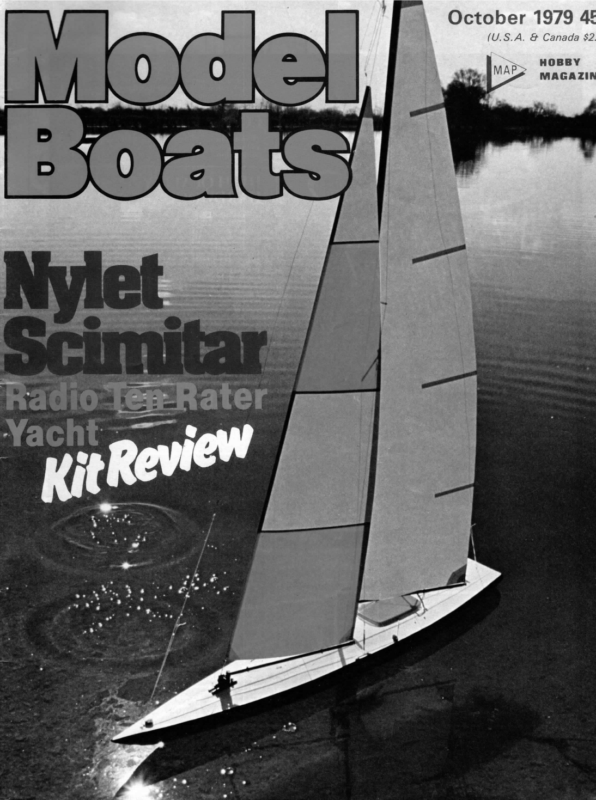
October 1979 45 (U.S.A. & Canada $2. HOBBY MAGAZIN
NYLET “tr RIOR SCIMITAR HE NYLET Scimitar is the latest addi- tion to this firm’s stable of model racing yachts. It is the second ten-rater, following the successful Pacemaker which featured in last year’s World Championships. Reviewed by Although similar in construction, comparison with the Pacemaker show some changes by designer Tony Abel. Most obvious is the length, 64in for the Scimitar against 78in for Pacemaker. Draught at 183in remains the same but the new boat is lighter at 173Ib. Mast height is Chris Bowler However this is a minor point in a complete kit costing as much as some ‘hull the same at 78in but the waterline for the only’ deals. Nylet inform though that new new boat is 83in less at 543in. On first impressions the kit larger and clearer drawings are now being seems used. sparse, but with a hull and deck moulded in fibreglass and very little wood to add to these this is hardly surprising. Fittings are to the usual Nylet standards as of course are the sails. Included in the test kit were the new swivel mast mount and the black anodised aero mast. Another new feature is the radial mount, in a deck slide instead So to the building First stage is rather novel, if you are used There is rather a lot of paper work in the kit. In my example the instructions took to putting inwhale strips in the hull first. the form of two duplicated sheets and several drawings. These | felt were rather weak: too much information imparted crossbeam stations measured from the bow at ten inch intervals. The 3’x2” Here we mark out a building board with inwhales are then pinned to the board following these guides. Crossbeams are then wire, plus bowsies and a tube of plastic from one drawing and too much cross referencing to arrive at some measure- padding for the bulb fitting are included. added at these indicated positions. Here ments. the plan was less than totally informative, of the alloy channel. All rigging hooks and sizes were not given for crossbeams, so | used the offcuts from the inwhales for as many. as | could and ‘sinxtin between. This will prove useful, if slightly heavier at stress points such as jib mounts and the area of mast pressure at the deck. | left the transom crossbeam out, to fit later when the inwhale frame had been fixed to the hull. Before bonding frame to hull, | marked a centreline lengthwise on the hull. From this | took a line at various positions and measured the centre to gunwhale distance. With dividers | transferred this to the inside of the hull. Using these guide marks the frame can then be lined up accurately and the hull sides trimmed. A little shaping of the frame may be needed to ensure a snug fit to the hull. Also it is vital to roughen the area to be glued when using fibreglass resin, so that a good bond is obtained. Trimming of the hull sides is always a chore. | have yet to find a really effective way to do this. Usually | start with a dreadnought rasp to remove the worst, finishing with a fine file and glasspaper. Of course care has to be taken not to damage the hull. Once this is done the hull may be turned over on the board and the keel slot cut. This is another of those jobs | dislike. A mistake here is almost irretrievable. Again Heading, against the sun with sails slightly filled in light wind. Left top, the marked out baseboard; middle, inwhale frames pinned to board and bottom, complete skeleton frame. 612 Model Boats
there is no quick way. Using the cord marking the hull centreline, mark the centreline of the slot and measure the distance from the transom to the rear of the keel slot. For some reason this is not on the plan. Nylet give a measurement to the top of the keel box inside the hull but of course you can’t arrive at that without hav- ing first cut the slot! For future reference the distance is 26in. Having obtained the centre and length of slot, the shape must then be cut. Using the keel box as a very rough guide, draw round it to the airfoil shape. A series of soles is then drilled inside this line and “sing a wedge shaped toolmaker’s file, a Sot opened large enough to put a cutting Dede in. | use a Stanley saw blade, it is @uite fine and does not chip the gel-coat. er that itis a question oftidying up with me We. Take care that you do not get way, fibreglass works quite easily we can soon overdo it. | ended up e keel slot just a little bigger than = mow have the basic structure, hull, arrange your work to leave the resin to set overnight, so much the better. Fitting the Keel Box and fin slot. When summarised it It always requires some thought as to how tseem much but this takes about to line the box up fore and aft and to TM twelve hours work. If you can ensure that it is square when viewed from the side. The method | have used anc which seems to work is to mount the hul in a cradle, | used my Cha//enger stand but the plans say cut upthe building boar¢ to make a cradle. Obviously a matter fo personal choice, but my way saves or building boards! Using a spirit level, chect Left, cleaning up frame, showing brace pieces of ply. Left below, marking gunwhale line tc transfer to inside of hull. Above, test fitting of frame to marks and below, no washing fo! one day as the hull is bonded to the frame, held by pegs. Top, cutting of keel slot with Stanley saw knife October 1979 61
latitudinal and longitudinal levels; when sure of these place the fin through the slot and firmly into the keel box. Let the box settle into the hull and with the fin hanging free check position by sight both fore and aft and from the side. | needed to adjust mine slightly by resting a set square against the fin to swing it into line. At this Right, keel box tacked into position. Note spirit level referred to in text. Below, deck being pulled down with tape to hold in place. Bottom left, keel retaining nut, and alloy keel plug fitted in keel fin. Bottom right, hull with keel in place. point tack glue the box in place. When completely happy with the fit, glass the box in place, making certain you have roughed yp both hull and box edge to make a good joint. Remember this area takes quite a strain so it needs strength. Additional reinforcement was added in the form of cross members from the box top to inwhales. Once the keel box was in | added the king plank, again 4inx in from keel box top as possible to the hull every half inch. | made the mistake of thinking more of pictures than boat and used PVC tape. Don’t. It stretches and allows the deck to ease a little. This did not prove as catastrophic as | feared, and | only took a couple of pic- tures at this stage. But at least the contrast is good! oe to bow. A shaped piece was added at the jib mount area to support the deck across its width. The plans suggest similar pieces for each crossmember, but! opted to leave them out, and when the deck was fitted it made little difference. At this stage the rear section of the king plank was added and the rudder tube glassed in. | left this long, protruding through the deck and used it as a reference point when fitting the deck. | always make a point of offering up the deck several times, as you only seem to notice mistakes when the resin is drying! The deck is a fair bit oversize, so having drilled it at the rudder tube posi- tion, swing it into place and mark the bow centre. These reference points will be used when bonding the deck in place. The deck may now be marked out round its joint with the hull so that it may be trimme d roughly to shape before fitting. A modifi- cation | made prior to fitting the deck was to fix captive nuts for the jib rack and mast step. The gunwhales were chamfered fora good fit and resin mixed. Allow plenty of time for the resin to set to give yoursel f time to work round the hull. Apply resin liberally to all areas of king plank and inwhales and all deck areas it touches. | placed the deck in position, bolting the jib rack to the previously mentioned anchor nuts, followed by the mast rack. Now the fiddly bit! To pull the deck down make sure you have plenty of adhesive tape to hand. Tape the deck edges down as tightly Final trimming of the deck is done after it has been left well alone to set to the hull. | used an electric drill with a milling tool to take off the worst. If you do, watch out for your fingers, these tools can be vicious. This was followed by careful rasping and sanding. | shall add trim tape when the model is finished to pretty up the joint. The keel fitting is next on the list. A fairly simple task of drilling through deck, keel box and into the fin to take a clearance for a 3/16in studding. In the fin itself a 3/8in hole is made with the vertical hole inter- secting its centre. The studding screws into an alloy plug secured with Loctite or epoxy. The fin is then fitted with a washer epoxied into place on the deck under the keel retaining nutto protect the moulding. Fittings From this point it is really a question of adding the fittings. These consist of fore and back stay deck-eyes, and shroud plates, the mast and jib racks having been fitted earlier. The rudder tube was trimmed to zin above the deck and the rudder fitted to its shaft. The final physical building is to shape the bulb © accept the airfoil section keel fin. The kit contained brass studding for —————— 614 — Model Boats
this job but | used some longer bolts from my ‘box of bits’ so that | did not have to bury the heads so far in the lead. | left the lead unfinished just in case it had to be moved when the boat is sailed. Above left, the bulb fitted to the fin. Right, /atest jib radial mount, and below, swivel mast mount showing Tufnol plug housing the ball bearing. Rigging is quite easy once the type of mast has been decided upon. There is a choice of three with this boat, the standard tubular, plain aero or swivelling aero mast. My example contained the latter and the rig for this is somewhat different. The fore and back stays remain normal but the shrouds are taken from the same point as the mast spreader. Strainers are anchored Radio Installation This is really a matter of choice to suit the gear you have. Of course there is plenty of room inside. | opted to take the quickest way out and swopped the radio box from my Challenger into the Scimitar. | use a Whirlwind Mk 2 winch in the RM but it will not be man enough for the larger sailsina blow, but for trials it will suffice. | always have my radio in a box, as most boats take on some water, and although a little heavy it stops water from getting at the works and spoiling a day’s sailing. Sheeting systems are many and varied. For some time now| have preferred a continuous loop off the double drum with a triangular perspex adjuster in the line from which the boom sheets are taken. Also at this point | use a short piece of elastic which if the winch over-runs or pulls in tight, will stretch and stop the motor stalling, thus running down the DEAC. October 1979 However, enough chat, down to basics of sailing again. When we did get to the lake, | roped in Geoff Chick to sail while | took pictures, it was a great sunny day, no wind except in distant ripples on the lake. We rigged Scimitar fairly quickly and trials showed she sat well in the water with the stern just on the 2in above the surface mark. In the light wind Geoff and | were surprised at the way this attractive boat seemed to cream along, seemingly on nothing. A feature repeated at later sessions in practically zero winds. When it freshened a little she really put on a nice turn of speed. The jib seemeda little far forward so | moved it back about two inches and this helped when sailing into the wind. When| did put her out in a blow she tracked dead straight hands off for Rigging at a point 64in from the deck, taken through the spreader bar and anchored via turnbuckles at the foot of the mast, 53in from the deck. This arrangement does not allow full 90 degree turn for the mast and | may try a swivelling spreader later, with the strainers leading to the rear position on the shroud plates. Booms were cut to length and the flow adjusters fitted together with eyebolts for sheeting and adjustment. The sails fitted easily, the main in the luff groove using a cord sewn in during manufacture, and the jib to a ‘guesstimated’ point on the mast as no measurement was given for the jib uphaul. back. some time. That just about completes building. An enjoyable boat to build. A bit large for me as it had to be built in my garage amid shuffling of car, lawn mower, etc. …, but that must be fairly typical conditions for most of us. Criticisms are minor, the plans for one and perhaps just one or two places where building could be simpler, especially over the keel-box area, | have the usual finishing touches to do and final setting up, which always takes longer than anticipated and then it’s off to the lake to see how she sails. Trials With the winter weather seeming never to end, | began to wonder if ever | could hold a sailing trial! The ice on our lake lasted several weeks, indeed long enough foramember to build an airboat and test it on the ice. It is comment enough to say that the motor stopped in the middle of the lake and there it stood, gloriously unreachable. Except for a friendly frogman on winter training who braved the ice and walked out to fetch it On this same day the radial jib, which had always worked well came into its own, as on the downwind run it did not hesitate to goosewing and really get a move on. The swivel mast operates freely and the rig seems efficient. Perhaps a little more channel would allow more adjustment of both jib mount and mast. The jib fixing point is not clear on the plans and in the end | hooked it to the top of the mast, but it may well be better to have an arrangement whereby the jib hoist can be mounted lower to keep the sail closer to the mast at the top. One big plus is the ease with which the mainsail is rigged in the luff groove of the airfoil mast, even in a bit of a breeze. The ten-rater steers well and comes about easily, more in the manner of an RM, but the size of the boat seems to give much more ‘feel’ than the smaller yachts. Most problems | have encountered with the boat have been minor ones. The major setbacks having been caused by blown DEACs, two rx. faults and of course the weather. | hope the pictures do justice to the elegance of the Scimitar and that she will prove a popular model for the producers, Nylet of Fordingbridge. | certainly enjoyed building her, and will no doubt enjoy sailing her when the electronics are eventually sorted out. Good Sailing, Gentlemen. 615
the dinner break Bill tried out this model in preparation for a planned demo at our forthcoming Lifeboat Rally/Regatta. The model fires six rounds, sets off depth charges and catches fire. The depth charge was very effective in that it lifted the model out of the water and sent the superstructure straddling in the water, leaving the battleship looking like the scuttled Graf Spee at the battle of the River Plate. Nice one Bill! We are always pleased to welcome competitors from other clubs and it was nice to see Mike Taylor of the Thames Ship Society paying us a visit again, and one of our old members who now belongs to the Southampton Model Club. the latter refused to call ‘starboard’ and changed tack himself allowing Peter to continue to port. Both Dave Hollom and Tony Owens had scored a first and a second in the two rounds sailed and a sail-off for 1st place was required. Despite the heavy rain everyone turned out to watch. The start found both boats on the wrong side of the line. Dave Hollom was tc leeward and was able to prevent Tony from returning to the start before he did. At the last momenta gust of wind enabled Tony to break the cover and having crossed the line it was now Dave’s turn to struggle to break. Very little separated the boats at the finish but Tony Results R/C steering and docking: 1st Bill Thomas, Crosby & District Model Club; 2nd Jack Baughley, Manchester MPBC; 3rd Des Newton, Crosby & District Model Club. Straight running: 1st B. Orpen, Liverpool MPBC; 2nd T. Mason, Crosby & District Model Club; 3rd D. Hitchin, Liverpool MPBC. Nomination: D. Newton, Crosby & District Model Club. Des Newton had covered Dave at each tack and took the gun to win the sail-off and the 1979 RM Nationals, with Dave Hollom second and Barry Jackson third. The prizes were presented by the Deputy Lord Mayor of Bradford, Mr Brown, who had been so interested in the proceedings that he insisted on going out to watch in spite of the rain and in spite of the fact that he was wearing a lounge suit only. The race had developed into a battle between Seahorse, Ashanti and Trapper, all three of which have strengths and slight weaknesses on certain points of sailing. Certainly the Trappers were particularly impressive downwind but appeared slightly less fast than either Seahorse or Ashanti to windward. A boat, also now produced in kit form by Nylet is The 1979 National Radio Marblehead Championships — Larkfield Tarn, Rawdon — 26th-27th-28th May A total of 47 boats entered for the 1979 RM Championships and 45 of these actually took part in the race following the withdrawal of two of them. The entry, at one time looked like being much lower due to difficulties with club affiliation fees and boat registrations but after much crossing of fingers the problems were worked out and all the entries were accepted. Much of the credit for sorting the problems must go to MYA Race Secretary, Brian Bull, who must have made innumerable telephone calls on the subject during the last two weeks prior to the race. A steady trickle of competitors started arriving on the Friday night and by 10am Saturday morning the Leeds and Bradford boathouse was bursting at the seams with boats and skippers. The race was to be run using a slightly modified version of the fleet system suggested recently in Mode/ Boats by Roger Stollery. The system had had one or two trial runs and seemed to work well. Certainly, if nothing else, it would ease the burden of the canteen staff, quaking at the prospect of providing meals for so many people. The entry had been divided into 5 fleets of 9 boats and each fleet would sail three times to decide who then went into the different fleets in the actual race. The top two boats in each fleet would sail in A fleet, the 3rd and 4th in B fleet and so on. The original intention of Derek Priestley, the OOD, was to hold a separate race each day. The winner would score ? point, the second 2 points and so on. These points would be totalled up over the full three days to supply the final placings. However, the weather was such that only two such races could be sailed. Racing got under-way about 11.30am and before very long the rain began pouring down. The winners of each fleet at the end of the three heats were Barry Jackson, Squire Kay, David Hollom, Dave Townsend and Tony Owens. Together with the second placers Allan and Brian Curran, Eric Nuttall, Peter Freeman and J. Hoer, this made up the top fleet. The boats consisted of 5 Seahorses, 3 Trappers, 1 Ashanti, 1 Challenger. Whilst waiting for the schedule to be reshuffled the wind changed direction and strengthened. Skippers who noted this and realised they had time to change sails, got into working rigs. Others who did not know there would be some delay were caught in high top sails and suffered accordingly. The first race was led home by Squire Kay and Tony Owens, both in low rigs. Squire, however, made a rare mistake and rounded the mark instead of crossing the finishing line. In the resultant scramble, Tony Owens and Dave Hollom slipped through ahead of him. For the remainder of the meeting Squire kept a drawing of the course clipped to his transmitter! At the end of the first round following a keenly fought final on the Sunday morning, the Challenger; a version of this boat, Ang/e, sailed by J. Hoer showed a good turn of speed on a number of occasions and finished in a very satisfactory 14th position. These are only personal opinions, probably other people’s will differ, but to the writer it seems that ‘You pays your money and you takes your choice”. Without doubt all four designs mentioned are very competitive and more to the point, available commercially. During the race, protests were not too frequent and none were trivial. The racing was keen in all cases and in the top fleets, very close. The scheme suggested by Roger Stollery seems to work well. Each boat raced 15 times over the weekend, by all accounts a good number with such a high number of entries and the racing was close using ‘seeded’ fleets. The use of penalty turns appeared to be well accepted and there were very few grumbles. Some comment regarding the function of the observers was heard and perhaps this is an area where a re-examination might be worthwhile. The final complete results were: Position Boat Skipper Club Ynot // T. Owens Danson Trapper 2nd Viking I D. Hollom Leeds & Bradford Ashanti 3rd Kalamari II B. Jackson Ashton Seahorse 4th Lady M D. Townsend Danson Trapper 5th 6th 7th 7.C.4 Capella Boots S. Kay B. Curran P. Freeman Bolton Leeds & Bradford Danson Seahorse Seahorse Trapper 8th Red Rum E. Nuttall Cleveland Seahorse Sth Jalyst A. Curran Bolton Seahorse 10th Lucy Fer V. Cooney Woodley Trapper 11th Trapper O. Lee Basildon Trapper Mk iil Angie Avanti P. Allen J. Hoer A. Hinkins Basildon Decoy Decoy Trapper Challenger Trapper 1st (after sail-off) 11th Equal 13th 14th 15th 16th 17th 7th 19th Equal “aa 20th Ferret Flicker G. Watchorn Basildon Design Trapper Shadow C. Dicks Clapham Own Cygnus A. Pollitt Ashton Seahorse Miss Piggy B. Axon Ashton Two Under Par CC. Eagle Basildon Triad N. Hatfield Basildon Trapper Seahorse Trapper Brian Barber leading positions were as follows: Position Skipper Yacht Design 1st T. Owens Ynot // Trapper 2nd 3rd 4th D. Hollom B. Jackson E. Nuttall Viking II Kalamari Il Red Rum Ashanti Seahorse Seahorse 5th 6th S. Kay A. Curran 7.C.4 Jalyst Seahorse Seahorse 7th Equal J. Hoer Angie 7th ~ 9th 10th D. Townsend P. Freeman B. Curran Lady M Trapper Boots Capella Trapper Seahorse Challenger The heats for the second and last round commenced immediately after the final, with the scores from the 1st round being used for seeding. Four heats were sailed to decide the fleets in rather flukey winds. On one occasion, Birkenhead Open Regatta Report — 10th June, 1979 After the last few weeks weather, we were all praying for a fine, dry day. I’m sure everyone agrees that there is nothing worse than racing in the rain. It was nothing short of a miracle, a bright warm sunny day and a calm lake — what no oilskins? All preparations over, anda last minute repair to one of the rescue boats, and racing got under way on time at 10.40am. The first heat, a 10 minute Unlimited electric, was for some reason showing a curious lack of competitors who had entered and payed up, but not turned out to race. This proved quite a talking point among the remaining devotees who decided that it wasn’t the weather that was to blame. Any ideas? Then followed the ‘A’ class 3.5cc heats with up to 14 boats actually on course together. After some radio problems had been sorted out which caused M. Allen of Birkenhead to retire before the race had started due to his boat trying to bore its way out of the lake through the concrete, emphasising the need for a frequency meter. Dave Marles of Wigan sailing anA/pha with a K&B 21 power plant showed howit’s done, gaining a total of over Chris Dicks, sailing a boat of his own design Shadow, built up such a large lead that no one could possibly foresee him losing. Only feet short of the finishing line Chris ran out of wind and just stood there whilst three other boats made up the ground and sailed by him course with a pit straight of over 60 metres. Not bad for a 3.5cc engine. 107 laps in the 50 minutes. By my reckoning this is less than 30 seconds per lap on a The schedule was tight so no time was allotted for a dinner break and we plodded on leaving him in fourth place. At the end of the day ‘A’ fleet consisted of T. Owens, D. with the 6.5cc ‘B’ class heats, which possibly could account for the difficulty in obtaining Hollom, B. Jackson, Squire Kay, D. Townsend, P. Freeman, B. Curran, V. Cooney, J. lap scorers, again 14 boat heats making for fierce competition. R. Brown of Leeds Richards and P. Allen. Monday morning arrived with the wind blowing in a south easterly direction. A new course was set with the skippers sailing from the bank opposite to that from which the produced the winning score of 107.2 laps whilst Brian Warburton of Birkenhead was hot on his stern with 105.2 laps, very close over 50 minutes on such a large course. The 10cc ‘C’ class heats proved to be excellent crowd pullers, so much so that constant pleas had to be made by the race controller to spectators to keep their children’s arms and previous two days racing had been sailed. The racing was excellent and the rain absolutely torrential. Umbrellas were seen in profusion and most were grateful for the shelter offered by the factory. Five races were sailed by each fleet in this heat and Dave Hollom over 100 laps as did Kevin Blears who was less than half a lap behind. P. Thompson of came out a comfortable winner ahead of Tony Owens. Dave received a special round of Featherstone took third place with 103.3 laps. applause for one heat in which he was so far ahead of the fleet that four boats were counted out of time. Quite an achievement in a fleet of such quality. Squire Kay seemed to have no end of bother in this round. He stalled a winch on one occasion and flattened his batteries. In another race he won only to hear that the race wes to be re-run following a bad collision between two other boats. The resulting re-run sew poor Squire finish well down the field. A particularly sporting gesture was seen in the first run of the rece. The lead boat, Boots, sailed by P. Freeman had been involved im the collision and wes in trouble with his jib, which threatened to become detached. Caught on port tack by Squire. October 1979 legs out of the water. Mark Wigglesworth of Leeds was very consistent, scoring again Denis Lightley dominated the spark ignition scene and also spent most of the race chatting to Dave Wooley who was eagerly awaiting the last electric heat. Dave’s Keller powered Nagari made my own troubled Scorpion look even more poorly sick and as if to add insult to injury he was still sailing minutes after the race had officially finished. The standard of driving had been excellent throughout the day resulting in few fatalities. After all who wants to take a jigsaw instead ofa boat home at the end of the day? It was a pity though, that the sportsmanship of some drivers did not extend to the rescueing of other boats nearby, whose owners could not retrieve them because the 625
/Model Yachting Association News me Cal ; 2 eee — D [a D HeSd9 4 OSEAN TS MYA/Naviga event has come and gone, and it turned out a very good meeting. In the R10R class there were 5 French, 2 German, 2 Dutch and 1 Swedish in addition to 18 entered by English clubs. Marbleheads included 10 from France, two each from Holland, Germany, Austria, Sweden, and Belgium, plus 30 from a wide assortment of English clubs. It was decided to run a form of ladder system, since the potential of many competitors was unknown, with a non-scoring first day for each class, intended to seed the competitors. Ten-boat fleet races were sailed, with the bottom and top four boats moving up or down a division initially, but only the bottom and top two boats towards the end, to sort out the divisions. When racing for points started, the scoring was pt for the first boat home in A division, down to 10 for the 10th boat; the first boat in B division scored 11 and so on. In addition the bottom and top two boats moved upor down to the next division. This worked extremely well, but there is a major snag in that a boat penalised for some reason can not only suffer in that race, but if it results in a move down for the next race, it means that his possible score must also be increased. Perhaps an example is the easiest way to demonstrate this. A skipper in the bottom half of a race in Division B is penalised; it might be loss of points, or compul- sory turns, or loss of so many places, dis- qualification (max. points plus 1) or evena gear failure, any of which may put him at the bottom of the race result. In Division B he can score anything from 20 to 11, but now, having lost points for his penalty, he must move to Division C, where his poss- ible score is 30 to 21, which is effectively penalising him again. No doubt there will be a lot of discussion on this, as it is the only apparent flaw in an otherwise practical scheme; as one suggestion, would it not improve matters if scores overlapped, i.e., Division A is down to 10, but Division B instead of 11-20 might be 9-18, Division C 17-26 etc.? The 10-raters had been allocated the Sunday and Monday, and on Sunday, the ‘seeding day’, a 20-25 mph WNW wind 640 dismayed the continental visitors but produced some exciting sailing, especially from the two Eclipses, which revelled in the conditions, planing almost all the time offwind and occasionally even on the beats, and finished every race streets ahead ofthe rest ofthe fleet. The shattered French contingent put in a ‘phone call to Graham Bantock for an emergency supply of third suits for their RMs, fearing that the wind would hold all week. However, Monday saw a much reduced wind, still WNW but very light and filling in very little throughout everyone’s surprise, and the no day. To doubt the chagrin of some, the Ec/ipses still managed to get ahead; only one race was not won by one or other of them (lost to Verve) though there was close racing for most of the time. Top six were: Pos. 1, 2 Boat Brigadier Gerrard Eclipse Skipper D.Hollom 3. Look Ahead L. Akesson B. Jackson 4. Mynzapint 5. Nookey Bear 6. Verve Brigadier Gerrard Eclipse J. Lee T. Fuller J. Mountain 6X1, 1X2, 1×3 Ss mnsha SNN TTY i ViWTee ysSSS SSS SAE EN EE ESAAANE SARA? 36, and 7. Ka/yo/a (France) 42. Something of a hiatus occurred in the first race on Thursday, when the leading yacht headed for the wrong mark and was followed by several other boats. These included 7C4, which as a result had to move to B Division; since 7C4 finished as runner-up by a margin of 4 points, this one error almost certainly cost Squire Kay the championship. The rest of the day was characterised by extremely close racing, with the lead changing frequently throughout; at the end of the day the top positions were Ka/42, ama Ashantiri 43.25, TC4 46.25, and Vandal 65. Friday was remarkable for the way in which the French boats started to pull up; Francois Foussard won five of his last six races. One of the most remarkable sights was when, in a wind of only perhaps 2 Country England England Sweden England © England England Design Points Eclipse Eclipse 0/D Sea King 0/D C. Dicks 9-5 17:75 34-0 39-0 41-0 55-75 1X1, 5X2, 1×3, 1×4 The 50 Marbleheads had four days to sail, one for seeding and three for scoring, and on the Tuesday a westerly of 12-15 mph pleased the British boats. It stayed in the same quarter but strengthened to 15-20 on Wednesday, dropped to light (perhaps 5-8 mph) on Thursday and to very light (2-5 mph) on Friday. Thus all boats had a taste of the weather best suiting them, and this was particularly notice- able with the French yachts, which climbed steadily higher in the results the lighter the wind became. Tuesday’s and Wednesday’s winds were tailor-made for the Seahorses of Barry Jackson and Squire Kay and Dave Hollom’s Ashanti. The first three races on Wednesday were romped by Ashanti but an unfortunate disqualification then cost 11pts. and relegation to B Division and another 11pts. for a day’s total of 24.25. Leader was 7C4 on 9.5, Kalamari 20, 4. Trapper Mk 3 27,5. Triad 33, 6. Superstar mph, Ka/amari held a 30 yard lead on the last leg, a beat of about 70 yards or so, and a French boat steadily caught him up, sailed through his lee, and won by a couple of lengths. The French sail in light conditions normally, and their fine-bowed, broadsterned boats have been developed accordingly. However, a lot of their per- formance comes from their light weather sails, mostly panelled and sufficiently limp to set well on changing tack in the merest breath. Extremely light booms (aluminium | section tapered and drilled to reduce weight further) contribute, and it was noticeable that the jib booms in several cases were counterbalanced at the forward ends so that the jib goes over in the lightest wind as soon as the boat starts to go about. It was also noted: that the radio installation sits unprotected in the bottom of the hull, safe enough for light weight sailing, but there was a little trou- Model Boats
Heading photo shows ten boats rounding the mark during a heat at the recent MYA/Naviga event at Fleetwood. At left, one of the French boats with very light b anda terbal. d jib. Above, the winning Seahorse, Kalamari. ble with water in some instances in the fresher conditions. Several employed jib twitchers and servo-controlled backstays for variation of mast bend during sailing. Ashanti was very unlucky to pick up weed in the eleventh race, right at the start. In the light conditions it took several minutes to coax the boat in, by which time the fleet was uncatchable and another excursion to B Division inevitable. The sun’s strength and the absence of real wind encouraged the appearance of blanket weed on the surface, and the course was moved a couple of times to avoid weedier areas. Ashanti’s misfortune meant that in the last race to go the champion must be Ka/amari or TC4, the latter only if he could finish seven places or more ahead of the former. With the wind almost non-existent, anything could happen, but inthe end 7C4 managed three places ahead in a race which was full of suspense. Top boats were: What a lot of ‘ifs’ are concealed in these figures! The dinner on the Friday evening saw distinguished company — the Lady Mayor of the Borough of Wyre, Lord Pilkington, Chairman of the NW Sports Council, Councillor G. Mann, Chairman of the NW Water Authority, Councillor B. MacGreggor, Chairman of the Leisure Services Committee, and Mons. Maurice Franck, President of Naviga, plus the President, Chairman, Radio Secretary and International Racing Secretary of the MYA and the President and Commodore of the Fleetwood club. Naviga had provided splendid trophies and prizes and — a nice touch — souvenirs for officials and distinguished guests. A much-appreciated gesture was the presentation of the results of a collection by the competitors and visitors, as a thank-you to the ladies who had worked so hard providing meals and refreshments a. Ashanti TC4 S. Kay D. Hollom Country England England England 4. Kalyola F. Foussard France Pos. 1. 2. Boat Kalamari Skipper B. Jackson in Fleetwood’s restyled Design Seahorse Seahorse Ashanti Points 57-0 61-0 7525 0/D 81-75 Vandal D. Andrews England Ashanti 6. 7. 3. Triad Light Fantastic Red Rum N. Hatfield A. Hollom M. Delange England England England* Trapper D. Hollom Seahorse 124-0 130-75 135-75 9. 10 Trapper Mk. 3 Don’t Touch P. Allen L. Akesson Sweden O/D 162-0 5. England Trapper *M. Delange is a South African visitor and member of Clapham club. It is interesting to note that Barry Jackson did not win a race, but sailed consistently, as the following breakdown shows: Kalamari 3×2, 6×3, 1×5, 1×6, 2×7, TC4 4×1,2×2, 3×4, 1×6, 1×9,1x1B 3xX1,2×2, 1×3, 4×5, 1x1B, 1x3B, 1 disq. 5×1,2×4, 1×6, 1×7, 1 out of time, 2x 2B, 1×8 Ashanti Kalyola October 1979 2×8, 1×10, 1×9, 1x3B 118-0 153-0 clubhouse. After the formal speeches and prizes, those with reserves of energy enjoyed a couple of hours of dancing. And what of the longer-term position between the MYA and Naviga? Asa first official meeting between yachting elements of Naviga and the MYA (to some extent in loco parentis for the IMYRU) it was 2 great success, though it would have been nice to see some of the Eastern European countries represented. All the overseas visitors want to come again, and there is no doubt that there would be British support for a similar meeting held within reasonable distance of the Channel coast, somewhere on the continent. The success of the week was due in no small measure to the efforts of the Fleetwood club, celebrating its Golden Jubilee, not only for the race organisation but for the social programme arranged. Wyre Borough Council were generously cooperative, and the North West Water Authority gave considerable help. On what might be called the political level, a great deal of ground was covered informally and possible future avenues for international model yachting develop- ment identified. After what could be termed in the language of diplomacy “an exchange of views” both bodies have a much clearer idea of the way the other works, the amount of common ground, and what steps may be necessary or poss- ible to ensure a strong future, no bad achievement for a first function of this type. Minor and Unavoidable Contact An advantage of the MYA’s affiliation to the RYA is that Council can refer knotty rule problems to the RYA Racing Rules Committee, higher than which it would be difficult to go! The confusion about boats touching which has occupied a lot of debating time was recently put to them and positive guidelines were received. What brought the matter up was a pair of boats match racing in calm conditions which drifted into contact; neither competitor could find a suitable right-of-way rule to substantiate a protest and therefore decided not to protest. However, someone else protested under Rule 33.2 (quoted here three or four issues back) and the race committee were asked to find that the contact was minor and unavoidable. Three questions were put to the RYA Committee: Q. Can the race committee dismiss a protest, without penalty to either yacht, when it is satisfied that the con- 641
tact was minor and unavoidable? A. opponent, but if contact occurs bet- Yes, but only if the sole ground for the immediately, the lower-scoring team mate shall automatically be disqualified. The benefits of rule 4.11 (Yacht between the yachts and neither has retired, exonerated herself by accepting an alternative penalty, or lodged a Materially Prejudiced) shall not be available to a yacht damaged by con- protest. Q. If it is necessary for one of the yachts to be penalised, is the race committee 1.4 required to establish which yacht was: o> at fault? Yes. Can the race committee recommend that a race involving only two yachts be resailed without penalty to either yacht? A. 1. 1.1 Sailing Rules A yacht may manoeuvre against a yacht sailing on another leg of the course only if she can do so while leg of the Except to protect her own or a team mate’s finishing position, a yacht in one team which is completing the last leg of the course shall not man- oeuvre against a yacht in another team which has no opponent astern of her. Right of way may be waived by team mates, provided that in so doing, rule 35 (Limitations on Altering Course) is not infringed with respect of an be in accordance with (method of scoring). 2.2 promptly /uff up to any reason whatsoever, will share €.g. 1 yacht not finishing a race will score 2 points. 2 yachts not finishing arace will score 3 points each. close-hauled. 3 yachts not finishing a race will score 4 points each. ward yacht’s right to /uff under rule 4 yachts not finishing a race will MYA R/C League Championships 1979 Club 1 Danson 2 3 Leicester Ashton 4 5 6 7 Decoy Leeds Basildon Bolton Woodley New Forest Birmingham 8 9 10 11 12 Clapham Cleveland Woodspring 13 14 16 19 Guildford Birkenhead Fleetwood Cheltenham Andover Lincoin 20 21 22 22 24 24 24 27 27 S.E. Essex London ~ Fairford St. Ives Broads Minehead Northampton Cleethorpes Crosby 16 17 18 : Hereford 27 27 27 Hove Poole Tameside score 5 points each. Points 670 446 381 341 281 270 222 175 131 130 83 82 78 74 75 45 27 14 11 10 5 3 3 2 2 2 1 1 1 1 1 1 1979 Position Club 1 Leeds & Bradford Fleetwood 2 3 4 5 6 7 8 9 10 Birmingham Bournville Birkenhead Guildford Gosport Newcastle Cleethorpes : 2 MYSA 11 Welwyn 12 Basildon Ryde 13 4.15 the points they would have scored, had they finished after the yachts that did finish the race. This clause does not restrict a /ee- Position rule Yachts which are scheduled to start a race, but do not finish the race, for does not choose to tack, she shall MYA League Championships (Vane) “another team are competing the scoring will or when she cannot assume such regarded as is Proper course without tacking and 27 course”. 1.3 yacht sailing aproper course relative to the leg on which she herself is sailing. For the purpose of this rule, each time a leg is sailed it shall be 1.2 /eeward not she has to gybe; current Eric. When two teams of three or more yachts per team and more than two teams of two or more yachts per (b) When the windward yacht is inside, she shall promptly /uff up to her proper course to the next mark, MYA Council’s decision giving an OOD the right to ignore a minor and unavoidable touch in windless conditions now has high-level backing and, hopefully, we may have heard the last of this. It would not be inappropriate to say that the MYA is grateful to the RYA for clarifying the point. may try them and report their findings to (b) course to the next mark whether or wer are ‘sole ground’. It appears that the retary, Eric Nuttall, and the major details are included here in the hope that clubs the she does not have /uffing rights, she shall promptly assume her proper summing up of the action required. The Team Racing Experimental rules for R/C team racing have been prepared by the MYA R/C Sec- per team are competing, the scoring may hold her course or /uff. When first question is, it is suggested, the most important, and the key words in the ans- League results is given as at July 23, but the vane race results are unrepresentative due to a considerable number of outstanding results. Race secretaries, please? When Method of Scoring (a) When two teams of two yachts will be 7 points for 1st, 6 points for 2nd, 4 points for 3rd and 2 points for 4th. inside, and has /uffing rights, she (Protests). the 2.1 changes: This seems a clear and very sensible in 2. tact between team mates. When two overlapping yachts on the same tack are in the act of rounding or passing on the required side of a mark at which their proper course (a) Yes, but only if it rules that the finishing position of one or both of the yachts has been materially prejudiced within the provisions of rule 12 (Yacht Materially Prejudiced) or rule 68.5(a) League Positions The standing of clubs 38. (Same Tack-—Luffing and Sailing above a Proper Course after Starting). ween team mates and neither retires protest is that there has been contact Points 722 470 347 311 276 176 173 154 105 63 60 44 11 3. Alternative Penalties for an Infringement (a) “Penalty Points” in accordance with rule 4.17 (a). (b) “Penalty Turn/s” in accordance with rule 4.17 (b). (c) “Penalty Wait’’ infringes any rule, a yacht which (i) before the start, may exonerate herself by starting after yachts not infringing any rule. (ii) on a exonerate leg of the course, may herself by passing the next mark of the course after yachts not infringing any rule. Notes Rule 1 is the same as Rule 1 of the l[YRU Team Racing Rules. The method of scoring puts the emphasis on rule knowledge and prowess, not speed, and a short course is more suitable than a long one. More detail on scoring and the “Penalty Wait” appeared in an article by Eric Twiname-in Yachts and Yachting, Dec. 22nd 1978. A further extension to this type of team racing, ideal as a club event, is to use existing MYA 4-boat schedules and arrange that each skipper has a different team- mate for each race. If the winning team skippers are awarded 1 point each and the losers none, an individual winner will emerge. An experienced skipper hoping to win will be obliged to help a less-experienced team-mate; novices will benefit from the tuning and tactical advice and everyone will learn from constant reference to the rulebook. Model Boats