- Round the Regattas Mickfinn Regional Champs Coventry and Kingsbury Tug Towing Fleetwood and Chester R/ Scale
- Panache Vic Smeed provides additional notes on finishing off his 30in. semi-scale ocean racer — subject of our Christmas Free Plan.
- Logbook Model Yachting Association News.
- Spook by Vic Smeed

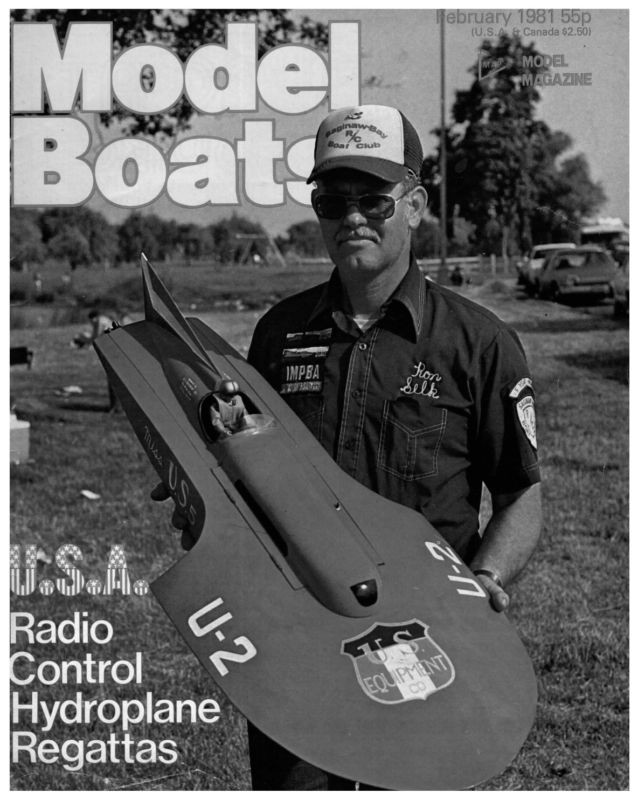
‘february 1981 55p (U.S.& Canada $2.50) oho DEL GAZINE Radio. control >? Hydroplane Regattas 3
Mickey Finn Coventry and Ki Fleetwood and Mickey Finn Association National Championship. November 2, 1980 Having sailed real sized yachts of varying shape and size over the past 20 years, it was with some reserve that | invested in a rather funny looking R/C yacht called a Mickey Finn. \t took me only a matter of hours to sort out the rig and kit which when finished bears remarkable resemblance to its full sized compatriot and there are now well over 250 ofthese lively little boats in circulation. The first Mickey Finn Association National Championship and AGM was held at Charnwood Water, Loughborough and hosted by the Leicester MYC, the organisers being Association Secretary Ken Shaw and Dave Andrews of Leicester MYC. OOD was Dave (Ragtime Cowboy Joe) Hollom with his able assistant Eric (Seadog) Nuttall. Racing commenced as programmed, just after 10.30am using the fleet system for the 20 Coventry and Kingsbury Model Tug Boat Towing Competition. October 19,1980 This was a joint effort by the Coventry and Kingsbury Model Boat Clubs, having two model tankers as the towed vessels. The Coventry tanker was built by our master carpenter, Mr. D. Tunnicliffe, and had a length of 16ft and 2ft beam. Kingsbury supplied the other tanker of Ps M. Hounsell from Plymouth leads Arthur Worsley from Ashton during the Mickey Finn Championships at arnwood Water, Loughborough. strong fleet which covered skippers from all over the country. The conditions were superb; a crisp cloudless autumn day with an easterly breeze, force 3/5, so providing some superb sailing for these nippy little craft, which certainly work wonders for the sharpening of both wits and reflexes when pressed to the limit. Working sails were initially the order of the day, but the wind was obviously steadily failing and the quick change of sail to the top suit which was undertaken by young Andrew Hollom put the cat among the pigeons and the fun really started! There were some superb submarining techniques demonstrated by those, including myself, who were just caught out by the gusts, but the classic example of the day was exhibited by young Andrew, whose boat, when caught on a dead run, was uptails for alla full ten seconds! The fleet system worked very well and two fleets each sailed three seeding races before lunchtime. A well laid windward start gave no room for bad judgement and an 80 yard beat was more than enough to sort out the well trimmed boats from the others. Incidents were frequent and friendly and only on the odd occasion did Ragtime Cowboy Joe have to cast judgement on penalty turns. Consistent sailing by the top six skippers in each fleet and in particular Jeff Hoer, Andrew Hollom, Barry Jackson and Mark Dicks,gave some superb close fought competition in the afternoon and as the results show, it was by no means a walk over by any particular skipper. The breeze steadily faded away towards 15.30 and racing had to be terminated a little earlier than was hoped due to the oncoming lakeside AGM and fading light. Mr, ‘Rojair’ himself, Roger Allton met and chatted with most skippers and showed great interest in the whole event. Ken Shaw, the Association Secretary, presented the new trophy and prizes to the winners and after the prize giving, the first meeting of the Mickey Finn Association, chaired by Ken, took place. The constitution, circulated earlier, was clear and was unanimously approved. However, a point raised by Barry Jackson brought forward varying views from members regarding whether or not the OOD should decide the sail rig of the day; put to the vote the decision was evently split, but no doubt this point shall reoccur and members’ views on this matter should be forwarded to the association secretary. It was quite evident that ‘Rojair’ have a winner here as these boats are relatively cheap, easy to build and don’t cost a fortune in accessories over and above the standard kit. The Nationals brought a racing standard with excitement second to none which was thoroughly enjoyed by everybody in attendance, in particular myself as this was the very first time | had taken part in model yacht racing which, to say the least, has magnetic appeal to full size sailors. Full details of the Mickey Finn Association can be obtained from Ken Shaw, 198 Bramhall Lane, Davenport, Stockport SK3 8TX. Results 1. J. Hoer, K5, Decoy. 2. A. Hollom, K2, Ashton. 3. B. Jackson, K3, Ashton. 4. M. Dicks, Clapham. 5. T. Saltonstall, K31, Bridlington. 86 6. D. Hackwood, K10, Cleveland. 7. A. Pollitt, Ashton. 8. R. Smith, Leicester. 9. J. Lee, K33, Etherow. 1 0. C. Hollingsworth, K29, Bridlington. Tony Saitonstall MODEL BOATS
Coventry and Kingsbury’s tug towin: (and pushing) regatta was a different and, according to all reports, _ also a successful event. Photo by G. Mi onal Champs yury Tug Towing ester R/C Scale some 9ft length by 12ft beam. Both had very shallow draught and were easy to tow, but very tanker during the day. susceptible to side winds as some competitors found out. It was planned that two teams would pull together, leaving from separate docks and in The larger tanker was used for tugs of the Sun size and upwards, and the smaller for opposite directions with both the tankers, which should have made exciting spectating as Bugsier, Neptune tugs etc., although a Neptune did manage a magnificent tow of the large they passed through the obstacles and channels. However, we ran into a problem at the start due to many competitors arriving on just a few frequencies, making it difficult to make up enough teams to keep a flow of tows on the water. Also, after the first few pulls, some teams were late in returning to their docks, causing a delay for the next team awaiting the tanker and also holding the other teams should they happen to be on the same colour. This then rather snowballed during the day. The weather also didn’t help matters as it poured with rain most of the day! We had hoped to have had two pulls each, but due to many hold ups and breakdowns there was only time for one. It did show up how unreliable some boats were, as many had coupling problems, and many ran short of power half way round the course. The teams had a free hand on how the tow was taken, ie, one pulling one on the stern and one assisting where necessary, or one pulling or two assisting. They could also determine the length of tow they required, much to their disadvantage when they got the length wrong. While most teams did quite well, some had a few problems, The Smit and United Towing Line (D. & G. Metcalf and L. White) on starting, promptly got their props tangled in the tow line and caused some coupling problems. The Duplex Towing Company (H. & E. Middleton and S. Allcock) got themselves into rather a tangle several times, even to getting the line tangled in the rigging. | don’t know what happened to the Bugsier Towing Company (D. Timmis, R. Stonard and B. Allcock) but | think the co-ordination of who does what broke down, sounding by the abuse they were throwing at each other! The average time for the other teams on the water was about 25-30 minutes but the A towing team inaction at the Coventry and Kingsbury Tug Towing event. Below: atight t during r ding of a buoy at the Mickey Finn Championships with 3rd place man Barry Jackson (K3) nosing ahead of Alan Pollitt (K7). Bugsier team took a total of 50 minutes and ended up with a score of n//. The course carrieda score of 235 points and a bonus of 20 points for performance on the water. Mr. and Mrs. Nicol from Dover had very good pulls, both in different teams and both ending up pulling the tanker solo due to the failure of the support tugs. All in all we had eleven teams sailing during the day and apart from the delays it was quite successful, and we may hold a similar event next year. / $ Results Concours d‘Elegance: Best scratch/exact scale tug. Alan Lock; Best kit/stand off. Ray Bridgen; Best Duplex TID, S. Allock; Best TID performance, |. Colley. Team event 1. Abbey Park Salvage Co. (Leicester) (1. Adcock, K. Stevens and P. Stevens) ……… 200.5 London Tugs (Birmingham) (B. Colley, E. Fowler and D. Evans) .158.0 3. Nothampton Towing Co. (M. Bell, J. Hughes and K. White) lan Smith 2. Fleetwood Scale Regatta, August 10, 1980 Uncertainty about the weather perhaps lead to a reduction of entries at the fourth Wyre Borough Sponsored Scale Regatta, Fleetwood. However, the weather wasin fact fine all day with just light showers, and the spectators were there in force. The now well tested formula was repeated with one new item, Rescue and Salvage. This scene is set with a gale battered schooner, dragging her anchors towards a lee shore. Two men are in the rigging, one to each mast, and the idea is for the rescue ship to work upto the side and touch triggers, whereupon the distressed mariners ‘jump’ down to the deck of the rescue ship. Most of the entries failed, but Jack Carter of Wigan, appropriately enough with his lifeboat Lady of Lancashire, proved it possible to save both men. Afterwards a vessel is towed through a dangerous channel. Another new event was a race between 575 class yachts, now accepted as scale. This was won by W. Thomas of Crosby. February 1981 87
Models judged for the Pandoro Trophy had to attain a certain standard and must have sailed in one of the events. We were fortunate in deciding the winner to obtain the services of Captain T. D. Brewster, formerly of the Blue Funnel Line and Mr. R. Ainscough, who is in the model trade. This was the ferry boat Water/oo built by F. Baker, also of Fleetwood. (Incidentally, inthe 1979 report the Scale Secretary in error made this model the winner, when it should have been the Avenger). Everything went smoothly, and there was plenty to see for the onlookers, as some of the events were sailed at the same time if one or other did not need radio. There was no lunch break, and as well as action on the lake, an exhibition in the clubhouse of scale models and yachts gave everyone a free show. A surprising thing was the number of people who had never seen models of this class before. Some believed that all sailing models were propelled by motors, and others who knew better were always anxious to learn how a boat sails to windward. A regatta always results in new members being enrolled. The Mayor of Wyre, Councillor Frank Townend, opened the event, and returned laterinthe day to present awards. He also took over the radio of the 10ft. railway steamer Duke of Lancaster and enjoyed the novelty of model navigating. Club Commodore Derek Priestley also had a try, as a change from sailing yachts. The multi-racing was to consist of one-hour elimination heats, with the first four in each class going into the final which was limited to 30 minutes. To give a fair chance for all classes, a system of handicapping was worked out. This caused a few vociferous voices to be raised, but from a study of the finalists and the lap scores in the eliminators, the results of the final would suggest that the handicappers did a fairly good job. A total of over 60 boats took part, the day starting off with a cold, damp outlook. During one of the ‘B’ class heats it rained ‘cats and dogs,’ with various types of ‘wet suits’ in evidence. The rain eased off during the afternoon to give a good day’s racing, until the final, when the heavens opened up, to pour down like stair-rods, however, the stalwart drivers carried on to the finish. The skies cleared for the presentation of the grand array of trophies. The organisers had agreed that all the entry-fees should be spent on prizes, down to fourth place in each class, with trophies for the juniors also, and what a magnificent show they made. The visitors agreed that this had been done admirably, so much so that it is proposed to make the Metro Enduro an annual event, so look out for it in the 1981 Regatta fixtures, and make it a date. The Bolton, Manchester and Wigan Clubs thank the Bolton Metropolitan Borough Council, for the use of Crompton Lodges. Results Class ‘A’ Results Winner of the nomination was K. Watkinson of Fleetwood and N. Morton of Wigan took second place. Rescue and salvage was won by J. Carter of Wigan and second was J. Stott, also of Wigan. Docking resulted in J. Stott as winner, with D. Collier of Wigan, second. Straight running winner was D. Collier, followed by T. Griffin of Fleetwood. Point to point sailing saw E. Littler of Fleetwood first, followed by D. Fisk, also of Fleetwood club. Finally, the radio sail round the lake was won by a junior, M. Edge, with E. Littler coming second. The day passed without untoward incident, until one of the ladies pulled out the radio tent pegs when some of the men were inside. Thanks are due to all helpers (some even in wheel- chairs), and especially to friends who came from miles away to support our efforts. C. Money Position/Name 1st D. 2nd J. 3rd A. 4th P. Marles Benson Hammond Mannock Club Wigan Barrow Saxons Middleton Laps 118.4 109.2 109.1 104.2 Junior 1st P. Booth Middleton Class ‘B’ 1st D. Jepson 2nd D. Spedding Leeds Blackburn 127.3 126.4 4th E. Swarbrick Blackburn 110.0 3rd S. Ingham Middleton 124.0 Junior 1st R. Reader Leicester Scale Model Boat Club, Abbey Park, August 17, 1980 This was the first open regatta held by the club and the preceding weeks had seen much feverish activity in the construction of extra bouys and docks. As the club boats on a park that is locked up at night it was possible to lay out some of the course the night before enabling us to start on time the next day. The day of the regatta dawned with typical regatta weather, damp and overcast. Final preparations were complete by 9.45am just as the first competitors started to arrive. The council temporarily lifted the ban on cars in the park for the regatta which enabled the Class ‘C’ 1st F. Whatmough Blackburn 3rd J. Benson 4th D. Jepson Barrow Leeds 2nd D. Tomlinson 1st B. Pitts The first boat started exactly on time at 10.30am by which time some 48 competitors from eleven different clubs had entered in the following classes; stand off jnr (8), stand off snr (2), Spark Ignition manoeuvring and overall impression. The judging on the water was done prior to the boats attempting the course on an adjacent area to the course. This allowed the boats to be held until required on the course. The judging was done by three judges who marked the exact scale models after their second run in the afternoon. With this system we managed to keep an average of four boats on the course at once. Gordon Lewis won the exact scale section with his FPB in convincing fashion, as did Spencer Hilton in the junior section. A good turn out in the ladies section culminated in a tight finish with Jenny Thayne finishing just ahead of Sheila Allcock. The closest finish of all was in the stand off scale senior where a ding-dong battle went on all day between Ray Brigden (oil rig supply vessel) and Barry Allcock (Bugsier 3 tug) joined in the afternoon session by Kenneth White. When the results were known only 1.6pts covered the top three Middleton 110.1 108.0 91.1 73.4 Junior competitors to park their cars next to the lake. exact scale (11) and stand off ladies (8). All boats were judged on the water appearance, Bradford Sheffield 1st A. Clegg 2nd J. Faux Manchester Manchester 91.0 66.0 Final ist D. Jepson 2nd D. Spedding 3rd S. Ingham 4th J. Benson Leeds Blackburn Middleton Barrow 65.0 55.0 48.1 48.0 Jess Faux I told you the figure head Was tec well endowed… places, Ray Brigden finishing just ahead of Barry Alcock. We would like to thank the judges for their time and effort during the day. We hope all competitors had an enjoyable day and hope to see you all again next year. By the way the weather did improve during the day. Results Exact scale Ladies 1. J. Thayne 2. S. Allcock 3. G. Adcock Jnr. Stand off (eed EO)e a pornt systems…… Re re it in Jeep a A a handicaps? We don’t OT need them at thes 2. P. Blake … 3. D. Thayne Snr. Stand off WSRRs EREIQCOMN 2500255003 soto caccacvesctuer gros et tea gnome tet races se Mitsanscectess dosucscdssvesleosssdecceovassecsuevers 120.6 DEAR COCK EE al codices cane cd ook eae Gh whe res aE MRR TN Sake esas laaeoteegeccnacennnte ceases 119.5 IC EAL ANNIV INO 2 cs yes cvcrassssescsarser testes iorte ROT Tae aero RON Te raUav oa netvagedcaescctescdvascisuiesemrintee 119.00 lan Adcock The Metro Enduro 3rd August, 1980 This Italian sounding regatta, staged by the combined Bolton, Manchester and Wigan Model Boat Clubs, was held at Crompton Lodges, Little Lever, Bolton. It is the first venture of its kind in the North Western area, due to both the Bolton and Wigan clubs wishing to hold an open regatta, but neither having enough members to stage separate events. 88 MODEL BOATS
‘Panache Vic Smeed provides additional notes on finishing off his 30in. semi-scale ocean racer — subject of our Christmas Free Plan. guard rail stanchions. It is simple to make up a crude jig with two pins in a block of wood to form a second “‘ball’’ for a second wire, but the clock was ticking so the split pins were epoxied into holes drilled round the deck edge and a single shirring elastic HILE the basic construction of this little yacht was adequately covered in the article accompanying the free full-size plan last month, space was a little short towards the end and some further details might therefore be helpful. It has long been our contention that a good finish on a model is likely to take as long as the rest of the construction, but in the case of the prototype Panache, time ran out and some corners had tobe cutas far as the actual painting and some of the detail work was concerned. In fact from undercoat to the model as photographed took just under two days, which included making up the spars and rigging details and the deck fittings, and installing the radio. Firstly, general detail. The plan shows a cross-member in the cockpit on which is mounted the coffee-grinder hand-winch. This was omitted as likely to cause a delay in fitting the rudder push-rod, and the winch was made full height, using a shaped pillar from the scrap-box with a wire handle expoxied through. The helm was made as per plan except that a plastic ship’s wheel was used; this had eight spokes, so four were cut out and all the spoke extensions outside the rim were cut and sanded away. A six spoke one with a much lighter rim would be more typical. Commercial plastic cowl-vents were simply epoxied into holes drilled in the deck; the midships two should have had waterboxes. Dummy hatches on the deck were outlined with Simoniz pinstripe tape, sold for cars and giving a waterproof seal to the deck. Past experience has shown that this tape really does stay put, and the dummy hatches are only to break up the bare expanse of deck. It must be confessed that there was insufficient time to include anti-slip. areas, but they are well worth including. Long, fine split pins were used for the 94 ‘wire’ threaded through. Be careful when drilling not to break through the hull side; angle the holes towards the bow and puta bend in the base of each pin. These stanchions were given a coat of unstirred paint so that the thick pigmentetc. filled the gaps in the pins but it was possible to wash the paint only thinly over the general surface. Dead white stanchions seem to draw too much attention to themselves, and the idea was to try to get them to fade into proportion. Done more carefully (i.e. in less of a tearing rush!) this is an effect worth attempting. The idea of a pushpit was abandoned and the rail just run round the stern, buta pulpit was essential. This was simply bent from a piece of stainless steel wire and two split pins threaded on for support, giving four wires to epoxy in holes in the deck edge. A pushpit could be made in the same way with little difficulty. Navigation lights and other details shown on the plan are easy enough to add, if you have time, but one omission is a pair of lifebelts of the horseshoe type, most likely to be hung on the guard rail. There are lots of other possibilities — a stowed boathook and spinnaker boom, an anemometer, gratings in the cockpit, instruments etc. etc. Ours had a sliding hatch, made from three slips of ply and a square of Formica in about thirty seconds flat, epoxied over where it had been intended to make a neat pair of doors and trompe d‘oeuil steps for the cabin entrance . . . half a dozen turned and spigoted odds from the scrapbox made a token gesture towards the winch drums in the vicinity of the cockpit, and photographic requirements called ‘Time’. Sanwa radio is fitted, with the lever winch positioned as onthe plan. The sheets lead out through the deck, the fairleads being the business-end ferrules of two fibre-tipped pens with the fibre nibs pushed out, epoxied into holes in the deck. These raise the exit points of the sheets nearly Yin. above deck, which reduces the chance of water capillarying its way in. The movement on the winch lever is really enough to allow the sheets to be tied off to the arm ends ona small boat like this; using the fixed end doubling system gives almost full boom travel using the transmitter trim control by itself! The receiver, in a plastic bag, sits on the port side aft of winch, down on the hull floor, and the batteries, also in a bag, just poke down on the starboard side abreast of the winch. The rudder servo is sticky — padded sideways onto the aft bulkhead — actually, to a piece of pre-sealed cork tile expoxied to the bulkhead, to give clearance for the output disc — on the starboard side, at a level which brings the output disc in line with the tiller. A hole has to be drilled through the bulkhead and the foreside of the cockpit, to pass the pushrod; the latter is made from two pieces of 18g s/s wire overlapping through a screwed terminal from a scrapped bayonet plug. The screw can be slackened and the wires slid fore or aft to centralise the rudder which is fairly effective and will repay accurate setting. Make sure that all the radio bits are well below the sweep of the lever arm on the winch, and that the sheet lines cannot snag on them. The hole in the foreside of the cockpit well really needs protecting with a piece of party balloon or one of the rudder bellows fittings available, since in any weather the cockpit will inevitably fill with water and this could dribble through the hole. It should only affect the area beneath the cockpit, but would be difficult to remove; if it filled up enough, it could work through into the radio compartment, through the other pushrod hole, though this is unlikely. Straws or tubes from the aft bottom corners of the cockpit to the outside of the hull, to make it self-draining, might be worth a thought. Suggestions for a simple vane gear are included on the plan. The outrigger to carry this could be a flat ply shape glued to the deck rather than the less obtrusive metal strip suggested, but whichever is used, a vane would be an asset on a free-sailing version. The total displacement should be within an ounce or so of 5lbs. (2.27kg) and the prototype worked out exactly and floated exactly level on the designed waterline when it was put afloat for the first time for last month’s photographs. With some of the paint still wet, incidentally! Performance is pleasing, nippier than expected, so if you don’t feel ready to tackle an R36R or an RM, why not try one of these? MODEL BOATS
believed, only one occasion on which the class N a discussion recently, the subject of official recognition of classes came up, with particular reference to the 6-metre and the 10/40 class, both of which are recognised by the International has been used for international competition, and if it has no future, it would seem sensible to dispense with it as a recognised class. Model Yacht Racing Union, but both virtually moribund. It was suggested that if criteria were being put forward for a minimum number of boats to be registered, etc., for recognition to be granted to a new class, would it not be logical also to establish a minimum below which recognition ceases? This was countered by the observation that one or two new 6 ms. had been registered in the last couple of years, and that neglect of promotional possibilities may be contributory to the decline of, particularly, the 6m. If people don’t know about them and never hear about them, how can interest be expected? This seems a subject on which a relatively small number of model yachtsmen hold opinions, but those that are held are strong. As always, points of view can be expressed through this column, but as a starter let us give a few details of the classes. 6-metre At one time 6m. yachts — ‘Wee Sixes’ as they were known in some countries — outnumbered any other class. There were hundreds in the U.S.A., Scotland and England, and they were sailed to some extent in Australia, Canada, and other countries. In appearance they are rather like small A Class boats of what might be termed classic shape, usually around 54-58in. overall length, perhaps 38-40 w.l., with a sail area of 1000-1100sgq. ins. and a displacement of around The 10/40 Class odel Yachting Association News l.w.l. extracts from these are interesting. L.w.l. (ins.) Min. D (Ibs.) 35.0 36.0 37.0 38.0 39.0 40.0 41.0 42.0 17.78 19.18 20.65 22.19 23.81 25.50 27.28 29.12 (ins.) falling off in numbers, the first being the success of the Marblehead class. As the Ms increased in numbers, so the 6ms. declined. Partly this is because the Ms, as they developed, gradually became faster than the 6ms., and, because of their simple rule, appealed to skippers who would like to have a go at designing, or developing, a boat but were unwilling to become involved with the second factor, the complexity of the 6m. rule. As far as is known, only two postwar 6 m. designs have been published, one believed to have been in Mechanix Illustrated in the U.S.A. in about 1946 and one in Model Maker in 1955. Before the war, two or three a year were not unknown, in Model Yachtsman and other now defunct publications. The 6m. is, basically, a scale model at 1.66in. to 1ft. of the full-size 6m. class, now obsolete, so that the full-size rule is used, applying the scale factor, even to the extent of a separate crew weight (up to 2 lbs.) which can be added inside the hull if desired, after measurement is completed. The rule takes up 10 pages of the M.Y.A. rule book, including measuring instructions and explanatory diagrams and includes bow and stern taxes, a girth difference tax, and such things as the length measured 1.5 per cent of rating above the I.w.|. All these are to reduce extreme design practices and produce a_ thoroughly seaworthy boat, but they are constraints that many modern model designers feel are irrelevant and even irritating. What the rule does produce is, on the whole, good looking models with a relatively small performance spread, so that good fitting out, sails, and skippering are needed to win races. The speed being slightly inferior to that of a Marblehead hardly matters (in fact, some older skippers think it’s an advantage!) since all boats are up against the same constraints. The rule includes minimum displacements and maximum draughts for load waterline lengths of from 35 to 42.8ins. as examples, and round figure 100 8.33 8.49 8.65 8.81 8.97 9.13 9.29 9.44 It will be seen that a much shorter waterline and much less draught are allowed than would be MODEL YACHTING INTERNATIONAL ASSOCIATION 6 METRE CLASS RATING RULES (Subject also to the M.Y.A. Sailing Rules & General Rating Regulations) INTERNATIONAL FORMULA |. = Rating in linear inches. (Scale 13” = 1’0″) L+2d4VS-F a 22-25 lbs. There are possibly two main reasons for their Max. Draught 32. 96ins. 2.37 Where:- L = Length in linear inches. d= Girth difference in linear inches. S = Soil area in squore inches. F = Freeboord in linear inches. 2. – Length. The length, L, for the formule is to be the length measured at a height of 1.5 per cent. of the Class Rating above the L.W.L.(0.5in) plus one ond one-half times the difference between the girth at the bow section measured to points 5 per cent. of the Rating above L (1.63in.) and twice the vertical height from L to these points, plus one-third of the difference between the girth, covering board to covering board, at the stern ending of this length, and twice the vertical height at the side of the yacht at this station. The minimum difference of girth at the bow station, as above defined, is to be 30 per cent. of twice the said vertical height. 3. – Girth Difference. The girth difference, d, in the formula shall be measured in the transverse plone, vertically, at 0.55 L.W.L. from the fore end, ond shall be the sum of the differences between the skin girth and the chain girth measured on the two sides of the yacht, from the covering board, to corresponding points in the hull surface at a level 12.5 per cent. of the Class Rating below the waterline. (4.10in) Extract courtesy of M.Y.A. found on an M; there is also a minimum beam requirement of 10in. at .55 of I.w.l. but even with this it is clear that the hull is going to be considerably deeper amidships than an M, inorder to tuck away the displacement in the short waterline. Because of the draught, beam might be used to give more sail-carrying power, but the girth requirements influence this to some extent. In fact, the rule is fairly tight all round and it is easy to understand that most designers prefer the freedom of the M, rule. Most skippers are not too worried about design restrictions once they have a set of drawings or a hull to work from, and most people seem to think that 6ms. are attractive in appearance. Lack of present-day popularity must therefore be linked to lack of exposure (probably a majority of today’s skippers have never even seen a 6 m., at least on the water), something of a dated image, and an erroneous belief that performance is considerably inferior to similar size boats, i.e., Marbleheads. In the 52 years since an official international body was first formed and the class internationally recognised, there has been, it is The 10/40, or International One-Metre class, originated in France c.1942 and some 500 boats were registered in the subsequent 25 years. It was taken up to a limited extent in Germany and Italy and subsequently recognised by the |.M.Y.R.U. and Naviga, although it is believed that the latter have dropped it or perhaps are about to do so. There has never been an international race under the |.M.Y.R.U. aegis as far as is known, and hardly any interest has been shown in the class outside Continental Europe. Effectively, it is a simple restricted class with a rule similar to the Marblehead, the main criteria being a length not to exceed 1 m. (39.4 in.) including bowspirit or other spar but excluding rudder, and a sail area not exceeding 40sq.dm. (620sq.ins.). The best boats seem to weigh between 9 and 11 Ibs. The closeness to the American 36/600 class is apparent; the British 36R is far more limited by the constraints on overall beam and depth, although the sail area is unrestricted. All of these classes, however, suffer from the popularity of the Marblehead, since, has been said before, the time and cost to build a boat 14in. longer (10% in. in the case of the 10/40) are very little different. Only one 10/40 design has been published in England (Geoff Draper’s Coquette in 1967) but the class has a lot of attraction. A ‘free’ class produucing, basically, four-fifths size Ms, seems in many respects, in this day and age, a better proposition than the 36R. However, it has never to have appealed to British yachtsmen and seems lost much of its support in Europe, for the time being, at least. Nevertheless, it is possible that it has more of a chance of a comeback than the 6m; there are still quite a lot of relatively recently built boats existing and they are still being sailed at club level, according to French sources. If an attempt were to be made to introduce and popularise a slightly smaller class than the M, the length of 1m. would be a hot favourite, and in view of the support attracted to the M, rule by its simplicity, a similar rule could well be thought desirable. For a 1m. boat 620sq. ins. is about the right sail area, so that the 10/40 rule could well be the obvious choice. With the gradual development of radio towards lighter and lighter equipment, a 1m. boat becomes an attractive prospect, especially as its portability is even better than anM, yet itis large enough to sail well. It may be that as RM competition gets hotter, some skippers may cast around for an alternative. The enormous response to the Mickey Finn onedesign is a pointer to the interest, and the 10/40 forms a neat compromise between the VF. and the RM class. On balance, then, we seem to be advocating the extinction of the 6m but the retention (possibly even active promotion) of the 10/40 as international classes. It would be interesting to hear other opinions and air them in this column. New Club An area of the country not well supplied with clubs is the far western Midland/Welsh border region, with up till now only the Herefordshire M.Y.C. flying the flag. A small group has now come together to form the Shrewsbury M.Y.C. all with Marbleheads, sailing on a small lake near Montford Bridge, so any other enthusiasts within range should get in touch with E.F. Coulson, 39 Belvidere Road, Shrewsbury, Shropshire SY2 5LX. MODEL BOATS
Join the rapidly rising interest in model yachting with this relatively easy-to-build hard chine Ten Rater, for vane or radio. E 10-rater class has been rather neglected of late, particularly from a vane point of view; new designs in the last three or four years or so have been primarily for radio sailing, although with the long, thin boats typical of the class, there is not a great deal of difference between the best boats for either class, except possibly in sail plans. Even radio designs have been sparse — the Nylet Scimitar kit seems to be the only one reasonably easily available, though there are outclassed so that there are fewer around, and it’s not surprising that interest has flagged, or perhaps more accurately, the number of people prepared to race has fallen. For radio use, rather surprisingly, the difference between older and newer boats seems less important, possibly because the older boats gain in manoeuvrability what they lose in absolute speed and the bigger sail areas allowed by shorter waterlines may well give them better acceleration, which can be quite important in radio racing. Just one second gained on each tack or change of course round an average radio course can mean a lead of 20 yards or more over an opponent sailing at the same top speed, soa boat slowtoturn and accelerate has to have a markedly higher top speed to be were four Hollom Eclipses, three Kay K9s, and four Newport F/ectras in the 17 boats which raced in the 1980 RIOR Championship at Birkenhead, which suggests that glass hulls of these designs maybe available for those who track them down. The last published designs were four and five years ago. Recently, a 10-rater Association was formed with a view to putting more life into the class, largely by encouraging more races and, by forming closer links between widespread supporters, spreading information on availability of hulls etc., among enthusiasts. There are people who suggest that the class has never recovered from the shake-up in the rules in 1968; this overnight put out existing boats, unless they went in for new sails, but in any event new boats developed to exploit the changed rules soon appeared to outclass the previous designs. The rule changes were not picked up by the Europeans, so that their boats were still following the old rules until comparatively recently, which led toa certain amount of confusion anda tendency for them to shy away froma class which seemed to embody competitive. The 10-rater rule is the most open of all the model rating rules and should attract the experimentally minded. Apart from the fact that it is restricted to monohulls and moving ballast is banned, almost anything can be tried. The basic formula simply relates sail area to waterline length; all sail area is measured, as is the mast side area, but it can be arranged however the designer fancies. Similarly, apart from waterline length (and notches or hollows intended to influence the I.w.|.) the hull can be any of beam, draught, or displacement, with any number of fins, even hydrofoils, etc. So far, reasonably conventional yachts have proved best, but this need not always apply. In the past, there have been quite a fewchine boats, even fromthe boards of classical experts like the late Bill Daniels, and it is interesting to note that one, Marie ///, published over 20 years ago, has been doing quite well in recent radio races. This design has a 52in. w.|. and a displacement of 23%lbs. More recently, the double chine Rio, 59.3in. w.|. and 24lbs., has proved competitive in radio racing. One of the most remarkable was Tum7um, a John Lewis design in the early ‘60s which was one of a series of experimental models leading to a successful full-size yacht sailed by Blondie Hasler. This particular model simply had a square cross-section throughout, yet, sailed with vane steering against conventional yachts, its performance compared surprisingly well. Roger Stollery’s Urchine also has an almost rectangular section throughout. some uncertainties. Despite this, the RIOR is easily the second most popular class internationally for radio sailing and could possibly increase in popularity if only more designs were published or available, since it is reasonably certain that the absence of information and easily available plans is one of the main inhibiting factors. As far as vane sailing is concerned, something of the same applies, but there are other factors; there are, for example, fewer waters ideal for 10r vane to racing, the boats are fairly lengthy to have around the house or g increasin the of view in important most probably transport and, average age of vane skippers, they are said by some to be too fast and hairy to sail ina strong wind. Add to this that most of the older boats OK The design shown here, then, is nothing particularly new, though it must be regarded as rather experimental, since at the time of writing no example has been sailed. It is intended for construction in lightweight gaboon ply (3mm, not 4mm) with modest section longitudinal strips; ramin is probably easiest to obtain in the sizes and lengths required, but it would be easier if a sawyer at a yard could be persuaded toslice upa 7ft. length of 4×3 prepared (that’s about %in. thick) into five %in. strips plus the odd bit left over; it is possible to find this sort of size occasionally in Oregon pine, but any clean, dry timber would do. Since the design is dual-purpose and could be used for vane or radio, a waterline of 62ins. was chosen, giving 1209 sq.ins. of sail, but this should not prove a disadvantage for radio, since the shape of the hull should allow it to turn easily. Aone-piece ply bottom is used, split from the fin forward, and the natural curves of the ply are exploited to give a V bottom forward, with a chine line which rises from amidships, but becomes virtually parallel with the water towards the bow. This gives a very easy entry, but rapidly increasing lift if the bow is forced down. There is an 11in. bow overhang and about 9’, ins. at the stern to give extra support when planing, which should occur 104 by Vic Smeed quite early with this hull. For vane sailing, a fairly large spinnaker is possible, which should lead to some spectacular runs. There is nothing in the construction of the hull, etc. which would be beyond the capabilities of anyone who has successfully com- pleted a hard chine launch kit, and it is not even necessary to cast a lead. The required weight can be cut asa series of shapes from lead flashing and epoxied together with, eventually, two 6 BA brass bolts run through as a safety measure. This soundsa little tedious, but in fact it is quicker and easier than carving a plug, making a mould and casting a lead, and the finished result can look like a good casting. The rectangular cross-section has no deleterious effect on performance, but for those who prefer to cast a torpedo bulb, the same shape can be used with circular sections. The drawing does not include rigging details, since these are usually a matter of personal preference and will differ according to whether the boat is to be used for vane or radio. It is not difficult to find guidance in books such as Model Racing Yacht Construction or Model Yachting, or in back issues of Model Boats; fittings etc. for Marbleheads are usually the same as for 10s. However, included on the drawing are suggestions for hull construction, as it seems posMODEL BOATS
The (O-RATER CLASS YACHT FOR VAME OR RADIO Full size plans for Spook are available from Model Boats Plans Service, PO Box 35, Bridge Street, Hemel Hempstead, Herts. HP1 1EE. Quote Plan MM 1297 when ordering. Price code F, £2.40 plus 35p postage and packing. sible that RM skippers who have never used other than a g.r.p. hull might be tempted to have a try at an RIOR as simple and inexpensive as this. One point that should be made is that the gaboon ply intended is 3mm exterior grade, with approximately equal thickness plies. It is possible to find a 4mm type with a thicker core of different timber, but this is notably heavier, though still not as heavy as ‘white’ ply. It would be feasible to use 1.5mm birch ply, though this is difficult to obtain in lengths greater than 48 or 50 ins. and would thus require a butt joint with an internal strap immediately aft of the fin on the bottom and at each side between, say, sections 3 and 4. This thinner ply is specified for the deck, and a joint on the deck beam at section 6 would be best. For those who just like looking at designs a couple of diagonals and a 15 deg. heel line are shown; the only irregularity here is in the diagonal taken through the hull bottom panels, which bulges a little from section 2 forward due to the hook in the chine. The raked fin moves the C.L.R. back, allowing the rig to be moved aft, which has off-wind advantages, but a vertical or conveniently raked fin would be unlikely to show much difference in performance if found aesthetically more pleasing. Similarly, the sail plan could be altered to individual taste; that drawn is moderately proportioned and has the feeling of suiting the boat, but a full masthead jib or a larger jib/smaller main, or even vice versa, might give a marginal improvement. One cannot be dogmatic about yacht designs, at least until several of a design have been proved; in this case, all that can be said is that despite its simplicity, it is believed that Spook will not disgrace itself in either guise. Overseas Readers Note: Check Title page for current Overseas rates. money order/bankers draft to: MODEL & ALLIED PUBLICATIONS, Subscriptions Dept. P.O. BOX 35, BRIDGE STREET, HEMEL HEMPSTEAD, HERTS., U.K. HP1 1EE — By Air please! days ofUKpublication! To: M.A.P. P.O. Box 35, Hemel Hempstead, Herts, U.K. Sa RSSeuniiy-© OPIES! OF. == 55. ssevs Semecsvan vera rare ee ema tonae tiles eel Gal get yourcopies within Dramatic time savings are now a feature of the all-new M.A.P. Subscription service. Copies are rushedby air to overseas bases, frequently before the official U.K. on-sale date for the magazine. It only takes as long as your own local postal service to complete the mission. Typical times — U.S.A. 14 days, Australia 9 days, S. Africa 12 days. Join the club! Subscribe today using the clip-out coupon, sending your cheque/