- It’s AN ILL Wind… A light-hearted account of the introduction and development of R/C Yachting within a hitherto, staunch band of traditional power boaters. By Sheffield S.S.M.S. Secretary, N.W> Heslington
- Logbook Model Yachting Association News.

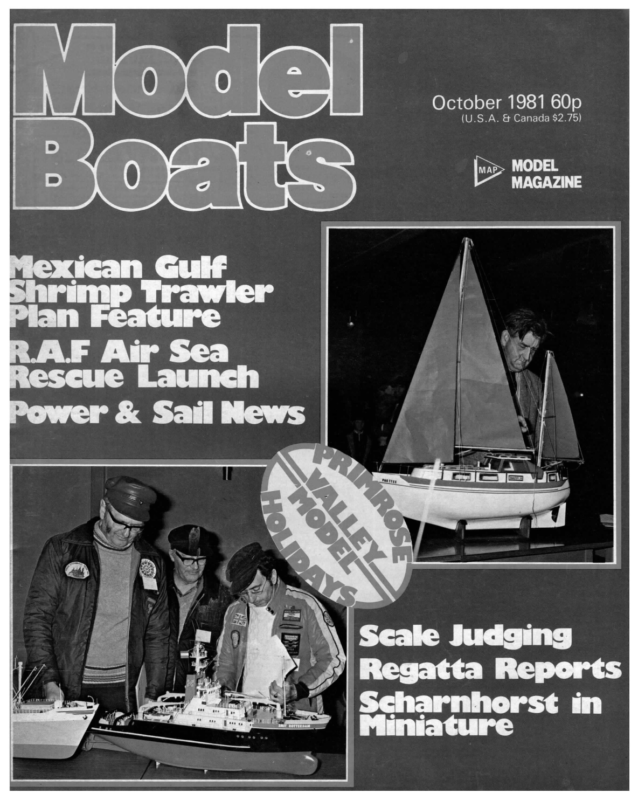
October 1981 60p (U.S.A. & Canada $2.75) a> MODEL MAGAZINE : rimp Trawler *jan Feature AF Air Sea rescue Launch Power & Sail News ii Seale Judging Scharnhorst i Miniature ——
SEV AA PEALE LAL IE A I ABE LE EE SERN al EEG RE BNE BEER EE BE NS OEE IIE, SO PEPER ILL OIL BAIL BREE ADEA NONI NN TORE RAL LE EAI EEE ONE A BLL ae A light-hearted accou development of R/C \ staunch band of tra li Sailing trials at Sheffield. Cliff Bean, rubbing his hands an anticipation, behind his Starlet. Photos: Glynn Guest. went a long way to help this cause. VWVaserniva model power boat club start to HAT do you do when members of a well the interest in this area demanded support from the club and the first problem to be tackled was show an unhealthy interest in R/C yachts? Would a disapproving digit wagging at their jibs be sufficient to show them the error of their ways? Or that of a suitable sailing water. The regular club will it take something more drastic to impress was realised that R/C yachts and the powered sailing water is long and narrow and the trees on three sides shielded it from prevailing winds. It upon these clearly unbalanced mariners (Well model could not safely be mixed and that a larger really, anyone who puts his trust in the nebulous area for the exclusive use of these wind-driven This situation proved to be the boost (if any were needed) that the sport required and the number of yacht owners doubled in quite a short time. The majority used the Duplex 575 kit, if being a natural choice on the basis of size and cost, especially as no expensive sail winches are required. The large sailing area enabled more meaningful comparisons to be made between the propulsive power of air currents, rather than a models was required. A further consideration ‘proper’ unit of energy, must be a that hanging bits of materials from poles, in the was the dependence on public transport of several of these enthusiasts, adding toan already species and encouraged plenty of ‘go faster’ work particularly by messers E. Wright and A. Lees, who’s models were never quite the same oneach hope of gaining momentum, was quite insane weighty problem. After much head-scratching outing! and would never catch on! ‘It’s interfering with nature came the cry’ and ‘if the good Lord has meant us to travel by wind alone, he would never the obvious choice suddenly dawned upon us — Each weekend and some weekdays, broughtthe attractive and colourful spectacle of scudding little suspect) have invented the I/C engine and electric motor,’ said others. Read on and discover how this unsavoury interest evolved and howit’s followers overcame the withdrawal symptoms from amps and methanol! In common with most model boat clubs, our member’s interests were evenly divided between the functional multi-racers and it’s opposite number, the true-scale model. Then, on that fateful Tuesday evening 3 years ago, the first member to succumb to ‘Yachtitis’, produced ata club meeting, his new Starlet R/C yacht, (MAP Crookes Valley Park. Situated just one mile from the city centre, it contains a lake some 100 metres square, used during the summer by the public yachts across the lake and if you think this state- rowing boats. Come autumn, these are removed comments of an elderly couple overheard to say, until the following spring. Could the Society ‘Ee it’s grand to see some colour and actioninthe obtain permission to sail yachts there during the winter months? It already had a foot-hold with the park during the winter months’. They were, of course, referring to the model yachts (at least, | two multi-racing regattas staged there in June think they were!) and November, so the next stage was to send a By 1981 R/C yachting was firmly established written request to the Head of the Recreation Dept. explaining our dilemma. Emphasis was placed on the absence of noise, pollution and the usual recovery problems normally associated and it was felt that a club regatta should be plan 1048). It was and still is, a credit to it’s with powered models, also the compatability of this sport in relation to the other main users of perpetrator Cliff Bean, and it created tremendous this water, the fishermen. interest amongst the gathering perhaps because Just two weeks later came the reply: ‘Your attempted. Fortunately, there was a_ trophy available in the Society, intended for annual presentation to any new area of interest. This had been donated by the previous sec’s wife, nodoubt in the hope that now his term of office had ended, he would finally get some domestic chores done! (‘| should have known better’ she was heard to request has been placed before the appropriate say). committee and permission has been granted for the members of the Sheffield Ship Model Society to use the afore-mentioned lake for the purpose of sailing model yachts.’ Imagine our conceit! The organising such a regatta, Mr Lees and Mr Wright volunteered to produce a set of rules for this good news was given at the next club meeting but with it went a warning to be on their best of severe restrictions size of models that might be entered (the majority of which would be the Duplex 575) and specified 3 classes according to o/a hull length. This would cater for the larger Star/et and Duckling (MAP No. 1344) models and at the other extreme, a 16in within the Society. By now the committee were showing the Society of this terrible blight. It was suggested that a liberal application of methanol/castor oil our minds. We were not about to lose this water own design built by junior member Jeremy Ash, incorporating 2-function radio. solution (via a tuned pipe of course) was a possible cure, or a few well-aimed volts directed through a similar incident and members were told The proposed rules were: to identify themselves to the Park Attendants 1. The event will be divided into three classes: to various parts of the anatomy, might succeed in upon arrival. | think it should be mentioned that Class 1 Oto 18in the eradication of this nasty disease. our club secretary (this will make him blush) always employs a most professional standard to his correspondence and there can be little doubt that his factual, lucid and neatly-typed request Class 2 18 to 29in 29 to 40in GR ILR SORIA at Memories event. They took into consideration the type and NAG behaviour. Since there was a distinct lack of experience in BRIAR RO POE for most, it was their first close look at a ‘real’ yacht. The writing was on the wall and the next member to stray was Ernest Wright who caughta severe case of ‘Duplexitis’ at the Brean Sands Holiday Week. This was to prove highly contagious and by early 1980, some six cases were confirmed and a similar number suspected ment somewhat fanciful, it was inspired by the POE ROR OPP RE OPO AGC BRIERE ILL Vv emergency imposed on i/c power boating in Sheffield caused meetings were being convened in an effort to rid by the criminal disregard of noise restrictions by several non-members, were still uppermost in signs Joking. apart of distress and (| though | had better tell you in case you had not realised) the committee (which can be an even better joke at times) decided that 568 Class 3 2. There is a time-based handicap for the different classes eg. 3 minutes between class 1 and Model Boats
f the introduction and ting within a hitherto, nal power boaters. 2. By Sheffield S.S.M.S. Secretary, N. W. Heslington 2 minutes between class 2 and 3. Came the 5th April and with it, bright, bitterly 3. All models must be identifiable by means of a club member or a frequency colour flag. wind. 4. Models Crookes will sail in a clock-wise direction around the course. 5. Models may be taken from the water up to the count-down time (1 minute from start of their class) but if any are not ready when ‘start’ is called, the race will not be held up. The victorious Ernie Wright. now known as ‘Captain Birdseye’. cold weather accompanied by a This highlighted Valley Park. the light variable only drawback of The buildings and trees which surround three sides, tend to minimise wind direction and it is not uncommon to see Tx pennants flying in one direction and the model sailing in the other! A 40 metres-per-side triangular course with 6. Any model or part thereof, crossing the line starting before the start, must go around the starting buoy before re-starting. (bulldog clips) secured to the bank, for recovery of 7. No deliberate bumping! Leeward boats must give way to windward boats! Penalty for above isa enough for our ‘little’ yachts and indeed, proved to 360 degree turn! gate was laid, using weighted lines the buoys after the event. This seemed quite large be so as during the course of the day, when 3 to 4 laps per 30 minute heat established the ‘norm’. 8. Any model colliding with a buoy must encircle that buoy without further collision before con- water, tinuing. curious subdued excitement took over. (Not at all 9. All models must complete the lap they are on when time is called. 10. If any model does not finish, it will be With just 9 of the promised 14 models in the all milling around the starting gate, a like your good-old multi-race with it’s vulgar blast on a klaxon and all hell let loose as engines roar times. However, the overall sailing technique of the other competitors was improving by now and the outcome was still unpredictable. The wind freshened up in time for thefinal heat and just for extra interest, it was decided to runit in the opposite direction (old multi-racing traditions die hard!). This had all the makings of a thrilling race with any one of three models in a position to win the event and one of the leading contenders, the B/ue Sonic, sped well clear tothe first buoy. But disaster struck here with a jammed rudder and whilst it went in ever widening circles, the remainder of the field went by with Ernest in the lead. It took 10 mins to recover the model and whilst it gave a good account of itself, it was too late to recover sufficient points for a win. This place went deservedly to Ernest Wright with his Duplex 575. The final result was as follows: 1. E. Wright Duplex 575 6 points 2. C. Bean Starlet 3. G. Guest 13 points Blue Sonic 600 Duplex 575 14 points 19 points Duplex 575 6. R. Gordon 21 points Duplex 575 7. R. Baines 25 points Own Design and models are slung into the water from all directions!) There came a single crack from a 4. last boat coming off the water in any heat andthe starting pistol and each yacht turned as though 5. J. Ash drawn start of the next heat. starting gate. Although it was a good beginning, positioned last in that race. 11. There will be a 5 minute interval between the 12. Scoring will be done on the following basis: One point for first place, two points for 2nd place andsoon… The competitor with the lowest number of points for the day will be declared the winner. This was a pretty formidable list and it was felt that two regattas should be held, the first being a preliminary affair which would serve as a test- bed for these rules and also as a practice run for competitors and judges in readiness for the event proper. Once again, our ever-helpful Recreation Dept. granted permission to stage these events, the first on 5th April and the main event for 13th June. Neither of these dates were random choice. The first was the last Sunday of our allocated ‘winter’ period and the second in June, was the day the Society erected the usual scaffolding landing-stage in Yorkshire Multi-race 50 readiness for regatta, the South held the This job is usually finished by 1.30pm and with half the lake roped off to prevent following day. the rowing boats. from encroaching the area, it presented an opportunity which was too good to miss! October 1981 a magnet and swept through the the remainder of the heat saw most competitors struggling in the light wind and trying to copy the actions of the eventual winner Ernest Wright. The finish was also unfamiliar (in our eyes anyway) in that, Note: Binoculars may be used. by as ‘time’ was called each model had to complete the course. We understand this is how the real thing is done and it resulted in some exciting racing to the line for those extra points. Duplex 575’s took the first two places in this heat, followed by a somewhat surprised Glynn Guest sailing his B/ue Sonic 600. The light winds had not favoured the larger Star/et and it’s owner had to be content with 5th place. Heat 2 had it’s interesting moments with some very close sailing between the B/ue Sonic and the Star/et, whilst on the lake-side, the club secretary nearly blew his head off trying to re-load the starting pistol! However, he survived, in common with the B/ue Sonic which took 1st place just in front of Cliff Bean’s Star/et. In the 3rd race two people had to retire due to problems and highlighted the need for radio adequate nicad performance in long events such as this. Ernest Wright won this comfortably despite difficult wind conditions which fell to zero at L. Cropper 30 points The time-handicap system, although not fully proven, did not appear to put the larger model ata disadvantage. The 16in ‘own design’ serious model by Jeremy Ash was not entered, so we do not know how this would have faired though at a later demonstration it showed surprising speed and with a 3 minute head-start, may have done better than his ‘575’ entry. In conclusion, everyone, including those who turned up to watch or help, enjoyed their day out and we can hardly wait for the Main Event to be held on June 13th! Already there is talk of an open regatta next year. To reflect the interests of our members and avoid stepping on the M.Y.A. toes, we could restrict it to the 25 and 40 inch length classes, enabling a variety of commercial ‘ kit models to enter along with numerous possibilities from the MAP Plans Handbook. (What about an R/C version of an ‘MM’ for the 25 inch class?) Also note that at 40 inch maximum length, we would not allow ‘RM’ or ‘R10R’ class yachts which appear to be well catered for elsewhere. But then, | suppose one of our lot will eventually have to try a big ‘un! 569
t hy eee erestittas 4 ‘ Model Yachting Association News OME three years ago, an article was written of radio racing after competing in major open for a full-size magazine suggesting that small races because they didn’t like the arguments, and displacement yachts with one-man crews fitting most beginners don’t actually start off in open in the hulls like Formula 1 car drivers could offer events. Tim goes on to put some quite cogent an avenue of inexpensive design development points: and a new form of racing. In particular double- “People must realise that sailing is not a quiet size A Class yachts were mentioned, as this Sunday afternoon sail round the pond, but an approach would produce boats very like one-third aggressive and, most important, a competitive size 6-metre yachts, the A Class having been sport. Unlike most other forms of radio control, you are out there sailing against 8-12 other boats who are all trying to get to the finishing line before intended to encourage 2in — 1ft models based quite closely on the 6m rule. Take an average pre-Lo/lipop A of 55lb on a 54in w.l., 80in l|.o.a., about 12in draught and you, on the same course, and it is this that people taking up radio sailing may not be ready for. sail. “The fules are not easy, but they are 100% Doubled, this wouldgive a 13ft 4in hull on 9ft w.I., necessary, in the form that they are in today. It 14in. beam with around 1500 sq.in. of Up and coming model yachters at Guildford Model Yacht Club‘s Junior Regatta run each year to promote the Club‘s activities. Photo Geoffrey Prior. refuse entries from such known individuals and let it be known that they have done so. Perhaps it could come to that, though there could be a lot of problems, largely arising from what is considered unacceptable behaviour and by who. A ‘booking’ system, in which complaints about an individual were forwarded and recorded in a central 28in beam and 24in draught, 41-42 sqft. of sail really is an all or nothing situation, and the only and a displacement of 440lbs. Knock off 140lbs way to learn the rules is to keep practising and get for the crew and 75lbs for the hull andrig etc. and to know almost by instinct the incidents which there is still a 225lb ballast allowance. It would be occur; just as important, learn not to put your boat register, with automatic penalties on a totting up basis, would be more impersonal, less divisive, and maybe, even, more convincing to the possible to work in a similar way from a model 6m in offender. class design, though there aren’t many of these at beginners say ‘But there was nothing | could do present. when they shouldn’t have put themselves in the Now, however, a yacht has appeared which a situation you can’t get out of. Lots of position in the first place. approaches the concept from the other way. This “It’s all down to experience and the new owner is a scale model of a 12m design (presumably 1/5 exhibiting all the behavioural features of a full- does find it hard, but if he sticks at it he will find that it is the most rewarding of all the radio sports. Disputes about the rules docrop up — let’s face it, scale 12; it was launched for trials just before in full size they have panels of solicitors to sort out or possible 1/6 scale) 12ft long and apparently Cowes week and will surely attract tremendous rule interpretations and award penalties. But it interest. Wood-planked and glass-sheathed, it is understood that building costs were about £600 really is worth it all, and knowing the rules and being able to use them to give you a racing and finished boats could sell at under £1,500, advantage adds an edge to your sailing. less than the price of many dinghies. If a g.r.p. “In the Southern District | have not come up An interesting slant is brough up bythis correspondent in respect of sailing penalties. The old system, based on full-size practice, was that a foul simply meant disqualification from that particular race, but the present system of penalties has a smack of ‘getting away with it’ about it. Certainly with a number of regattas experimenting with a discard system (each skipper can discard his worst race in, say, every six) it might be a thought to go back to disqualification, which demands a quick and clear decision and has advantages that if a disqualified boat has to stop racing immediately and does not mould was made, we would have thought the against arguments spoiling a meeting; most open complete the course, subsequent argument is price would be even lower. Apparently it carries races go by without any protest meetings at all. about 450lb of lead, so its displacement would be under 7OOlbs with crew. An iron keel would the judges advise of any bumps, and it is the two reduce the cost by at least £50, more if a hollow skippers involved who have to sort out who is in glass fin filled with concrete and scrap metal was the wrong. Done this way there is very little room for argument, especially with the 0.0.D., who should not be involved in protests… Atclub level something akin to Class 2 does already exist, together with a friendly atmosphere, but open clearly pretty fruitless anyway. Skippers could be discouraged from calling ‘Protest’ and sailing on by instituting a whopping penalty on top of the disqualification if the protest was not upheld. This may seem a sweeping suggestion, but if used. For match racing, tactical 12m training and proving new designs from designers who would have little hope of seeing their plans built full- Don’t forget that the O.0.D. is there torun things, scale, this approach must surely have a future. meetings must be run properly or the whole thing Although as man-carrying craft they could not be becomes a farce”. strictly classed as models, in another sense they Much of this is absolutely valid and no-one are models and for some years it has been our would quarrel with it. However, where the fly lies ambition to build one when (and if) we have time and can afford to retire. in the ointment is the bit about “the two skippers Class 2 Racing involved have to sort out who is in the wrong ‘leaving’ very little room for argument’. Pow! It would be easier to pass some skippers through some skippers won’t conduct themselves as sportsmen it is in the interest of the majority — including those who would enjoy sailing if we didn’t get a touch of the McEnroes so often — to introduce measures which reduce the room for animosity and argument. To revert to the earlier suggestion, those who enjoy radio racing in its present form can carry on, sailing Class 1. Those who would prefer a more relaxed atmosphere (and it really isa majority) would happily settle for a recognised Class 2. Far from dividing model yachting and weakening it, such a move would produce increasing numbers of radio yachtsmen, many of whom would be prepared to compete in Class 1 once they had become familiar with their boats and the basic sailing rules for which Class 2 Our remarks on this subject have produced a the proverbial eye of the needle than get them to number of telephone calls and verbal comments, all very much in favour of the general idea (‘This admit that they were wrong, even after a protest approach should have been adopted years ago” at personal has come up once or twice) but so far only three letters, one of which appears elsewhere. Tim sours the whole atmosphere for a considerable number who would otherwise turn up to enjoy would give them the opportunity. It might even be Fuller, who is one of the few top skippers who sailing. shallow end a bit, in an organised way, before ever write letters, doesn’t feel that argument This view is supported by another writer, an old hand model and dinghy skipper, who suggests plays quite so big a part in open events as our remarks indicated. Well, fair enough, though we know twoor three skippers at least who pulled out 580 against them has been upheld. It is the wrangling level, caused by a minority, which that as the persistent offenders are known, the remedy is in the hands of clubs — they simply put that people would like to splash around the having to plunge in at the deep end with the experts, some of whom have forgotten that they had to learn to swim too. Does that sound suchan impossible situation? Model Boats
Team Selection The comments on team qualification for the meeting’ or words to that effect might legiti- given by the League table. Would it be a pos- mately be uttered by a skipper known to be good sibility, on this occasion, to use a points system, with 60% according to the 1981 League position, 1982 World RM and R10OR Championships in but a point or two short of qualifying. There is, too, August’s issue attracted some valid observations the point that a skipper’s 1982 boat may notbeas from, again, Tim Fuller, as follows: 20% from the 1982 Nationals and 20% from the good as his 1981 first (a) Qualification should not depend on one race, one, which he has sold or broken up, although this is less of a possibility in three 1982 open races attended by a potential team member? Naturally a keen and as bad luck, availability of time to attend, failure of yachting particularly, aircraft or even experienced team is required, but anyone keen radio gear and the like suddenly take on huge power boats (e.g. engine damage) where similar and experienced in the first four months of 1982 is likely to have been so throughout 1981. than in, penalties. It could also raise the temperature of problems of team selection have arisen in the the meeting, with possibly very bad feeling due to past. “And what about Z, whose new boat is The idea of using the Nationals as an eliminator disputes etc. as skippers bear in mind that it isa faster than anything else?” is another cry when came up virtually incidentally at the May M.Y.A. qualifier as well as a National Championship. selection is made on a previous year’s results. (b) The Nationals are too late in the year for Although it isn’t much help at the present time, some skippers still to be able to plan to take time this indicates that off work to go to France. selection needs to be hammered out for future (c) Previous experience should play a part in selection. shown by entering as many open events as possible. (e) It use, so that skippers keen to participate in events will know in advance exactly what they have todo (d) Keenness to participate and gain experience should be a permanent policy on team would be better to towards qualification. So far all the major internationals have been in the July/August period but entries have been called for several months in reject the bottom advance, which is understandable when the host skippers in the list of people wishing to go rather than qualify the top skippers, which would take some of the heat out of selection. country wants to take entries up to a practical In view of these points, it would seem that possibly the best method of selection should Brazillian team is hoping to travel to Dunkirk, and depend on the results of the 1981 League table, with keenness, experience and consistently good results being the criteria. These views will undoubtedly attract a lot of support, the main objection being that the choice would be retrospective. “‘If |‘’d known that’s what was being done I’d have made sure | sailed at X maximum and is uncertain how many countries will take up a full quota of entries. Incidentally, a we also hope to see an Italian team for the first time. Selecting a team on the basis of one event is unsound for other reasons than those given above. As an example, three days of heavy weather would produce quite a different group from three of light weather, which supports the argument for the maximum spread of events as Pat form of kicking strap by Graham Banto for use with luff-groove, pocket luff and othe. forms of mast/sail arrangement. Boom is pushed rather than pulled down and tension is fully adjustable. The complete fitting is available from Graham in kit form. Council meeting and gave delegates little chance to think things through. It may be that at the September meeting further discussion will take place. New Zealand Nice to see a copy of the N.Z. M.Y.A. Newsletter, from which we learn that there are currently six affiliated clubs with 66 registered yachts. There are also at least seven major population areas which at present have no club and it would seem that the new Chairman (H. Short), Secretary (M. Rundell, 32 Sea Vista Drive, Pekerua Bay) and committee are to try to stir up these areas, as well as existing clubs. The N.Z. RM Nationals, April 18/19, ran ona modified Stollery system with four prelimary grading heats and a one up, one down arrange- ment for 21 entries in three fleets. O.0.D. on the first day was a prominent Auckland yachtsman, Peter Beaumont, and on the second day Olympic gold medallist Helmer Pedersen, both of whom were happy to explain points of law etc. between races; the idea of using experienced yachtsmen for the duty was highly successful. There were 15 races in 20-25 knot winds onthe first day and 24 ina 3-5 knot wind on the second. Wendy Marten (a lady?) ran out a very convincing winner with 12%, points with Brett Russell on 35%, and Fred Marten on 40. Sorry, no details of boats, but the winner had the most recent registration number. Old Gosport hands may be interested to hear that Maurice Seear is active out there; apparently his 10 rater Ghei/a has found its way to N.Z. and Maurice is trying to track it down. C.B. In his useful letter, Tim Fuller also mentioned two further points on C.B. radio. (a) He has noted that for some reason FM receivers seem to get more interference from C.B. AM transmissions than our AM receivers. (b) He monitored the band at the RM Nationals at a distance of 500 yards from the start line and there was no doubt at all that the model signals blotted out anything else that might have been around on the band — in fact it was surprising how strong the signals were even at that distance — and he has never heard C.B. break through model signals on the monitor during any sailing at New Forest. Frank Parsons We were very sorry to hear of the death at the age of 72 of Frank Parsons, of Nylet Ltd., after a long illness, during which we’d spoken on the telephone and gained the impression that he was mending. Frank was truly one of nature’s gentlemen and was alwaysa good friend to model yachting; it is difficult to realise how chancy it was to have set up a regularly-advertised model sail-making business well before radio yachts became popular, but there can be no doubt that the easy availability of well-cut and made sails and, later, yacht kits contributed in no small measure to the growth of the hobby through the 1960s and 70s. Condolences on behalf of all yachtsmen are offered to his family, particularly Frank Jr. who will continue to run the business founded by his father. October 1981 581