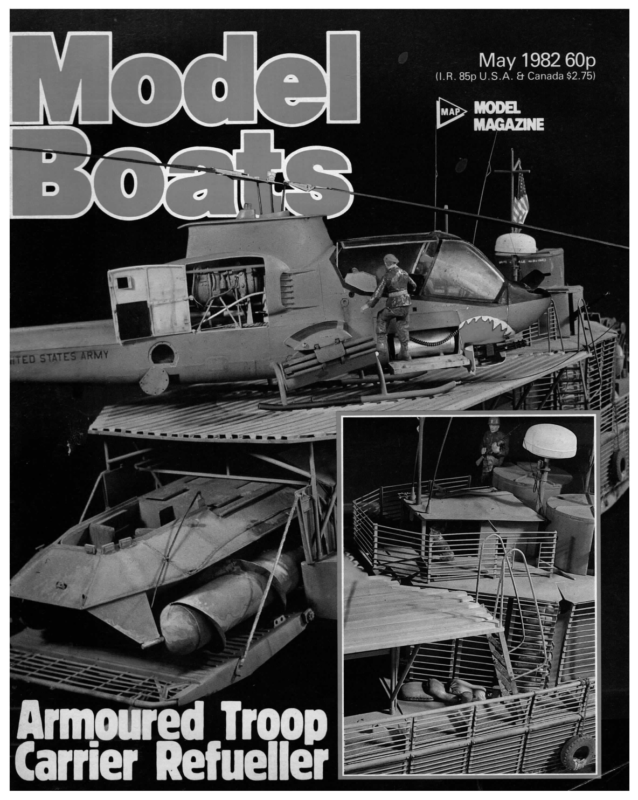
- 1st YEAR OF R.M. SAILING a beginner’s first step into competitive sailing.
- Tack, Gooseneck & Kicking Strap Device
- Logbook Model Yachting Association News.

May 1982 60p (I.R. 85p U.S.A. & Canada $2.75) ie Se ms oe
Get on the right tack with Groupner- RIC YACHTS They’re designed from the start to give superb response to radio control — but make equally good free-sailing yachts. The kits are also designed to cut building time drastically — get you afloat quickly. Both models feature ready-formed hulls and other parts in tough, smooth ABSplastic, plus die-cut balsa and ply parts ready to install. No chance of going wrong, either, with the detailed ‘Quickbuild’ plan and a separate profusely illustrated instruction booklet. Beginner and expert alike will appreciate the care that has gone into producing these kits. £24.95 GRAUPNER OPTIMIST £63.65 A round bilge yacht with a scale appearance and truly excellent sailing characteristics. Length 710mm (28in); beam 166mm (6 1in). Displacement Scale model of a 1-ton keel yacht, length 1040mm (4 1in); optimum hydrodynamic shape duplicating the elegant 0.3kg (0.66Ib). Kit includes mast and spars, sailcloth, ballast for keel and other miscellaneous parts. ginal. Fittings set is an optional extra (£4.95). This model is designed for rudder control, using just one servo. cellaneous parts. Optional accessories are a fittings set (£28.75) and moulded metal keel (£16.40). Designed for GRAUPNER COLLIE beam 270mm (10’/2in). The ready-formed hull guarantees lines and outstanding sailing characteristics of the oriKit includes mast and spars, sails and other mis- 2-channel radio (rudder control and sail winching). …but if you prefer POWER with no-noise, no-mess and switch-onand-go operation choose one of Graupner’s ‘fast electric’ boats. True racing craft which genuinely reach speeds of 11-12 knots. Ideal for sport or course racing — the stability and control response of these models is quite outstanding. Again these are produced in QUICKBUILD kit form. GRAUPNER MINI-SPEED £18.50 Length 515mm (20′,in). Beam 230mm (Jin). Kit includes formed hull top and bottom shells, lid and other parts in ABS plastic, plus die-cut ply parts, prop shaft and tube, coupling, racing propeller, rudder set, wire linkage, decals, etc. Power by Jumbo 540 (6v) or Jumbo 550 (9v) and matching Nicad battery or equivalent motors for top performance Add radio for rudder control and motor on/off GRAUPNER MAXI-SPEED £23.95 Length 630mm (25in). Generous 275mm (11in) beam permits very tight turns without danger of flipping over. Really FAST on a Jumbo 550 or Jumbo 750 motor, or equivalent and 8 .4y Nicad battery. Suitable for FIE contest work (weight 1.8kg). Similar FULL kit content as Mini-Speed GRAUPNER MINI-PROP £13.50 An exciting NEW model from Graupner with a special sporting appeal Electric powered for no noise, no-fuss operation on any pond. (Motor not included). Add 2-channel radio for complete control! An extensively prefabricated kit which you can complete in an evening. Hull top and bottom shells, cover, motor console, nacelle and other parts in ABS plastic. Plus printed and die-cut ply parts, brass tubes, rudder shaft, antenna wire, decals and other miscellaneous parts. Length 530mm (21″). 230mm (9″). Weight approx. 1.3kg (2.9!bs) Beam SCALE ENTHUSIASTS are also well catered for in the Graupner R/C boat range all noted for their fabulous authenticity and detail. Check them out at your local Ripmax stockist. THE BEST COMES FROM May 1982 AX AT YOUR MODEL SHOP 245
Rojair MICKEY FINN OVER 700 36” ONE DESIGN Complete kitless glues. SAILING IN ~ — Belgium, and Radio. Holland, £72.00 inc. VAT. France, ; : NA From your NS VAG Sweden, U.S.A., South Africa, Australia. ~ty- — Belgium, Holland, France, Sweden, U.S.A., South Africa, Australia. Model Shop SCANDANAVIA: Sail-A-Model, Box 14023, S-400 20 Goteborg, Sweden. U.K. Class Secretary: Ken Shaw, 12 Ashfield Road, Davenport, Stockport, Cheshire. In case of difficulty: Direct from Rojair Ltd., Brand Street, Nottingham. Tel: 0602 861 481. AUSTRALIA: Alan Fish, 145 Clontarf St., Seaforth, N.S.Wales 2092 U.S.A. Keen R/C Sailing, 8460 Farm Pond Lane, Maineville, Ohio 45039. Northern District Championships 18th July, Ashton-under-Lyne. National Championships, Bourneville, 22nd August. Open Meeting Crosby, Liverpool, 5th September. Open Meeting Etherow, Ashton-under-Lyne, 12th September. Open Meeting Nantwich, 26th September. two or three years and is ofte picked by beginners because of it reasonable size and _ therefor conODEL Yachting is trolled in England by the Model Yachting Association and M_Y.A in Scotland by the Scottish There are a number of recognised classes sailed by members of the steadily growing clubs affiliated to the yachting associations. Before taking a brief look at these classes, we unhesitatingly recommend that prospective model yachtsmen seek out their nearest club — they will find portability, though it has som way to go to catch the Mclass. Th hull must fit inside a box 36 x 11 Qin. and the maximum displace ment is 12lbs. The 12 metre and 6 metr classes have received little sur port in the past but the 12 in part cular is currently undergoing revival because of publicit surrounding ‘Project Acorn’, joint effort by modellers and fu size yacht sailors to find, hope fully, a winning combination fc the next America’s Cup. The 6m are also receiving more than second glance and we may see regrowth; they are around 5Dft. i a warm welcome. Either ask at your local model shop or drop ans.a.e. to us at Model Boats. M.Y.A. recognised classes are: A Class — The largest, usually around 7ft. in length, 50-80lbs. displacement, and 1500-1600 sq.in. of sail area. 10 Raters — Probably the fastest class, 6-7ft. overall length, 23-35lbs. displacement, and around 1000-1100 sq.in. of sail. Marbleheads — The M, or 50/800 class heard, is nationally the and as length and 30lbs. displacement. Radio control yachting is ver much a growth area in man countries; one of its advantages i that boats can be sailed on water sometimes with limited access whereas wit vane models it must be possiblet most popular internationally reach the model from any point o the banks of the lake. The M.Y.4 Length must not exceed 50in. and maximum sail area is 800 sq.in. Displacement varies between 13 recognises DIGIFLEET EAHORSE OUTFIT The complete outfit is supplied set-up andready ‘to install, with Ni-cad packs and proportional THE above boats are available as packs of finished components ready for assembly in the absolute minimum of time QR as finished ready-to-sail boats requiring only radio and winch. & =f cess has been overshadowed by the more numerous successes of the SEAHORSE. The SEA-URCHIN is our latest design — produced to excel in light weather conditions, but still be an excellent all-rounder If you want to ‘do your own thing’ by building from a published design or even from your own design, then our catalogue of fittings and materials will have something to interest you. It lists the fittings and materials which include such useful items as brass and stainless steel wire, nylon covered stainless steel cable, polyester braids, sailcloth and so on The quickest way for a beginner to gain experience is with a well-proven kit-boat. Success requires two things — a good boat and a competent skipper. We can provide the boat — you have to acquire the skill and experience Sent?4 0p for your catalogue containing information on all yachts, fittings, sails and materials. Overseas customers -—— we ship anywhere in the world in a strong carton -— ask for quote of cost SOLARKRAFT ACKHURST ROAD, CHORLEY, LANCS. 262 van THE Rater (R10R) Marblehead (RM) Marblehead (RM) Restricted (36R) The SEA-KING doesn’t often receive the credit it deserves It has won the last two World Championships -— in South Africa in 1978 and Canada in 1980. It has been World Champion RIOR for 4 years. Its suc existing YACHTSMAN YACHTS, KITS & ACCESSORIES SEA-KING. 10 SEAHORSE 3. SEA-URCHIN. DOLPHIN. 36” all classes for radio usage, ident fying them by the prefix R, i.e., RA R10r, R6m, RM and R36. Onc again the Marblehead is by far th and 25lbs. the trend being towards lighter boats. 36in. Restricted. This class has returned to popularity in the last & ‘® winch, type FPS-8, plus mains charger. _—sODIGIFLEET YACHTSMAN £125.00 SEND S.A.£E. FOR FREE BROCHURE AND PRICE LIST PAY BY: ACCESS. BARCLAYCARD, VISA, HOBBYCARD, CHEQUE, CASH Fleet Control Systems Fleet 5011 ~47 Fleet Road, Fleet,Hants.tel: Model Boats
i “B75” GREAT FOR SPORT AND COMPETITION SAILING — OVER 4,500 bs pS (TS. 4s” One-designs are playing an in- The three better known examples are (a): 1.5m — a 60in. longracing model which already has a good following, (b): Mickey Finn — an unusual una rig of 740 sq.in. ona 36in. hull, this yacht has the advantage that a conventional servo operates the sail, (c): 575 — a small and very inexpensive model, only 17’%in. long, which has already introduced hundreds, if not thousands, to radio sailing. M.Y.A. class events, including in some cases — the Mickey Finn and 575 — they are available from All Points pages. There are now a number of manufacturers producing kits for class and one-design yachts. These are available mail order and one of the large range of sports models available at many model shops. Scale sailing models are relatively difficult subjects to model, although light radio control equipment and light modern materials are tempting more people to have a go. There are also a number of specialist suppliers in this area — for instance the impressive gaffrigged racing cutter and the J. Class America’s Cup boat from the ‘30s as advertised on these pages. We at Model Boats have a large range of plans for most of the classes and also for scale sailing craft. These are listed in our Plans Handbook No. 2. Focus continues overleaf with the MYA National Regatta list. \ The next Focus will appear in the August issue covering scale power clubs — please send your information in now. |) 15 The oa , Tetbury, Glos. e S -GL8 BEU. Tel. (0666) 52831 PAY BY ACCESS, BARCLAYCARD, VISA HOBBYCARD, CHEQUE, CASH. SEND S.A.£, FOR FREE BROCHURE AND PRICE LIST PRICE: £175 (plus carr. if – BUILDING BALLAST TIME & PAINT & WHY 575mm PONG, WITH NOT Syl OWNERS CLUB CHOICE OF FOUR SAIL SEND LARGE COLOURS SAE FOR # PRICE | LIST AND ACCS. £20.73 + P&P £1.50 W. F. MOSS OSS QUICK , model shops. Modellers not wishing to sail competitively may be attracted by Mickey Finn, are listed later. 575 in WRONG. NEED IS creasingly important role in bringing newcomers into the hobby. listed CAN’T BE ALL YOU winning. are SKIPPERS of most popular choice. Free-sailing yachts are raced in pairs along the length of the lake, scoring 3 points for winning a beat and 2 points for a run. Each yacht sails every other. R/C yachts are sailed usually over a triangular course, two or more laps. Naviga free-sailers sail in pairs once over a 75-100m course, the first boat to pass between the finish buoys events SATISFIED / PRICE: £1 75 4 (plus Carr. . if| ; | have based these models on actual boats The tine quality fibre sass hulls have the lead cast internally applicable) The decks are in one applicable) piece of waterproof ply varnished several times They are screwed and sealed to the hulls with seelastic to facilitate removal if needed The rudders are fibre glass and are fitted with a simple self-steering device The spars are wood Ohtainable from all good model shops or direct from: DUPLEX CRAFT DEPT. 28, 5 BRINSMEAD ROAD, KNIGHTON, LEICESTER. Tel: 0533 884172 The Pirol had been designed from the outset as an optimum performance yacht conforming Naviga class F5M. to We can supply three sets of sail each with “‘tuned”’ performance to match with the conditions. Pirol features a Plura moulded hull. The rudder is pre-formed and only requires fitting into the moulded hull. Pirol, is a thoroughbred through and through. except the J mast which ts aluminium All fittings are stainless steel or brass except the J CLASS RACING YACHT from GAFF RIGGED RACING CUTTER the 1930s America Cup from the late 19th century Length overall 61in/1549mm | Length overall. ine bowsprit 59in/1500mn4 iqqing screws which are ated 8in/202mn4 m/190mnqy The sails or white terylene are made with integral luff ropes and eyelets as needed The Height of mast above deck*%2in/1828mm | Height of mast above deck 70in/1778mn{ Approx 10kq internal ballast Approx 8kq internal ballast Sail area 1430 sy in/3632 sqcm | Sail area 1300 sy in (3302 sa cm] whole rig takes about fen munutes to assemble and each sail is in Length waterline Draught Beam 50in/1270mm | Length waterline 11in/279mm | Draught 10in/254mm | Beam . 36in/912mn} 7 dividually fitted May 1982 ( renin dpe: COUGAR CRAFT COUGAR CRAFT 21 Station Street, Meltham, Huddersfield, HD7 3NX. 263
David Trippe reflects on a beginner’s first step into competitive sailing Fig. ig. Fig. Servo LH | Servo RH O) ¢ es UU Rudder Pintle 6) Fig. 3 ‘ OFF Rudder pintle Red to battery (7.2V) Red to winch $ b Red to charger |$ ° 9° | Black to battery Red to receiver t to charger Black White to battery (4.8V) | ON ; { Black to receiver ) to batte\ ry (7.2V Red 4 Black to battery Fig. oe ne Red t sg o a y Red op ksh wor all e: in Ag nt lme ge e cea g e r a c i con ed of defi has nder remi drawers and beemannya modconseltantmakers/ dinghy nile, Bolen wd tools Paoum ONL, the orsnostalfeelgia when passing a stretch of and fishing tackle a oe ° ° ° sailwater. They, like the writer, may havoeyacconhtMcK to Eneaquickly,Blacand,k to wincash with e gear OR 15 years a Walter Jones van sidered building a competititheve radilocal radio but baulked at the cost. An advertisement in Bowood House, model shop led me mto Mod el Yacht Club where the Chippenha Sunday afteron sail to lies fami r bring thei some back wit d ple cou t noons. This visi Yachting hNew tters editions of Model required forslemyself ous mul sti the all was financed by the sale and my 14year old son, s, to order two cam e iqu of a couple of ant ds. era se the We identical marblehea e therecho is astrong marblehead class becaus average Car fleet in the SW area andtwothehull s. te oda omm boot can acc Selection of boat heads have a great As a class, Marbleall the competitive that in , advantage as kits or as grp er eith e labl designs are avai s can be lable design hulls: a list of avaihti ng News No. 6. Boatb Yac el Mod in nd fou d around the 15l ere hov e hav weights , Sea Horses, Asha s, mark for some year ppyntis his Trappers, 247s and Ski s are arou ndt f ht. New desi‘ gns are Vepting, towarders weig boats of 11 to 12lb weight; these bght 4 27 boats accelerate sailing freer lighter dinghies, may require rd. Asa beginner it when beating to windwacomp etitive hull so is important to pick a ppoi ntments occur disa le itab inev when the skipper into ed ibut they can be attr experience and not to the boat. Radio gear to be little guidance on There seems | thought modern radio installationrs toandencl ose the the whe on hard and long hindwith but box, of rpro wate a radio in hull The ous. obvi was sight the answer r- | have a wate must become a sealed unit;held by a plastic is proof hatch cover which k to fasten and Dzus fastener, which is quic smaller the hatch y the release. Obviousl worse the better the waterproofing but the y. ilit ssib acce for ct| have made many chassis before sele light and strong, with ing a design which is and removeable. | finc or HS3well0)alloLtd.y, forfromtheJ 19Smiorth20&gauSonges HS15 rken (Cle chassis will take 6BA threadands,elbyBoausintsg Mod each item accessible
nylon screws, there is no danger of A Trapper with swinging jib – stripping the threads in the chassis. Nuts are not recommended as they can be awkward to fit and often harder to retrieve. boom and mast ram. Here the winch drum is above deck. The sail winch and rudder servo do not experience shock, so the rubber mountings can be replaced by nylon bushes. Features to aim for in the design of the radio chassis: 1. Lightness; radio gear, batteries, sail winch, rudder servo and chassis should weigh under 13oz. 2. Lead the receiver aerial away from the battery pack or shield it in an aluminium tube. 3. Keep the sail winch in line with its pull, see photo. diel Je ( DIGFFLEET Em -_ | Above, showing easy access to radio equipment bay and P.T.F.E. bushes for smooth sheeting runs. Right, radio gear suspended between deck beams. Note P.T.F.E. \/,;in. tube which carries sheeting from winch to bow of boat. 4. Crystal and on/off switch to be as accessible as possible. 5. Battery pack to be easily changed but reliably held. 6. Centre of gravity to be as low as possible and on the centre line of the boat. The most popular rudder servo is undoubtedly the Futaba 17M, it is powerful and practically waterproof. A smaller lighter servo is the Futaba 30M used in radio cars; although | have used one successfully at meetings, | have returned to the 17M for the extra arm length and power. The more expensive RC transmitters have a facility for reversing the servos, but for equipment that does not, you should check with your local model shop because the servo direction shown in linkage Fig. 1 is different to that in Fig. 2. The advantage of the second linkage is that less effort is required from the servo when the rudder is and rudder servo. The wiring through the four pole on/off switch is shown in Fig. 3. The Mklill Andrews winch runs off 7.2 volts and will emit 6 volts for the receiver and rudder servo, making the wiring much simpler as Fig. 4. Andrews or Jackson drum type winch or the new Futaba arm winch FPS25. We bought the MkIl Andrews winch which Decks Vain. ply is the traditional deck covering and some builders argue that the additional the hull; weight is justified in strengthening however more boats are appearing with Solarfilm, Supergloss, Coverite or .010in. high density polystyrene decks. Solarfilm is thin and easily damaged but like the other two easily replaced. The high density polystyrene should be stuck with Dunlop Clear from Halfords. Most other glues including Bostick Clear will attack the polystyrene. Trappers, Seahorses and Sea Urchins have grp decks moulded to the hulls. Mast and rigging Simplicity should be the aim of the beginner, do not embark on jib twitchers and rotating masts until you have achieved reliability of rigging, sheeting and rudder control. An excellent book to read is C. A. Marchaj’s Sailing Theory and Practice published May 1982 mast is not straight! So | set off with a by Adlard Coles Ltd. masts to carry around, the spreaders soon damaged the sails which | preferred to keep attached to the masts. Various skippers had commented that the carbon fibre masts stiffened up appreciably when bent, this was confirmed by Mr. C.. R. Jeffries in Mode! Boats recently when he found that a carbon mast bent to %in. then became very stiff. So with more expense (this hobby grabs you!) carbon fibre masts were bought and bent under rigged conditions, the bend being measured every 6in. and the curvature taken to the sailmaker. Under varying wind strengths | still got a sail crease but up six 500m/amp 1.2 volt Ni-Cad pencells batteries to give 4.8 volts for the receiver Ask a sailmaker what is wrong with your sails and he will invariably say that the hoist and cross trees halfway between the jib hoist and deck. Unfortunately with four requires 6 or 7.2 volts supply and by wiring in series, we took a tapping off four of the every page. groovy mast, a pair of spreaders at the jib fully to port or starboard; a disadvantage is that some sensitivity is lost in the central position due to a pin running in a slot near to the rudder fulcrum. For lightness one must consider the with photos and diagrams on practically This book this was eliminated bya mastram. Thisram would not be necessary for masts which go ~-through the deck to a keel step. | am useless at hard soldering so fittings are machined from the solid and made of HE15 or HE30 alloy where possible and anodised. | make full use of PTFE for running rigging as it is easy to drill and machine, it cannot jam or fret the 50Ib Dacron used for the sheeting. PTFE is avail- theorises on sail setting, hull forms, wind strengths and eddies with over 400 pages (continued on page 279) 275
D Sail Tack o =) Through o Bolt @: |i “SO Fulcrum HE? Boom Hinge ee rin i ee eee it yy piel i Hole for Spinnaker Pole End View Swing Arm a Chamter to clear sloping deck Mast Step Plan on Bottom Fitting for StarDuring the construction of the hull plan 1048, | let by V. E. Smeed using MM ult the MAP found it useful to cons which gave (among Specialist Booklet No. 8 other things) recommendationst.for carry yach this on ing rigg the ing out | could forsee personal difficulties in kicking strap So | applied myself me which would be easier for ion of my efforts, illustration is the culminat ent the function of each compon being self- making the ive system to the problem to find an alternat to make. The stain| was fortunate to have a thin wall nadva ht weig a has ch whi t less steel mas did not lend evident. tage over aluminium, butws.this through-bolt itself to self tapping scre elAhous ing with swiv top the for used was in place ied epox g bein one the bottom . step t mas together with the The swing arm was made from a thick hacksaw, drills piece of duralumin, usinggood for developvery — g filin and plenty of short length of ing the arm muscles. A the fulcrum. for brazing rod was used aerial with the boom clamp, a to a fitting off the aerial. formed by a The ends of the boom weren, the spigot turned piece of duralumi lathe . being epoxied into the hollow boom ess a prow re futu my of ic mist opti g Bein fitting the tac’ the centre line of the boat and acon being directly over the fulcrum gives stant tension to the luff edge. hole was provided in the bottom mast S! THE WORLD’S FIRST UNIVERSAL PRECISION SAW . THE HEGNER UNIVERSAL SAWS (U.K.) LTD 12’/,p stamp details to: 36 Great Eastern Road, Hockley, Essex SS5 4BX. Southend-on-Sea (0702) 205669 part of the to take a spinnaker pole — this ion. fruit to e com ng havi yet project not ce is tha The main advantage of this devithe there is a constant downhaul onmakesboon witl no matter what angle the sail TV undant The boom was made out of red modification — steelwith d —nal10mcuttm ing m woo 50ming ing!wind cuttght, saw-Strai out ofetc. work hard It takes s—thePlast inter or ic — Rubber, Bras ease and MAXIMUM SAFETY.ition, Southend Airport, 28th April to 3rd May. and 23rd. Tradex Exhib Demon l Craftat theand Country Show, Stoneleigh. Kenilworth, May 22nd and Modeions at Thestrat STURDEE NG HULLS 29 DEL RACI HA MOSE, . SEX SUS T EAS EASTBOURNE, CLO BN23 6AZ. Tel: (0323) 23651 als PICCO EN PICCO RACING ENGINES ……-..-:.0 £52.00 PICCO 21 (MARINE) PICCO 40 (MARINE) ….-….–:::6 £65.000 INES -~ £75.0 PICCO 80 (MARINE) ………-::-++ £25.00 12v BOAT STARTERS. …..—re:–each 75p FUEL FILTERS. …….-.–::e-::e 3 Sizes: MRH. TUNED EXHAUST PIPES 0 21 OF 3.5CC ceccccccceseccesoesererene £15.0 00 AO or 6.50 …….-ceeeeeeeeeererees £16. 0 £18.0 GO to 90 SIZES …..-.-.eeeeeeeees FULL RACE ENGINE TUNING AVAILABLE DEVELOPED VERY HIGH POWER ON TESTS ORDER: ALL POST FREE wou M.R.H. 29 STURDEE CLOSE, EASTBOURNE, MAIL Tel: (0323) 23651 SEND CHEQUE OR P.O. ORDERS TO: EAST SUSSEX. Model Boa
numbers for three or more suits of sails is a nuisance. ~” Model Yachting Association News ST SS HE meeting of the M.Y.A. Council normally moved into February this E isk in January was of reasons mostly related to year, for a number the ability of key officers to attend; in view of the weather during much of January, it was perhaps just as well. Despite a fairly full agenda, this was probably the most straightforward meeting for many months, much of the business consisting of reports of, usually, fairly non-controversial nature. Fixture lists for 1982 will be ready shortly (probably before these notes appear) and will in fact be booklets containing a list of club secretaries and much other information as well as the regatta list itself. Ken Shaw has put a lot of work in on them and not the least of his achievements is virtually to cover the cost of printing by selling advertising space. As mentioned previously, as each club pays its affiliation fee, a supply of these lists equal to the number of affiliated members will be sent, so that not only will every member have his own copy but he will know that the secretary has sent in the requisite fee. This is important since national regatta entries will not be accepted from clubs who have notre-affiliated, and there are of course some early meetings this season. One of the earliest is (was) the Model Maker Trophy at Bournville, brought forward to March 27/8, followed a couple of weeks later by the RM Championship at Cleveland on April 10 — 12i.e. over Easter. Following the weight of opinion expressed both at the A.G.M. and in correspond- ence, it was agreed that this Championship’s results would form the basis of selection for the World Championship in July; R10R selection would remain dependent on the results of a special race meeting to be held on April 25 at the Leicester club’s water. If any skipper should qualify for both he will have to choose in which class to sail and the resulting vacant place will go to the next in line of the relevant list. Similarly, if additional places are offered by the French organisers, the next in line in the appropriate results list will be offered the opportunity of entering. The entry fee per boat is, incidentally, F250, or about £23 at current rates of exchange. The O.0.D. for the Cleveland RM regatta, Eric Nuttall, submitted a draft of his proposed instructions to skippers, from which several points emerged. One is that the O.0.D. must follow M.Y.A. rules except where unusual circumstances or physical conditions force a departure. This arose mainly in connection with that hardy annual, whether skippers should be able to walk the course or whether they should remain roughly in one spot. A lot of people are puzzled by the rule allowing skippers to move over 30 yards minimum, feeling that this should be maximum, and it has always seemed rather surprising that power boat multi-racers can control eight or so boats moving at 40 m.p.h. plus over a 200 yards 284 course without moving from their pits while some yachtsmen want to scramble along the bank, which in some places can be quite hazardous. Walking is a comparatively recent innovation and in many people’s view has done nothing to make racing better or easier — quite the reverse, at times — while the effect of a lot of shouting along the bank must give the public a strange idea of model yachting. However, that is a digression. The other principal discussion centred round race nu mbers on sails. Undoubtedly large two figure race numbers on the jib simplify scoring, but the attachment of adhesive film numbers to particularly very lightweight jibs can alter the flow of the sail. More than two numbers can make scoring confusing, and the standard four-figure- registration number is often not sufficiently legible and, if only the last two digits are called, can mean duplication in any one race. Then, jib numbers are likely to be altered at different regattas, and cutting out (or buying) adhesive A logical answer might be to double the size of normal registration numbers and ‘stack’ them in two pairs. If the registrar has ten black numbers correspondingly followed by ten red and ten green in the subsequent hundreds, and tells the skipper the colour when he _ issues the registration, duplication in new registrations would be 300 apart. Thus, taking a totally random example 3732 would be black, 3832 red and 3932 green. The scorer would work only on the number 32 and if he knew there was duplication would note B, Ror G. The chances of confusion should be reduced to negligible proportions, the skippers wouldn‘t have to worry about changing numbers, and the last two digits would be easily read — in fact, 4Y,in. high rather than 6in. would probably be large enough. The colour differentiation should be no problem if a fairly light green (or lightish blue, though B covers blue and black!) is used. Thinking further, this would obviously mean (using the example above) that for simplicity all numbers 3700 — 3799 would be black, 3800- 3899 red and the next 100 green. Would skippers object to coloured numbers? The knowledge of which colour is likely to be allocated might influence their choice of hull colour, but in general the advantage of not having to change numbers and being able to paint on apermanent racing number (paint is less likely to affect flow) would outweigh any aesthetic concern. Analternative would be to set the 1000 number next to the national identification and use the other figures as race numbers, as sketched in C, using 4),in. height for the group of three (in this country) and insisting on plain sans-serif numbers rather than computer-style or other for hard to read numbers. This avoids the needdon’t scorers d provide tiation, differen colour
mind working on three figures rather than two. fittings, bowsprit andrudder. In those days Braine sailing in this size. It might be thought that the gear was normal and to get maximum directional class still has much of its potential untapped, but think of the comparative legibility. This is, of course another digression. Other points from the meeting include the reminder that Stability and steering power with a first the rule needs a Stand the page six feet away and see what you national meeting host clubs are required to send in statements of accounts and the beginning of a drive to attract individual members. Some investigation into insurance which might cover individual members is under way; this would primarily be a service to clubs and might perhaps show a saving over the separate third party policies held by many clubs. There are, apparently, some aeromodellers with an interest in yachts who have wanted to use 35MHz equipment for sailing; since the frequency was allocated for the exclusive use of aircraft, regatta organisers may not accept 35MHz entrants. Apropos of radio and the dialogue between the Home Office and power boat, yacht and car bodies, the Home Office has apparently confessed to a belief that the S.M.A.E. and the M.H.T.F. (Model Hobby Trade Federation) had been representing all modellers and is surprised that there are other national associations who feel that their views have not been heard. In future they will be consulted, H.O. says. So much for the support given by the surface modellers to the aircraft fraternity .. . The 1982 A.G.M. will be held in the Colson Room at the Central Council of Physical Recreation (C.C.P.R.) offices, Francis House, Francis Street, London SW1 on December 4th. It was generally agreed that the experiment of holding it in Manchester had proved a failure with the lowest attendance and the lowest number of clubs represented for many years. There was one new affiliation, Milton Keynes M.B.C., Sec. R. Littlhewood 7 The Crescent, Whittlebury, Towcester, Northants. An unofficial request for a long-arm stapler (for publicity material) was made by Graham Bantock, Exhibitions Secretary, should anyone have one spare! Formal recognition was accorded to the Mickey Finn class (the class secretary being present) and will be offered to the 575 class. One of the main results of recognition is that a club sailing either of these classes but not official M.Y.A. classes can become affiliated; it also means that major regattas for the classes can be included in the M.Y.A. list. There is, of course, a difference between recognition and adoption, recognition meaning that the M.Y.A. has no jurisdiction over class rules etc. which remain in the hands of the relevant class association. Other items discussed were inconclusive and will be reported when further progress has been made, or concerned matters which will be over by now, e.g. the Dinghy Exhibition. Perhaps the only other subject worth mentioning is the dissatisfaction over the 36R rule as amended at the short, fat and usually relatively plumb-sterned hull it became the practice to mount the rudder trunk flush with the transom, with the rudder overhung as in Fig. 2A. Ignoring the bowsprit, which is rarely seen on modern designs, the other exclusion is “‘fittings’’. This was intended to mean deck fittings such as sheet horses etc., which could stick up on inch or more above the highest point of the deck line. However, with the increasing use of vane steering gear and the long booms resulting from unrestricted sail areas, it became necessary to allow the axis of the main spindle of the vane gear to be outboard, in order to ensure clearance between the vane feather and the boom end; this is covered in S.R. and G.R.R. 29(b), which also states that any (other) part of the gear may overproject the hull. It is implicit that the vane spindle is allowed to be outboard, the outrigger carrying it is not subject to measurement, and herein lies the snag. such yachts. It is an ingenious interpretation of the rules and it cannot seriously affect the sailing of lateral area aft. It also makes the rudder more effective, with directional stability beneficial and results for nimbleness in both tacks. Moving the CLA aft means moving the mast (or sail C.E.) slightly further back with less bow — down forces when reaching or running. in performance and quite clearly hanging of the transom and requiring that the outrigger Carrying it is above water with the yacht at rest, was passed at the recent A.G.M., and this is a compromise which appears to accept the principle in order not to discourage the construc- tion of new yachts to the class. Also adopted was an amendment to the effect that acertificate can be refused if in the opinion of the measurer the arrangement sailing has length the effect of the yacht, us with the rule to remain legal during their lifetime. It the rule and the amendment thereto are some- that advantage for many years; there are one or clause is provided and the yachts what contradicting and could leave measures two 1930’s 36R boats which are still sailed in slightly confused. A re-write of this short rule, vane competitions and, up to a year or two ago, returning it to its original intention, may well be proved highly competitive. At present the class is the least numerous the 1930’s not without controversy — requires but has shown signs of an increase in the last two or three years with well supported entries in open point of the deck line must fit in a box of inside dimensions 36 x 9 x 11in. Acovering board or rail up to in. thick could be added. This was (and vane events. There is no official radio activity in the class (which has always seemed strange as the weight limit of 12Ibs is more than adequate very occasionally still is) a bead laid on the deck for radio) but of the five vane classes it is third in round the edge, the main purpose of which was to order of protect the top corner of the single-sheet deck attracts many beginners interested in building from chips and splits. and sailing as opposed to racing, and the Mickey Fin, which is basically, a 36R hull with a slightly awkward May 1982 bit — the dimensions exclude (KC) Canada (D) Denmark (K) England popularity. There is no doubt that it deeper fin, shows that there is interest in radio 4 Nyora Court, Devonport, Tasmania, 7310, Australia. Royal Model Yacht Club, Antwerp, F.R.E. Vermandel, 23 Julialei, 2130 Brasschaat, Belgium. Federacao Nautimodelista Brasileira (F.N.BR), Alvanir Bezerra De Carvalho, SOS 303 Bloco E, Apto 506, 70336 Brasilia, DF Brasil. Canadian Model Yachting Association, R. J. Button, 342 Lorindale Road, Oshawa, Ontario, L1H 6X4, Canada. Dansk Modelbads Union, N. Harvey Hansen, Egelokkevej; 51, Tjorring, 7400 Herning, Denmark. Model Yachting Association, Roy G Gardner, 6 Rowner Close, Rowner, Gosport, Hants, PO13 OLY, England (F) France (G) Germany (H) Holland (KH) Hong Kong (1) /taly (J) Japan (KZ) New Zealand (N) Norway (P) Portugal (KS) Scotland Federation Francaise De Voile, Michel Lahure, 2 Avenue General De-Gaulle, 94240, L’Hay-les-Roses, Paris, France. Deutscher Segler Verband, Joachim Kullick, Ansgarinsweg 3, 2000 Wedel Holstein, West Germany. Nederlandse Model Zeil Organisatie (NEMOZO), Paul Prior, Straat van Magelhaens 36, 1183 Hd Amstelveen, Holland. Hong Kong Model Yachting Association, P. R. Barker, Flat 1b, “Ellyridge”, 15 Ho Man Tin Road, Kowloon, Hong Kong. Federazione Modellistica Navale Italiana, Giancarlo Tomarelli, Vicolo Della Serpe 81, 00149 Rome, Italy Japan Model Yacht Society (J.M_Y.S.), Ritsuri Honda, 2-16 Ote-Cho, Takatsuki-Shi, Osaka 569, Japan New Zealand Model Yachting As- sociation, Mark Rundell, 32 Sea Vista Drive, Pukerua Bay, Wellington, New Zealand. Norsk Modellseilforening, Bjorn Nygaard, Oreliveien 12c, Oslo 5, Norway Associacao Portuguesa De Modelos A Vela, Jodo Figueiredo, Av. Almirante Reis 178 r/c Drt., 1000 Lisboa, Portugal Scottish Hugh (SA) South Africa overall of the four main official M.Y.A. classes, that the hull of the yacht measured to the highest The hull could be tilted in the box and — hereis (BL) Brazi/ has been pointed out that if the rule is rewritten and such a 1208 Hipolito Yrigoyen, 3519 DP to4, Capital Federal, Republica Argentina Australian Model Yachting Associa tion (A.M.Y.A.) Incorporated, Rod Adams, (B) Belgium allowing all boats up to the time of alteration of concerned are at an advantage, they will enjoy the (KA) Australia something of camel. Inthe past, insome instances at least, rewriting of arule has often included a ‘grandfather’ clause Box 6, Rickmansworth, Herts, Member Countries & National Authorities (A) Argentina Federacion Argentina De Yachting Modelismo. Guillermo Jose Medin, of increasing the leaving up to date list of WD3 4RE, England. Racing Rules. Roy Gardner, 6 Rowner Close, Rowner, Gosport, Hants, PO13 OLY, England. Rating Rules: Chris Dicks, 1 Windborough Road, Carshalton, Surrey, England. Liaison: John Cleave, 54 Upper Mall, London, W6 9TA. Rating Rules Standing Committee: Standley Goodwin (U.S.A.) Jean Pierre Dole Robbe (France) Alan Fish (Australia) a rudder three inches astern is not in accord with the intention of the rule. An addition to the rule, limiting the distance of the rudder pivot to 1in. aft the next A.G.M. The point is that the addition to Basically, the rule — which was introduced in Publicity. Vic Smeed, P.O. None of theseeffects is necessarily great, but in total they are likely to produce a slight overall gain here is an Executive Officers President: Byron Sansom, 4319 Caminito Del Diamante, San Diego, Ca 92121, USA. Chairman: Norman Hatfield, 26 Shanklin Drive, Westcliff on-Sea, Essex, SSO 9XU, England. General Secretary/Treasurer: Ken Roberts, 51 Edinburgh Drive, Prenton, Birkenhead, Merseyside, L43 ORS, England r length of the yacht except that it moves the centre A.G.M., but it was agreed that it must stand until the best solution. As promised, outrigger (Fig. 2B). Since neither the rudder nor the outrigger is subject to measurement there could be no grounds for refusal of a certificate to ’ national contacts in affiliated countries: Recently one of two boats have been built using a spade rudder pivoting 3in. aft of the transom, the pivot being carried on the vane spindle little attention. I.M.Y.R.U. addresses (E) Spain Model Shields, Yacht 36, Association, Nimmo Street, Greenock, Scotland Model Yacht Association of South Africa. D. J. Fairbank, 52 Kew Avenue, Avenue, Westville, 3630, Natal, South Africa Club De Modelismo Naval De Barcelona, Camil Busquets Vilanova, Sants 75, Barcelona — 7, Spain (S) Sweden Svenska Modellseglarforbundet (S.M.S.F.), Parkgata Jan Dejmo, 65B, S-431 Krokslatts Médlndal, Sweden. (Z) Switzerland (US) USA. Association Suisse De Modelistes De Bateaux (ASM.B,), F. Barben, 39 oh des Bossons, CH — 1018 Lausanne, Switzerland. Union of American Model Yachtsmen, Robert Girdley, 1029 Leisure World, Mesa, Arizona 85206, US.A 285