- STARTING IN SAILING Vic Smeed continues the discussion on keel casting.
- Logbook Model Yachting Association News.
- THE RACE OF CHAMPIONS MIKE KEMP REPORTS ON THE MARBLEHEAD CLASS CHAMPIONS CUP REGATTA AT LOUGHBOROUGH 9th/10th OCTOBER, 1983.

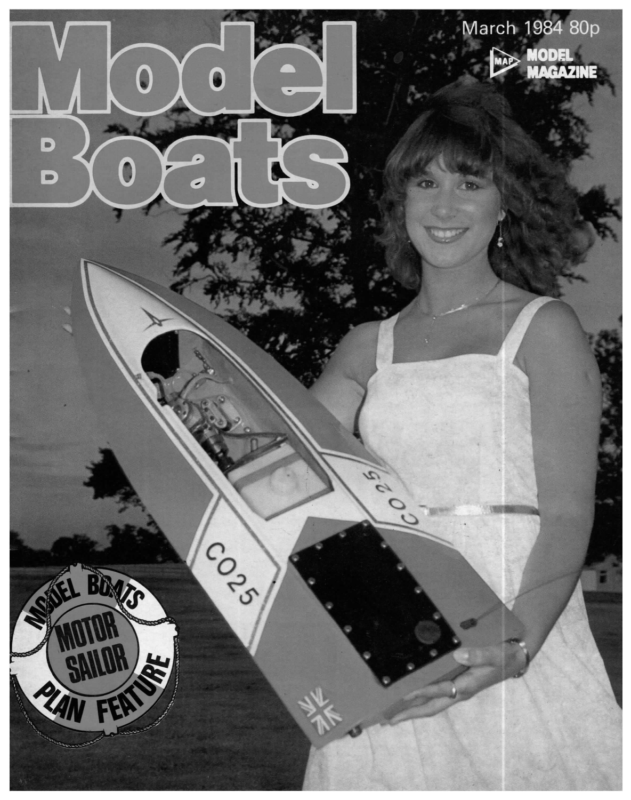
March 1984 80p paige MODEL MAGAZINE
SIARTING IN SAILIN Vic Smeed continues the discussion on keel casting ete. lead, as we have seen, is not eyond the scope of the average modeller, but it needs to be treated with a degree of respect. A stout pair of glovesi sa help, and flimsy or unsteady utensils or preparations should be avoided. One of the most important points is dryness — of the mould, the equipment, even the lead. Adding dirty and damp lead pieces toa partmolten quantity can beda ngerous, so make Sure that the lead is dry and reasona bly cleaned beforehand. Similarly, molten lead on to damp concrete can spurt about, so the mould should be stood on dry timber or hardboard just in case. A firmly stood dry brick or wood block makes a useful rest on which to steady the base of spilled the pot to assist a smooth and even pour. (Fig. 1). It may sound extravagant, buta ‘dry run’ is well everything worthwhile is to hand to ensure and that that the movements required with the molten lead are well understood. It’s heavy and it’s hot, and places to put it down can be limited! Most ‘amateur’ lead casting is likely tobe with plaster moulds when an_ all-over shaping is required, and plaster of paris is most frequently used. Building plasters are rather coarse and dental plaster unneces sarily fine (and less cheap) for lead casting. It is desirable to use fresh plaster, which sets off hard ina very short time. Stale stock takes longer to go off, does not set so firmly, can hold more mixture and can damage more easily during casting. The first step is a pattern, which is usually wood but can be clay or anythin g capable of being shaped accurately. A wood pattern can be laminated (bread FIG. 1 and buttered) and this is often much easier than trying to use a solid block. Apart from this, if you have access toa lathe and want to turn, Say, a pattern for an 11 or 12Ib bulb, a block of probably 2%in. square or so is likely tobe needed and it is surprising how hard this can be to find without going to a yard and buying a lump (at a price), whereas three layers of 1 x 3in. nominal (25= 75mm nom.) would be simplest to find or buy and certainly easier to rough-shape. A modern bulb is likely to be slotted to fit over a ply fin and it is far better to cast the slot rather than try to saw it out afterwar ds. However, there is little point in slotting the pattern and trying to mould and straigh ten from it as it would be almost impossible to detach the pattern from the mould without breaking off the plaster tongue formed in it. To stand a chance the slot would have tobe given a pronounced draw each side and then it wouldn’t fit on the ply, so it is better to introduce a piece of the fin ply into the mould, tacking it with a thin coat of runny plaster, after the mould shape is formed. This will then come out stuck in the slot it forms in the lead, and because its surface will char shrinks to some slightly on extent and cooling, it the lead is simple enough to drive out, leaving aslot requiri ng only a little work to fit sweetly. The snag with this simple approach is alignment of the ply piece in the mould, since any misalignment will skew the bulb on the fin. It is possible to adjust the slot by filing when fitting to the fin and this is acceptable provided great care is taken with alignment. The alternative is to slot ZZ Pa March 1984 BLOCK OR BRICK | MOULD PLY os FIG. 2 eae ae the pattern and to screw a larger ply shape into the mould box before making the plaster mould. The pattern is then mounted on the ply, the mould poured and the pattern removed by gentle levering off the ply. The cast lead will also need to be levered out and this might damage the mould, though for one-off castings this is not a serious consideration. Usually the pattern is painted and filled and sanded toa respectable finish (if wood). If you are in a hurry it can be treated with potters’ slip (a sort of milk-consistency solution of potters’ clay) which will prevent the plaster from sticking to the pattern. If there is no rush it can be wax polishe d, soaped or coated with Vaseline (petrol eum jelly), any of which will prevent flammable constituents being absorbed by the plaster. Failure to allow time for this could produce interesting complications when the hot lead hits the plaster. A moulding box providing at least ¥,in. of plaster between pattern and box interior is needed. Any thinner plaster can crack away when waxing the pattern out. The box should be in two halves (split horizont ally) and only the lower half needs a bottom, the upper part being basically an open frame. The two parts need some sort of key so that they always reassemble exactly the same way, and this is easily provided by a Strip of thin timber on each side, glued either inside or, better, outside the bottom half, so that the top half is always precisely located (Fig. oF: It is possible to fill up odd corners with scrap wood to reduce the amount of plaster
surface and the tiny pip likely to appear on the lead takes only a second to smooth away. The pattern should be mounted so that its widest surface area coincides with the top edge of the bottom box (Fig. 5), or, if it is to be treated in a less formal way, just pushed into the wet plaster up to its widest area. Most people nowadays have some conception of simple moulding shapes, which are basically a matter of avoiding undercuts and vertical surfaces (Fig. 6). Most conventional lead ballast weights for yachts can be moulded in a two-piece mould splitting either at the widest horizontal point or on the vertical centre liné. If, on consideration of the intended shape, it cannot be moulded in this way it is FIG. 5 Qui aon Ea be ~- \ Shsee =, & mould box is ready to receive the plaster. Now, there is a tendency for a wood pattern to try to float, though normally it can be held in place while the plaster sets, but fussier types may like to drill small holes in the pattern and mount, say, 16g wires in them which can temporarily be stapled to the lower box (Fig. 4). Positive positioning of the pattern is, of course, essential if it has to relate to some other feature in the mould. An alternative to wires is to use two long thin screws through the bottom of the box which will be withdrawn when the time comes to remove the pattern; the small holes they leave through the plaster can easily be plugged to just short of the plaster WIRES FIG. 4 4 required, always ensuring that a good thick layer of plaster can be accommodated. Attend to any further work, such as a ply piece to form the slot or whatever, and the SCREWS the long run to ditch the batch and make up a fresh lot, working quicker. The half-mould should be filled to the brim, preferably with one mix of plaster, and allowed to set. If the pattern is to be manually held, push it into the plaster before it starts to set and hold it as still as possible until the plaster starts to stiffen. First-timers are often surprised that the chemical changes taking place in the plaster generate a noticeable amount of heat, and not until the half mould has cooled down should the next stage be started. Check round the pattern that the plaster formsa flat surface perpendicular to the pattern surface, as any vestige of fillet will crack away when the pattern is removed later and result in a pronounced line round the lead. Surplus plaster can be scraped away with a narrow chisel point and the resulting debris brushed and blown away. In ‘proper’ casting a couple of small hemispheres would be scraped out at diagonally opposite corners to form a key ensuring correct reassembly of the mould exposed part of the pattern is still slippery, then place the upper box frame in place, mix more plaster and pour in, again tapping the bottom to drive out any air. Make sure that the highest part of the pattern is well covered and leave to set. Some people may wish to fill the frame completely and tack a ‘lid’ on it but this isn’t strictly necessary, although if the mould is to be filled through a gate cut in the side it might prevent the block of plaster moving. Like glass fibre laminates, plaster goes through a ‘green’ stage when it first sets off, when it is easier to scrape or shape and can be slightly crumbly. It is really best to leave it in a warmish, dry atmosphere overnight before extracting the pattern. Lever the box halves apart a little at a time at various points until it is clear that they are separate; the pattern may be stuck in either half and it may be necessary to intoduce a small screwdriver etc. between plaster and pattern at the least crucial point to lever the pattern gently out. The tail tip of a torpedo bulb is an obvious example, as any small pip on the final casting (from the point where ale etter to change the shape or use a different technique, to be described later. Plaster should be scattered on to water while stirring briskly until the mix is the consistency of thick but runny cream. It should be just runny enough to find its own level when poured, encouraged by tapping the mould box to compact the liquid and expel any tapped air. Fresh plaster sets very quickly, and if it starts to stiffen it pays in halves, but if the box halves are accurately keyed so that alignment is maintained on reassembly plaster keys are somewhat | FIG. 7 superflous. The surface of the first half has to be treated to ensure that the second half will not stick to it, and ‘slip’ is ideal for this. Alternatively, paint on several coats of shellac to seal the surface and wipe over with petroleum jelly. Check that the FIG. 6 \ 134 oc’ 1S ial Model Boats
the screwdriver damaged the plaster) is FIG. 8 easily filed smooth (Fig. 7). There may be other faulty areas on the plaster mould, mainly broken-away corners round the joint line or possibly air bubbles on the surface. For a one-off casting the former is not worth bothering about unless a considerable area is damaged, but air bubbles should be filled with runny plaster applied with a small pointed brush. A slight depression in the surface is better than over-filling the bubble to leave a bump. A fairly generous hole or grate must now be cut, into which the lead will be poured. This gate will be filled with molten lead and forms a reservoir from which the main casting can draw lead to compensate for contraction. A generous diameter means that although the lead starts to solidify around the periphery, the centre will A generous hole also makes pouring easier! It is suggested that the diameter at the casting surface should not remain liquid. be less than in. and at the exterior mould surface 1¥,-1¥,in. This means a boss Yin. dia. cast on to the main casting, which will be sawn off, so some thought may be given ~< the mould in the airing cupboard or on a radiator for at least three or four days. If you're in a hurry a couple of hours in a low oven can be used. The idea is to dry out any trace of moisture from plaster and wood, otherwise pouring the lead could prove dangerous. It is simply not worth risking short-cutting the drying out stage. Melting and pouring the lead was touched on last month. After pouring , leave to cool unopened — the casting holds the heat for longer then you might think. An alternative for plaster mouldi ng a one-off job is to shape the pattern from expanded polystyrene and enclos e it in a top or bottom etc. of the casting (Fig. 8). box. The box is then filled with plaster, sealing the pattern in. The gate/ri ser are cut through to the pattern and a small sprue is that if it is in a hole cut through the By swilling it round the polystyrene will be to where this loss will occur; it will usually be at the widest diameter but can be on the Another point about having a conical plaster, it will be necessary to break the plaster to extract the casting. The only way to avoid this is to cut the gate on the mould separation line, half in each half-mould, and this isthe normal practice if more than one casting is wanted from the mould. Risers are also necessary to allow air to escape from the mould as the lead is poured amount of acetone or even petrol poured in. dissolved and the resulting remnants can be tipped out. The mould now needs thorough drying and ventilation to remove all traces of the inflammable solvent , for obvious reasons. However, it is possibl e to dispense with the solvent stage, since if the lead is poured smartly into the mould it will > burn away the polystyrene and produc e a complete casting. Past experience with this method has shown that the only likely drawback is a somewhat scaley appearance of the outer skin, but this takes only a few minutes to clean up with a file and/or medium abrasive paper. The disadvantage of this whole syste m is that both pattern and mould are destroyed, but where only one lead is required this is not unacceptable. There are other ways of casting, for example using mouldi ng sand for the moulds, but this is less conven ient for most people because of the difficu lty of obtaining a small amount of sand and other materials like plumbago which are needed. Sometimes a poke around a scrapyard will turn up a Concave metal panel in teardrop from, or a panel can be beaten toa Suitable shape (Fig. 9). This panel can be mounted on a rough frame and used rather like the blockboard moulds discussed last open time. Two melts of lead each of approximately half the total ballast required are simply poured in into the concave shell to produce two symmetrical halves which can be bolted to the fin. in, and since in simple casting of this nature it is desirable to pour fairly rapidly, the airways need to be adequate. A riser is Strictly a hole at an extreme of the mould large enough to allow the lead to be seen rising as the mould is filled, to a point where is clear that the whole of the mould it contains lead. Airways need only to be Vein. or So, provided there are several of them. Only a trace of a blip will be visible on the casting surface at an airhole position of this small size. . PRESSED OR BEATEN PANEL Check that everything is in order then put continued from page 128 authentic sounding hooter, the second so control was an essential part of the project. As | mentioned earlier a bracket was fitted to take a servo to control the rudder, the motor was controlled by a Propulsion ‘Pompey’ switcher. Unfortunately these are no longer available, but| understand that Model Boats have produced an update d design that does the same job. A home made proportional sail winch control s the three sails. The radio equipment used is a somewhat and elderly Electronics channels, rudder, Radio Digital motor Control! Models set with and sails. The four fourth channel is a spare servo operati ng two micro switches; March 1984 one works an far is unused, but may later be used to switch on lights. Once at a public exhibition, | used this spare channel to switch on a small portable radio hidden in the cavernous interior! Regarding its sailing performance, | found | had to add another five pounds of lead to get it to float down to its correct waterline. | expected it to sail, and was very Satisfied with its performance. In a reasonable breeze, it would tack to windward, beat and run. Under certain conditions, it was a bit slow coming about, so | just had to give it a burst of power. On demonstrating to a Director of the builders, he said they often do this on the full size ones! On power alone, it was great fun manoeuvring. Being previously a sailing man only, | now had a boat that would go astern as well! The ‘Pompey’ switcher gave me anything from full ahead down to propeller stopped to full astern, all on the “one stick on the transmitter. Power for the propulsion motor is a six volt 4 amp DEAC. So far | haven’t run the battery down whilst sailing. If | did, all that was necessary was to come home on sails alone. | have been able to show a number of of the construction of the model hull and its plug and mould, togethe r with several photos taken in a boat shed on a cold dull day of several Fisher 46s under photographs construction. 135
Autumn meetings LOGBOOK Entries have been heavy around the London area for the last few 1983 meetings. At Clapham the Friendship Trophy for Model Yachting Association News RMs drew 35 entries on October 23 and a month later the same number of 36R vane boats for the Pugwash Trophy. The 1983 RA Championships reading Guildford club hosted this meeting on September 17-18, the first national to be beaten, Chris Dicks had to leave early and November 6 attracted 32 entries. Over 100 accept three retirement scores, which must held at the Willow Park water at Ash. Club boats in three events in October/November have seems remarkable. members had put in a lot of preparatory Rothwell, John Cleave, Dave Trippe and We hear, incidentally, that the annual work, including constructing a permanent Derek Priestly filled the next four places. A invitation ‘Race of Champions’ held this staging to allow boats to be placed in the social evening at a nearby hostelry included year at Leicester in early October was won water without the necessity for waders. Harry The were 16 entries from eleven clubs and cost anticipating. him Cutler’s the Although championship. video films un- Neil of the day’s racing. Mermaid RM Trophy at Guildford on by Torvald Klem, who once again came over from Norway and showed how it should be with an assortment of boats including John Sunday started wet but faired up in mid- Osborn’s 32lb 6m rated as an RA (which morning with a steadier wind, though still allows him more sail’, no fewer than five gusting, which lightened in the afternoon. Highlanders (ranging from 48 to 56lb, or 41b done. (See report elsewhere in this issue. Ed.). Leading each side of what they should be), Roger by mid-afternoon was John Cleave, with races 47 and 48 to come. He 1983 AGM The MYA AGM on December 3 saw a fairly poor turn-out, possibly because the Stollery’s 12m Wake rated as an RA and decided to change batteries but the set he sailed by young Peter Stollery, the 1953 fitted rapidly developed a fault, costing him agenda did not appear to include anything vane A winner Arabesque which has won any reasonable score in race 47 and almost vital, although what it did include produced the RA championship two or three times certainly his chance of the championship. under discussion and argument. Graham Bantock, sailing Baker’s Dozen on behalf of Andrew Schuman, who was in members will now be covered by third party the name Jenny, and even won ‘penalty entries’ — yachts which are below A pleasant announcement was that MYA the minimum displacement allowed by the hospital, had meanwhile found his yacht’s A class rule and suffer a reduction in sail insurance for up to £1m at no extra cost to speed an advantage and had worked up to area as a result. themselves. The cover includes individual the point where he, Derek Priestly and John Saturday was sunny with a 6-10mph members, clubs and their guests sailing Cleave could all win in the very last race; as yachts (only yachts) world-wide, except in wind gusting to 20mph now and then and it turned out; Graham won the race and the the USA. Clubs will receive a photocopy of swinging continually, putting a premium on Championship. the policy to produce to local councils or other bodies requiring evidence of in- surance. Note that the policy runs for the calendar year and cover only exists when a club has paid its affiliation fee for the year; it is obviously sensible for clubs to pay on January 1 to ensure continual cover. John Cleave’s Speculator and Derek Priestley’s Highlander sandwich Chris Dick’s Sol – not the happiest position to be in! These yachts placed, respectively, 2nd, 3rd & 4th in the RA Championship. Which tack? John Cleave is ahead of Derek Priestley and Russell Potts (nearest) on port tack, while Graham Bantock (light hull, centre) is changing to starboard and Len Thompson is full & by on starboard. Winfsurfers are not racing… It was also announced that Andrew Schuman had bid £250 for the copy of ‘Model Racing Yachts’ offered as a fundraiser and had expressed the hope that a video film could be produced for publicity purposes. Moves are afoot to put this into effect, including inexpensively, a obtaining, copy of surprisingly the excellent ‘professional’ film of the Dunkirk World Championships. Sincere thanks were extended to Andrew for his generous donation. Other pleasant movements were the award of the Eric Nuttall Trophy replica to Mrs. Nuttall and the Trophy for 1983 to our hard-working secretary, Roy Gardner, com-
pliments to Martin Roberts (Birkenhead) on the notable achievement of winning all three District 36R Championships and the Nationals, the first time this (b) Items of radio control equipment may only be replaced by similar items during has been (a) Centreboards. (for the second year running) in the Pug- (d) 25 in vane) who amassed 100 points or more during the season. Extracts accompany these notes. For those unfamiliar with the system, points are scored for entering and placing in National Championships, District Championships, and nominated it is also points weighting for 1984 and we will publish such details when received. All officers were re-elected, except for accepted the vacancy for a Trustee. Of the motions No. 1 was carried, revers- ing the 1982 vote to exclude pension ers and juniors from club affiliations and thus removing confusion over National entry, receipt of fixture lists, club voting strengt h and insurance. No. 2 was carried as amended, so that all National Champi on- ships will be open to all MYA members and members of IMYRU affiliated bodies. No. 3 (R/C Racing scores not allowing discard s) was lost, 3a (6m rule possible amendments) carried. No. 4 caused the longest discussion and the final 36R Rule approve d is given separately. Motion 5 (A class fore triangle amendment) was carried. Excerpts from the Chairman’s Report will appear in the next Log Book. Table 3 i to official wording) (subject also to MYA Competition Rules and Rating Regulations) 1. Hull measured to highest point of deck excluding fittings and bowsprit but rudder, which may be turned, including shall fit completely into a rectangular box of internal dimensions 36in. (914mm) long, Yin. (229mm) wide and 11in. (279mm ) deep. The yacht may be tilted provided the keel touches the bottom of the box. 2. The weight of the point in racing trim complete with the heaviest suit of sails, spinner and spinner boom (where used) shall not be more than 12Ib (5.45k g). 3. The rudder thickness shall not exceed Yin. (13mm). * 4. (a) Ballast may not be moved or varied during a race or series of races. March 1984 (6mm) 1¥,in. (63mm) 1%, in (44mm) (9mm) Yin. measurement rules in force at that time but shall conform to sections 2 to 7 of these rules. Club Designer Design Ibs. sq.in. Points K1169 2. J.W.C. Cleave 3. D. Priestley K1147 4. C. Dicks K1177. 5. N. Rothwell K1062 Speculator New Forest = Ecky Thump I! ~~ Fleetwood = Intruder Clapham Tumble Down _Woodspring 7. D. Trippe K1175 7. J. Richards = Intrepid 83 K1153 Chippenham ~~ Leveller Sykes Danson ‘Sol’ 1213 Wake Special 52), K1173. Potts 39 8. P. P. Stollery Guildford Stollery 38 1253 ‘Wake’ 54Y, 54 1519 58y, = Fulmar K1170 Kings Lynn Stollery ‘Baker’s Dozen’ 41 Lewis ‘Speculator’ Priest ‘Highlander’ 1312 36%, 44 1590 38%, 52 1550 39%, Sykes ‘Sol’ 39 1213 Priest 40Y, ‘Highlander’ 48 1593 49Y, Wind K754 10. R. Burgess Jenny K1083 Poole Osprey The Streak Priest 54 K960 Woodspring ‘Arabesque’ 11. C. Colsell Hove & ‘Highlander’ Shepherd 65 ‘The Streak’ 1522 68%, 50 1210 69¥, 12. R. R. Potts K1163 Bartleby Danson 13. R. P. Aucott K1094. 14. K. Butler Littlejohn Brighton Lewis/ Woodspring K1176 Venceremos /! J.C. Osborn K1172 Karma A. Youd Woodspring K1143. Shona Fleetwood Priest — Bournville Butler Priest 64\, ‘Mod-Quasar’ 45 1250 764%, ‘Highlander’ 49 1541 824%, Potts Amanda 1555 ‘Venceremos II’ 41 1199 6 metre 32 1555 Retired ‘Highlander’ 52 1604 _ Retired 87 Table 2 MYA League 1983 Club Championship Radio Vane Division 1 1. 2. 3. 4. 5. 6. 7. 8. Woodspring Leicester Danson New Forest Clapham Cheltenham Chelmsford Ashton 9. Fleetwood Division 2 1. Broads 2. Chippenham 3. Hove and Brighton 4. Etherow 5. Birkenhead 6. Woodley 7. Poole 8. Cleveland Radio Division 1 1034 795 571 552 542 411 332 267 Birmingham Guildford Leeds and Bradford Gosport 241 349 339 219 138 132 83 81 72 9. Decoy 64 10. Leeds 16 Vane Division 3 Bournville Birkenhead Fleetwood = Clapham 2728 1. Guildford 1309 ~ 2. Kings Lynn 784 3. Doncaster 783 4. Milton Keynes 539 465 227 166 5. 6. 7. 8. Appledore SE Essex Bournville Rugeley 9. Gosport 10. Hereford Division 2 Chelmsford MYSA Southgate Cleethorpes Norwich Wicksteed YM60A 323 276 185 11. 12. 13. 14. 15. 16. 17. 18. Woodbridge Lincoin Petersfield Ryde S. Wales Cleethorpes Shrewsbury Chiltern 370 235 152 76 69 55 31 24 Division 3 Danson Hove and Brighton Milton Keynes 103 60 50 22 18 16 14 13 11 11 11 8 2 Individual Championship 36in. Restricted Class Rules (subjec t and 2y2in. 1. G. Bantock 9.L.G. Thompson possible to earn points by officiating at such events. Adjustments are being made to the three who wished to stand down. The new Publications Secretary is Chris Jackson , 5 Crofton Court, Cypress Road, South Norwood, London SE25 and the new A Class Registrar Walter Jones, 57 Forest Road, Birkenhead, Cheshire. Mike Harris More than two channels of radio Table 1. 1983 RA National Results Pos./Skipper Reg. Yacht Thickness Yin. (19mm) Yachts registered before December 31, 1983 may continue to conform to hull (e) Spinnakers on radio control yachts. 1983 League results and tables of club Width lin. (25mm) 7. control. scores plus the 46 individuals (21 in radio, District: (min. size) metal. showed that Association finances were in better shape than for years. ‘ Peter Somers (Bournville) produced a very detailed statistical breakdown on the each Reg. No. (b) Movable keel and trim tabs. (c) Masts and spars other than of wood or wash of 36 36R yachts, though only 34 sailed, and the Treasurer’s report which racesin Height Class Mark 5. Prohibited achieved in any class, the remarkable entry Open 6. Distinguishing marks. race or series of races. Radio 1. C. Dicks Clapham 2= R. Burgess 2= J. Cleave Woodspring 4. Woodspring N. Rothwell 5. D.Trippe 6. T. Owens New Forest Chippenham Danson 7. M. Hammond 8. D. Priestly 9. Fleetwood D. Andrews Leicester 10. J. Osborne 11. Woodspring T. Fuller 12. New Forest R. Smith Leicester 13. P. Stollery 14. C. Colsell 15. E. Andrews 16. B. Corley 17. M. Golding 18. R. Potts Cheltenham Guildford Hove and Brighton Leicester M. J. Harris M. Roberts 205 A. Austin 195 V. Bellerson 181 P. J. Somers 168 G. Bantock 150 J. Brooks 148 M. Dicks 147 Clapham J. Vice 171 Clapham 170 143 ~~ C. Somers 142 |. Taylor 134 J. Bush M. Dovey 21. Leicester G. Bantock Chelmsford 23: 24. 25; Only competitors with more than 11 points shown. 336 H. Dovey C. Dicks Ashton 346 151 105 B. Jackson 392 Bournville K. Roberts 131 D. Nixon Bournville Chelmsford D. Latham 117 19. 636 445 406 163 Cheltenham Danson Bournville Birkenhead Guildford 164 Chelmsford 20. 22. Vane 344 205 R. Baker 103 W. H. Jones 102 A. Trinder 101 R. Williams P. Whiteside K. Butler D. J. Rose F. Percival Birkenhead Fleetwood Bournville Fleetwood Bournville Southgate Birkenhead 274 239 200 192 167 165 153 Gosport 152 Bournville 152 Clapham Birkenhead Bournville Birmingham Fleetwood Bournville Fleetwood Leeds and Bradford 133 130 122 V7, 104 102 102 100 137
THE RACE OF CHAMPIONS Hammond ‘disposed’ of Barry Jackson within a few feet of the start with a resounding collision. Barry was windward boatat the time and thus lost that one! Although the former holder of the MiniAmerica’s Cup, John Cleave, left no one in any doubt that he is the current master of match racing, he did not have a particularly easy time of it. In one race, with Tony Drury, there were only inches in it at the finish. After a close fought first MIKE KEMP REPORTS ON THE MARBLEHEAD CLASS CHAMPIONS CUP REGATTA AT LOUGHBOROUGH 9th/10th OCTOBER, 1983. IRTEEN of the ‘Champions’ of the Marble- head Class met on a dull and overcast Saturmorning at the Leicester Club’s water. This gave rise to 156 races. One round was almost completed before lunch with the leg John was ahead, only one and a half boat lengths separated them at the start of the second leg, but then Tony passed John downwind. John managed to get an inside overlap at the third mark, rounding it in the lead; Tony switched his course to get to windward on the approach to the finish and nearly got ahead. But nearly is not enough! In another race, with Alex Austin, John scene of some very close racing during this two remainder of the races being completed during the afternoon. Everyone had their successes and their failures, some notable, some possibly pre- the usual tacking match did not take place as Alex the first mark in one; from then on John didn’t day Charnwood Lake, Loughborough, was to be the day trial to find ‘the champion of champions.’ The dictable. First race of the day was between com- skippers were drawn from the first three places in petitors numbered one and two. Torvald Klem had each of the MYA District Championships and travelled all the way from Norway to take part in from the top ten of the MYA National Champion- the event and was rewarded with another meet- ships. Fortunately for the OOD, Dave Andrews, ing with Barry Jackson. This first race went in not all of those eligible to be invited were able to favour of the tall Norwegian and his own design be present; otherwise the task of getting through craft. The next time they met Torvald also won; in all the races necessary would have been all but all he won 16 out of his 24 match races, the only impossible. With only 13 the racing could be a skippers not beaten at least once by the current pleasant blend of pressure and relaxation; at least MYA Champions were Norman Hatfield and Tony that is how it appeared; some of the competitors Owens. The racing proceeded at a well ordered pace with a 30 second countdown being used for may have thought otherwise. The weather man had been promising some pretty heavy wind for this particular weekend, in fact it was force eight to nine around the coasts, but Loughborough must be conveniently The wind swung about a bit during the whole round between John Cleave and Tim Fuller. Tim meeting but remained basically from a south had taken a good start and was approaching the westerly direction. This is one of the better directions for Charnwood Lake although it does make first mark on port tack and ahead, at least so it for some peculiar start line positions which end close up being an acute angle to the bank on which called ‘starboard’; Tim was thus conned into skippers operate. Even so there were still times tacking when most on the bank thought that he when yachts out on the lake did not appear to be would pass clear ahead. The deceleration caused getting by tacking allowed John to get inside Tim and skippers. Matching Saturday was to be the day for match racing, every skipper was destined to meet all the others in a straight sail off around a one lap course twice. squeezing inside at the last mark and shaving it by fractions of an inch; then holding on to the lead right to the finish line. Race three of heat eleven saw a classic covering match whereby Tony Owens gave Torvald Klem no chance of victory. Race four of heat eleven was quite an interesting battle between Barry Jackson and John Cleave. Barry got away to a good start with John not far behind: approaching the first mark John to the second mark Barry still had an overlap but racing the result is instantloss of the race. Among the more notable was the last race of the first to the stand a chance. In another close race Elizabeth Andrews snatched victory from Ron Leckie, by tacking. Having taken him beyond the mark John then tacked some two boats ahead of Barry who sheltered because most skippers stuck to top or the wind that was getting got A/axis to point high enough to almost reach the starts and a second pair of boats being started as soon as the pair racing rounded the second mark. There were very few incidents of rule infringement, probably because in this style of second suits of sails throughout the weekend. all was not so favoured; after a closely matched start seemed to many of the spectators. John, being behind and approaching on starboard, when they both tacked to round the mark there was a touch, with Tim both on the outside of the mark and to windward he was disqualified after a protest meeting; he got his revenge in the last race of the day. In another incident nearing the end of the meeting, race six of heat nine, Mark crept up to windward enough to prevent Barry slowly moved alongside downwind. Getting near had sailed so far below his course to the mark that the correction necessary allowed John to break away to go to the finish a boat length ahead. Mark Hammond’s second attempt to beat John ended with a disqualification after a good tacking match up the first leg. Mark didn’t cover John well enough as they approached the first mark; the Japanese design tacked around the stern of the 247, Mark tried to cover but was caught as windward boat: the resulting collision ended that race. So ended Saturday’s racing; the competitors went their various ways to sample the delights of the Leicestershire night life! Fleeting After Saturday’s rather dull and overcast conBelow: Torvald Klem obtains a good start in the first of the fleet races. Below right: Alaxis shows off its ‘new technology’ fin and rudder; eat your heart out Alan Bond. ditions, Sunday dawned a little brighter but a whole lot wetter. Umbrellas and waterproofs were the order of the day! The skippers were <2 Pb HEX 156 Model Boats
briefed at about 10.40am and racing started at about ten to eleven. The course threaded its way round the L icester Club’s variously coloured buoys to forr: a rather elongated triangle followed by a sort of sausage. The initial laying of the start line favoured a starboard tack start from the extreme starboard end. From there a yacht that pointed well could just make that first mark without tacking. Those familiar with the Leicester water also realised that an alternative and, initially less populated, course was to sail along the bank to the extreme port end of the line and tack onto port; thence through the fleet to try and gain an advantage to windward at the first mark. The first of the 13 seven boat races saw yet another clash between Barry and Torvald; this the lot and finished in first place. By the time the fifth race was ready to start the Alaxis superbly into first place whilst Chris and Norman held onto their places. shorten the course. The right hand end of the John Cleave managed what seemed the impossible in the seventh race; he got between Torvald Klem and the starboard end start mark. third. The sixth race came with the wind picking up again and bringing rain; in the gusty conditions Unfortunately for John he was justa little bit too early and was caught over the line at the start. Despite having to recross the line John caught Stone. Alex Austin managed to sail around the the pack down the second leg. Ron Leckie led into the third leg with Torvald and Elizabeth some two and four lengths behind. Ron held on to finish wind had dropped sufficiently for the OOD to course was reduced; Mark Hammond took this race with Tim Fuller in second and Ron Leckie in Norman and Chris got away to a good start but were quickly caught by Tim, Elizabeth and John outside of most of the fleet after a particularly good first leg from a poor start. Halfway down the second leg he was in second place behind Chris and just ahead of Norman. Alex managed to sail time however John Cleave, Chris Dicks, Tim Fuller, Tony Drury and Alex Austin also joined the fray. The latter has the distinction of being the first skipper to tack onto port and try and get everyone had to tack up the windward leg. Bang on time at 2:00pm the sun came out which must have suited John Cleave who romped home Elizabeth and Barry had a very close race in the tenth with the latter just taking third place, meanwhile Torvald and Tony were wrapping up first Torvald led around the first mark with the rest of and second place. During the rush to get into the water for race eleven Norman forgot to switch his receiver on. Thus a little diversion was provided the pack close behind: by the end of the third of six legs of the course Barry was in the lead but could not hold this position. Mr. Klem took first place with Barry second, following were Chris D., Tim as several competitors tried to use their boats to guide Shogun back; eventually Brian Ladkin had F., John C., Tony D. and Alex Austin. The second manned the rescue boat and did the right thing. race saw the first of Barry's three first places The little mishap did not seem to unnerve Norman who finished second to Barry in that race. The last whilst the first race winner came homein fifth place behind Tony Owens, Tim Fuller and Norman two races were won by Ron Leckie who found his Hatfield: Ron Leckie and Elizabeth Andrews completed the line up. Ron was the only other skipper form a to clock up three wins during the Sunday's racing. little too late in the day. Evens As Barry was heading for his second win in the third race he clashed mastheads with John Cleave who, on port tack, was on his way to the final mark. Whilst the delay caused by the A study of the day’s racing suggests that the only clear impression is of a very evenly matched group of competitors. Even a study of the boats involved did not show any clearly beneficial manoeuvring to unhook did not rob Barry of his trends in design or fittings. | don’t propose to go into a detailed study of the construction or radio equipment of the competitors, most of the details first place; the completion of two penalty turns by John, trying to avoid the rest of the fleet, delayed him so much that he failed to finish within the time allowance. Race four sawa slight change of have been published before. However there were one or two that are perhaps worthy of comment. bit more tacking on Norman Hatfield was sailing one of the two Japanese designed boats present; John Cleave sailed the other. They each had a different design the windward leg. Tony Owens was the first skipper to take good advantage of the ‘clean’ air available at the port end of the start line. He stole a good start while the rest were stuck in the slack of keel and rudder; John used a basically triangular section bulb with a flat bottom anda short, broad rudder. Norman’‘s craft had a bulb air at the other end. Despite this, Mark Hammond was the first to round the first mark: John Cleave and rudder of more conventional dimensions. The latter used a Bantock ‘groovy’ mast whilst John’s moved into fourth place after a particularly bad By the third mark Norman Hatfield had moved into the lead and proceeded to pull out a start. was equipped with a carbon fibre unit and four radio, two to adjust the shape and channel considerable distance. John eventually hauled position of the foresail. Norman meanwhile used Above: Norman Hatfield's beautifully neat and tidy Shogun; a fine example for model yacht builders to follow. Left: Torvald Klem’s Suzy Q and Tony Drury’s Sea Urchin beating up the second leg of the match race course. Right: John Cleave’s four-channel Netsuki reaching. March 1984 while John sneaked through into third behind Torvald. After lunch Tony Owens took race eight when the wind swung around to ensure that ahead of our Norwegian friend and Tony Owens. through the fleet; not that it worked too well. course to try and introduce a first,
a scoring one point for a win and zero points for a craft, not outclassed in any way. 247 and Deception ‘loss’ of amatch race; how about this: a win would rate 2.2 points; a non-penalised loss would score one point and a penalised loss or disqualification would result in zero score for that race. Applying designs also took part with no obvious conclusion this a conventional clinically two clean channel installation set job. up with These Results Competitor Yacht T. Klem Suzy Q 68.0 meeting 2nd_=sJi. Cleave Netsuki 65.5 1st 6th 3rd Flo 62.2 5th 4th about which is best; and of course Barry cam- makes no difference to the first place but does 4th paigned his old watery warhorse, the Seahorse, even still a force to be reckoned with. Torvald’s yacht seemed remarkably slim and pretty rapid when though some three or four years oldin design and perhaps unfashionably broad in the beam, were scoring to the Champions Cup O/A Place 1st A. Owens O/A Match Fleet %age Place Place 2nd 2nd N. Hatfield Shogun 61.6 4th 5th B. Jackson K2 60.1 7th= 1st John Cleave and Barry Jackson; both masters of 6th=_ C. Dicks Deception 57.3 3rd 8th their particular ‘craft’ but equally not so successful in the other. There do not appear to be very Shadowfax 57.3 7th= 3rd going to windward, but A/ax/s could well take any 8th 50.2 10th= prizes awarded for pointing ability though it did many match racing competitions around for radio not seem to be outstanding downwind. The Sea controlled craft so we may well have to wait a Urchin of Tony Drury now and then demonstrated while before the scoring system can be proved: Toed Lemon an inclination to get to the bottom of the Charn- but it is surely worth a try. My ownclub is embark- wood whilst the ing on a match racing series over the winter Pigeon Toed Lemon Ashanti of Elizabeth could months, so we may be able to do some proving. water (see the photograph) up the apparent discrepancies between 6th=_—_—R. Leckie 9th M. Hammond Deejay A. Austin 47.7 46.3 7th= 6th 5th 7th 10th T. Fuller Alaxis Junzuki 9th 10th 11th E. Andrews Pidgeon 32.7 12th 12th J. Stone Hankwind 30.6 13th 11th 13th A. Drury = 22.7 10th= 13th 11th hold its own under some conditions. Prospective boat buyers looking for tips on which design to build won't get much joy out of studying the form after this meeting — nothing was conclusively better than anything else. The only clear thing is that most of the best known forms of construction and rigging were represented in various combinations. There were deck and keel stepped masts of both alloy and carbon fibre; radial and ‘see-saw’ jib mounts; single and multiple shroud setups; flatcut and panelled sails together with single pull and endless sheeting lines. Tim Fuller was not the only skipper to use a deck mounted winch but was the only one to use a deck mounted rudder servo. John Stone’s 247 was a little unusual these days in that it was equipped with a very nice laminated veneer deck mixed with a CF mast, radial jib mount and single panel sails. Both Japanese designs used a relatively simple jib mount but fitted to a rack sunken in a trough on the foredeck. Light relief After the real racing was over but just before the’ arrival of the local Lady Mayor a number of competitors took the opportunity to have a general sail about. By the time she arrived those sailing were sufficiently organised to set off ona demonstration race. The major difference being that not everyone was sailing their own yacht. The OOD, Dave Andrews, was sailing Torvald’s craft; Torvald was sailing A/axis whilst Alex Austin had taken up his camera. John Cleave took over the role of starter and ‘coach’ whilst yours truly had a go with Vetsuk/: | can vouch for the fact that it is a very nimble craft indeed. Tony Owens, meanwhile, took the plunge and handed over the controls to the Lady Mayor who, with a little guidance, sailed quite successfully. During her speech at the prizegiving she told us that she found the sailing fascinating ... and she might even consider taking up the hobby: anannouncement met with a cheer from the gathered skippers and spectators. After Norman Hatfield had said thank you to the Lady Mayor, the competitors, and the organising team, the prizes were presented. The trophy presented to Torvald was accompanied by an egg shaped glass paperweight; different coloured glass eggs were also presented to the second and third placed skippers. The meeting over everyone packed away their yachts, sails, radios and waterproofs; said their goodbyes and departed leaving a rather wet Charnwood for 1983. Controversial The results show that there is distinct bias towards the match race successes. In other words the scoring favours a skipper who is good at match racing but not quite so good in competing ina fleet. Since the meeting one or two people have been putting their minds to the problem and a suggestion for a solution follows. Instead of just 158 Above: Shogun slips across astern of Elizabeth Andrew's Pidgeon Toed Lemon. Below: pardon the focus. Tony Drury’s Sea Urchin nearly lifts its keel out of the water for a fraction of a second in a gust. Above: the Mayor of Charnwood Borough Council presents the Champions Cup to Torvald Klem before he rushes off to catch his plane home. Below: an incident in the making? Norman Hatfield's Shogun just ahead of Chris Dick's Deception at the final mark.