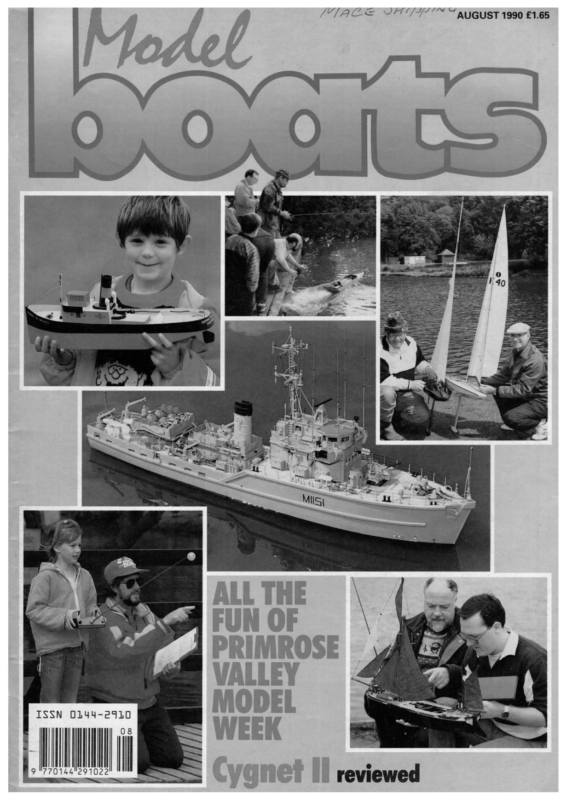
- CYGNET II Richard Webb reviews Tony Abel’s latest One Metre yacht
- Yachts Rule OK? A practical introduction to IMRU Rules – by Nick Weall – Part Four
- CURVED AIR Model Yachting News from Russell Potts

CYIA CSE PHL?” ~ GUST 1990 £1.65 ISSN 0144-25910 144°291 ALL THE FUN OF PRIMROSE VALLEY MODEL WEEK ~yon e? | | rev ie wed
Richard Webb reviews Tony Abel’s latest One Metre yacht he Eastleigh Model Boat Club has a Sunday sailing league mainly for Radio Marbleheads. The club also has a Wednesday afternoon social sailing session and in 1989 more and more members were turning up with One Metre boats. New members to radio sailing were buying One Metre boats and existing sailers were having one as a second boat. The R36 class seems to be losing out to the One Metres and with the sometimes gusty conditions at Eastleigh the new class perform better with their deeper keels. I intended to use my trusty Sea Scamp RM for Sundays and build a One Metre to join the Wednesday sessions when my shift pattern permits. I had vague thoughts of building a plywood One Metre but these thoughts waned when I saw Tony Abel’s new MKII Cygnet on the MYA stand at the Model Engineer Exhibition. I had a chat with the MYA reps and they told me the new Cygnet has several subtle changes and it should be very competitive as well as being reasonably priced. Time marched on and in February I gave Tony Abel a ring to see if he had any of the new kits ready for sale. Tony said he would be coming down to Eastleigh soon to test and set up his own model ready for the season. He asked me I took my camera to record the event. It was a very cold blustery day in late February and Tony had set up the boat Heading: the completed model yacht ready for her maiden sail. Above: Tony Abel’s original yacht which inspired Richard to build his own. ifI would like to come along and have a go. Well you can’t miss an invitation like that, can you? We set a date and met at the lake, and AUGUST 1990 in the warmth of his workshop and brought it ready rigged to the pond with the working suit of sails. It fits nicely into the back of his Honda hatchback fully rigged. I took some photos whilst Tony checked the radio functions for rudder and winch and stuck down the hatch. He launched the boat on its maiden voyage and to his delight it sailed straight away without any obvious problems. Tony was particularly pleased when a very heavy squall blew across the lake and the boat leaned over, lifted its bows and shot off down the lake with not a hint of burying its bows. The extra flair and height of the bows has done the job. Even with very heavy squalls the boat was never overwhelmed and one wonders when the smaller storm set of sails would ever be needed. Tony handed me the transmitter and I sailed the boat around the lake and found it responded to every command with no obvious problems. The Bantock wood keel and the grp keel box as supplied. The cold weather beat us eventually and we retired home for hot coffee and a chat. Tony explained his ideas for the new boat, mainly the new hull shape to give it more lift in a blow by raising the bows by in. and introducing more flair. Tony’s idea is to supply a strong reliable boat to stand up to the bumps and shunts of club racing, especially with beginners taking part. He says ’you don’t win points by not finishing’. Tony had brought my kit with him complete with 23
already, and also the rubber bumper. 7 deck is a one piece moulding in white with a shedwater and raised hatch position. The keel is from the Bantock factory in laminated wood and here a from Tony is to be careful with the she trailing edge as it is likely to break. He suggests you give it a coat of sanding sealer which is supplied to stop any di discolouring the wood whilst you work on it. The lead is very clean mouldings in two halves, cleaned up and fixed to the keel with two brass studs and nuts. Th lower mast with the gooseneck fitting : permanently fixed to the hull and deck and this fitting, like all the rigging, is a very high quality and strong. The mi and booms are black anodised aluminium, *%in. for the booms and 1) Above: the fitting kit. Right: the hull as supplied – note wood inwales. Left: bows showing rubber bumper and wood inwales already fitted. red hull as ordered. He explained his boats conform exactly to the One Metre rules, especially with the use of clear resin on the lay up. Contents Later I examined the contents of the box and the first and most obvious thing, the hull, has wood inwales resined in for the mast. The sails with my boat are panelled and supplied by House Martin which i the trade name of Martin Roberts, or Tony can supply JP Sails if required. There are several packets of small fittings, all of the highest quality and Clockwise from top left: the black anodised mast with cross tree spreader, head fitting, gooseneck fitting and turnbuckles all in stainless steel and chrome on brass; the prototype at sea; the kit as it comes out of the box with working suit of sails and a tin of sanding sealer, and enough wire and chord for two suits of sails; working suit of sales as supplied by House Martin.
with a good chrome finish. The only thing to buy is a small pack of five minute epoxy and a small tin of resin for glassing in the keel and deck. The kit comes with three A3 sheets of instructions and drawings. Construction I already have a boat stand but for anyone not so fortunate now is the best time to make it, as it will help in setting up the rigging. The first job is to cut the slot for the keel and the instructions suggest stretching a length of cotton from the bow to the centre of the stern and measuring 425mm from the stern. I put some masking tape on the hull and drew the shape of the keel on the tape. Above: lead weight mouldings, keel, keel box and rudder parts. Left: keel box and mast step brace fitted. Below: close up of transom. Bottom: access to R/C equipment. 12mm. x 6mm. KING PLANK. r PACKER. i (q”. x 2″.PLY STRIP. CROSS BEAM. KEEL BOX. GLASS & RESIN JOINT. AUGUST 1990 25
GROMMET. KING PLANK MAX DRAUGHT: 420mm. FROM WATERLINE. PACKER. – ——_ jee [EES Ye”. x 2″. PLY _ WOOD FIN. aS a Se is a : je A | SCRE! CROSS BEAM. 305m. FROM HULL. MAST. a DECK NYLO! Se a PLUG. KEE BOX PAD. KEEL LEAD. MAX ‘5ibs. \ oP WOOD KEEL. pers = BRASS STUD FOR LOCATION. BRASS STUD WITH NUTS, COUNTER BORED & FILLED. Below: completed model, neat clean lines, and varnished keel and rudder makes for an attractive boat. THE REMOVABLE FIN KEEL IS HELD INTO THE GRP. KEEL BOX WITH A ROUND HEAD SCREW AND A NYLONPLUG SET IN THE WOOD FIN. of the deck and the radio tray made tc Tony’s drawing or to your own layout The radio tray can now be resined o to the underside of the deck and the di resined on to the hull. This has been made easy by having the wood inwale fixed to the hull when supplied. Make sure there is sufficient resin to seal th joint between the hull and the deck ar carefully remove any surplus resin be it sets on the outside of the hull and d Some people prefer to use the 24 hot Araldite for this job as it is easy to pu where it is needed and you have all th time in the world to get things right. Hold the deck steady with elastic ban PVC tape and weights whilst the resi cures. The mast, booms and goosenec fitting were all prepared, again taking care and checking all the measureme1 twice and drilling once. The keel has 1 be cut to length and shaped at the bottom to fit the lead mouldings for tl keel. The instructions suggest you try boat in the water and when you are satisfied with the balance you flair in Time spent checking this measurement will save a lot of grief later on if you get it wrong. Drill a series of small holes carefully round the inside of the line and remove the centre and clean up the hole with a fine file and emery cloth. A Black and «Decker Workmate is handy for the next bit. Dry fit the keel and keelbox to the hull and check the measurements, and when satisfied glue the keelbox to the hull with a couple of blobs of five minute epoxy. When this is hard, check again and glass in the keelbox with polyester resin and glass cloth which is supplied. The king plank and crossbeam can then be glued as well as the rudder tube with its support bracket. I made the rudder next from the two pieces of 3mm ply and the 3mm shaft supplied. Tony suggests you bend the lower end of the shaft to stop it turning inside of the wood. The hatch hole can now be cut out 26 MODEL BO.
Hatch cover in place and all on the very necessary scissors stand. Right: Tony Abel winch – neat and powerful. Below: the %in. main sheet tube and elastic tensioning system. lead with P38 Body filler and paint it. The boat was placed on the stand and the mast was set up with some temporary shrouds and stays, enabling me to make each permanent shroud to its correct length and keep everything square and true. By eyeing the boat from ahead and astern you can easily see when the keel hangs straight and the mast is upright. The drawing shows the sheeting lines from the winch with an elastic tensioner but this could be AUGUST 1990 27
Top: Tony Abel s hands stick down the hatch ready fo the prototype maiden voyag BACK STAY. WIRE LOOP. Y%q”dio. TUBE FOR MAIN SHEET GUIDE. \ \\ RUDDER SUPPC \~- 3%”. x “WOO |__|. BEND SHAFT. wood RUDDER. Above: R/C layout showing the receiver and winch drum. Right: the bow section — note the jib slider and anodised jib boom. changed to a loop system which some people prefer these days. The hatch cover is a good quality sticky patch rather like Fablon and is quite adequate for the job but it would be very easy to fit a ASDA pot and plastic hat if required. In Conclusion A very nice well balanced boat at a very competitive price which is suitable for beginners to radio sailing and for experienced yoties alike. Tony Abel has done himself proud with this kit by 28 MODEL BO/
GOOSE NECK f 14″lg. x %”.dio eS “. PLY PRESSURE PADS. _—_—S——————————————— NICE STRONG STUB MAST WITH GOOSENECK & MAIN BOOM FITTED. 4”.dic. ALI Above: general view of the deck sheeting arrangement. Below: Cygnet // bears away. producing a strong reliable boat with very good performance especially in gusty conditions. The MkI Cygnet had a reputation for pointing high’ and in our brief trials this one seems to be equally good. I hope the One Metre class succeeds as it is such a handy size combined with a sensible formula with the commitment to keep the price down by restricting the use of exotic materials used by other classes. Tony emphasised to me his boat conforms exactly to MYA rules, especially the use of clear resin for the hull and deck lay up. I like the fact that I can launch the boat with ordinary ‘wellies’ and don’t have to wear waders all day. My only criticism of the kit is the old chestnut of instructions. I found them just adequate and I have already built two racing yachts before, but I think they need improving for the beginner. The drawings are much better than the instructions and show clearly all the major measurements. Very much on the plus side is the very high quality of the mouldings, fittings and sails and there is enough rigging wire and chord for two sets of sails. The time required to build the model is about two weeks of evenings – about 20 hours working at an even pace unless you know a man who can do better etc. etc. The One Metre National Finals will be held at Brentwood just off the M25 in September. Happy Boating, I’m off to the pond to get in some practice. Supplied by Tony Abel Model Racing Yachts, Highnoon, Petersfinger Road, Salisbury, Wilts, SP5 3BY, tel: 0722 24677. Price £134.95 complete kit. Winches and Radios supplied also. AUGUST 1990 29
; his is the fourth article in a series of 48 which are looking at The International Yacht Racing Rules as applicable to Radio Controlled Model Yachts and the tactical applications of the rules from both defensive and attacking points of view. The first dozen odd articles set out the basic rules and objectives required to sail around the commonly used Olympic style of course. As such they are of great interest to the Novice Skipper and to any yacht owner who has always intended to get round to racing but has found the thought of all those rules off putting. The first three articles, if you missed them, set out in fact most of the basic rules that we will be using, besides providing definitions of yachty words and many other useful basic pieces of information. So may I suggest that if you have not got them that you write off to our publishers enclosing £1.50 payment including postage for each photocopy well worth spending just a little bit of time getting a basic understanding of the basic rules so as you can get more enjoyment out of your racing, not having always to be worrying whether or not you are in the right or wrong each time you are involved in an incident. Rule 38 is a good example of a rule that is expressly there to help a yacht being overtaken to windward to defend its position by luffing. Use of the rules to defend position or to attack a yacht in front is quite legitimate and any yacht A practical introduction to IMRU Rules – by Nick Weall – Part Four that tries to win by speed alone, unless leading from the start is going to find the going extremely tough. If such a speedy yacht tried to overtake a yacht to you have not got. I’m sure you will find it worth the money. Some of you may have been put off by the amount of cold, solid rule that has been quoted at you in the last three articles, I apologise, but I can assure you that the worst is behind us now, although of course we will be constantly referring back to various parts of those rules, we will not need to write them out again in full. (Another good reason to buy those back numbers if you have not already got them!) As I have written in each article racing is fun, it really is! It is 40 MODEL BOATS
windward, not knowing anything about luffing, then it would be taken completely by surprise when luffed. Contact would be made and our speedy yacht protested. It is highly likely that it would have no idea that it was meant to do penalty turns either and would be most indignant at the end of the race to learn that it had been disqualified! By the next race of course it would have a rough idea that luffing was something to look out for, but how much easier it would have been if speedy had spent a little time reading a few articles such as this. As I have written before you can learn as you go along, but it really is a great help to have that basic understanding of the fundamental rules and objectives. Anyway enough of this moralising, let’s get on with the race. You may recall that the first three articles covered the progress of our novice skipper sailing boat C in a fleet of five yachts around an Olympic type of course. The first article covered the start, the second the windward leg and the third covered rounding the windward mark. a The Reaching Legs Diagram 3 of the last article is now reproduced as diagram1 of this article, to show the actual position we left our intrepid yacht C in. She is rounding the windward mark after the first windward boat in third position, but with yacht X able to turn tightly around the mark and thus gain a better position than C. Let us look a little more closely at this, to justify why I think X will then be in a better position. What I am really thinking of already is the position the yachts are going to be in as they approach the Diagram 1 leeward, yachts immediately ahead rounding the mark at a speed slower than yours forcing you to go wide to avoid them and bad judgement by yourself as to the relative position of your yacht to the mark and thus over shooting it. Every boat length you sail directly beyond a mark before turning to assume a proper course towards the next mark is, at the very least, a boat’s length further that you are sailing than your more able competitors. At a leeward mark it becomes practically two boats’ length lost for every single boat’s length that you overstep the mark by! This is one of the main reasons why Radio Heading: pictured at Dovecote, Chris Dicks on the left with his new Mystick – Krystick? Mark Dicks on the right with – Lipstick! Designer is Chris Dicks. Mysticks are off the shelf and available from Sails etc. Left: the two triangular shaped boxes on the roof contain all of Lindsey Kirk’s and my sets of sails, permanently mounted on their appropriate rig — leaving room inside the car for two M’s, toolbox, R/C gear, waders, lots of spare clothes — and us! Above: One Metres in heavy wind at Setley during the M&S District Championship in April at Solent Club’s new water. AUGUST 1990 magic four boats length ring around the wing mark. (The distance from the next mark for establishing an overlap to leeward, so as to be entitled to space to round the mark). It may be obvious from the positions in diagram 1, that if X can round the mark tightly, she will be travelling less distance than C, which had to round the mark wide enough to allow A room. Thus the shortest route around a course will always be to round the mark as close as possible. The factors that make rounding a mark tightly difficult are: other yachts close to you having an overlap to Controlled Yacht Skippers walk up and down the bank of the water that they are sailing on. Not for the exercise, but so as to be in the best possible position to see their yacht and to be able to judge its relative position to other yachts and the marks. By the nature of the Olympic type of course being a triangle of marks, you are always going to have at least one mark across the water away from the bank on which you are standing controlling your yacht. There will often be flags or markers set upon the bank limiting skippers’ travel in either direction along the bank. Race organisers are well advised when ever possible to allow skippers to get as near as possible to the windward mark and to be able to walk back as far as possible to the other mark nearest the bank too. Skippers must bear in mind that they need to be in a position to hear other skippers’ protests and hails, plus any 41
calls from race observers. The skipper who does not bother to walk the bank rarely gains anything and stands to lose an awful lot. However, since most of us cannot walk on the water, what are the clues to help us when rounding distant marks? Believe me that it can be very difficult when you are in a bunch of yachts approaching a distant mark. Yachts behind you tend to blanket your yacht from your view and the whole thing becomes very tense. Whatever you do don’t panic! If you are a leewardmost yacht then keep shouting for overlap, move on the bank to get a better view of your yacht and keep a close eye on any yachts ahead to get an idea as to when to round the mark. Yachts being overlapped by other yachts to leeward can do nothing other than to keep clear of such yachts, only rounding when the inside yachts start to round, thus you can end up going very wide! In less congested situations clues to help you judge your relative position to the mark are: Shadows from your sails crossing the mark, if the sun is in the right direction. The wake of your yacht touching the mark. The mark moving because you have hit it! (This is not a very good clue, because it means you have got it all wrong and now have two penalty turns to do!) Lastly part of your yacht being obscured by the mark shows that you have gone past it. If the bank WINDWARD MARK- LEAVE TO PORT ae / s ~~ Rp Th ~ 4 Coy, Ecr N / / : ! I | \ \ \ : \ \ ~ as ‘eh Diagram 2 Some One Metre Cygnets at rest at Setley in the New Forest. No. 128 is a Mark Two, reviewed elsewhere in this issue. a # (a) by the retirement of the other yachi (or by the other yacht accepting an alternative penalty when so prescribed in the sailing instructions) in acknowledgement of the infringement, o (b) in accordance with rule 74.4(b), Penalties and Exoneration, after lodging a valid protest. I will now expand upon this rule. “Touching the Mark” means just that, please note that the slightest touch by that you are sailing from has some ground with height nearby, then it is often to advantage to gain that height which will give you a much better view of distant marks. Come down again to bank level when approaching the marks near to the bank. A few lines ago I mentioned that if you hit a mark you would have two penalty turns to do. This is true and Rule 52 Touching a mark, sets out the conditions:52.1 A yacht shall neither: (a) touch: (i) a starting mark before starting, or (ii) a mark that begins, bounds or ends the leg of the course on which she is sailing, or (iii) a finishing mark after finishing and before clearing the finishing line 42 and marks, nor (b) cause a mark or mark vessel to shift to avoid being touched. 52.2 (a) When a yacht infringes 52.1, she may exonerate herself by sailing well clear of all other yachts as soon as possible after the incident, and remaining clear while she makes two complete 360 degree turns (720 degrees) in the same direction, including two tacks and two gybes. (b) When a yacht touches a finishing mark, she shall not rank as having finished until she first completes her turns and thereafter finishes. 52.3 When a yacht is wrongfully compelled by another yacht to infringe rule 52.1, she shall be exonerated: any part of your yacht, booms, sails, flags etc counts as a touch and turns must be done. If you touch a starting mark before the start but during the count down, you must do two turns, you may however do the turns immediately, you do not have to wait until the startin; signal. (You must of course keep clear of other yachts whilst doing your turns.) Thus the penalty for touching a starting mark can be as severe or light as the time remaining to you before the startin; gun. If you touch a mark that begins, bounds or ends the leg of the course that you are sailing then you must do turns. If you touch the wrong side of the mark before you have rounded the mark, then you must sail clear of the fleet and execute your two turns before you attempt to sail around around the mark! If you simply touch the mark during the normal rounding of it or after having rounded it, then you must sail clear of the fleet and execute your two turns as soon as is possible. You keep all of your racing rights whilst sailing well clear of the fleet, you then lose them once it is obvious you are executing your turns. YOU MUST NOT OBSTRUCT ANY OTHER YACHT WHILST EXECUTIN( YOUR TURNS. You have no rights and will at the very least incur another penalty. (In major races you will be immediately disqualified!) Before we get MODEL BOAT
back to the race with yacht C let’s just have a quick look at what you need to do if you attempt to sail round the mark in the wrong direction. Every mark has a correct side, direction and sequence to be rounded. The course must be specified in the sailing instructions, which in turn must be in writing and made available for inspection before the start of the racing. At club level it is more common that the course will be called out before the start of the first race and any subsequent changes similarly called out before the next race. The easy way to see what is required is to look at rule 51.2 A yacht shall sail the course so as to round or pass each mark on the required side in correct sequence, and so that a string representing her wake, from the time she starts until she finishes, would, when drawn taut, lie on the required side of each mark, touching each rounding mark. So if you start to sail around a mark of the course on the leg you are on in the wrong direction, you must turn around and go back on a reciprocal course so as to unravel your string before rounding the mark on the correct side. Diagram 2 helps to illustrate this dirty wind on boats to leeward. If you haven’t read the previous articles you may be wondering what dirty wind is. As the wind passes round and over a yacht’s sails it becomes disturbed; an area of low pressure is formed to the immediate lee of the yacht’s sails and as the wind gradually fills in again to leeward of this area, eddies and other confusions occur. Diagram 4 may help to illustrate this to you. Any other yacht sailing in this area of confused wind will be ata disadvantage. They will not enjoy the same driving power as a yacht in clean wind. To a lesser extent, there is also the problem of sailing through disturbed water. It takes more effort to sail through another yacht’s wake than it does to sail through undisturbed water. C, in diagram 3, is probably only suffering from the wake of B and would be sailing inside the main wave of her wake, which would be fairly dissipated by the time C reached it as well. So there is a good remain aware of the fact that if she luffs up C too much then she might well put herself to windward of B and allow X to slip through to A’s leeward. These are some of the main thoughts that should be passing through racing skippers’ minds as they race up the reaching leg to the wing mark. The novice is probably much more concerned with being able to keep in sight of his boat and trying to keep the wind in its sails. We have already covered in this article the basics required to keep your boat in sight. How to keep the wind in your sails, takes a bit of experience. As your yacht sails further away from you it is more and more difficult to actually see correctly what aspect the sails have to the hull and also exactly what direction the hull is travelling in. By keeping a close eye on the relative positions and directions of other yachts in your vicinity you ought to be able to quickly spot any deviation in direction by your yacht from the general direction a MARK S RY One last little point on all this, just to make a note of rule 51.5 It is not necessary for a yacht to cross the finishing line completely; after finishing, she may clear it in any direction. A yacht finishes as soon as any part of it crosses the line. She may then clear the line by continuing to cross the line and sail off beyond the course or she may bear away and return to the course side of the line. In either event she must keep clear of the finishing marks whilst clearing the line and must keep clear of other finishing and racing yachts. Thus it is prudent to continue on over the line and to keep well out of the way of other yachts until all yachts have finished. You can be disqualified as a finishing yacht if you obstruct yachts that are still racing. Diagram 3 takes us past the windward mark, showing all five of our racing yachts on a broad reach sailing towards the wing mark. We are skippering yacht C and as we feared X has gained an overlap to leeward. Why is that a problem? Well if all the yachts were to retain their present relative positions right up to the wing mark, X would still have an overlap and would round the wing mark with a much tighter radius Diagram 3 ~*~ AUGUST 1990 XN ‘ RM Ranking Race at Dovecote in late April. The weather was great, but the wind light, swinging backwards and forwards through 180 peng and fickle! It was still a good spectator sport. than C. By the time the mark would have been rounded X would most likely have have drawn clear ahead. The other problem is that D might well be able to slip into leeward as well, tightly rounding the wing mark and gaining distance on C. From this you might well gain the impression that there is some advantage in attempting to overhaul yachts ahead to their leeward rather than to their windward sides. You would generally speaking be correct in my opinion. However C did not really have any choice, circumstances at the windward mark have put her in the position she is and as we wrote in the last article, it was impossible for her to prevent X from getting an inside leeward overlap. What can C do to make the best of her position? It is not all bad news, as the most windward boat, she is getting clean wind and is in a position to put ~ ke ‘\ of the next mark. As to the sails, if you notice that your boat is slowing down in relation to other boats near to you, then you need to check your sail setting. If the sails are flapping a bit, you need to sheet in a touch to get the wind driving you properly again. If they are not flapping and you are slowing down, then it is likely that you need to sheet out a little. Try and get to know the approximate position of your transmitter control in relation to actual sail position. Ideally, with the control fully or nearly fully up, your sails should be fully sheeted out for running. Around the half way mark (neutral) your sails should be somewhere near the reaching position and fully down should you have sheeted in for a beat. Having a burgee on top of your mast can help you spot shifts in wind chance that she can proceed at a better speed than X and possibly A. Because A is probably suffering more from the effects of sailing in B’s wake, C will have to remain alert to the possibility of A luffing C up, should C get too close to A. However A at the same time has to direction, although again it becomes an eyesight test the further away from you the boat sails. The pattern of the wind upon the water is usually a much clearer indication of what is going on. Always keep an eye on the setting of the sails of — near to you. There are clues to be ad. Again for the poor old novice it is all 43
into in sucha situation. It could well be argued that a proper course in fact force one to sail below a direct course so as t¢ keep in the wind. However at this stage let us stick with the simple definition that a proper course off the wind is the shortest course to the next mark. Shoul the boat you are overhauling start to bear off, you must hail it first and give the boat a chance to respond to your he If it persists in sailing below a proper course, then protest it loud and clear twice. A collision is not necessary to prove an incident, the obstruction itsel/ is enough if obvious. The protested yac must either break clear of the fleet and accept the alternative penalty of two complete turns or simply continue to sa and attend the resultant protest meetin after the race, arguing its case. Rule 39 a most useful rule from an attacking point of view, because it allows you to gain the all important overlap to leeward, which on an Olympic type of course gives you the inside overlap at t! wing and leeward marks. Thus it is qui natural that the boat clear ahead will want to do everything in its power to stop you gaining such an overlap. Its recourse is to anticipate what is going t happen and sail below a proper course before any boat astern comes within three boats’ length of it. That of course not always possible. That is where we are going to leave our intrepid yacht C this month. Next month we will round the wing mark and complete the seconc reaching leg to the leeward mark. you can do to keep an eye on your own boat and six inches in front of its bow. This is understandable, but it does become rather worrying, when another yacht “pops up from nowhere into you narrow view’ you have no time to take avoiding action and no time to think who is right or wrong. A collision is the usual result with you having to do the turns. So do spare time to look all around your yacht to keep yourself aware of what other yachts are doing. Sailing below We now need to look at a short rule that is most important when we are Off the Shelf Photo sequence, top, photo 1: leaving the wing mark to port. The front of a fleet racing during the Midlands RM Ranking Race at Dovecote. No. 33 Krystick sailed by Chris Dicks holds the all important inside position. Photo 2, No. 66, Lipstick by Mark Dicks starts to sail across and above No. 69 sailed by Hugh McPeake. Photo 3, 66 obscures the mark – shouts of ‘Overlap’ — ‘Water’ may be heard! 69’s sails have a different set to more close hauled than everyone else’s, whilst its hull is bearing off more than anyone elses! sailing on a free leg, that is a reaching or running leg of the course. Rule 39 SAME TACK – SAILING BELOW A PROPER COURSE AFTER STARTING: A yacht that is on a free leg of the course shall not sail below her proper course when she is clearly within three of her overall lengths of a leeward yacht or of a yacht clear astern that is steering a course to leeward of her own. If we look at this from the basic premise that yacht racing should be fair, then remember that if an overtaking yacht tries to pass to windward, then the yacht being overtaken has the defense of of being able to luff. Therefore if a yacht wishes to expose itself to the hazards of overtaking to leeward and into the 44 windward yacht’s dirty wind, that is considered handicap enough, without the overtaking boat having to put up with the boat ahead bearing off to make matters even more difficult. Therefore if the boat ahead is sailing straight towards the wing mark (or the leemark) then as an overtaking boat to leeward you can protest the leading boat if it starts to bear off to stop you gaining an overlap to leeward, once you are within three boat lengths. A proper course is open to interpretation, but ignoring tides and river currents it may be described as the shortest course to the next mark. One would also have to consider any wind shadows that such a course might sail I have been promising all of you readers for some time that we would review some of the off the shelf type kit that are readily available from some of the “Cottage Industry” producers. All o the producers I mention advertise in th: MYA yearbook, cost £1.00 including postage from the Supplies Officer: Davi Hackwood, 10, Grangewood, Coulby Newham, Middlesbrough, TS8 ORT. Many of them advertise in this magazil from time to time. I am only looking at yachts that may be considered to be competitive in the right hands. After al these articles are solely concerned with racing and racing rules. Therefore it makes little sense to cove any of the many old designs that are st available either as plans or kits. It has be said that there are skippers amongst us who could sail a plank with a sail on and still come first. They are exception: World Class Skippers, for us lesser mortals it seems to me to make a lot of sense to equip yourself with a proven competitive design. There will be a natural bias towards the Radio Marblehead Class, since that is the clas I know best and it is the class that provides at present the most race meetings and numbers of racing skippers. To my way of thinking again, if racir is what turns you on, then it must be sensible to choose the class that provid: most of the racing. Cost of course is an important consideration as well, but if you compare the cost of Radio Controll Model Yacht Racing to full sized racing golf or any other outside pursuits, then you can see in fact that it is quite MODEL BOA
economical. and very popular around the country, don’t win. That isn’t Graham’s fault, it is wooden One Metre Kit imported from needed to win. It takes time to learn the There are available some very reasonably priced kits which will provide reviewed in this issue. A total kit is around £134.00. Tony also handles a of Salisbury is one such producer. His France called the Firecracker selling you with competitive racing. Tony Abel current Marblehead called the Osprey sells for under £200.00, conventionally rigged, including one complete set of at the end of the tiller! because of the nut It takes time to gain the experience rules properly. (We are going to take four — mt eeeeieaiaied £ around £138.00 for the complete kit. Tony usually uses sails made by Peter Wiles of Poole and by House Martin made by = Martin Roberts of Birkenhead. Peter also produces a wide range of yacht fitting and stocks a few exotic foreign hulls. Tony Abel can also supply all the Radio Gear that you require including his own range of winches. The designer and producer that has sailed his own designs to the highest levels internationally with the most success over recent years is Graham Bantock. His design skills and years to get a good grasp of the rules and the tactics we can employ knowing the rules). Don’t get disheartened, rejoice, here is a sport that can provide you with a long term challenge, whilst being able to give you masses of enjoyment along the way. sails, mast, booms and rigging, glass fibre hull, wooden keel and rudder plus lead. The swing rig version sells for just over £200.00. The Osprey was reviewed by Trevor Reece in a very good long article in the September/October 1989 Another producer of competitive designs is Squire Kay who under the name of Solarkraft manufactures hull kits such as the RM Sea Scamp and the one metre Sea Petrel. However the pelt 4 disappointment experienced by one issue of Radio Control Boat Modeller, our sister magazine. Even cheaper comes his appreciation of what a model requires to make it go, combined with the updated version of his original design devastating team. Their quality of production and attention to detail is unequalled in my opinion. If money is no object and you want to win, then look no further. They produce a wide range of yachts for many classes and in fact they claim to stock the World’s largest range of model yachting equipment. I would not argue with that! The depth of experience behind Sails etc, Graham’s company, is phenomenal, you could ring them up and talk about design theory at best left to more experienced builders. The lack of information, fittings and finished quality of hull in this particular kit has left a very bitter taste in one formerly very keen embryonic Marblehead skipper. It must be said however that Martin Roberts has sailed a Sea Scamp to second place in the 1988 RM Nationals and Squire Kay himself always is a hard man to beat. A newcomer to the cottage industry is Swan Models who amongst other things skippers, is that his boats produce the goods! It is as well to remember though, that there are an awful lot of Bantock boats out there racing, and a lot of them Chris Jackson of Radio Control Yachting News. Swan Models are in Bexley, Kent and are producing a range of hulls, fittings etc besides stocking One Metre Class Cygnet Two, an novice skipper at Gosport who received his much looked forward to kit leads me manufacturing skills of lan Cole make a to believe that RM Sea Scamp kits are any level you wanted. All we need to know however, as embryonic racing have taken over all of KIP Marketing’s products I believe from the former owner, Top left, photo 4: Oops! 33 claims her rightful overlap and ‘room at this mark.’ 69 is in all sorts of bother, sails stalled and penalty points to do. Top right, photo 5: well at least 33 has got 69 going again. Meanwhile 36-09 and 97 feel that ‘old magnetic attraction.’ Middle, photo 6: 33-69 and 66 move on through. 66 has to give room to 69 even though 69 has been involved in an incident. Until 69 breaks clear of the fleet and can plainly be seen to start doing turns, she retains full racing rights! What are 36-09 and 97 up to? See what it is like to be a race observer! Above, photo 7: as an observer it is still hard to know if 36 and 97 have touched each other from this aspect. 09 hides them both. 09 seems to be clear astern. 33-69 and 66 keep clear of each other. Right, photo 8: surprise, surprise! 36 pops back into view — even more surprising, 36’s bow is inside the stern of 66! (1 mean between 66’s stern and the mark — not boring a large hole!). Is 36 touching the mark? More problems for the observer to sort out! — whilst two more boats rush up to join the fun. AUGUST 1990 ; 45
products from other producers such as Sails etc., PJ Sails and others. I would now like to review a book that I was reminded of again at a recent “Introducing the Rules” session at Harlow. It is a fairly new publication by the sadly recently deceased Trevor Reece entitled Radio Control Model Yachts. I had the pleasure to know Trevor Reece slightly, in fact the picture of his RIOR on the cover of his book has me at the helm racing it, during the 1988 RIOR Nationals at Gosport. He had kindly lent it to me to race for the meeting. This book is the only up to date book aimed specifically at the the Radio Controlled Model Yachter and in particular to the newcomer to what is without doubt one of the most demanding and satisfying model sports you could choose to do. Vic Smeed’s book Model Yachting first published in 1977 and reprinted in 1984 is still a very useful book for the newcomer, but Trevor’s book should be the first Without a shadow of a doubt this book is a very worthwhile investment for the newcomer to radio controlled model yachting to make. Personally I find it rather like the curate’s egg – good in parts! It touches upon some subjects far too lightly and there is the odd mistake, although nothing that is going to confuse the newcomer seriously. Buy it and you will not regret it. Use this series of articles though to acquire your knowledge of rules and tactics, as Trevor readily acknowledges in his chapter on the rules, he is only brushing the surface of a subject that can take up, as it does, many complete books. If you find that you want more information on the basics of building your own hull, rather than using one of the many excellent ready moulded hulls buy a copy of Vic Smeed’s book, mentioned above. Feedback please It might be possible to arrange sailing meetings for novices at which the main answers and study them carefully. Mz thanks for all of your various answers and especially to those of you who included a few kind words, it is very encouraging. You may not be surprised to learn tl we received answers that put A, B or ( all around the mark first! With some very plausible reasoning. A very popu misconception was that a windward b on starboard has to tack to port to allc a leeward boat also on starboard to ta to lay the mark; i.e. the position that boat B finds itself in after tacking to starboard to give way to A. Sorry folk: that ain’t so. A can carry B as far beyond the layline as she likes! Back to the question. It was a nasty little question in a way because I state that yacht A would hold its course for least another three boat lengths. By doing this yacht A sailed slightly bey« the laymark! That is she went beyond the point where she could have tacked port and “laid the mark”. The only rul Below, photo 10: outstanding questions — who are going to do turns? Hugh McPeake – skipper of 69 breaks away shortly after this photo to | his turns — that | can remember! Did 36 touch the mark? Did 87 touch. whilst hidden by 09? Some of the interesting problems that can arise a the wing mark — often far away from the control bank – remember ther were only six boats involved in the real action —- imagine 16 or more ini same situation! Above, photo 9: the mark has moved! What moved it? Boat, wind or wake. The boats are moving too slowly for it to be likely that a boat’s wake has moved it. The wind whilst variable, seems to be holding a steady direction through this series of photographs. purchase and contains much more relevant information. I’1] list out all of the chapter headings to give you an idea of the coverage and the number of pages to each chapter. (1) Introducing radio controlled yacht racing. Nine pages. (2) The radio control system. Seven pages. (3) Installing the yacht electronics. Thirteen pages. (4) Choosing a yacht. Nine pages. (5) Materials, adhesives and processes. Nine pages. (6) The mast and sails. Nine pages. (7) The sail plan. Fifteen pages. (8) Construction – the hull. Twenty pages. (9) Rigging and checking. Fifteen pages. (10) Measuring and tuning. Five pages. (11) Sailing and racing. Fifteen pages. (12) Building in wood. Fourteen pages. Plus 17 pages of references and appendix. 46 emphasis would be upon instruction. Basic rules and yacht tuning probably being the two areas of greatest potential interest. I could certainly arrange for one or two of these days to take place on either a Saturday or a Sunday at the Gosport Club later this year in November. If such a thing appeals write and let me know and tell me what sort of things you would like to be included in such a day. For those of you too far away to make it to Gosport, please still write, so as I can get an idea of whether or not we need to try and arrange a similar type of thing up North or in the Midlands. The cost per person would be likely to be no more than £5.00 per day. The day starting at 10am say and finishing around 4pm. Answer to Question 1: I’m sorry it has takena little time to publish the answer to question 1, but as I explained in a recent article, you must allow us time to receive all of your we needed to consider was rule 36 “Pon gives way to Starboard”. The correct approach to solving the puzzle was to project a straight line forward of the three yachts showing their course continued in a straight line. We knew that A’s course most certainly was goi to be continued for at least three boat lengths. So it was pretty easy really to measure that it would take yacht C ab 12 boat lengths to cross C’s course, by which time, of course, C would have sailed 1% boat lengths along her own course, thus C would either just miss C stern or would have to alter course slightly to starboard to do so! With yac B only being %th of a boat length awa’ from the bow of A after having travell 1 boat length, it was obvious that B ha to tack to starboard immediately to mi A. She was too close to A’s projected path to even consider bearing off to mi A. All of you came to the same conclusion, so we can all agree on that Some of you thought that yacht C wou MODEL BOA
loss of speed and quick thinking is required to make the best of such a situation which ever position of the three boats you are in. The person who in my opinion came up with the correct answer that C was first around the windward mark using just the information presented in the first article was Kenneth Clark of Hutton, Essex, CM13 1PR, a member of the Brentwood MYC. To that lucky person will soon be winging a copy of Eric Twinames’ book on the Rules. Special mention must be made of Colin Hayes’s well presented and well argued answer and I especially liked R.S. Francis’s answer which besides getting C first round the mark let us into the secret that at the time of reading the question he was piloting a 254,000 tanker through the North Sea and that he was tempted to ask the Captain to borrow the ship to do a spot of tacking but decided he couldn’t solve the problem without the assistance of two other ships! I can just imagine three great super tankers belting around a drilling rig as a mark, shouting “Overlap”! Now you all have seen how the question section works, let’s have lots more of you having a bash. You have nothing to lose, if you come up with a crazy answer it doesn’t matter. In fact it helps me to see if I need to make any point clearer than I might have. Just address me as Nick there is nothing formal about this what so ever. It is a bit of fun, that should provide some useful conversation over lunch at the pondside or over a pint in more congenial surroundings. Also if you ever see me at a club racing somewhere, because I race all over the country, come and say hello. Tell me what you think of the articles and most certainly tell me anything you’d like to see included. ‘C’ IS FIRST AROUND THE MARK IF ‘A’ HOLDS PRESENT COURSE FOR 3 LENGTHS! lose much more ground than I think going under A’s stern. So what does happen after C has ducked under A’s stern? B is out of the running although slightly ahead of A she is to leeward of A and can only tack to port after A has decided in her own good time to tack to port. As already mentioned A has overstood the mark by being committed by me to hold her course for three more boat lengths! C after she has ducked under A’s stern can sail on for another length and a half or so and then tack to starboard to lay the mark. She will at that stage be two boat lengths from the mark. A can tack to port through her fourth boat length, but will find that she is too close to C to risk cutting across her bow. Consequently she will have to bear off and sail under C’s stern before tacking to starboard to round the mark. Because B was slightly ahead of A but to leeward, by the time she tacks to port after A has she is likely to be clear astern of A and thus can only follow her course avoiding C. Thus the correct answer is C gets AUGUST 1990 round first, who was second and third does not matter, the question did not ask for this information. Now you have had the the opportunity to read article three, you may realise that had I not committed A to hold its course for those three boat lengths the best course of action for A would have been to tack across to port as C was ducking her stern. C would then not have been able to tack to starboard until A did because she would have been tacking in A’s water! B would have already just been forced to tack to starboard to miss A whilst A was ‘on starboard and thus would not have the speed to tack to starboard to miss A whilst A was on starboard and thus would not have the speed to tack back to port immediately and by the time she could A and C should have tacked back to starboard to lay the mark! So I hope you all enjoyed that and that it helped you all to think out what is a very common situation occurring at the windward mark. In real life of course boat speeds don’t remain a constant, tacking nearly always involves some This month’s question for the Eric Twiname book of rules is photographic. How many boats are approaching the wing mark at the RM Ranking Race at Dovecote this year. The mark is being left to port! Send your answer to Nick care of our offices
GURYLG AR rrangements for the first ever One-metre Nationals have been finalised. The dates, originally allocated to an Eastern District race for the class, are to be 22-23 September and the venue is the newish club at Brentwood. Mike Ewart is taking on the job of Race Officer. The entry fee is to be £7.50 and entries should reach the host club not later than three weeks before the day, that is by close of play on 1 September. All boats must have a certificate, either a full IYRU style or the MYA’s interim certificate. The former is preferred and in any case boats must conform fully to whichever style of certificate they present. There is no opportunity to mix and match elements from the slightly different Rules that were in existence in the formative period of the class. It looks as though there may be a large entry, as the registrations for the class are romping ahead. 183 numbers have been issued and of these 89 have so far produced full registration of finished boats. More than 20 of the certificates issued are to full [YRU standard. Above: beach yaw! with revised rig and rudder fitted. … and at the stern. All photos: Russell Close up of fittings on the beach yawi at the bow. A One-m Rule Query The One-m Rule was intended to be restrictive and to prohibit everything that was not expressly permitted. No sooner does it go into use than a query is raised that shows that the new Rule is less than perfect. When asked whether a 56 compression strut form of kicking strap was permitted under the Rule, the MYA was obliged to say that it didn’t know and that there was some doubt whether the words of the Rule permitted any sort of kicker, since there was no specific mention of them as being permitted, only a passing reference to the use of adjustable kicking straps. The question is being referred to IYRU-MYRD Technical Committe the meanwhile the MYA position i: conventional kickers are permitted that compression types are at best doubtful. The advice is to avoid compression struts for the time bei until the Technical Committee has out the problem. I report this in the interests of better understanding o Rule and with a degree of quiet gle when you have spent a working lif trying (and generally failing) to de foolproof systems of rules do you g full pleasure of schadenfreude aris: from someone else’s failure to get i right. E MODEL
International Competition The European Grand Prix circuit for RM’s has got off the ground and a series of two day meetings in various European countries have been designated to form part of the competition. The MYA’s contribution this year is to be the South Western District ranking Race at Cotswold MYC on 22 July. This is the only one day race in the series and because of this, the distance from the Channel ports and the proximity of the RM World’s, it may not attract too many of the Continental skippers. It simply wasn’t possible to organise a suitable two day event at short notice. For next year, there is talk of making one of the RM Ranking Races, probably the Met & Southern, a two day affair and nominating that for the Euro circuit. Naviga and IYRU Another unfortunate clash of dates has occurred with Naviga’s model yachting World’s to be held in Poland is another unintended by-blow of political change in Eastern Europe. The new governments there are turning away from most of what has gone before, including the organisation of sporting activity by the State. Having decided to stop what went before they have not given much thought yet to what comes after. This is understandable; newly installed governments in Eastern Europe have a lot of problems more pressing than the future organisation of toy boat racing. While the loss of organising manpower might be borne, the loss of state funding cannot; the sports organisation on the other side of what used to be the Iron Curtain have no great tradition of voluntary effort and shoestring financing to fall back on and will take some time to reinvent one. At the major sports level, there will probably be an auction by Western commercial organisations to provide sponsorship for East German athletes or Romanian gymnasts, but I see no white knight riding to the rescue of model yachting in Eastern Europe. This change of financial climate in East Europe must have repercussions for Naviga which, while including both Eastern and Western nations in its membership, has been disproportionately dependent on the input from the East for its organisation and for the staging of many of its World Championships. Vane Rules Revision The incoming Racing Secretary on the MYA Council, Martin Roberts, has put together an experienced committee and will be leading them in a thorough review of all aspects of the competition and racing Rules for vane sailing. When they have finished there will be a single document which will contain everything that the competitive vane skipper needs to know apart from the Class Rating Rules for his boat. This will go to IYRU for a formal endorsement, which should h Top and bottom: success at last! Looks good, goes well, might even be as fast as her type was reputed to be in the 1880’s if we get a decent breeze. Above: a scene at the Bournville Vintage Day; a general view of the parking area. organisation. Attempts to get [YRU and Naviga world championships into alternate years having failed, we had at least thought that there was going to be a sensible interval between them, and this had been intended when Naviga planned for their World’s to be held in Poland and IYRU to stage the RM World’s in the Canary Islands. For different reasons both these plans fell through and the dates for the rearranged venues have as near as dammit overlapped. The Poles have cried off and the Naviga meeting is to be held in Wolfgangsee in Austria, starting the day after the Fleetwood meeting closes. Even if you wanted to, it would be physically impossible to compete in both. The failure of the plans for the AUGUST 1990 Naviga 57
about GCG’s attempts to form a National Model Yacht Racing Association in the early years of the century. Soon after the foundation of the . Norwich and Norfolk club, he started assembling material for a publication to be called the British Model Yacht Club Guide and Directory. He wrote to every model yacht club he could find by Ralph Nellist and Richard Howlett hang on the words of someone who is just out of shot at the Bournville Vintage Day. be no more than a formality, as there now seems to be no organised vane racing outside the UK. combing through the back issues of the specialist journals and where he had no reply, he assumed, rather against the balance of probability, that the club was still active and at least as large as its greatest reported extent. He ended up with a total of 100 clubs and claimed memberships for them of 40 to 100 each, “giving a total of quite 6,000”. Juniors at Fleetwood At the May Council there was a special congratulation for the Fleetwood club for their efforts to attract new blood to the sport. A number of old vane M’s had been taken in hand and renovated for and with the assistance of a group of juniors, some as young as 8 or 10, and these boats were sailed in the M Nationals held at Fleetwood over the May Day weekend. The youngsters didn’t really have a chance of winning anything, given the age of their boats and the high quality of the senior entrants, but they struggled manfully and seem to have enjoyed themselves immensely. During the course of the meeting a more modern boat was produced and was awarded as a prize, not to the best placed junior (though he got a prize as well) but to the junior who Nan, a 5-rater from before 1914, beautifully restored by Richard Howlett. A more sceptical interpretation of the data which he used suggests that the active clubs in 1908 could not have been more than 80 and that the membership was much lower, probably not more than 2000 in total. It is clear from looking at the detailed replies provided by some the likely events of a day’s racing wit pomposity of style and overseriousne of intent that have to be seen to be fu enjoyed. There is a fulsome acknowledgement of the generosity o the guarantors who had undertaken 1 cover any loss on the publication of t] Guide, and of the clubs that had mad contributions to the cost of publicatio possibly by undertaking to buy a fixe number. We don’t know, at this dista in time, what the print order was, nor sales. Given GCG’s inherent optimisr it’s quite possible that he printed a fu 6,000 copies in the expectation of selli one to every one of the model yachtsn he had persuaded himself existed in t country. I know of only two extant co of the Guide, one of which belonged t: Percy Tatchell, a contemporary of GC and a mainstay of the London MYC 1{ many years, the other is in the possession of Wesley Roderick, now o Fleetwood, but whose father was Secretary of the West of Scotland MY on Victoria Park in Glasgow in the 1920s. The Guide was sold originally a shilling (5p) but after a year it was offered as a remainder at half price. I suspect the guarantors had been calle on to meet a substantial payment anc were trying to cut their losses. One curiosity of the Guide is the inclusion in the preliminary matter o: drawing of the “National burgee’, or flag of the “British Model Yacht Raci Association”. Though the questionna to clubs included a sounding on their attitude to a national body and sever: clubs had expressed an interest, noth concrete has been done by the time th A well-preserved ‘A’ boat from the 1950’s. Dick Priest’s Roberta. was thought by the other competitors likely to make the best use of it. As a final touch to the extremely successful and friendly meeting, the third placed ~ boat, sailed by Peter Maskell and Wally Jones, awarded the prize they had just one to the youngster who had put on the best trim when sailing against them. This sort of effort and this sort of attitude is what the sport needs if it is to continue to grow and to attract new blood. Other clubs might like to consider what they can do with some of the other boats that are lying at the back of the clubhouse. More on George Colman Green Last time I promised to say something 58 clubs that he had used some form of standard questionnaire, and that with very few exceptions every club that was active when he wrote to them replied in some detail. Many sent photos of their sailing water and of their star boats. Some of these GCG reproduces, others he used as the basis of line drawings showing charming scenes of gaff cutters processing sedately across park ponds. The Guide was provided with some general and rather suspect material on the history of yachting and model racing, a page of club burgees, a note on the Rules in use and a description of how to measure a boat to the then new International Rule, and a few pages of “Model Yacht Sailing Rules” which combine a practical provision for most of Guide appeared in 1908. Though he claims in later writings to have been t founder of the BMYRA in 1905, it is cl from the records that it was not until 1908, shortly after the publication of t Guide, that GCG wrote to the Model Engineer to propose a general meetin; clubs for the purpose of establishing « national association. This came after foundation of the Scottish MYA in February 1908 and a steadily increasi flow of correspondence from other mo yachtsmen calling for some means of standardising the rating Rules and sailing procedures to be used for inter club racing. In passing, GCG mention that he had letterheads printed and h ordered from Gamages examples of th National Burgee in silk. MODEL BO,
This anticipation of the results of the proposed meeting seems to have had the effect of turning many clubs against the idea, at least in the form proposed by GCG. The correspondence it provoked seems equally divided between those who wanted a national association, but on their own terms (“fall in and follow me’’) and those who felt that its aims, which included the adoption of a single rating Rule, would be self defeating. The Return of the beach yawl Some months ago I showed some photos of a beach yawl model that I had restored, using a rig very similar to that found on the full size boats, down to a loosely footed dipping lug. I have now had the opportunity to try the boat and I have to report that with the rig shown she just won’t sail. The balance of the rig over the hull is so far out that she screws up into the wind no matter what I do. this column from time to time. This has produced a pretty looking boat, if a rather unlikely one. The bowsprit is enormously long, but it has to be so, because the set of the lug yard prevents the forestay from running any steeper. The detail photo shows the installation of the bowsprit and the use of one of the hooks on the fore gunwhale as a base for the jib sheet. The other, rear end, photo shows the swinging rudder installation Left: an ‘A’ boat hull of great interest. After the event we found out that she was Modesty, built by Bill Daniels in 1929. Had | known at the time, | might have taken more and better photos. Below right: John Cherry and two helpers are busy setting up Jane. inaugural meeting seems never to have taken place and GCG left for Australia fairly soon after. In 1911, a national association was founded, but it was based on some of the London clubs and owed much to the commercial acumen of Bassett-Lowke and his shop manager E. W. Hobbs, who became the secretary of the new Model Yacht Racing Association. GCGQ’s “BMYRA” was still-born and never had an existence outside his own hopes and imaginings. Nevertheless, he cherished its memory, and recorded it as one of his clubs in the engraved ivory plates mounted on the hatch of one of his boats that is still in the possession of his family. In 1913, after the foundation of which is controlled by a line from the bumkin to limit the amount of helm given as the boat heels. The rudder is made from brass and the weight is very crudely made up from tinman’s solder in an irregular mass on the side of the rudder that is not photographed. It looks awful even when painted black all over. The brass paint was an attempt to make it look a bit better than in its raw “brass and solder” state, but I’m by no means MYRA and GCQ’s departure for the Antipodes, Gamages were rather forlornly advertising the BMYRA silk burgees, but only in the style illustrated with the East Anglian provincial letters incorporated in the design. I wonder how many they sold and where they all went to? GCG’s papers record on a copy of the drawing for the flag that the original flag is in the Bridewell Museum, Norwich. Do they realise what a national treasure they are guarding? AUGUST 1990 sure that it’s an improvement. I was quite glad to find that with her new rig the boat can be made to sail sensibly with no rudder at all. Even removing the mizzen altogether will not cure her. The solution seemed to be to move the mizzen into the forward of its two possible positions and to fit a jib on a long bowsprit to hold her head off. I also took the opportunity to fit booms to the two lug sails in the style of the Southwold models that have appeared in Note also the fixing for the false keel. A circle of thin sheet brass is screwed to the base of the hull and the two arcs bent down to grip the false keel and small screws to keep it all tight. The lead keel is nailed to the false keel with iron nails which have rusted totally solid in their holes. 59
NATIONAL BURGEE. | DESIGNED BY THE COMBINED CLUBS OF EDINBURGH, WEST HARTLEPOOL, NEWPORT (Mon.), & MIDDLESBOROUGH. COLOUR RED WITH PROVINCIAL INITIALS EA=EAST ANGLIA The “National” Flag of the British Model Yachting Clubs, designed by Edinburgh M.Y.C., West Hartlepool M.Y.C., Newport M.Y.C., Middleshoro’ M.Y.C., etc., etc. is. each, post id. extra. Acknowledgments. Particular indebtedness to Guarantors :— Str Groree Wiutr, M.V., J.P., Grange, Baton, Norwich. The new rig had its first trials at the Vintage day at Bournville, when there was very little wind and what there was was extremely flukey. The result was extremely gratifying as she could be made to beat, to reach and (with some difficulty) to run. The trick is to keep the jib set for a close beat at all times and to rely on it to hold the boat’s head off the wind while the two lugs get on with supplying some driving force. They do this to some effect when there is a decent wind, as one of the photos shows. Having got the boat sorted, I find that she is probably not eligible for the yawl class at Southwold, as they sail without a jib, so I may still have to build something if I actually want to sail in competition there one August. Now I must make a decent suit of sails for her so that she looks as good above deck as below. Vintage Day at Bournville, 29th April The sun shone, the wind barely moved over the water and the sailing was considerably less than frantic. A number of old friends were on the water again as well as some newly restored boats that were getting their first outing. One of these was Richard Howlett’s Nan, a 5-rater of skimming dish form dating from the pre 1914 period. She is now more or less complete as regards the hull and very finely finished in grey, black and white. The rig is still a temporary affair, because Richard did not want to spend a lot of time on sails until he had made sure that his restored sail plan was right. The present sails are cut from rip stop spinnaker cloth, which needs no hemming and finished with sticky back terylene, even to the “lacings” holding 60 Above: a possible Rousset J. Conman, Msq., DL, J.P., Crown Point, Norwich. Bantock’s small hull for first time builders. The line illustration is the Lieut.-Cov. Harvey, D.S.O., J.P., Holmwood, Norwich. A.C. Grirrikin, Bsy., 725 Hawthorne Street, Glasgow. rT anak preliminary page from Colman Green’s British Model Yacht Club Guide and Directory, 1908. GCG’s later manuscripts comments typically over-egg the historical pudding. Mason Scuartien, Roysl Military College, Camberley. Also to the following Model Yacht Clubs for financial aid :— TYNEMOUTH SovuTHPORT FT epEeer ee Barrow Newrvonrt (Mon.) SUNDERLAND SouritaAMPTON PooLe (iRIMSRY CARDIFF ILASTINGS MIppLEsuoro’ Weat ILArRTLEVrOoL the sails to the spars. As it happened the rig is just about right and at her next appearance Nan had her sails properly laced. Eventually she will have proper sails in real cotton, but these things all take time. Two important ‘A’ Boats There were a couple of very important ‘A’ boats turned out for the day. One was Roberta K707, an early and successful Dick Priest boat that had not been sailed for many years. She has not been much altered since the 1950s when she was built. The photos show how well she has been looked after. The other was the cause of considerable speculation on the side of the pond. The hull had been given to its present owner only the week before and he had done nothing to it except to note that it had an inscription in Indian ink on the inside of the hull “W. J. Daniels, builder, 1929”. I had not previously seen a Daniels boat with such an inscription, but Philip Leigh tells me that it was his custom to sign most of his work. The boat was certainly the right age but she AND CLEETHORPES NEWCASTLE looked as though she had been through : number of conversions over the years. Though now fitted for a vane gear, she had clearly had an earlier rudder post in a different position that had been intended for Braine steering. This was vertical, as if for a standard skeg mounted rudder, though the skeg had been removed when the vane gear was fitted. The form of the fin and, in particular, the very heavy section of the trailing edge in the rather small cutout were unusual and very untypical of a boat designed to have the usual sort of fin and skeg arrangement for Braine gear. The speculation among the knowledgeable was that the hull had originally had a full keel, with the rudde mounted on a raked sternpost. If this was the case and the boat was by Daniels, she could really only be Modesty, K125, a boat that Bill built in 1929 for Richard Fairey, the aircraft manufacturer. Fairey was another of the full size sailors who were persuaded by Bill that they should own a model as we as their big boat and Modesty was named after and may have design MODEL BOAT
similarities to Fairey’s full size boat Modesty, which was to the International Rule. The fact that she was built for an owner familiar with full size practice probably explains the use of a full keel style of hull, since in 1929 a full size racing yachtsman would be unfamiliar with the virtues of the fin and skeg configuration. Daniels built relatively few full keel ‘A’ boats and Modesty is thought to be the earliest; Anglican, K261, for his own use was built in 1932. Later again he built Effort for T. O. M. Sopwith at the time when he was challenging for the America’s Cup with Endeavour. Though Modesty was entered for the ‘A’ Nationals (sorry, “The British Empire Championships and International Selection Races” is what it should properly be called) in 1929, she did not actually start, and I have been unable to find many details of her racing career. She was raced at club level in YM60A by Fairey and had some success, particularly in light weather. In 1932 she passed to the ownership of Dr Greville; he certainly would have kept her in commission and raced her regularly. In 1934 she went to new owner is planning to to restore the boat to its original 1929 condition so far as available information permits. Other new arrivals on the Vintage scene Other boats not seen at earlier Vintage days included two 36R now owned by John Cherry of Hull. One is unnumbered and unidentified, the other is 1052, Jane, a boat built in 1967 by Harold Dovey to a Nason design. She was originally a Bournville boat, so she was coming home for her Vintage Day outing. Geoffrey Pout took the opportunity to try out a brand new boat to the Southwold yawl class. The rig is entirely traditional but below the waterline the hull has the characteristic rounded box form that Geoff employs for many of his Southwold boats and a short vertical fin with a ballast bulb in the most modern style. Another new boat seen at Bournville and another that is not “Vintage” in any sense except that she is built in wood and is, to my eye at least, beautiful, is the radio 6-m being sailed by David Trippe. This is a modern image design, built to a very high standard by more or less traditional methods. CaDeT: further ideas Another shot of the Bantock small hull. A little larger than the proposed class, but a distinct possibility as a method of building. Following up last month’s idea of a small simple Rule that could be used as the basis of design and construct projects for CDT students at GCSE level, some photos of a hull that doesn’t quite fit the sizes that Roger Stollery suggested and I publicised but is very close to them. It is a project for a small but superior toy boat developed to this stage by Graham Bantock, but not taken further. The construction is in lightweight ply and use is made of many of the concepts that are found in Graham’s class racing boats. Though the hull is a very simple shape, it looks good and would present Vacuum formed plastic hull of a 25in. toy. All the strength is in the deck, which is plywood. The ballast ratio is a commendable 66%/ Birkenhead and was owned by Pemberton, but seems to have gone off the register after this. Her subsequent history and how she got her vane gear are not too clear. Following the Bournville meeting, her present owner, fired with enthusiasm, took the deck off and found on the underside an inscription, Modesty, rebuilt 1948, Walsh BMYC”. The club is presumably Birkenhead and this would probably be the stage at which the conversion to fin and skeg was made. The Vane gear conversion could just possibly have been done as early as 1948, but it is unlikely as the form of the skeg and rudder is that of the fully developed vane steered boat rather than any of the transitional styles more commonly found at that date. Her AUGUST 1990 only minimal difficulty to a first time builder. Next month, I hope to have some thumbnail sketch ideas for designs to the new Rule from a number of experienced finish is exceptional. The hull shell weighs only 60z, while the 3mm ply deck and its minimal representation of a cabin top weighs 8oz, and the rig, which is a simple sloop rig crudely made in heavy red cotton, a further 40z. The rest of the displacement of 3lb 60z is made up of lead in a neatly cast billet to fit inside the hollow fin. The ballast ratio is exactly 66%, infinitely higher than any other form of toy sailing boat known to me. The potential for a serious performance is great, and I thought it well worth the work to repair the six or seven cracks in the hull that had been caused by the lead breaking loose from its moorings and banging about inside the hull. These were repaired with fine tissue applied on the inside with a goo made up from polystyrene scrap melted in liquid cement. The idea was that if anything showed on the outside it would be white like the hull. And so it is, but not quite the same white. It hardly shows except where the original hull shell has broken away completely at the centre of some of the star cracks. Once the shell was watertight, the deck was cleaned up and varnished. This was the first touch of varnish the deck had ever had. The deck itself which is oak faced and lined, came up well, but not much could be done with the “eabin’”, which is so crudely cut from a bleck of obechi that it is neither symmetrical nor centred on the deck. Most of the screw eyes and other fittings that should have been on the centre line had wandered a bit too, but they were easily put right. The original sails were rotten so they were replaced with a new suit to the same dimensions, but rather better made and using a boom on the jib which was not present in the original. Now she’s finished; I haven’t had a chance to sail her yet, but I anticipate a real sailing boat performance, even though there is no steering gear of any kind. Just as this was going to press, I came across another very similar boat, but only 20 inches long in a local charity shop. This one had various ‘improvements’ made by a previous owner, a new deck, with a hatch and cockpit and some attempt to provide a rudder. There were also larger sails made in hot rolled terylene. The hull appeared to be half full of concrete, but she didn’t float particularly deep, so I assume that this was in place of the original lead ballast, not an addition. Whether these are in fact improvements in terms of sailing remains to be seen. designers. An interesting toy Finally this month a toy boat dating from about 20 years ago that is an interesting combination of great sophistication in the basic manufacture and equal crudity in finishing. The hull, which is 25 inches long, is vacuum moulded in polystyrene about 10 thou thick. Despite the great depth of the draw, particularly in the fin area, there is a remarkable uniformity of thickness over the whole of the hull and no weak areas. The standard of the external Contact addresses: MYA Matters: Ian Taylor, 115 Mayfield Avenue, London N12 9HY. Tel: 081 446 1625. Vintage Group and old boat queries: Russell Potts, 8 Sherard Road, London SE9 6EP. Tel: 081 850 6805. 61