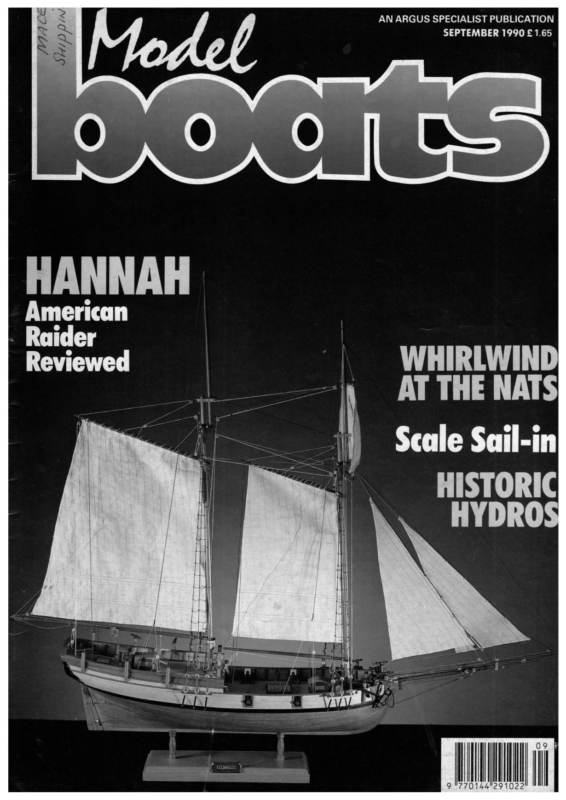
- 7th World RM Champs – Fleetwood Mike Critchlow outlines the background and programme for the RM Worlds – 18 to 24 August
- MARINE MISCELLANY by BASIL HARLEY A Minor Mystery
- Scale Sail; Rally Herne Bay Chub hosted this year’s Scale Sailing Association Rally – Reported by Ray Brigden
- Yachts Rule OK? to IMRU Rules – by Nick Weall – Part Five

AN ARGUS SPECIALIST PUBLICATION SEPTEMBER 1990 £1.65 HANNAH American Raider Reviewed WHIRLWIND AT THE NATS Scale Sail-in HISTORIC i] { 01
7th World RA a N Mike Critchlow outlines the background and programme for the RM Worlds – 18 to 24 August s many readers will know, the 7th RM World Championship was scheduled to take place at Las Palmas in the sunny Canaries. Unfortunately the man behind the organisation there died suddenly in November of 1989. His fellows decided that they could not continue and the Championship was handed back to what was then the International Model Yacht Racing Union IMYRU and is now the International Yacht Racing Union Extract from the Notice of Championship Authority Following a decision taken by the Model Yacht Racing Division IYRUMYRD. That is one very large mouthful ofa title! In a few short weeks the IYRUMYRD handed the World Championship to Fleetwood Model Yacht & Power Boat Club simply because they were the only club able to take on the event at such short notice. Fleetwood has had a lot of experience of large scale International events and set to with a will. Permanent Committee at its meeting o1 6/7 Jan. 1990, the right to host the 199( Graham Bantock and lan Cole take a break during the ‘86 World Championships at Fleetwood. Marbleheads racing under a storm canvas in a strong wind at Leeds. Opposite, scenes from the ‘86 Championships. “OLYMPIC” Course. Ca Finish Wind Start The The boats again start tack to buoy number 1, run line 3, completing down line between buoy You can is between buoy toward buoy to buoy 1 see why 28 number the 3, and the Olympic 1, 3 and a mark on reach triangle, and a mark on “triangle and sausage”. R/C Marblehead Class World Championship, on the dates stated in t heading, has been granted to Fleetwoor Model Yacht & Power Boat Club. Venue With the assistance of the Model Yachting Association MYA and many volunteers from the clubs around England and Wales the Championship has been organised from scratch, in seven short months. The 1986 World Championship took 2 years to arrange. Congratulations are in order to all the members of the Committee for their successful work so far and best wishes The for a happy and trouble free week of to} class racing in August. I have included some details, below, about the who, what, why, where and when of the 7th World Championships for your enlightenment and informatio: The notes were taken directly from the Notice of Championship, a copy of whi: was sent to each competitor. I would like to express my personal best wishes to Graham Bantock and al the other English competitors. I hope y all have an enjoyable week and some exciting races as you represent us in front of the world’s best skippers. I wis! you all good luck, good weather and go sailing. then to buoy tack back tack up to the bank. 2, reach to buoy the finish the bank. course is refered to as a The venue is Fleetwood, Lancashire, England. This is a small seaside resort on the North West coast of England about eight miles from Blackpool. The water is a large rectangular salt water lake on the sea front. The site is expose and winds can be strong even in the summer. In heavy weather the wave pattern is severe and confused close to the banks. The host club was founded in 1930, r: its first National Championship in 193 and its first international model yacht race in 1933. Since then it has hosted a large number of international meeting: including the 1979 joint meeting with NAVIGA, the 1982 Marblehead Jubilee Regatta and the extremely successful 1986 RM World Championship. The 19! event is being run by a team which includes many of those involved in the organisation of the 1986 event. The lakeside facilities include a large clubhouse with a canteen that will be open throughout the meeting anda lar; boatstore which will (if necessary) be supplemented by temporary accommodation. As in 1986 Competitoi and Observers will operate from a larg: scaffolding platform. Rules Racing will be conducted under the International Yacht Racing Rules (IYRR) 1989-1992, the Radio Control Racing Rules Appendix (RCRR) of the Model Yacht Racing Division and the Sailing Instructions for the Championship. . . Boats will be expect to conform to the current rating rule fo: the R/C Marblehead Class. Racing will be organised using the Model Yacht Racing Division’s Radio Control Racing System 1989 (RCRS89) Races will be divided into five (5) heats each of fifteen (15) boats. RCR89 is an MODEL BOAT
ChamPs – Fleetwood Protests Protests will be made in writing… The protest committee will consist of three members of International standing and may, if necessary, divide to hear protests as a series of three committees, each of one member. In the case of decisions taken by a single member, there will be a right of appeal to the full protest committee ON THE INTERPRETATION OF RULES ONLY update of the previous RCRS86 to permit the use of larger fleets. Committee The Race Officer and Committee Chairman will be Derek Priestley (Vice Chairman MYA, Commodore of Fleetwood MY&PBC), a very experienced official who was in charge of the 1986 RM World Championship. Treasurer: David Rose. Competitors’ secretary: Russell Potts. Liaison officer: John Cleave. Co-ordination secretary: Ian Taylor. Publicity officer: Mike Critchlow. Sales: David Hackwood. Canteen/social officials: Members of the Fleetwood MY&PBC. Race Officials Asst. Race Officer: Chris Dicks. Starter: Bill Winstanley. Observer control: David Coode. Observers, scorers and other assistants will be drawn from the ranks of all the willing volunteers from Fleetwood MY&PBC and from all the willing volunteers from other clubs who are present during the week. Anyone wishing to offer his/her services in any capacity should contact the Assistant Race Officer. Racing Programme Saturday 18 August Arrival. 1100 Registration and Measurement. 2000 Skippers’ Briefing. Sunday 19 August 0900 Start of racing. Preliminary rounds. Start of Fleet racing. Monday 20 to Thursday 23 Fleet racing. 0900-1800 (approx.) Friday 24 August Conclusion of Fleet racing. (1500 approx.) Evening, Dinner and Prizegiving. Given reasonable weather conditions, this programme should enable us to provide between 30 and 33 races during the Championship. Observers The observers will operate in the Active Mode, calling contacts as they occur. (IYRR 77.4). There will be no appeal against the decision of the full committee (ITYRR 1.5(b) (i) ). Entry The entry fee is £40 per entrant. The initial allocation of entries per country: PT OAGIT Fo cilea chs cctkscsoesonsees PMN sta snc cocsessectraestiennsscnes USE ANEN cteescccdesecrenstactosetencovetes ie.) Peay E10, OU en AL oy ee Brazile ee te CG RTE Fas iss ssectansassosececedegccnueess POVID GPK 4. sos ecbascctentveatteresactoes LOE: a aap en, Re coon 1ST 0 C2 01 ¢ bespeeapn i en este SIS 2 2 2 2 2 2 2 6 4 PPANCO \.00s5eccec8oivescoscstsearteegeteeweset 5 W. Germany ……….::ccccceeeseeeeeee 5 FROM EN Ole sstcsccntetacaisdcccitassssteasees 2 Hons Kang scat pivttieetesverst 2 Treland: 3.5.i..Gh eit kotAbecccss nace. 2 TUARES ~.. cacdeccatavoececnsensesnsesxactteternsaes 4 SEDO ssdicscsiscsccnncancdnwuss 2 Moma ……ccccecceesessceeesseeseeteeeeees 2 New Zealan ………….cccceeeceeeeees 3 IN OR WAY. ccscecsiscccscccssnscdatonteetueenss 4 ge a ee ee ee 2 Scotland ….c…ccn..ccocsoccsscsssconsecess 2 BOSD rtccisnscmmsccanetoen accuse 4 SS) Fo ee ene a Ue Sean 2 Switzerland …………….ccceeeeeeeeeeee 5 US As wit Bika Bat as 5 Tota emer ys cscs ekisiedesdsseiees 75 Some countries may choose not to send any entries in which case their allocation will be redistributed to other countries. Entries from England have been drawn from the Ranking List and are, in order of rank: Graham Bantock, age 36. Member of Chelmsford MTC, from Kelvedon, Essex. Boat name Nimrod K4291. Peter Stollery, age 16. Member of Guildford MYC, from Godalming, Surrey. Boat name Pitstop K4239. Philip Playle, age 34. Member of Chelmsford MYC, from Harlow, Essex. Boat name Dark Crystal K4297. Martin Mickleburgh, age 39. Member of Dovecote S.C., from Malvern Wells, Worcs. Martin Roberts, age 25. Member of Birkenhead MY&PBC, from Birkenhead, Merseyside. Boat name Zap! K434’7. Roger Stollery, age 45. Member of Guildford MYC, from Godalming, Surrey. Boat name Top K4217. In case of a withdrawal by one of the above the first two reserves are: Ian Cole. Member of Chelmsford M.Y.C. John Cleave. Member of Ryde M.Y.C. Additional Attractions Saturday 25 August World Masters RM Invitation only. At least 12 top skippers will contest a series of races designed to offer a spectacle to the public. Note: details not finalised at time of writing. Sunday 26 August Fleetwood MY&PBC Open Day This is run by the scale section of the club and is one of the biggest and best attended competitive exhibitions of model boats in Britain. The bulk of the entries will be scale models, both power and sail, plus some vintage yachts. Marblehead Class Exhibition Throughout the week of the Championships there will be a small display of drawings and photos in the clubhouse illustrating the design and technical development of the class since its inception in the early 1930s. It is also hoped to have a small number of boats on display dating from the early years of the class in Britain. The display will be presented by Russell Potts who is the Secretary and Founding member of the MYA affiliated “Vintage Group”.
any of my correspondents are kind enough to think that I have some magic knowledge about every type of historical toy boat you can think of. All very flattering but, really quite unjustified. Nevertheless, I am always pleased to have queries because, by discussing them in this column, other readers frequently come up with some answers. This time Gary Daniel, of Weymouth, has sent me these most interesting photos of a clockwork launch which he has recently acquired. She is 33 inches long with a beam of nearly 7in. and her hull is a one-piece aluminium pressing. This is an attractive material for pressings, being very ductile but it has the disadvantage of being difficult to solder and before epoxy resins were available fittings were not easily attached. This must be one of the reasons why few makers have used it for hulls. Her mahogany deck has a transfer trademark which just says ‘B Boats’ in a lozenge. The questions are, who made her and roughly when? Gary has done a lot of analytical work having examined her very carefully, from what he thought was papier mache with the wooden deck overhanging it by about “in. all round – just like Gary’s which is fixed with aluminium rivets. The clockwork motor is of a good quality but it doesn’t have a German look to me. It is not one of Bassett-Lowke’s and neither can I find a similar one in Steven’s catalogue. Lastly, the final mystery is the ‘B Boats’ trademark. Does anybody recognise this? The more that can be discovered about what appears to be a very big range of between-the-wars boats the more interesting our discoveries in swapmeets and collectors’ sales will be. A Minor Mystery Views of Gary Daniel’s aluminium hulled clockwork launch with the trade mark B in a lozenge. The advertisement showing three K yachts is from the Triang catalogue of 1934. Could this launch be a modified yacht hull? noting particularly that she has a round bilge hull not unlike a model yacht without the keel. There is a blocked up hole in the foredeck which may have been for a mast. These clues have led me to wonder if she may have been one of what we now know to have been a very wide range of models marketed as ‘K’ boats. As far as can be discovered these were made from the late 1920s by Georg Kellner in Germany and sold through retailers here and elsewhere. It is thought that Kellner was Jewish and, with the rise to power of the Nazis in the early thirties, was forced out of business. From about 1934 Lines Bros started to include ‘K’ boats in their catalogues, some of which appear to have been made here. It is possible that they were made under licence or perhaps the trademark had been purchased by Lines Bros. An aluminium hull of this size would have needed. fairly big press tools to make and as many variants as possible are likely to have been generated. On page 34 of the reproduction Lines Bros/ Triang catalogue for 1937/1938 (published by New Cavendish Press) there are three yachts, the largest, Rosemary, with a 32in. hull. The form of the hull is very similar to Gary’s boat and the mast is shown well forward, approximately where the hole in his deck is located. The specification includes ‘Special lightweight, weather resisting LAL? K4. YACHTS 2 Evizasetn «3 MARGARET Models Nos. 2, 3 and 4. 2917 Patent lightweight, weather-resisting hull. Perfect balance wooden keel, lead weighted. Magnificent craft. AUTOMATIC STEERING. Masts and booms made from the finest selected Solid mahogany, polished deck. Beautifully finished in blue and white. material. Best quality sails. Waterproof rigging cord ; brass fittings. Nos. 3 and 4 have two-piece mast. We talked about ‘K’ boats in Marine 32 K “K” AUTOMATIC STEERING YACHTS hull.’ Miscellany in January 1988 and John Norris remembered having one made ROSEMARY _Page Thirty-four K2 ELIZASETH … hull 21” K3 MARGARET ..- hull 26” K4 ROSEMARY… hull 32” MODEL BOATS
iLJerne Bay Chub hosted this year’s Sca __ Reported by Ray he Herne Bay Club were once again hosts to the Scale Sailing Association’s annual rally. The Association, now into its third year and already boasting a registered membership of two hundred, once again chose a good day weather-wise for their rally, and a nice summer breeze coming across the Memorial Park Lake was enough to keep the large sail areas of the predominantly spritsail barge fleet puffed out for them to make good progress around a large course taking in most of the lake. As to be expected with a Southern regatta, the Thames barge was the most favoured model. It was obvious that many of the membership had been busy during the winter months, with the barge fleet containing a good number of new models, all built to the now customary half inch to the foot scale. Standing out among the fleet with a sparkling white and red hull and some very neatly tailored sails was Ray Parrott’s new model of Sara; another with some nice deck detail was Steve Crew’s Ernest Piper. Seasoned model SEPTEMBER 1990 Brigden roe Tony Leach was resting his trusty Kate and seemed very happy with the sea trials of his new model named after his new grand-daughter Victoria, and even Mike Taylor had managed to get some modelling done during the winter, sailing a new river barge Pied Piper. Mike’s model is built onto a fibreglass hull moulded by Association member Tony Williams; Tony’s own barge James Piper is on a hull from the same plug and has the reputation of being one of the fast ones of the fleet. Mike sailed the new model into second place in the nominated time event pushing Tony into third place but just getting pipped by Trevor Wilkinson with his Westmorland. The nominated time event is good fun but the skipper intent on winning really must know how to read the wind and know the performance of his boat. Trevor nominated 17 minutes and put the Westmorland across the line on 16 minutes. In the barge match Westmorland’s customary first place was not to be this year; a new name in the winner’s frame after an exciting three lapper was Eric Piggott with a nice model of the spritsail Veravia. The secret of the model’s fine trim and finding the wind to complete a good win became clear when Eric told me that he served as a third hand aboard the full size Veravia in 1949. Another of the Association’s members with experience of the real thing is Vic Friend. Now, four years into a happy retirement, Vic spends most of his time building sail models of the full size craft that he helped build over a period of 46 years in Anderson’s Yard at Whitstable. Apart from his barge model Vic brought along with him the near finished hull of a fishing yawl and the unpainted hull allowed a good view of Vic’s skills with plank-on-frame building. Another model that showed off its builder’s skills with fine timbers was Unicorn, a 1:40 scale paddle model by John Carter from Banstead. John’s neat building and clean paint work have produced an impressive model that is based on the William Fawcett (1824), the P & O Line’s first ship that worked with passengers and cargo between Falmouth and Gibralta. 33
ANS ie i Le. wT Bite MODEL BOATS
Opposite top left, Vic Friend preparing his barge — alongside “— : . ae ; is his plank-on-frame hull for his new yawl. Opposite top right, Tony Lench chose this meeting to launch his new model of Victoria. Opposite bottom, Tony’s Victoria seen fighting off a challenge for the lead from Steve Crew’s Ernest Piper. Above middle, the Thames Sailing Barge models make a realistic sight as they catch the wind to start the match race. Above, Veravia steals the lead at the mark in the barge race. Right, Silvia Wilkinson’s barge in the foreground tacks to challenge Mike Taylor’s model in the barge match. SEPTEMBER 1990 Left, Eric Piggott trims his model of barge Veravia. Below, — Veravia at speed while crossing the line to win. Below, Tony Williams’ model of James Piper, with full sails and making a — good speed.
Mike Taylor passed his transmitter to any spectator who wished to try sailing his new barge, while he started to rig his now legendary Green Dragon. As is norm, he attracts an audience which he holds with his interesting tales of how and why he built the Dragon. Among the audience this year I spotted author and builder of the Warrior series, William Mowll, also a member of the S.S.A. As the Green Dragon was launched and sailed majestically across the lake, Mike’s audience melted – apart from Will – he was behind Mike studying the Dragon and first in the queue for a sail! I did ask Will “How goes the Warrior’? “Like the Forth Bridge Ray” he said, but he was smiling so hopefully it will not be too long before we see the masterpiece completed and sailing. The S.S.A. has thirteen events published in its second newsletter that members can attend. Unfortunately most are in the South but with the S.A.A. now having a Northern Sec., Mike Finnis, and also the Fleetwood Club holding a few Sail Scale events, the programme could even out next season. With the Southern skippers choosing the Thames sailing barge as their main competition model, it would be interesting to hear which is the favoured workboat the Northern modellers choose to build; and how about the West Country modellers joining in. There must be many a work boat from that part of the Isles that would scale to a good sailing model. But whatever sailing model you favour, founder members of the S.S.A., Max Cockett and Mike Taylor would be glad to hear from you should you want to join. No doubt they will be holding court again on their stand at the next Model Engineer Exhibition at Alexandra Palace. There are no fees for membership to the S.S.A.-financially they are surviving on donations/badge sales and regatta receipts – no meetings to attend – all is sorted out at the pond side or in the MODEL BOATS
Opposite top, Ray Parrott leads the fleet across the line with Sara in the Nomination event. Opposite bottom, a close up of Sara, showing off the nicely tailored sails. Below, John Carter’s 1:40 scale Unicorn — the model is based on P&O’s William Fawcett of 1824. Right, Mike Taylor gathers an audience, including at far left William Mowll of HMS Warrior fame, as he prepares the Green Dragon for a sail. Bottom, Trevor Wilkinson’s realistic model of Westmorland, winner of the Nomination event. ‘ ” a tod as LS — ew —— newsletter. Competition was not the founders’ reason for forming the Association, SEPTEMBER 1990 : =: rather to bring marine modellers together who have a specialist interest, but the boat talk/laughter and contented faces of the modellers at Herne Bay suggests that Max and Mike are getting it right. 37
A practical introduction to IMRU Rules – by Nick Weall – Part Five e are now well into the sailing season and those of you who have been reading this series from the start are probably becoming seasoned campaigners. Please forgive me if I take a little space to welcome any newcomers to this series of articles and to explain what has been covered so far. The basic purpose is to introduce more people to the challenges and enjoyment of Radio Controlled Model Yacht racing. To race you must, to some degree, know the rules that control yachts racing. These articles, over four years, will introduce you to the International Yacht Racing Rules firstly in a fairly basic way, then at an intermediate level and finally at an advanced level. There is no need at all to learn rules off parrot fashion, all that is needed is a working knowledge of the principles and applications of the various rules. To acquire this knowledge we are racing a Radio Controlled Yacht around an Olympic type of Course, covering roughly a leg of the course each article. Since the first few articles set out a lot of the ground rules, if you haven’t read them it would be well worth writing off to our publishers enclosing £2.00 payment including postage for each back number you require. The series started in the May 1990 issue. So far we have covered the start, the windward beat, rounding the windward mark and slightly up the first reach. Diagram 1 (which was diagram 3 of article 4) shows the position we had left our yacht C in the race we are participating in of five yachts belting around an Olympic type of course. We are not last so far and the five boats are still fairly close together. It must be said that in real life it would be highly likely that the boats would be more spread out by now. It is, however, much more convenient to be able to draw diagrams that include all five boats’ positions without using up all of the page each time! It also helps to illustrate various points easier. In a large fleet of yachts racing anyway, whilst the fleet might get well spread out, there will often be little bunches of yachts having their own race within a race right round the course. As skipper of boat.C we have a problem! (Besides being a novice that is.) If we MODEL BOATS
look ahead to rounding the wing mark, which we will be leaving to port (our left) as we round it, and if we remember about giving inside overlapping boats at four boat lengths from the mark room to round the mark, we can see that X is likely to gain a place and possibly D as well. You see, as we would have to round the mark wide enough to allow X to round it as well, D might slip through the gap we leave. What can we do? The answer is I’m afraid, at this level of racing, nothing other than try to sail faster than the other boats so as to be able to draw ahead of them enough not to have to give them an overlap at the wing mark. You might imagine that we are in winter wonderland considering DIAGRAM 2 1 WITH THE SAILS SET TOGETHER CORRECTLY AND AT THE RIGHT ANGLE TO THE WIND THE WIND IS ONLY MILDLY CONFUSED DOWNWIND. TWO OR THREE BOAT LENGTHS this. Go faster than the other boats? Us being complete novices! Well, you are probably right, but what is the alternative? Slow down enough to let X and D overhaul you and then duck under D’s stern to try to get an inside overlap. To do that we’d be giving away three boat lengths before we even started to fight back. If we did achieve that all important overlap before and at four boat lengths from the wing mark though, we would certainly regain fourth position for the second reaching leg. So the alternative plan does have some merit but let’s stick with the immediate decision we made and try to gain speed or distance over X. 2 Towards the Wing Mark As we covered in the last article, usually as you have rounded the windward mark and proceed towards the wing mark your boat will be sailing further away from your control point on the bank. Thus, it becomes more difficult to see accurately how your sails are set. Here are some clues to help you. Firstly, when not racing, practice doing complete turns of your yacht near to the bank. Practice keeping the sails full and driving through all points and also feed into your memory bank the relative positions of your transmitter’s control stick for the winch for all the various settings of the sails. Then you will have some idea of the angle your sails are at when too far away to judge by eye. Next, when on the reach, study the behaviour of your yacht’s sails; if they are flapping they need to be sheeted in a bit. If the boat is going slower than others around it and is heeling over too much, then the sails need easing out a touch. Be gentle with your adjustments and constantly studying the effects of your adjustments to your boat’s relative speed. As boat C in diagram 1 we have the benefit then of clean air, that is, there are no boats to windward of us confusing the wind’s direction. We may also just be in clean water, keeping just ahead of the wake boat A is producing. If we get caught in Opposite top, what an R10R looks like up against its owner; Eric Roberts, Vice Commodore of Gosport, early in the day of the R10R Championships this year. Opposite bottom, RM Midlands Ranking Race at Dovecote. Sometimes this was the windward mark, sometimes the leeward, with a wind that swung through 180 degrees. Mind you that was the only thing wild about the Force 1-2 wind! Roger Stollery leads Graham Bantock and the fleet. SEPTEMBER 1990 WITH THE JIB NOT QUITE FAR ENOUGH OUT IN RELATION TO THE MAIN- EXCESSIVE TURBULENCE !S CREATED DIAGRAM 3 WING MARK A’s wake it will very likely slow us down. B’s wake will have spread far enough to reach beyond the water we are sailing through, but it will have largely dissipated and our objective here should be to keep inside of the leading edge of B’s wake anyway. This is how we shall proceed up the first reaching leg. Now let’s just have a think as to what rules are most likely to affect us on the reach. 51
The Reach Firstly if we start to really gain distance on Yacht A there is the very real danger of A luffing us! Remember luffing, where A might suddenly change course heading up as tight as she likes into wind but not beyond, causing us, as overtaking boat to windward to respond to her luff and have to luff up as well. That usually has the effect of slowing us down more than the luffing boat and if, heaven forbid, the luffing boat caught us unprepared and managed to touch us, there are going to be penalty turns to do! Remember the number of this rule? No, nor do I; who cares, we can both look it up at the end of the race if we need to, the important thing is that we remember the actual workings of the rule. Do you remember the way to curtail a luff? If the boat you are overtaking is slow to spot the danger or is not very interested in luffing you, once your mast is abeam the stem (pointed bit or bow) of the boat being overtaken to windward, you, as overtaking boat, can shout “Mast abeam” which immediately removes the luffing rights from the leeward boat! If it was in the process of luffing you, it immediately has to stop luffing any higher and if it was not luffing you at all are rapidly approaching the wing mark and the magic four boat length’s circle. Why magic? Well, remember that is the point at which you must have established or held an inside overlap to be able to retain that overlap as you round the mark. Rule 42 covers overlaps and mark rounding. It is such a long rule that anyone that can remember it word for word can’t possibly be sailing; they would still be studying the rule book or on Opportunity Knocks! Diagram 3 shows the up to date position in our imaginary race, although we tried hard to maintain good speed on the reach, we did not manage to overhaul it must retain its proper course. Yes, rule 38 covers all these points and more. Should we be lucky enough to pull clear ahead of yacht X, we might well be tempted to ease across to leeward and assume a course more directly in front of X. In this case we must be mindful of rule 39 sailing below a proper course after starting. Do you remember we covered it in the last article? I’ll quote it again because it is only a short little rule. A yacht that is on a free leg of the course shall not sail below her proper course when she is clearly within three of her overall lengths of a leeward yacht or a yacht clear astern that is steering a course to leeward of her own. Whilst it is only a short little rule, as I wrote last time, it is a very useful rule for the yacht overtaking to leeward on reaching and running legs. However, for us in the present situation being discussed it works against us to some degree. Notice, however, that the rule says that we must not sail below a proper course. Since we are a yacht ahead and to windward of X, our proper course to the next mark will be a converging course with X’s projected course. Thus, it is possible to ease our boat nearer to a position where we are actually more or less dead ahead of X, but we must NOT sail below that proper course! The reason for doing this would be to ensure that X firstly did not get an overlap at the wing mark and secondly had absolutely no chance of trying to nip in any gap we might leave as we round the wing mark. Right, all of the above should give you some useful clues as to some of the thoughts that will be going through a competitive club skipper’s mind. Some of them might even go through your head as you are lying in bed after a tough day’s racing wondering what went wrong. In fact if they do, that is a good thing, because it is very useful to cast your mind back after the racing in a peaceful place and re-run the races trying to learn from your mistakes and the mistakes of others that you spotted. Whoops, back to the race. Our yachts 52 own yacht’s wake will also give youa clue, when it touches the buoy you will be well past. Sometimes the sun will be obliging and cast a shadow from your sails on to the mark. That, then, gives you very useful feedback. In diagram 3 yacht X has an overlap on A and had it at the all-important four boat’s length from the mark. Thus A must allow X enough room to round the mark in a seamanly manner. There is often discussion as what constitutes seamanly like rounding. The thing everyone would agree upon is that it means you must round the mark fairly tightly and assume a proper course towards the next O WING MARK DIAGRAM 4& “THE HAZARDS OF GIVING TOO MUCH ROOM” DIAGRAM S TWO BOAT LENGTHS FURTHER ON THAN DIAGRAM 4! O WING MARK f) X. We did manage to keep clear ahead of D and at the four boat circle from the mark we do not have to worry either about giving an overlap or maintaining one. Clues All we have to do is to judge when to round the mark! This is easier said than done and often becomes an eyesight test. Here are one or two clues to help you judge for yourself when it is safe to round that distant mark. Boats ahead are a good guide, you can easily see if they hit the mark or miss it on the right or the wrong side. Their wake will also give you a clue as when to turn. Your Grateful thanks must go to the /YRU for permission to reproduce IYR Rules, 1989-92. mark immediately. The variables are some allowance must be made for people’s varying sailing skills and eyesight. Also it much depends on the weather and in particular the wind strength. It is one thing to round a mark well in a breeze and quite another in a gale. In the gale one would be quite entitled to give the mark a wide berth. But, remembering the fair sailing principle, one must do their best according to the prevailing conditions. One thing you should try to avoid, although it is very difficult, is giving too much room to inside overlapped boats at the mark. Let’s look at diagrams 4 and 5 drawn with only two boat lengths of MODEL BOATS
retires, accepts its alternative penalties or lodges a valid protest after the race. The third thing, of course, that can dramatically slow your progress around the mark is having a collision with another yacht since that is highly likely to mean you are going to have to accept the alternative penalty of doing two complete turns. If the wind is fairly light or if the race organisers want to save themselves a lot of protests it will often be put in the sailing instructions that the alternative penalty will be reduced from two complete turns to one complete turn. If that is the case and you face the unenviable choice of hitting the mark or touching another racing yacht, touch the yacht – you will then only have to do one turn instead of the two you would have to do if you had hit the mark, Rule 52.2. Back to the race and diagram 5. A is feeling a bit sore, by her own stupidity places have been lost; what can she do R10R District Championships at Gosport. An early start before the wind got up! Left to right, 55 Steve Ehlers – Woodspring, 23 Ernie Abrey – Woodspring, 07 Peter Wiles — Poole, 46 Mike Ewart Dovecote, 22 Lars Andren —- Guildford, 12 Roy Burgess – Woodspring, no number possibly Ken Collins – Poole. progress being made from 4 to 5. Look at what A has done! Not only given away a place to X as might have been expected, but also given away a place possibly to our boat C. In fact, it is even possible that D might gain an inside overlap on A by the time they get to the leeward mark! All because A went far too wide rounding the wing mark. Do remember that every boat length you sail beyond such a mark is another boat length you have to sail back just to get back to where you were before! Thus it costs you two boat lengths to sail one length beyond a mark in the wrong direction! Boats very often give away five to ten lengths and more whilst rounding distant marks. Again before the start of a day’s racing if you have the opportunity, it is well worth your while to get your boat on the water (having checked your frequency with race control, and taken your peg) and sail around the course. Practise sailing right around the distant marks and even try to bump into them to get their positions fixed into your mind. manoeuvring into a position just behind Again at Gosport, broad reach down to the leeward mark in heavy wind… Mark it Do remember, however, that when actually racing, the only thing worse than overstanding the mark is hitting it! If you hit it then you have to immediately clear the fleet and execute your two complete penalty turns before resuming your course. Remember that if you hit the mark before rounding it, then … the foreground yacht leaps into the air, quivering with excitement at the prospect of tacking to starboard and possibly frustrate the » passage of 22 Lars Andren (eventual winner) and 40 John Carroll. Notice how 40 is changing direction… you do your turns before rounding the mark, if you brush the mark as you round it, then you do your turns after rounding the mark. You must keep clear of racing yachts whilst you are doing your turns. If you have a collision with another yacht whilst doing your turns it is automatic disqualification! Doing turns usually means that you lose places on the water! So try to avoid hitting marks. One point that not too many skippers know is that if another yacht forces your yacht onto the buoy, you may protest the other boat. Without you having to do turns for touching the mark! Under rule 52.3 you will be exonerated provided the protested yacht SEPTEMBER 1990 now to try and salvage something? The first thing she can do is to head up to wind more on a converging course with C and hope that will accelerate her a little bit faster than C is travelling, so as she can close and try to engage ina little luffing match. However, by the time she draws close, C has got her mast abeam of A’s stem and calls “mast abeam”, curtailing A’s attempts to slow C down. (Our novice skipper must have been reading these articles!) A’s skipper gives up and falls back a bit more on purpose and comes up under C’s stern ..- 40 has dived into the ‘Suckers Hole’; there has been no contact; wind is heavy; what happens next? The windward mark lies 200 yds to the right. Who will be best placed to reach the windward mark first? Answers to Nick please, backed by rules applicable. Winner, to be announced in two months time with confirming pics, will receive a copy of the Eric Tinames Rules Book. and to windward of C’s stern. A also now has full luffing rights over D, so all is not lost. This brings us to the position shown in diagram 6. The reason why, of course, that everyone is very busy trying to get an overlap to windward on the boat in front is that they will be rounding the next buoy, leaving it, as usual, to port, thus the inside overlap required to round that leeward buoy is a windward one. If you can have just a bit of an overlap over a leeward boat established at the magic four boat lengths circle from the mark, then that boat has to allow you room at the mark and, because you will then round the mark on a tighter radius than the outside boat you should come out clear ahead! That is the theory, of course, as I ask in the diagram, there is the not inconsiderable possibility of being luffed as you try to establish your overlap on the boat in front. In fact, the correct defensive tactic for the reaching boat in front having a pursuer nibbling her windward stern quarter is to initiate a luff followed by a rapid return to course which will hopefully push the hopeful, overtaking boat, clear astern again. This is a leg that can see some very interesting luffing tactics ranging from the luffing tactic described above to long length luffing matches that have the participants sailing more towards the windward mark than the leeward mark! All good fun, but do remember to keep an eye on what the rest of the fleet are doing meanwhile, otherwise, as mentioned before, you may find back markers (those behind the luffing pair) slipping through to leeward whispering thank you very much! Rounding The rounding of the leeward mark can 53
be quite interesting or even stressful depending upon the number of racing yachts near to your yacht as you round, your experience and state of your nerves! The higher the strength of the wind the more interesting it gets! Imagine, you have a crowd of yachts hammering down towards the leeward mark on a good reach, all wanting to whip round that mark immediately hardening up to a close hauled course towards the windward mark. Remember that we are rounding the mark to port. Some of the yachts as they round will want to tack across to starboard and some will perhaps continue on port. All yachts are likely to slow down as they are rounding the mark, depending upon the varying abilities of skippers to maintain full drive in their sails. (This requires excellent co-ordination between rudder control and winch control – it takes a bit of practice and concentration. The concentration can easily be lost in the excitement of the moment!) One or two yachts may even seem to engage reverse gear, which can be a bit disconcerting if DIAGRAM 6 event. Lars was trying to turn to port. He obviously needs a larger rudder! you happen to be the poor boat screaming along behind them. Thus, if there is a bit of a wind blowing you most definitely need to be thinking ahead and to be hyper alert. Yachts that are clear ahead of you as you enter the four boat circle.have to be allowed room to round the mark, you have a duty to keep clear of them in anticipation of their rounding manoeuvre. Why? Go back to rule 42 and in particular rule 42.2 and I quote “When not overlapped a yacht clear astern” (a) A yacht clear astern when the yacht clear ahead comes within four of her overall lengths of a mark or obstruction shall keep clear in anticipation of and during the rounding or passing manoeuvre, whether the yacht clear ahead remains on the same tack or gybes. (b) A yacht clear astern shall not luff above close hauled so as to prevent a 54 MARK C TRIES TO GET AN OVERLAP TO WINDWARD OF X 0 HAS AN OVERLAP TO WINDWARD OF A! WHY ARE THEY ALL TRYING TO OVERTAKE TO WINDWARD – THE SIDE THAT THEY CAN BE “LUFFED UP” ON? B ‘S OUT UF SIGHT- CLEAR AHEAD DIAGRAM 7 Sometimes with too much sail up and a heavy wind, the wing mark seems even further away than usual. Lars Andren’s R10R S22 at Gosport dives for bread. The boat did win the WING THE SECOND REACHING LEG “TOWARDS THE LEEWARD MARK” “ROUNDING THE LEEWARD MARK FOR THE FIRST TIME IN THIS RACE” WIND (_)tsewaro yacht clear ahead from tacking to round a mark.” So there you have it, however, let us just continue to read the same rule as it goes on to cover what the duties are of the yacht clear ahead. A yacht clear ahead (c) A yacht clear ahead that tacks to round a mark is subject to rule 41. Changing tacks – Tacking and Gybing. (d) A yacht clear ahead shall be under nc obligation to give room to a yacht clear astern before an overlap is established. So once again, as is often the case, by digging into one rule we find that we have to refer again to another rule if we are to understand entirely what the rule is getting at. Here is rule 41 reproduced. 41 Changing tacks – Tacking and Gybing. 41.1 Basic Rule; A yacht that is either tacking or gybing shall keep clear of a yacht on a tack . 41.2. Transitional; A yacht shall neither tack nor gybe into a position that will give her right of way unless she does so far enough from a yacht on a tack to enable this yacht to keep clear without having to begin to alter her course until after the tack or gybe has been completed. 41.3 Onus; A yacht that tack or gybes has the onus of satisfying the protest committee that she completed her tack or gybe in accordance with rule 41.2. 41.4. When Simultaneous; When two yachts are both tacking or both gybing at the same time, the one on the other’s port side shall keep clear. Phew! “Gordon Bennett,” I hear you cry, by the time I’ve remembered all that lot I’ll be right up someone’s transom! Relax – I keep on writing – you do not have to remember all of that or even have to quote it all at someone on the water. You MODEL BOATS
stern must then allow you room to tack to miss that obstruction which, in this case, is one or more starboard tacked boats. That’s it really; keep clear of boats in front and do not tack in the path of boats behind unless you have time to get across on to starboard tack before they have to take avoiding action. They do, of course, have then to have a bit of room to take that avoiding action, so bear that in mind if you value the port side of your yacht! Next Month Next month we shall look a little bit more at rounding the leeward mark after the reaching leg and we will battle our way all the way up the windward beat back to the windward mark. This Month’s Question: Take a good look at diagram 7, which Master Class. Graham Bantock holds up an intermediate swing rig – complete with mast stays attached to a cross beam seen at the base. This is a new rig for Phil Playle who can be partly seen behind Graham. is where we are going to leave our intrepid novice skipper of yacht C. What I want to know is who is going to be where, after all the yachts have rounded the leeward mark. Are any of the positions from first to fifth going to be changed. If not, why not? So let’s havea drawing of your guess at everyone’s Lindsey Kirk holds Phil Playle’s B rig to give another aspect of well set sails. The idea of the mast stays is to give the rig more power during gusts by stopping the mast twisting or bending so much. Below, RM National Champion and Master Sailmaker, Boat Designer, Builder, etc. holds up Phil’s rig to give you another view of how a well set rig should look. do not even need to remember the rule number! If you need to look up the rules after the race all you need to remember is that you were rounding a mark, so you need to look for the rule that applies to rounding marks (42) and that will lead you on in turn to any other rule you may need to check on. Back on the water, however, this is roughly what you do need to know from a rare survival point of view: Yachts clear in front of you need to be missed, if they slow down and get in your way steer to go round them, not through them. Remember that you are rounding the mark on port, there will be yachts in front of you that will rapidly tack to starboard. Be prepared for this, because once they are pointing in a starboard close hauled position relative to the wind direction, they are considered to be on starboard whether or not their sails are full and drawing. At that stage you must take avoiding action! So plan your action; are you clear ahead enough of a boat astern to be able to tack to starboard yourself to avoid a tacking boat ahead or do you need to duck under the tacking boat’s stern? If there are several boats ahead all tacking to starboard, you may not have any choice but to tack to starboard, if so, call immediately for water to tack to miss obstruction. Any yacht close to your SEPTEMBER 1990 position when yacht D is one boat length past rounding the leeward mark. The drawing that is accompanied by the best explanation or justification for positions drawn will receive as a prize a copy of Eric Twiname’s book The Rules Book 1989-92 International Yacht Racing Rules, which as you may recall has masses of beautiful little drawings illustrating all of the common tangles yachts get themselves into, with captions as to who is right and who is wrong, together with a reference to the appropriate rule. At the back of the book all of the rules are listed out in full. A very useful prize, which if you already have one, you’ll be able to sell to another club member with ease! Anyway, whether you already have a copy or not, have a go. Post your answer to me, c/o Model Boats. Tuning! This is much the same as the way you used to have to be constantly twiddling the dial to get Radio Luxemburg to get any sort of decent reception! Boat tuning needs constant attention according to the conditions. High and low pressure weather systems most certainly effect the strength of the wind more than Radio Waves! The set of your sails needs to be different in light winds to the set in heavy or medium winds. So does the size of sail! Most of us, when we get drawn into this magnificent sport, tend to have far too few sets of sails. There is nothing wrong with that, whilst you are getting a feel for the sport, but once you are hooked you ought to consider getting a full range of sail sizes to suit your yacht. Some classes only allow you three sets of sails or so. Others like the Marblehead Class allow you many more. If you have bought a second hand boat then my priorities for getting that boat up to maximum potential would be: (1) Get it waterproof. (2) Ensure that the electrics are waterproofed and reliable. (3) Get the motor going right, tune it up and beef it up! 55
“Hm, I thought yacht racing was all about fair racing, sailing using only the wind and water to increase, maintain or decrease her speed, etc.!”, questions a reader. “Absolutely,” says I, “but your sails are your motor, they alone snatch a teeny weeny bit of the wind’s energy to produce the drive required to move our intrepid yacht through the water!” Right, back to ordinary script, I hope you get the point, nothing else is going to move your yacht through the water in the direction you want to go, with the help of fin and rudder, better than the wind. Tide, currents, jelly fish and string all have their limitations. In my humble opinion nothing else is likely to have the dramatic effect of influencing the Year Book 1990 tells you where, price £1.00 from David Hackwood, 10 Grangewood, Coulby Newham, Middlesboro’, Cleveland TS8 ORT. There are, over the length and breadth of the country, a handful of model yacht sail makers. I think the best test of a good sail maker is can he or she sail their own sails to success and here are the names of three who can do just that: Graham Bantock of Sails etc., Peter Wiles of P.J. Sails and Martin Roberts of House Martin Sails. All of these gentlemen can talk to you most knowledgeably about the type of sail that would be best and the type of material that would most suit the size of sail required. Mr. Bantock will even go so far as to give you written tuning instructions too, if you ask for it. I rely totally upon my sail maker to make the best choice of material, sail ratio, etc., for the type of yacht I require it for. All I will tell him is the overall size of sail area I require and the type of rig I am going to use. I might specify the colour required and I most certainly will remember to ask for a set of sail numbers and jib numbers together with any class insignia required. Who do I use? I know them all, I use the one nearest to me, since that is the most convenient should I wish to visit and discuss matters. I would be happy to use any of the three I mentioned above. Some people make their own, it is not easy and takes time, probably a lot of time since you are quite likely to make several suits of sails just trying to get it right. I’m sure there is a lot of satisfaction to be had once you have mastered the art. I have one friend who just dived into it that way and in the end produced some quite nice competitive sails. He was very good with his hands and well into boats, full sized as well as models. Having made the effort to get a decent suit of sails you might as well make sure that the things you hang them on are going to allow you to set the sails to the shape you require. It is important that your mast is truly vertical on the port/starboard axis. On the bow/stern axis it may need to be vertical or have a slight rake aft. The mast itself should either be completely straight or have a regular gentle curve on the bow/stern axis with the belly pointing forwards. Your main sail should be cut either with a straight luff or a curved luff to suit. The things that initially control the mast’s position and aspect are the stays on a conventionally rigged yacht together with a mast foot plate or tube and solely the mast tube on a swing rig. You can check the set of mast tubes by firstly setting up the hull so it is supported on its waterline, level fore and aft, with the keel vertical. (A plumb line taped to the centre line of the hull just in front of the keel will help you to establish this). A spirit level across the hull aft of midships will tell you if the deck is level or not. (It does not matter if it is slightly out, but you ought to know). Ste a One of the problems rounding the leeward mark after the reach and tacking immediately onto starboard for the beat is you have to watch out for boats behind you still reaching down on port. Yes, | know you are on starboard and close hauled, but if the port tack boat gets it wrong. . . you get dragged off for an excuse me dance! And drop several places. You can appeal under 69(d) as did Peter Wiles here against 33’s infringement of rule 36… 07 and 33 were lucky to separate quickly and continue. 07 got its redress awarded, but you may well not as some protest committees have different attitudes. potential speed of your yacht (discounting plastic bags, weed, jelly fish, etc.) than the set of your sails and the quality of the actual sail. Sail Quality Let’s look a moment at quality of sail. I am not going into all the different types of material available for making sails and what is best for what. If you want to race and to race competitively, you need decent sails. Where do you get decent sails? From a sail maker! Where do you find decent sail makers? The M.Y.A. 56 The spirit level will also show you from above if the hull moves from its set-up position. Next get a straight piece of dowel or something similar that fits snugly into the mast tube and that is around the same length as your mast. Suspend a plumb line from the top of the mast and, hey presto! you have all the feedback you require for checking. If the tubes are not in the right position or are not set at the correct angle, rip them out and start again! Having actually got a mast that has the correct rake and position we need to consider all the various things there ought to be on the yacht to enable us to alter the set of the sails. Diagram 8 will help to explain. I have chosen to illustrate a stayless conventional rig, since that removes the necessity to show the side stays and forestays that hold the mast in a vertical position on an ordinary deck stepped conventional rig. Obviously, if your boat is conventionally rigged with stays, you use the stays to get the mast perfectly set before you start to mess about with the sails. Then the first thing to do is bung the sails on. There are various different methods of doing this, especially fixing the main to the mast – Luff cord going into groovy mast, rings around the mast, vertical wire and hooks, etc., I’m not going into the relative merits of different types of rigging here. On the main the downhaul attached to the tack of the sail and the uphaul attached to the headboard are the two adjustable lines that can put tension in MODEL BOATS
the luff of the main and alter its position up and down the mast. (Within the measurement bands on Marbleheads!). On the jib the jib stay produces the mounting point for the luff of the jib usually by means of a luff tube/pocket or tabs on the luff of the jib. Tension is introduced by means of a bowsie up by the mast. The head of the jib is also attached by a separate line and bowsie at the mast. The jib tack is usually fixed to the boom by a line or hook. The curve or belly introduced into both sails is by means of the outhaul attached to the clew. There are again various types of adjustable outhaul – sliding or screw in and out hooks, grommets that are a tight fit to the boom but that can be slid up and down, moveable eyes and lines etc. Just make sure that whatever type you use, stays in the position you want and does not distort the sail! Twist in the sail is introduced by means of the kicking strap (also called vang) on the main and the lifting strap on the jib. The back stay should simply hold the mast in position and prevent the mast from bending forward when on the run. It can also be used to introduce the appropriate amount of bend required for the main to fit nicely all the way up the mast. The compression strut shown forward of the mast is really there only to stop the support boom lifting. It can also be used to help control the shape of the lower mast. It is not essential, so don’t worry if your boat does not have one. It is not seen on swing rigs either. All the other twiddly bits mentioned are, in my opinion, necessary if you really want to control completely the shape of your sails. (Provided that they have been correctly made.) The movable pivot points from the jib support boom (or deck) to the jib boom allow you to get the jib back as close as possible to the mast and also to adjust the pivot point upon the jib boom so as the jib swings out easily as you sheet out for the reach and run. You will finally have on each boom an attaching point for the sheets that go to the winch. It is important on conventional types of rig that the jib sheets out no slower than the main and, in my opinion, slightly faster. This is achieved by having the radius of the attachment points slightly different if you want to have the jib sheeting out faster, then the jib radius should be smaller than the main’s radius of attachment point. To set your sails up have the main sheeted right in to the close hauled position, say five degrees off the centre line of the hull fore to aft. The jib should always be further off the fore to aft line than the main. Opinion varies but it should be somewhere between ten and fifteen degrees off the fore to aft centre line when the main is five degrees off. Once you have done that you want to check to see that you have a nice curve or belly in both sails, perhapsa little less in the jib than the main. Try and get the sort of shape you might see in the cross section of an aircraft’s main wing. (glider rather than jumbo jet). Next, pick up the yacht by the keel and look at the main and the shape of its leech from the stern of the model. Try and get the wind to fill the sails at the same time. What you want is for the leech of the sail to SEPTEMBER 1990 MAST CRANE TOPPING LIFT OR UPHAUL > HEADBOARD —. JIB UPLIFTER UPHAUL JIB STAY BACK STAY (DOWN TO STERN HULL EYE) LUFF_— | LUFF LIFTING STRAP CLEW 4en, OUTHAUL OUTHAUL MAIN BOOM KICKING STRAP » MOVABLE PIVOT POINTS = A Aveck vever A DIAGRAM 8 JIB BOOM COMPRESSION STRUT MAST TUBE FIXING OA TO HOLD DOWN FORWARD SUPPORT BOOM STAYLESS CONVENTIONAL TYPE OF RIG twist away from the mast to leeward gently as you progress up towards the mast top. You then want the jib to copy this twist parallel to the main’s twist for the first two thirds up and then to have slightly more twist at the top. The amount of twist required varies according to conditions and sails. For a * Marblehead in light to medium winds a couple of inches from top to bottom in the main would be a rough guide. The important thing in tuning is do not be afraid to experiment, find out for yourself what makes your yacht go best. To do this effectively you need other boats to pace yourself against and you need to only adjust one thing at a time, otherwise you will not really know what caused the difference in performance. The other thing is most pond side skippers love to offer their opinions as to what constitutes good tuning. This advice is often confusing, however well meant. Be selective in receiving advice; make sure that it is coming from someone who is in the habit of winning races, not losing them. When there is an open meeting in your locality go along and look carefully at how some of the visiting competitive skippers have their sails set, make a few notes and go back and experiment on your own yacht again. The last point I want to cover in this article on tuning is – do check that your mast is mounted in the right position fore and aft so as you can sail close hauled to windward hands off on both tacks without the boat falling off or luffing badly into wind. If you want to have it deviating at all from a steady course then a very slight tendency to luff up is to be preferred. I prefer my yacht simply to sail straight up the course by itself, responding to any increase in wind strength by pointing higher. Feedback please, folks AmI providing you with the sort of information you want? Do you find the explanations on rules and their applications easy to understand? Are there enough diagrams? Are there enough photographs? Do you enjoy the little monthly quiz? Would you like to have the first set of articles on the basics produced as a book as soon as possible? Are you making sure that all new club members and prospective members are aware of these articles? Please send me your letters c/o the Editor. 57
Nick Weall survives a mini-whirlwind at the RM Nats ormally I leave all of the reporting of the season’s major events to Mike Kemp whose well written articles appear in our sister publication Radio Control Boat Modeller. This magazine is published every other month and Mike’s column is a must for anyone who is the slightest bit interested in radio controlled model yachting. In fact the only complaint I’ve got about it is that I suffer withdrawal symptoms in between each issue! It is a super magazine and it only costs £1.45 an issue. Buy it or better still subscribe to it, that way you will not forget which month it is coming out. and sail bags started to lift off the ground and circle around rapidly gaining height! “Whirlwind” shouts I and no doubt many others. I raced up the bank and hurled myself to the ground by my boat, Lindsey appeared from somewhere and dived down beside our sail box and her hull, trying to hold everything down. The intensity of the wind increased and instead of watching sails disappearing upwards, I concentrated on getting my head down. The next second a deck chair flew by, hitting my hull as it passed. I moved my body to protect the hull better and shouted across to Lindsey to get her head down. She was going cluck, cluck, cluck with her head up, until another of those lightweight fold up picnic chairs whacked across her head with a resounding clunk; she then got the message. This period of headdown Anyway the real point of this little add-on is to give you a report right from the centre of the action in a real live whirlwind. Around 2pm on the Saturday I was standing on the waterside at Cleveland’s magnificent venue watching one of the fleets sail their particular heat in light wind. The boats that were not being raced were being stored on a mown grassy area some 50 yards up a bank and away from the water. An area had been fenced off to keep most of the passing public away from any chance of treading on a rudder or worse. I heard that familiar sound of wind fluttering in sails and I looked round expecting to see some stronger wind moving in towards us. What I saw was one or two skippers holding their sails up to the wind for tuning and then the next instant sails Whirlwind 62 MODEL BOATS
inactivity seemed to go on for ever. I kept thinking to myself “Whirlwinds are meant to move along, why doesn’t this one?” Eventually after what seemed a lifetime, this tiny little playful whirlwind decided to whizz over to the water to catch a yacht or two. You can imagine the havoc it could have caused the race, although in fact only three boats I think were affected and only one of those actually caught. Up on the bank people including me were picking themselves up and looking towards heaven where sails, sail bags, large pieces of wood from broken boat stands and assorted debris appeared to be floating about just underneath the clouds. Lindsey reminded me that I ought to get my camera out and so I grabbed it and rushed down to the water’s edge snapping off shot after shot. I’m sorry Heading, people that I was so slow off the mark, the results you can see here. The interesting thing is how small the area of water affected by the whirlwind is. In fact to call such a little thing a whirlwind you might think is exaggeration. That may well be the case, but just think, that little twister picked up chairs, boat stands, tossed over the odd boat, ripped up sails into the heavens, broke carbon fibre masts, and caused at least three injuries, one serious. Thank goodness it was not any bigger. The serious injury was to the editor of a competing magazine, Chris Jackson, who had a camera around his neck at the time and failed to get a shot! However he was concentrating on trying to fend off the rescue boat which apparently was approaching the pontoon in a wild manner as the whirlwind passed by. Chris grabbed something to fend off the boat, only to let go of the red hot exhaust pipe of the outboard somewhat quicker I suspect than he grabbed it. He came’back from hospital later, arm in a sling and all fingers and thumb bound up. Speculation is now running rife as to whether Chris has been branded for life with ‘Seagull’ or ‘Yamaha’ or some such exotic name, in mirror image of course. No doubt Chris will be reporting all in due course. Luckily despite losses and damage, no one was put out of the racing, repairs were hastily done and the show went on! Sails, clothing and other odds and ends were gradually returned to the control centre over the following few hours. Stars such as Graham Bantock, Phil Playle, Chris and Mark Dicks were caught up in the worst of it and I must admit I had a vision for a moment or two of our best skippers disappearing at a rapid rate of knots heavenwards. The other vision I had that evening was of the whirlwind sucking all of the water our of the lake and 53 very bored skippers waiting on the bank for the stream to refill the lake! For all the proper news of the RM Nationals at Cleveland, who won and who lost, Mike Kemp will tell you all about it in his next column. Don’t miss it! PS. It was the best run Nationals yet! We thought Rhyl would be hard to beat but Dave Hackwood, Ian Hall, Bill Winstanley, Vulture Soft and many more managed it magnificently. Roll on the RM Worlds at Fleetwood, Saturday 18th August onwards for a week! PPS. Did the concentration on the ground of so many Whirlwind winches attract a big brother? recover sails etc. from the rough ground between the pits and the water. The camera was in my sailing bag so had to be dug out. The whirlwind can be seen by the pattern on the water. Notice the flat section in the centre. Opposite middle, a yacht desparately tries to evade the whirlwind. Opposite bottom, it manages to sail down and round the edge. Above, escape continues. Talk about spotting wind shifts. Notice how calm it is on the left of the whirlwind. Right, back up the bank the compound is a real mess and one or two search the skies for their sails, which are‘still at cloud level. The worst hit area was up beyond the houses. SEPTEMBER 1990 63