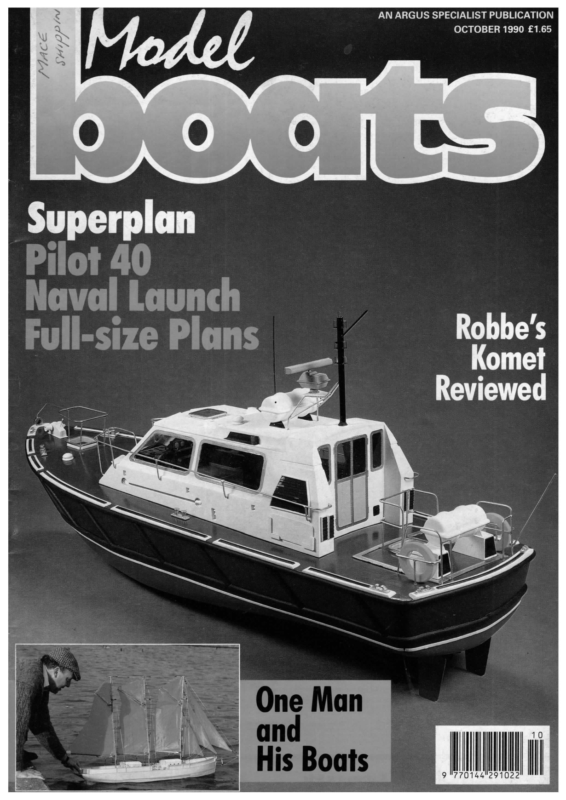
- One Man and His Boats Captain Bob Moggridge outlines his modelling career — with photographs by Ray Brigden
- Yachts Rule OK? By Nick Weall — A break from the rules this month – but we have answers to questions posed in Parts two and three
- CURVED AIR Model Yachting News from Russell Potts

AN ARGUS SPECIALIST PUBLICATION OCTOBER 1990 £1.65 é [oe | con ee Ol Pilot 40 Naval Launch Full-size Plans and His Boats Robbe’s Komet Reviewed
Captain Bob Moggridge outlines his modelling career — with photographs by Ray Brigden adaptable method, I even made a showcase model of an Ivatt Atlantic, building the boiler from the same construction! WhenI left the Army Air Corps in 1984, my wife and I chose Chesham to live in and from the first weekend, my eyes focussed on the pond in the middle of town. It had everything one would wish for. An island to navigate round, kerbstones on every side, deep water at the edges, everything except boats. On Chesham Pond Duly inspired by my new abode, I got off the shelf a model I had built some years earlier. It was a model based on Vic Smeed’s Guardsman. I increased the size by a ratio of 1.7 and fitted a steam plant with a vertical boiler to my own design, with an engine built around the cylinder of a Hornby Rocket. This little engine turns over a 3in. prop quite happily making the boat fairly boil along. It created quite a stir when first seen on the pond. The next excursion was a model of the floating restaurant at Berkhamsted. Basically a 55ft. narrow boat, it was so successful the owner of the restaurant bought it and it resides now as part of the decor! I sensed a problem entering my modelling policy, because whilst I was getting immense satisfaction building the models, the challenge of operation was missing, especially with electrics. A hen I was a boy I was fortunate enough to have a father who encouraged me in the use of hand tools and the value of craftsmanship. An eminent engineer of repute, it is nice to be able to claim that snippets he passed onto me are still regarded as ‘gems’ by the youngsters I try to encourage in our model crafting arts. I should explain, first of all, that ‘Captain’ does not elude to a nautical background but is in reference to the fact I have a Commercial Pilot’s Licence and as an aircraft commander am referred to as Captain in the aviation industry. I have to confess my modelling tastes are not confined to boats. During my modelling career, I have made a Din. gauge passenger hauling loco, over 200 model aircraft and over 20 boats. A first boat My first model boat was live steam, 46 such was the privileged upbringing I had. It was bought as a reward for passing the ‘eleven plus’ from a, sadly now defunct, model shop in Willesden called Turners. This notable gentleman specialised in making boats from Smith Crisps Tins. She was 38in. LOA, all in tinplate and bore two funnels and the name of Falaise. The engine, for its day, was modern and unusual. It was a vertical twin made from aluminium, with a sliding cross head servicing both cylinders. It looked like, and revved like a small car engine. Alas, this boat was not one that endured in the family, unlike other models that came my way in later years, but the White Stone pond at Hampstead Heath gave me many Sundays of enjoyment. Over this period, my own models were predominantly plank-on-frame. This was balsa for the aircraft and spruce for the boats. Other than chine hulls, I have found no reason to change over the years, it is an surprise gift of Model Boats by Vic Smeed gave me an urge to try RC model sailing, and suitably inspired, I constructed a freelance yacht from a piece of wood unwittingly donated by the Chesham Station Restoration Project. The said piece was one of the entrance pillars, a noteworthy billet inasmuch as the station celebrated its centenary last year and the growth rings showed the pillar to be cut from a 60 year old tree. This means that some time during the Crimean campaign, the wood for my boat was growing. No problem with seasoning here! A beautiful smell of pitch pine permeated through the house as my router hollowed out the middle of the hull and after an obechi deck was applied and everything suitably varnished, my trusty Futaba was fitted and off to the pond we went. As a policy, I elected, as I had with my steam boat, only to use rudder. In my book, winches are for the MODEL BOATS
a Opposite, Bob’s latest model to be launched is a three masted sailing schooner with R/C. The 60in. overall and 10in. beam model travels at breathtaking speed when running before the wind with its powerful sail plan. Right and below, one of Bob’s fleet is this vintage rebuild of a 60 year old 6M yacht that has a fine turn of speed when under R/C. OCTOBER 1990 ee oe The neat herringbone patterned timber work on the radio hatch, and bottom, simple and effective brass deck fittings, the latter contributing towards a good sailing performance.
MODEL BOATS
modelling trade. I enjoy fiddling with sails at the pondside and all my boats have radio for homing devices only, as Herts and Bucks do not have many ponds with all-sides access. The boat sailed superbly and gave me the hankering for another one preferably, for I am just like any other schoolboy, bigger. Restoration The solution came from an unlikely quarter. There are golf widows, aviation widows and all other sorts of long suffering females universally enduring mass absentia whilst husbands indulge in their hobbies. My wife is a sixth dan black belt in this discipline as she has to suffer widowhood from full size aviation, model boats, real boats, model aircraft and preserved railways. However, she came upon a very graceful hull of 30’s lines in a model shop in North Wales toting a Stockport auction ticket. The hull proved to be of venerable bread and butter construction, the poor thing had a split keel, finally succumbing to the mass of a beautifully moulded keel weight of some 9b. There was no deck, daylight in some of the seams and evidence of bleaching as though she had forlornly lay by a window, forgotten. The boat had been dropped on its pintle at some time and the resulting concavity filled with Brummer (remember this, the stuff we used before Isopon?). Now I have used a lot of Brummer and remembered seeing it part company from wood with no other application that sunlight. Examination of the keel and after fin showed substantial and solid wood, so I fashioned a solid beam to mortise into the rear of the hull and reasoned that with some long stainless Philips screws, I could enforce the concavity out, and if heat were applied at the same time, remove the Brummer completely. My wife commerited the garage experienced unprecedented drama when, having pre-drilled the hull, I applied screwdriver and blowlamp together and with a loud report, the Brummer came cleanly away in three biscuits. After I and the wood cooled down I wetted the outside to prevent splitting and then, with liberal application of Araldite, I permanently screwed the new wood into the stern and fin. At this point, my mother-in-law donated an old desk top of about the same era and asked if it would be of use. OCTOBER 1990 It was *in. thick and I saw it as an excellent midships bulkhead if suitably fretted and shaped. Two days anda packet of fretsaw blades produced a substantial tabernacle foundation which, when epoxied into the middle of the hull, transformed the hulk I had bought into a solid, yet light and graceful hull. I ruefully thought that three months’ work had got me to the stage one would be when walking out of a model shop with a grp hull, but then, there would be no sense of history! A piece of the desk top was fashioned into a long stake, lin.sq. and this was mortised into the bow and the new bulkhead, thus providing lots of anchor points for the fittings and something solid to carry the hull by. The hull was then given three coats of yacht varnish inside to keep body and hull sole together, and the formers were added in preparation for the deck. This was to be Yin. obechi planks, laid up with PVA and spruce for the hatch, diagonally straked to break up those long deck seams. I make all my own fittings and this model was no exception. I departed a bit, however, with the use of a brass kitchen cupboard handle to carry the boat, and the mast dowel was selected to fit wardrobe rail fittings, the end bracket forming a very smart tabernacle. The mast length and sail plan are a compromise. Since I did not wish to enter competitions, the sail plan had to conform to the following: (i) The mast length had to be short enough to fit in the boot of the Jag. (ii) The entire rig had to roll like an umbrella and also rig and de-rig in five minutes flat. (iii) The jib had to have a higher aspect ratio than the main so that the sails could be set with the booms forming a divergent duct, enabling the boat to both run and point without adjustment. (iv) The sail plan had to be large enough to make the boat perform well but not carry so much sail as to need reefing when weather conditions got rough. Above left, Robert with his interesting collection of timber built marine models. Above right, Bob built this handsome free sailing 30in. yacht from a piece of timber that for over a hundred years had been one of the pillar posts at Chesham Railway Station, and being well seasoned, Bob believes the tree could well have been growing during the Crimean war. Below left, the 6M, and the 30in. free sailer at right. 49
This formula has proved so successful that the boat has been taken to sea without detriment. She has been sailed in all weather conditions from very light winds to storms and is always responsive, with superb performance. She will point and run, just as designed and has a turn of speed that causes comment at the pond side. This boat, like the last, has the radios on the hatch roof. I have never mounted my radios in a Plackybox and have never experienced problems, even after removing a pint of water after a particularly lively day. The photographs of the boat speak for themselves and she has given me two years of wonderful sailing, providing me with the incentive and experience to try something really ambitious. Into scale sail In consequence, I drew out the sheer lines for a three masted schooner, loosely based on the Lucille May, Britain’s last three-master, laid down in Corby in 1910. I had always admired gaff-rigged boats and having had a look at the excellent range of Star boats, obtainable at most toy shops, happily sporting two jibs and no winches, I elected to sport three such sails on the same principle. The result, it transpired was a very well balanced sail plan. The hull was built, one might guess, using plank-on-frame. I built the hull to be beamy, with a fat counter (one of my few vices, I love fat counters) and to ensure alignment, I incorporated three keels. One was in the traditional place, with two more forming an equilateral triangle along the length of the boat. This allowed me to plank the boat without a jig, providing the planking was applied symmetrically. Further, I laid up the planks in staggered format, like brickwork. This allowed me to keep the planks parallel for the entire length of the boat, leaving a plethora of comparatively small triangular inserts to be fashioned and set in. This method, whilst not traditional, certainly is very time saving and looks most attractive when finished. I never paint my models, always leaving them in the varnished state and it can be seen from the photographs that the finished effect is most attractive. With the Editor’s permission, I may do some drawings and a further article on these methods at a later date, since it does away with large building boards and jigs and enables ambitious hulls to be attempted. It is a method used extensively in the model aircraft world, all I have done is apply it to boats. The last innovation on the hull is the adhesive. I use PVA, mixed 3 to 1 with water and a dash of Fairy Liquid. The wood dries back completely stain free and when varnish is applied, I have found there is sufficient water content to cut back the glues in the seams and ensure a really watertight seam. With the rigging in mind, the gunwhales were made strong enough to secure upon and at outset, the entire ensemble was designed to pack flat. There are no true gaffs. In practice I made up six goosenecks. The result is the masts can secure their own standing rigging when removed from the hull, with the sail becoming the wrapper. 50 A great fan of Vic Smeed’s ASP marine plans, Bob enlarged Vic’s plans for the pilot boat Guardsman to enable the fitting of Bob’s modified Hornby Rocket steam plant. Again there are no winches, all sail adjustment being made on bowsies. Similiarly, the whole boat is stand off scale, being primarily designed for sport. For the radio this time I built the aft cabin to be a watertight box all the way to the bottom of the hull. The front cabin is a hatch and the cavity used to transport pondside support equipment. A closed circuit for the rudder is used, incorporating picture rail brass braid and fishing swivels, passing back to a steering box with cross hatch work. Hipkiss eyelets form the portholes and masses of screw-in eyelets support the various lines. The bowsies were made from ‘H’ section plastic and sea twin is the standard material for the lines. The sails are rip stop nylon, with the seams given a coating of Pritstick and then ironed. Hipkiss eyelets set into the sails complete the assembly. The keel was cast from 4lb of lead pipe and although not scale, was kept shallow enough so as not to disfigure the hull when out of the water. I know there are oodles of technical reasons for fitting long bulb keels to scale sailboats, but to my mind, the ugliest thing in the world is a Thames sprit sail barge with a modern keel, lying like a stranded whale at the pond side, so there! An interesting feature, when comparing the two boats, is the method one adopts to change direction. The yacht is obviously faster and I naturally turned her by coming about whenI first started sailing with her. This she responds to.with aplomb, turning on a sixpence and zooming off as the sails fill. With the Schooner, a similar tactic will result in the boat coming up in irons and to my surprise I found that her preferred method was to jibe. Friends of mine who have tried her comment on the response if the missen is allowed to coax her rear round and once mastered, she will point and run, behaving like a well-mannered child. In conclusion, the amount of pleasure I have had from these two boats represents a true culmination of a long and happy modelling career. Sunday afternoons are established as an institution at Chesham and it is surprising how many fathers and sons appear on the pondside with models retrieved from attics and garages. One openly admiited it was a result of seeing my boats regularly sailing that inspired him to try. Model sailing is truly a relaxing pastime, away from the rigours of corporate business and the joy I have seen, with young and old alike who come to watch, is more than enough reward for all the hours spent carving duty planks. I trust readers have found this article of interest and would hope the pictures of my boats demonstrate one does not need fancy winches or large budgets to sail one, two or three masters on single channel successfully. I hope the pictures and dialogue serve to inspire others who may be contemplating such a project and look forward to seeing the results as I embark on the next 35 years of enthusiastic modelling. MODEL BOATS ;
to rule 35 “Limitations on Altering stionsposed inkPare reebyNick Weall Answer to Question 2 in June issue I’m sorry about the delay in getting the answer to question two published, but I wished to give everyone a good chance to send their entries in, especially those that enter from abroad. The question, if you remember, described a very common situation, that of the port tack close hauled yacht judging the converging starboard close hauled tack yacht’s course correctly and zipping across the starboard yacht’s bows with inches to spare. What complicated the situation was the starboard yacht’s subsequent luff to tap the port tack boat right on the stern quarter. Rule 36 plainly states that a port tack yacht shall keep clear of a starboard tack yacht. Which at first glance might suggest that the port tack yacht was in the wrong. But if the starboard yacht had not luffed the port tack boat would have cleared the starboard tack yacht! So let’s have a quick look at the luffing ruled – Rule 38 and we see that the heading of this rule in large letters states “Same tack – luffing rights after clearing the starting line.” That was the twist in the question the starboard yacht could not possibly legally luff the port tack yacht. Therefore all the starboard yacht did do was alter course, we thus have to refer OCTOBER 1990 Course” which states – When one yacht is required to keep clear of another, the right of way yacht shall not alter course so as to prevent the other yacht from keeping clear, or so as to obstruct her while she is keeping clear, etc., etc. Whilst several of you correctly pointed out that rule 35 had a part to play in the solution to the incident only one person pointed out that rule 38 only applies to yachts on the same tack. So, whilst the remainder of his answer was a little confused I am awarding this month’s prize to Colin Hayes of Shoreham-by-Sea, West Sussex for correctly identifying the red herring. The common situation that occurs on the water is that if the starboard tack yacht gets a lift, i.e., the wind shifts and thus allows the starboard boat to point higher close hauled, she is inclined to respond to the lift, the port tack yacht that under normal circumstances would have cleared the bows of the starboard tack yacht, suddenly finds a hole in its stern quarter. Under rule 35 the starboard yacht is NOT allowed to tack any advantage of the lift until the port tack yacht has cleared its bows. The starboard tack yacht must maintain a steady predicable path whilst the port tack boat is endeavouring to keep clear. If the port tack boat cannot rely on the starboard boat to hold a steady course, it is impossible for the port tack yacht to safely choose a course to miss the starboard tack yacht. Answer to Question 3 in July issue This is how I set about trying to come up with a solution to question three. It is perhaps worth pointing out that there is no absolute right answer to this sort of question. When judging the answers, what I am looking for is a sound basis for anyone’s calculations with due regard to all rules that have been covered to date through the series. Measure the length of the yacht in the drawing and then project each yacht’s likely course. As two yachts converge on a collision course one or the other must take some avoiding action, either by slowing down or altering course. We ignore speeding up as being an extremely unrealistic solution in most situations. It takes the unmarked yacht on starboard, which we shall now call X, two boat lengths to have the port bow quarter adjacent to the mark and three lengths to round it, three and a half lengths to clear it. It takes 1 around a boat length of travel to tack to starboard and start to round the mark – in the process of tacking some speed will be lost, depending upon the speed of approach, but 1 should be on the starboard tack before X has to take avoiding action (Rule 41.2). There most certainly will not be room for 2 to try and sneak in on X. Any attempt by 2 to tack across to starboard to miss X would simply put 2 straight into the mark. X is on the layline for the mark and there is no room for 2 to leebow X. Therefore I think 2 must slow down and take X’s stern, calling for water to 3 to avoid an obstruction (X). 3 in turn must call for water on 4 so as 3 can give water to 2. As soon as 2 has cleared the stern of the unmarked boat, she can tack to starboard and take third place round the mark. Likewise 3 can tack to starboard as soon as 2 has tacked to take fourth place round the mark. However, 4 will not be able to tack (Rule 41) until 5 tacks to starboard. 5 has just proceeded along the port layline until at three boat lengths she has to slow downa little to miss the stern of 3. 4 cannot tack to starboard in any case until 3 has tacked, by which time 4 will be above the layline, which would, I think, possibly allow 5 to tack inside 4 to starboard to round the mark ahead of 4 whatever 4 does. So final positions 1 first, X second, 2 third, 3 fourth, 5 fifth and 4 sixth. It is worth mentioning that a more prudent skipper of 1 instead of running the risk of possibly being accused of tacking in X’s water to round the mark, might have simply sailed on to port across the bows of X and then tacked to starboard on the outside of X, thus allowing X to round the mark first. The name of the winner will be announced in the next issue. 51
pologies for the hiatus last month. I simply got snowed under with paperwork for the RM World Championship at Fleetwood. I should never have let on that I had a new computer and a laser printer. “Fine, you can do the Programme!” they said. AND the working documents, AND the cover for the Sailing Instructions AND the Protest Form AND the design for the engraving on the prizes. Well, yes I can, but it all takes time, especially as the production process had to be combined with learning my way round the software and coping with a much less sophisticated WP program than I was used to. It’s all Oe yey PY he °* done now and I should havea little time to devote to the more important things in life like the restoration of old boats and the nurturing of the Vintage Group. One side benefit of playing about with the drawing program is the new logo at the head of the column. Poole Vintage Day — 10 June You will understand that I have not had much time to sort out the photos I took at the Poole Vintage Day, but the day itself was a great success. About a dozen members turned up to sail a variety of boats and there were many more boats produced by members and intending members who were still grappling with the problems of restoration and, in some cases, recognition of their boats. My own sailing was fairly limited; a couple of reaches across the pond with my beach yawl, which found itself a touch over canvassed and taking in water through the mast holes when hard pressed. Had I not had other duties to perform, I should have spent more time experimenting with the rig to find a way of sailing her in what, for a boat of her size and type, were relatively boisterous conditions. More about this later in the context of an extremely interesting, if wet and windy, visit to the Isle of Man. The other boat that I sailed was a conversion from a radio 36, a Tempo from the Oliver Lee stable. This is in no sense a vintage boat, only six years old and all GRP and Solartex, but will be my answer to the Southwold rule book that says that beach yawls may not carry a jib, and thus that my little yawl is not eligible for the beach yawl competitions there. The idea was to remove the radio from the Tempo, substitute a fixed skeg for the rudder and attempt to sail her free with her original pivoted una rig. The skeg was made in the same way as the original rudder from two pieces of balsa sandwiching the rudder post; it is retained by forcing the radio tiller hard down onto the top of the rudder tube. The forward end, as seen in the photo, is held 56 a Above, Radio 36 Tempo converted to free sailing: on the right the rear end and ineffective vane gear ona Festive from the 1950’s. Caradoc K997, an Alexander 10-rater dating from 1936. The hull form is very attractive, but the bandaging to hold it together is not. Middle right shows the typical rear end fittings of a Braine steered boat of real quality. central by a length of the ubiquitous sticky tape. What did modellers do before insulating tape? In the final installation a slight location channel will be formed on the hull with a superglue, just enough to prevent the skeg skewing out of the central. The last thing we want on a free sailing heat is a permanent rudder working one way only. The idea was that if the concept worked with her radio una rig, the boat would be given an MODEL BOATS
additional pair of mast tubes and a yawl rig in an attempt to introduce something a bit more up to date to the Southwold scene. Sailing at Poole showed that the skeg was not big enough to get the centre of lateral resistance in quite the right place. The boat would beat well enough, indeed she was very close winded if a bit luffy; she would reach, but kept coming up into the wind. On the reach this was much more of an upset than on the beat and she took much longer to recover from being headed. Running was impossible with only a large mainsail set well out. She went straight enough for about 20 yards, but as soon as the full force of the breeze caught her she would round up. Not quite right yet but sufficiently encouraging to justify the provision for a yawl rig. The next step is to try her again with a bigger skeg. If, as is likely, this is too big the boat can be trimmed out to her una rig by slicing bits off the skeg; when that’s right, the yawl rig can be tried. With two sails to play with, trimming her out should pose much smaller Pe ed a A See Above shot shows where the bandage was ripped off to expose the failed joints, seen in process of being reglued. ‘If all fails use B great nails’. problems, but if necessary the sails can be chopped about readily enough as they are only going to be bin liners. The third boat I took to Poole was an example of Bill Daniels’ 1951 Marblehead design Festive. There is a view of her rear end and vane gear in the photo of the Tempo. She was built soon after the design appeared and the vane feather bears a nice hand drawn Festival of Britain logo to date her perfectly. The vane itself is a rather unusual design that appeared in Model Maker in 1952. The idea was to make a compact and very light mechanism out of surgical stainless steel tubing. The example on my boat was built in brass and I have to say that it was not a success. Whether this was because the workmanship was not sufficiently good to give a really free movement or, as I suspect, that the design was at fault in giving insufficient leverage between the vane feather and the rudder for the gear to be effective in steering gear and moderately well with the vane operating, but on other courses the vane simply didn’t operate reliably. Another boat that will get rudder only radio in the near future. I expect she will be one of the historic “M’’s that will be performing in the margins of the RM World at Fleetwood. As I mentioned in an earlier article, some of the Vintage Group will be there for the latter end of the Championship and will stay over for the scale exhibition and sail-in on the 26th August. Other boats that turned up at Poole included an example of the GRP Victorian hull that Bob Underwood does, which was originally produced by Moss some years ago and some of the old faithfuls of the Vintage Group like Paul Croxon’s 10-r Victoria and Dennis Saxcoburg’s Moonbeams. In the plural because this time Dennis had two examples of his 30 inch boat in the style of the 1950s on the water fitted with rudder only radio and the pair of them raced up and down the lake all afternoon. It was particularly fitting that when it came to prize time it was decided OCTOBER 1990 Above, the interior of Caradoc. Beautifully finished and still with a good coat of varnish. Sec light weather is not entirely certain, but the end result was that it didn’t work. The boat went well to windward with no that, rather than using the prize which our hosts, the Poole club, had provided for a concours d’elegance, an award should be made to Dennis for the sustained effort he has made over several years to bring this interesting project to fruition. There are now three or four boats in existence some in wood, some in GRP and all good looking, good sailers and FUN. Can’t ask for more. An Alexander 10-Rater A pre-war 10-rater. Pre 1914 war, that is! Some photos of a 10-rater, 779 Caradoc, dating from 1936. She was designed by Alexanders of Preston the previous year and built in North Wales by E. C. Taylor, a member of the Llandudno club. So far as I can determine, she was sailed only at Llandudno, but the condition of the boat suggests that she gave her owner full value for the money and time he invested in her construction. She was not a particularly pretty sight when I got her as she had been bound round with bandage and lots of paint as a way of keeping her together and then partially sprayed with blue cellulose in an attempt 57
to hide the worst of it. The rest of the paint work was in poor condition and the oiled cloth sail roll had several suits of sails in it but smelt foul and seemed to be covered in fine white mould. I wondered what I had got for my money and thought again about the wisdom of buying boats by telephone, sight unseen. In the event, as I took the bandage off the horrors were tempered by increasing pleasure at the shape of the boat and the quality of her original construction. She was built bread and butter in pine and the layers were also jointed longitudinally. Rather unusually for a boat of this date the glue appears to have been ordinary scotch glue, rather than the casein types that were in general use by model yachtsmen from the early 1930s. She had been sailed so much that all the glue had leached out of the centre line joint and one of the horizontal joints of the bottom layer so that it required only a very little persuasion to take out a Vintage day at Poole. In the foreground, a semi-scale model of a Victorian cutter produced as a semi-kit in grp by Bob Underwood. triangular shaped section of the lower hull. The first job was to get this refixed in a permanent way and I glued it with epoxy resin. Cramping the joint was impossible given the shape of the hull and the relatively light construction on which the cramps would have had to bear, so I nailed the piece to the adjacent timbers while the resin went off and then withdrew the nails. It is important to pre-drill the nail holes to avoid any risk of splitting the wood, which is quite thin in some of the places where you need to get a good purchase on it to close up the joint. The photos show the technique. As the wood had shrunka little since it was first put into the hull, the joint is not quite perfect and there will need to be some filling and sanding before the hull is repainted. There are nowa lot of holes in the surface which will need to be filled A restored M, Swallow. Probably to a Littlejohn design, she was built but not completed in 1950. Taken in hand by Brian King, she had her maiden sail while | was in the Isle of Man. Goes well even in heavy weather if you put a small enough suit on her. when the old paint is off. The inside of the hull was stripped of the mast step and the small blocks that had brought the keel bolts up through — This is a boat built in 58 1939 Daniels’ 1936 Pocohontas design. There is at least one other boat to this design on the island. MODEL BOATS
the hull. I think part of the problem with the bottom layer may have been that these blocks had been used rather than larger shaped floors that would have spread the wringing strains of the lead over a wider area of the hull. The centre line joints and some of the horizontal joints between the layers of the hull which were beginning to look a bit suspect were filled with resin and the whole of the interior given a coat of epoxy before setting in four of five glass cloth “ribs” to ensure that the hull did not move any further when I started working on the outside. The bolt holes were drilled out to take a tube lining which will permit the fin to be easily removable. When the time comes, proper floors will be fitted so that the hull will survive her next 60 years better than she has the first 60. The fittings, all of which were chrome and standard Alexander patterns, were cleaned up and now look as good as new. The next job is to get all An Older 10-Rater Briefly, two rather murky photos of a boat that is known to have been built by the present owner’s grandfather and to have been sailed to some effect on the lake at Forest Gate in the years before and after the 1914 war. Very heavily constructed and (probably because of this) holding together very well, she has a simple gaff sloop rig. The sail area is about 1393 square inches and the waterline about 43 inches. The displacement is 26 pounds, rather heavier than most 10-r of her style and vintage. Close inspection of the fin shows that there are three narrow This example of the 30in. Sharpie design from Daniels & Tucker’s Build Yourself a Model Yacht came out of a neighbour’s loft when Brian was working on his M. It looks very boxy on the bank, but better in the water. vertical members fore, aft and centre and the gaps between them have been filled in at a later stage; this suggests to me that originally she had an openwork keel and was filled in at some stage under the influence of the Daniels’ style of boat introduced with XPDNC. Though the fin and skeg form is typical of that used with Braine gear, this model has an earlier and simpler form of sheet to tiller gear. The owner became interested in the boat, which has been lying in an attic for some 50 years since it was last used, when she was researching the history of her family. We spent an afternoon sorting out which club her original owner would have belonged to and which local papers would be worth looking into to find whether, as family tradition maintains, she won cups and things in her youth. It looks as though she will be restored and sailed again in due course. Second of the 36’s engaged in the regatta. One of the 36’s engaged in the Port St Mary regatta. Both date from before 1939. the old paint off and make good the dents and scratches of a long and active career. I think it may be politic to combine this with the stripping of the front door of the family home which has been wanting a repaint for some long time. The sail bag, which I had been warned to open only in the garden for fear of spreading leprous spores all over the house, proved to contain a full set of four suits for the boat, two of them by Charles Drown and two by an unknown maker with the monogram “ET” or “TE”. All of these were in Union Silk and in remarkably good condition for their age, as were the two spinnakers, one flat cut and one balloon which clearly belonged to the boat. The white mould turned out to be french chalk or something similar that had been put on the sails when they were rolled up for the last time. There was a varnished terylene top suit that suggests that the boat was still being sailed in mid 1950s. As well as all these 10-rater sails, there was also a suit in Perks “XL” sailcloth which would be about right for a Marblehead of the period, and couple of suits of cotton sails OCTOBER 1990 that looked about right for a 36. These had Sunray and some numbers carefully lettered on the hem, but the numbers aren’t the same. Neither of them yields a Sunray from the Register, nor do the figures add up to the areas of the sails, so I’m a bit flummoxed as to the significance of it all. The final gem, crushed into the bottom of one of the sail roll segments, was the original sail plan drawing done by Alexanders on tracing paper in October 1936. Manx Interlude Some time ago I carried some photos of vintage boats that had been restored on the Isle of Man. The proud owners invited me over to attend the annual Port St. Mary regatta which is held on July 5, Tynwald Day, each year. This has been running about three years now and is the beginning of a revival of sailing on the island. From the boats that have been appearing it is clear that there has been serious model yachting on Man since the 1880s at least, with active clubs in Douglas, Ramsey and Port St. Mary. The Ramsey club sailed on a large lake in Beach yaw! with full and reduced rig. When the mizzen is off you need only a tiny bit of jib to hold her off while the main gives power. 59
long after the design appeared. Competition is still a bit rudimentary and getting the boats up and down the lake in the strong wind was a sufficient challenge. The smallest class, under 30 inches was allowed to sail across the width rather than attempt to get the boats away in the very heavy chop at the lee end. This meant that my yaw] should really win something, given a beam reach both ways. The only problem was that the wind was knocking her flat if I carried all the sails. Removing the mizzen and slacking off the jib ’til it was barely working gave a good reaching trim and the boat could keep her feet with only the main doing any serious work. In this trim her speed was such that she was half way across a fairly small pond before I could haul myself to my feet after setting her off. When it came to the race, I managed to complete four crossings while the others were just about doing three, so it was a satisfying end to the visit. One particularly interesting boat that came out after the racing was over was the cutter Redwing, built in the 1880s Redwing, a Manx cutter of the 1880’s. Mooragh Park and the Port St. Mary outfit built themselves a pool on a headland overlooking the harbour in 1937. Prior to this they sailed on various natural waters. There were professional model builders in Ramsey; the grandson of one of them still has a boat that was built in the early 1920s for a retired officer visitor to the island and correspondence about the payment of the fee of £7.50. The boat is a 12 metre style of hull but a bit smaller than I would have expected, very finely planked in mahogany and may have been intended to measure as an 8 or 10 metre. As the boat is still in Ramsey, the customer must have omitted to pay up. The number of boats that have come out of the woodwork since the sail regattas have started up again suggests that model yachting was a major pastime in the island. Many of the boats that Hugh Revill, the main protagonist of vintage sailing craft on the island, has found are typical 19th century straight line pond yachts with deep hulls and lots of sail in gaff cutter or schooner rigs, but there are also class racing boats from the 1930s incuding a 10-rater, Marbleheads and 36R. Organised sailing seems to have petered out in the late 1950s; the locals attribute this to the younger generation moving over to dinghy sailing as the post war boom in small boat sailing took off. During my long weekend on the island it either blew hard or rained or both, but we got in three sailing sessions, two at Port St. Mary and one in Ramsey. At the deferred running of the regatta proper held on the Sunday after the wind proved altogether too strong for everyone on Tynwald Day itself, there were five free sailing Ms, three of which were pre-1939 designs and two from the 1950s, three 36R, a 1930s 10-r, a couple of Veron kit models from the 1960s, a 12 inch paper boat and my beach yawl. A few radio controlled boats also competed, but the sail interest is mainly in free sailing at present. Among the radio boats was a 36 to the 1951 design Lady Betty which Hugh Revill had built before he retired to the island, possibly fifteen years ago but 60 She went up and down the pond with great ease to the delight of her elderly owner. This was one of her smaller rigs. MODEL BOATS
and still in the same family. Her present owner is too old to sail her and she had not been in the water for twenty years, but she had had a repaint in anticipation of her outing. She went like a train, storming up the lake without a rudder and going straight down the middle on the run on one of a selection of siz or seven swing rudders made from lead sheet. Her owner looked once down the lake and said “number 5 should do” and he was right. An object lesson on what can be done with the simplest equipment. One item I had not seen before was a large wedge that went under the main horse to hold the sheet over to one side of the horse, giving a much closer trim if the boat should get onto the wrong jibe. As the owner had made such a good judgement of the rudder to be used, it was hardly called for, but the effect is to heel the boat much more severely on the “wrong” jibe so that the rudder very quicky brings her back to where she ought to be. For the rest of the Model Boats readership there are masses of the motor cruisers that scale power men find so attractive. There is a wide range of scale power boats of many different types (for instance there are a dozen submarine plans). Most of the originals are of French origin including a generous coverage of French naval vessels of all periods; to me, they look a bit out of the ordinary compared to the general run of scale models in this country. The plans are prepared to a high standard and the more recent ones are packed by articles on history and construction which are very good value if your technical French is up to it. The catalogue is available, as are the plans, from Ian Tunstall, MR Plans, Springfield Bungalow, Butlers Cross, Aylesbury, Bucks. HP17 OTS. Prices are very reasonable considering the high quality and completeness of the drawings and the additional costs of import. MRB Plans Handbook The well respected French magazine Modele Reduite de Bateau has been producing plans for model boats of all types since its foundation in 1942. They produce a handbook of their products similar to that which comes from Argus Plans Service and a copy of the 1989/90 edition has just reached me from their new UK agent. From the point of view of this column, the catalogue is particularly strong on scale sail models including versions of Australia IJ the America’s Cup winner in 1983 and the J class Shamrock from the 1920s, quite apart from a wide range of models based on French sailing fishing craft of the turn of the century. There is a good selection of modern radio yacht designs including a number from the board of Paul Lucas who is one of the few designers who manages to produce boats which both go fast and look good. The two do not always go together by any means, as any cursory inspection of the boat park at a radio regatta will reveal. OCTOBER 1990 61