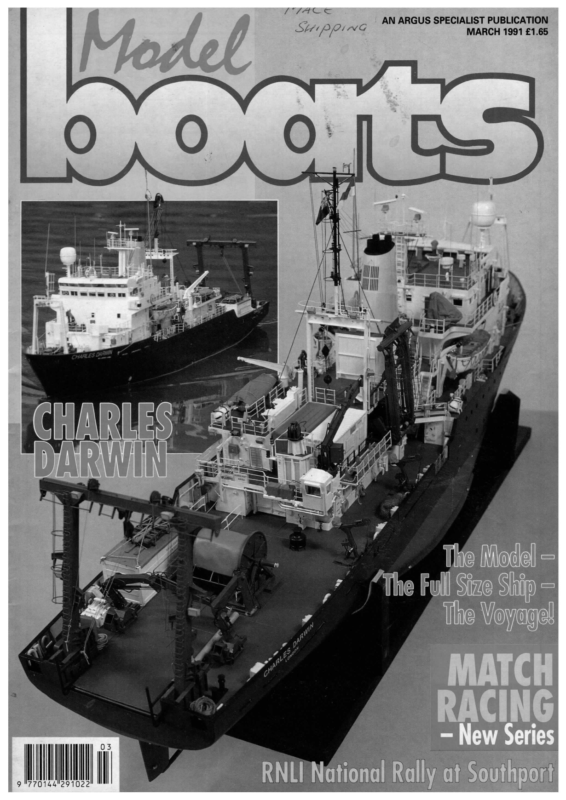
- Match Racing We welcome Bill Green, who will be presenting a regular bi-monthly series on all aspects of Match Racing.
- Yachts Rule OK? Nick Weall presents Part Nine of his introduction to yacht racing tactics and strategies
- CURVED AIR Russell Potts on Prospero, Bassett-Lowke, 30’s models, amongst other matters

LSFACES ~ _ St PPiNG 7 El 2 a 0 a Ge ee eo AN ARGUS SPECIALIST PUBLICATION MARCH 1991 £1.65 ‘ ak | Rall
MATC ello and welcome to the first of a series of articles which will concentrate on Match Racing of Model Racing Yachts in all its We welcome Bill Green, who will be presenting a regular bi-monthly series on all aspects of Match Racing. forms. Match Racing covers all of the free sailing events and primarily Radio 6 metre class boats, although some match racing of Radio Marbleheads does take place. I think I’d better begin with an explanation of what Match racing is. In its simplest form it is competition between two yachts; in practise it is much more complex and there are variations between radio and free sailing. Now before any one has any strange ideas that free sailing has shrugged off its mortal coil or even possibly is an ex-form of competition allow me to assure you that in this country, at least, it is alive, well and definitely kicking. As far as the rest of the world is concerned I’m afraid that it is virtually extinct, but I think that has more to do with availability of suitable lakes than anything else. Free Sailing The UK has a very active vane fleet and a full schedule of races throughout the year and the country. There is constant development in all the classes that are recognised by the MYA (Model Yachting Association) but development is much more orientated around minor detail changes rather than wholesale ‘throw it away and start again’; evolution rather than revolution is the name of the game. A vane sailor tends to hold onto his boat, tweak it and tune it, until its optimum performance is realised on a consistent basis, and then make a considered judgement whether increased performance can be obtained from a different design. This optimisation process may take years rather than a season. The only other reason for change will be because the boat is so badly damaged from racing that it has to be replaced. Free sailing boats do take a hammering just by the very nature of the sport, no matter how careful the owner is. Damage occurs from collisions with other boats, which in most cases is unavoidable, from the inevitable ‘bash along the bank’, and from head on collisions with the bank. The other major source of damage is from the stresses and strains of competition. There are those who consider that because there is not a high turnover in boats that development is not occurring. They are wrong! If you take a look ata typical vane fleet you won’t find any swing rigs, you won’t find much carbon fibre and even less Kevlar. All these are developments which have been brought about to fulfil the requirements of ‘round the buoys’ radio racing. Vane sailing is essentially about straight line performance which has a different set of criteria and hence a different set of solutions. Because radio solutions tend nat to be adopted by the free sailors does not mean that development has stagnated; it is simply that a different set of criteria is being .satisfied. During the next few articles I hope to be looking at some of the changes that have occurred to illustrate my opinion. 16 res oe Blitz is one of the latest breed of vane “M during the Nats in 1989. Below, this is what Free Sailing is all about. Two “M’s barrelling down the run, two excellent trims and it will be anybodies guess which will win. In this case Alaxix (L) beats Jitterbug (R) after a flying run at Fleetwood in the “M” Nationals in 1988. Radio Match racing under radio is becoming very popular, particularly for the Radio 6 Metre class. For successful match racing under radio what is needed is a class of boat which has relatively similar performance across the designs range, and the aptitude of the skipper for head to head competition. The 6 Metre and the current crop of skippers sailing the class fit that bill beautifully and as result the class has seen a dramatic upturn in interest. Until this year 6 Metres were found either in the Midlands or in Scotland, and there where odd ones about in other parts. That is now not the case as North Wales MYC, Brentwood MYC, Lee Valley, Cotswolds MYC, Solent MYC have all adopted the class, and clubs like Etherow are seriously considering it. All of these clubs are turning away from RM’s and moving to 1 Metres as their main racing machine, with 6 Metres as the alternative boat. They have many attractions:- 6’s look good, they look like the real thing, they behave differently from the likes of 1 Metres and RM’s, they lend themselves to strip planked hulls which has its own appeal, and they are cost effective. Their biggest attraction is that they have long competitive lives. This is possible because of the Rule which governs the class; it is probably the most difficult of the MYA Class Rules to read. The Rule has put folk off the class in the past but now
skippers realise that the Rule is primarily for the designer and the measurer, and providing that the hull is constructed accurately to the design, then the rule is of little consequence to the owner \builder. Match racing this class of boat has one major advantage over fleet racing. The current numbers of boats is still pretty small, probably 3-4 boats per club. In my Above, tight competition is one of the joys of any sport. These two “A” boats are neck and neck after fighting it out over the length of Fleetwood lake which is the best part of 900ft. Taken at the 1989 Nats. Below , who says 6 Metres don’t go! Billy US is flying. 1991 Free Sailing Season So having given the uninitiated a brief taste of what match racing is about, what does the 1991 season have in store for the free sailor? Most of the interest revolves around the Nationals and for the first time humble opinion this makes for pretty boring fleet sailing, however if they are match raced the interest in the racing is back up to the normal level. You only have one opponent at a time to consider and you can put all your sailing effort into beating him. I also believe that match racing is, in a pure sailing sense, far more aggressive than fleet racing. That statement would lead you to believe that match race events are not very friendly, but like the free sailing regattas they are. Whilst competition on the water is very intense, sportsmanship has been of the highest order so far. In the whole of 1990’s match racing season there was not one protest, even including the National. It was common to see skippers doing their penalty turns without being screamed at. Off the water the atmosphere is great; there is time to chat, time to take a look at the other boats, and time to watch the tactics of the others. Again you could be in ages there is considerable threat from fooled into thinking that these are slow going events and again you would be wrong. At the last of the Match race series at Bournville there were 17 entrants and for most of the time three pairs of boats on the water at one time. There was no lunch break, just continuous sailing, and you have to bear in mind that there was the added complication of 17 entrants and 12 boats and two of the boats were out of action for most of the race. It can all be summed up as great fun and This photo was taken at the inaugural R6m event at Bournville in 1987. For a change Nemesis rounds the mark ahead of Transition. MARCH 1991 that for me is what this crazy hobby of ours is about. If you want to try some match racing at your club it is very easy to organise. I’ll be dealing with that in the next article, and I shall also be taking a look at the actual practise of match racing. the Fleetwood Club. This threat is entirely due to the efforts of Derek Priestly and his entourage of enthusiastic youngsters. Derek has done a grand job in recruiting and encouraging these lads and he has taught them to sail in his own inimitable style. Everybody has contributed to the effort by handing over anything which is usable by the merry band. As a consequence these lads have had passed on to them some competitive stuff and in a short space of time have grasped the principles of not only free but radio sailing. We have already seen this band descend on Birmingham for the A weekend and I’m sure on their home water, where the M and A Nationals are to be held, they are going to pose quite a challenge to some of the established free sailors. One thing is certain they are going to boost the numbers considerably. Who knows, from this group of lads may come the National Champions of the future. I, for one, hope that this happens andif it doesn’t, it won’t be for a lack of effort on Derek’s part. Who are the characters that make up the cream of the Vane fleet? Alex Austin made a virtual clean sweep of the 1990 Nationals, taking the 36, M, and 10r Nationals as well as being one half of the team that won the M Team National. Now that is a difficult act to follow, but knowing Alex it is perfectly possible for him to repeat the performance. What is interesting is that his 36, M, and 10r are all his own designs, as will be his new A boat. Alex is one of those people who plug away at a boat until it performs with absolute consistency and then and only then will he change it to gain further advantage. His boats are always being modified, albeit in small ways, to improve their performance. As ever, in 1991 he will 17
Match Race Series 1990 Series Summary Result Competitor Club M Kemp M Ewart A Bright W Akers W Green P Heys D Trippe BCawley N Rothwell R Neave V Bellerson G Williams R Pierce M Peabody P Legg C Chambers G Casey S Bright Dovecote Dovecote Chelmsford Birmingham Bournville Brentwood Cotswold Cotswold Woodspring Cotswold Bournville Guilford Royal Wind. Sneyd Royal Wind. Dovecote Sneyd Chelmsford Racel % Stoke DNC 7 DNC 7 7 DNC DNC DNC DNC DNC DNC DNC DNC DNC DNC DNC DNC DNC dns Race2 % Race3 % Dove 0.00 11 0:33: 5 S10… 0.00 0.33 0.33 0.00 0.00 0.00 0.00 0.00 0.00 0.00 0.00 0.00 0.00 0.00 0.00 0.00 7 «2 6 3 DNC _ DNC _ DNC DNC § Bham 085 | “0.77: Race 4 Discs Final’ Position 0.54 0.15 0.46 0.23 0.00 0.00 Score 2.65 1 pnts. 2 (164 139 1.02 0.90 G36. 0.86 ). The 10R is the fastest of all MYA classes. It is a machine built and sailed simply for speed. Nothing « compare with the exhilarating sig of a 10R, spinnaker full and the ht on the plane. This photo shows Breathless, a 10R design by Alex Austin and it demonstrates how clean they are through the water. 3 4 5 6 7 7 9 DNC. DNC DNC DNC DNC DNC DNC DNC DNC:- Did Not Compete be difficult to beat. Peter Maskell is a man again who develops a relationship with his boats over a long period of time and will always be difficult to beat. Martin Roberts, one of this country’s top radio skippers can be guaranteed to do his best, and on his day is a formidable opponent. What of my club mate Mike Harris? Well he has been around the vane scene since Adam was a lad, and you cannot ever write him out of the equation. What about the ever increasing group of folk who fill the minor placings and occasionally make it to the top ? I could write for ever on their potential but all that I would achieve is speculation, which can be fun, but is uncertain, and it rarely achieves anything except to annoy some. Best to see what really happens because you never know, but Ill be there to tell you what happened. Watch this space. 1991 Match Race Series for R6M Class If I had been asked this time last year what my highest hopes for the Radio 6 Metre class were, I would have replied a small, but dedicated, band of followers; that the circumstances that had inhibited the growth of the class for years would still be in play: that classes like the 1 Metre would have much more universal appeal; that as ever the class would be confined to the Midlands, except for a few assorted likeminded fruit cakes; and that we would all have a good time doing something different.I was hopelessly out with all these expectations. ~ Certainly the year started out that way with myself, Mike Ewart of Dovecote MYC and Bill Akers from Birmingham having a great time at Stoke in light airs and swinging conditions. The next event at Dovecote saw the appearance of Mike Kemp – Dovecote MYC, Alan Bright – Chelmsford, Paul Heys – Brentwood; some of these guys were borrowing boats. The weather again was light airs and a cracking time was had by all. What we needed was a good blow to sort out a few of the cobwebs and we definitely got that at Birmingham. By now we had added Neil Rothwell Woodspring and Simon Bright from 18 Chelmsford to the already assembled multitude. Then came the National, where we put the cat amongst the MYA pigeons, by not only holding the event on a match racing basis but by allowing the OOD to sail and win. Shock! Horror! Probe! Fancy turning most of the sacred cows of the MYA on to their udders. By now we had added David Trippe – Cotswolds and Jack Day from Dovecote. Then came the Midland District at Sneyd and we added Charles Chambers from Dovecote to the regular crew. The real biggy was the final event at Bournville, which saw Richard Pierce and Paul Legge from Royal Windermere, Gerry Casey and Mike Peabody from Sneyd, Brian Cawley and Roger Neave from Cotswolds and Vic Bellerson from Bournville join the now swelling throng. You will have now gathered that this thing was taking off at about warp factor 5, and most of my preconceptions, were rapidly being thrown happily out of the window. Bournville club was being inundated with requests for measurement, causing us to increase the number of available measurers, my phone was and still is red hot from folk trying to find out more, where they could get hulls, what designs where available, can we host a race and can I join the throng. I was absolutely amazed, nay dumbstruck, by the response. At the request of the MYA, Mike Kemp and myself have written the Match Racing Rules and the MYA have recognised that the Match Racing Series will provide an entirely new MYA National Champion for 1991. The series calendar for 1991 has been extended to 6 races and new venues like Lee Valley, Cotswolds and Brentwood have been included. The calendar is as follows: Race 1 Venue Brentwood Date 3 March 2 Dovecote 7 April 3 Lee Valley 4 Cotswolds 19 May 7 July 5 Sneyd 6 Bournville 13 October 3 November The 1991 National is to be held at Windermere and should provide a great venue, not only for the competitors but fo: the assortment of wives and gir] friends who perhaps are not as hooked onto mode yachting as some of us are. Perhaps some our friends from North of the Border wou care to join us. I know some guys from North Wales and the Isle of Man have certainly expressed an interest. So it is clear that the message is spreading to the four corners of the UK at a most amazing rate of knots. Why should this class take off in the manner it has? I have had the opportunit of talking to many people and there is a common thread throughout the conversations. They are turning away fro RM’s mainly because of the expense of keeping up with the rest of the pack, and are looking for an alternative class of boa to sail in conjunction with their 1 Metre, they enjoy sailing competitively but want do so without some of the aggravation which seems to occur wherever RM’s are sailed. They do not want a big boat like a A; it poses too many transport and storag problems. The 1 Metre is so similar in performance terms to the RM that there i little difference. The 6 Metre seems to fit their bill and they look and behave like tt MODEL BOA
real thing. They also want a more friendly and honest form of competition which match racing seems to provide. As I mentioned earlier the spirit in which the events so far have been sailed has been superb and I sincerely hope that this can be maintained and encouraged. For those of you who want further information on available designs, below is a list. Some of these are line drawings for planked hull construction and I suggest strongly that you build accurately to these lines otherwise you could find yourselves incurring penalties which could seriously affect the final sail area when measured. The measurement of this class of boat is a tricky and painstaking job, it normally takes between 2-3 hours and it is not made any easier if the construction does not measurement process. Inevitably the sails that you have will not be the sails that are required. This is not so bad if the sails need to be reduced in area as they can easily be trimmed to suit. If you end up with more, which is possible, then you either have to put up less than you are allowed or go out and buy another set. Both of these are going to involve you in some expense, the one more than the other and it is unnecessary if you think about it. In the next article I’ll be taking a look at the measurement process and offering some advice on what you need to do before Design Name Glenrosa Designer Alexander Bob Underwood Tern A Brewer Tern Wild Rumour Address & Phone No G BantockSails Ete. J Lewis J Lewis ___siR Stollery Hull & Wiltshire BA15 1QR, 02216 5224 6T6 Tony Able Kit High Noon, Petersfinger Road, Salisbury Wiltshire SP5 3BY, 0722 24677 All the above designs have been proven in competition either under radio or vane and each has their individual little foibles. G Bantock G Bantock Type Mouldings you offer your boat for measurement. Revival Revival | Phone Number wise not to have the actual sails when the Renaissance you do not fancy your chances with the mainstream. Please heed my words concerning accurate construction particularly concerning the kit boat; the style of construction ie:-hard chine ply panels can give problems with hollows being created if you are not very careful. Also please bear in mind what I said concerning sails as they are provided as part of the kit. Address & Also be careful with your sail selection; it is Design Name __ Designer themselves in serious competition, but you may. find them attractive for fun sailing if 6 Winsley Road, Bradford-on-Avon follow the designer’s lines. It also helps if the owner can get the boat to sit on its correct design water-line and is at the design weight. This is not as difficult as it first seems as most 6m’s will fit into the average bath and with a bit of juggling can be made to sit on the design water-line. boat is first measured because the sail area allowed is a direct result of the There are a couple of others which are available, but as yet have not proved 141 High Street, Kelvedon, Mouldings Essex CO5 9AA, 0376 71437 Type Hull & ; As Above Mike Butler Drawing Hull & Touchwood Products Unit 10, Attwood Street Lye, Stourbridge, 0384 424025 Mouldings Ken Butler( after 6.00pm) 0562 886137 J Lewis 4 Monument Lane, Rednal Birmingham, 021 453 7423 Drawing Mike Butler Hull & Touchwood Products Unit 10, Attwood Street Lye, Stourbridge, 0384 424025 Ken Butler( after 6.00pm) 0562 886137 Ray Baker 8 The Meadows, Fareham Hampshire PO16 8UM, 0329 236288 Mouldings Hull & Mouldings If you are like me a reader of our sister magazine R/C Boat Modeller, you will now know that they have recently published a new John Lewis 6 Metre design, and if the rest of the Lewis stable of is anything to go by it should prove itself both to be attractive and winner. Bill Dicks I could not let my first article for my new magazine go by without paying tribute to Bill (Poppa) Dicks, who passed away late last year. Bill had always been involved in model racing yachts and in his day he was one of the best. I got to know him over the last ten years. Bill was very mucha part of the vane circus, although over the last years he was not an active participant. Whilst his legs were past their best, his eyes and his mind could still pick up the tiny differences that separate a good trim from a duffer, and he would tell you what to do to correct it. Inevitably he was right. I know that I shall miss him being around as will many others. I hope that this article has opened your eyes to the possibilities and attractions of Match Racing and I shall be returning in two month’s time to add a little more. This will remain as the everlasting visual memory of Bill (Poppa) Dicks. Standing on the causeway at Fleetwood, water lapping around his feet, all the fleet has gone, the sky is leaden, the wind is freshening and there is a nip in the air. Bill was there to start the next windward board as he did all that day. MARCH 1991 19
Nick Weall presents Part Nine of his introduction to yacht racing tactics and strategies his is the ninth article in a series of articles introducing would be Model Yachtsmen to the tactics and strategies of yacht racing. In order to do this properly it has been necessary to include basic references to the rules. Without rules yacht racing can become a shambles at least and at worst serious damage can result. In full sized racing of coursé the other major element comes into play – that of lives being risked! So it was that rules evolved and anyone who thinks that they can simply race and ignore the rules is in fact denying themselves the opportunities that the rules offer the racing yachtsman to defend his position or to safely attack a yacht ahead so that both parties have some idea of each others’ reactions. We have been following the fortunes of an imaginary radio controlled yacht “C”,one of a small fleet of five yachts racing around what we tend to call “A Triangle, Sausage course”; that is an Olympic type of course, starting off with a windward beat up to the windward buoy, leaving that to port and bearing off 135 degrees towards the wing mark. We leave the wing mark to port and gybe through 90 degrees and broad reach down to the leeward mark, again leaving that to port – we then harden up, pulling the sails tight in and proceed to beat up the course to the windward mark again. Once again we leave that to port and bear right off and assume a running-before-the-wind course down towards the leeward mark. That is as far as we have so far got. You may be relieved to read that the race is coming to an end! Once we have run down to the leeward mark and left it to port, all we will have to do is harden up and beat up the windward course to the finish line! There is still plenty of time however for mistakes to be made and places gained or lost upon the water. Running Running is perhaps rather a paradox in so much as at first glance it appears very easy and even rather boring. Perhaps that is the first danger, because in reality it is far from easy, and if you allow yourself to get bored by the relatively slow moving yachts you will surely be in danger of losing a place or two! Being novices however, at this stage of studying racing techniques the most important thing to remember is to concentrate. As we have mentioned many times before keep a good eye on what other boats near to you are doing. If you are not too sure which is the best course to follow running down towards the leeward mark, don’t be afraid to simply follow the crowd. If we continue to ignore the effects of 50 windshifts, it is in fact quite interesting that widely differing courses taken by yachts that round the windward mark together down to the leeward mark, usually have all the yachts converging again in much the same order as they approach the leeward mark! Indeed taking it to extremes I have even witnessed a yacht that forgot that it did not have to round the wing mark, round the wing mark and still get to the leeward mark at much the same time as those yachts which simply sailed directly to the leeward mark from the windward mark! Have a look at diagram 1. This simply reminds you of the positions that we left our fleet of five in at the end of the last article. We will now have a look at the basic thoughts that should be going through the various Skippers, minds. B in front is of course feeling rather pleased with himself so far, leading the race with not much further to go. At the same time he is however biting his nails, as any increase in the windspeed will of course be felt firstly by the boats behind, and they will come rushing up towards B with any such stronger wind. He is also worried about X who is hovering about just behind him trying to steal B’s wind. At present X seems to be trying to get to windward of B, something that B will try and encourage given half a chance. X has only one thought in his mind – how to get past B! (He really ought to have more thoughts in his mind, but still!). X has not been sailing that long and is still obsessed by trying to overtake everything to beating up the windward leg towards the finish line that are on port, will have to give way to any starboard running boat. So it is one less thing to worry about. The other nice thing about running on starboard is that any boat in front of you running on port is going to have to keep clear of you or waste time gybing back to starboard! If it gybes back to starboard in your water and a collision occurs, then the boat doing the gybing will be in the wrong! (Rule 41). In real life of course the wind is hardly so kind as to be blowing in that steady constant direction. Often you will find that you have to gybe to the port tack after rounding the windward mark because the wind is a little biased in that direction. Whatever tack you are running on, the quickest thing you need to sort out if you are using conventionally rigged sails is to get that jib out the opposite side to the main. Having let the sails out to a good running position all that is usually needed is for you to give the ruddera little wiggle, bearing off slightly to flip the jib across and then back to your steady course. Easier said than done, but it usually only takes a few practises to get this simple manoeuvre done first time every time. Once you have the sails out and goosewinged you can take a moment to take stock of the situation. First, how is your boat speed relative to the other boats around you. If you are moving at the same speed as the others, fine; if you are going faster, don’t complain! If as is often the case you are moving slower, don’t panic! Try and see why? Are you pointing in the same windward; he thinks he is going to get better wind and thus better speed, and is convinced that he can respond quick enough to any luff that the overtaken boat throws at him. I doubt that he has seen a violent luff yet, so he has a lot to learn! Our Skipper struggling along with C is of course rather overwhelmed by the closeness of D and A, besides trying to make sure that the sails are set in the right position and more importantly that the jib goes across to the opposite side to the main. You will notice in diagram 1 all of the yachts have their mains out over the port side and thus are all running on ???, Yes starboard! That is because they all rounded the last mark leaving it to their port and thus were all on starboard as they rounded. It is therefore much easier to leave the main out on starboard and run for the leeward mark. If the wind is doing what it should be when the course was laid, that is blowing straight down the lake from the windward buoy to the leeward buoy, then that is fine. In such a situation it is also always to be favoured to be running on starboard. Why? Well if you remember the rule about starboard boats have right of way, it means that a running boat on starboard does not have to ARTICLE 9 DIAGRAM 1 give way to any boat on port. So any boats that are still beating up the windward leg of the course either to round the windward mark from the last leg, or as we near the leeward mark, those yachts that have already rounded the leeward mark and are MODEL BOATS
direction as everyone else? Are your sails set more or less at the same angle as the other boats around you? Is there some nasty boat between your boat and the wind, hogging all of your wind?! If none of these things, is the bow of your yacht being pushed down into the water too far for the weight of wind on the sails? (Perhaps you’ve picked up a bit of weed!) Is the twist in your mainsail all wrong and the top of the main moved forward far beyond the best setting to catch the wind – the wind consequently just brushing straight past. If this is the case sheet in the sails a little. Unless the wind is really honking it pays to be a little gentle with your movements whilst on the run. It is the slowest point of sailing and violent movements are only going to slow you down some. You may recall me writing a little earlier that the Skipper of C was a little overwhelmed, partly because he’d managed to get back in front of D and A, but mostly because they were now sitting firmly on his tail. In fact things are not too bad for C. D has been forced to go to the windward of C, and whilst D night be taking some of C’s wind, all C has to do is to bear off a little for clean air. D of course might simply follow C, but all the time C bears off the blanketing effect of D’s sails will be mostly lost. The fact that C will by this time be sailing by the lee will not help her. Sailing by the lee is when really you should be gybing across to the other tack to get the full benefit of the direction of the wind in your sails. It is only possible on the run and when sailing by the lee it pays to let your main out as far as it will go. Not a thing to do for long, but it can be useful as a short term tactic, when you consider that gybing for what may be a very short period on the opposite gybe would waste too much time and possibly lose too much speed. A, as last boat round the windward mark, has the luxury of seeing exactly where and what all the other boats are doing. Although no doubt he’d rather be up in the front looking backwards at what all the other boats are doing! However he knows that all is not lost and that now more than ever he really must concentrate and try a few tricks to gain places. He » knows that his windshadow will be effecting D and C to some extent and he also well knows that any increase in the wind’s strength will come to him first! His main pre-occupation at this time is to be sailing through as clean water as possible. He will therefore no doubt sail right up the middle of the wake left by C. At some stage he may well bear off to try and break through the wave of the wake and into clearer water. The problem with doing this however is that any wind shadow effect on C and D will be lost. Which Side? All of the Skippers at this stage should be thinking about which side they are going to round the leeward buoy. As we know they are going to leave it to their port. This is the usual side in Olympic types of course. Race Officers always, if they have the choice, should lay a course that allows all marks to be left to port. The reason for this is that it avoids many of the complications that can arise when rounding a mark leaving it to starboard. At the windward mark this often arises in yachts clear ahead tacking to port just in front of starboard tacked yachts approaching the mark with all the dangers involved. I’m afraid not all Race Officers appreciate the potential dangers and I must admit I’ve sailed in some meetings all day long with starboard roundings all the way, without an incident. It does however call for fine judgement on the Skippers’ parts, and a good knowledge of the rules. Occasionally you will get courses set with both starboard and port rounding involved which can make life very confusing indeed. The course then becomes a memory test as well and does throw up the potential for the always very interesting situation where you get a yacht rounding one mark in each direction and meeting half way round! Because we sail from the pond side and often can only use one side of the water to sail from, these are problems that a Race Officer has to try and resolve as best he can. The main thing is to get the yachts racing! At club level this is fine. At open and above level a more careful approach is needed. Anyway all Skippers in this little race of ours know that they are going to leave the leeward mark to their port. This knowledge immediately allows them, if they think about it, to plan which side is the best side to try and overtake any yacht in front. On this run it will pay to try and overhaul yachts in front, passing them on their port side, leaving them to the starboard side of the overtaking yacht. This way the overtaking yacht is gaining a potential inside overlap for rounding the leeward mark. There is nowhere else an overtaking yacht should be. The yacht that is trying to overtake a yacht in front to its windward is crazy! It runs the risk of being luffed all over the pond, and worse still it is going to be on the outside when rounding the leeward mark, unless it is going so fast that is will have passed the other yacht long before coming to the magic four boat lengths from the leeward mark. Rule 39 The other thing of course is a little rule that actually helps us when trying to overtake a yacht ahead to its leeward. Remember it? I used to love this one when I first discovered it. At club level of racing it is very common for the yacht in front that is being overtaken to its leeward to simply bear off so as to make the task of overtaking almost impossible. This used to frustrate me. Id think, if I try to pass it to windward it will luff me up, and if I try to pass to leeward it bears off! How do I get past? As usual there was something in the rule book to make this manoeuvre fair Rule 39, which for the benefit of those of you that are still being frustrated by this sort of ungentlemanly behaviour I’ll quote in full:Rule 39 Same tack – Sailing below a proper course after starting. “A yacht that is on a free leg of the course shall not sail below her proper course when she is clearly within three of her overall lengths of a leeward yacht or of a yacht clear astern that is steering a course to ~ leeward of her own!” The meaning of a “free leg of the course” within this rule is entirely related to the actual wind direction at the time – NOT the leg of the course as originally set by the Race Office. In other words it is possible that the original windward leg can become a free leg of the course if the wind swings sufficiently so that the previously close hauled windward beat simply becomes a reach! For our purposes though all we are worried about is that we are on a proper run, and we do not want the boat in front bearing off as we attempt to overhaul it. If it does we will most definitely be hailing it to stop sailing below its’ proper course and if that doesn’t work we will be protesting it loud and clear twice! So there! You do however have to be a little careful as to what is a proper course. Normally in Model Yacht racing we tend to think of a proper course as being the shortest distance MARCH 1991 51
between two marks, in other words a straight line between the two. It can however be reasonable argued that a yacht be sailed below that course to avoid sailing into a wind shadow cast by a tree or bank etc. Should that be the case the yacht being hailed to not sail below her proper course ought to immediately reply to the hailing yacht the reason she is sailing below an apparent proper course, in order to defend her position should the hailing yacht decide to protest her. Normally of course the hailed yacht simply stops bearing off and you can continue to attempt to overhaul it to leeward, accepting the fact that you will have to sail through her wind shadow to do so. It is no so important to get right past her. You simply want to have a good overlap established by the time the four boat lengths is reached at the leeward mark. Unless of course you are so far behind the rest of the fleet that you are trying to gallop through the fleet! Easier said than done, I might add! However I have seen it done on rare occasions, even in World Class Fleets! So never give up. The only time to give up is when you have crossed the finishing line. Until then no matter where you are in relation to the rest of the fleet, you must keep concentrating and trying your hardest. I remember that during the 1989 RM Nationals I had been up in the A Fleet for over the first two days. During the final day I had the misfortune to drop into B Fleet. Well of course the pressure is then really on you to get into the top four positions in the B Fleet race so as to get promoted back up to A Fleet. Well I was so keen to get away that I had an excellent start, or so I thought until I was called over the line a second or two later! This was in light winds! I returned and recrossed the line thus being well behind the rest of the fleet. I was now looking at the very definite prospect of being relegated to C Fleet! Progress up the windward beat was slow and painful; by the time the windward mark was reached I had just caught up with the back markers! By the time we reached the wing mark I was no longer in danger of being relegated. Then coming up to the leeward mark I was involved in an incident, I forget what, except that it was most likely my fault! Thus I did my turn, only one was required. I was now again in last position going around the leeward mark for the final time. The prospects were looking grim! The wind was getting so light as to be non-existent; the fleet were spread out from near the leeward mark right up to ten boat lengths from the finish line. Those near the finish line were on the side of the lake furthest away from the bank we were controlling the yachts from. I had a little forward motion being on the tack opposite to the rest of the fleet. I continued on that port tack right up to our controlling bank. I could feel the faintest breeze upon my ear, thus I knew that was the place to be, despite the fact that you would expect the bank and the Skippers standing upon that bank to blanket that tiny breeze. I tacked to starboard and crept along the bank. I drew level with the leaders stuck in the middle of the lake, and as the breeze filled in slightly from over my right hand shoulder I continued on my starboard tack to take the race! Most people probably thought it was jam; I call it concentration and never giving up whatever the odds. Back again to our little race. As shown in 52 diagram 1, X is at the moment trying to pass B to windward, however there is just about enough room for X to swing across, ducking under B’s stern to try and either pass B to leeward or to attempt to get an inside overlap on B by the time the next mark is reached. B at the moment has the option of bearing off, so as to make that choice of plan by X unworkable. Why can B bear off at the moment? Well B is not steering a course to leeward of her own, thus she may bear off as much as she likes! – until such times as it is obvious that X is steering a course to overtake B to leeward, when of course B must hold a proper course to the next mark, by which time of course the actual proper course to the leeward mark may well be a broad reach which is sailed at a faster speed than a dead run. It would then be very difficult for X to even gain an overlap to leeward. C, which is our yacht, has exactly the same sort of considerations to make regarding D. The only complications for C are that A is within three boat lengths of C as well. As shown in diagram 1, A at present is not sailing a course that aims to overhaul C to leeward. So C’s immediate plan should be to bear off, so as to ; ARTICLE 9 e DIAGRAM 2 PROBLEMS FOR ‘A’ S THE ee MARK! encourage A to attempt to pass to windward and to keep D well and truly to windward too. The additional advantage of this plan is that if C gains any speed relative to boats A and X, she will be well placed to attempt to pass them to leeward as well. A favourite dodge by the way is to immediately sail below a proper course to an off-the-wind mark the moment you round the last mark. At that time no one can possibly be trying to overtake you to leeward and by the time they are, you ought to be well in command of the situation so as to respond to any treat the best way you see fit at the time. I have now given you the basic thoughts that ought to be going through your mind as you enter the downwind leg. These considerations will remain your objectives throughout the running leg. You must of course keep a sharp look out for boats that are beating to windward across your projected course. You must identify what tack they are on and you must also check the tack that you are on as well! If you are running on port you must give way to every thing! If you choose to gybe to starboard so as to gain some rights, you must do so sufficiently clear of other yachts so that they have time to respond to any right of way you gain, AFTER you have completed your gybe! If you are running on starboard, you must remember that you are windward of any close hauled starboard yacht that is on a converging course, and as such it is your obligation to keep clear. Keep alert Consequently you must keep fully alert for these developing situations. If you don’t you can find yourself forced to harden up suddenly and assume a course in a very different direction to the one you would like to pursue. This will become a very real problem as you approach the leeward mark unless you are leading the fleet. Many yachts will round the leeward mark and shortly after tack to starboard on a closehauled course, beating to the finish line. They have absolute right of way. They are of course not allowed to tack in your water to gain such rights, but do be aware that the environment around the leeward mark will be rapidly changing as you approach. Have your alternative plans of action ready in your mind and be prepared to call for water to avoid an obstruction to any nearby yachts that restrict your manoeuvring abilities. Diagram 2 sets up a typical situation: B has, immediately upon rounding the leeward mark, tacked to starboard and straight away A has a problem. B has probably lost a lot of speed by tacking so quickly, and also because she is now sailing through the disturbed wind and water that the remainder of the running fleet have caused. (She’ll also be sailing through her own wake too!). A will however be taking a big chance if she tries to sail across B’s bows; her better course of action is to aim to sail very close to B’s stern. If she points straight at the mark now, she’ll probably achieve that and still be able to round the mark without too much inconvenience. A’s problems could get worse if any of the remaining three yachts also decide to tack quickly to starboard. A may end up having to sail under the sterns of all those yachts that do tack to starboard, which will certainly slow her down somewhat. There is no easy solution to this problem other than to be leading the race! As I wrote before be alert and ready with alternative plans of course to evade close hauled starboard boats. As I have written in earlier articles it is not in fact in B’s interests to tack immediately having passed the leeward mark. It immediately put her on a course to cross her own wake which will slow her down! The other fault is obvious in diagram 2, that is C and X when they tack to starboard will quite likely be in a position to take command over B, stopping her tacking back to port to lay the finish line! Barging We will continue with our mythical race in the next article, which might even see the MODEL BOATS
mark in several issues time, when we will be in covering how to win Club Races. At the moment we are concentrating on surviving in a club race as a novice and keeping up with the fleet. If we finish second from last we are going to be happy, so the odd barger is not going to upset us too much. Quiz Results Now, once again, I have to apologise to those of you who have been entering the monthly quiz and who have been wondering what on earth has happened to end of the first race! In the meantime it seems an opportune moment to answer the request of Ed Childs from the U.S. of A of explaining how to deal with “barging”, that is when a yacht with no overlap rights established at the four boat lengths distance from a mark, sees a gap and slips through, gaining places on yachts that were previously ahead. Ed suggested that I cover the windward mark as that is where the | yachts are most often still fairly tight together after the first beat, before becoming spread out. Well it is also quite a problem at the leeward mark, because it is a longer, wider procedure rounding the leeward mark since no yacht can turn on a sixpence. Some yachts can turn tighter than others though and some Skippers plan their entry and exit lines better than others. Firstly please note that there is NO rule against barging other than at the start, (Rule 42.4). If a yacht that is clear astern within the four boat lengths wishes to take a chance and dive through a gap, it does so at its own peril! If it gets away with it all well and good, but…..if it fails and contact is made either with the buoy or with any yacht that was clear ahead, then the result is all to clear – the barging yacht has turns to do or face being disqualified! So the onus is firmly upon the yachts clear ahead to stop yachts clear astern barging through. How do they do this? By sailing properly and rounding the mark in such a manner that there is not room for a yacht clear astern to poke its nose in where it is not wanted. At the leeward mark the favourite way of doing this is by entering wide and coming out tight to the mark. However if a yacht has an inside overlap over another yacht it cannot practise this particular manoeuvre, because Rule 42.1 states that an outside yacht that is overlapped by an inside yacht shall: give each inside overlapping yacht room to round or pass the mark or obstruction, except as provided in rule 42.3. Room is the space needed by an inside overlapping yacht that is handled in a seaman-like manner in the prevailing conditions, to pass in safety between an outside yacht and a mark or obstruction, and includes space to tack or gybe when either is an integral part of the rounding or passing manoeuvre. It does not provide for the inside yacht to be able to enter wide and come out tight in a fast rounding manoeuvre; the rule only provides for the inside yacht to make as tight a turn as possible around the mark. The fact that that will slow her down a bit more than a wider sweeping rounding is tough. So if you are an inside overlapping yacht MARCH 1991 at the leeward mark be careful. If you can enter wide, without pushing the outside yacht further out, do so and be grateful. If not, you must come in tight to the mark, turn as tight as you can and assume your new course. If that manoeuvre allows another yacht that was clear astern to poke its nose in as you are coming out from rounding the mark, what can you do? Firstly luff it up and into the mark! That is always a good one if possible! The trouble is it is often not possible simply because you are already turning as hard as you can and thus there is no rudder left to luff up higher than you are already turning. The second problem can be that you do not have enough speed to luff up any higher either. If so, just bite the bullet and congratulate the better turning ability of the barging yacht. You can work out later how to improve the turning circle of your own yacht! All however may not be lost because as you build up speed on your new course, you may still have the opportunity to give the barger a violent luff, which with any luck will hit him or at least force them across on to the other tack, which will then allow you to tack also and hold command over them should you so wish. Do remember though that although you are rather annoyed with the barger, there are many other yachts in the race and itis a waste of time engaging in a private war with your new enemy. The barger only did what any sensible racing yachtsman would do; take an opportunity that was there to be had. However one does have to be rather careful and this is where it pays to know your opposing yachtsmen, because some more experienced Skippers will purposely leave what is known as a “suckers gap”! You’ve got it – as soon as some innocent sticks their nose in between the experienced Skipper’s boat and the mark wham! the door is shut and the innocent the answers. The first excuse is that we have to wait a couple of months after publication to allow all of the overseas entries to arrive. The second excuse is that intervening articles covering such things as the World Championships at Fleetwood do not allow space for one of these articles and so the whole thing slips back further. Much the same can be said for holidays and minor points like marrying Lindsey Kirk, the well know pink Marblehead Skipper. (The boat is pink as well as Lindsey!) It also has Laura Ashley type floral decorations on its deck and is a sight to behold! Anyway it is now Christmas, at the time of writing, and it will be early Spring by the time you read this, so if you can remember the questions here are some answers! Going back to the September ’90 issue, I asked you all to have a go at forecasting the relative positions of our little racing fleet after they had rounded the leeward mark for the first time. (The positions going into the mark were shown in Diagram 7). Most of those of you who entered this particular quiz got the order exactly right B,X,D,A and then C. As you know, in the series I then altered the fortunes of the yachts rounding the leeward mark so as not to give the game away! Since you all got it right anyway, I needn’t have bothered! The lucky winner who this month presented the answer correctly with the most persuasive argument was Mr. Rod Carr of the U.S of A. Well done Rod. I’m reproducing some of your letter below and thank you for the kind remarks that you also wrote. “D is owed room to round by A, and A is owed room to both give room and round herself by C. If everybody stays in their ‘lane’, and if D is given enough room to swing her stern as she rounds the mark, I ends up at least touching the mark and at worst touching the mark and being hit by the luffing Skipper. Ho Ho Ho, two lots of would expect the picture provided to show the most likely configuration (7a). D will have had room to round the mark and tack onto starboard, A will have to wait until D tacks to tack herself, and in the diagram C follows on and tacks too.” Rod goes on to study other alternative choices of course for D,A and C and in fact penalty turns to do! What fun, one barger firmly taught a hard lesson. Barging at the wing mark is often looked at the whole problem in great depth and with sound reasoning. A final quote from his letter sums it all up: “All in all an possible, usually because the wing mark is far away from the controlling bankside and peoples’ judgement of their yacht’s position relative to the mark varies enormously, and there are often large gaps to be dived through. Again be very careful though because it is very easy for the outside boat to luff up hard after gybing to the new course coming out from the mark. interesting problem, and one which faces us At the windward mark the whole game becomes much more complex and different rules come into play. I therefore propose to cover the barging problem at the windward many times a day on the course. Anticipation seems to be the key. To plan what you want to do, minimise the tacks and maximise the boat speed. Above all, to be not controlled by others as much as can be arranged.” That in my opinion sums it up nicely. Well done again and a copy of Eric Twinames’ book will be winging its way across to you shortly. Now there was also a sequence set of three photographs taken during the 1989 53
DIAGRAM 7a ‘D’ ROUNDS FIRST & TACKS AWAY \ ane geen — 5 < WIND ses ~~ ALT. A Ta R1OR Districts at Gosport. They showed yacht 40 diving into what I had captioned as the sucker’s hole. The photographs are reproduced here for you to have another look at. Now what none of you guessed correctly and I must admit I did not expect you too, was that 40 in fact not only got safely through the sucker’s gap but she also had such speed that she was able to safely cross the bows of the striped sail yacht and assume the winning position! Thus very ably demonstrating my attitude that to tack at the leeward mark too quickly slows you down. It certainly slowed the striped sailed yacht! So no prizes to anyone for that question, but I hope it does illustrate the very point I was writing earlier about in this very article! The results of the Christmas quiz should be published in a month or two’s time, together with all the correct answers! (I hope!) In the meantime I do not propose to set a quiz this month; you all deserve a rest. If this upsets you greatly, please write in and tell me because frankly the number of entries we received for each of the first six questions was not enormous, so perhaps you'd all rather do without a monthly quiz anyway? The End is Nigh! Lastly please remember that this first series of articles is rapidly coming to an end. This first series sets out the ground rules and the basic tactics involved in surviving a serious yacht race. The second series will be of much more interest I suspect, since it will be primarily concerned with how to win Club Races, tactics, strategies, tuning, preparation on and off the water, and all the other little things that go to make up a club winner. So if you are into pot hunting, get tuned in! Take out a subscription to the magazine if you don’t already have one; if you do, make sure you renew it! These articles will be hotting up! Kiwi Time Many thanks go to Mark Steele of New Zealand who was kind enough to send me a copy of a publication called One. You’ve guessed it; it is all about the one metre class in the land of the long white cloud. Mike Kemp in our sister magazine Radio Control Boat Modeller will no doubt be reviewing it. For those of you who are not aware of it, Mike writes articles in this bimonthly publication covering all of the upto-date news of major sail meetings, updates on model developments and a host of other well written information. It is always an enjoyable read. Back to N.Z. It is great to read about what is happening over there Mark, and it was also nice to meet some of the Kiwis at the RM Worlds last year, where of course Robert Wattam did so well to come second. I had met Leon Talaic previously and it was a pleasure to see him again and his way out boat, which now belongs to a member of the Fleetwood Club. Geoff Smale made up the remainder of the fearsome team and was in fact the designer of Robert’s boat! 2nd, 16th and 22nd places meant that the whole team finished in the top third! I am toying with the idea of each month featuring a review of a sailing club. I have in mind a plan of the lake, together with landmarks that affect the wind, shallows etc., facilities that the club offer, a contact name and telephone number plus simply directions on how to find it. If you are interested send me details plus a decent photo or two. Again at Gosport, broad reach down to the leeward mark in heavy wind... ° . .. the foreground yacht leaps into the air, quivering with excitement at the prospect of tacking to starboard and possibly frustrate the passage of 22 Lars Andren (eventual winner) and 40 John Carroll. Notice how 40 is changing direction... ... 40 has dived into the ‘Suckers Hole’; there has been no contact; wind is heavy; what happens next? The windward mark lies 200 yds to the right. Who will be best placed to reac. the windward mark first? Answers to Nick please, backed by rules applicable. Winner, to be announced in two months time with confirming pics, will receive a copy of the Eric Tinames Rules Book. 54 The three photographs in the left hand column, together with the accompanying captions were published in our September issue as a photo quiz question. The answer is described in the text above, and the two additional photos here complete the sequence. Above, amazing as it may seem No. 40 had such good speed that she was able to slip past 22 before 22 could come up high enough to hit 40, and 40 then sped across the bows of the blue hulled boat - which had lost all of its speed jumping in the air and now is pinched too high to the wind to get best acceleration. Left, notice the leeway the right hand boat has made, from its position in photo 3. Did 22 tack in the latter’s water? Or was 22 on this new tack before the right hand boat got so close? The RH boat must now keep clear! Easier said than done. 40 meanwhile is out of frame, still moving fast towards the windward mark and in a position to tack to starboard to cover Pie unnecessarily from yacht building. I spent several evenings looking at the plan and thinking how to set about building it. No disrespect to John’s excellent “how to do it” article, but I always like to work out my own way of building things. I have now 57
Above, the fin is in two parts so that the lead can be encapsulated within it. This makes the fin a little thicker than the original design. Right, this shot shows the changes to the fin and skeg that we have made so far. Only experience will show whether these are right. Bassett-Lowke, Ltd., Bassett-Lowke, Ltd., London and Northampton. London aud Northampton, /° a) sr | ) SIS SS . as > vi al * 4 ey ae Vay t oe | The “WHITE HEATHER” Model Racing Yachts HIS season another Cont new we new design model is well are model and introducing yet yacht of entirely construction. This balanced and finished, and guaranteed to sail fast. The masts, boom and jib-boom are made of a new rustless light alloy metal that is practically unbreakable. The sails are carefully made of union silk. All fittings are either of aluminium or polished brass and nickel-plated. Models Nos. R.3, 4, 5, and 6 are fitted with mahogany rails. Model R.4 is fitted with model skylight and R.5 and 6 have the Racing Hatch and Coaming, while the Decks on Models R.4, 5 and 6 are lined. 3 Each Model is sent out complete with a wood stand and carefully packed in a good strong box. Full Assembling and Sailing Instructions are sent out with each Model. When comparing these yachts do not go by =~ ¢% length 24 in. L.O.A. Yacht. Clyde Craft Yachts are miniature racing Yachts of special design and high quality. { Every hull is built up, and is accurately hand-finished to template, the sides and bottom being reduced to the least possible thickness consistent with strength to ensure the H ; H 4 H A necessary lightness and buoyancy. alone, The skeg and fin are shaped to template, and the keel, R.2. ‘} Conforming with prevailing fashion, all Clyde Craft Yachts are Bermuda rigged. ‘| R.4. ‘ R.5. \} Parts and accessories for these yachts can be supplied. mainsails are battened. f All standing and running rigging is adjustable by means of bowsies. Clyde Craft Yachts are made in Scotland by British craftsmen, and all the materials used are of British manufacture. ences 241m. L.O.A. Yacht, complete… eevee UE. sax 1* ” ~ ——_te ly equal White and Green. 22 in. long a R.3. . >> are PRICES ‘White Elf’. made specially of Union silk, and are designed to give the greatest possible efficiency, in accordance with the principles established by recent aero-dynamic research. All 30in. they in bulk. 6 to 9 in. longer. ; { a die-casting of special lead alloy, joins the skeg in perfect streamline. The sails are 36m. as power and sail area to the usual model yacht ” a te oo os te – = ae eet saa oes fs eee oe oo vas ees 4 SO ; ; ‘ H H . “White Foam’’. preee = | White and Blue. a ; 050 26 in. long 4217 ‘White Spray’’. White and Red. 30 in. long ” is . ‘‘White Heather’’. White and Green. 36 in. long £612 6 }|_R.6. “White Heather Il”, White and Blue, 42 in. long 5 ig 6 5 0 Prices and details will be sent on | | Wel a Bescentny J Y 9 6 £412 6 i ee ~ (GH 10 Above teft, Bassett-Lowke catalogue, 1937: Clyde Craft yachts. Above right, Bassett-Lowke catalogue, 1937: White Heather yachts. These were manufactured by Alexander’s of Preston, though they don’t get a credit from Bassett’s. started on a version of the boat for myself. Though the basic method is the same, there are many points of detail where I have chosen to do it differently from the way John suggests. These are mainly adaptations to suit the materials I had to hand or to follow my own preferred practice in radio installation. The fin is made in balsa with a carbon fibre overlay, rather than filed from aluminium, and the radio installation is based on a saddle that slides over a small horse mounted in the boat. I 58 like to keep the radio gear out of the boat when I’m not sailing and this makes taking the whole kit out of the boat very easy, but calls for a larger and different sort of hatch. Pictures of these ideas next time, and of the triangulated deck beams that I have used so that I can fit a shrink fabric deck rather than have to go out to buy a sheet of balsa specially. Everything else (apart from the mylar for the sails) has come from the stock cupboard or the scrap box, so it will be a fairly cheap project for me. I am looking forward to getting this one on the water as I think that she will give a lot of pleasure in use. I’m afraid that my enthusiasm for this little boat has got in the way of developing the Prospero shell further, other than deciding that the fin fixing arrangements need some more development work. Bassett-Lowke in the 1930’s I recently came across a copy of Bassett’s Ship Model catalogue for 1937. The book runs to over a 100 closely packed pages and MODEL BOATS
Bassett-Lowke, Ltd., London and Northampton, . Try A ‘. ee TAS SSIS —- ~- J,| SILVER-PLATED HIGH-CLASS RacineBr Fittings. ‘ Goosenecks 4 4 With mast ring, clip, and boom socket complete. Finished silvered and lacquered. ; Boom diameter Price each § ¢ 4 == H Boom diameter 2040/3 vn in. 4/3 yn in. 4/6 3/9 No. 2040/4 A 3’, in. rain 2040/5 4 in. i No. 2041/1 Width in Jaw Price each Zin. 2041/2 2041/3 2041/4 2/9 3/6 3/9 in. 2/9 © f “A 4 2 in. 2040/6 lin. 2041/6 ij in. +8 in. /3 5/- Suitable for 12-Metre or 10-Rater Models Gaff Jaws, Tubular Pattern. Width in Jaw . RY Price each = +4 6/- 2041/5 #4 in. te R in. in. Suitable for use with the above Goosenecks. 4 L} Mast Diameter 2040/2 5/3 4/ Price each Gaff Jaws, ‘‘Archers Pattern.” 4 Y f No. 2040/1 Mast diameter 4 No. 2042/3 AT fin ; 2/3 Mast Tube Sockets. LSB ee Bs: So | ae 2 Turned jameter No. 2003/1 : in. from light 2003, metal, finished lacquered. 2003/4 1s silvered 2003/5 jin. 1/6 and 2003/6 lin. ast ‘ = os Above, Bassett-Lowke Catalogue, 1937: part of the yacht fittings pages. Below, Alexander 30in hull from the 1930’s. Photos: lan Dent-Davies. reverted to wooden spars, possibly reflecting the availability or relative prices of alloy tube and wood. One late example which I saw at auction had with it its original photo-illustrated “how to sail it” brochure with its heading “Alexander Yachts: British Toys for British Boys”. (What about the girls? don’t they get a chance to sail a boat?) The pages in the catalogue given over to fittings for model sailing craft are limited and showa range of fittings that could well have been designed before the first war. Indeed some of them clearly were, as the identical engravings appear as illustrations in the first (1923) edition of Model Sailing Boats, written by Edward W Hobbs before 1914 but delayed by the war. Hobbs was Bassett’s marine model specialist and manager of the Holborn shop from the time it opened in 1908 until the start of the war in 1914. I can’t think that there can have been much sale by 1937 for “Gaff jaws, tubular pattern, suitable for 12-metre or 10-rater models”. I have included some photocopies from pages of the catalogue, but the half tone illustrations do not reproduce very well, so I am also including photos of a 30 inch Alexander model that probably dates from the same period. It was marketed by Alexander’s under their own name and still has their original transfer on the deck. I have it at present to do a restoration job for a customer who was insistent that I should do it myself rather than pass it on to one or other of the members of the Vintage Group who is more skilled than I am. The hull needs a repaint and some new toe rail beading, but is otherwise in very good condition. On the other hand, the rig will have to be constructed from scratch as there is nothing left above the deck. Since I wrote the paragraphs above, Eric is full of real model engineers’ stuff, steam plants and boilers in large sizes and of fearsome complexity, as well as toy boats of all sorts with clockwork and electric power. The sailing model is comparatively poorly represented with only four ranges of sailing models, all of which appeared to have been bought in rather than made by Bassett’s themselves. The “Clyde Craft” models were Bermuda sloops, very much in the style of contemporary racing models with Braine steering gears and, on the larger sizes, an early form of radial jib fitting. The catalogue makes clear that, as was appropriate to the Imperial Preference concerns of the day, “… yachts are made in They were sold direct by Alexander’s both in the 1930’s and for some years after the war. I don’t know how long they were sold by Bassett’s, but they were kept up to date with the latest practice in serious model racing. For example, the Bassett’s versions in 1937 were using aluminium alloy masts and spars. There seems to have been some variation in practice over this as some boats clearly built after the war have Shaw has sent me his Xmas card and included with it is a photo of two original Alexander models and two modern glass replicas; they are, from the front of the photo, a 36 inch Alexander original, a 30 inch Alexander boat, a 30 inch GRP shell by Bob Underwood. Also in the photo at the back is a-GRP version of the 1944 Alexander 6-metre Glen Rosa. The family likeness between the little boats and the Scotland by British craftsmen, and all the materials used are of British manufacture”. There were three sizes, 24, 30 and 36 inches at £2-5-0 (£2.25), £6 and £9-9-0 (£9.45) respectively. These were not cheap, and for the larger sizes were approximately 50% higher than the excellent models by Alexander’s of Preston, which Bassett’s sold under the name of “White Heather” model racing yachts. These came in five sizes from 22 to 42 inches and were offered at prices from £2-5-0 to £9-5-0. (£2.25 to £9.25). The relatively high prices of Alexander models in the small sizes is probably accounted for by their practice of giving even the smallest models all the equipment and fittings that they would have put onto a class racing model. They only knew one way to build a boat and that was properly. I have seen a number of the Alexander boats over the years and they are all finely built and sail exceptionally well for their size. MARCH 1991 No. 40 on the 36in Restricted register, Jolie Brise, built in 1933 to Bill Daniels’ Babette design. 59
the full keel version because the plan in the magazine was big enough to work from without the expense of buying a full size print. The great majority of the early boats on the 36R Class register are recorded as having been designed by Daniels and they must nearly all have been Babettes. beam must make her pretty stable and well Jolie Brise was built in 1933 by the then Major Holden, later the owner of the “A” boat Naiad that won the YM Cup in 1935. She is rather unusually built in single was sailed without a rudder. able to hold up the 880 or so square inches of sail that she carries, even though this is arranged in a rig that is, for the period, quite high. The weighted rudder seen in the photo is entirely conjectural and it is possible that the boat in its original form A Mystery Next some photos of two boats that I can no longer connect with any of my correspondents. Usually, I can remember boats even when I can’t link them to people, so I write the name of the sender on the back of all the photos that people send me, but these have been floating about in the pending tray for a long time and I have no recollection of how they got there. No name diagonal planking. The Farnborough club Above, another 36 from the same period; an unknown design but very clearly influenced by Babette. Below, a family group of Alexander boats. See text for detailed explanations. Photo: Eric Shaw. registered a batch of ten 36’s in the early months of 1933, all of them to Daniels’ designs. Some are noted as being Babettes, and it is likely that all were to this design. One is noted as “A sharpie, Holden adapted from Babette.” Of the seven owners recorded, three including Holden were army officers, one a doctor and the other on the back, no indication of who sent them name that means anything to me is that of to me. I know I haven’t seen these in the Arthur Levison, who was to become a flesh, so I have a nasty feeling that I owe someonea letter, so if you recognise the boats and I haven’t replied, please get in touch. The boats themselves are clearly from the same owner, though possibly not from famous builder and sailer of “A” boats in the post war period. This may well be his first appearance in model yachting records, as the first boat noted as being owned by him appears to have been built by someone else. By July 1933, he was building another one himself and starting on a distinguished the same original builder. The plain varnished hull labelled Violetta on the hatch (with a date that I can’t read), is career. As the photo shows, Jolie Brise’s hull is crude in concept and execution, with little rather the worse for wear and would be 6-m is very noticeable, probably because the typical high displacement hull of the 6-m most easily meets the need for a relatively high displacement in smaller models. Or it may be that Alexander’s just liked the shape. The GRP Shells have suppressed the skeg to make the moulding easier, and because the majority of buyers will want to fit radio. Those who want a traditional Braine steered boat can easily add a wooden skeg in 1930’s style. The 6-m is in full production, but the 30 inch hull is still a prototype. Enquiries to Bob Underwood on Bradford on Avon (022 16) 5224. More 1930’s Small Models general crafts magazines of the period, possibly English Mechanic or Practical Mechanics. I have not yet been able to identify it positively, but the general similarity to Babette is uncanny and another example of the enormous influence that Daniels wielded in his hey day. hull, just about all that was left to be used in the restored boat and much of the reconstruction has had to be somewhat conjectural. The fact that the rig and sails were in relatively good condition suggests that they had been renewed at some point in the 100 years or so the boat had been around. The hull is typical of the later styles of deep keeled boats used in the 1880’s and 90’s, but does not appear to have been influenced by the “plank on edge” Tonnage Rule. The beam is a massive 19 inches, which suggests that if she was built size print. I suspect that most people built base of the keel would surely be inadequate to hold up any sort of rig and points to the hull itself being very heavily built. The In complete contrast; both of style and condition, a 36 inch model dating from the experiment with “simple” rules for a small class. The first was photographed at the Phillip’s auction last summer. She is number 40, Jolie Brise, and is an example December 1930, and was the first published design to meet the 36 x 9 x 1lin criteria chosen by the MYA for their new class. She was one of Bill’s very few published designs to use a full keel. There was an alternative fin and skeg version, but I have never seen an example of this; nor have I seen the drawing, which was only available as a full The very small amount of lead let into the A Nineteenth Century Original latter part of the 19th century which has recently been restored by a Vintage Group This was published in Model Yachtsman in almost any period, but was probably built some time in the 1920’s. There has been some form of automatic steering, probably Braine gear and the rig was a schooner. The deck is “planked” in a pretty crude alternate paint and varnish strakes that do little for the appearance of the boat and apart from a plethora of screw eyes round the edge of the deck there are no fittings remaining apart from the mast tubes, which appear to be commercial products. The other 36 this time is a boat that was built in the 30’s by the present owner’s father to a design taken from one of the A couple of photos of early models to the 36 inch Restricted Rule, which was adopted by the MYA in 1930 after some years of of yet another Bill Daniels’ design, Babette. attempt to give the hull a shape other than sharpening the front and rounding the back. Carved from a solid piece of not very good quality deal, the style could date from difficult to restore to sailing order, All the rig and equipment are original however and she will make a superior decorator’s piece when she is polished up. survival of the hull in such good condition suggests to me that it was very little used. The second boat, which appears to have the name Mignonette IJ on the hatch and a date in similar style to Violetta. The date appears to be 1942 or 1947, but it’s not possible to be sure. The hull form is much more sophisticated that that of Violetta, but the style is from a somewhat earlier period member. The rig is, apart from the basic to a rule it was of the length overall type. Combined with the depth of the keel her – than the date on the boat, possibly a design that appeared in a general craft magazine during the 1920’s or 30’s. The Braine gear is still present and appears to be home made. The tangle of sails looks to have been a gaff sloop rig, probably in the Solent rig style favoured by model yachtsmen from the turn of the century till gaff rigs finally faded away. Though by no means a class Violetta, a crudely made schooner model, obviously home brewed and probably from the 20’s. MODEL BOATS
Mignonette Il, much more like a proper boat but still the victim of the same hand with the painted deck planks, despite the 1940’s date, the design of the boat must be earlier. racing yacht, this is a much more serious sailing model and the condition of the hull and sails suggests that she was sailed much more during her life. If I have read the dates correctly from the photos, she was a very late example of this particular style of boat. Just possibly the dates refer to a major refit, which would explain why both boats have the same style of deck painting and so many superfluous screw eyes around the deck. A 19th Century loa Rule boat? 36 x 19, with 880 square inches of sail. Photo: Laurie Bishop. and effort that went into producing a design was to publish it and make it available through the plans service. Now that the market is much bigger, and (by and large) made up of people who would not want to build their own boat, and, more important, now that the production of a truly competitive Marblehead shell is beyond the skills and experience of the average club member, the way the designer makes his turn is by marketing or arranging the marketing of finished hull shells or complete kits. To do this profitably requires that the design is not made available to all and sundry. Even if it were available, the number of people who would be willing to go to the trouble of making their own boat when, in all probability, they could not match the standard of work available from commercial suppliers is not sufficient to make publishing the design a preferable course to marketing the shell. WhenI first started in radio M’s in the early 70’s a shell in GRP would typically weigh two pounds as it came out of the mould. This is a standard which almost anyone can meet with very little practice. After a few years of serious radio competition the typical home-produced shell had to be less than a pound and a half and the best commercial GRP production was coming out at a few ounces over one pound. About this time, the early 80’s, the really competitive skipper began to feel may give more scope to the home builder and to the cottage industry supplier to meet the professional manufacturer on more equal terms. Let’s hope so, because many of today’s skippers have never had the satisfaction of doing well with a boat that they have built themselves from basic materials rather than a kit that requires them to shake the box and tie a few bits of string together. I can remember a discussion at an MYA Council meeting of just this problem of the dearth of up to date published designs in the hot competitive classes, which ended in the recognition that it was exactly the people deploring this who were currently producing the desirable drawings but (for very good reasons) choosing not to publish them. Nautilus To end with this time, a little jeux d’esprit, to show that the Vintage Group are not all seriously involved with archeological reconstructions of past modelling practice. This is a little model of a submarine in the style of Jules Verne’s 2,000 Leagues Under the Sea, built by Hamish Grimes, who has a nice line in fantasies like this, mostly made in scraps of mahogany and other pretty timbers. They include an ice yacht about six inches long mounted on three Xacto knife blades. The ice yacht is not a runner, in that there are no sails yet, but the What’s in Model Boats? In the Mail Bag section of the January issue is a long and interesting letter from Fred Marten in Auckland, New Zealand, commenting at some length on the contents of Model Boats. Fred raises one point that deserves some comment. He remarks that there have been very few designs published recently for Marbleheads or any other competitive boats, when in the past a high Hamish Grimes’ submarine Nautilus. Photo: Hamish Grimes. proportion of the best designs were available through the Plans Service. Hard though this may be on the few who want to build from scratch to a competitive design, it reflects the growth of the sport and the increasingly high levels of technology that he had to buy-in his shell if he was not prepared to put in the amount of practice that would enable him to match the standard of the best commercial producers. This was only financially viable if he involved in the completion of a class racing became a commercial producer himself. yacht. In the past, (by and large) skippers built their own boats from scratch or on the basis of a simple GRP shell produced in very small batches, usually on a non commercial basis by a fellow club member; then the way to make a modest profit out of the time MARCH 1991 submarine has electric power and looks very good on the water. Unfortunately, Hamish has so far ducked the problem of making it so that it will go under the water as well. Now we are in the era of the eight ounce Contact Addresses shell, the levels of expertise involved in regularly and reliably producing watertight shells to these weight limits are such that, with very rare exceptions, only a full time commitment to the work will do. MYA Matters; Ian Taylor, 115 Mayfield Avenue, London N12 9HY. Tel: 081 446 1625. Vintage Group, old boat queries, Curved Air Press; Russell Potts, 8 Sherard Road, London SE9 6EP. Tel: 081 The 1-metre Class, with its weight limits, 850 6805. 61