
- Sail to Win Nick Weall’s second series looks at improving your sailing — Part Four

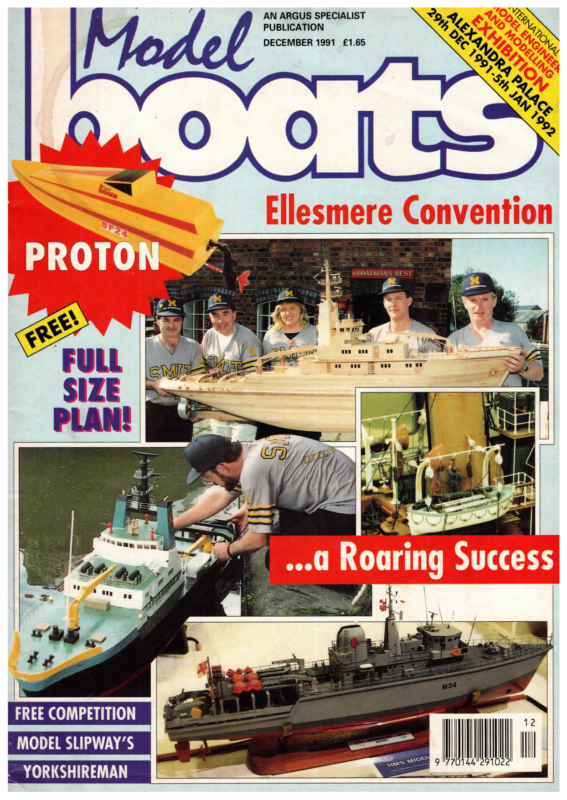
AN ARGUS SPECIALIST PUBLICATION DECEMBER 1991 £1.65 PROTON FULL MM
fair idea of what to expect. Gales that are forecast often do not materialise and the direction of light winds force one to two is likely to be variable. I do hope that the Meteorological Office staff members will not take offence at my criticism; they perform a valuable function and without shipping forecasts and gale warnings many more lives at sea would be lost. The Meteorological Office are able to give incredibly detailed information on wind patterns and expected behaviour for a specific area when major full sized events are taking place. It is much more difficult to give precise forecasts for larger areas, even when reduced to the size of the shipping forecast areas. eave. Nick Weall’s second series looks at improving your sailing — Part Four his is the fourth-in the second series of articles on yacht racing. We are at the intermediate stage aiming to help aspiring club members improve their performance sufficiently to be able to start winning club No. 88, Miss Q, with a quarter of a second before the start at the 1991 Nationals; the model ended up second in this race. The trick was to aproach the bank on starboard and call for water, hopefully ending up leading the fleet. See next pic below. So the day’s shipping or local forecast is going to give us some basic clues of what the wind might get up to over the course of the day. This information is of most use to the person setting the racing course for the day. For the rest of us it gives an idea of what we should be looking out for in terms of wind strength. A wise skipper brings all of his different sized sails with him every time he is racing! I have known skippers that listen to a forecast and only bring a few of their sails with them. That type of skipper is most definitely going to get caught out sooner or later and not have sun but for proper wind forecasts you are going to have to look elsewhere. The most accurate wind information is going to be found by listening to the shipping forecasts, local sailing programmes or by ringing up your local shipping information line. the appropriate sails with him when the wind deviates dramatically from its forecast strength! So if you have the rigs take them with you always! As Radio Controlled Model Yacht Skippers we usually sail races that last at If you do not know what number to ring, go to your local yacht chandlers as they 88’s tactics can now be seen to be a working a few seconds after the start. The pontoon is only yards from the buoy, the reason that 88 had to events. We start off this article by looking at the driving force of the yacht – wind. Wind! Whilst it is always quite possible to race yachts without any understanding of wind behaviour, it certainly helps to win races if you develop some knowledge of localised wind behaviour. As model yachtsmen,we do not have to delve into the subject of weather patterns and wind evolution through the day in the way that our fellow full sized skippers need to. Our individual races are so short as to render all that as unnecessary information. It certainly is a great help however to have some idea as to what is likely to happen over the day’s racing from a wind direction and strength point of view as well as having an idea as to the type of weather expected. Ordinary weather forecasts are pretty useless when it comes to mentioning wind. They are fairly good at predicting rain or 30 will be able to tell you or even give you a little card with the numbers on it. It is as well to know that even the best of wind forecasts are imprecise. It seems to be extremely difficult to forecast the wind’s strength with any real accuracy. Forecasts are much better at getting the general direction of the wind right, although localised conditions can alter this. Despite all of this, forecasts can often give you a call for water to tack. most half an hour and usually much less. We sail those races over a relatively small area of water. We are thus in the lucky position of only having to react to the immediate weather conditions rather that the slowly developing conditions. Certainly within the time span of the race in progress any dramatic change in wind MODEL BOATS
When the wind at Gosport blows from the North East there are some blocks of flats several stories high that produce very confused wind on that portion of the lake down wind from them. Hills, banks, hedges, trees, buildings, vehicles, people and other objects all have an effect on the wind blowing over your water if they are to windward of the water. It is up to you to understand this and to try and visualise the effect any obstruction Strength and Direction So let’s look at the way the wind can vary in strength and direction over the area of our racing water at any one time! What is wind? You cannot see it! You can see the effect it has upon objects though. If the wind is imagined to be lots of invisible molecules moving rather like the water in a river in a general direction but flowing over or around rocks and other obstructions in its path then we can perhaps visualise better the effect any large object near to the water we are sailing on is likely to have. If we imagine the wind blowing straight down a lake and we then put a large rectangular block at the windward end of the lake, the wind is going to have to rise over the top of the block and split around each side of the block. Now it ought to be easy to visualise that immediately downwind of this block and near to the block there is going to be little wind. If we wanted to shelter from the wind for example we would stand in the lee of the block, that is the downwind side of the block. At that point we would be completely sheltered from the wind! As we moved directly downwind from the block so we would start to feel the effects of the wind again. If you look at the behaviour of water as it runs over and round a large boulder in a river you will notice the eddies and confused current that is down river of the boulder. Similar patterns occur in the wind, although in a more complex manner. Moving air is like any other fluid in motion in so much as it is effected by friction and solid objects. The wind is happiest moving over clear water. As a rough rule of thumb the wind blowing over the open ocean will be moving at twice the speed it would move over a large expanse of land! At two thousand feet up in the air it is likely to be around three times as fast as its relative speed over land! Thus as the wind flows over and around the block it is not only diverted but also slowed down. Immediately downwind of the block an area of low pressure develops. Into this area tumbles and swirls eddies of wind until finally well down wind the flow joins together again to resume the general flow of wind direction. Now what may not be generally realised is that large objects some distance from the water you are sailing on will still be effecting the wind by the time it hits your water. For example at Gosport there is a very large gasometer at least half a mile away from the lake to the south-west. When the wind is blowing from this direction the wind direction over the part of the lake downwind from the gasometer is still effected and will have a slightly different direction at that point! DECEMBER 1991 has in its immediate lee no wind at all. As you move down wind of the barrier to the equal distance of its height times 30 the wind strength gradually regains its mean speed. Now a barrier that consists of many objects, but with gaps between each object so as the whole barrier consists of 40 to 80 per cent objects may be described as a medium dense barrier. Immediately downwind of this type of barrier the wind is stronger than five to ten of its height distance downwind. You would have to sail in fact around fifteen or more of its height distance downwind to enjoy better wind than in its immediate lee! In its immediate lee you would be experiencing around forty per cent of true wind speed. This drops to around twenty per cent true wind speed at around five height distance downwind. Full mean wind speed is not regained until 35 odd height distance down wind as opposed to 25-30 odd height distance downwind with the completely dense wind barrier. Lastly with a more open type of barrier to the wind of under 40 per cent of the frontal area covered, there is again a definite advantage to be gained by sailing close to the lee, rather than 5 height distance down wind, where again a thirty per cent loss in wind strength is experienced as opposed to in this case a a speed is going to effect us, but it will also effect all the other competitors as well usually. Consequently the aspects of wind behaviour that should interest us most are simply wind shifts and very localised wind behaviour patterns due to obstructions or any other topological features that cause the wind to split or deviate from its mean direction. As regards wind strength, all we need to do is to cover the rest of the racing fleet as to sail area put up, since lives are not at risk or rarely boats; it is simply performance that is vulnerable. ten per cent drop in wind speed in the near lee. Full wind speed is more gradually Tinkerbelle, sailed by Lindsey Weall, in a breeze at Gosport. is likely to have. If it is a permanent obstruction and the wind direction fairly steady you can of course simply sail up to _ the area of water likely to be effected by the obstruction and find out for yourself what effect it has upon your close-hauled direction. If the wind is blowing strong enough to leave a pattern upon the water, you maybe able to see the effects that way. Do bear in mind however that the wind direction a foot off the water might be a little different! The larger the object the more the wind is going to be deflected and the more the wind is going to be confused down wind of that object. Barriers to the Wind Now there is a very interesting phenomena concerning the wind and what we might describe as barriers to the wind. As you would expect going back to our block idea, a complete barrier to the wind recovered in this situation by twenty five height distance from the barrier down wind. Think about the above and try it out for yourself! Notice how it takes between twenty five and thirty five times the unit height of the object downwind for the wind to recover its full velocity! The origins of the above information were from studies made for the erection of shelter belts for protecting crops for farmers from the damaging effects of high winds. I learnt about this not from experience but from reading a book called ‘Wind and Sailing Boats’ written by Alan Watts and published by David and Charles. Priced around thirteen to fourteen pounds this book is the best investment you could ever make if you wish to understand the wind and its behaviour. Alan Watts is an exprofessional meteorologist whose original research was into the seabreeze phenomena at coastal stations,and the inter-relation between wind over land and adjacent water. Get it out of the local library, have a read and I will be surprised if you do not go out and buy yourself a copy, because there is too much in the book to simply get it all out in one reading. Now I do not wish to go on about this subject in great depth, the book mentioned above can provide that sort of information for you far better than I, but you should also consider the fact that any object on the downwind side of the water you are sailing on will also have an effect upon the wind up wind of it! If we go back to our wind barrier study then all of the barriers will effect the wind up wind of them by around nine times their height unit up wind. The dense barrier is likely to have very little wind immediately upwind of it within its height, the medium dense around sixty per cent and the least dense ninety per cent. The danger for all types of frontal barrier is that there may well be swirling eddies completely backing the wind in the 31 ‘endl
two to four height units distance from the obstruction upwind! That again is some thing to think on! You ought to be able to realise from the above that there can be tactical advantages to be gained as to where you place your yacht in relation to such obstructions. At the very least you ought to be aware that the wind does alter its behaviour at barriers and pay particular attention to the performance of other yachts in the areas likely to be effected by such barriers. fleet in contention. It is all too easy to allow a major advantage and winning position slip away through getting too far ahead of the rest of the fleet and getting wrong footed. In other words you end up on a header whilst a good proportion of the remaining fleet enjoy a lifter and get to the next mark before you! The best teacher for this is I’m afraid bitter experience, but with a bit of luck if you remember my warning it will be something you keep an eye out for. Now usually it takes a race or two to get a real idea of where on the course such bends are currently to be found. Gradually the wide awake skippers begin to take advantage of such phenomena until even the less alert skippers possible get the message! However as always there is a trap! There is no guarantee that the bend is going to last all day! Time after time I the same strength or come from the same direction for very long as a general rule! Different weather patterns produce winds of differing behaviours. Also the direction the wind is coming from plays a large part in determining how gusty and shifty the wind is likely to be. The further over land the wind has had to travel, then the more gusty and shifty it is likely to be. Another very interesting phenomena is that as a general rule gusts in the wind are likely in the Northern Hemisphere to veer the wind. Veer means that the wind’s direction moves in a clockwise direction. When the wind’s direction moves in an anti-clockwise gue direction it is said to back! Nowitdoesn’ttaketo much imagination to realise that if gusts are going to veer the Peter Stollery’s yacht shows proposed new main sail layout, an effort to make the jib no. (last two no’s.) more easily seen in all aspects. What do you think? Wind Bends We are probably more interested however in the effects of wind bends than barriers. Wind bends may be described 4s the result on the wind after it has passed over or by some obstruction that produces a different wind direction on part of the water being raced upon that may be used to advantage or disadvantage! Somewhere upon the water that you usually sail upon, in certain wind directions you are bound to have the wind blowing in slightly different directions at the same time owing to wind deflection by nearby obstructions or topological features. It really is up to you to find out how any particular wind bend can be used, the basic premise is that if you are on the windward beat for example on one tack the bend will lift you up on to a course approaching nearer to the windward mark or conversely it will put you on a eourse sailing further away from the mark than you were before entering into the area effected by the wind bend. It may well be the case also that only part of the wind bend is of use to you. You must never loose sight of where it is you are trying to get to and the shortest possible distance available in the wind conditions and directions for getting there. You also always need to consider most carefully the relative positions of the remainder of the 32 last years Jeremy Offord receiving his two suits of sails kindly donated by P J Sails as a prize in of Gosport Club, notice at what may be described as local open meetings skippers falling into a certain pattern of course coverage and continuing with the same sort of course coverage long after the wind has shifted setting up new advantageous areas to be exploiting. Naturally enough in my time I’ve fallen into the same trap myself! It is a very easy trap to fall into at the start of a race. Previous races have gradually shown you that it is best to be at a certain place upon the start line at the gun. You are so busy concentrating on achieving this position that you fail to notice until just after the start, that in fact the wind has shifted and your previously brilliant winning start becomes the flop of the century! Oh well,you mutter,the race will be more of a challenge now! True enough, but if you are after winning a series of races, it doesn’t help too much! Variable Strength Now the most annoying thing about the wind is that it simply does not blow with Christmas Quize. Commodore Eric Roberts at the rear, Nick Weall at right. wind and you are close-hauled beating to windward towards the windward mark, if you are on a starboard tack as a gust moves across the water you are going to experience a lift up towards the mark. That is to say your course is now taking you more directly towards the windward mark than before. The converse of course is that if you are on port tack as a gust moves across the water, you will be headed. That is to say, you will be pushed away onto a course that is taking you further away from the windward mark than you were sailing immediately before the gust! Just to complicate matters a little, most Marblehead yachts if correctly balanced will tend to screw up into winda little when hit by a gust to find a better and higher course to windward anyway. You still have to bear in mind that the most advantageous tack to be on in a gust will be the starboard tack. Whilst that is most certainly the general MODEL BOATS
water, in our case the sea. Obviously sea breezes require the sun to be warming up the land and a sea breeze will tend to set in the quickest where you have south facing hills fairly near to the coast. Living on the South Coast as I do, I tend to be looking for a sea breeze to set in late morning, although its more subtle effects may have been felt far earlier. Of course a sea breeze is at the mercy of the existing wind if the existing wind is – stronger than the sea breeze effect. Sea breezes around our coast are usually in the region of 10-15 knots in strength. Thus a directly opposing wind of the same strength might result in no wind at all! Sea breezes can reach inland considerable distances up to the fifty miles mentioned previously, although of course their relatively slow speeds can mean that a sea breeze might reach some parts after the day is done! To confuse matters sea breezes do not necessarily run in over the land always from the direction of the sea. When looking at fairly narrow parts of the land, Cornwall, Devon, and Kent for example it is not unknown to have a sea breeze coming off the Northern coasts! Again because of the short period of time any individual model yacht race tends to be over, it is not essential to have any understanding of sea breezes at all. It does however go towards you having a better understanding of the forces that provide your motive power. You need to know about land breezes even less since they tend to set in during the late evening. As the land cools down again the air over the land also cools and sinks towards the land spilling out and over the surrounding sea. Thunderstorms can be fun, although frustrating, provided you are not in the middle of one with lightening striking all around. Being an abject coward, I strongly advise bringing your model rapidly ashore, putting down your transmitter under cover and tacking cover yourself. Standing Tony Ryan’s Raven at the Northern Ranking Race at Cleveland. Tony ‘s yacht is at least 2 years old, but looks as good as new. rule, you must consider carefully your actual position upon the water. For example I doubt if there is much to be gained from continuing to sail on a starboard tack well beyond the port layline for the windward mark. In those circumstances you have to bit the bullet and sail on the header on port tack. This is one reason why some skippers prefer to sail up the windward course ‘in the middle’ that is not going too near either layline until perhaps fairly near to the mark. To be honest it all depends upon the relative positions of the rest of the racing fleet andyour own particular position within it. For example the tactics are very different for the leader of the race and someone near the back of the fleet who is trying to gain as many places as possible in the time remaining. We will look at this is some depth when we shortly study the windward leg. By the way if you live in the Southern Hemisphere then gusts back not veer from the mean wind direction! One of the nice things about gusts is that they can be extraordinarily localised even at our little model scale. It is quite DECEMBER 1991 in a thunderstorm waving around your transmitter aerial seems to me fool hardy. But, when the thunderstorms are simply possible upon the averaged sized model sailing pond for only one or two yachts to enjoy the benefits of a particular gust. Gusts are usually easy to spot by the passing your lake by in the near distance, leaving you safe and hopefully dry, you will experience sudden major shifts of wind direction through as much as one hundred and eighty degrees! In between observant by the black mark they leave upon the water’s surface. Thus you might have a few seconds to place yourself in a these shifts you may get complete lulls! So be prepared in such circumstances for the momentary injection of overdrive! Gusts do easily thus gain a few seconds advantage position to take advantage of one or simply to watch in envy as another yacht has a travel long distances over the water and if sailing off the wind can provide enormous benefit to back markers. There is nothing worse than to be gently wallowing down the run in the lead watching the rest of the fleet coming up fast on the back of a gust! They stand a very good chance of sailing right over you! Sea breezes! Being an island an awful lot of our sailing clubs are exposed to sea breezes or land breezes. The first thing to understand is that the effect of a sea breeze can negate the normal effect of the gust! What is a sea breeze? The basic cause of the sea breeze is that as the land mass warms up through the heat of the morning the air above the land rises allowing cooler air to move in from over large expanses of new wind to set in from any direction except its previous direction, you can over your fellow competitors! I think that at this stage that is really all I wish to write about the wind as an individual study. Of course the subject will come up again and again as we look in greater depth at our tactics employed sailing particular legs of the course. We will also look more carefully at the different tactics employed in different wind strengths. As I wrote before anyone that wishes to investigate the wind in great depth can do no better than to invest in a copy of the best book available: ‘Wind and Sailing Boats’ by. Alan Watts, published by David and Charles Publishers ple. My knowledge of the wind was certainly enriched through reading that book, besides of course many others. Spending some of my life aboard one sort of craft or another has obviously helped as well. 33
Having now built John Bone’s Ripple — Free Plan in November issue — learn how to sail it successfully t has been a good many years since anything has been written on the subject of free-sailing a small model yacht. The principle of the vane gear has almost been forgotten, although it is still used by enthusiasts in the racing classes. On a very small model that could not possibly carry radio equipment, the vane remains supreme as the perfect helmsman. A free-sailing yacht normally has to be sailed on a purpose-built lake, or at least one with good access all around. Due to her small size, Ripple can be sailed on many ponds and natural stretches of water, provided that a suitable means of retrieval is arranged. A hoop made from Sailing Ripple The Vane and its Operation Although the steering system is not FIG.1 STATIC SAIL TRIM PLAN VIEW connected to the sails as it is in some other self-steering methods, the two must work together in harmony in order to avoid a fight between them. For our purposes at this stage we shall first consider the vane on its own. A yacht with a vane can only be made to sail in a straight line, or an approximation of it. You cannot therefore make your boat sail to the middle of the lake, turn itself around and return to the starting-point again. For this reason you must always have a predetermined course or goal in mind when trimming the model; once it has left your hands there is nothing more that you can do. A common misconception with a vane is that the wind blows on it and so turns the rudder. What actually happens is that the vane remains stationary; the boat turns and so turns its rudder. For a practical demonstration hold the vane steady and rotate the boat from side to side, noting what happens to the rudder. The reversing gears apply opposite helm, returning the boat to its original course. coathanger wire, attached to the end of a long bamboo cane is a convenient way of lifting her modest four ounces from the water. The hoop is passed underneath around the keel and will pluck her safely 58 from reed-beds and other difficult places. She is therefore quite versatile and has even been sailed in the sea. One of my ambitions is to sail her across the Channel; are there any Sponsors? The vane remains stationary because it is flying in the wind like a weathercock. By ‘setting’ its angle relative to the beading of the boat and the wind direction, the vane does precisely nothing, other than to hold the rudder amidships. As soon as the boat wanders from its ‘set’ course, the relative angle is altered and the vane re-aligns with the wind, applying corrective rudder MODEL BOATS
BEAT (STARBOARD TACK) SAILING TO WINDWARD (PORT TACK) =~ Sail Trim If sailing was an exact mathematical science it would be easy to give precise details and settings. A famous model yachtsman knew his boat so well that he kept a little black book of trims that had been carefully worked out by trial and TACK y Peet SAILING OFFWIND success. On some points of sailing, however, its trim is critical and you will no doubt learn very quickly by your mistakes. | BEAT a Ket, CLOSE REACH error. He could assess the situation and select a trim to suit, reducing much of it to BEAM REACH a mathematical process. In his day, he was successful. Most of us sail by the seat of our pants, with experience and knowledge of the capabilities of our boat being the main factors when trimming. Some lakes have certain peculiarities whereby the wind is funnel led or deflected and this often means that a straight course through the middle is neither practicable nor even possible. The circular drawing gives a selection of sail and corresponding vane trims to suit whatever course you may be sailing. These can only be given as a general guide and are theoretical, based upon the ideal conditions that do not exist, Sailing cannot be learned from a book but in the meantime sit back in your armchair, imagine the wind is coming from the BROAD REACH QUARTERING RUN DEAD RUN (BOOMS CAN BE ON EITHER SIDE) FIG.2 THE POINTS OF SAILING (NOTE THE ALLOWANCE MADE ON THE VANE TRIMS FOR REACHING TO COUNTERACT THE EFFECT OF APPARENT WIND) until balance is restored once more. The principle, like all great inventions, is remarkably simple and one wonders why it was not thought of centuries ago. The vane can be set to any angle by means of its friction-grip and is capable of applying rudder within the sector of main gear and helm-limiting pegs. This form of steering can even be used on a small freerunning electric powered model, guiding it safely and accurately across a large lake without the risk of it turning in everdecreasing circles until the batteries run flat. So far we have only looked at the vane when operating in an ideal situation. It FIG.3 SAILING A BEAM REACH VANE FEATHER WIND DIRECTION Je. e a NA ger See HEADING UPB does become a little more complicated in practice and we shall examine this later. Armchair Sailing BOW SHOWING THE SMALL SECTOR IN WHICH BEATING TRIMS ARE SET FIG.4 CLOCK FACE VANE DIAL COUNTERWEIGHT The sails need to be adjusted to work efficiently, as it is no good hanging up two triangles of material and expecting the boat to go well. Look at the sketches showing Static Sail Trim and you will see what needs to be achieved The sails can be filled with air by waving the rig like a fan, holding it at the boom joiner and mast stump. The important point to look for is the relationship between the leeches of the two sails which should run parallel with a gentle curvature. In stronger winds the curvature is reduced by increasing tension on the bowsie above the jib and tightening the clew outhaul hooks. This has the effect of flattening the sails, reducing the camber. To a large extent camber is built into a sail due to the round cut into the luff and should never be excessive, except for specialised light-wind sails. The Static Sail Trim is only a guide at this stage but gives the basic settings from which experiments can be made when on the water. Although the Swing Rig is perhaps not the best all round for a free-sailing model, it has advantages of simplicity and ease of rigging at the lakeside. Due to its balanced nature it makes fewer demands on a small yacht and guarantees a greater degree of television and sail all around the room! Get used to the look of a correct’ trim so that it becomes almost instinctive. By doing your homework at this stage, much frustration and annoyance can be avoided when it comes to the real thing. Teamwork Mention was made earlier of a fight between rudder and sails. A sail trim, especially that of a swing rig, is only correct for one particular course, with a small tolerance of maybe five degrees on either side. Likewise a vane trim will only hold the helm amidships on one particular setting, causing rudder to be applied and drag created, should the boat try to sail a different course. The perfect trim will therefore bring about vane and sails working together as a team, driving the boat hard towards the pre-selected destination. In this situation there is no imbalance between the two and the boat sails smoothly and continuously and fast. This is the goal that we are trying to achieve and it is often better that the teamwork is there and the boat sailing well, even though the settings have been misjudged with the result that it comes ashore only halfway down the lake. Let us now consider two things that can go wrong due to an unharmonious trim. For example:The boat is sailing on a beam reach with 59
Sailing to Windward Closehauled or Beating the sails correctly set for that course. The vane trim has been incorrectly set by a few degrees only, causing the boat to sail above its course (in other words, closer to the Bearing in mind what we have learned about sailing on a reach, sailing to windward can be looked upon as a logical wind). As it tries to sail closer to the wind, steered there by the vane, drive from the rig will be lost causing the sails to flutter. In this situation it is not so much of a fight progression. There is an ‘impossible sector’ into which no yacht can go as the sails will produce no forward drive due to the narrow-angle at which they are presented but a difference of opinion between vane and sails. The vane says, “I want to go this way” but the sails say, “You go there by yourself, I’m not going anywhere!”. The boat comes to a stop and, as the drive from the rig is lost, it slowly returns to its correct course and continues sailing. A moment later it happens all over again with the result that the boat sails in a series of arcs, stopping and fluttering its sails in between. The wind that is sensed by the vane is FIGS Ducks are fair game, but swans are royal birds. Not amused by impertinent sailing. BOAT TRIMMED ‘TOO HIGH’. SAILING TO WINDWARD. _— S e ae WIND DIRECTION ~ FIG.6 SAILING TO WINDWARD. VARIATIONS IN TRIM. ict amount of wind created by its own movement and allowance must be made for this when trimming. This is known as sucking! The best course that can be made good into the eye of the wind is in the region of 27 degrees. This figure is for an efficient and powerful displacement yacht such as an ‘A’ class or 6 metre. As a general rule light displacement planing boats cannot * not always from the wind direction, due to the boat’s own speed through the water. The vane feather ‘catches’ a certain to the wind. I do not intend to become involvedin a deep hypothesis as to how a yacht can sail against the wind; if you really want to understand the mechanics, you can find out for yourself! All we have space for hereis to know how to make it happen. I will, however, throw a spanner in the works and suggest that a Westerly wind blowingis actually an Easterly wind achieve such a good figure and are much happier sailing at around 35 degrees, although moving a good deal faster as a result. Ripple falls into this latter category as she has been optimised for better offwind performance. When forced to sail hard into the wind at a closer angle, the speed made good, or ‘footing’ as it is known, drops away rapidly. In full-size, the practice of sailing at a freer angle to WIND DIRECTION _ Apparent Wind. Returning to our example, let us see what happens when the vane is set so that the boat is trying to sail a few degrees below her course (further away from the “~ ie PINCHING me wind). FULL & BYE POWERSAILING The sails are now sheeted in too closely for the new course and the boat becomes FIG.7 AN IMAGINARY LAKE Tani WIND DIRECTION < EMBANKMEN SX } CDR BANK SS FLOTSAM CORNER aes LEAGGRINDER’S ADEE’ fon CLOCKTOWER END CLUBHOUSE END the wind is known as ‘powersailing’ and is useful for a small boat, such as a dinghy, to maintain speed and efficiency through rough seas. The same principle is therefore applied to Ripple and she can only ‘point high’ (in other words, sail close to the wind) in light to moderate conditions, whilst maintaining a reasonable footing. The golden rule is, therefore, do not try and make the boat point too high until you have had time to experiment and find the optimum settings. Start with a reasonably conservative trim and gradually tighten it up on each consecutive beat until the boat shows signs of ‘pinching’ or going ‘into irons’ (slowing down, sails fluttering). BAY OF BISCUIT DEVIL’S REACH The Vane FOOL'S COVE“ After a while you will know when there is likely to be a mutiny aboard your boat. In both cases mentioned above it was the Having discussed the basics, let us now turn our attention to the vane. Firstly, it must be emphasised that all vane settings should be carefully checked, making sure that the rudder is central. The vane angle is easily gauged relative to the centre-line of the boat, but if the rudder is not amidships you are being led although it could just as easily have been the sails. In truth it was probably both. As we are dealing with a very small sector when it comes to setting a beating \___ THE CAUSEWAY < LEEWARD BANK over-driven, heeling and protesting at the struggle, like a car being drivenin the wrong gear. The excessive heeling angleis inefficient and leaves little power in reserve should the wind freshen momentarily. Although it appears to be sailing well, it would go with a lot less 60 JELLYFISH BAY fuss, if properly trimmed. vane that was the villain of the peace, up the garden path! MODEL BOATS
FIG.8 te THE GYE OR SHORT TACK, \ OO mca The vane tacks the boat through the wind and returns it to the Gaining leg, for further progress up the lake. In this way only a short distance is sailed on the Losing leg, considerably reducing the total distance that needs to be sailed to reach the goal. The Short Tack can be quite a tricky manoeuvre and even ‘full-sized’ models _— often have difficulty. Much depends on the strength of the wind. If it is too light, the boat may sail almost to the other side, before it manages to tack itself. In a strong wind the opposite is sometimes the case; the boat spinning around in its own length before it has had a chance to move any distance from the bank. Try adjusting the tension on the rudder centring line to vary trim on the vane, it will be useful to adopt a simple analogy: Imagine the vane settings to be calibrated like a clock face, as shown in the sketch. If the counterweight of the vane becomes the minute-hand, an average vane trim for sailing to windward will be eight minutes on either side of the hour, depending on which tack you choose to sail. Close it down to five minutes and she will be sailing above her course (into the impossible sector) and, no matter how close-hauled the sails are, they will be saying, “This is as far as we go, tough luck!”. This is the classic case of being in irons. The boat stops, the sails flap and after a while it slowly bears away, only to repeat the whole procedure a moment later It might even try and sail on the other tack same trim from point number two will bring you ashore along The Causeway, leaving no option but to change tack onto the Losing Leg, arriving near Leadgrinders Deep. This is a greater distance and will take longer. In order to get through in one tack from point two, the boat would have to sail much closer to the wind with corresponding loss of speed and the risk of overcooking the trim. Therefore, if you have the option, do yourself a favour and start from a strong windward position, with a ‘safe’ trim. Do not overdo the start position, however, as there is a dead patch all along the weather bank, caused by the steep embankment of Mount Doom. To become trapped in this area of fluky wind is bad news for a small yacht. the length of tack. So, your boat has finally made it to the Clubhouse End - quite an achievement. It will be even more of an achievement when you get up out of your armchair and do it for real! Sailing Offwind or Running Offwind sailing with Ripple is relatively simple. The swing rig is nicely balanced and drives the boat in a straight line that is easily controlled by the vane. If it took fifteen minutes to sail the windward leg of the lake, you can be back again in five. Fhe rig is eased until the mainsail boom is a shade below right angles to the wind and the vane set for a course down the lake. In our imaginary drawing the best course to take starts at point three and before being stubbornly pulled back by the vane. Meanwhile you stand and wait, learning your lesson and promising never to do it again! skipper overcooks their trim FIG.9 WALKING IT OFF. WIND DIRECTION. occasionally, especially with a new and untried boat. What of the opposite? With a vane set at perhaps twelve minutes the sails will be sheeted in too closely causing excessive heeling and loss of speed. In a gust the boat will try and point higher, only to be held back by the vane. Ease the sails or tighten the vane to restore the balance and keep the peace. Scoring Goals Should the wind be a few degrees straighter down the lake this dead patch will become less. There is also less difference between the Losing and Gaining Legs and it will be impossible to sail the aims to finish in the Bay of Biscuit. This places the model in the best available wind, away from the dead patch below Mount Doom but well clear of Fool’s Cove where many a yacht has been caught when lake in one long tack. The only option now racing. When confronted with a lake and the to do a lot of running, it is helpful to have there has to be a plan of attack in order to select the best course to be taken. The sketch shows an imaginary lake (actually it is rather like Gosport lake) with an imaginary wind blowing from an imaginary direction (just like Gosport!). knows how to set the vane. Using the clock-face analogy, the vane will be set at around five o’clock or perhaps a few minutes after if there is any sort of breeze. This ensures that the boat will The Gye or Short Tack down the centre and so it has been deljberately biased in the drawing. You are at the Clocktower, facing the Returning to our imaginary lake with the wind in the direction as shown, you may find that the boat cannot quite reach the Clubhouse End after making its long tack So far we have only looked at sailing to windward in the most general terms. necessity to sail from one end to the other, Very rarely does the wind blow straight wind and preparing to sail down towards the Clubhouse. It can be seen that on Port tack it should be possible to sail a good way down the lake, whilst Starboard tack will carry you more across it than down. The Port tack is therefore the Gaining Leg in this situation, whilst Starboard is the Losing Leg. By starting from point number one and trimming to sail comfortably close to the wind it should be possible to fetch right down the lake in one long tack, coming ashore near Jellyfish Bay. Sailing on the DECEMBER 1991 is to tack from side to side, re-setting the vane each time. Unless you are prepared an assistant on the opposite bank who Should you be sailing singlehanded, however, there is one little trick that sometimes comes in very useful. down the lake. It comes ashore somewhere along the Causeway. Instead of re-setting the vane and sailing off on the Losing leg.towards Leadgrinders, the vane is left alone. In other words, the boat is deliberately released with the vane set for Port tack, when in fact it is trying to sail on Starboard. It will move out from the bank and sail a little way with a full-scale mutiny on board. In fact, the sails do not mind which tack is chosen but the vane is very fussy. close on the leeward bank, hopefully coming ashore along Devils Reach where, if necessary, a simple re-trim can be made to reach the goal. When sailing singlehanded this is a good ploy as it takes away much of the uncertainty as to which bank you should walk down. If the boat does not sail through but arrives along Devils Reach, the vane is re- set to approximately four o’clock whereupon it should draw steadily away from the bank to arrive below point two. An alternative re-trim would be to sheet in the rig by a few degrees. This should only be done in light winds and has the effect of driving the boat harder and pushing it away from the bank. Be very careful when doing this as it is easy to overpower the model. A vane re-trim is usually the better option, especially in a breeze. Sometimes a combination of both may be required. Should the boat approach the bank at a 61
There will be times when you very close angle there is a chance that it will deflect itself, due to the wind bouncing back onto the vane. This creates a degree of apparent wind change that may be wish you had never bothered with the enough to steer it away. By walking along close beside the boat, additional wind is deflected by your body to improve the chances of it happening. ‘Walking it off is a fine art amongst racing skippers and manya race has been won by this method. A re-trim can cost several boat-lengths and if it can be avoided, so much the better! spinnaker! A yacht will sometimes head up in a gust and bear away in a lull. This is due to minor imbalance in the design or trim and variations in the apparent wind speed. It can be useful or not, depending on the circumstances. Sometimes the boat may become trapped along the leeward bank in a lull and, even after several re-trims, it will not sail itself off. Suddenly the wind freshens and it charges off up towards the weather bank, as the sum total of your retrims has wildly overcooked it. Heading up and bearing away will also be caused by changes in wind direction and are often peculiar to each lake. You may have to allow for this as the yacht will follow a curve or S shape that was not originally anticipated. Should you be unlucky enough to end up along the weather bank when sailing offwind, the best course of action is to ease the sails and gybe the rig. The lack of wind means that progress will be slow and uncertain whilst re-trims to the vane should be done cautiously once the gybe has been made. The boat will often ‘niggle’ along the edge of the calm patch, frustratingly close to the bank but still out of your reach. DREMEL ith, asi here can be applied to any vane-steered Whilst flags, burgees or wind indicators may be useful, the water on yacht, large or small. Ripple will serve you well as a simple introduction to this hobby, the lake will usually tell you more about where the wind is coming from and its strength. Before sailing, spend a few moments ‘reading’ the lake so that you can trim the model to make the best use of it. Simple sailing is sometimes not so simple and by now you may even be having second thoughts about it. For a fully-functional model Ripple is small by any standards and a lake is like an ocean! Conquering that ocean is all part of the challenge. Almost everything that has been written or provide some light entertainment for those who already sail. Sailing cannot be learned from a book, however, and there is no substitute for first-hand experience. Everything written in these pages can be assessed in the twinkling of an eye by a practised skipper and Ripple can demonstrate it, so that it all becomes second nature after a while. If Ripple is your first yacht I hope that you will have fond memories of her for many years to come. Christmas Reader Offer! MINIMITE CodZs Drill bit 1/8” PRECISION DRILL KIT f SS) Perfect for all modelling, you can drill, sand, shape, grind, de-burr, clean, polish most materials around the house and car - even try your hand at light wood-carving with the accessories provided with this precision tool! HSS cutler Just add a diamond burr from the full range of over 140 other Dremel accessories from model/hobby and toolshops nationwide to engrave glass, security mark va;uables or add smaller collets to drill pcb holes down to 0.4mm. 5,000/ 10,000rpm motor runs on 4 alkaline or re-chargeable AA size batteries (batteries not included in kit) | MINIMITE DRILL KIT ACCESSORIES £29.95 ROET/19 OPTIONAL 2 HOUR CHARGER + 4 NI-CAD BATTS £21.00 ROET/20 Wire brush Please supply ........ ROET/ 19 @ £29.95 ae — Rotary Drum sander Soft felt polishing | mop & polishing : compound Telephone orders...call now on 0442 66551 (24HRS) Sanderband 62 | |! | Please add £1.50 p&p per item, or £2.50 if both items ordered. | Reader Offer Dept., Argus Specialist Publications, Argus | Please‘supply ..0.-.:. ROET/20 @ £21.00 : I enclose my cheque/P.O. for£ ........ made payable to ASP or please l debit my Access/ Visa Signatures 20 Fee BE ig Ssicwutie sea RRB dearer ene eE ct ll a ple et | EXPY He. TP Eos l INAINC = siaioicso 6c oreo axepu geo G6 (ele ones oso) Mae nr sheila 86) obs: Sous cereale ave O\gie artuel sas~ fo751e) ora. | VNC bec en Met CRE oe BE ee SEE Re Or, OCS TIO Ooo COC EGO OCT | oys,..0: she POStMOdE! FT tae es eee eee | Please allow 28 days for delivery U.K. only - overseas upon request. Please note the above House, Boundary Way, Hemel Hempstead, Herts. HP2 7ST [_ information could be used for marketing purposes. | 11/12/91 a MODEL BOATS