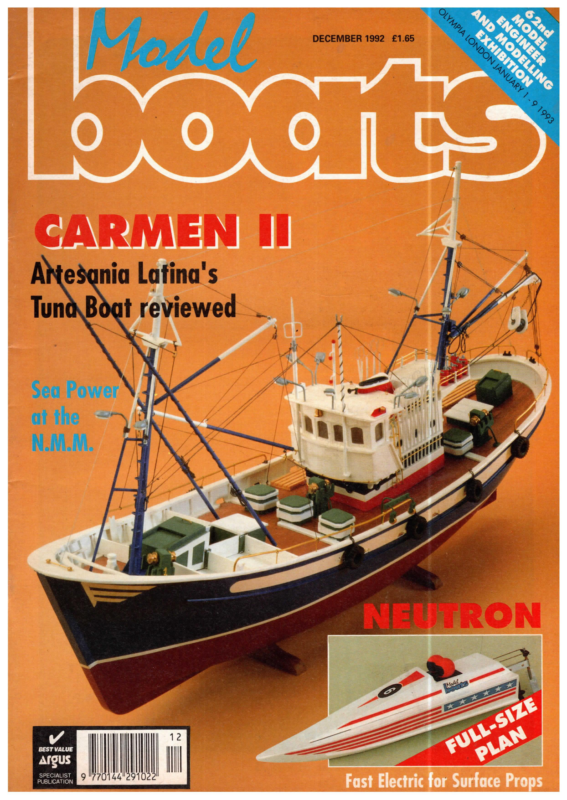
- RM Worlds in New York Nick Weall reports on a British win — Bantock is Champion

DECEMBER 1992 £1.65 | Og CARMEN II Ar —ina’s Sed oat al ihe Fast Electric forSurface Props
RM Worlds in New York Nick Weall reports on a British win — Bantock is Champion eport on the first Radio Controlled Marblehead World Championship sanctioned by the International Yacht Racing Union Model Yacht Racing Division, held at Eisenhower Park, Long Island, New York under the race management of the 1992 World Sail Challenge Committee, the President of which was Dan November. This was, in fact, the eighth World Radio Controlled Marblehead Championship, but the first to be sanctioned by the IYRU. It was held over the period starting Sunday 13th September until mid-day the following Saturday. Twenty three complete | cut down and adapted the packing crate used for last year’s Europeans in Finland, however the box weighs more! | put much more in the way of oak protection strips on it, after seeing the way ground staff Handled fragile packages in Finland! The orange painted lead bulb may be seen in the lower centre of the box with the attached fin leading away to the right and under the floor of the right hand storage compartment. Lots of wet water gear etc., filled up any spaces. races were held allowing competitors to discard their worst three results. Ceremonials The event got off to a very good start with an impressive opening ceremony. Near to Norman Hatfield, Chairman of the |[YRU-MYRD addresses the gathering at the Opening Ceremony of the first RM World Championships sanctioned by the lYRU. DECEMBER 1992 John and Madeline Tucker who put so much into this Championship present themselves to the competitors at the Opening Ceremony. Behind John sits the young lady who sang the American Anthem so well. 23
The British Team sprawl out in the foreground. The tent provided cover for lunches etc., to be served up. The building on the right is the dressing rooms for the stage which provided secure storage for all the yachts and room for the International Jury, plus the Race Officials. made a short speech and after several other formalities and a splendid rendition of the American national anthem racing got under way. Tetuo Takahashi from Japan shows off his yacht 54 with which he enjoyed some fine racing. Conditions top of several previous World Weather conditions were excellent as regards the sun, but most unfortunate as far as the wind was concerned. During the entire week the wind strength never exceeded force three and usually was force one to two. Variable wind directions and marks laid in wind shadows demanded the very best of attention from the competing Skippers as they lurched from wind shadow to wind shadow, fortunes often changing along the way dramatically. Those Skippers who managed to Championships. Graham Bantock the well known sail maker, boat designer and general provider of yachts of high quality from his company Sails ete of Kelvedon, Essex. Sailing his own designed Paradox which Graham had especially designed for the anticipated wind conditions in New York, he found the essential boat speed that had to some degree been eluding him through this season’s build up to the World’s. Graham had won his first UK Nationals at Guildford in 1987, the following year he was the race officer for the Nationals at Gosport. The following Robert Wattam’s yacht 106 that took him to 2nd place in the Championships. rise to the challenge were without exception those same Skippers who one would have expected to do well, whatever the conditions. They wére wise enough to sail the middle of the course and to keep their yachts creeping forward no matter what. A crowd gather around Janusz Walicki and his world famous boat, the Skapel design, as he the workings of his patented ‘Butterfly’ explains device, éxplained in earlier issues of MB. the lake was a stage with a gentle slope facing it. The natural acoustics were first class enabling all of the competitors to be introduced first to the organising committee. Then each of the sixteen competing countries followed their flag bearing team captain up one side of the stage, walked across the stage and down the other side. Each. team captain remained on stage until all sixteen team captains were sitting in a row. Norman Hatfield, President of the [YYRU-MYRD 24 Their skills in rising to the occasion and reading the wind and its patterns upon the water, kept them to the front of the fleet. It was very interesting to note that local skills could not overcame the talents of the very best from the rest of the World, all of whom were suffering by various degrees to the changes to their normal body clock rhythms. Bantock Victorious It was entirely fitting that the eventual winner, five times National Champion of Britain should have finally mastered the rest of the World at a World Championships, having been near to the MODEL BOATS
Graham recalled that there was very little opportunity for tactical sailing in the Championship, the wind strength was not very steady and the wind strength varied over the lake in a rather unpredictable way, so it was all very seat of the pants stuff, taking opportunities when they were available. You couldn’t really plan very far in advance. Even picking a place on the start line was not something to get too excited about, almost anywhere seemed to be O.K. because the wind varied so much in strength and direction, etc., but in an irregular way so it wasn’t possible to pick good places. When asked if in that case Jon Elmaleh’s yacht 69 that helped him gain 3rd place. Chris Dicks’ yacht 133 lies in the background. Graham went for middle of the line starts Graham replied, “No, I just tried to get a start where I was not pinned down by other boats and I suppose that I succeeded most of the time.” Graham soon learnt however that even if you made a bad start that it was not the end of the World since the boat seemed to be fast enough to make up lost places. He quoted one race in which he was over the line early and did not hear the recall until quite late. After having restarted he was a leg behind but he still managed to end up by the finish in the middle of the fleet. I then asked Graham to explain what the new “Gizmo” does on his boat. Graham described it as the most useful thing that Neil Goodrich’s 151. Finished in 17th place with this unusual design called an Eel. | believe the idea of the Polynesian bow is to provide more buoyancy at the bow to resist burying the bow when overpressed by the wind on a run. The hull is very slim and is well suited to the light winds of New York. the boat has at present. The gizmo works on the rig controlled by radio control and it slackens the tension on the rigging whilst on a reach, the run and when not sheeted in very closehauled. It seemed to be quite important, the boat had good speed whether it was blowing quite hard (A rig conditions) or when the wind went light, whereas some boats by the fact that they could not adjust their swing rigs during the race would often go quite well as the wind was light, but half way through the race if the wind picked up, then their jib would be too slack and they would not be able to point to well, or if they had everything strapped for strong wind, the slot between the jib and the main was too tight for the lighter wind conditions. Graham had in fact made a brilliant start to the series, sailing confidently well A pair of Paradox’s or as some people might describe them – a puzzle of Paradox’s. 195, Graham’s Championship winning yacht lies above Phil Playle’s 97. four years he has managed to win the Nationals to make a record five wins. Despite strenuous efforts the first place in International competition has previously eluded Graham although he got second place at Berlin in 1988 in light air conditions, which was another RM World Championship. I was lucky enough to be able to interview Graham at the airport in New York before we started the long trek home. Graham’s memorable moments of the current championship included recollections of one or two blunders by the other top competitors that allowed Graham to gain one or two extra places in individual races. He realised very early in the series that the New Zealand boats of Robert Wattam and Geoff Smale were very fast and likely to prove to be the boats to beat. DECEMBER 1992 An exceedingly rare sight. Three International Judges of the fair sex relax before becoming involved in the lengthy protests of the Final Day’s racing. L to r, Mary Pera (UK), Marianne Ericsson (Finland), Gay Lynn (USA).
the east side of Manhatten and out to the Statue of Liberty was for most people the highlight of the week. It was a truly memorable experience and without doubt the best organised trip ever to date. Back to Racing A shot of the inside of the club house at Central Park, New York. Note how slim the racing yacht’s hulls are. Thursday again started off a little light with some slightly stranger breezes moving though in the early afternoon. Protests and some heat confusions delayed the racing somewhat, Robert Wattam, Peter Stollery and Jon Elmaleh were the favourites, John Cleave was slipping gracefully and slowly down the pecking order towards his final tenth position. As usual he had some cracking races and in fact in one race where due to some problem or another he started almost a clear lap behind, he practically overtook the entire fleet by the end of the race. The Stollery designed boat “Roar Edge” that John Cleave, Peter and Roger Stollery were all sailing in fact took the most A fleet first over the first two days. Over the same Period John Cleave and Geoff Smale were also enjoying good results. Peter Stollery, Jon Elmaleh and Robert Wattam were also in the hunt. Tuesday was yet another day of light airs and delayed races. Coupled with an early finish there was not much racing done on the Tuesday. Graham however, if my memory serves me correctly, started to slip away at this stage, dropping downa fleet and allowing others to reach towards their dream of winning the Championship. Peter Stollery was sailing with great maturity and quite a lot of smart money The famous Central Park lake. Almost the only wind to reach this lake is directly downwards! positions. Seven in all. This design in my opinion is the best British design at present in England, showing the widest range of performance ability from the very light to the force six wind strengths or so. Graham’s Paradox may in time prove to be its equal or superior, Graham’s sailing experience is without doubt the best in our Country and he may well have developed the Paradox to perform better than the Roar Edge over a wide range of winds, but it is yet to be seen. They are both, without doubt, great designs. Chris Dicks must have been very Lindsay Weall waves a hand as she prepares to observe the final ‘A’ fleet race. Out and About —— es Wednesday was a lay day, when most was backing him to win. Jan Elmaleh was also very close whilst Janusz Walicki was slewly climbing back up the score board with his light weight Skapel. Janusz had managed to reduce the hull weight of his Skapel by around 500 grammes. He had encapsulated his batteries in the’lead bulb and had thus prepared his very successful design for the light and fluky winds expected. As soon as the wind was force two or so the Skapel could hold its own. In the force one drifting conditions it struggled and it was only the skills of Janusz that kept his boat in the race. The final ‘A’ fleet start. 26 competitors chose to visit New York city. The previous evening had been tremendously enjoyed by all competitors. A boat trip from Port Washington on Long Island out into the East River and down pleased to see his design “Slick” sail to eighth place under the guidance of Mike Weston, closely followed by Martin Roberts in eleventh place. Martin had borrowed his girlfriend Kirsty’s boat “She Devil.” In Martin’s hands the boat had a lot of fun. Chris’s specially designed “Trucker” was not quite so successful, although in Chris’s very experienced hands it finally reached nineteenth place, Where from? It was very encouraging to have sixteen countries competing in this Championships. It was obviously very
two years ago. National service in the French army has kept Christophe away from most races this year, thus his result is in fact a fine achievement. Claes Lundin from Sweden came in seventh position whilst Torvald Klem managed to maintain his usual high results with a creditable ninth. Competitors from sixteen countries have now returned to their homelands, all enriched by the experience of competing against sixty-nine of the World’s top skippers and most of them looking forward to new battles in two year’s time in South Africa. The Future Meanwhile the Europeans will be _Graham Bantock concentrates on sailing his yacht up the final beat towards the finish and the World Championship. Three boat lengths from the leeward mark, see below. expensive for most competitors to get to America and unfortunately some European Countries had not been able to muster a team together. It was thus all the more encouraging to welcome back South Africa to the International scene. South Africa fielded a team of four competitors under team leader Geoff Mundy. Brazil, Argentina, Australia and Japan were other far flung Nations that were well represented. Canada could not manage to find anyone prepared to make the effort which Was a pity. The combined efforts of Graham Bantock, Peter Stollery and Mike Weston were sufficient to ensure that the team award called the Yachting World Trophy, presented by the well known magazine “Yachting World” for the highest three placed individuals from any one country competing in the World Championships went to Britain. Jon Elmaleh managed a very creditable individual third place thus retaining America’s honour in this prestigious event. It has to be said that without Jon’s dreams and ambitions there would never have been a RM World Championships held in America. He was very well supported in the task of realising his dreams by Dan November, John and Madeline Tucker plus a whole army of very willing volunteer unpaid workers, providing all of the back up facilities required to run a top flight event. Protest Committee Much credit as always must be given to the long suffering protest committee chaired on this occasion by International Judge Mary Pera, who must be the most well known authority on the racing rules in the World. She guided her committee with great patience and humour through the week. Their hardest task must have been after the final A fleet race. This was a very scrappy affair with plenty of incidents as the somewhat highly strung finalists engaged in the last battle of the event. The second, third and fourth positions were all hanging upon the results of last race protests. I did not envy for one second the heavy responsibilities placed upon our protest committee. Defending champion Christophe Boisnault of France could only manage sixth position with the same yacht as he won the Championship with in Fleetwood DECEMBER 1992 sharpening up their talents in preparation for next year’s European Championships being held at Fleetwood. Here once again the name of Derrick Priestly will come to the fore as the leading authority in running a successful International Regatta. It will be very interesting to see what design changes are made in anticipation of the ever possible heavy Fleetwood weather. Finally, once again, the very warmest of congratulations to Graham. He thoroughly earned his title “World Champion” and as always he will put much more back into the sport than he takes out. And Thanks A great big thank you to our hosts. To spend more than a year of your life organising such an event, just for the love of the sport is an enormous commitment and sixty nine competing yachtsmen and women are very much in the debt of a handful of dedicated officials who put in many weeks of work, and a further army of helpers who rallied round over the week itself helping in a hundred different ways to make the event run as smooth as possible. A fair percentage of the sixty nine competitors tend to get rather highly strung and find all sorts of things to complain about in their search for the perfection that eludes them and whilst ideals ought to be pursued, the reality of International Competition is that it operates on a slightly lower plane. It provides many opportunities besides the honour and achievement of winning the event outright. The pleasure of meeting competitors from all over the World, making new friendships and renewing old ones, the exchange of opinions and ideas are all valuable facets of a World Championships which should not be ignored. The opportunity to see a little of another country is another bonus, which without doubt in the case of New York was an extremely big bonus for most people. Results after 23 Races Place 2 3 4 5 6 7 8 9 10 11 12 13 14 15 16 17 18 19 20 21 22 23 24 25 26 27 28 29 30 31 32 33 34 Skipper Graham Bantock Robert Wattam Jon Elmaleh Peter Stollery Points 79.2 95.5 95.7 104.4 Janusz Walicki Christophe Boisnault Claes Lundin Mike Weston Torvald Klem John Cleave . Martin Roberts Remi Bres Wick Smith Roger Stollery Christian Lindholm Geoff Smale Niel Goodrich Javier Aguirre de la Fuenta Chris Dicks Werner Gerhardt Jochen Weiss Gerhard Kelter Ulf Neumann Guy Lordat Leon Talaic Daniel Seoane Peter Walford Simons Klaus Schroder Pascal Crussely Harry P Jefferson Jorge Manuel Cardoso Camilo Nestor Bettinotti Bruce Edgar Masami umebayashi 104.4 108.8 : 176.7 177.4 179.7 192.7 211.7 229.0 232.0 233.0 245.7 245.0 275.4 288.3 309.0 312.7 379.7 394.7 422.0 437.0 437.0 447.0 478.0 478.0 482.7 487.7 490.0 §20.7 545.0 564.0 35 36 37 38 39 40 41 42 43 44 45 46 47 48 49 50 51 52 53 Standley H Goodwin Jon Estlander Nick Weall John C Amen Emile Servella Phillip Playle Dennis Astbury Jose de la Fuenta Cabra Roberto Azar Henry Ericsson Jean-Claude Gibon Frank-Rainer Renner Masaaki Hirano Olof Ginstrom Heinz-Wolfgang Krull Mark Dicks Toshiyasu Kitagawa Francisco Manuel Barbosa Da Cunh Tetuo Takahashi 586.0 595.0 600.0 600.0 608.0 624.0 658.0 658.0 662.0 664.0 679.0 729.0 740.7 779.0 784.0 792.0 794.0 837.0 861.0 55 56 57 58 59 60 61 62 63 Antonio Guimaraes Henry Nehrybecki Luis Eduardo Gomes Elke Wismann Steve Van Ness Tom Roos Geoffrey Mundy Wiliam Astbury 913.0 917.0 924.0 926.0 935.0 955.0 981.0 996.0 Erie Stone 1005.0 65 66 67 68 69 Richard Simmons Brain Ealy Luis Lires Roy Langbord Ashley Marshall 1079.0 1115.0 1135.0 1238.0 1238.0 54 64 David Paterson Gerry Norris 871.0 1068.0 The World Champion’s Paradox design boat rounds and leaves the leeward mark for the final time. Many congragulations to Graham for a well deserved win.