- Sail to Win Part Ten of Nick Weall’s course to improve your Sailing

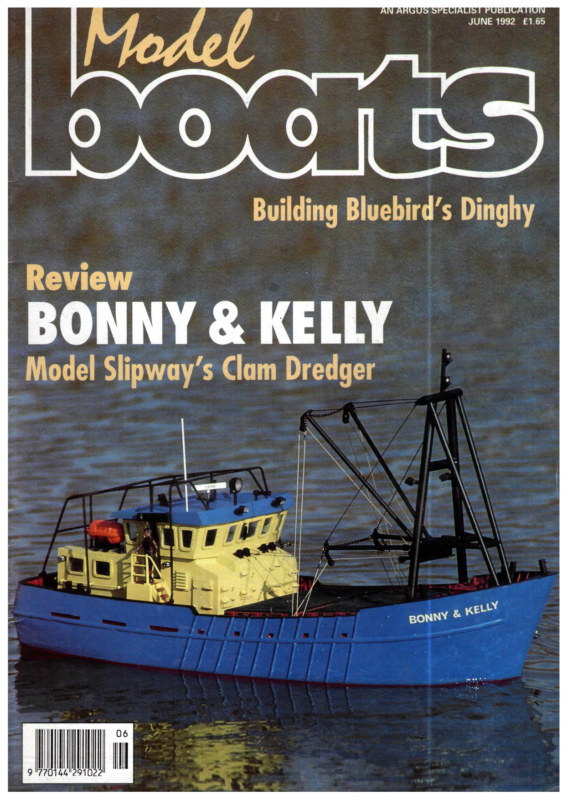
PUB JUNE 1992 ‘ ey £1.65 Building Bluebird’s Dinghy Review BONNY & KELLY» Model Slipway’s Clam Dredger Lli
Sail to Win This shot gives a good impression of the difficulties skippers can face in trying to avoid collisions at this mark. It is equally difficult for a race observer to be quite sure as to what is actually happening. To get a good idea of what designs are doing well it pays to study the top level competition results. At present it is still the Marblehead Class that seems to offer the most International competition. The regatta report of the 1990 RM Worlds at Fleetwood contained a load of technical information regarding all of the yachts entered. I have no doubt that for a small fee Elizabeth Andrews of Whirlwind Winch fame could supply a copy of the technical analysis that she did for that event to anyone interested. The 1991 RM European Event at Hanko was also a reasonable gathering of top flight Skippers and yachts, but the 1992 RM Worlds in New York promises to be even better. National events in any class ought to be sufficient for most people to study to get a fairly good idea as to what developments are going on locally and as to what designs appear to be competitive in what conditions. Personally I am coming to the opinion Part Ten of Nick Weall’s course to improve your Sailing his is the tenth article in my second series offering tactical advice to aspiring radio controlled yacht skippers who wish to improve their potential to win club races and above. written that achieved. It is very difficult to find such a design. If one splits wind strength into light, medium or heavy it is quite easy to get a yacht that will perform well in two adjacent of the three strengths, but not all three. Graham Bantock, Chris Dicks, Roger Stollery and Squire Kay are four British designers and boat builders that constantly design and produce yachts that have good potential. New Zealand, France and Germany all have a wealth of design that a yacht that is at its best in medium talent too. however the box is handled. to light conditions with an ability to survive in heavy conditions is best suited to the overall conditions that we enjoy in Britain. If you wish to confine your racing How to packa fixed keel and rudder Marblehead for air travel. The tube located into the mast tube at the top and the wooden clamp around the lead weight at the bottom of the keel are sufficient to hold the model totally secure Whilst there maybe a third series written in the fullness of time, this present series will take readers a long way along the road to success. As I have written many times the study of tactics will reward the student of yacht racing far more quickly and successfully than devoting too much time scheming ways of making your yacht faster than anyone else’s,. The other point of course is that if anyone does succeed in developing extra speed out of a particular class of yacht, it will not take very long for the idea to be taken up by others. Tuning of yachts and ensuring that you have a basically competitive design do of course play a part in getting to the top of the tree. Design What one should really be looking for is a design that offers all round performance in all strengths of wind. This is much easier JUNE 1992 29
to a particular part of Britain then of course your requirements may be different, but at least give the matter some serious thought before investing in your next yacht. conditions and sometimes even in fog as well! The major difference on the Walicki design is the facility to be able to change the camber and twist of the sails, plus the slot of the jib on the move. These are not facilities anyone seems to bother with too much in this Country and I must admit I have tended to hold the opinion in the past that the simpler the whole set up is the better. There is less to go wrong and less to worry about altering in the heat of the race. Simplicity At the Worlds in 1990 I noticed quite a few yachts with extra channel facilities. Camber and slot adjustment were the favourite options, with separate kicking strap controls in evidence here and there as well. Little attachments to aid goose winging were also around. Obviously such additional control facilities have not guaranteed every Skipper success and indeed may even have cost their owners dearly, as in the case of Alan Gardner of Canada whose complicated control system let him down as his transmitter constantly played him up. It is interesting that our most successfully competing Skipper Graham Bantock has not yet yielded to the temptation to introduce more control/adjustment facilities by remote control on his yacht yet. . My Choices Top, one of a sequence of 1 three photos: No. 49 Claes Lundin of I was very satisfied with my Graham Sweden seems a little Bantock designed Enigma which provided me with good all round performance. Light winds were perhaps its weakest point, but even there it was i : pretty competitive. That yacht has now of Denmark room at the mark – despite an overlap being established at four boat’s lengths. Left, photo 2, now if been just passed on to Lindsey, my wife, who no doubt will you are an observer what do you think? Is there contact or not? sail it on to yet more success in many events to come. I have deserted Graham for a while and gone to Janusz Walicki of Germany; he has built me a RM Skapel to the latest specification. This yacht in Janusz’s hands won the 1991 RM European event in Hanko, Finland and as at Fleetwood the year before shows a marvellous potential in all conditions. People seem to think that it suffers a little in heavy conditions, but having just given it a try in a force eight at Gosport I am not so sure. It held up well and flew across the lake. It did not bury its bows as one might expéct, and cut a very clean line through the water. Its’ second trial sail was in whisper light conditions and again it cut a good trail through the water. Tomorrow it gets its first regatta at Chelmsford – the Oliver Lee Trophy. A yearly event it usually gets a good attendance of top Skippers and a competitive day’s racing can be enjoyed, albeit usually in light wind Right, photo 3, there were no shouts or protest from either boat or from 144 John Cleave who sensibly lets them get on with it, keeping well clear. Action from 1991 European Championships. 30 unwilling to allow No. 9 Bjarne Clausen
Rigs Conventional rigs seem to be making a comeback too for all strengths of wind. As a generalisation a conventional rig seems to hold a much wider envelope of performance than its swing rig equivalent. This thus requires far less rig changes and provides a wider tolerance to wind conditions on the water. Couple this to a possible better performance to windward and it is easy to see why people are changing back. The swing rig however still remains an extremely easy rig to sail with once one has got used to using one and the ability to change rigs in the twinkling of an eye does have advantages on occasions. On my Enigma I was using swing rigs for the A and B high aspect rigs and then I would change over to the stayless conventional rigs for the C suit and the remaining four sets of progressively smaller suits that enable the yacht to cope with the strongest of winds that racing can continue in. At Fleetwood for the Commodores Cup in 1990 the Enigma and its smallest suit of sails were able to struggle around the lake in the very strong gale that prevented the second day’s that your yacht does not have the comparative speed of the other yachts at any race meeting do not be afraid to ask the most competitive Skipper at the meeting for his advice. There is no guarantee that his advice will work for you, but it is well worth a try and usually will result in an improvement in your yacht’s speed or some good advice as to why perhaps it cannot gain such a speed. Keeping Warm Now at the time of writing this article we are still in the winter season so it is perhaps worth repeating the advice to always take more clothes with you in the car than you ever think you are going to use. I in fact always include a very basic change of clothes so as if I am unfortunate enough to fall into the water I will have a few dry things to crawl into. Falling in the water is a very rare occurrence, I have done it once and I have seen two or three other people do it over the years. In the winter however it could be a serious love of queuing here, it is push and shove, cut and thrust all the way. As we have already explained your tactical objectives change according to where in the fleet you are currently placed or seem to be placed. The further down the fleet you are the more opportunist you need to be, looking for every gap to dive into or incident to sail around. One of the traps we have not particularly covered is the shifting wind. If the wind is shifting at all there is a chance that some yachts that have tacked for the mark dead on the existing layline are going to get headed if the wind shifts against them. This obviously becomes a problem for yachts on what was to be their final approach for the mark, they now have to put in two more tacks to lay the mark. If this happens to you, you must immediately assess the situation so as to , be able to choose your best option. Do you have yachts close astern to windward preventing you from tacking? If they are able to lay the mark you have a problem because they obviously have no need to put in extra tacks. However if they can lay the racing from taking place. Only three other boats braved the water on that second day to try out the conditions. All four yachts found tacking extremely difficult and at times impossible, but by gybing one was able to control the direction of the yacht to a large degree. These were conditions where it was literally difficult to stand up. The only way to launch the yachts was by throwing the things into the water. To get the yachts out required the assistance of another person and a pole to prevent the yacht from dashing itself to pieces against the bank. That was Fleetwood at its windy worst in sever gale conditions. So the Enigma has a total of nine suits of sails, since it has two A suits, one with a normal weight of sail cloth and the other with a very light almost cling film sort of material for whisper light winds. The Walicki Skapel has a total of three sets of sails for all conditions up to force eight! It is going to be interesting to see how it copes with all strengths of wind and how competitive it remains over all of the various wind strengths. The answer has to be that it copes well or else Janusz would not have enjoyed the considerable success that he has with his yacht, or the answer maybe that Janusz is a superb Skipper who is able to sail his yacht in such a way that it is able to cope with a wide variety of wind strengths. Time will tell and more information will follow in future articles. The point of writing all this is to help you when you are considering what yacht to go for next or how to improve your existing yacht. The Motor! Once you have checked out that your existing yacht has been built square and well balanced and that it has a good rudder and fin profile with smooth joints to the bulb and hull, the best investment is in the motor. The sails and their shape obviously contribute more to the success or failure of a yacht to hold its own against other yachts. We have covered basic tuning of the yacht and sails in the first series of articles, (now consolidated into my book ‘Sail to Win’,) but as an aside if you feel JUNE 1992 Photographed at the Europeans, the windward beat. problem if you did not have anything else to get into and most certainly would ruin your day’s racing. More importantly though spare clothes allow you to put on more layers if you feel cold; there is in my opinion nothing worse than feeling cold and miserable when you are meant to be out enjoying yourself. On this note there are nowadays lots of good quality yachty clothes available designed to keep you warm and dry that are well worth looking at next time you are thinking of buying a new coat. Tactics You may recall that last month we were still stuck around the first windward mark. We have spent quite a bit of time discussing the first windward mark because it is usually such a congested area of yachts all doing their very best to get around the mark as quickly as possible and before as many other yachts as possible. You will see none of the British mark you cannot be that far off laying the mark yourself, so consider easing off a touch to build up maximum speed before swinging up at the last moment to shoot the mark. Shooting the mark is where you luff no higher than head to wind very very close to the mark in order to be able to round the thing on the correct side. You have to do it very close to the mark because your yacht is not going to travel very far without any wind driving it, also the closer to the mark you are the less distance to windward you are going to have to travel. It is often a good idea to ease out the sails a little as you swing up to windward, it is also a good idea to warn any yacht to windward of your intentions. You have every right to shoot the mark provided that you do not go beyond head to wind and any yacht outside of you that you has an overlap must give you room. However you are not going to be too pleased if that yacht does not give you enough room and it pushes you onto the mark, because you are likely to stay there for some seconds since it is unlikely that you will have the momentum to overcome the resistance of 31
the mark and to roll right around it. If you do get stuck on the mark and have to drift off it backwards you are going to loose places and whilst it was the other yacht’s fault you are not going to be able to claim redress for such an incident unless you have a very sympathetic protest committee. There was no entanglement as such and you have not suffered damage of a material nature – so try to avoid the possibility in the first place. Now if there are no yachts close astern and to windward as you are being headed on your final approach, it is still better to carry on towards the mark and leave your tacks to the last moment as well, just in case the wind swings back again and gives you a lift. There is no point in putting in two extra tacks until absolutely necessary. However if you are already quite near to the mark and you suffer a large header, then it is better to put in the two tacks required than mess about trying to pinch your way around the mark. Severe pinching simply slows you down too much and can then even produce too much leeway so you end up worse than before, with no way left on to even shoot the mark. Speed is essential at the windward mark if possible. It is also worth reminding you again that you should be looking out at how yachts are rounding the so as to be in the best position to gain an overlap and so as not to have to give an inside overlap to any other yacht. To be an outside yacht at the wing/gybe mark looses a lot of ground. Because of rule 39, the best place to safely sail below your proper course to the next mark without any fear of infringing rule 39 or upsetting a yacht close astern is at the windward mark. If you just keep rounding the mark tight there is no room for a yacht astern to even attempt to get below you and you ought to be able to select the course you want without interference from yachts astern. On the first broad reach there is little to think about other than trying to overhaul as many yachts ahead as possible to leeward. Since the first broad reach is usually having the yacht sailing further away from your control position it does become harder to see properly how your sails are set. For this reason it is important that you have a very good idea of the relative positions between your control stick and the actual sail settings. Direction It can also be quite difficult to know exactly what direction your yacht is sailing in. Obviously you will have a general idea, but your general idea may in fact be If you have got the yacht moving through the water well and positioned low then you can be looking forward to see what is happening with the leading yachts rounding the wing mark. The sort of things you are looking for are; are they leaving the mark wide? Thus is there a chance you might be able to cut inside one or two yachts ahead as they round the mark. Is there a chance that there is going to be a big gang of yachts rounding the wing/gybe mark directly in front of your yacht? If so it is very important to arrive at the mark close to the mark so as to have a chance of rounding the it quicker than the outside yachts ahead of you. They will have to round the mark so wide, giving room to the inside yachts that they will have left plenty of room for you to sneak inside of them to windward as they leave to begin the second reaching leg. Now if you were unfortunate enough to have been forced into a windward position on the first reach as you rounded the windward mark, you will have rather more to think about as you sail along the first reaching leg. Are you going to try to sail over a yacht or two to leeward, risking a luffing battle or are you going to slow down a little and duck the stern of the yacht at present to leeward so as to try and gain an inside overlap at the next . windward mark if you are unfortunate enough to be near the rear of the fleet approaching it, looking out especially for windshifts and yachts pinching too much as they approach the mark. If this happens, overstand the layline yourself and plan to approach the windward mark wide with speed. This way you can avoid any tangles ahead of you at the mark and simply sail around the lot of them with speed gaining places. Whilst actually rounding the mark, apart from concentrating on missing other yachts do try very hard to keep the wind in your sails and driving as you alter direction. This naturally requires good coordination between both thumbs and it is an essential skill to develop. This is one of the skills that can be developed without having to have other yachts to compete with. Until you have this off to perfection you ought to be using every available moment to practice. The best way is to keep sailing round and round a buoy until you can retain full speed right around it. This practice is also useful to enable you to take your penalty turn/s as fast as possible when applicable. It is very easy to get demoralised after an incident and whilst you accept that the fault was entirely of your own making you lose concentration and make an absolute pig’s ear of doing a simple turn, losing all boat speed in the process. The race becomes a nightmare several degrees out. This in turn makes it harder to have the sails set for optimum 67, Werner Gerhardt leads a late afternoon ‘A’ The converse is when you are involved with an incident with a more proficient Skipper – he immediately admits that the fault was his and peels off to execute a perfect and well driven throughout penalty turn. You grit your teeth as the same Skipper passes you just before the next mark, thinking I thought I had got rid of these problems; but until you have developed this experience it is important to be aware of the problem and to remain extra vigilant. Keep a sharp eye on the behaviour of your sails and the angle of heel. If your sails start to flap at all you need to sheet in slightly and if the yacht appears to be heeling too much the you most likely need to ease the sails out a little. It is most important that you also keep constant attention to your yacht’s speed relative to those yachts around it travelling in the same direction, because mark? The answers to these questions all depend upon your ability and your yacht’s to get the best speed out of your yacht on the reach, plus the actual distribution of yachts ahead, astern and around your and your mood blacker. that one! On the reach towards the wing/gybe mark you need to be thinking about where you want to be as you round that mark whilst you are rounding the windward mark. All other things being equal you want to be approaching the wing mark low 32 performance. Experience will help solve they ought to be the best indication as to whether or not your yacht is travelling at near to optimum speed. Keep any adjustments you make slow and gentle so as to avoid the possibility of losing even more drive. fleet race at Hanko. yacht. At best you have to be an opportunist constantly searching for opportunities to improve your yacht’s actual position in the water relative to the other racing yachts around so as to be able to grab any opportunities that arise to gain places. The biggest opportunity is still likely to be at the next mark. Yachts are still going to be leaving too much room between themselves and the mark as they round, good judgement on your part will give you a chance to gain places. You have too be careful of the yacht that goes in wide ahead of you but hardens up to come MODEL BOATS
look out for yachts ahead but to leeward violently luffing you as you poke your nose to windward of them. Violent luffing battles are to be avoid if at all possible. If you consider that a luffing battle on the second reach can Another shot for Russell Potts’ readers. An oldie worldie yacht moving through Helsinki Harbour. out very close to the mark. If you are able to round the mark very tightly yourself and continue to round the mark tightly slightly further than necessary you will much better position to complete the second reaching leg, being on the windward side and on the side to gain the inside overlap at the leeward mark! often avoid this problem, because for the outside yacht that was ahead it is in fact quite hard to come up quickly enough to shut you out. Again this is an area where experience does need to be developed so as to be able to judge the situation correctly and assess your chances of successfully getting away with such a manoeuvre. The one thing you can almost guarantee is that the outside yacht or yachts will be most annoyed at seeing you nip inside them and will do everything in their power to frustrate your efforts. As with any mark it is important to know where you want to be coming out of Luffing Now while luffing contests are unusual on the first reaching leg since everyone is more interested in overtaking yachts to leeward, on the second reaching leg you will witness some spectacular luffing battles. There are two reasons for this, firstly leeward yachts never like being produce both yachts ending up on a close hauled course sailing away from the leeward mark, you will understand that yachts previously astern can cheerfully slip by to leeward while such a battle is taking place. It is always worth considering and being prepared to duck the stern of a luffing yacht. This will give that yacht the inside position at the leeward mark, but it will at least avoid sailing across the pond in the wrong direction. It is possible by this tactic to actually gain some distance over the other yacht too. You will not sail straight past it and clear ahead just like that, but you might at least draw level. A better option might be to be patient, save establishing that all important overlap to windward until say five boat lengths from the mark. At that stage the yacht to leeward is very unlikely to want to engage in anything more than a minor luff, since the leeward mark is firmly set in his sights and the importance of maintaining a direction towards it is plain. In my opinion this is the time to gain the overlap. It does of course depend upon how many yachts lie ahead of you as you sail down the second reach. The more yachts ahead, then the more pressing it is to try and overhaul a few of theme but not at the expense of being luffed halfway up to the windward mark! Be patient and remember that the windward beat is where the best potential gains can be made. There are also gains to be made rounding the leeward mark for yachts astern that plan it correctly against yachts ahead that are a little bit sloppy. It is very common for yachts ahead to tack the mark before you go into it. The usual objective is to be on the inside coming out as well as going in. There are exceptions, especially if you have good coordination between your two thumbs and can keep your yacht travelling at top speed throughout the rounding. There will then be occasions when in fact you can sail around the outside of two yachts caught up in their own private battle and get clean ahead. Now going back to being the outside yacht on the first reach and having had no chance to alter the situation as you reach the wing/gybe mark it is very important to assess the situation accurately. If at all possible you do not want to become the outside yacht.of several yachts all rounding the mark together. If you can do so it is better to slow downa little and take the sterns of all of the yachts previously to leeward and take the mark tightly a second or two later. By doing this you ought to gain places over the yachts that allowed themselves to be trapped as outside rounding yachts. They will have had to have travelled that much further through the water, whereas your course has been the shortest course possible albeit slightly slower, and you will gain distance over them. You will also be ina JUNE 1992 A close ‘A’ fleet race at Hanko 1991. overtaken by yachts to windward and more importantly the leeward yacht being overhauled wants to push the overtaking yacht clear astern so as to deny that yacht an overlap at the all important four boats circle from the leeward mark. Thus luffing now becomes the most important thing to be looking out for, both as a tactic to use and as a tactic being used against you. If you achieved your objective at the wing/gybe mark of being the inside yacht or at least coming out of the mark as the inside yacht, then you will only have to immediately they have rounded the leeward mark. On a normal Olympic type of course, having the marks left to port, this means they will be tacking from port to starboard. To some skippers it is almost an automatic part of rounding the leeward mark. I am tempted to recommend this as being the best tactic, only so as those of us that know better can still pick such skippers off easily. In my mind there a several very good Cont. page 43 33