- Mail Boat
- SYLPH An Experimental Six Metre design — especially for light weather conditions — by GRAHAM WELSH
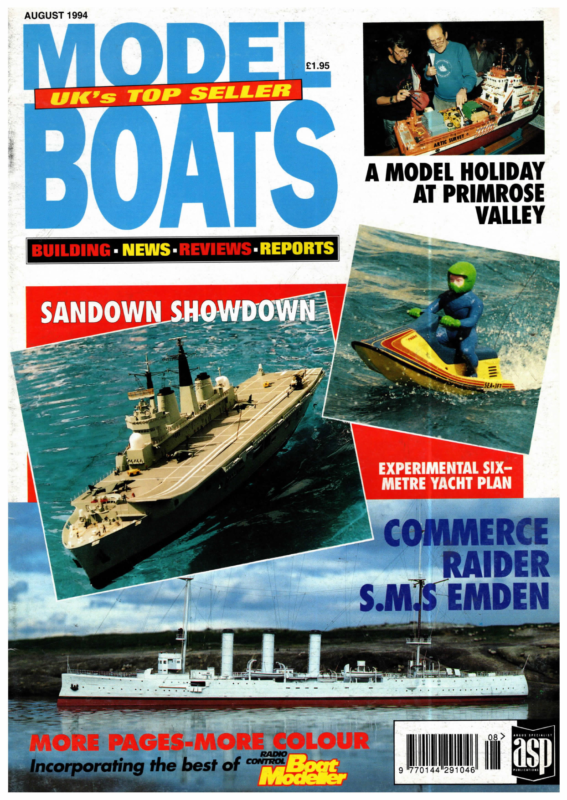
- Yacht Lines Anthony Corbett continues his contribution to Model Boats with a review of the model yacht kits currently available from your local hobby shop
- small YACHTS – MIKE KEMP rounds up some championships and offers thoughts on Primrose Valley

AUGUST 1994 A MODEL HOLIDAY AT PRIMROSE VALLEY ARGUS SPECIALIST asi PUBLICATIONS
WRITE TO: THE EDITOR, MODEL BOATS, ARGUS HOUSE, BOUNDARY WAY, HEMEL HEMPSTEAD, HERTS HP2 7ST Dear Sir, Thank you for sending me the details of the Scottish Model Yachting Association. Unfortunately there is nota club around Dumfries and Galloway but local newsagents seem to sell a number of copies of Mode! Boats and similar magazines so there are people in the region, who have a keen interest in the hobby. With this is mind, could you please publish my address and phone number, asking anyone who is interested in forming a club in the area to get in touch. Many thanks, your help is appreciated. R G Williamson Edenwood Clarebrand Castle Douglas DG7 3AH Tel: 0556 503571 Dear Sir, While reading a recent Mail Boat column, it occurred to me that someone out there could help me find some information which would mean a lot to me. | am originally from Crawley, West Sussex, and have been living in Northern Ireland for 20 years. | left when | was 11, and lost track of my Grandfather who_ has since passed on. He was Mr Henry Arthur Robert Foulston (Bob) who lived in Ifield, formally Mitchem. He was a great man who gave me my passion for warships. He served in the Navy during WWII on HMS Wryneck and HMS Renown. | know nothing about HMS Wryneck. | have plenty of books but cannot find anything about this boat. | would be very grateful if anyone who knew him or the ship could let me know. | have already built one model, a 1:96 HMS Intrepid. | would like to build one of the above boats and would be very grateful for information received. Kenny Rogers 8A Slieveshan Pk, Kilkeel Newry, Co. Down Northern Ireland, BT34 4DS (According to Conway’s All The World’s Fighting Ships, HMS Wryneck was an Admiralty ‘W’ Class destroyer, launched 191718, 1490t deep load, converted to AA destroyer in 1938-40. She was sunk by bombs on 27 April 1941. Ed.) 10 Yachting’. Mark Steele from New Zealand, enjoyed a recent trip to ther UK. See ‘Magic of Model my boats. Dear Sir, Permit me space in your Mail Boat columns to express my thanks to the hobby of model yachting, for friendships made as a direct result of interests shared. Early this year, when ona visit to the United Kingdom, my wife and | travelled to Falmouth in Cornwall for the express purpose of meeting a person with similar interests with whom | had corresponded for some time. Ken Impey who builds beautiful schooner models (first seen in Model Boats) and | enjoyed a few days together, and a delightful sail of his creations at Perranporth pond. Our wives got on extremely well, and thanks to you who kindly forwarded my letter to him a couple of years ago, our lives have been enriched by a common interest in model yachts as we now continue a great friendship. There were others also – Tony Searle in Poole who is building a New Zealand RC scale scow (as indeed is Ken) and Mike Taylor and Tony Lench of the Scale Sail Association, with whom | enjoyed another special day of sailing, this time with barges. May human contact with good friends forever point high on the wind. Mark Steele Auckland New Zealand. Dear Sir, May | propose that there is no such chap as ‘Mr Average’. We all have some unique spark, some blessed eccentricity, and all of us are therefore much the better for it; in our case manifest as a compulsion to build boats. | grew up between the wars, in Bayswater, handy for the Round Pond. My father, as a marine engineer with time in sail, made a schooner for my first birthday. Thus from then till now, boats it is. Steam Sundays at the Pond were captivating and in due time | joined, with-bits from BassettLowke and Bonds; and was made welcome, a junior among encouraging seniors. We were all sorts – clockwork, electric, spectacular unreliable petrol, all dominated by steam. | took to steam, burnt fingers, singed eyebrows, the acrid smell of meths and part burnt paraffin. The excellence of BassettLowke and Bonds were followed by Stuart Turner’s superb miniature marine engines, and the school Drummond came in Model Engineer is knee deep in complete steam locomotives, the infrequent pieces on stationary and marine engines are, in my memory of the last twenty years or so, confined to the engine – no boiler or heater. The important precedent, therefore, made by Mr Arnot, is to give us the whole thing, engine, boiler, boiler-feed and heat source. Moreover, since its boat machinery, what better place to present it than Model Boats. Surely variety is what we need, such that the greatest number of people may find some new thing to entertain – and perhaps encourage into new departures. | happen to prefer boats which float, driven by sails or steam, but | admire and enjoy the perfection of Dockyard models and the near museum quality it seems possible to approach with modern kits or scratch built, electrically powered vessels. Then let us have more, not less, variety – to encourage us all to venture new skills. John Mcintyre Cambridge for a lot of treadling. | soon learnt a hidden virtue of the steam engine, for newcomers, it’s tolerance. | had no proper measuring kit, verniers, micrometers of the like, just an inky wooden ruler and callipers. My engines fitted in places but drove Dear Sir, Many thanks for publishing my enquiry about a Bristol Channel Pilot Cutter in your May issue, the response | had was quite MODEL BOATS AUGUST 1994
With all the penalties and deduction she still has a very good sail area/weight ratio (47.27 per lb of displacement), and much less wetted surface than Bournville. The table below gives comparisons of several designs’ sail area/ weight ratios. SYLPH An Experimental Six Metre design — especially for light weather conditions — by GRAHAM WELSH ylph has been designed as an experiment into improving the light weather performance of the current crop of Six Metres, by shortening the waterline length, and decreasing the displacement until a reasonable Sail Area/ Displacement ratio is maintained Light displacement has become the norm in most model yachting classes in recent years and I felt that a lighter, shorter Six may appeal to both the junior ranks and also those of more mature status. Sylph features a somewhat less than normal amount of average freeboard, and, although this has the effect of reducing the available sail area, the gains in both the portability and presentation of the smaller hull profile when going to windward will hopefully offset any loss of driving power. The design philosophy owes a lot to the concepts developed by Brit Chance for the modifications to the Twelve Metre Intrepid, and his continued application of the concept in the Twelve Metre Mariner. In his book Aero-Hydro Dynamics of Sailing, C.A. Marchaj shows how Intrepid’s after sections were filled out for her second defence of the America’s Cup, after tank tests of models indicated that a flatter wave formation resulted from this modification. Brit Chance developed this further in Mariner to the extent where the sternpost actually becamea triangle in section. The theory behind this is that the squared off after ending actually produces a vortex which sucks the water over the after sections close to the hull, thus preventing a (she sounded like a motor boat, apparently), however the tank tests must have indicated this was a viable proposition at the scale of the model tested. This may be another one of those things that works for models but is not translatable to full size. C.A. Marchaj is quite positive in his advocacy of this theory, and also the theory that thick foils with squared off trailing edges may produce significant improvements in wave formation and skin friction. Sylph has been designed along the above lines of thought, and only actual racing will prove or disprove the theories. I had better get of my box and give some details about Sylph. LOA LWL Rated L Girth Tax Sail Area Displacement Draught Lead Beam (max) Australia and over the years has impressed me with the quality of Additional note from Alan Bright, his draughtsmanship and original thinking. Having received the design of Sylph (which has also been entered in the 6.M.O.A. Design Competition), I felt that it deserved to reach a wider audience. Graham has very kindly donated his designer’s royalties to the Six Metre Owners Association which is a very generous gesture and greatly appreciated by the Owners Association. Both Graham and | are currently constructing a model of Sylph, keeping construction as light as possible to maintain a good ballast ratio. Hopefully there The sail plan as shown has a 12% lead in front of the C.L.R., this may be excessive, and perhaps only 10% is required (this brings the sail plan aft another 0.67inches). Sylph features an immersed transom, to test the case for this type of stern, as used in the Twelve Metre Mariner. Hon Secretary, Six Metre Owners will be additional details on her Association construction published at a future As a result of a great many enquiries and comments from individuals who expressed a date, when completed. It must be emphasised to the intending builder that this is very much an innovative design which is breaking new ground within the Six Metre Fleet, as such, any purchaser of plans should be prepared to experiment. Additional advice and details of modifications etc., in light of experience can be obtained from myself (Tel: 0245 344798). desire to own a Six Metre, but felt that the current average displacement of 26lbs was beyond their physical capability, coupled with a desire for my 12 year old son to have a boat which he could handle, I requested Graham for a design. Graham Welsh is a keen amateur designer living in 49.85 ins 36.90 ins Design Sail Area Bournville 6T6 1160 1063 1216 49.73 ins nil 969 ins Rennaissance Wild Rumour Revival 10.72 ins Seismick 20.05 lbs 8.50 ins 14.00 Ibs Petrel 1040 941 1100 Displacement 1066.90 26.61 26.11 26.61 Sa/Displ Ratio 39.08 36.04 41.34 23.61 24.68 26.60 49.13 43.07 45.71 27.80 38.38 # SS op a JP — ‘| \NLI ONY We | SS | i | oy ) separation of flow in the quarters immediately ahead of the stern post. Mariner was not a success Full-size copies of the plan for Sylph can be obtained from Model Boats Plans Service, ASP, Argus House, Boundary Way, Hemel Hempstead, Herts. HP2 7ST. Please quote plan number MM 1463. Price ts £3.65 plus £1.25 inland and £2.00 overseas post and packing. MODEL BOATS AUGUST 1994 25
not only put off modellers (although having seen some of the past correspondence on _ Classes at the Model Engineer Exhibition, I’m not so sure!), they are also difficult to teach to those starting to sail, whatever the size of the yacht. To be honest, it is only a small part of the whole who really have a good understanding of the Yacht Racing Rules, so how does the learning process differ between full sized and models. This could be the subject matter for a book, but fundamentally I believe that for models, we do not have the opportunity to just go cruising and learn gradually. A Sports Class? Hopefully, the light may be beginning to dawn for those readers who wondered what any of the above has to do with the proprietary kits that I set out to review. The absence of “sport’s flying”, as a recent correspondent so aptly put it, at MYA clubs may well be a deterrent to those who simply their prized possessions. I make no secret that my passion is with the MYA class yachts and racing in particular. However, I approach this particular hobby froma sailing background where rules are the accepted norm. I can however see that for others, these rules might be extremely intimidating and a deterrent to becoming involved in such an enjoyable hobby. So why have rules? Well like all forms of competition, it is really difficult to decide a winner unless that competition is run on a basis fair to all. Ifyou decide there are no rules, apart from this being a contradiction in itself, at least everyone knows where they stand. Yacht racing is run to rules administered by the International Yacht Racing Union and are really a development of the International Rules for the Prevention of Collisions at Sea, or common sense as it used to be known. MYA racing is run to the same set of rules as the big stuff, which is not so bad when one has already learnt them but Above, Robbe’s can be pretty intimidating for a newcomer that is trying to learn to sail at the same time! Perhaps it would be better to approach this Contesse makes her sprightly way down wind. question from another view point. Rules do want to sail model yachts and perhaps enter the sport of racing in a more genteel manner. It is for this reason that the MYA are considering the establishment of a “Sports Division” which will be intended to establish a simple framework within which clubs can run events for people sailing yachts other than the MYA classes. It is probably inappropriate to discuss too much detail here, as the idea still has to be approved by the MYA Council. But if you are interested in doing more with your yacht than just the occasional foray to a local park, why not go along to your local model boat club and push for them to adopt this new idea? The incentive of new members and the associated fees, should be enough for them to welcome you with open arms. So to Kits So now to the kit yachts that some of you might be considering buying. Having already set out my stall and forewarned the reader of my own particular bias, I must say that there really is quite a difference in performance terms (and in some cases cost) between proprietary kits and MYA classes. The latter are designed and built to sail in all conditions Above right, when compared with more expensive kits, detailing on the Contesse is fairly basic. Howevera little ingenuity can vastly improve the yacht as shown in this shot where the addition of red “cushions” and blue decking makes the finish stand out. continues his contribution to Model Boats with a review of the model yacht kits currently available from your local hobby shop irstly, may I thank those readers who have either written or spoken CR914 darting to windward. This kit although small and to me directly offering their comments (many complimentary!) on my article in the June issue of this publication. In a time when it seems so much inexpensive, sails easier to criticise than contribute, your surprisingly well. comments are much appreciated. I was also Aftention to detail and a good paint finish would also provide a model that looks good and doesn’t take up pleased to receive a number of enquiries about the Model Yachting Association (MYA) and trust that this interest in the hobby of model yacht modelling and re-yacht racing in particular, will continue to grow. more space than the As I suggested in my last missive, there does seem to be a lot of model sailors out sofa. there who are put off by the idea of racing MODEL BOATS AUGUST 1994
equipment you need to get on the water. small proportion of model plane or car sales. It is also obvious that the energy put into promoting these type of products is also small, which might explain why the sales Left, Koh-I-Nor also These will probably include a basic two looks good under sail. channel radio transmitter (TX) and receiver (RX) operating on the 27 MHz frequency. This is because it is the cheapest option, however they don’t tell you that there are only 12 channels available on 27 MHz and 32 channels on the 40 MHz sets which cost slightly more. This must be frustrating for the beginner, who could turn up at a local club lake and find twelve other people sailing and get little chance to get afloat. At least frequency clashes are not as terminal with yachts as they are with planes. However be well advised to consider the options and get at least two additional alternative crystals (these allow you to alter the channel within The decking applied by model maker David Semper transforms the kit into a small luxury yacht. are low……….. Anyway, my enquiries seem to support my impression that most shopmade purchases of model yachts are very much done on impulse, with the buyer obtaining what is available, perhaps without a lot of guidance. I found out about most of the kits from reading the from light winds to a near gale. All classes utilise a variety of rigs and sails to suit the prevailing conditions and unlike a lot of their kit brethren, have deep efficient keels to improve stability and performance. The other point is that in the majority of cases, competition skippers realise that water and electronics-do not mix, therefore work hard to keep them apart. Some of the kits I have seen have some fairly basic design faults which allow water into the boat when over- pressed. This and other problems are normally resolved by most model builders, but if you are new to the hobby, then take my advice and visit a local club. Here you should be able to get friendly tips and guidance that will enable you to build your chosen boat in such a way as to avoid the problems that come from poor kit design or construction. Lecture over, so let us move on to what kits are available. It surprised me how difficult it is to find out about model yacht kits. Having spoken to several distributors, it is clear that the marine kit market is only a adverts in both this magnificent publication and another, almost as well known magazine. From these enquiries I think it is as well to list some points for you to consider before you dash out to buy your re-yacht. 1. MYA class yachts are not as expensive as you might think (Come on, I’m honour bound to say that). 2. A lot of kits come in several parts. The kit price quoted may well exclude the fittings that you see on the examples within these pages. 3. The kit price will probably exclude the electronics. For the smaller and more basic yachts you will require a servo to operate the rudder and a larger sail servo (arm type) to operate the angle of the sails to the wind. For the larger yachts (and all MYA classes) you will need a drum winch (a large more powerful servo that rotates a drum) which adds to the cost. 4. Staying with electronics, think carefully before buying a package deal. Most shops will sell packages complete with all the Above, Inga IV under Manufacturer Graupner Kit Name Kid Yacht Inga IV Nordeney Yacht Price Length App. £300 App. 1200mm £89.95 £213.50 Group Notes sail. This ae 3 Sorry about the lack of detail. might appeal to anyone 750 mm 2 765 mm 2 Complete ex. electric’s Overall length is 960 mm including booms. Price includes fittings Graupner Ruben £399.99 1170 mm 3 Ascale One Ton yacht kit. Special sails Graupner Butterfly £299.99 pack is £54.99 Trimaran 590d 590 mm 2 HFM £66.25 1130 mm £62.95 £109.95 590 mm 640 mm 1 1 Complete ex. electric’s Complete ex. electric’s HFM Kyosho Kyosho Lesro Lesro Ritual Yachts Ritual Yachts Robbe ~*~ Robbe Robbe Robbe Robbe Robbe Robbe Sails etc. Tamiya 590s Beneteau Fair wind II 900 mm 2 £50.13 £59.77 575 mm 497 mm 1 Requires ballast to complete America Cup 12M £37.95 Approx. 400mm 1 CR 914 Cup Racer Pirol £95.00 £130.00 Approx. 600mm 1 I am told that this kit can be bought for £75.00 complete! £111.50 £176.70 950 mm 1000 mm 2 2 £185.99 1200 mm 2 3 2 3 Fittings kit £125.50 Catamaran. Fittings kit £51.25 Fittings kit £308.50 £79.50 600 mm 1 £299.99 985 mm 2 Includes one rig kit, the No 2 rig costing an additional £18.50 * Contesse Topaz Twin Masted yacht Koh-I-Noor Smaragd Top Cat Atlantis Twin Mast Schooner Tactic Yamaha AUGUST 1994 £209.50 £209.95 £278.75 1 interested in producing a working scale model. Complete ex. electric’s £125.00 575 Yacht Gemini Whitbread 60 MODEL BOATS 1 interesting project that Check whether keel weight is included. Catamaran Available at some retailers, otherwise by, special order 1375 mm 1350 mm 1375 mm Fittings kit £27.50 Fittings kit £37.20 Fittings kit £74.75 Complete ex. electric’s 59
Right, the model many pages on this collection, however the point of the day was to play, sorry sail, the Yamaha looks really good under sail and model yachts and get a feel for their strengths and weaknesses. I will deal with each in order of size. performs well. Finishing with a crew seems to bring the America Cup 12 Metre model alive, although The smallest of our group, this kit gives a realistic model of the last of the 12 Metre class yachts to be used in the America’s Cup Competition. It provides, at a reasonable the kit could not be described as cheap Far right, the price, a model that one could easily display without having to choose between the boat or the furniture. The test boat sailed well and Fairwind sailed (an early version) seems a looked good on the water but it is closer to a toy than a model yacht. If used in a gentle breeze, it could probably provide a lot of entertainment and would be well suited to reasonably priced yacht that ts readily available. However it doesn’t relish strong some fun racing on a sunny day. breezes, a fault that can apparently be 590 reduced by the addition A slightly larger version of the 575, I remain unsure as to whether these boats are marketed as inexpensive models for racing or ofsome lead shot in the Reel. cheap semi-scale re-yachts. Both the 590 and the 575 can be rigged with a storm suit, so Below, the Smaragd is they can be sailed in rougher conditions than a big boat that can be rigged with a genoa. It is an ideal candidate for special attention as the shot of Ken Pickersgill’s representation of Hofbrau brilliantly demonstrates. the operating frequency) within your package. 5. My last point, again on electric’s is the power source. Not surprisingly, little advice is offered on this during a busy day in a shop. However, if you intend to do a lot of sailing, your average Duracell is going to prove an expensive option. Think about rechargeable batteries, especially for the bigger model. If you are strapped for cash, this can be added to the birthday present list, without causing a delay to that maiden voyage. As to the kits themselves, I have prepared a table of the alternatives available and the prices advised by the distributors or advertised by retailers in previous publications. I have also tried to guide you to the potential total costs by dividing the kits into categories, however I should point out that whilst I will always try to be objective, this column will reflect the personal views of the writer. This can be taken with the same some kit yachts but they remain fairly tender (unstable) without the benefit of the deeper fins of their larger cousins. Having said that, both kits have sold in large numbers and are raced in a very relaxed manner at many of the model boat clubs around the country. Tactic Although not sailed during this particular trial, this kit deserves a mention. Designed pinch of salt as the opinions of the salesman trying to part you from the hard earned folding stuff. Group 1 would include small lightweight models that would require a basic electronics package to complete. It is fairly certain that because of the small servos needed, the power drain would be small, reducing the need for rechargeable batteries to complete more than a day’s sailing. Group 2 is for the larger, say around one metre long yachts that would utilise a more sophisticated sail arm or cheaper drum winch. With larger sails and more complex electronics, rechargeable batteries would be worth considering. ‘ Group 3 is for the heavyweights. Apart from being larger than the other two groups, these are the type of models that might appeal to the modeller who may wish to add a variety of additional functions (Who puts to sea without an auxiliary engine anyway?). Because these models may have high displacements, they will probably have more ballast in their keel and carry more sail area. They will therefore need powerful drum winches and perhaps more than a two channel set, adding to the cost. Ni-cads will be the only sensible solution for this group, so the battery and charger costs should be taken into account in the budget. So to the table. Please assume that a radio is needed to complete all the kits listed. In order to help you make an informed choice between these kits, your intrepid reporter braved the elements and spent part of the day at the Childe Beale nature park, near Pangbourne in Berkshire, sailing some of the boats mentioned in the table (hard life isn’t it!). There I met the senior trustee of the Park, Richard Howard, who is known to most modellers as an obsessive collector of all types of model boats. Richard has a magnificent collection of boats, some of which are displayed within the park’s pavilion but the majority of which are securely stored around his home. This Aladdin’s cave, houses many of the proprietary kits that Richard has had built from time to time. I could write 60 and manufactured by Graham Bantock’s Sails etc., Graham being the current World Champion of the RM class and winner of most MYA events at one time or another. Nothing wrong with the pedigree then and as one would expect, the kit produces an economic racing re-yacht, rather than a semiscale toy, that performs well in a wide range of conditions. CR914 America’s Cup Style Yacht A larger model than its 12 metre brother, this is intended as a semi-scale model of the latest breed of yacht built to the America’s Cup Rule. Although I didn’t feel that the test boat made the greatest kit for display, some time on painting could produce an interesting exhibit for any mantle-shelf. On the water I was pleasantly surprised by the boat which looked great and sailed well, benefiting from a proportionally deeper fin and sensible weight at the end of it. As usual the boat only has one rig but this will probably cope with a wider range of conditions than some other kits. Contesse We are now entering the semi-scale yacht territory and as can be seen from the MODEL BOATS AUGUST 1994
Yamaha Whitbread 60 If there was ever a production kit that could take off as a separate racing class, this must be it. The kit has been reviewed just about everywhere recently, so there is little need to repeat what most readers will already know. Supplied with an adequate rig that performs well in fairly breezy conditions, this part of the model could be easily improved to give one of the few kits that could sail as well as it looks. The advantage of this particular model is that someone new to modelling can produce a well finished example from the many pre-finished components. The draw back is that all the boats might look the same but you can’t have everything… Inga IV This model is a scale representation of a ketch rigged cruiser and was fitted with an auxiliary to help when the wind died. A large model with plenty of ballast, it sailed reasonably well. This isn’t the type of re-yacht that appeals to me but it would probably give hours of pleasure to the modeller who can take advantage of the kit’s size to add a lot of detail. Smaragd This must be one of the largest kits available and results in an attractive model that can be finished with all sorts of exciting detail. The owner of the particular example featured here raves about the boat and considers it the best to sail of all the kits reviewed. This should not really come as surprise, given that its length, displacement and ballast are similar to the larger of the photographs demonstrating the efforts of marine model maker, David Semper, this kit can be finished to a standard that results in a MYA classes. The finished model can be model that is good to both look at and sail. I found it hard to differentiate between several of the kits tested in this group. One’s final really makes the model fun and interesting to sail. What one has to remember is that this arrangement requires two winches rather choice is really going to be a combination of personal preference and price. This particular than one but what the hell? ………. It’s only kit is similar in size to the Kyosho Fairwind. It sails reasonably well but is quite tender and is soon on its side in quite gentle conditions. Despite this, what I see as undesirable trait, this kit is reasonably priced and would provide good sport and a real challenge to those that enjoy individualising their models. Fairwind Il Those that have visited the Earls Court Boat Show in recent years will have seen this fitted with a genoa, an overlapping headsail not suited to most types of re-yacht but which money. Well that’s enough for this particular issue. Sorry if you might have wished for more detailed coverage of any particular kit but the intention has been to give a flavour of what is currently available on the market. It would have been interesting to have tried a few of the multi-hull kits, particularly the new Graupner Butterfly which comes with a better pedigree than some similar products. As a past and enthusiastic owner of a competitive multi-hull, I know how exciting model used in the races held on the pool, or this type of sailing can be. Unfortunately, I lagoon as the show’s operators are sometimes inclined to call it. Seemingly more readily available than some of the other kits reviewed, the Fairwind in its revised form can make a well finished yacht, but again this needs effort on the part of the modeller. In my view such effort is rewarded by a better wasn’t able to track down any examples, so perhaps another time. In closing I might mention that as a big boat sailor, it surprises me that there are not more scale models like the Tamiya kit, which successfully combine the requirements of sailing and display. With the increasing coverage of sailing and record breaking events such as ENZA’s recent circumnavigation, there would seem to be plenty of examples that would appeal to a much wider market but then I’m not in the business. For my next article, I’ll have a look at the wide range of surprisingly inexpensive MYA class yacht kits that are available from several small manufacturers dotted around the UK. For more information about the Model Yachting Association and the location of your local club, please contact the MYA Information Officer, Mr Ian Taylor on 081 446 1625 (between 2pm and 9pm please). Above, the America’s Cup 12M is a surprisingly good little sailing boat, although really only suited to sheltered waters, however it would also make an attractive model for display. Above left, this photograph shows just how simple HFM’s 590 is, although both it and the very similar 575 have brought quite a few into rc-sailing. appearance than is normally the case with the standard kit but then all these things are a matter of price. For sailing, I have always thought this kit to be far to tender, however it is worth pointing out that the example sailed had about one pound of lead shot added to its keel, which seemed to make a big improvement without sinking the model. Koh-I-Nor Surprisingly I was quite taken with this particular model, probably due in part to the excellent standard of finish achieved once again by David Semper and the fact that it Left, man and his boats. The models in the foreground are the looked good on the water. Like its stablemates, the model doesn’t like too much America’s Cup 12Ms, breeze but perhaps this isn’t a concern for Inga IV to the right, those that purchase this type of kit. Anyway, the model’s appearance reminds me of a Swan yacht, the equivalent of Rolls-Royce in the sailing world and I’d be quite happy to have one tucked in the corner of my living room. MODEL BOATS AUGUST 1994 Yamaha centre; the Fairwind, Contesse and Kor-I-Nor and the Smaragd can just be seen to the rear.) 61
League News The competition is hotting up, the big guns are starting to get into their open event competitive stride so we now have some changes at the top of both competitions. As the National Championships come along we should see some more changes; but remember- if you enter an event for league points let the Race Officer know which club you are sailing for and show him your yacht’s registration certificate. Look out next time for an update on the Vane league situation. Top Five Clubs 1st 2nd 3rd 4th 5th Club Woodspring Chelmsford Clapham Gipping Valley Guildford Score 296.8 292.4 232 230.6 221 Top Ten Individuals 1st 2nd 3rd Martin Roberts tacks 4th 5th 6th 7th 8th 9th 10th Roy Morgan’s Panther to try and escape the cover of Blythe Spirit being sailed by Maurice Steadman. Martin went on to take third in the R6 Metre Skipper Graham Bantock Chris Harris Tim Townsend Keith Skipper Mark Dicks Martin Roberts David Taylor Mike Harris Jim Vice Mike Kemp Score 89 87 78 77 ‘ke 69.2 67 66.6 63 62.5 Nationals. Midland District Radio 6 Metre MIKE KEMP rounds up some : ‘ championships and offers Designer/builder Roy Morgan looks on with uring the early part of the season some of the MYA Championships have taken place. We have a review of some of them here and a look forward to the first World Championship for _IYRU One Metre Yachts. The Midland District of the MYA could, in the past, have been quite justifiably called the heart of 6 Metre activity in England. Thus it is not surprising that the longest running District Championship for this class was fought out again on Sunday 27th March. For a change the venue moved slightly further away from that long time home, Birmingham, to Charnwood Water on the outskirts of Loughborough – the home of the Leicestershire MYC. Many previous visitors thoughts on Primrose Valley some concern as one of the experts of mid-race yacht surgery dives into Panther after a rudder servo failed. Skipper Martin Roberts completed the job in time to take third place in the R6 Metre Nats. Right, the old and new; Promise (45), one of the newer John Lewis designs races Northern Lights (34), one of the earlier Bantock 6 Metres. Graham Elliott brought the latter into seventh place and Ian Taylor finished ninth in the Nationals. 62 MODEL BOATS AUGUST 1994
Far left, he’s done it again! Graham Bantock collects the rewards of retaining the Radio 6 Metre from Championship Councillor Ros Scott of Suffolk County Council. to this lake, scene of many illustrious competitions in the past were probably wondering how they were going to be able to launch, and more importantly, retrieve their relatively heavy craft from the concrete podium that graces the side of the lake. They had no reason to worry; firstly the water level was higher than I can remember it and several wader-clad home club members were on hand to help out. The weather avoided an all-out onslaught but remained fairly dull throughout the day: the wind was quite co-operative providing more than enough driving force for many. The race was to prove a show down between three yachts: two carbon fibre Renaissances and Bill Sykes’ ‘Caprice’ fresh from achieving a Silver Medal at the Model Engineer’s Exhibition. ‘Caprice’ was once again in the hands of Mike Harris while two more Mikes ‘Red Dwarf’ sailed slowly towards the far bank which at this point is not too far away but far enough to mean that that race was to be a ‘discard’. Moral? When the wind is blowing hard be prepared to change your battery packs earlier rather than later! The day was eventually to belong to Mike Harris and ‘Caprice’. This yacht, as well as being beautiful to behold, showed that its forte is really the sort of wind we experienced. While the Renaissance was a match travelling to windward; off the wind the Bantock boat was tending to bury its bows, even wave its winged keel in the air at one point, meanwhile Bill’s boat just streaked away demonstrating remarkable stability. At the end of the meeting our Race Officer Alan Lewis announced the result and presented the alcoholic prizes; sadly Mike H. was unable to take away the trophy, another of those lovely crystal bowls much sought after in the 6 Metre world, as the ‘93 champion Jim McDonald did not come to defend his title. MYA Radio 6 Metre Nationals directed the Bantock designs. While this battle was going on local man Dave Andrews was doing his best to prove that there is still life in the old designs by charging around with his pre-1985 ‘rule change’ dual purpose Bantock Sigma in its radio trim. My own day was marred by a couple of incidents from which we can all draw lessons relating to preparation. During the first race I had a shroud break – I knew it was going to fail right from moment when I assembled the yacht in the car park. The previous meeting had been the ‘blown out’ Cotswold match race which had severely stressed the rigging and had started to break some of the stranded stainless. Leicester’s strongish winds completed the-job. Fortunately I carry a spare set of shrouds already made up so was able to fit them between races. The second lesson regards battery life: my radio set-up is reasonably light on batteries so I rarely need more then two sets during such a day’s racing. After one particular race Mike Harris asked how many races I normally got from a set; replying that I was planning to change after the next I proceeded to charge off around the course with something like a half leg lead going into the leeward mark. As I turned up onto the beat I turned the rudder and went to pull in the sails; to my dismay MODEL BOATS AUGUST 1994 May 14th and 15th sawa great deal of Radio 6 Metre activity in the Gipping Valley Nature Area a little way outside Ipswich in Suffolk. Home of the Gipping Valley MYC whose members have become known on the International Arena the venue was to host their very first National Championship. A select band of seventeen sixes gathered in the Saturday morning sunshine under the Race Officership of Keith Skipper, no longer the owner of a ‘6’ having sold it to the bMOA Secretary Mike Wareham. Keith had been fretting somewhat about this first national event, which Race Officer hasn’t? He need not have worried, the whole thing passed off in a remarkably friendly and good natured way. The wind co-operated by blowing just about all the time, varying its intensity and direction enough to make us skippers think and seek out the best paths between the marks but not enough to force Keith to keep moving them about. This was yet another of those cases of “it’s not normally like this here” providing the slightly unusual direction of Easterly on Saturday and mainly Westerly on Sunday. As a result we sailed from the car park shore just about the whole meeting. Great, because we did not have to pick up heavy boats and decamp to the far grassy shore. What of the yachts and the competition? Really there were three groups which separated out during this event. The first consisted of just one, Graham Bantock: right from the start he took a firm grip on the championship and did not let go, although individual skippers occasionally claimed his ‘scalp’. The second group included six yachts skippered by Nigel Gilson, Martin Roberts, Graham Elliott, the Harris Family and yours truly. For the whole weekend this group was One man and his boat. No, this man is not coming to attack me! Nigel Gilson is on his way to sail his J.Sann 4 Radio 6 Metre into covered by no more than twenty points and often a lot less. Nigel staked an early claim on second place with his slightly controversial Force-6 named ‘J Sann-4’; he then spent the rest of the weekend fending off attacks on this position and showing ever increasing concern over something within the yacht. The others, in addition to having a crack at second place in the Nats; one of two Force 6 boats currently on the the water. special attention to sail adjustment before Nigel, swapped places throughout the event and were rarely far apart in the points or on The ‘rest’; the other ten competitors, were not as separated as the former paragraph suggests. Practically all of this third group spent some time in the ‘A’ fleet of a two heat EORS organisation: several spent a lot of time in both fleets as they ‘Tiggered’ – bouncing between heats (remember, Tiggers bounce up and down!). They were the ones who got through their batteries at an alarming rate! One of the standing jokes that emerged during the weekend was between the Race Officer and John Daines. John was sailing his circuit. Left, caution, Champion at work! Portrait of Graham Bantock as he pays another race on his way to retaining the Radio 6 Metre title. brand new Deep Lilac coloured Renaissance in its first serious meeting and seemed determined to sail in as many heats as possible: Keith saw it a different way, his Top Five in the Midland District Radio 6 Metres Design Club Skipper Place Caprice Bournville Mike Harris 1st Renaissance Two Islands – Mike Kemp 2nd Sigma Leicestershire David Andrews 3rd Renaissance Cotswold Mike Wareham 4th Dolphin Woodspring Neil Rothwell 5th Designer Bill Sykes Graham Bantock Graham Bantock Graham Bantock Roger Hatfield 63
Current fittings: above, interpretation was that John was trying his design weighing in at 12.05 Kg. with 1075 the French make some hardest to avoid being called up for Observer duty. In a meeting where there were nineteen sq.ins of sail on a 1046mm waterline: I nice fittings. These KMS shroud hooks allow adjustment yet instant assembly without disturbing settings. From P] Sails, among others. Above right, one style of gooseneck, this from * Sails Etc. fits on outside of tube or groovy mast. Middle right, mast head fitting from Sails Etc. It neatly plugs the top of the groovy, supports the backstay crane and allows the mainsail head-board to pivot freely. races John managed to compete in twenty six heats: he was just beaten as ‘Top Tigger’ by local lad Dave Cousins who took part in suspect we shall be seeing some more of these kit based yachts on ‘the circuit’ in the near future. The Renaissances sailing were quite a surprise when one considers they are twenty seven. all from the same source. The lightest and A simple survey of some of the vital dimensions of the competing yachts does carrying the most sail was ‘Night Vision’ nothing to confirm whether a successful 6 displacing 11.98 Kg. and collecting 1042 sq.ins. on a 1038mm. waterline. Next up were the original and my own ‘Red Dwarf’ both Metre should be long, short, heavy or light. The oldest yacht competing was first registered in September 1983: ‘Northern carrying 1005 sq.ins. compared to my 1023. Lights’ was also the heaviest at 13.5 Kgs and the longest with a 1079mm waterline. last design at this meeting – 1041mm while the year it was sailed into second place, this year Graham Elliott brought it into seventh so it must still be considered as competitive. The lightest yachts this year were the two Force-6 designs, Henry Farley sailed the lightest without too much success but Nigel Gilson took second place with his weighing in at 10.8 displacing 12.02 Kg. but with ‘Renaissance’ My yacht had the longest waterline of its newest of the crop being sailed by John Daines, weighing a relatively massive 12.18Kg and was allowed only 984 sq.ins. The largest sail area was permitted to be carried by Dave Cousins’ John Lewis designed Petrel Aamed ‘Etive’; 1220 sq.ins. with a displacement of 12.25 Kg. Bill Sykes’ supersuccessful ‘Caprice’ is another middle-of-theroad yacht at 12.56 Kg. and carrying 1099 Kg. Nigel’s yacht obviously has some penalty problems for it is only allowed 967 sq.ins of sail while Henry’s gets 1103 sq.ins. In third sq.ins with a 1037mm waterline. What can we place was the truly unknown quantity, the glass fibre prototype of Roy Morgan’s ‘Panther’ design. This is a middle-of-the-road following the conclusion of Race 10, first thing on Sunday morning, but the protest conclude from these figures? I believe – not a lot! It just seems that, whether you love sailing them regularly or just borrow one for SYRPH at work: after the protest forms have been filed and the observers’ reports the annual ‘bash’, the rule is continuing to produce a closely matched bunch of yachts that look different yet similar enough to be obviously of the same class. A ‘High-Tech’ all carbon yacht isjust as likely to be beaten by a ten year old glass yacht with a fin (no-bulb) keel as by an exhibition standard wooden planked craft. The number of yachts carrying ‘first registered’ dates in 1994 shows that the class is thriving and is well on the way to having become re-established. I make no apologies for quoting a mixture of metric and imperial figures in the above Typical of the modern jib boom end fittings, this one provide an adjustable anchorage for the jib and retains weight; from Sails Etc collected the evidence is showed to both parties and they have the opportunity to retire or proceed. One of the parties retired in the face of the evidence so there was not a disqualification throughout the whole meeting. There were a few other retirements either due to gear failure or rule infringement and one or two Did Not Starts following gear failure and one other which I suppose will ‘do the rounds’ so I might as well own up here. I did not start the very first post-seeding heat race because | missed the start after getting summary: these days we should be looking at deeply involved in a conversation with 6 Metre Registrar, Paul Heys, about rules and the yachts through metric eyes but I am sure that most of the 6 Metre skippers can relate more easily to 1220 sq.ins. rather than yacht compliance etc. what a fool I felt when the R.O. came up to me and said; “shouldn’t you be sailing in this one!” 0.786860 sq.metres! I was a little more vigilant for the rest of the meeting and it probably served as a stimulus for the rest of the fleet to be aware of what was going on as Keith successfully kept This was one championship where the protest committee never had to debate or a counter balance never reached us. This was an example of come to conclusion: we were called to preside the meeting moving along at a good pace. Top Ten -.MYA Radio 6 Metre Nationals Place Skipper 1st Graham Bantock Nigel Gilson Martin Roberts Chris Harris Mike Harris Mike Kemp Graham Elliott Morris Steadman Ian Taylor 2nd 3rd 4th 5th 6th 7th 8th 9th 10th 64 John Daines Club Chelmsford Gipping Valley Birkenhead Bournville Bournville Two Islands Birkenhead Gipping Valley Lee Valley Two Islands Design Designer Points Renaissance Force Six Panther Renaissance Caprice Renaissance Sigma Revival Promises Graham Bantock Adrian Brewer Roy Morgan Graham Bantock Bill Sykes Graham Bantock 6.8 54.4 55.4 55.8 61.7 68.1 Graham Bantock Graham Bantock John Lewis Graham Bantock 71.8 120 136 147 Renaissance With a start at the leeward end of the beat and the finish at the other end we had some good long races with lots of tacking and finding the way through some twists and turns. In the sunshine just after four o’clock on Sunday afternoon we all gathered around the control area to hear Councillor Ros Scott, representing both the Mid-Suffolk District Council and the Suffolk County Council, say some nice things about our visit to Gipping Valley and the racing we had presented. It sounds as if the local club have made a useful friend in a potentially influential position so MODEL BOATS AUGUST 1994
Memories of Primrose look out for another National in Gipping Valley in future years. Prizes were presented in reverse order so Chris Harris was first up in fourth place with Bill Green’s ‘Night Vision’. Next came Martin Roberts, doing his bit for the ‘North’, he took Roy Morgan’s budget price kit ‘Panther’ into third place on _ its first top class outing, quite a performance. Valley: the prototype of Roy Morgan’s slim Lynx One Metre being sailed by Al Taylor. The Mark 2 version is a little fuller toward the bot = In second place was home skipper Nigel Gilson with an Adrian Brewer Force-6 which has been somewhat controversial during its short but quite effective life so far. As befits a Champion the super silver salver was once more presented to Graham Bantock and he, in turn, tried to blind us all with it and so the 1994 Radio 6 Metre Championship drew to close and we went our various ways; many with serious thoughts about the soon to be re-written 6 Metre rule swirling around in our heads. One thing that must be preserved, at all costs, is the friendliness and close competitiveness promoted by a rule that leads such a diversity of yachts and skippers to charge around such a lake in one large pack instead of the processions often seen in other classes. some four point seven points adrift. Off the holiday village site the One Metres spent three days of action on the Scarborough Model Boat Club’s water which forms part of the mere that bears the same name. Extensive work is being undertaken from those taking a rest from ‘A’ heat. The drawing of randomly selected Teams of Three promoted this even further and is an important feature of this style of event where many beginners come out of the week with their sailing skills considerably improved. overall depth: fortunately the Model Club’s Primrose Valley Sailing section has neither silted up so as to prevent Sailing during the Primrose Valley, Haven Holidays/Argus, modeller’s holiday week is sailing nor had work started on it by the time split into two groups. One sails on the holiday __ we got there. village site the other goes off site to make use Fourteen yachts signed in for sailing of the Scarborough Model Boat Club’s part of although not all took advantage of the available water all the time. Frank Goldsmith Scarborough Mere. The twelve months since last year have seen some significant changes ventured out to the Mere on one day, probably the windiest, but found that his around the Primrose Valley boating lake. As Atlantis – a product of the Robbe kit – couldn’t part of considerable developments around quite handle the conditions particularly off the village’much of the surrounding the wind. This was a pity for during some shrubbery has been removed from the lake: received a lot of attention as well. Jake Kelso and his colleagues from the North-East have been busy lately both in the production of nicely finished Ragtimes and, via the drawing board of Roy Morgan, a new One Metre design. This slim craft named ‘Lynx’ appeared in its original planked form under the control of Al Taylor and ina delicious deep pink moulded form guided by Tom Akenclose. This yacht has potential, like so many other One Metres, and might be going in Mark 2 form to France with Martin it has been replaced by a wooden ‘hard’ edge which makes the whole thing a lot more friendly to model yachter although aesthetically it seems a lot less ‘environmentally friendly’. It would appear that the floor of the lake has been cleaned up somewhat as well with fewer obstacles and lumps on which to catch the deeper yacht fin. The more open view around the lake makes spectating at such an event much more possible which must have benefited the power boats as well. Over the last few years the original sailing yacht at these events, the 575, seems to have been eclipsed by its larger brother the 590 which is easier to sail and more stable. This is reflected in the numbers of entries for the 1994 event where there were only eight 575 yachts entered compared with twenty 590 s. Because of the limited time slots arranged to fit in with all the other radio boat activities only two races could be arranged for each class during the on-site sailing sessions, resulting in eight races each. One of the skippers from those early days has stuck with these classes and still dominates though he was beaten in the 575: Graham Breeze was squeezed into second place this year this year to dredge the mere to increase its The rigging and trim of their yachts has practice sailing on the Holiday Village lake Roberts. advantage of this arrangement in this afoot to expand this theme and maybe in the ‘B’ heat could receive a little coaching next year. The inevitable battle was rejoined between showed that, just as with 6 Metre yachts, this yacht’s speed is quite comparable to that of Peter Holmes, sailing a Ragtime this year; Ian Damant with a Magpie; and John Downham the One Metres. These latter yachts fought their way through the three days of friendly with his Jazz. It was nice to see John competition in a variety of conditions but recovered from the heart attack which fortunately not too much rain this year. knocked him out of the week last year. This Although frequencies were not a problem the —_ competition persisted all week and resulted fleet were divided up to sail in a two heat in a win for John by a margin of 0.8 points; EORS arrangement. This gave us a sailing after a close chase Jan finished third ten fleet of ten yachts with many sailing in points further back. One or two ‘visitors’ consecutive heats as they ‘tiggered’. One dropped in to have a sail and there are ideas environment is that the ‘not so expert’ sailing squeeze this ‘event’ onto the MYA Calendar A Top Five Primrose Valley One Metres Place lst 2nd 3rd Skipper John Downham Design Jazz Peter Holmes Ian Damant Jake Kelso 4th 5th Ragtime Magpie Ragtime Harry Lee Own Design Points 49.3 50.5 60.4 94.7 123.4 = although he just managed to win the 590 class some 0.2 points ahead of Ian Adcock ed uZzZ A sa ee a ct LT of ee. Wo vias taking b beealeiroin.providitiga Who is this man ? What is he doing ? Where ? When ? ‘shop’ service to the resident ‘campers’. His Answers next month ! mother, Gwyneth, proved that it is not just a man’s world by taking third place in the 590s . = . . Top Three – Primrose Valley 575 & 590 575 Yachts Place Skipper Ist Steve Clark 2nd Graham Breeze 3rd Brian Holmes Points 6.8 17.4 2D 590 Yachts Place Skipper 1st Graham Breeze 2nd Tan Adcock 3rd Gwyneth Adcock Points 6.8 if 11.7 MODEL BOATS AUGUST 1994 65