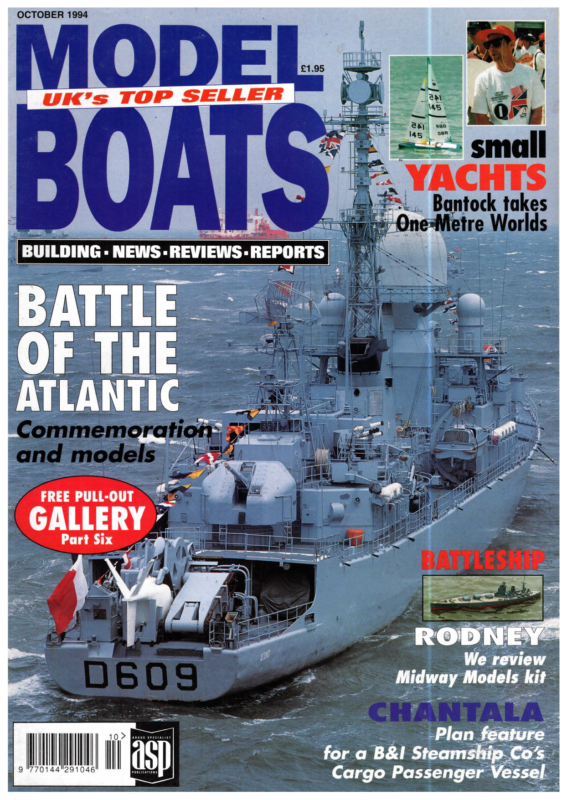
- small YACHTS – It’s all One Metres this time, plus a Diary from France by MIKE KEMP

OCTOBER 1994 BUILDING.NEWS:REVIEWSREPORTS ” 0144 ll
YACHTING It’s all One Metres this time, plus a Diary from France by MIKE KEMP It took four orfive days of waiting and negotiating at frontier post before Romanian skipper Ion Ungureanu was able to launch his One Metre. He had the chance offour races on the final day, that’s dedication for you. | \ Friday the 1st July saw the opening of proceedings leading to the crowning of the first world champion in the One Metre class. At such high level events it is usual to completely check that competing yachts comply with the governing rules, this necessary ritual started for many during a hot and sticky day while others were making their way into the heart of the Vendee region of France. For my family and me Friday was rather hot and noisy while we drove, windows open, through Normandy and bits of Brittany for some 240 miles to arrive in a strange place which was to become home for a week. What follows is a sort of diary report of the first TYRU-MYRD World Championship for the One Metre class. sma Saturday evening A grand inauguration of the new and impressive club house is combined with the opening ceremony of the World Championship. Various local dignitaries came and made their speeches, preceded by a group of local folk musicians and dancers. Following this the teams are introduced on stage and team representative introduces their associates. Andrea Chisholm from New Zealand is chided afterwards for not being verbose enough while certain team ‘leaders’ have trouble remembering, (John Cleave), or even knowing, (Remi Bres), who all their team members are: shouldn’t have so many entrants! Following the team introductions it is announced that the draw will take place for the seeding rounds. At the same time aperitifs are served: somehow the draw takes a back seat when everyone descends on the ‘Tivoli’ to devour, sorry sample – (no, devour was correct), the tasty treats on offer. These The rostrum is where model yachters display extreme concentration. Sitting in front of them were the observers who were joined for this, the last race, by members of the International Jury. Many will recognise the heavy MYA presence in the ‘A’ heat. include some fascinating delicacies such as a green ‘spread’ on little biscuits which includes in it’s composition cabbage, onion, garlic and so on. I won’t try this one but I find it’s rabbit based partner rather tasty. Some find the goat’s cheese to their liking, though not all. The wines on offer are also quite pleasant, the fortified win ‘Pioue de Poitiers’ is quite popular: it’s wine/Cognac combination producing a sherry like taste and a fairly potent alcohol content. Sunday 9.00am, the scheduled start time for the first race. The degree of activity made the Italian European RM. championship look positively frantic. The lack of effective air flow undoubtedly has something to do with it. Mme Bernadette Delbart the Race Officer is faced with unenviable task of chasing the wind around the lake. Sensibly a series of marks had been laid but the start line seems to be something she is having a problem with. Eventually we are commanded to load our boats – and fire them! The start tape runs, not the precise, some would say clinical – 3 minute countdown we are used to. A more laid back approach ‘3 min to start’; then some rather loud music; ‘two minutes’; some more music: ‘one and a half minutes’; then a rather lazy countdown in tens to a 9, 8, 7, etc. that sort of creeps up on you. I start well; found a piece of the line in clear air, boat is pointing in the right direction: there’s only one problem – at the moment of the start the wind is all at the other end of the line! I and the majority of the fleet desperately try to regain contact with the leaders, unsuccessfully for all but the first four are ‘timed out’. Our understanding of the ‘system’ is that places and points are awarded for position on the water. The scorers have a different perception and book us all for R.G.F = 15 points: my first discard! Remaining three heats of the race proceed with Chris Dicks giving a masterly demonstration of light airs sailing in heat C to win by a mile and nearly put all the others out of time, only one other manages an ‘in-time’ finish. The day wears on: sun rises and falls, wind slowly spins in the opposite direction much to John Cleave’s consternation – J ohn maintains that the wind should be going round with the sun. The continentals and South Americans sit around in the shade and shelter of the main boathouse and measuring shed: only the British and their antipodean cousins take up residence at the top of the dinghy launching ramp with the boats on the adjacent bank; undoubtedly reinforcing stereotype of the British abroad. Around 2 o’clock; a break is called to allow construction of a shade to protect the observers and active skippers from the relentless attack of the sun. This presents an opportunity to go for a gambol in the lake until just after racing resumes when an announcement is made that all swimming MODEL BOATS OCTOBER 1994 42
should cease for there is a snake in the water. It swims through the passing fleet withoutous causing any problems – unlike some infam eels at Fleetwood. The race committee decide to call a halt to proceedings after the three seeding races are complete and call a team leaders’ meeting at 5.30pm. This gives some of us a chance to view and try out a 1/10th scale 12 metre, complete with a slightly temperamental but remarkablyin quick acting Genoa. This is being sailed one man mode, without the spinnaker, usually Very operated by the ‘crew’ in two man mode. impressive, match racing these could be fun! So ended the first day’s racing – three down, how many to go? Perhaps it is prophetic that the results boards only go up to race 15! Monday A team leaders meeting the previous evening agreed that racing on Monday will be put back by one hour and finish one hour later to try and fit the wind ‘envelope’. Such is the rapidity of racing that a whole four races are completed between 10 anda s into little after seven. As the afternoon move evening the wind holds but shows signs of abating as the last heat starts. Nine hours to complete sixteen heats of around 15 minutes each. Even allowing for the wait from one race to the next, that is a lot of waiting around. The day is not without it’s incidents however. Two masts broke, though neither were actually racing at the time: they were milling around awaiting a start. In one case, that of the Croatian entry, there was ample time to rescue the boat, return with a Number 2 probably more suited to the afternoon’s wind, and rejoin in time to race. The other, ed skipper Francisco Cuhna (POR 3) snappboat his at the spreaders whilst handling the at the jetty. Monday evening is the barbecue which can only really bedescribed as a good natured shambles. One of the decisions taken about Tuesday’s sailing at the evening meeting is that it, too, will start no earlierthan than 10.00 am and no heat will start later 5.30 pm. This will give everyone time to prepare for their trip to Futuroscope. Tuesday Once again the morning starts breathless and gradually fills in. Racing proceeds at a perceptibly quicker pace: we actually 10.00 complete four complete races between am and 4.30 pm, by which time it is too late officially to start another. This is MODEL BOATS OCTOBER 1994 understandable but a great shame for the wind is really quite acceptable. the fall Among the high spots of the day is ng and rise of Brian Wiles who is exper.ienci his first dose of international sailing After a fairly untypical and inauspicious seeding session Brian started in C heat and languish progressed in a negative direction toay for most of Monday and early Tuesd in D heat. As is often the case it needed some outside influence to lift Brian out of his depressed state. That influence arrived in the shape of Chris Harris. Between races Chris ly has a re-tune of Brian’s rig: subsequent Brian climbs out of D, through C and into B. r Another fall and rise of a UK Team membe features Nigel Sharp. Nigel had climbed out of down into B into A, then did the negative thingsailing C. With a superb display of positive Nigel sweeps off the Port end of the line under the cover of a French yacht who eventually tacks off onto Port, leaving Nigel to carry on and tack when he wants to. This apparently extreme move is to pay off as he is whole able to put a very effective cover on thehande of the fleet an the approach to the Port rned asd windward mark. We growa little concetacks to Nigel leaves himself a couple of short round the mark, but once around he benefits from clear air and stretches out a the commanding lead. Just to rub salt into catch wounds of those desperately tryinga to the flying green Slapstick he sails second triangle instead of a proper sausage and still finishes nearly a whole leg of the course in front of the fleet. What a show-off Another to lead the fleet n with such conviction during his progressio es to A heat is Nigel Gilson who then manag get to ‘hang in there’. It seems that when you out to one end or other of the fleet you stay of the A there! Martin Firebrace did it in front rtune to heat and Chris Jackson had the misfo do it at the other end of C heat before clawing his way into B heat. The chief measurer for the event, Alain Tribut, is playing the ‘hard man’ by carrying out predetermined random spot check day measurements. Some time during Satur ic the organising committee selected specif places during certain heats of selected races a that would be subject to a check. As soon as er is yacht finishes in that position, its numb immediately called to report to the measurer for a quick check of weight, band position, ts and, basic sail cross width measuonremen the transmitter. latterly, a frequency check It takes until race eleven, during Tuesdayinto afternoon, for a non-British yacht to fall of us, one of those ‘cherished’ positions. Two re of Chris Harris and myself, had the pleasu in being called twice during this period: later three the week Graham Bantock has a total oftwo checks and Chris Dicks and Remi Bres consecutive checks each. One interesting point arose during the first of my checks from which we can all learn – see Lessons. ed The first non-British yacht to be checkian happened to be yacht number 101, Brazil Antonio Carlo Vadola’Gumares: some say it chap! could not have happened to a nicerre-est ablish The organisers may be trying to The ‘A’ heat charge off the line towards the end of the regatta. Thomas Dreyer (15) looks well placed while Roger Guinneau (62) is about to tack away onto port in front of Martin Firebree (05) risky! There could not be a finer combination to be involved in a mid-event boat building challenge than Martin Roberts and Graham Elliott, seen here with the British Team prototype for the ‘Water Bottle Challenge’. These frail craft had to endure a one way voyage across the lake. This one nearly did it during testing.
One ofthe rare occasions when there was wind to accompany the waves. Here John Cleave (9) escapes to the middle of the lake, while Chris Dicks (33) is pinned to the shoreline by Roland Gandon (57). their authority which had taken a bit of a knock on Monday when we all had to have our vital bits re-stamped because the original stamp had gone missing. Rumour has it that the fancy stamp has been stolen, but a counter-rumour has it simply being lost. Either way the stories developed: if it has been lost no-one will want to admit losing it. If it has been stolen in order to work some substitution of ‘illegal’ parts or sails it is suggested that the perpetrator will already have stamped the replacements and then present them for re-stamping, which was carried out without re-measuring. Perhaps the ‘random’ checks will catch them. Tuesday evening sees us on an organised tour of part of the Futuroscope. The nearby high tech theme park is the pride of the Poitou-Vienne department of France and boasts some very impressive pavilions featuring such as a 850 section video wall and some remarkable dynamic cinemas where large screens, stereo sound and hydraulically operated simulator seats are combined. Wednesday – Lay Day Many use the day off to explore nearby Poitiers, the local forests and medieval towns. Some however opt for the ‘organised’ coach tour of La Rochelle and Cognac. This started well with an autoroute drive to the famous maritime town where the coach was used for a guided tour of many of the historic parts of La Rochelle. As lunch time approached the party were dropped in the new marine area M Merelot brought along his 1:10 scale 12 Metre to show us. Some had a chance to try it out. He is one ofa small group who build and race these yachts which compare in size with large ‘A’ class yachts. Its windward performance with that overlapping took another knock! The afternoon trip to Cognac did not fulfil the promise that some expected although others found some of the historic and technical content very interesting. For instance, did you know that a black, alcohol loving, fungus takes up residence on the Genoa was impressive and tacking easy with a huge, fast, winch controlling it. A similar yacht was for outside walls of a distillery? Keep an eye open sale secondhand for 10,000 French Thursday Weather is a little less sunny today and the Francs, about £1250. 44 ‘Port Des Minimes’ and informed that they could find lunch for around 50fr. Most homed in on the local cafes and restaurants where they set about ordering and eating. What had been omitted from the instructions was the key piece of information that lunch had been laid on for them – at 50fr a head – in the Yacht Club by the lady in charge of publicity for Voile ‘94. This information only reached seven of the almost 50 strong party so they had a good lunch, and Radio Sailing’s credibility for those remote farmhouses with black patches on their walls! MODEL BOATS OCTOBER 1994
Performing better than its ‘Technicolour Yawn’ predecessor, this design named Snafu was sailed into eighth place by its designer/builder Martin Firebrace from New Zealand. reduces the New Zealand team to two and Andrea Chisholm, current New Zealand One Metre champion slides into C fleet from where she is not going to recover. Today also saw the hatching of a design and build competition to create a ‘yacht’ sailing vessel – out of three 1.5 litre water bottles, some canes, two sheets of A4 sized paper and sticky tape. You can guess who is behind this can’t you? You cannot? Who else but the younger members of the British Team, effectively challenging the ‘world’ at impromptu free-sailing boat building. There is much construction activity in the boat garage as various national teams work, in secret, on their entry. In the end they very important business commitment. This Friday The final day. For a change we start sailing couple of hours the weather deteriorates to the point where waterproofs are being worn and the previously dusty dry soil that forms the ‘British’ boat park turns damp and very, very clingy. Meanwhile the wind builds to a point where many are scurrying for their number two rigs. Andrea and I, both now in C fleet, are torn over the decision to change or not. We have the decision taken out of our hands when the fleet is called to ‘load your – boats on the water’, We now find ourselves almost alone and what seems to be another Yew well protected against the scorching sun. Martin finished the week on equal points with Rob Vice but took ninth place as a result of a better set of race postions. wait in the offing while the rest of the fleet appear. We are urging Madame race officer to ‘start the music’ and not wait for the others to complete what we have not had time to do. This is not without a certain self interest, for we find that the wind has dropped considerably and number1 is the one to have. Our protestations eventually bear fruit and the music starts, now a horde of skippers and boats come rushing to the water, many in number two. This suits me fine and I proceed to get a rare good start and lead virtually from start to finish, that was my one race trip to C. Andrea, however, is not able to capitalise on her sail area advantage and fulfil the promise of the early part of the week. It is the A heat of the same race that finally seals the championship. At the start there is a bit of a kerfuffle during which Thomas pee Roberts starts the week Seg hint of drizzle in the air. During the first Watch out, this guy means business. Martin raw = re Tet & ask questions of the members of the committee that are present, John Cleave, Graham Bantock and Nick Weall, who seems to have ‘flown in’ especially for the meeting. The meeting is attended by quite a few but shunned by others who suspect that it might develop into a purely ‘rules’ oriented session and prefer to have a lighter evening. at the proper time – 9.00 am. Also for a change there is wind, probably because of the rather more ‘English’ weather – dull, overcast with a Ee Thursday evening is given over toa demonstration sail-in and display with a dinghy, “Ville de Poitiers” as the backdrop. This craft is obviously sponsored by the authorities and appears to be allied to this event. The evening also sees an informal meeting of the IYRU – MYRD where the competitors are presented an opportunity to iaPs the day the top group have almost settled into order and close battles are being fought between Chris Dicks, the early leader, and Graham Bantock: the next three places are being closely contested by Remi Bres, John Cleave and Mark Dicks. Thomas Dreyer is twelve points back in 6th with Rob Vice a shade over eight points away in seventh. The next trio consists of Martin Firebrace, Martin Roberts and Chris Harris. This top ten battle is to persist until the end of the regatta. Thursday sees us sailing without David Coode who has been called away by some are no match for the combined talents contained in the UK team. ae meBarus4 wind a little more constant: just like the flow of racing. We achieve our standard four races for the day; indeed had it not been decided to put on a show for the dignitaries who were to ‘host’ the evening aperitif – from Poitiers, we might have made five races. Midway through Some nice diagonal planking and fascinating ‘end grain like’ deck planking characterised this Dreyer is quite clearly over early and French yacht; designed, immediately returns to re-cross the line. Other boats are also in close attendance and Henri Laugier. built and sailed by 45
One of the duties of Team Leader is to administer assistance to team members. Here John Cleave helps dry off the newly crowned, and dunked, One Metre Champion, Graham Bantock. John Cleave proudly displays the One Metre World Championship Team Prize which he f collected on behalof the MYA Top Trio. With Ist, 2nd and 3rd, no other team stood a chance in the end. Leeds and Bradford member Nigel Sharp is justifiably happy at his top twenty place after the ups and downs of a week’s racing. Top lady in the One Metre world, Andrea Chisholm came all the way from New Zealand where she had already * become National Champion. Far right, nearly, but not quite. Chris Dicks proudly show off the Runner-Up Trophy. d Championship – Top Thirtyname 1994 IYRU-MYRD One Metre Worl C’ntry Yacht r Place 2s1 45 67 89 1011 1213 1415 1617 1819 2021 2223 2425 2627 2829 30 Score 23.6 4252a 69.4 72.4 154 93.7 105.7 123123 136 155.7 208.7 210.7 225 232.7 244 7 255; 262 268.7 281 284 304 805:7 308 318 321327 348 363 No. Sail 145 3366 94815 0512147 9962 14277 24ye 06102 9278 5207 4516 107 147 27451 2551 101 Skippe m Bantock Graha Dicks Chris Mark Dicks s Dreyer Thoma Cleave John Bres Remi Harris Chris aces Firebr Martin Robert Martin ViceGuionneau Rob Roger m Elliot Graha Gilson Nigel an Amend Jens Gando Roland r Keith Skippe Baron ique Domin t Chapelot Lauren Sharp Nigel Gibon Claude Jean Kemp Mike Chisholm aWiles Andre Brian redo Figuei Joao Adam Paul odDupuis es Bonell GeorgPaul Richar Jean Fonda Ezio David o Carlos V’guimares AntoniTaylor GBR GBR GBR GER GBR FRA GBR NZL GBR GBR FRA GBR GBR GER FRA GBR FRA FRA GBR FRA GBR NZL GBR POR FRA MAL FRA ITA GBR BRA Design Winek Magick Red Rouge Vin Metric k Magic k Metric Crossbow bowy R. Cross Jazz Murph Red Wine One OveraneThe Eight Stella Sarbac Bubbles 2 Bubbleit EY. Snafu e2 e Wheels Popey Popey es Bubbl on Hell mede Archi Archi Bad Bad Dan 2 3 J~Sann Test Test FeFe II l Meneo Tango Ognat FeFell White Spirit 1000 Dephi L5S1 ick Slapst Slash Jazz JYCA r Gold Gophe CiUp Town Girl Haka Stella Kiss 2a hgumm Frenc Jazz Umma Stella : Baby Bird Jazz ic Fintast ar Drakk Drakk Cinese -Take Offar Imicta Uly tion Presto Design Bantoerck GC Dicks Dicks k MG Bantoc ck he GC.H.BantoDetric AMAustin Firebrace Dicks CA Austin Doisy JCPriamDicks Gilsona JNC.H.Amend Detrick he GC.H.Bantoc PC SolDicksDetriche Bantock GB Jury GC.H.Draper Detrick he GCH.Bantoc Detrick he Bantoc G- J-Paul Richard Cinese mares V’GuiTaylor ADavid step Mast Keel Keel Keel Keel Keel Keel Keel Keel Keel Keel Keel Keel Keel Deck Keel Keel Keel Deck Keel Keel Keel Keel Keel Keel Keel Keel Keel Keel Keel Keel Matl. Hull Glass Wood Wood Glass Glass Glass Glass Glass Wood Glass Glass Wood Wood Glass Wood Glass Glass Glass Glass Glass Glass Glass Wood Glass Glass Glass Glass Glass Wood Glass MODEL BOATS OCTOBER 1994 46
well be taking placed in deepest rural England. After the comparisons many had been making all week this strikes me as a remarkable twist. Some more remarkable twisting takes place in the almost pitch black outside the measurement shed as a multi-country group wreak their typical revenge for being beaten. A few surreptitious words around the tables lead to the newly crowned champion being taken from his meal; stripped and, with all the due ceremony lavished on such occasions, chucked in the lake! Eventually he is joined by one or two others although it is difficult to discern who they are in the dark. Back in the Tivoli a plot is being hatched to confer the same honour upon Madame Delbart, our Race Officer. Only authoritative action by her knight in a black suit, John Cleave, is to prevent her dunking – with or without her limited clothing! are called as well. Unfortunately the person calling does not have the loud, bellowing, voice often associated with events in the UK and the microphone chooses this moment to mis-behave. Consequently the fleet are halfway up the first leg before the individual recall comes through loud and clear. ‘Number 48’ is clear over the speakers and Remi Bres peels off and returns to the start, reluctantly I guess. The other number sounds like 33, Chris Dicks, but there is no response. When the race ends three protests go in; one each for Thomas and Remi, for redress; and one from the race committee against Chris, for not sailing the proper course. Remi eventually gets his redress, presumably fora late call from the line judge. Chris collects a disqualification and 56 points despite considerable evidence that the call was inconclusive, late and generally not in accord with the rules and sailing instructions. The moral: if there is a chance of losing a protest, exonerate: if you are ‘materially prejudiced’ you can always protest for redress – you may get it and avoid the almost inevitable demotion. By having to discard the DSQ Chris now has to count one of his previous bad scores, this terminally hurts his chances because he also has to get rid of a B heat score as well. It is during this time that our rising star from Birminghamis filling in his marks on a finish in most of the A heat positions. Chris Harris managed at least one in every position but 10, 11, 13, 14 and 1st. His closest comes in race 18 when he leads the field going into the final tack to the finish – then he forgets which line he is aiming for! By the time he remembers Remi Bres, Thomas Dreyer and Mark Dicks have got through ahead of him. The last race of the official championship was completed close to the designated finishing time of 4.00 pm and comes as a bit of a shock. Out in front is Frenchman Roger Guinomeau whose previous best placing was a fourth in the first seeding race and two sixth places at the end of Thursday. In second place however is Graham Bantock whilst a somewhat disconsolate Chris Dicks can only manage tenth. Several yachts swapped hands for the first of the expected ‘unofficial’ post-event races and a One Metre is now in the hands of Nick Weall. He has rather gingerly taken control of John Cleave’s “One over the eight”, a new GB Red Wine. Mr Measurer, Alain Tribut also has his hands on a one metre; while Thomas Dreyer starts late and almost flies around the whole fleet with his Graupner ‘Butterfly’ Trimaran built to fit the 1.2 metre multi-hull class in it’s number two rig. The mass race is a chance for many to ponder why they could do so well in this way yet perform the way they did during the week. Indeed the race was won by a German skipper who had not been sailing at all well during the main event. David Taylor is another who has just surprised himself during this get together. MODEL BOATS OCTOBER 1994 The prize giving session is scheduled to start at 7:00 in the evening: by about 7:45 pm we are taking our places. Hors d’oeuvres are distributed and a collection of dignitaries gather on the stage – something is about to happen. In contrast to the Fleetwood performances and others we have experienced the prizes are to be presented before we have a chance to feed or get too merry. There are the inevitable speeches, though this time they are fairly brief and mostly translated for us unable to keep up with French at full speed. The Mayor of St Cyr is introduced to us as is a lady connected with the overall organisation of the Voile ‘94. Suddenly we are launched into prize giving and the first to be presented is for the best overall team prize. Won by the U.K team it is collected by our leader John Cleave who is already on stage as part of the official party. Then, working from the bottom up we are all presented with a small paperweight version of the Voile ‘94 badge, our team photos and a pair of Remy Martin cognac glasses. Andrea Chisholm receives a special award as the first lady, having already collected the furthest travelled team award. From tenth place to first there is a series of special trophies, starting with especially produced porcelain bowls and commemorating in a beautiful blue Sevres vase for the winner. One of a limited edition, numbered and inscribed by the president of France, this certainly is a handsome addition to the collection of pots adorning the Bantock household. In addition Graham receives the South Africa Cup; originally presented for the RM. worlds but out of favour during that country’s spell in the sporting wilderness, it has been re-presented as the perpetual trophy for the One Metres. Once the competitors have received theirs it is time for the organisers to be recognised: Remy Barbarin Chairman of the Organising Committee, Bernadette Delbart – Race Officer; Alain Tribut – Chief Measurer; Francis Chevalier originator of the computer program used to manage the scores; the group of youngsters who acted as ‘gophers’ all week and individually the jury led by jolly Jacques Simon, representing the FFV; Mary Pera, had already left for home, but the others remained. The remainder of the evening is spent chatting, signing team photos, occasionally eating intermittent courses of the Dinner and eventually watching the local folk dance troupe who returned after their debut earlier in the week. As the cheese course slowly disappears to be followed at a distance by a Pear Bavarais and its red fruit coulee, the dancers venture off the stage. This forces the retraction of the tables to the edge of the ‘Tivoli’ Marquee and the inauguration of the So ends the First World Championship for One Metre Yachts. To many it was a reminder Interesting combination of aluminium angles used for fittings on this French entry. Jean Pierre Leroux’s Fe-Fe 2 is called Drole de Zebre. Our hero from Bournville; he ‘sailed his socks off!’ Chris Harris brought his 21st birthday present Bubbleit into seventh place overall; here he is concentrating on trying to stay in front of the pack. of what sailing at international events can mean. For others it was their first exposure to the noticeably different pace, procedures and frustrations frequently experienced at such events. One skipper summed up his feelings with “Wouldn’t it be nice if we could race in England and socialise in France? “ mm…… I am not sure about that combination but there is a germ of an idea there”. The Boats As might be expected with a Class where the rule sets out to produce a simple yacht with a One Design sail rig there were not too many immediately obvious differences in appearance. Hulls fell into two main forms of construction; wooden, planked in one way or another, either naturally finished and painted; moulded, presumably in glass, either painted or with a coloured gel coat. As far as foils were concerned there was everything from Keith Poulton, representing Malta, sends his Jazz offfor the last race of the event. Keith and his team mate Georges are the first to represent their country in an IYRU-MYRD event French equivalent of a Barn Dance. Ultimately there are as many as 50% of the assembled skippers and their partners joining in on a series of dances which, except for slight differences in the music, could just as 47
He can smile now. Thomas Dreyer has assured himself of a top ten place with his Graham Bantock Lessons carbon wood, through plain metal to mouldedon the the keys to the success of the two One of is leaders, Graham Bantock and Chris Dicks, consistency: it is something that many of usd have yet to master and lack of which robbe French Champion Remi Bres of a place in the top five. Occasionally brilliant but with other disappointing trips to B fleet Remi must have construction with a few combinations It was in the detail that differences showed _ for instance, a small but significant part of the fleet were using deck stepped masts, almost all making use of checkstays to adda their little rigidity. Many of the majority with masts going through the deck made use of a ram to help shape their spar. At least one of way. designed Jazz named Murphy R. Thomas has an enviable job helping Graupner develop their models and kits There’s a hint of determination on the face of Mark Dicks as been feeling frustrated at times that he was in the not able to mount a serious challengebefore . event on a water he had experienced ing the German yachts showed a masttomount the New Zealander, Martin Firebrace was sing another for whom things looked promi but for the odd trip to B fleet. Martin’sonyacht looked to be every bit as competitive all arrangement that owes its origins Walicki style masts. Several yachts showed some pretty intricate internal wood work l beneath their transparent film decks. Severa he contemplates holding on to his third place some ten points behind his father. The impressive heavy air points as the British and top French yachts of the wooden yachts showed some impressive planking. Probably the most striking was Henri Laugier of France with his diagonally planked hull and a deck which looked as if it had its planks cut from endwas off-wind performance of his Crossbow was never really tested during this event. grain material. The neatest, to my eyes, fleet the one half of the Canadian OnengMetre Jean that was entered by Paris dwelli d’Avignon from Montreal. This yacht was beautifully detailed with carefully set up able calibration marks on each of the adjustwere parts of the rig. The hull/deck edges nicely made, and it went well also. Our home precise hydraulic juggling to satisfy the measurer. Graham Bantock’s new yacht tested the rocker checking procedure while the Trevor and is derived from his original and yacht is unfortunate Technicolour Yawn: thiscan be may stay in England if a new owner found. Balmforth sails tested the sail checking gauges. Indeed a small sliver was decreedrto1 need removing from the top of my numbe rig. This was nothing compared to that which had to be removed from one particular suit poor belonging to one of the home team. This the chap was left having to fit new eyelets at A special note is due regarding Ion Ungureanu from Romania. On Friday all morning a special petition was posted forjoin skippers to sign to agree that he should the competition at such a late stage. All agreed and Ion joined us for the four last had races, in D heat of course. The poor chap been held up at a border for four days, I bottom of his mainsail. There also appear to be some differences in interpretations of the word ‘section’. Onea Italian found himself at the centre of such of discussion when his yacht carried booms an aluminium with many large lightningas holes. Section was applied to this yacht meaning a boom which would have a consistent cross section at all stations along the boom. were also reminded on the second day We to remove any sticky tape bands holdingthe Burgees or wind vanes that were below top most band. This would appear to be a ‘ocal’ interpretation, but quite a reasonrable band. idea to avoid confusion with the prope imagine because he did not have a suitable John Cleave, for instance discovered that the first to receive his momento. Moral, you set This affected quite a number of the Some very neat engineering and adjustment touches compliment the super wooden construction of the Canadian entry. Built and sailed by Jean d’Avignon, this modified Fe-Fe revelled in the unlikely name of Fred the Stone Killer! At international events such as this there is often a considerable interlude between races: as a result many additional pastimes emerge. Here Martin Roberts (left) and John Cleave brush up on their backgammon skills. ‘< grown yachts showed up well with Ray Baker’s planking of Chris Dicks’ Metric Magick looking and performing well. Most yachts appeared to be using push/pull rods to operate their rudders from a central gear position, though some had and borrowed from-contemporary RM layout mounted their rudder servo in fairly close proximity to the rudder. At least two were making use of a two wire closed loop system terminated in pulleys at either end. The al German yacht had its rudder pulley externad. with the wires emerging through a bulkhe My own is totally beneath the deck and out of sight. One or two, including Martin Firebrace’s and Nigel Gilson’s, had raised foredecks in an attempt to add some buoyancy during the One Metre “dive”, when overpressed offwind. The “humpy” shape also helps the yacht recover its composure by more easily tends shedding the water; whereas a flat deck to dig further in. Martin’s had a stern deck with a convex curvature, similar to his RM.a photo of which appeared in a recent issue. Measurement One or two things emerged during the measurement that raised questions over the _ original measuring procedures. It wouldare in New Zealand appear that dimensions marginally larger than in Europe. David Coode’s yacht wasa little too deep while Andrea’s similar craft was a little too long. My ‘instant’ glue isn’t quite in his quest to overcome the problem. The remeasurement caused few problems, though not understanding how yachts were chosen could have led to a substantial international dispute. Protests and the Jury I was fortunately not involved in any serious protests at this meeting: a deliberate best non-belligerence policy seems to be thedidn’t at such events. (Perhaps that is why I finish higher up the list) I had only one for experience of lodging a protest whichofwas redress following a hook up with one the close two Maltese skippers after a particularlyitor dual to the finish of the race. My compet up lost went off and did a turn but the hook me several places and dropped me into a relegation place so I had to try and recover from something. The fifteen minute time limit and the end ofa heat was strictly adhered toJacques then the Jury swung into action. J olly ded me Simon who chaired the jury, he remin of some cartoon character but I can’t think visa to enter France. Although in the inevitable last place lon was to receive a was special cheer at the prize giving when he check for such requirements before off to such events. My own experience of mid-race my remeasurement is a salutary one for when outer measurement bands were checked,e the they were found to be marginally outsidhas its limits. A One metre number 1 rig that bands set on or close to the maximum spacing stands an excellent chance of in the expanding outside the limits when left have scorching hot sun all day. Many wouldrig suspected this, have you noticed your hot setting mysteriously changing during a for meeting? Moral, when setting up a yacht measurement set the bands at least 1mm inside the limits. I suspect that Mark Dicks would have had a draught problem had hishad yacht been checked after a race where he shipped a little water. As we all packed up and headed for home we can reflect on a pretty successful and enjoyable event; what it might have been and what it might be like in two year’s time. who, seemed to have a sense of humour and an excellent command of the event operating language. The evidence was listened to; questions were asked, the protester and protestee retired from the room while the jury deliberated and the decision was announced after you were recalled before the yacht just scraped in at a few grammes over jury. must have had the yacht that was closest to the draught limit and required even more be quite a time. the minimum with its number 3 rig so I hadweto put the big rig on for the tank check, then t. had to top up the water to check the draugh Following on my heels was Mark Dicks who nat den sting assembled mass and caused some interetried. sights as alternate arrangements were In the case of some ‘proper’ protests the procedure was a bit more protracted. In onel ed severa case I was a witness and was recall times: so how long the parties to the protectto were involved I’m not sure, but it did seem MODEL BOATS OCTOBER 1994 48