- small YACHTS – Relax and think ahead, post this to Santa! Says MIKE KEMP as the racing season is coming to a close and we have a look forward to 1995
- Yacht Lines Anthony Corbett continues his contribution to Model Boats with Model Yachting Association news and a review of the model yacht kits to MYA class rules

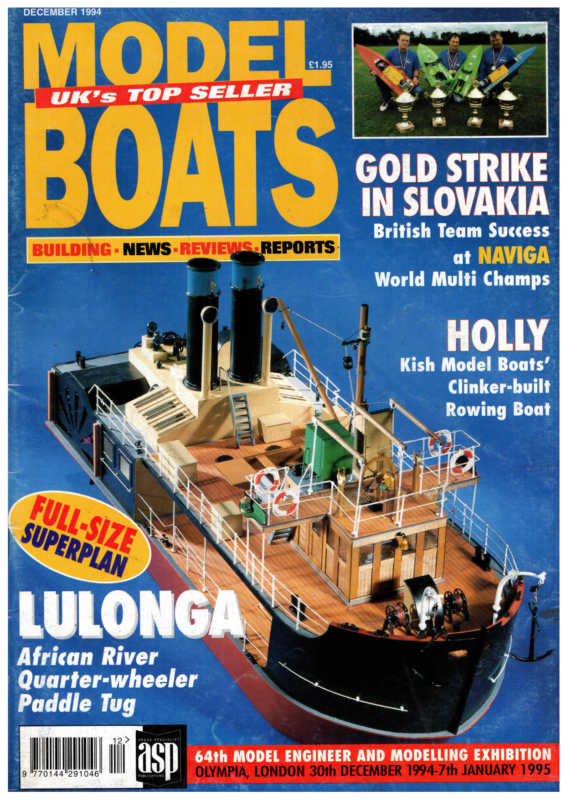
_ DECEMBER 1994 uK’s TOP SELLER GOLD STRIKE IN SLOVAKIA British Team Success at NAVIGA World Multi Champs Se African River Quarter-wheeler Paddle Tug 9 °770144°291046 ll
YACHTING small YACHTS Relax and think ahead, post this to Santa! Says MIKE KEMP as the racing season is coming to a close and we have a look forward to 1995 League News By the time you read this the MYA League Championship will have finished for the 1994 season; the statistics will have been computed, the reports printed to be presented at the MYA AGM. Remember, however, that this text is being written in the middle of September and not all of the qualifying events have taken place yet so it is not possible to announce any winners. That does not stop some predictions being made: for instance there is a very good chance that Fleetwood will retain their hold on the Radio League Championship, but who will take second place is not so easy to predict. The chances are that it will be one of the next three. There is an excellent chance that Graham Bantock will take the Individual Radio Championship, but he could still be beaten by, either of the Dicks family, and Martin Roberts could just be in with a chance. ee — ; — ——— —- on i ae ee xs . The New Zealand based Fun fellow Una rigged One Metre Fun Class derivative is easy to rig with reduced draft. The design is based on John Spencer’s Shortfellow One Metre. Will it be as successful as the Mickey Finn? Photos: Mark Steele. hole in our collection of crystal on the sideboard next year. Top Ten Clubs Club Score Birkenhead 1,389.4 1st 2nd 3rd Fleetwood Guildford Chelmsford 5th 6th 7th 8th 9th Bournville Clapham Woodspring Gosport Ashton Quays 4th 10th 2,787.2 1,614 1,514.5 Gipping Valley 1,360.5 1,333.9 1,056.3 955.7 871.5 798 1st 2nd 3rd 4th 5th 6th 7th 8th 9th 10th Chris Dicks Mark Dicks Keith Skipper Phil Playle Anthony Corbett Score 504 443.2 443 437.3 411.6 385 376.4 Peter Stollery 375 John Cleave 366 Paul Jones new faces appearing so a number of the ‘old hands’ must have found other things to do. This is a shame because we now seem to have mastered the art of getting through complete schedules within the racing day so there is every chance of packing in a lot of sailing during a regatta. Despite the fact that some are starting to get serious about it, match racing is still a fun and friendly way to go Radio Sailing: perhaps 1995 will see an upturn. Top Ten Individuals Skipper Graham Bantock Martin Roberts There have been noticeably fewer participants at events during 1994; on the other hand there have been some 367.3 Match Racing Once again, by the time this hits the book stands the Marine Modelling Match Race Championship will have been decided: at the time of writing for me to make a prediction is very difficult. There are two more qualifying events to run, a new one slipped in on October 9th to replace the one that was ‘blownout’ at the Cotswolds early in the season and the traditional final round at Bournville in November. All I can say at the moment is that I am gently persuading my wife that there may be One Metre District Champs As I write this the results of the recent One Metre District Championships are starting to arrive through the League Secretary letterbox. In the North there was at last sufficient entry to avoid the ‘low entry’ bonus system having to be employed. Martin Roberts was given a thorough going over by the Fleetwood bunch and could only achieve third place behind Andy Kissick, the new champion, and Tommy Mills. First seen with a transmitter in his hand at the One Metre Nationals, MYA Treasurer – a Vane Man – David Rose hauled himself into sixth place: watch out David, this could get addictive! From the other returns it would appear that the North managed the largest of the district entries; there were eighteen in the East at Harwich & Dovercourt, a disappointing eleven met at Three Rivers for the Met. & Southern event, and only three more entered for the Midland District event at Two Islands; perhaps ‘everyone’ is still recovering from the Nationals. 21
Jack Day’s Sylph fin and ballast. The heavy bit and the light bit. Foil is ply skin over a balsa core with thin ply ribs. The heavy bit is roughly 75% of the total yacht weight. Jack Day’s new Radio 6 Metre. When measured it proved to be permitted to carry 1320 square inches of sail, that’s an enormous more care for their compatriots on the number in Metric! water than many who only go to ‘local’ John Cleave proceeded to dominate the meeting to win six of the nine races; many of them with a comfortable margin. Home club expert Brian Wiles sailed his new boat into second place: Brian has returned to another French design ‘Fe Fe 2’ after his sometimes inauspicious experiences with a Stella. Rob Vice borrowed his dad’s Bubbles 2 to find his way into third place and was chased home by another two French yachts: Stellas in the hands of Anthony Corbett and David Fox. The meeting was not without its protests, but they didn’t hold up proceedings too much and no blood was spilt! Stern deck detail of Tess, probably the Sirst 6 Metre built to Graham Welsh’s Sylph design, featured recently in Model Next Year Boats. Jack Day has made a beautiful job 1995 looks like being another busy of this one and promises that the next will year for Radio Skippers in particular, be better. One Metre Ranking in the Southwest Big underwater transom! The shape that Nineteen gathered on Sedgemoor’s slipway to contest the South West District One Metre ranking race on Australian 12 Metre America’s Cup Sunday 18th September. One or two representatives from outside the district made the trek down the M4/M5 to have a bash in what were basically light winds. Race Officer Ted Putt had to send everyone off towards the trees on the left hand perimeter of the lake during the morning for a quick triangular dash. After lunch however he was able to extend the course to include worked well on tank test models for the yachts. It didn’t translate to full-size very well; will it work for Sylph. the traditional sausage, and send the two fleets around the other way when the wind swung to its more ‘normal’ direction from among the bushes to the right. Finally getting the hang of sailing his Red Wine called ‘One Over the Eight’, so called because of its sail number – 9, especially if they sail more than one class. Irrespective of what is decided at the MYA AGM being held about the time you are reading this the various National Championships are circulating the country. It is possible that the Ranking and League Race systems will have an overhaul for the coming season but there will still be plenty for the beginner to have a go at, and that includes these events – sometimes perceived as ‘top’ regattas by the newcomer. Take my advice, don’t regard them as events to steer clear of for fear of having to mix it with the ‘top’ skippers. You might be pleasantly surprised to find that they sail with a bit Top Five One Metres in the North Top Five One Metres in the East Place 1st Andy Kissick Skipper Fleetwood Club Place Skipper Graham Bantock Chelmsford 2nd Tom Mills Fleetwood 2nd Keith Skipper Gipping Valley 3rd Martin Roberts Birkenhead 3rd Nigel Gilson Gipping Valley 4th oth Karl English R Stevens Fleetwood Cleveland 4th 5th Brian Bardow Dave Cousins Chelmsford Gipping Valley Place 1st Skipper Dave Mann Club Market Bosworth 2nd Tony Edwards Leicestershire 4th 5th David Fox Mike Weeks Banbury Cross Leicestershire 3rd Gordon Sears Market Bosworth Top Five in the Southwest Ranking Place Skipper 4th 5th 22 Guildford Paul Tickner Peter Popham Vic Cooney Sedgemoor Fe-Fe 2 C.H.Detriche 19.8 Anthony Corbett Guildford David Fox Clapham Banbury Cross Graham Bantock 4.7 Bubbles 2 Alex Austin 25.7 Stella C.H.Detriche 41.7 Stella ‘wrong’ tack, and hook everyone up. Such is the behaviour of the sort of skipper who rarely visits a top rated event and is not normally too welcome at open meetings. WhenI started at this game I had some particularly hairy experiences which left me feeling a bit bitter at the way I felt I had been treated: I quickly learned that one of the quicker ways around a racing course is one which does not involve contact with other yachts. This is often the same course that avoids being what some who explain the rules call the ‘burdened’ boat – i.e.. the one that does not have right of way. If you adopt a similar practice at your early ‘opens’ next year you will learn a lot and almost certainly enjoy the sailing: you will also find that most of the ‘experts’ are only too willing to help you out – as long as you don’t ask while they are involved in a race! So where are these races? At the moment it looks as if the Radio Marblehead National Championship will be going to Coatbridge, just outside Glasgow over the Spring Bank holiday at the end of May. The One Metre West in 1995, although whether they go south to Woodspring or North to Anthony Corbett Brian Wiles Rob Vice mark, especially if they are on the Three Rivers Woodley 3rd Points 3rd 2nd slow their progress. Nor will they dive into a pile of yachts trying to round a August. Club Ryde 4th 5th Red Wine certainly damage their own boat and Guildford Skipper John Cleave Designer Ryde hole in it. Doing so would almost 2nd Place 1st Design John Cleave won’t usually plough in and punch a Top Five One Metres in London the South Club 1st action and then protest you for being on the ‘wrong’ tack or similar; but they National Championship will once again be over the August Bank Holiday and will take up residence in the Gipping Valley near Ipswich in Suffolk. The Vane or Free-sailing skippers look as if they will be renewing their knowledge of the roads to Fleetwood with the M class Championship over the ‘May Day’ bank holiday (weekend of the 7th); the A National Team Championship on the 1st Top Five One Metres in the Midlands Club meetings. They do not plough into your boat if it is in the way; they might get near it, shout and take violent avoiding C.H.Detriche 36.4 11th June; and the A week – National Championship from the 30th July to 4th : ; : _ Radio A class skippers will be going Fleetwood is not yet clear. 36 inch Restricted skippers will find themselves going to Bournville for their Nationals whether they sail free or do it by remote control: the latter on August 13th, the former on October 8th. Radio 10 Raters will be chasing around the Round Pond in London on October 15th while their free sailing brothers will be in Bournville a month earlier on September 3rd. Championships for the MODEL BOATS DECEMBER 1994
6 Metres have not been settled yet watch this space! As usual the MYA Champions Cup, that invitation event where District RM. Champions and the top few from the Ranking list meet for a day each of Match Racing and Fleet Racing starts the season at the end of February at a lake yet to be identified. Almost the last event of the season will be another specialist event, the Pugwash Trophy for 36 inch Restricted yachts at Clapham. This event has a particularly strong appeal as it is designed as a ‘fun’ event and skippers even maintain a 36R just to fetch it out for this event. Look out for more details in future issues. Christmas is Coming With the run up to Christmas well under way I thought it might be an idea to have a look at what Father Christmas might be persuaded to ram into the Model Yachter’s Christmas stocking. There are a number of items that might make life just that little bit more pleasant for the devotee of this sport that sometimes requires some slightly unexpected tools, skills and operations. Carrying the gear: a glance around the ‘paddock’ at regattas reveals a number of ways of containing and carrying the necessary kit for supporting a racing yacht. For a long time now one favourite has been the ‘baby box’; available from sources such as Mothercare, these thermoplastic containers have many advantages. They are relatively roomy to easily contain a couple of transmitters plus small boxes to carry spares such as servos, battery packs and ‘sticky’ things. They also have a built-in tray which is retained and revealed when the box is opened in which small tools; spanners, screwdrivers and files; can be stored. These boxes also can serve as an impromptu support for an inclined yacht while it is being rigged and have been seen to be used as a seat – though this often exceeds their capacity. A Mothercare baby box will set you back just under £15.00, and one current style Just the tool for lakeside repair jobs. A gas powered soldering iron that can be equipped with a hot knife for cutting and sealing plastic cords. MODEL BOATS DECEMBER 1994 * even has a ‘yachty’ style logo – albeit including a teddy bear! Amore recent challenger in this field is the plastic tool box available from the likes of Raaco and Curver. Both of these are available from the more traditional outlets like Halfords and Do-It-All but have a struggle to match the baby box both in capacity and value. If you can find the right size it will swallow two transmitters in the bottom of the box and some have convenient drawers to contain servos, crystals etc. There is often a tray which can be used to store the tools. One important thing to look out for is security; not necessarily to prevent people breaking in, but to prevent the contents breaking out! Inevitably when travelling by car these boxes are likely to be subjected to a ‘turning over’ force. As you round that sharp corner there is a tell-tale bump and rattling noise from the back of the car as the box turns turtle and everything is unevenly distributed around the boot space. What is the best? I can’t really say: when my baby boxes finally cracked up I invested in a Raaco box which still needs a bit of ingenuity to pack in all the gear when going toa multi-day meeting. Boxes of this type will cost you in the range of £15 to £20. Another tool that many find extremely useful is the mini-drill. There are two main sources of these devices: one from a name that has been in the American model scene for a long time Dremel, the other from a name better known for larger power tools – Black and Decker. Both offer several sizes of basic drill unit and there are ‘kits’ available containing a drill and additional parts that are intended to get the hobbyist under way. These tend to be specifically aimed at certain niches in the market, the motor-repair or glass engraving groups for example. In many cases these kits come contained within a moderately robust plastic carrying case which, if the original vacuum formed liner is removed, can provide sufficient space to carry the drill ready for action with cables drillbits etc. Among the accessories available are things like a long car battery connection cable to facilitate working away from the mains supply; there are also a multiplicity of drill bits, grinding and cutting implements which can be fitted in the chuck of the more useful drills. Over the years I have graduated to a small Minicraft drill when my original (from Marx in GermanyI believe) finally ‘popped its armature’. During this time I have gathered a number of accessories from various sources: for example, Dremel market an excellent packet of disc cutting wheels, there is an ingenious drum sanding device where the abrasive portion is retained by an expanding rubber arbor, and – from the Proops stand at the ME – tiny packets of dentists burrs. These implements work wonders on most of the materials that find their way into my models, as well as the odd jewellery, automotive and household repair job. Slightly less well known are some of the other powered implements in the ranges, miniature orbital sander (wickedly useful for flatting down epoxy finishes), lathes, drill-stands as well as specialist engraving tools etc. Get Father Christmas a Minicraft and a Dremel catalogue in time for his provisioning. Prices for drills start at about £25; kits, including a mains transformer from about £40 and vanish out of sight! While on the subject of powered tools, I once heard Roger Stollery extolling the virtues of a Black and | Decker Powerfile, now that is a tool-anda-half! Have you ever found yourself desperate to achieve a soldered joint away from your workshop? There are three possible answers to this one, a low voltage soldering iron to be clipped to a car battery: a re-chargeable soldering iron; or a rechargeable gas powered soldering iron. If one of these things is your target, a key point to remember is that you will almost certainly require more heat for the same joint in the open air than you would in the workshop. Having tried all three of these over the years my preference is for the rechargeable gas powered device. Apart from the inconvenience of performing better when shielded from draughts the unit I use spends a lot of its time with a plastic cutting blade in place of the soldering tip: this is extremely useful for instantly sealing those bits of plastic solder power the range would seem to stretch from about a fiver in Maplins to around ten times that amount with RS Components – “you pays you money and you takes your choice.” Does your yacht spend much of its time on the bottom of the lake? If so you might like to invest in some de-watering fluid available, by various means, from RS components. I have used this stuff infrequently, but my can has a prominent place in the top of my kit box, since I acquired my stock (it can last a long time) they have changed the propellant to be a bit more environmentally friendly but I am assured that the working bits are the same. Available from Electromail to the hobbyist as Ref. Nr. 569-278 at a little over a fiver if you include postage; could be a lot less if you order something else from their catalogues as well to spread the cost. Alternatively you could seek other avenues to RS Components for the same product code. Want to expand your knowledge of the 1993-96 Yacht Racing Rules? There are a variety of books available: the traditional ones from Adlard Coles, ‘Paul Elvstr6m explains the Yacht Racing Rules’ and Eric Twiname’s ‘The Rules Book’: in addition to the ‘real thing’ from the IYRU or the national version available from the RYA. Then there is the classic volume ‘The Yacht Racing Rules’ from Mary Pera in which this extremely knowledgeable A Mini-Drill fitted with a suitably small drum sander makes short work of those deck cut-outs. Watch your fingers on those rotating bits though – and don’t forget the specs, that debris can really fly! string we use. Some of the rechargeable battery powered devices work like the larger Weller type solder guns and use a solder tip which forms part of a resistance loop: like their larger cousins they also may have the facility for a plastic cutting blade. The gas powered devices take a few seconds to come up to working temperature but will give around twenty minutes or more of working time per charge of gas. They are easily replenished from the cans of lighter fuel, widely available. Sources for these are various but one of the most widespread is the chain of Tandy stores who market a couple of the Portasol range. The cheaper of the two, approximately £15, does not appear to have the facility for interchangeable bits so is probably of less use to us. The more expensive of the two at around £20 does accept the interchangeable bits including plastic cutting tips, although you may have to ask the shop to get them especially for you. Similar articles are available from RS Components who actually have two in their catalogue, they are not interchangeable and are a little more expensive. Maplins also carry a Gas Torch combination kit which includes soldering tips for around £25. If gas is not your thing but you still want some portable, rechargeable, lady takes apart each rule in turn and enhances its explanations with her experiences of the International appeals system. In this section we should also mention a couple of books aimed specifically at the small yacht skipper: from Nick Weall “Sailing to Win’ – A Complete Introduction to Model Yacht Racing’ which, though not specifically updated to conform to the 1993-96 rules, shows how the rules should be applied to our specific part of the sport. Nick has been known to have an idea of what he is talking about – he led the RM. Ranking list for a while; and has been through all the necessary training and examination to become an International level judge. Some of the longer term readers of this magazine will remember his series on the rules which led to the publication of the book. The second is a book aimed more at the construction end of the sport from the late Trevor Reece: ‘Radio Control Model Yachts’ provides an up-to-date description of many of the techniques that go into producing a current Model Yacht. Unlike the other ‘Standards’ in this field; ‘Model Racing Yacht Construction’ from Roy Griffin, Model Yachting from Vic Smeed, and Radio Control for Model Yachts by Bob Jeffries; Trevor’s book contains details and pictures of yachts that are recognisable as ‘current’ craft. The other books, all of which I remember reading whenI first got into this game (and they were old then!), are worth reading for many of their tips and processes are still valid. The difficulty might be finding them, chat up the local library. In addition to all these little ‘extras’ of course you could ask Santa to consider something boring like a new boat! Want something different? Tell him to contact Steve Walters at 17 Hale Crescent, Glenfield 1310, Auckland, New Zealand for a ‘Shortfellow’ hull, foils, and drawings to try your hand at a Fun Fellow One Metre Una Rigged fun boat you never know, it might catch on! Happy Christmas to you all. 23
Top level competition is not for the faint hearted as this photograph of a Marblehead race start on a breezy day in Poole illustrates. continues his contribution to Model Boats with Model Yachting Association news and a review of the model yacht kits to MYA class rules e and deadlines! Having crawled and grovelled to our esteemed . Editor, I must now apologise to the readership, or at least those of you that noticed this particular contribution was missing from’the last three issues. I’m afraid that apart from having to work for a living, personal circumstances prevented Yacht Lines making it’s copy date, but the good news is that I’ve been asked to make two contributions for this and the following issued. Spoilt aren’t you! So what are we going to look at this time? Well for those that remember way back to the August issue, I had a look at the some of the proprietary model yacht kits currently available from your local hobby shop and followed with the promise that I would take a look at kits available to MYA Class rules. But first I would like to take the opportunity to touch on a number of MYA related matters. MODEL BOATS DECEMBER 1994 MYA Classified For those of you in the know, it will come as no surprise that the MYA have established a classified advertisement service available, free of charge (as at the time of writing) to it’s individual or affiliated members. One will hope that the editorial staff will not see this as competition to the ad’s at the back of this particular publication. (Well, they obviously are competition, but good luck to the MYA for their enterprise. It is my personal opinion that MB’s Private Classifieds should also be free, but that is another story. Ed) I can recall when I first caught the bug for rc-yacht racing, it seemed painfully difficult to just actually go out and buy a boat and get sailing. It is for this reason the MYA have established a register of boats for sale (I avoided that pun folks!), with the intention of providing one port of call for those interested in getting into model yachting and re-yachts One has to recognise the in particular. For those of you with a fleet of model yachts gathering dust somewhere, here is an opportunity to advertise that race grace of Marbleheads winning machine and pass it on to someone that might actually sail it, rather than utilise it for decorating their latest restaurant! Details of the service are available from away from the start line most MYA affiliated clubs, ask your Club Secretary to see the latest newsletter (or Acquaint as they are more generally known), or from the MYA Secretary Henry Farley on 0707 265791. MYA Sports Division As reported in the last edition of Yacht Lines, the MYA have approved the principle of creating a division for fun sailing which has been called the Sports Division. The idea is to create a group that can be accommodated within the existing MYA and Club organisational structure that will allow those sailing in top suits as this A fleet group, break for race three of this year’s RM National Championship at Eastbourne. Several of these boats have recently been offered for sale through the MYA Classified sales service. 27
For those that are uncertain about the difference between a conventional rig and a swing rig, something that needs to be considered in choosing your class and kit, the following group of photographs should help to illustrate the difference. This shot of more Marblehead racing illustrates a shroudless conventional rig mounted on a Paradox, No 97 being pursued by a Roar Edge, No 17 sporting a Stollery style swing rig. The swing rig turn around the vertical axis ofthe mast, to be explained in more detail in a future edition of Yacht Lines. Right: another Roar Edge design Marblehead, No 144 powering downwind in a swing rig. This particular rig was specially designed and built by Sails Etc and again will be discussed in more detail in a future article. Far right: finally a shot to help explain the reference to shroudless conventional rigs. The latest RM’s have very narrow beams, which combined with the need to change rigs quickly results in the use of carbon fibre masts that do not need shrouds to keep the masts up. Other centred on the construction and racing of a radio controlled yacht. As this tied in well with the idea of creating a yacht class specifically for youngsters, it struck your scribe as extremely exciting, especially if it would be promoted by the Royal Yachting conventionally rigged classes that have larger sail areas or preclude C/F utilise shrouds and spreaders to support the mast. with kit yachts to actually get sailing together in groups. The Division will operate within a set of guidelines the detail of which should be circulated to the MYA Clubs towards the end of the year for implementation within the ‘95 season. I would hasten to add that these guidelines will not be a strict set of rules, but just a general set of principles that should allow groups of like minded folks to get together and have some fun. The success of the division will rest with the Clubs and their members, so if your interested in the idea, you had better get along to your local model yachting club and join in. Inter-School Yacht Competition 28 Association. q The concept was to provide a national competition that would promote an interest in sailing as well as encouraging individual and team skills in the designing and building of a yacht. The beauty of using an rc-yacht class is that costs, so important to both school budgets and parents alike, can be contained by the development of a specific rule. However having had personal experience of stirring up a hornet’s nest when making an enquiry about a “simple rule”, one would wish to ensure that the specification for such a boat would achieve the objective of encouraging sport and recreation rather that intellectual debate on the meaning of words. So is the idea worth pursuing? Well I Your correspondent is now going to take the opportunity to ask the readership for would like to think so as I am all for some views and even perhaps help. Following the Sailboat ‘94 exhibition at Crystal Palace, the writer was approached by a member of that exhibition’s organising committee who encouraging youngsters into sailing, modelling or any other recreation that suggested that it would be a good idea to run a competition for schools and youngsters stretches their minds a little further than the local video arcade. But what about the rules? It is straight forward enough to restrict those elements of an re-yacht that involve significant chunks of change, but would people prefer a one design. requiring strict rules and patterns, or an open development rule like the 36R (it has to fit in a box!)? A member of the MYA Council has already suggested that the boat should be suitable for free sailing competition as well as radio, as this does away with a lot of the cost, but what do you think? Is there anyone out there, especially those involved in education or youth training, who would care to offer advice or assistance in putting some flesh on the bones of this particular idea? Please send your contributions the Yacht Lines, c/o the editor. Ever Been Wound Up? Then of course you would know that one of the key elements on any rc-yacht is the sail winch. Unfortunately there aren’t too many of these particular products available on the market. It’s all right for these small kits that can make do with a sail arm servo, but MYA class yachts require more substantial winches that give up to 12ins of sheet travel. Apart from the drum winch marketed by Robbe, this scribe knows of only two winch manufacturers; Tony Abel Model Racing Yachts and Whirlwind Winches. Most skippers know that the latter was run by David Andrews, so it caused some concern when it spread down the grapevine that David MODEL BOATS DECEMBER 1994
challenges to a skippers skill. The great thing is that without the emphasis on physical ; rev Bridge Er cha IN prowess, skippers of either sex, of varying age and even those suffering from a disablement can compete at the same level. e sem. o1 Edinburg Birkenhez So where, apart from the MYA classified can you get your boat from? Well of course : : you can design and build it yourself, but for us lesser mortals the local model shop would probably be the first place to head for. Wrong! Apart from Fewsters in Northumberland, which is not exactly on my doorstep, I don’t know of any retail outlet that sells these type of boats as complete kits. What we have to erie 26 Eastcro D, Midi realise is that apart from a few notable exceptions, the suppliers fall into the garage section of Cottage Industry Listings and the only way to track them down is through the MYA, local clubs or Yacht Lines of course. To help you I have compiled the following list of suppliers, with details of the classes they manufacture. You will have to look at the notes for prices and comments as not all suppliers sell production kits. To those that are not listed here, stop hiding yourselves! It pays to advertise and the MYA are keen to promote any supplier of good quality products. (See table 1) | Due to the restrictions of space, I cannot } “Hillside” E anc 10rle burgh, deal with all the products in this one issue so | will start by looking at two of the suppliers who manufacture for different areas of the ; Vunbarte market, Tony Abel Model Racing Yachts and Sails Etc. This will not only lead nicely into next month’s article and hence save this particular writer a lot of time (and make sure he meets the deadline – Ed), but give those of you who have still to forward photographs (and prices!) of your products (you know who you are don’t you M****n?!) time to do so. i sailing (vane steered) and radio controlled yachts. These are defined by the introduction of an R before the class insignia to designate radio controlled, i.e. 6M – free sailing, R6M There are a couple of other things I should mention. The first is the dreaded VAT. Some suppliers build as an extension of their hobby, so are not VAT registered. This may give them a price edge on some of more MYA Classes are not scale reproductions of full sized boats, but small yachts designed established businesses. The other is quality. You pay for what you get and whilst I would be the last to suggest that you need to spend a fortune to obtain a competitive boat, there will be a value judgement that only you the unlike their model brethren, have to be seaworthy enough to sail in all weathers. Racing events are run to the same rules as the “full-size” and provide the same As far as costs go, see the first edition of Yacht Lines for guidance (and remember that you will need a winch, rudder servo and radio gear to complete your pride and joy). If all you want to do is a bit of fun sailing, there radio controlled. and built to comply to a specific class rule. They are generally built for competition and reader can make. Left: Keith Skipper’s own Marblehead, now a test bed for Whirlwind winches sails goose winged downwind, showing the difference between conventional and swing rigs. Below: a typical completed Tony Abel kit, this time a 1 Metre Cygnet 3 sporting laminated timer fin and shaped rudder. The rules for the 1M class are fairly restrictive with the aim of making the boats simple to build and rig. wanted to retire (again!). Fortunately all’s well as the business has been taken over by Keith Skipper who intends to step up production and reduce the ever increasing back-log of orders (which is handy as my super high speed widget thingey just packed up and needs repairing) caused by the demand for Whirlwind’s wide range of products. Keith says prices remain fixed for the foreseeable future. Keith can be contacted at 26 Sebert Road, Bury St Edmunds, Suffolk IP32 7EB or by fax and telephone on 0284 704482. So Back to Boats As a guide to anyone that might have missed the first edition of Yacht Lines which took a general look at the MYA recognised classes, there are six class rules administered for the 36R, 1 Metre, Marblehead, 10 Rater, 6 Metre and “A” Class. Apart from the 1 Metre which is not a free sail class, the classes and competitions fall into two categories of free MODEL BOATS DECEMBER 1994 29
Above- reader to to help the understand the writers comments about Tony Abel’s 6 Metre, compare the hull of the Dolphin against the Panther, the latter being marketed by Fewsters Model Shop (to be reviewed in the next edition). The Dolphin has a lot going for it but the Panther reflects the more recent trends towards winged keels and efficient fins. Below: shots of a Sails Etc., 1 Metre Jazz. Not much superficial difference between this and the Cygnet, although with a little studying one can pick out a number of features including the C/F fins that have contributed to this designs past success. The stern view shows the stern chine which is a feature of all recent GB 1 Metre and RM designs. I haven’t got space to explain the reasoning for it. wouldn’t seem much point in going to the expense of the cutting edge techno trends. Equally if you want to get stuck into the big boys, you should be prepared to source the best bits of kit available within your budget and building abilities. You would also be well advised to bear in mind that for competition, light weight composite materials are de rigueur in all classes, where permitted within the rules. C/F fins and rudders have now become the norm, as this method of building allows construction of much stiffer and hydrodynamically efficient fins than can be achieved using timber or GRP. Rig choices are also important, but this will be a subject for a future article. So for now, whatever your desire be assured that there is a builder who can provide the right boat for you and never be afraid to seek advice before parting with the hard earned cash. Tony Abel Model Racing Yachts As mentioned previously, Tony Abel manufactures and sells a wide range of competitively priced winches, however for this missive we are turning to his boat kits. Tony is one of the few manufacturers who actually markets a range of comprehensive kits designed to comply with a number of the MYA recognised class rules. As regular readers of this publication will know, his products receive fairly regular reviews, so I do not intend to repeat the comments of others in respect of particular designs. It is also difficult to offer advice as to what design to select as unlike other manufacturers, Tony no longer competes at the big events and I can’t say that I have personally seen any of his boats optimised for the highest level of competition. Having said that, I don’t believe that top competition is what this particular range of kits is all about. As the reader will see from the following analysis of what is an extensive range, these kits are very competitively priced and therefore have a wide appeal to those who wish to purchase within a strict budget. I would have to add that I started racing Marbleheads with a second hand Osprey which served me extremely well and to the best of my knowledge, is now doing sterling service up in Shetland. This is more than can be said for a more delicate eggshell that I subsequently purchased in the hope of obtaining the extra speed necessary to win at Marblehead events. So as I said earlier, you need to decide what sort of sailing is for you, then adjust your budget accordingly. (See table 2) Pretty reasonably priced aren’t they! Things to note are that the hulls are available in a wide range of colours, but delivery is extra. You can have the fin and mast boxes fitted at extra cost, an example being £25 extra for fitting to the 1M hulls. If you’re considering a Marblehead then it’s worth talking to Tony about the hull materials as I have known him to build using C/F to special order. Swing rigs for the top suit and probably the B as well are generally MODEL BOATS DECEMBER 1994
Table 2 Class that Sails Etc. offer products at the “Rolls Design Specification Price Kiwi Wren As above + groovy mast & fittings C/F hull, wooden fins, all fittings & 1 swing rig £131 £125 Cygnet 3 GRP hull, wooden fins, all fittings & 1 rig R36r Kiwi 1M Woodpecker R36r R36r 1M 1M 1M 1M GRP hull, wooden fins, all fittings and 1 conventional rig Cygnet 3 Wooden hull, wooden fins, all fittings & 1 rig As above but groovy mast & fittings prices may come as a shock to those of us £125 who have to be careful with the pennies. You £125 best quality products available, it being hard £165 £170 don’t have to spend a fortune to be competitive, but it sure helps get some of the to find anyone that can match the quality of this company’s mouldings. GRP hull, C/F fins, all fittings & 1 rig As above but with the 3 rigs permitted in the rules £200 £296 Magpie As above but C/F fin and rudder £210 prices” from Sails Etc., is that except for the RM Osprey Wooden fins, alloy mast and 1 conventional rig £220 their products are built to order. You have to already swamped you RM Osprey C/F fins & C/F Swing Rig £260 call the bible of model yacht fittings, to Sails E 8 Paradox. 1M 1M RM RM RM RM R6M Cygnet 3 Cygnet 3 Royce End” of the market and some of the Magpie GRP hull, wooden fins, all fittings & 1 rig (Extra rigs are available) Osprey Kingfisher As above but with 4 rigs (2 C/F & 2 alloy) Wooden fins & 1 C/F swing rig Kingfisher Dolphin As above but with 4 rigs (2 C/F & 2 alloy) GRP hull, ready fitted lead and rudder, all fittings, Kingfisher As above but with C/F fins groovy alloymast and one suit of sails £175 £485 £210 £245 £485 £275 So how much do their boats cost? (See table 3) The problem about the so called “kit see their catalogue, which incidentally many in photographs of the appreciate all the alternatives offered in the construction of the more high tech classes the Marblehead. like Generally their kits are very complete in that a hull kit will include all the components needed to finish the boat, such as fin, rudder and ballast. The Jazz kit includes all resins, fillers, syringes etc. even down to a particle mask however the basic hull kits do not include these items. Rigs and sails are generally dealt with separately as once again a range of choices is offered, aimed to suit different pockets and levels of competition. It is also worth noting that for those with good building abilities, Sails Etc. market a range of plans for all the classes referred to above. So you can have the latest GB design without having to buy one of their kits. i gals tere FP OUOS, & might be useful to illustrate the workmanship that goes into their mouldings. The RM class is the first choice for Interuahonal competition and has for years been at the forefront of design and technology. It is for this reason that great emphasis is put on weight saving as well as hull design. This hull is virtually complete, awaiting And so to bed… Well that’s about it for this month. To make only the radio gear and fabric deck patches. No sure that you have plenty of time to prepare the Christmas list, I’ll conclude my review of the other manufacturer’s next month. It will be interesting to know how you determine which particular boat is going to become this year’s Winter project, so don’t forget that Yacht Lines is always pleased to hear from it’s readers. Until next month, enjoy your hobby. other strengthening is required. Left: Graham Bantock of Sails Etc. ts a qualified naval architect. His attention to detail explains his winning ways and why his products cost that little bit more. Slimmer fins built in carbon are part of the considered essential in this class. The same can be said of the R36r, although my personal view is that conventional rigs are not seriously disadvantaged in anything other than the lightest of winds and I suspect that the conventional rigs are probably easier to sail. The 1M rigs are one design so there are few choices here. As for the 6M, I don’t have any experience of the class but know that they allow carbon masts, although only one and most skippers have a choice of three suits of sails for serious competition. For advice on design choice, speak to either Tony Abel himself or people at your local Club. The Dolphin 6M is a fairly old design but probably appeals to those who like amore classic hull shape for a bit of fun sailing. It is certainly pretty on water. As stated previously, I cannot offer any comments on the R36r or 1M designs offered but can tell the reader that the Kingfisher RM is the latest development from this particular stable and follows the narrow beam trends established by the Paradox and Roar Edge designs. Sails Etc. This company is run by Graham and Lorna Bantock with Ian Cole producing the mouldings. Graham makes the sails and travels around the world beating all comers at the very highest level of competition. He is currently the Radio Marblehead National and World Champion, 1M World Champion (2nd at the Nationals) and Radio 6M National Champion. MODEL BOATS DECEMBER 1994 I offer this information for the benefit of those that may be new to the sport and are unaware that Sails Etc. in all but the RIOR class, manufacture hulls, fins, fittings and sails to Graham’s own designs. Readers may also recall the recent inclusion within this magazine, of the ‘Rhythm’ plan, a Bantock 1M design detailed with the intention of achieving an economic all in building cost. Buy products from this company and rest assured that they are race proven and at the leading edge of design and technology. Having made that statement, I must then add route to success in classes like the RM and 1M. For the Paradox GB developed a hollow fin moulded in carbon/epoxy with a central corrugated core. The photograph shows the three parts with blue core mould lying below. Clever isn’t it! Table 3 1M Design Ragtime 1M Jazz 1M Red Wine RM Paradox RIOR Airshaft R6M Renaissance Class Specification The price quoted consists a short kit for a planked hull, plan, 3 basic rig kits and DIY sail kit for 3 suits of standard sails Basic kit, with 3 basic rig kits and 3 suits of panelled sails (deluxe versions of hull and rig kits available at extra cost) This is GB’s latest 1M design with which he won this year’s World Championship. Price is unavailable at time of going to press, so call Sails Etc. for details Basic hull kit, C/F Fins, fittings pack, C/F A & B+ swing rig kits and sails, plus two shroudless conventional rig kits and sails The component specification is identical to the Paradox, however 10 Raters are not restrained in the design of their sail plan, so price comparison is difficult. The price quoted includes for a C/F groovy rig with 3 interchangeable suits of sails. 5 suits plus a range of masts are recommended for top level competition, adding to the cost Basic hull kit, 6 Metre fittings pack, spars & rigging pack of C/F Groovy mast section & 3 suits of sails Price £291.04 £434.64 fe £1356.00 £1060.75 £910.25 Silt