- small YACHTS – It’s now the end of the 1994 season, the last regattas have been run and all the results wrapped up. MIKE KEMP ties up the loose ends
- Laying Racing Marks and Retrieving Becalmed Yachts
- Yacht Lines by Anthony Corbett discusses ‘Elite’ One Metres, Thames Heritage Centre, Housemartin kits and inexpensive yachting. LORIS GORING offers a useful method of model rescue

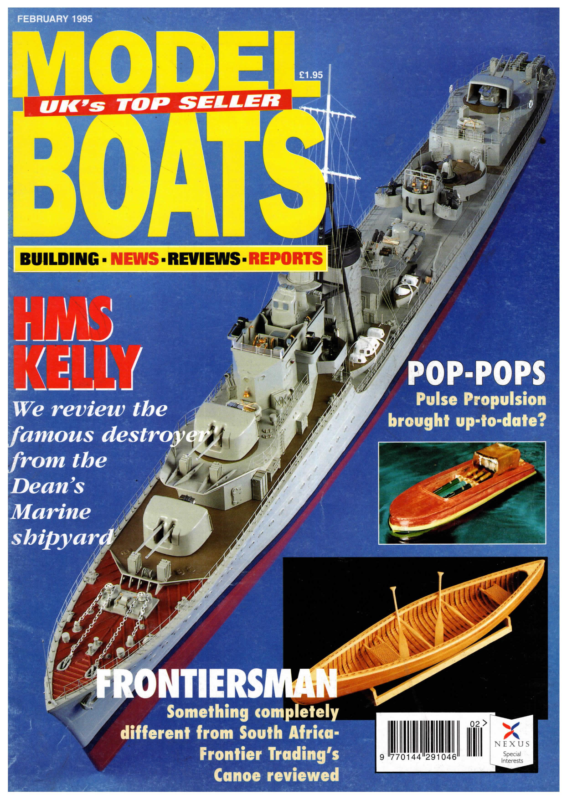
| FEBRUARY 1995 ) d D ) 0 aUe n Kiid TOP SELLER Wy Mall 7 pop-Pops Pulse Propulsion brought up-to-date? We review the y famous destroy rom the : Dean’s Marine Something completely different from South AfricaFrontier Trading’s Canoe reviewed | 02> 9 “770144°291046 | x NEXUS Special Interests
YACHTING small YACHTS It’s now the end of the 1994 season, the last regattas have been run and all the results wrapped up. MIKE KEMP ties up the loose ends control gear coupled with the freedom thus bestowed from rare regularly shaped lakes. What many fail to realise, because they have never seen or experienced it, is that Freesailing is an inexpensive way to really learn about how model yachts should be trimmed and sailed: it is also often an absolute hoot of a social activity. It is not just a relic from the past either, many youngsters in selected areas are having a go and are becoming very effective skippers as a result – witness the success of the Fleetwood ‘brats’. Seek out those hard edged lakes and give it go – don’t let vane sailing die! entertainment for those who happened to miss them; picture a well endowed, tender, yacht suddenly being swept off its ‘feet’; but understandably were less humurous for those who were sailing at the time. The Dicks family, Mark and Chris came out on top with 38 points just two points ahead of the Harris Reflections on a Few Years of MYA Sailing As winter draws on I find my sailing, and just about all other, activities severely curtailed as a result of a back problem; something that I know many others have experienced. My thoughts family from Bournville. Chris was being partnered by new Vane League Champion, and father Mike and finished just two more points ahead of two pairs; the Leeds and Bradford combination of Richard Costigan and Nigel Sharp who tied with the third son/father combination – local ‘lads’ Rob and Jim Vice. For some inexplicable reason the 1995 event is being billed as the ultimate Pugwash so anyone with a freesailing 36R is prompted now to book November 5th 1995 as the day to be at Clapham to try and persuade the ‘organisers’ to reconsider. Otherwise another traditional bit of our sport will have disappeared. The ‘A’ heat start at a recent Midland District RM event with John Cleave (144) at one end and Brian Cheetham (13) at the other. Peter Stollery (39) is well placed to go on long time. Graham Bantock took the Mermaid home after four first places and a selection of other top five places to achieve 9.4 points after discards. Closest rival Martin Roberts also had four first places but had to discard two disastrous 31 point scores which meant that his other respectable places in the top ten had to be counted to give him a total of 20.7 points. Martin’s travelling companion and fellow ‘Stark’ skipper, Graham Elliott, took the other two available first places and was consistently in the top ten overall to take third place overall. Nick Weall did a bit of consistent ‘middle of the road’ sailing to wrap up fourth while local man Roy Pearson took fifth. Proving that the Stollery EORS system works, everyone had the chance of ten races in two heats of sixteen to eighteen. 30 Confirmed Ahead of a lot of frantic activity to try to win this one. uildford is traditionally the venue for the last major Radio Marblehead regatta of the season, the Mermaid, which gives the afficionados of this class a last chance to thrash it out before winter sets in. In 1994 some thirty took the opportunity to try out Guildford’s new water at Chertsey, close to the well known Thorpe Park. The latest of the Guildford Club’s available stretches of water over the last few years, it seems that this could well be the best they have had for 1994 League Results Pugwash In previous years the Pugwash trophy meeting for Freesailing 36 inch Restricted yachts has provided the climax to the ‘Vane’ season. It has been the meeting where the vane world has ‘let their hair down’ and unwound before hibernating for the winter. It has seen some unlikely pairings fetching out and dusting down some ancient MYA specials to make it one of the best attended regattas, certainly for the class. It has gained the reputation of being even more of a social gathering than the normal vane meeting. In 1994 however entries were mysteriously down to such an extent that only nine pairs lined up to tackle the vagaries of Clapham Common. Within the eighteen skippers and mates lined up there were four father/son combinations although Roger Stollery preferred to get together with Lindsey Rowlands while his son Peter had to make do with Alex Austin! The radio world was represented by Tim Townsend who teamed up with ace builder John Gale especially for this event. The small entry meant that Race Officer Ian Taylor was able to sail the event to a conclusion, apparently the first time this has been possible for years, despite the generally light winds punctuated by some short gusts. These gusts brought a certain amount of and alter the way the Radio League in particular will be organised for next season we have a result for 1994. It came as something of a shock to see that previous Radio Club winners, Woodspring from the Bristol area, had increased their total of points gathered from competing in events yet only finished in seventh place. As previously predicted Fleetwood finished on top of the pile with a tremendous score but they were chased by five other clubs, each of whom had gathered more points than Woodspring. All of this suggested that, contrary to some popular belief, the MYA League has been becoming increasingly interesting to clubs. One of the ‘old hands’ in the Radio Yachting game, Squire Kay, who had previously been around second place for a number of years also scored more points than in previous years but only finished in nineteenth place overall. There were a lot of skippers reaping the points during 1994 even though some of them proclaim an acute disinterest in the league: it would be nice to see them similarly disinterested in travelling to other people’s events during 1995! The Freesailing world has also seen quite a lot of activity despite several events being cancelled for various reasons. This seems to have become a singularly British way of sailing model yachts, I guess largely because of the spread of relatively inexpensive radio Top Ten 1994 Freesailing Clubs and Skippers Club Score 1,690.5 1st Bournville 5th Leeds& Bradford 10th 2nd __—s* Fleetwood 3rd ~~ Gosport 4th — Birkenhead 1,158.5 1,033.2 496 432.4 Clapham Guildford Doncaster Newcastle 411.9 335 248 175 Birmingham 130.7 lst 2nd 3rd__—_—4th Skipper Mike Harris Graham Wyeth Peter Maskell D Bush Score 305.7 295 211.5 248 7th 8th 9th 10th Chris Harris Alex Austin Nigel Sharp David Rose 218 214.6 202.9 186 6th 7th 8th 9th 5th 6th Peter Hopkins Derek Priestley 245.8 242 Top Ten 1994 Radio Clubs and Skippers Club Score Ist Fleetwood 2,840.2 4th 5th 6th 7th 8th 9th Birkenhead Bournville Clapham Woodspring Ashton Quays Gosport 1,543.4 1,360.5 1,333.9 1,324.8 961.5 955.7 2nd ~—- Guildford Chelmsford 3rd 10th Gipping Valley Skipper Graham Bantock Ist 2nd = Martin Roberts Chris Dicks 3rd 4th 5th 6th 7th 8th 9th 10th Mark Dicks Keith Skipper Phil Playle Anthony Corbett Peter Stollery Paul Tickner Paul Jones MODEL BOATS 1,673.5 1,598.7 863.1 Score 558 485.2 443 437.3 436.7 385 376.4 375 369.2 367.3 FEBRUARY 1995
I had another chuckle when I considered articles and events concerning yacht evolution. In the late seventies there were reports of revolutionary new Marbleheads with unheard of minimal displacements. In one article Larry and Neil Goodrich from the New York Central Park based club were telling us that ‘Light is Right’. He described these dainty 14.5lb (6.6 Kg) Radio Marbleheads which used radio gear with an all-up weight of 1.25lbs (570 gram.)! Note, however, that they could sail all day on a 6 volt 375 mA.Hr. set of NiCads. What struck me about those days was the considerable thought that was put in by many, if the number of published articles is any indication, to the theory of model yacht design. There were several suggesting mathematical systems which could be =— = Another pic (some last month) ofyachting in the Orkney Islands. This is a 1960’s 1200 sq.in. M class sailing off on a windward leg. A long way to go, but what a wonderful piece of water for racing. Photo: Hughie Shields. 1994 Vane Champions 1994 Radio Champions RA Derek Priestley R10 Rater R6 Metre RM , R36R Graham Bantock Graham Bantock Graham Bantock Anthony Corbett Fleetwood Chelmsford Chelmsford Chelmsford Guildford One Metre Chris Dicks Clapham turn again to the beginner at this game, althoughI still feel as if I am still a relative newcomer I suppose I have actually been sailing the MYA way for some time now. A question probably to the forefront of a prospective new entrant into this sport is: “what constitutes a year in the life of a Model Yachts-person?” All of us who write this sort of column regularly exhort the ‘beginner’ to get involved with the local club but what can be expected when they do? For many clubs the Autumn, winter and early Spring months are when they turn their attention to identifying new officials via the Annual General Meeting. Sometimes prospective new members find themselves being tempted by special membership offers as the club ‘year’ comes to close and existing officials feel a little guilty when trying to convince new members to pay their subscriptions for only a small part of what remains of the season. This is often a good time to join! This period is also one when many clubs put more energy into organising regular Sunday morning events to keep the club together during the more inclement months of the year. As a result, in many cases, there are actually more skippers seen at the lakeside than during the more favourable weathered months. During the ‘season’ many of the more competitive minded club members often take their sailing ‘on the road’ to open events, ranking races, championships and the like. I am definitely guilty of this and spend more of my available sailing hours at away events than at ‘home’ during March through to November. I am sure many of my club colleagues wonder who I am when I turn up at the lakeside, so rarely do I attend our club meetings during the summer: I suspect that I am not alone. The winter months are also a good time to get some MODEL BOATS FEBRUARY 1995 A 10 Rater 6 Metre M 36R Alex Austin Graham Wyeth Peter Hopkins Peter Maskell Rob Vice assistance from these ‘experts’ as the pressure to concentrate on preparation for competitions is less and they are frequently seen trying out new yachts or new ideas on rigging in readiness for the next season. Thus there is a ready source of information and advice on how to set up your newly built yacht. How to overcome those inevitable bits that break when the wind gets just that little bit stronger than you ever expected it to. Never under-estimate the power of the wind and the wave: OK you are less likely to become physically threatened when the wind whips up the waves around a model yacht, but when you see your pride and joy disappearing beneath the waves you have good psychological battering! A few ‘experts’ on hand can be very helpful in such circumstances. If you haven’t completed that first yacht there are almost certainly going to be questions about “where can I get this…” and “what should I use for that…” which are much more likely to be answered by those who have already found solutions. There are times during the construction of a model yacht when you might just as well be in the middle of the Sahara Desert as in ‘Middle England.’ To say that November through to March is the closed season is not strictly true. There are often small invitations from one club to another to come and have a short ‘friendly’ sail-in to boost the numbers on an extended Sunday morning. There are also some regular open meetings that punctuate the gloom of winter, by now the Oliver Lee Trophy at Chelmsford has become a classic way for Radio Marbleheaders to spend what is usually the nearest Sunday to New Year. Not only do you get a keenly contested event where many a new boat has been tried out against known competition but there is Guildford Gosport Bournville Fleetwood Clapham applied to create yachts starting from various view points. Bearing in mind that these were times before the ‘IBM PC’ had been invented, yet alone become accessible to ‘the masses’, then quite a lot of number crunching time had been put in by the authors of the articles. At least one of the authors had built his naval architecture degree on the subject of model yacht design and published his theories as a series: I find it makes interesting reading although I never had the opportunity to sail against one of the yachts that resulted from the calculations. I shall never forget my first Radio Marblehead Open Meeting: it was in the sandpits that used to form the home waters of the Kings Lynn club. It was a the added bonus of hot mince pies and, these days, a non-alcoholic punch to warm up the lunch time break. For other classes there are often small regattas with innovative names like ‘frostbite’ to visit. Without the pressure of ranking and league and with the common ‘enemy’ of the cooler weather these can serve as a good introduction to the ‘away’ game. Looking Back While pondering over what to write in this column, having been forced to withdraw from active sailing for, hopefully, a short while, I had a look back through previous issues of Model Boats. It was then I realised that I have actually been sailing Radio Yachts of one form or another for some sixteen years, starting back in 1978 with a 575 that yacht is still intact. Looking back it struck me how much things have changed in those few years and yet how some things have not really changed at all. For instance I came across a regatta report where there was acry for an improvement in the standard of observation at radio race meetings – in those days it was referred to as ‘judging’, perish the thought. There was an article exhorting us to adopt some new ways of sailing the radio regattas from guess who? Some of you will know – Roger Stollery. In September 1979 there was a report of the first major event run under the new system which had been published in these pages in May of that year. What soon became known as the Stollery ‘Heap’ system had its first success although for some time to come there were articles published attempting to refine the ‘schedule’ system. The latest in the evolution of Stollery systems has become almost universal in the UK for Radio Fleet meetings: being attributed to Stollery the younger. gloomy day with a wild wind which was stronger than I really had proper sails for. I remember getting well and truly ‘carved up’ on several occasions by much more experienced skippers as I put my yacht where I thought it should be – without too much appreciation of what that meant in terms of ‘rights of way’. One name sticks in my mind from that meeting – Chris Eagle, now no longer featuring in the results lists. But there were quite a number who are prominent now who also featured in those days. The Dicks family Chris and Mark, John Cleave, Derek Priestley to name but a few are still active today: and in March 1979 I spotted the first example I have seen of an advertisement for someone who has gone on to become one of the truly top skippers, designers and sailmakers of the world – Graham Bantock! There are many that probably think the international flavour of our major UK meetings is a recent innovation: not so – in 1978 our old friend Emille Servella was placed tenth in the MYA RM. Nationals at Gosport. Also the 6 Metre / One Metre thing is not as modern as some would like to think. In February 1981 someone writing under the guise of Model Yachting Association News put forward a very brief description of the – then – 6 Metre rule and some suggestions as to why it had fallen into dis-use and therefore should be dispensed with as a recognised class. On the same page was an even briefer treatise on why we should consider introducing the One Metre class, or 10/40 rule as it was then known on the European continent: and I bet there are many who thought the One Metre is a new phenomenon! That’s all for this time, next time I hope to be up and about again with some more news on ‘Sylph’; competition ramifications of the MYA AGM; and maybe even the Model Engineer Exhibition – happy sailing to you all. 31
Racing Mark Buoy Laying by means of R/C Electric Power Boat BALL FROM w.c. CISTERN | ANCHOR WEIGHT COCKING WEIGHT COCKING WEIGHT ‘yu’ BOLT IN TRANSOM CAN ALSO BE USED AS ATTACHMENT POINT FOR FISHING LINE TO RUN OUT AROUND A BECALMED YACHT KEEPS LINE OUT OF THE x WAY OF PROP TOWING LOOP ye ANCHOR WEIGHT Laying Racing Marks and Retrieving Becalmed Yachts I n all except the most shallow racing pools where you can wade out, laying racing marks or retrieving HANDY HINT becalmed models usually involves LORIS GORING offers a useful method of model rescue having a club dinghy and crew to do the work. Not so in the Paignton club where Julian Wilmot has developed an electric power boat that lays racing marks at a remarkable speed and will flash out to a rescue of a yacht faster than the R.N.L.I. The boat itself has a deep €Vi hull and twin electric motors which are used for steering rather than a rudder. This has the advantage that there is less chance a far aft rudder getting caught in the fishing line or buoy lines. The cunning part though is the way a single servo is able to jettison the marker buoy in precisely the right spot. The sketch show how this is done. Just as important, the marker self adjusts to the depth of the water it is dropped in within reasonable tolerance once the usual depth of the pond in known. As for retrieving becalmed yachts a fishing rod and reel with plenty of line on plus the boat are the only components needed. The same éUi bolt on the transom that is used for the buoy loop has the end of the fishing line attached to it. While one person drives the boat, the other pays out the line with the reel free-wheeling but controlled so that loose line cannot get round the props. The boat is then made to circle the casualty and then driven back to the starting point. With the boat ashore and held safely, the fishing rod line is reeled in bringing the casualty with it. The same method is used for retrieving the racing marker buoys when the dayis racing has finished. A The specially modified simple set-up that might well save a club model is being prepared _ the trouble of having a full size tender to to lay outa marker buoy. 32 hand and the effort of rowing it out to place markers and retrieve them. MODEL BOATS FEBRUARY 1995