- small YACHTS – We get out for some serious high power sailing at the IYRU-MYRD Radio Marblehead World Championship plus the latest from the MYA league – by MIKE KEMP

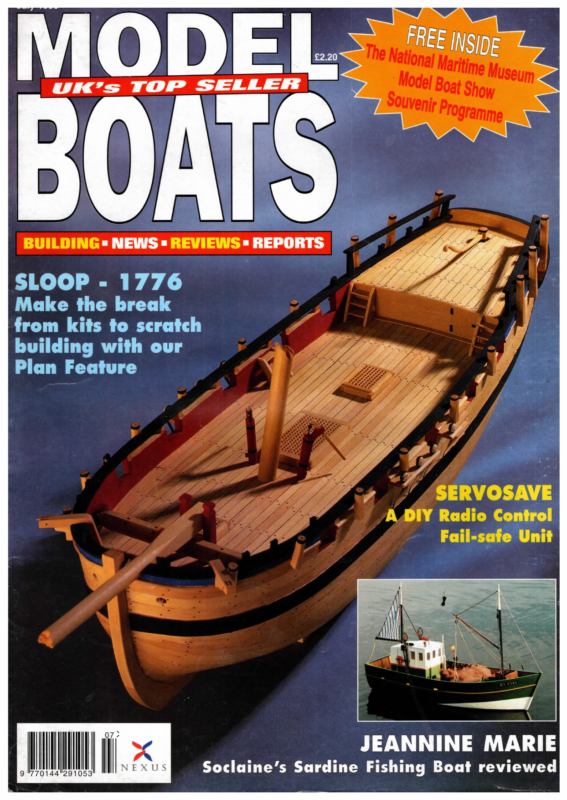
— OD UK’s TOP SELLER | BUILDING = NEWS = REVIEWS= REPORTS SLOOP – 1776 Make the break from kits to scratch building with our Plan Feature 1 4SERVOSAVE A DIY Radio Control | Fail-safe Unit JEANNINE MARIE A | NE x Us Soclaine’s Sardine Fishing Boat reviewed
classes raced from various yacht clubs around Melbourne’s magnificent bay which has a narrow entrance to the sea some 30 At the Rgdio Marblehead Worlds in Melbourne, the three miles from the beaches and harbour leading boats in this adjacent to the city. In addition to the Radio Yachts there were Olympic classes sailing in Heat Race 1 would also lead the Championship for the rest of the week; the World Cup Series and a challenge from the USA for the Little America’s Cup. Like many things in that amazing land Albert Park lake is big as a radio yachting lake, 2000 metres by 200 metres and shared by dinghies, yachts and rowing clubs. There Torvald Klem (47), Graham Bantock (95) and Peter Stollery (39). There was plenty of planing too! are even water fountains at the north end nearest the city centre. The racing was run from one of the rowing clubs near the Southeast end of the lake, the traditional home of the Albert Park Model Yacht Club. During the week the winds came from every direction but for most of the time they were easterly, blowing just over the RADIO YACHTING spectators left shoulder, and from the south, blowing in your face from the direction of the sea. The changeable and unpredictable nature of the wind was a race officer’s nightmare as well as giving all the skippers a headache. Which rig? How much leech tension? To where will the next wind shift on this beat? In Melbourne they jokingly say “If you don’t like the weather – wait ten minutes.” We found that this was no joke: a flat calm could become 12 mph in a matter of We get out for some serious high power sailing at the IYRU-MYRD Radio Marblehead World Championship plus the latest from the MYA league – by MIKE KEMP Hub Bell (101), Christian Lindholm (2), and Peter Stollery (39) arrive at the wing mark together. seconds and then revert to being very light from a different direction, in the same heat, a few minutes later! Whatever caused it, even the thin line of tall trees at the lake edge and those beyond played a small part in the plot. One man who was not bemused by all this was Rod Clack, very much the local, who o sooner had I made the pledge not report on any more events by ‘proxy’, basing my reports on information gained from others who did attend than the Radio Marblehead ‘Worlds’ took place in Melbourne, Australia. As there was no way that I could report on this important event from first hand I have made use of a report put together by Roger Stollery. Roger is no stranger to this sort of event, nor is he totally new to putting together such a report, so I feel we can be pretty confident in his interpretation of the week-long happenings. Because Roger provided rather more text than I could squeeze into this issue I have edited it back a bit but, hopefully, without losing the impact of what appears to have been a successful event: over to Roger. The city of Melbourne was the venue for this championship run on Albert Park lake between the 9th and 14th January 1996 as part of a much bigger gathering, Sail Melbourne ‘96. During January 27 different John Cleave (144) leads William Dalgeisa (78) and the eventual winner of this heat (722) round the first windward mark in the light winds on « Thursday. could be seen virtually every race jumping into his inflatable and whizzing around resetting the course at break neck speed. It was a marvellous example of the very best of course setting that was admired by everyone. Such high standards were also held by the rest of the race committee who, under the chairmanship of David Birrell, carried out the myriad of tasks very efficiently. There was good local support for the organisation including the race officer Peter de Lange who was excellent. A Flying Dutchman sailor, he made it quite clear from the start who was in charge; he mollycoddled no-one, made good decisions and stuck to them. He was always on the control platform, a metre or so above the water and from here he encouraged communication amongst the competitors. Occasionally he would congratulate skippers who had managed to stay clear after lots of overlapping boats rounded a wing mark close to the shore. He also issued general encouragement to cool it when such 48 MODEL BOATS JULY 96
Right: The ‘slippery ripe banana’ was the most unusual boat in Melbourne and the creation of Leon Taliac, an architect. All his rigs were simple double luff swing rigs and the hull was shaped from foam and coated with a light reinforced epoxy skin. It was another low cost, home made, simple Marblehead able to compete with the most sophisticated. 73 ae potential incidents began to develop. His influence was one of the factors contributing to the incredibly low number of incidents that went to protest. A lot of competitors arrived on Sunday 7th January 1996, set up their boats, sail storage, had their boats measured and transmitters checked. There were sufficient frequencies available to allow all forty eight yachts a unique frequency for the event. Many of the Northern Hemisphere skippers were revelling in the warmth, sunshine, long daylight hours, and in particular the moderate to fresh winds after six months of wind starvation. In the afternoon these got up to 14 mph and there was much planing around the lake in C rigs. More practice followed on Monday with the official opening of the championship at midday followed by a civic reception in the city hall for radio yachtsmen and some of other classes. Cadbury were the main sponsors for the event and on Tuesday morning at 9.00 am all 48 boats were gathered for a race in front of TV cameras to get some promotional footage before racing ‘proper’ started. The radio racing received a lot of media attention as these cameras found the logistics of filming easy and they returned several times during the week and to record the exciting climax in the last race. Good newspaper and local radio coverage appeared to give radio yachting here better publicity than the full sized classes. Races were divided into four heats and a preliminary round of three races was necessary to comply with the RYRS. In the very first race Graham Bantock MODEL BOATS JULY 96 Ee demonstrated his intent to retain his World Title by winning it along with UK challenger Peter Stollery and Australians Cameron Clarke and Alan Robinson. Other preliminary race winners were Gordon Maguire, Torvald Klem, John Holmberg, Chris Dicks, Colin Gooley, Henry Ericsson and Christian Lindholm. The wind was light and fluky to start with but built up to B rig by lunchtime when the heat racing started and gave fast planing conditions on the offwind legs and some exciting racing. Heat race 1 involved the three skippers who would lead the championship scoreboard for the week. There was a fine scrap at the front of this heat with Graham leading in his B rig until he nose-dived and was overtaken on the run by Peter in his C rig. Turns for a mast touch allowed Torvald through to win and start a battle of wits that was to be decided some twenty seven races later! The international jury were given some work to do during the afternoon and unlucky Gordon Maguire was disqualified for insufficient number of turns when hit by another boat whilst doing turns for an alleged buoy touch in race two. Over an hour later racing was resumed anda total of six races were completed. Moderate Easterly winds greeted skippers on Wednesday with gust of up to 18 or 20 mph recorded during the day. The highlight for me, having struggled in B heat previously, was in the A heat, race 4, when leading round the final leeward mark with Robert Wattam and Peter on my tail. Second placed Robert looked most dangerous so I covered him and so could not prevent Peter from tacking on the shifts and coming through to win by six inches using his C rig in contrast to my A rig. As the wind increased everyone was in low rigs and Gordon Maguire achieved his only win in race 5 using a B rig, whilst other race winners were Graham Bantock and Janusz Walicki using conventional rigs. The next three races went to swing rigged skippers. Peter and his C rig won by large margins ending race 9 impressively with a whole leg lead. The last race of the day was won by Torvald Klem and started the most brilliant display of sailing skill of the championship as this was the first of four wins on the trot. Thursday was to be a half day and it started in hot sunshine and fluffy clouds with a flat calm before the wind came in from the sea to the south. At the end of race eleven a protest hearing went on for hours and prevented any further racing. In a light, fitful, breeze the leaders were running down to the wing mark right in front of the Above: Graham Bantock (95) leads Philip Page (3) to the wing mark in Friday’s moderate winds. Above left: Torvald Klem’s own design 3erlioz was beautifully simple as can be seen from the deck layout. The radio gear was a cassette type mounted on a carbon spar and simply fitted through the central hatch. Eight wins was proof that simplicity does succeed in this class. control point. Graham made it quite clear that, at the four boat circle, no boats inside him had an overlap. They persisted in their rounding inside him so Graham let them have room to comply with the sailing instructions that required right of way boats to make a reasonable attempt to avoid incidents if they could but protested them for their transgression of the overlap rule. The jury considered the case very carefully and although the evidence clearly backed Graham’s action it was dismissed as no incident was deemed to have occurred. So much for sailing by the book! If this protest did anything it made skippers think twice about protesting and Left: Martin Robert’s creed designed Starkers was another simple boat in the top six. It is very narrow and light (10.5lbs) and gained its stability by using a stiff Bantock fin. 49
one as the wind dropped back to 5 – 7 mph Geoff Smale’s own design New Zealand Edition had the most unusual keel which was at the end of the day. There were now two leading contenders with Graham having overtaken Torvald to hold a comfortable lead of fifteen points. very thin (6mm) and Sunday was a very hot day with temperatures rising to 39 degrees C with not a lot of wind, mostly calm to 2 mph with short bursts of 5-7 mph. It was very fluky and this heightened the excitement. Torvald started well with a win in race twenty five whilst Graham could only manage a sixth which reduced his lead to six points as the like the rest of the boat, home made. The rigging at the end of this yard tensioned the leeches by using the trim on the end of the sheet travel when fourth discard now applied. In the next race sheeted hard in for the beat. Dave Wattam’s sistership was fifth. Torvald was second to Robert Wattam giving him a lead of just 0.3 points. For the penultimate race the Melbourne wind was at its most fickle. Before the start it was calm but by the end of the second beat it was 10 or 12 mph making sail setting difficult. Graham was able to use his sheet travel controlled leech adjustment mechanism (the ‘gizmo’) to good effect, applying tension for the stronger winds and beat Torvald by four places to take over the lead of 3.7 points. ojolela Above: Chris Dicks (33), Peter Stollery (39) and Gordon Maguire (94) chase Graham Bantock hard in the stronger winds of Wednesday in race 7. Above right: From left to right Race Officer Peter Delange, Christian Lindholm (behind), John Cleave, Torvald Klem and ace course setter Rod Clack, soaking up the excitement of the last race. All Melbourne photos: Roger Stollery. losing half a day’s racing without certainty of a result. The half day gave everyone a chance to take in more of what this great city had to offer as well as take coach trip some 50 miles to the coast at Summerland Beach, Philip Island to watch little Fairy Penguins at dusk come ashore for the night. With so many tourists gawping we felt that the penguins had a rough deal but maybe they were just as amused by our antics. Friday started dull and overcast with a5 mph southerly wind which gradually built up during the day. Torvald remained in Place 1st 2nd 3rd 4th Skipper Graham Bantock Torvald Klem Gordon Maguire Peter Stollery Country UK Norway UK UK 6th 7th 8th 9th Martin Roberts Paul Jones Janusz Walicki Mark Dennis UK UK Germany UK 5th 10th Robert Wattam Christian Lindholm New Zealand Finland Design Paradox Berlioz Paradox Roar Edge ? Starkers Paradox Skalpel 2. Paradox Viper Designer G Bantock T Klem G Bantock RStollery ? D Creed G Bantock J Walicki G Bantock R Stern Total Score 101.8 103.5 132.8 148.1 167.4 185.4 189.8 218.4 236.4 247.4 brilliant form and won the first two races whilst Peter who had led the event since the first day became the last of the top skippers to founder and go down to B heat for a couple of races. In race thirteen the sporting manner in which this event was sailed was exemplified by the action of Robert Wattam in an incident on the water between my ‘Oar’ and his ‘Kim Magic’. After contact at the windward mark I had sailed into clear water to do my turn, I completed the tack and gybe and the 360 degree turn when at that instant, Robert sailed very close to my course and protested. On return to the shore he went to fill in a form whilst I considered my defence. Not being able to prove conclusively that my turn was complete, I decided to retire but as I approached the protest caravan, Robert greeted me with a smile and the news that he had withdrawn his protest. We both felt better after that and went on to have a fine scrap at the front of A heat in the very next race along with Torvald who recovered well after doing a turn early in the race to finish second and allow me to break his winning 50 Top Ten in the World run! He won the next race though for a total Torvald now had the task of beating Graham With two days to go the gap between the three leading boats was closing, Peter and The wind stayed light at 5 – 8 mph but there were big holes down to 1 mph that could turn the results around and no position would be safe. John Cleave, who seems always to turn on the pressure in the last race of a championship made a perfect start at the port end and closely followed by Peter, lead up to the mid point on the second reach when the wind died. Torvald had made a better start than Graham and was leading him by two places at the first mark. Graham overtook him on the reaches of eight wins over three days. Torvald were separated by only 3.7 points and Graham was a further 4.7 points behind. Saturday started calm and gave John Cleave, who had struggled in the lower heats earlier in the week, a chance to demonstrate his skill in race 18 to win by a few inches from Peter and Torvald. The wind was very fickle, no more than 2 mph, and set a pattern of amazing changeability that was to last all day. Torvald’s win in race 19 was followed by Christian Lindholm’s in what was now a good A rig breeze of 6-9 mph. This race marked the end of Peter Stollery’s challenge as he had a series of bad races and spent the rest of the day and two Sunday races in B heat. As the wind increased Martin Roberts took up the running and won the next two races; Janusz Walicki took the next using a lower rig in 8 12 mph winds while Robert Wattam grabbed by four places to win in the last race. but a calm patch bunched everyone up together. When the strength of the wind returned John accelerated away and was never challenged again. After the sausage Graham was lying third one place ahead of Torvald and this was retained until the final leeward mark of the second triangle. Torvald had caught up on the final reach and was four or five boat lengths behind at that final mark. On rounding, the wind MODEL BOATS JULY 96
headed for Graham and freed for Torvald, and as they approached the finish line Torvald sailed by as did New Zealander Robert Wattam to beat him by the narrowest of margins. However this was enough for Graham to retain his World Champion’s crown by just 1.7 points in the most exciting of finishes; a gripping climax to a superb event which was very well organised, friendly and competitive with lots of excellent sport and warm sunshine. Thank you Roger for that report and some excellent photographs. Solaglas Trophy Billed as number two in the series of Midland District internal league races the Solaglas has traditionally given the Market Bosworth club a chance to gather a sizeable One Metre fleet together in the middle of England for a good old thrash about their lake. Because of a lack of sailboards and dinghies on the main lake of the Bosworth Water Trust park which is home to the club we were able to move on to the main lake and stretch our ‘legs’. Unfortunately, as is becoming all too common these days, the wind failed to come up to expectations and nullified much of the advantage of the larger section of water. Nevertheless some thirty five skippers had the chance to partake of seven races of a length which was quite reasonable considering the light and variable nature of the wind. When we first arrived it seemed as if we might not even get started for the water was glassy smooth and any flags and pennants were hanging limply from their poles. A few of us rigged and gently placed our yachts on the water, we didn’t want to disturb the surface too much, and found that there was a little bit of a draught after all. By the time most of the entry had found their way to the water’s edge the wind was blowing at a respectable level although not from the absolutely ideal direction. Gordon Sears, playing Race Officer for the day, set us quite a long course from a start down on our right hand side, between a mark and a post on the bank but including an ‘inner distance mark’ to keep port enders away from the shallower water at the edge of the lake. We proceeded, mainly on starboard, to a mark which was set quite close to the adjacent island, turned to port and came back down to a wing mark before a short reach to the first of two leeward marks. I think Gordon did this to try and prevent too much confusion with ‘incoming’ port tack reachers being faced with starboard tack beaters coming out of the leeward mark resultin g in mayhem close to a soft shore. Whatever the reason he presented us with a long windward leg which was predominantly a starboard tack, indeed there were times when by hanging on to port for just a little while coming out of the leeward mark before going on to the opposite tack one could then proceed all the way to the windward mark in one go. The fleet was split into three heats for a seeding race during which the Hamble club were much in evidence at the front of the separate fleets. Gordon Maguire took the first of his three first places and Simon Russell one of his two wins: in the third David Taylor became one of only three nonHamble skippers to claim a first place during the day. He seemed to hit the water with his new Nigel Gilson designed Dann-3 yacht just about ‘ready-to-go’. Unfortunately David then spent the rest of the day frustrating himself as he played with the yacht’s tune, with generally detrimental effects: he was to finish the day in tenth place overall. Both the other non-Hamble eventual winners-to-be finished their seeding race in sixth: Pete Moore from Bournville would eventually score a zero in race 5 while Rob Vice from Clapham took his brand new boat into its first win in race 6. Rob’s newly built ‘Tonic’ designed by Alex Austin had its first dip in a real lake immediately prior to the start of racing and was not measured for this meeting, nor was it sailing at its proper rated weight. Nevertheless its first outing showed that the design has a strong possibility of becoming yet another competitive One Metre in a growing field of successful designs for the newcomer to choose from. Gordon chose, I believe wisely, to reshuffle the fleet into two heats and give us races of a.decent length at the expense of the total number of contests. In the variable winds prevailing this meant that there was a chance for someone caught in one of the occasional lulls to make upa bit of space before the finish – so helping to keep down the levels of frustration and aggravation. Even with these attempts to avoid protest trouble there were still a few outstanding incidents at the end of a heat: including a number where one of the two or more involved fell back on the claim “if an observer didn’t call it – it didn’t happen!” Fortunately Gordon handled protests with commendable speed and I imagine that many of the entry never even realised that a hearing had taken place between heats. As the day wore on the wind strengthened slightly although it never reached a point where changing to a lower suit of sails seemed a real option. On one or two occasions it actually swung right around for a few minutes such that getting to the leeward mark became a beating experience but it didn’t last for long. When race 7 drew towards completion it became obvious that we were not going to get any more racing in so the boats were packed away and Gordon’s right-hand man for the day secretly withdrew to his car to compute the results in secrecy. Many, I guess, are a little suspicious of such secrecy when the results are being totalled up but it is almost imperative that such things are done in private as any spectator or questioner severely adds to the pressure being placed on the scorer at this time and pressure leads to mistakes. Mistakes can be embarrassing at best and result in loss of friends, followers and face at worst. Eventually, proverbial smoke was seen to be issuing from the back of Gordon’s car where the prizes were on display and from where they were distributed. Another Gordon, Maguire of Hamble, had triumphed and took the trophy with a grand total, after one discard, of 6.4 points: in second place with twenty seven points was his Hamble club colleague Simon Russell while in joint third place were Rob Vice and Chris Harris with twenty seven point seven points. Mike Hounsell completed the top five with twenty eight point four points just beating another of the Hamble bunch, Darren Maple. So ended another Solaglas trophy meeting at one of the Midland district’s pleasant and easily accessible lakes: we shall no doubt be back next year although some will be back before that to witness the 1996 Radio 36 Restricted National Above: Eastern District One Metre Ranking Race. Graham Bantock’s new yacht (55) follows the Bubbles 2 being sailed by Peter Stollery. Above left: Presumably in its European Championship livery, Gordon Maguire’s own design Stiletto now carries Irish ‘plates’. This will be one to watch at Fleetwood: but how is it in very heavy airs? championships in May. The League By the timé I write this the season is well under way, by the time you read it the 1996 season will be half way to completion. At this time last year it looked as if the revised scoring system might be shaping up for a closely fought championship in both Radio sections even though the then leaders-had been on top for some time and actually remained there until the end. This year the competition seems even more intense, particularly in the Club section of the championship. There is a new name at the top of the individual section and I predict he is going to be difficult to shift, although I guess there are a number who Solaglas Trophy – Top Five Place Skipper Gordon Maguire Simon Russell Rob Vice 3rd= _— Chris Harris Ist 2nd 3rd= oth Mike Hounsell Club Hamble Hamble Clapham Bournville Woodspring Design Stiletto Stiletto Tonic Bubbles Single Malt Designer G Maguire G Maguire A Austin A Austin G Bantock Total Score 6.4 ar 217 PAU 28.4 MODEL BOATS JULY 96 51
Both below: Race 8 at the Euro Grand Prix. The whole fleet stayed in a tight bunch on the beat to the first mark; Gordon Maguire (94) is showing signs of being a little quicker until…the bulk of the fleet are still close together as they round the second, wing, mark. By now, however, Gordon Maguire (94) has really broken away and is actually halfway up the next leg of the course! One man and his new boat. Martin Roberts is in jovial mood as he prepares his new One Metre for the Eastern District Ranking Race. The yacht is rumoured to be electrifying in a blow. That was something we just did not have at Chelmsford. might wish he would go off and get himself a good berth on one of the top class Ocean Yacht racers. Indeed that might be the only circumstances when he could be dislodged from the top of the section. Gordon Maguire’s departure, even if only temporary, for such action will still leave a bunch of Hamble colleagues to carry on their challenge for a Radio League success in their first year of existence. However with such as Simon Russell as past, and presumably future, members of Lawrie Smith’s Vauxhall sponsored Ultra 30 campaign crew their club performance may falter during the summer months. We can only wait and Top Ten Radio Clubs * 1st 2nd 3rd 4th 5th 6th 7th 8th 9th 10th Club Birkenhead Guildford Chelmsford Hamble Bournville Doncaster 353.3 267 252.7 250.4 201 179 Market Bosworth 165.8 Fleetwood Leicestershire Clapham 152.7 137.4 Top Ten Radio Individuals Ist 2nd 3rd 4th 5th 6th 7th 8th 9th 10th 32 Skipper Gordon Maguire Martin Roberts Ken Roberts Paul Jones Anthony Corbett Keith Skipper Paul Tickner John Cleave Phil Playle Peter Stollery Score 151.2 1115 108.4 101.3 88 87.2 82.1 73.6 72.3 69.7 again with the cream of the Radio Marblehead world with my hands on a top class yacht. I had a wonderful time! I had my ups and downs but then so did just about everyone else, even those who had a few weeks earlier been racing these very same yachts in the sweltering heat of Melbourne Australia. be creeping into contention soon now that Consequently this report is from a somewhat different perspective because my pre-occupation over the weekend was trying to do justice to this magnificent racing machine. Perhaps this report is as much a ‘road test’ of the yacht as a report on the event. Unfortunately the ‘European’ content of the entry was less than could have been hoped. I can appreciate the difficulty in rf Euro Grand Prix and Ranking with very little of the falling wet stuff but it was just a little chilly at times. Some from the Each year the IYRU-MYRD nominates up to eight Radio Marblehead regattas to form the wind came from a direction which gave Roger Stollery, who was our Race Officer, the see if this extremely keen bunch of ‘crossover’ sailors can mount a successful challenge to the more established Model Yacht clubs who are already vying for the honours they have savoured in the past. They are all there in the top ten at the moment with the exception of Woodspring; and I suspect this club will Score 454.6 actually sail in the event I could hardly believe my luck! I am not sure of Roger’s motivation for this; whether he was just being kind to me, wanted to help swell the numbers, or wanted to get some photographs of his own yacht in action. Maybe it was a combination of all three: whatever the reason it gave me a wonderful chance to mix-it once their leading lights are settling down with _ travelling to such an event for just the weekend, getting on to the ‘continent’ for a their new boats and the other members get going in the warmer summer months. regatta is as much a problem for us as it is for ‘them’ but, in my opinion, they all missed a As keeper of the MYA Radio League truly great weekend of sailing! scores I am particularly pleased to see The weather was typically English for the how well the championship is flourishing: time of the year, although we were blessed keep it up! Race the European Grand Prix. Each event is in a different European country and is open to all European MYRD yachtsmen. The British nominated event for 1996 was the MYA Metropolitan and Southern District RM Ranking Race organised by the Guildford Club on its current water opposite Thorpe Park near Chertsey on 23rd and 24th March. I was fortunate enough to be able to go along to this meeting and when Roger Stollery included an offer to borrow his Roar Edge to south of Europe would probably have described it as down-right cold! On Saturday chance to lay one of the long courses for which this lake is rightly becoming famous. I would have preferred it if he had been able to make use of the multi-hundred metre beats a little more often but the wind was swinging just a bit too much for some of the time. Nine races were completed during the first day and there appeared to be no real pattern of performance emerging other than that Torvald Klem, Gordon Maguire, Paul Jones and Peter Stollery appeared to be regular visitors to the top half of MODEL BOATS JULY 96
Far left: One of the i French visitors to the Euro Grand Prix, { Jerome Jacquin, was sailing this Margot with the superb graphic paint job. Unfortunately his sailing was not quite up to the same standard. He finished in twentieth place. It is often considered to be an advantage to have a raised view of the yachts when racing. Torvald Klem has just that little bit more advantage than most; that lucky clip-on the A heat. On the other hand quite a number of the rest of the twenty eight skippers also paid one or more visits into the rarefied heights of this elite bunch who had last previously sailed together in Melbourne. One of the most consistent skippers during Saturday was Frenchman Christian Goubet who, after a pretty miserable first three races, suddenly found the advantage of EORS to take a third in 4B to climb into 4A and latch on to fifth place which he made his for three straight races after which he climbed into second in race 7. In race 8 he dropped to sixth followed by a potential relegation place in race 9 after which we went our various ways for the evening. On Sunday the wind had gone through some 110 degrees to make use of the other main control bank necessary. This gave us some slightly shorter beats but with the increased wind strength included some exciting off wind sailing as well. Race 10 saw Christian Goubet escape relegation by virtue of another skipper’s disqualification in the inevitable pre-packup protest on Saturday. That skipper didn’t reappear for the Sunday session so we were down to 27 actual competitors for the remaining twelve races. While most had spent Saturday in their tall rigs, Sunday saw much more activity in the sail changing department as skippers sought to find the right rig for the strong but variable wind. Again one of the most consistent skippers was number 44, Christian Goubet who notched up four first places and one second during this day: unfortunately for him he also found himself down the field somewhat in the other races so did not run out a clear winner. The same could be said for the others in the eventual top five: Gordon Maguire did what he seems to do best, pack in a consistent but not necessarily brilliant series of races to emerge some twenty four points ahead of the pack. Peter Stollery, Torvald Klem, Christian Goubet and Chris Dicks all had an up and down type of meeting to finish with a mere three point four points covering all of them. Torvald got into too much trouble for his own good, suffering two disqualifications one of which has to stick – under the EORS discard system you can only discard one in every two DSQs. This second infringement probably cost Torvald the event, although it would still have been tight. fi Oar There were two of us sailing on a ‘charter’ for this weekend; Mike Harris sailed Roger’s Roar Edge yacht number 117 while I had number 17. WhenI took charge of the yacht on Saturday morning Roger’s training session was surprisingly brief, showing me how to switch on and off, change battery packs and plug the rig into its socket. The Stollery swing rig differs from the Bantock rig in several details the most obvious of which, to the casual observer, are the complete absence of any ‘backstay’ and the inclusion of a ‘floppy’ arm which carries the jib boom. MODEL BOATS JULY 96 Considering the latter first: this is designed to overcome one of the drawbacks of the normal swing rig where the slot is considered by many to be too small to be effective and/or the leading edge of the jib goes too far to windward. The amount of ‘break’ of this ‘break-back’ operation is adjustable but only during initial tuning; once set it does seem to be necessary to alter it during a racing session. The backstay control on a Bantock swing rig is usually used to control the sail shape by bending the mast with its normal effect on the flow, belly and twist. Without the backstay how can the Stollery rig sails be controlled? Roger showed me that it is almost all done with one control – I like that idea, simplicity – that tensions the jib/forestay. Looked at closely, the bowsie above the jib is moved on the halliard between two marks – one black the other red. As the wind speed increases the bowsie is moved up towards the red mark. This increases the tension in the rig which is just what one should do as the wind increases, when the red line is reached it is time to change to a lower rig. Amazingly simple and, as I found out, very effective in the ‘heat of the race’ but this is only the culmination of considerable background observation and experimentation. I have commented before on Roger’s habit of making seemingly endless notes between races at regattas all over; it is this vast documented experience that undoubtedly enables him to have a yacht set up like this. Any necessary trimming of the mainsail tension which would be adjusted with the kicking strap on a conventional rig is taken care of by a small nylon screw at the junction of the main boom and the mast. The whole adds up to a yacht which, for the charter skipper, is remarkably easy to set up and adjust – if only I could get all my own yachts to be as easy as this?! What did it perform like? I could sum it in one word – fantastic! This yacht was an absolute joy to sail and, once I got used to it – after the first seeding race – I could get down to sailing with ‘the rest’ of them, or was that ‘the best’ of them for I found myself getting straight out of B heat and into 7th in race 2. In race 3 I went one better and Top Ten in swapped places with Peter Stollery sailing the sister ship ‘Zoom’: wow beating Gordon Maguire and Peter Stollery, I could get to enjoy this! In race four it took me into fourth and in race six I was chasing John Cleave across the line – and Place 1st 2nd 3rd 4th 5th 6th and I lapsed into B heat for the 9th John was in first place! Race seven saw my brain gotosleep end of the day. 7th 8th 10th mascot on his stronger so I put the B rig in and adjusted that forestay bowsie to about halfway between its marks; got Roger’s approval, we tweaked the kicking screwa little, and off I transmitter probably helps, as well. went to chase Peter Stollery out of B heat. Roger was almost beside himself with joy at the finish of that B heat for there were four Roar Edges all going for the finish line within inches of one another. John Cleave got across first, Mike Harris took 117 over next, Peter and ‘Zoom’ followed with me in hot pursuit, the key point about this was that the bow of my yacht crossed the line before John had cleared it. This was not the last of these close finishes, they came thick and fast during the windier conditions of the second day. With this lower rig the Roar Edge really came alive and I found myself doing wonderful things at the start like finding a clear space, crossing the line at full speed, sailing off into clear air and storming around with the fleet trailing behind. This is an exhilarating experience in any fleet but in this sort of company it gives a real ‘high’. I was able to bring this world championship entry yacht into eleventh place just behind John Cleave which seemed to me to be a pretty reasonable finish in this fleet. I can certainly understand why there are more and more Roar Edges finding their way into the hands of skippers around the South in particular. Paul Tickner, I believe, is able to produce mouldings on a semi-commercial basis, Graham Bantock produces sails to fit Stollery type rigs and the Stollery ‘Boot’ containing all the radio components is beginning to find its way into yachts of other designs and classes. If I were looking for a new Radio Marblehead to get serious in that class again, the Roar Edge would be a serious consideration: ‘Oar’ is my kind of yacht! I would like to give Roger a public thank you for presenting me with a chance to have a great weekend of racing: terrific yacht, great meeting sailed in good competitive company, all with understated, unoppressive and efficient organisation. the Euro Grand Prix Skipper Gordon Maguire Peter Stollery Torvald Klem Christian Goubet Chris Dicks Paul Jones Club Hamble Guildford Norway France Clapham Doncaster Design Designer Paradox G Bantock Roar Edge _ R Stollery Berlioz T Klem Margo Blade C Dicks Paradox G Bantock Peter Wiles Poole Berlioz Martin Roberts Phil Playle John Cleave Birkenhead _— Starkers Chelmsford Paradox Ryde Total Score 72.4 96.4 97.9 98.4 99.8 110 D Creed G Bantock 119.4 = 120.1 Roar Edge __ R Stollery 125.4 T Kem 124.7 On Sunday the wind was 53 ‘