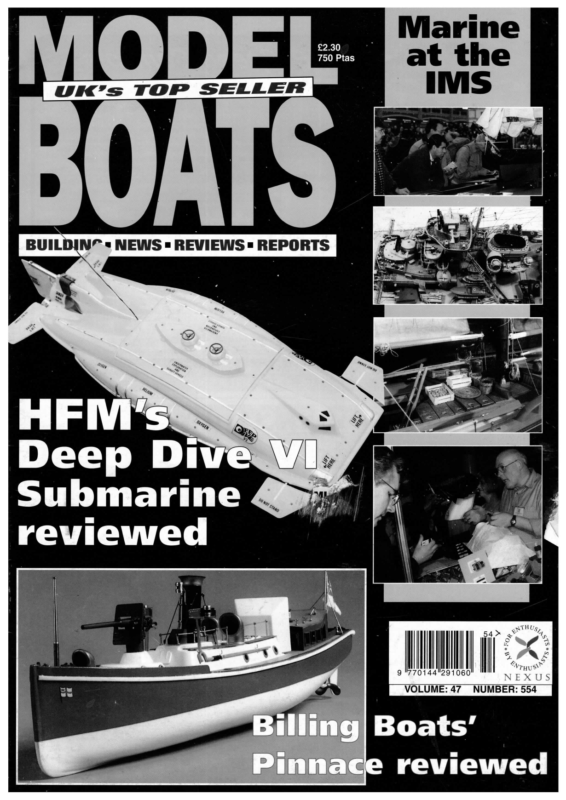
- Hampton Court MYC – DAVID BELL introduces a club with over 100 years history
- small YACHTS – It’s show time again: but not much to show! These are the ramblings of a frustrated model yachtsman: sun, sea and, hopefully, lots of sailing beckon in the far distance: look out for the next issue! Says MIKE KEMP

£2.30 750 Ptas UK’s TOP SELLEF C7)yy 7, llDive Vil) Submarine @y reviewed Pinnace reviewed
HamptoniGourtsVviViG DAVID BELL introduces a club with over 100 years history The Boat House in 1996. § e Rick Pond in Hampton Court Park (also known as Home Park) has been the venue for model yacht racing since the 1890’s. Rev. Leonard Sampson Lewis-Low founded the Surbiton MYC in 1893, the first club to adopt the water. By the late 1920’s there were three clubs using the pond. The YM6mOA (Yachting Monthly 6 metres Owners’ Association) was founded in 1924, probably by Mr W J Daniels and Major Malden Heckstall-Smith. In 1923, the Major, whilst Editor of the Yachting Monthly devised a formula based on his 18 footer rule (the Yachting Monthly 6 metre). This was on a scale of 2in = 1 foot, later known as the international A class. It was devised in collaboration with Mr W J Daniels for a series of international races between England, Denmark, America and countries of the British Empire. The association’s southerly branch sailed at the Round Pond, Kensington, Gosport, and the Rick Pond at Surbiton. The headquarters for the YM6mOA was initially at the MYSA at Kensington, but moved to the Rick at Surbiton in 1929 when the boat house was built. The YM6m0OA was now recognised as a club with full and associate members. The club raced these newly developed A class yachts until the present day, and continue now, though occasionally. Today its main class is the One Metre which was introduced when vane racing was temporarily suspended in 1995. The SLMYC (South London The YM6mO0A club house. Model Yacht Club) were sailing on the Long Pond at Clapham between 1918 and 1928, when they then moved to the Rick Pond. They sailed A class and 10 raters before the second world war, then postwar the club introduced the more popular Marblehead class. By the 1950’s very few 10 rater races were held. The club introduced radio controlled marbleheads to its fleet in 1986 and have sailed both free sailing and radio up until the present day. All three clubs had storage facilities. The Surbiton NYC and the SLMYC had two adjoining sheds, but these were very basic by comparison to the YM6mOA club facilities. In 1947 the Surbiton NYC ceased to exist, the SLMYC bought the adjoining building and converted it into one clubhouse. A few yards away, the YM6m0OA had a very grand timber building (as model yacht clubs go!). The boat house was constructed in 1929 at a cost of £250. In 1930 the then President of the club, Mr T B Davis, put at the club’s disposal £1000 for the purpose of building a clubhouse to adjoin the boathouse. The clubhouse was completed in 1931 and consisted of a lobby, kitchen, ladies’ and gentlemens’ dressing rooms, President’s room, and a function room. The water supply was pumped to a storage tank by hand from a nearby well. Lighting and cooking were supplied by gas. The main clubroom walls were decorated with plaques and pictures. Most of the furniture was donated by various members of The club in February 1955. Taken from cover on the club. Readers Digest magazine. The pond’s water comes MODEL BOATS VOL. 47 – No. 554 = On the Rick Pond in 1996. from the River Longford. The river feeds all the ornamental gardens of Hampton Court, flowing down the canal-like long water into the Rick before departing into the River Thames. It is situated in a very attractive Royal Park with mainly wildlife as the only spectators. The pond has a fairly open aspect with mainly prevailing south westerly winds running straight up the length of the pond. The southerly end of the pond was extended by about 100ft in 1931 to1010ft in length. There has been a problem over the past few years of weeding up during the summer months but this is being addressed by the park authorities. The most recent change to the pond was when the southerly end was filled in returning it to its former length. This was to allow avenues of trees to be planted returning the park to the layout designed by Charles II. The drawback to this was to make vane racing down the lake very difficult due to the steep and unsettled soil recently placed in the pond. The racing calendar has been shared between the two clubs with a race scheduled most Wednesdays and Sundays throughout the whole of the year. The clubs are very rich historically with past members as Mr W J Daniels, designer, builder, and winner of national and international championships spanning some 25 years. Mr G Howard-Nash, Brigadier F R Inglis, Mr O M Gosnell, Mr T H Willey, Major General W C Holden, and Mr A Levison all made their mark in national and some international events. More recently, with such a full calendar of events at home, club members rarely sail away, although occasionally other clubs visit for social racing. In 1996 the ground rent for the club premises was substantially increased, this encouraged the two clubs to decide to merge. The SLMYC boat house was no longer required and the club has been renamed the Hampton Court Model Yacht Club. The newly merged club will continue to sail One Metre, Marblehead and A class yachts.The club is affiliated to the MYA and has full and associate members. If you are thinking of taking sin a —_ =. ai . 2 up model yachting A team race in May 1956, YM6mOA members versus and would like more information about the club, the secretary Mr Bill Every (tel 0181 398 2599) Eastbourne MYC. would be pleased to answer your questions. A Class boats on the Rick Pond in 1949. a
R/C YACHTING It’s show time again: but not much to show! These are the ramblings of a frustrated model yachtsman: sun, sea and, hopefully, lots of sailing beckon in the far distance: look out for the next issue! Says MIKE KEMP Piss: and still known by many as reviously called the Model Engineer the ME, this year’s show took place again at London Olympia over the Christmas to New Year period. With many things occupying my mind at this time in 1997 I went to the show equipped with, probably, a larger pair of blinkers than in previous years: it is with this in mind that I file this report. Yacht presence at the Show Not a lot on the ground floor of the show, indeed the number of yachts actually included in the competitive part of the exhibition could be counted on one hand: and some might think you were being rude while doing it. The MYA actually occupied a much larger floor area than in previous years but I suspect this was more by way of being left to fend for themselves than by design. Unlike most of the other model boat groups they had been banished to a far flung corner of the balcony. This, like most things in life had its advantages and drawbacks. The good thing was that a logical progression for anyone straying up off the ground floor was around the outside of the largest portable railway in the world: this almost automatically exposed visitors to the impressive sight of rigged 6 metre and A class yachts in one direction and the eye catching sight of Roger Stollery’s Roar Edge and Taxachun in the other. Thus it was very difficult for anyone up there to miss the line up. On the other hand there was precious little in the way of Stand-like publicity media, no spotlights under which the yachts could gleam, and no wall racks on which they could be seen to gleam at convenient eye level. Indeed, until the ever enterprising supporters from Chelmsford and the other clubs that got involved went searching there was not even a table surface on which to lay out the usual publicity material, supplier leaflets etc. The end result was really quite impressive even if it did lack some of the professional appearance that the people who manned the stand would have preferred. It seemed that this expansion in ultimate display space was unusual when compared to the space allotted to some of the other regulars like the Scale Sailors who, with a comparable area of ‘canvas’ to display seemed to be gathered in a rather cosy fashion. Overall, however, the layout of the ground floor seemed to offer an easier walk around this year and the return of the tiered ‘grandstand’ seating for both the car racing 64 and the boat pool offered a much improved view of these activities. More like those days gone by at Alexandra Palace. I got the feeling that there were actually fewer competition models this year: although I have no statistics to support this, indeed when the statistics do emerge I will probably be proved wrong. I saw some impressive Model Engineering Exhibits but I didn’t see too many of the Sci-Fi type of models. The model yachting end was more than ably upheld by that past winner of Golds – Bill Sykes. This year it was Bill’s prototype 2 Metre yacht that dwarfed the surrounding models and proved just how unsuitable the standard display tables are for model yachts. That the yacht only received a ‘Very Highly Commended’ might be seen by Bill as a disappointment and; by those of us who are used to seeing his magnificent models; as a bit low, should not be discouraging. After all we witnessed the official launching of this yacht at Fleetwood during the European One Metre Championships: this is a prototype racing yacht not a showcase model. There are not too many around who could achieve what Bill does and end up with a yacht that could go out and win races – if only there were more of them to race. Just a few feet away from the ‘Souther’ was the only other example of the sort of yacht we normally concentrate on here. Not built to one of the normally recognised classes this was a ‘Fidget’ constructed by Anthony Roberts and named for his young daughter. It reminded me of a yacht that was being promoted by this magazine when I began at this game: the 25 inch long 1/2 M: it was planked and was quite nicely presented although not ‘mentioned in dispatches’. With the MYA being set way up in the gallery and the demonstration pool necessarily in the middle of the ground floor the opportunity for the visiting populace to see model yachts in action was somewhat limited. Some had been seen earlier in the week but operating at such a distance from the stand was not really practical. Consequently the power boaters had it more or less all to themselves which I suppose was quite reasonable as it was being operated by the MPBA, although there are some in that camp who have been seen carrying sail from time to time and they had set up a battery of fans at the edge of the water: but no one to blow at! I thought that the overall prospect of the MYA stand was impressive despite the lack of surrounding construction. Fortunately most of the yachts are big and bold enough to ‘make do’ with just their normal boat stand. In addition it gave those who were interested a good opportunity to get close to them in pretty near natural state: which was good. One comment I heard from another visitor to the show seems, on reflection, quite a good summary of some areas: “it’s a bit like a large car boot sale”. Certainly some of the exhibitors loosely connected with the ‘engineering’ side of what used to be known as the Model Engineer Exhibition seem to have adopted the same tactics as they might in your local Sunday morning field job. Undoubtedly there is much to be found by diligently rummaging around these stands and I know that, in the past, I have gone to the show specifically to seek out the odd item that I haven’t been able to locate elsewhere. Actually that was one of my reasons for going this year: and I was disappointed for there seemed to be less on offer in the areas I was interested in. My particular theme for 1997: slightly upper market radio control gear. In previous years I can remember being spoilt for choice going from commercial stand to commercial stand, not just looking for a specific type of servo but actually to compare prices. I may be mistaken, I don’t think so, but I actually had difficulty finding a stand that had a choice of servos. Has business actually got so bad that those ‘pile it high – sell some of it cheap’ types of model shop can no longer afford to come to the show? Or have they gone out of business all together? Model yachting & the Internet Did you know that there is a considerable amount of Model Yachting information on the Internet? I knew there was some; but of late I have been hearing about quite a lot, so I decided to take advantage of some of the offers one sees on the covers of the specialist magazines and have a go, I must confess it was with a certain amount of trepidation that I approached my initial signing on for although well used to using a PC and E:mail software through a modem and dial-up connections I have always felt in control as it has been with a package that I train people how to use. With this stuff I was not sure just how much control I would have and I have heard some funny old stories about the ‘Net. There a quite a number of sites that might be worth a visit including those set up by some of the familiar names in ‘the sport’. Like that of Keith Skipper and the Whirlwind winch business where you can find the catalogue should you be in the market for a new power MODEL BOATS VOL. 47 – No. 554
house for your sails. Rob Vice has started a site which is headed by a simple but striking MYA image which is worth a visit. From it you can kick off in the direction of some of the overseas sites, the biggest of which I have seen so far is that of the American Model Yachting Association where you can expand your knowledge of what’s available over there for the model yachter. Of course the Internet is not all about searching out useful, or other, information. Most people also have E:mail addresses which can be used for transmitting messages, in most cases, quickly and Even from these initial perusals I can see procedures provided for by the rules and not several areas where I might try to alter the to resort to any other court or tribunal not way in which I would approach certain points provided for by the rules. Basically if you of the course. decide to join in; you agree to accept the In some instances the rules suggest to me that situations will arise in totally different ways, while others will not arise at all. The Match Racing Appendix contains a number rules: which seems fair enough and what a very few people have had to be reminded of over the past years. There are two other rules of Part 1 which of changes which I predict may be welcomed point out that the decision whether to start or by the Radio Match Racing circus. Notably to continue racing rests solely with the boat (i.e. the skipper) and, finally, that no one regarding penalties which becamea little famous during the last season when two yachts ‘traded off’ their acquisition of penalties and carried on sailing: in total competitor shall take a substance nor use a method banned by Appendix L. Interestingly, an alleged contravention of this last therefore fairly cheaply from places far apart. It is for this reason that I publish an address at which E:mail can reach me. If anyone ‘out there’ has any information they think others contravention of the current rules. In some fundamental rule is not grounds for a protest: circumstances this is now quite legal in that so how do you get the race committee to if one yacht already has one or more ‘delayed not so well endowed might like to read also awarded a penalty then both yachts may drop one penalty. I can see some interesting tactical duels arising out of that one! prevent a skipper taking to the water under ‘the influence’? Whereas in the current rule most of our please address it to me at Mike_Kemp@Ccenter.Co.UK. This is in addition to the mail that reaches me via penalties outstanding and the other yacht is The Radio Racing Appendix is included, interest comes from Part IV, in the new rule it is Part 2 which is likely to be the subject of much study. It is headed ‘When Two Boats surface (or ‘snail mail’ as those electronic types like to call it) direct or via the magazine editor. Remember, to ensure correct transmission, keep it simple: straight forward ASCII text works fine, but you cannot always guarantee what will happen to fancy formatted attachments and files. You should there were rumours that it was going to be dropped from the main publication, it now carries the letter E. It seems quite a lot shorter than before, perhaps because there see what the ‘Net’ and software did to the last issue’s copy whenI tried to send it succinct and would seem to be easier to electronically to the Editor! In future issues, be more clearly laid out. if I eventually find much of real interest I will pass it on. sections with Part 1 being the Fundamental The new rules rules which, as one might expect, have not Limitations and starts off by saying that a changed that much. After all sailing is still boat shall avoid contact with another boat if the main aim of the game and oneis reasonably possible. However, a right-of-way boat or one entitled to room need not act to avoid contact until it is clear that the other It has become almost a tradition that, in Meet’ and could almost be the title for a film! The first section is sub-titled ‘Right of Way’ and carries four clauses simply headed ‘On Opposite Tacks’, ‘On the Same Tack, fewer rules to modify or perhaps the main Overlapped’, ‘ On the Same Tack, Not rules are more general in their application. Overlapped’, and ‘When Tacking’. These The main fundamental rules are more clauses are so blindingly simple in their phrasing I wonder whether anyone will understand and the exceptions also appear to As before the rules are divided into still succeed in reading in any devious interpretations: you can bet some will try! We will expand on these in a future article. Section B of Part 2 is headed General the year following the Olympics we should expected to do it using wind power in a fair expect to see a new set of Racing Rules and sportsmanlike manner whilst having a appear to govern and guide the way we do keen eye for fairness and safety. Safety is now fundamentally at the top of the list with boat is not keeping clear or giving room. Rule 1 being, you guessed it, Safety. Sub- there is contact which causes damage. The heading 1.1 expands this by laying down that degree of damage is not specified so might well be a small scratch on a pristine yacht but things out in the middle of a Race Course. In 1997 the set which will apply until the start of the new millennium get published. What is there in store? Some fairly major changes, that’s what! For these rules which will stay in force until 2001 the ISAF have done a more or less complete rewrite with a new numbering system, new words, new appendices, the lot. It would take more than this one issue to digest and explain the full ramifications of the rules to Radio Sailing and I am almost certainly not fully qualified to do so anyway so I won’t try! However these are the key things that struck me as I read through them for the first few times. The language; there appears to have been a terrific effort to simplify the way some of the rules are laid out. I suspect that we shall find this will result in a different emphasis being placed on some of the well known situations that develop during a race. What this does to the style of racing, we can only await with eager anticipation in some areas. MODEL BOATS VOL. 47 – No. 554 a boat or competitor shall give al? possible help to any person or vessel in danger. Safety of one’s self is then considered with 1.2 being Furthermore it shall not be penalised unless would probably need to be an almighty crack on a boat which has been regularly allowed LIFE-SAVING EQUIPMENT AND by its owner to scrape along the edge of the PERSONAL BUOYANCY. Rule 2 is FAIR SAILING and decrees that a boat and her owner shall compete in concrete pathway. There’s one that a jury might have some anguish over. Overall there doesn’t really seem to be much different in compliance with recognised principles of sportsmanship and fair play. I wonder where this places those who borrow, and those who the concepts of what is covered in this bit but time will tell. Section C lays down what should happen when boats meet at or while rounding marks. lend, boats for competitions? The rule goes on to say that a boat may only be penalised under this rule if it is clearly established that those principles have been violated. Fundamental rule 3 is about Acceptance of the rules and reminds us that by participating in a race governed by the rules From first glance there doesn’t appear to be too much in this section that has changed fundamentally, although the words certainly have. Rule 18 is the one that applies when passing marks and obstructions and it is split each competitor and boat owner agrees to be governed by those rules, and to accept penalties imposed and other actions taken into five sub-sections covering when the rule applies, giving room and keeping clear, tacking, gybing, and passing a continuing obstruction. The ‘overlap’ rule does not under them. Only subject to the appeal appear to have changed much at all except 65
statement that: “A boat moving astern by go racing. Meanwhile, if you cannot wait for me to have a go and you want something a bit more authoritative look out for the familiar ‘Rules’ books. The first of them is due to be published on January 31st: no doubt the really useful tomes from Mary Pera and Brian Willis etc. will follow shortly backing a sail shall keep clear of one that is after. Rule 20 is about getting it wrong at the start, doing penalty turns, and moving astern. I find the last bit particularly interesting for I suspect we have a possibility for dispute in the Radio Yachting area that would not be entirely covered by the not.” I would suggest that the phrase “backing a sail” implies a deliberate action that is not always necessary, nor indeed possible, with a model yacht to go astern. Backing a sail means holding it against the wind and there are not many radio yachts that have the mechanism for doing that: in most cases the sails simply flap and it is the action of the wind on the flapping sails, rigging, and hull that drive it astern. Never the less it is possible with some yachts to get them going in quite a controllable way astern; to the detriment of those yachts coming up from behind. On other occasions it is possible for a yacht to find itself going backwards in a somewhat less controlled manner: “Thik’ appeared to demonstrate this tendency quite well at the 1996 R10R Nationals. In none of these cases would the reversing yacht seem to be strictly fitting the words of this rule. Perhaps we shall have to have an ‘interpretation’. The Other Rules section also defines a capsize which fits some models as well as the more usually accepted full sized inverting activity. “A boat is capsized when its masthead is in the water”. Simple and straightforward and eminently applicable to the ‘tripping over’ performances of many models when over-canvassed. Thou shalt not interfere with another boat is enshrined in Rule 22 in two situations; when they are racing and you are not; when they are I have no doubt that there are still those who question what’s in the Model Yachting Association for them. In addition to the usual responses about belonging to and having a say, albeit distant, in the governing body of the sport in the UK (so what – I hear some say) and being able to take advantage of a pretty effectively priced third party insurance cover (you never know when you are going to do someone an injury with that flapping sail) you have communication. Over recent months the periodic ‘Acquaint’ from the resources of the Secretary to Council, Henry Farley or St.C. as he is frequently listed, has become quite a neat little publication in its own right. To such an extent that it is bordering on a minimagazine, rather than the dry sort of information sheet. It really is a shame that it is only seen directly by the club secretaries, MYA officials and those who are direct members of the Association. Only if the clubs have an internal system for circulating it do the ordinary members get to read it. The Acquaint is now joined by a professional looking broad-sheet setting out what Model Yachting, the sort that most of us do, is about. It lists, and illustrates with photos, the various classes; explains a bit about the club and association organisation making penalty turns and you are not. In the and should prove very useful in the drive to former case it is if reasonably possible, in the ‘2000 by 2000’. Produced under the leadership of Mike Hounsell who has also done another great job on the MYA latter it is deliberately and we have seen what some people can do ‘by accident’! for a telling clause in its tail which reads: “If MYA Publications The Appendices have been rearranged and Yearbook, another publication that it would there is reasonable doubt that a boat ‘our’ bit is now Appendix E while the Match be worth buying, if you didn’t get it as part established or broke an overlap in time, it Racing is now Appendix C. I have yet to sit of your MYA subscription, the publicity shall be presumed that it did not.” I can see down and compare the new bit for Match Racing with those which we have been using for Radio Match Racing in the UK. I have a feeling from my first scan that we shall need to make fewer revisions to the full sized sheet helps us present a much more ‘up- version than we did before: but that’s just a date on the antics in New Zealand: depending on how much information I gather and how much I can write in the 24 hours coming back home- it might be a some discussion taking place in the jury room over that one, but if the fundamental rule of fair sailing is applied at all times there should not be a real problem. Rule 19 strangely is allotted entirely to Room to Tack at an Obstruction which, in essence, appears to continue unchanged apart from the phraseology. Section D contains a few ‘left over’ rules and rather quaintly opens with: “When rule 20 or 21 applies between two boats, Section A rules do not”. gut feeling, and you know how your guts can feel sometimes! No doubt lakeside discussion will raise some more interesting possibilities for interpretation of the new rules and in future columns I will endeavour to expand on what some of the key bits mean to those of us that market’ and ‘up-front’ image. Let’s all try and build on it to raise the public awareness and standing of our sport. Next time I shall try to bring you all up to two-parter: for I return on the very day the text is due with the Editor. Think of the UK ‘Non-Team’ as we endure that sun in New Zealand’s hottest month! MODEL BOATS VOL. 47 – No. 554