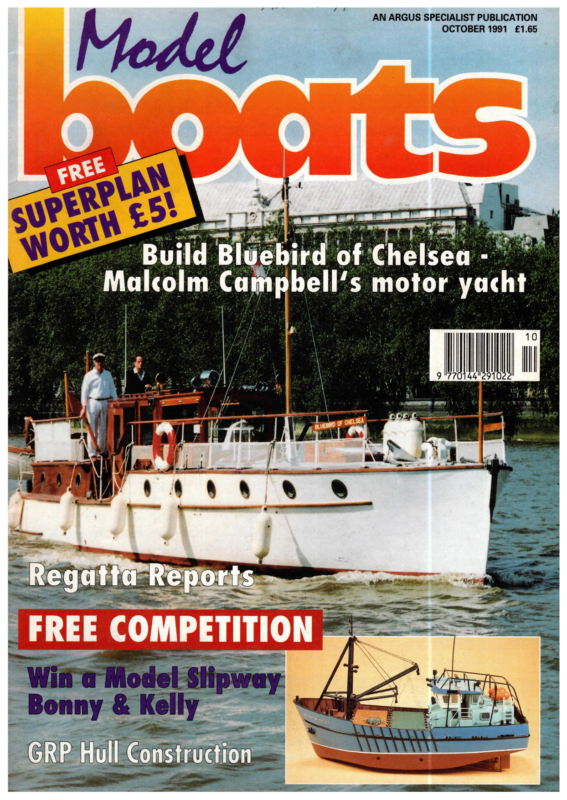
- Match Racing Bill Green at the RM Nats and two R6M meetings
- Sailing to Win Nick Weall’s second series looks at improving your sailing – Part Three

AN ARGUS SPECIALIST PUBLICATION : OCTOBER 1991 £1.65 sired of.aacook bell’s sa Ff bg q VET q eo tw a, ss oA 4 a || i , e a | ner erm 7 7 We : —— ? aye Ly ‘eee Pe oe eer sens| © a e 8 .’ ,
Bill Green at the RM Nats and two R6M meetings Priestly Butler Rose Taylor Priestly Wiseman Simpson Berry Martin Roberts English and EL Bandido the Champion. Windows Windows Marblehead National Fleetwood – May 4/5/6 1991 Bell English Settle back, plump up your pillows and make yourself comfortable,because Tm going to tell you a story about a baker, a bunch of youngsters and a model boat race. Now once upon a time there was a group of Davies Mills Baines Whiteside youngsters who grew upon the Free Sailing circuit, and as they grew they Webster Young matured into very capable sailors. All were potential winners and champions in their Whittaker own right having been instructed in the Bush noble art by their mentors. When they were together they were known as the “Rabble”. The name was not of their choosing, it was bestowed upon them from the “Elders” and it was rightfully earned. Some turned their attentions to the dark side of the hobby, but in time returned to the free sailing fold a little noisier, a lot Vice Dicks Kinder Harris Harris Green wiser and older. The “Rabble” travelled the Bright terror into the hearts, minds and ears of the “Elders” and some carried off trophies. Roberts length and breadth of the land striking They even ventured into Europe and some even travelled further. Word of the “Rabble” spread through the model yachting world and their reputations went before. The “Elders” stood, watched, sailed and kept them in their place until the time was right for them to take their place in the higher echelons of the society. And so it came to pass that the time of the “Rabble” is now nearly passed. The “Elders” looked at the free sailing fleet competitors and shook their heads because there were only a few youngsters to replace the “Rabble”. They feared that the noble art would die a slow and painful death and be totally replaced by the dark side. This air of gloom and despondency prevailed until the baker, who himself had turned to the dark side, began to do 18 Roberts McNulty something about it. The Baker gathered about him a bunch of acolytes and he moulded them in his own ways, boats were built,and he instructed them well into the ways of the free sailor. Their time was just beginning. They trained well on their home waters and soon they were ready to begin their travels into the big wide world of model boat sailing. Their initial foray was to the “A” weekend at Birmingham in late 1991 and they gained a taste for competition. Then came the “M” Team National at Bournville at the start of the 1991 season and they acquitted themselves well at this notoriously difficult venue. And so it came to pass that their time for a major assault on the free sailing scene was upon them. That event is the one that I’m going to tell you about, the “M” National at Fleetwood in 1991. Day 1 – Saturday The day dawned, with 36 competitors drawn up and raring to go. The Race Officer Ian Taylor announced his intention to complete the schedule and the “Elders” groaned, they knew what was required. To complete a free sailing race with a fleet of such size would require complete cooperation from all. They knew that they had to come when they were called, that MODEL BOATS
into use. Martin Roberts consolidated his lead to win his first “M” National, Alex Austin produced his customary late charge to finish second with Nigel Sharpe and Ken Roberts having to sail off for third place, Rob Vice sailed well into 5th place. It was a physically demanding race but a good one. Ian Taylor intended to sail all the heats but in the end was three short, which is very good going indeed and a credit to him and his assistants Simon Redford, Jim Vice and Karl Watkins. Now you may have noticed that I haven’t mentioned the efforts of the massed Fleetwood youngsters and if you look at the results sheet you will see that in scoring terms they finished well down the list. That is deliberate on my behalf, because it was not what they scored that ‘ mattered, it was the way that they sailed that did. The youngsters were dangerous and were quite capable of taking some high level scalps which they did. There Paul Whiteside (r), one of the Fleetwood Juniors who came a creditable 33rd they would have to leave half drunk cups of tea on the bank and that they would have three long days of hard sailing ahead of them. The wind gods were kind and sent a moderate South Easterly and were generous enough to keep it going for the three days. The rain gods were not so certain and kept the contenders guessing. The sun god did not play at all. A South Easterly wind at Fleetwood means a long leg fixed vane beat and a Sharpe and Rob Vice coming into the frame. It was all very close and all was to sail for on the last day. Day 3 – Monday Thankfully it started off light with most competitors in “A” but as on the previous day it soon piped up and most were in “C” suit. The wind started off being South Easterly and gradually swung into the West. As the wind swung spinnakers came was no such thing as a “gimme” with this lot. They fought well, but a lack of experience and the all important part of being consistent was running against them. These elements will come in time and they will be tough competitors but they need the experience. My only hope is that they will stick at it and become the “Rabble” of the future because with kids like those around the future for free sailing is good. So what happened to the others; my club mate Martin Kinder sailed his new Dave possible spinnaker run back. Everyone elected for “C” suit and away it went. It went off at a cracking pace and to our absolute amazement it stayed that way. There where no hold ups, the start line was always full, and Ian Taylor was reduced to calling up the next set of starters. Simon Redford had volunteered his services as starter and he carried out his duties superbly. Towards the end of the day the wind lightened and as a consequence most of the fleet changed up into “B” suit, some even went into “A”. There were quite a few resails to be had and these where taken after sailing had stopped. At the end of day 1 Mark Dicks sailing a Mystick was leading with Derek Priestly (The Baker) and Martin Roberts close behind. Day 2 – Sunday Herr Race Officer decided that today was EL Bandido at right and Sarasola beating into the moderate blow on Sunday. came out in sympathy after a little coaxing Potter designed boat very well to end up in 9th place. Graham Butler sailed his Ashanti superbly for 10th place. Chris Harris beat his dad, again. Peter Maskell was well off song finishing in 17th place. Mark Dicks was leading after the first day and well in contention until late on the Sunday when he injured his leg and was in considerable discomfort which had its inevitable affect on his score. Derek Priestly, Bernie McNulty and Dave Rose all sailed consistently to finish in the lower placings. Alan and Simon Bright sailed very well in their first National and with a number of resails increased. The best part of 12 hours of running up and down Fleetwood lake is hard on the soul and on the legs so as you could imagine there wasn’t too much leaping up and down at the Quiz and Fish’n Chips. The day 1 leaders were now being future. Adam Taylor really got his new Scamp going after he got used to it. The results of the other competitions within the main National were Nigel Sharpe won the Model Maker Trophy, the Tots Trophy (ie team of three drawn at random) was won by the team of Ken Roberts, Derek Priestly and Peter Maskell. Bernie McNulty donated two prizes for Juniors which went to Karl English and Allyn Davies. going to be a long one, sailing started on the dot of 9:30 and was not going to finish until well after 8:00pm. The wind gods and blew. Most everyone started in “A” or “B”and were very soon into “C” and before long they would be into C2. The wind had swung to be off the sea and it was now a definite reach in both directions. As is normal in these sorts of conditions there were a few gear breakages but these are part and parcel of vane racing. The proceedings were not held up, just the challenged by Martin Roberts who had overnight lead with Alex Austin, Nigel OCTOBER 1991 competitive boat will be a threat in the Karl English (1) and his mate study form before competing. Karl finished in 28th place. 19
- _ -_ 3 Ss watch Race Serie Name Boat mw Kemp Red Dwart B Corley Jj Day mM. Ewart ~ R Nee p Heys agai Rival Lady Luck White Magic ; Excalibar Bleu Jean . Florentine Cc Chambers ight Vision Nig Green Ww G Williams 43 \100.00% Rennaissance Doveco : Revival ara Revival Dolphin Rennaissance Tern ‘a Rennais Dovecote Dovecote Cotswolds Brentwoo d Dovecote Petrel Tammie if Only vis Tern Revival vival R6m Match Race Series – Race 3. Lee Valley – 19 May The regular crew turned up to this race and experienced the hospitality of the Lee Valley Club which was superb. Ian Taylor organised the racing with his customary R6m National – Windermere – 2= I’m not going to write a lot about this 8/9 June 2= 61.54% A= 40 76.92% Cotswolds ; 40 \ 76.92% 8 8 61 ce 7 \ 53.85 46.15% . ance Bournville Rennaiss Guilford id Rumour Bee be: tight competition, good sportsmanship and good camaraderie. In other words a radio race with a vane atmosphere. Eo a Radio Rumour Wi Petrel Petrel Lee Valley – Results Chelimstord oft Gasp Dovecote Gosport icester si ae ae 6 : 6 5 38.46% 38.46% 5 4 | 30.77% 4 30.77% 3 36% 93,08% 2a event, I’m leaving that for others better skilled to report it except to say that I now second suit all wee end and at one time was marginal whether third suit was A= know why its — Windermere, it blewit 6 7= necessary. This was my first excursion into T= major league fleet racing, it was an some e and I’d like toTheexpress experienc views. The one on thing g that ly personnel views. =9= purely personnel that intrigued me was that the atmospherewas had pervaded the Match Race Series 41= – not present to anywhere near the same Lig 13 44 ——— | degree and yet this was a group of guys whohad sailed together now for the best part of 12 months with hardly a cross word said and sportsmanship of the highest order. One of the competitors summed it up when we spoke on the phone after the event when he said “In match racing you can decide what is going to be your game plan and carry it out. If you win, fine; if you lose, where’s the next competitor. In fleet racing you can’t do that; you can only outline a plan, try and carry it out because sure as eggs is eggs somebody will do words to sailing terminology when he beat Mike Ewart. For a change yours truly had a cracking day and came home with a smile on my face. This Match Race Series is now a hugely enjoyable event, with every thing that a model boat race should = —_—— ——- —— efficiency and he drove the complete fleet on*to complete a whole schedule for 16 boats. The racing was continuous with three pairs on the water at all times. There was no lunch break either, just get up and go. The wind was kind being light to moderate and with very few holes.The racing was tight, as I’ve said before the fleet are now becoming very familiar with one anothers style of sailing. Tactics, which are fundamental part of full size match racing,are now coming more and more into play and as result the racing is very much interesting. Mike Kemp kept his 100% record but had a real battle against Alan Bright. Brian Corley sailed well into second spot. This was a race of many firsts; it was the first time that everyone had a boat, it was the first time that a complete schedule was sailed and John Gale, having joined up with his thumbs, scored his first victory. Johns’ victory was greeted with a huge cheer from the skippers not sailing and now he was in the groove he registered three more. Jack Day added some new How’s about this for a bit of fancy construction on Mark Dick’s radio/vane Boat? A field of 36 competitors and mates. There are 15 youngsters although. 20 MODEL BOATS
ry Pontes are Osition SCORE At R3 1 Rob Vice’s Showtime seemed to enjoy the underwater approach. something completely unpredictable and mess up your game plan, that is incredibly frustrating. ”I’m not saying that everybody behaved like Pit Bull Terriers at a kids Christmas party because they didn’t, but Palmer there where times when it was just a little too fractious for me and as result fleet racing at this level is not an experience Gale that I personally will care to repeat too Clements often. I think this is a case of each to his Knowles Coventry own. Colye r Akers Congratulations Two members of the “Rabble” Dave Potter and Dave Geldard got married, I hasten to add not to each other, but to two lovely ladies, so I’d like to add my best wishes for their futures and to pass on my deepest sympathy to their new wives. MODELBOU IRMMA ’91 will take place on – Friday, Saturday and Sunday -the 27th, 28th and 29th of September 1991 in the Brabanthallen in’s Hertogenbosch, Netherlands. The information provided by companies, co-ordinating organisations and clubs at IRMMA ’91 will be at least as important as the many live demonstration stands in the hall and outdoor areas, where, apart from radiographic and statistic model construction, model railways, steam models, wooden models and miniature cars will be on show. IRMMaA is famous for its friendly and relaxed atmosphere and interesting items and information. IRMMAis instructive for the experts as well as for the beginner. IRMMA promotes model construction in its own, specific way. Argus Specialist Publications, will be exhibiting at |RMMA 91 Dates & opening times: Friday Saturday Sunday Sep. 27 Sep. 28 Sep. 29 13.00-21.00 hours 10.00-18.00 hours 10.00-17.00 hours Admission Adults Dfl. 7.50, Children and Senior Citizens Dfl. 3.50 FA. 7.50 Kinderen en 65+ Fl. 3.50 OCTOBER 1991 RABANTHALLEN Information: Organisation Office tel.: 010 31 55 427 249 ‘‘S-HERTOGENBOSCH 21 ———— eee Volwassenen
Nick Weall’s second series looks at improving your sailing Part Three his is the third article in the intermediate stage of a series that overall will cover radio controlled yacht racing from beginner to expert. At this stage we are looking to improve the performance of the club skipper who has been racing for a year or two and who wants to try to do better within the club. It is of course a direct follow on also for those people who read the first series of articles through 1990 and the early part of 1991. Last month we were reviewing the start of the race – how to establish which end of Above, (24) Javier Aguirre of Spain has a brave attempt to start on port, thwarted as X? appoaches on starboard. Left, Bjorn Nygaard of Norway makesa flying start at the RM Worlds at Fleetwood. Geoff Smale (NZ) has best speed but is low with Peter Gernart of Germany (34) in hot pursuit. the start line to start from and some fairly basic objectives in positioning during the run in to the start. We left the article promising to look more closely at those rules which are most Right, (75) Stanley Goodwin (USA) and oldest in race, finished 44th out of 75; just above (X). important during the pre-start manoeuvres and during the approach to the line. The first thing to realise is that whilst the IYRU Rules only apply to yachts that are intending to race or actually racing, common sense will keep you observing these rules during the period from when you launch your yacht to when the one minute warning of a one minute count- down is given and racing rules apply. Before the one minute warning you in fact are sailing under the International Regulations for Preventing Collisions at Sea or Government Right of Way Rules applicable to the area concerned or even 42 river board authorities rules. Since in fact I doubt if too many of us know what particular set of those rules we would be sailing under in any location, it is a lot easier to simply remember the racing rules and avoid collisions! Before the one minute count-down there is no liability to accept or do penalty turns. Once you have been warned that you are now under racing rules, penalties will have to be accepted and done or protests lodged! All of the racing rules now apply, but we will look at the ones that are relevant at the start. Rules to Start with Rule 36 is obviously in play – “A port tack yacht shall keep clear of a starboard tack yacht”! Rule 37 Same tack Basic Rules – also is extremely relevant. You know this is the rule about windward/leeward etc. Rule 40 is a rule that applies exclusively before the start and thus we need to look at it in great detail. Before we do however there is something most important for you to make a note of. That is penalty turns! For the first time in MODEL BOATS
give a windward yacht room and opportunity to keep clear. Furthermore the leeward yacht shall not luff above a closehauled course, unless the mainmast of the windward yacht is abaft the stem of the DIAGRAM 1 ARTICLE 3 SERIES 2 leeward yacht. Rules 38.2(c), Hailing to stop or prevent a luff.,38,.2(d) Curtailing a luff and 38.2(e) Luffing Rights over Two or More Yachts, also apply.” Those eagle eyed skippers amongst you may have noticed that this rule does not read exactly as rule 40 appears in the IYRU Rules. That is because it has been WIND amended by the 1990-91 supplement, Appendix 16 for the IYRU Rules 1989-92. Appendix 16 is the Model Yacht Racing Rules. In particular it sets out the amendments to the main body of the [YRU Rules required for Model Yacht Racing.. Should you want a copy of this supplement to the 1989-92 ITYRR then send a Cheque for £2.00 made payable to the M.Y.A. to David Hackwood, 10 Grangewood, Coulby Newham, Middlesborough, Cleveland. TS8 ORT. The price includes postage and packing. Do remember to include your address with your request! If you haven’t yet purchased your year book you could buy one of those as well for an extra £1.00! ‘L’ LUFFS ABOVE CLOSEHAULED- SHE BREAKS RULE 42.4(b) ‘W’ SHOULD PROTEST! the TYRU 1989 – 92 racing rules it states under Appendix 3., 1 720 degree turns.,1.1 “A yacht that may have infringed a rule of Part IV may accept an alternative penalty by sailing well clear of all other yachts as Two ex-Martin Mickleburghs boat start to engage in battle – Sorcery comes up leeward of Hemlock. See over. soon as possible after the incident,.and REMAINING clear while she makes two complete 360 degree turns (720 degrees) in the same direction, including two tacks and two gybes. How this rule differs from the previous rule is that two tacks and two gybes need to be executed. It was possible, if on a running course for example, to execute two 360 degree turns and assume the previous course, only completing one gybe! The other major difference and the difference which concerns us at the moment is that you can start to do turns before the start immediately after the incident! It used to be that you had to wait until after the starting gun to be able to start doing the penalty turns! A lot of the racing fraternity still do not realise this extremely important change eighteen months after the rule was changed! Stand up for your rights and remind any Race Officer who thinks otherwise to refer to Appendix 3! The reason why this is so important is of course that if you suffer an incident early on in the pre-start manoeuvres you will have time to complete your penalty turns BEFORE the start of the race!!! The nearer the incident happens to the actual start of the race the tougher the penalty of doing the penalty turns! Of course even OCTOBER 1991 doing the penalty turns early on during the count down may well upset your favourite starting tactic, but at least you ought to be able to keep up with the pack! So remember- incidents before the start, when you are in the wrong – break away to clear water and do your turns immediately. Also remember not to get in the way of other yachts whilst executing your penalty turns! Because if you do, you are automatically in the wrong (read again Appendix 3,1.1 !) and there is no alternative penalty available for infringing a rule under Appendix 3, thus disqualification is the only option open to the race committee or protest committee! Hopefully you will find the above useful information! Back to rule 40 Same Tack – Luffing before clearing the starting line: “Before a yacht clear ahead or a leeward yacht has started and CLEARED the starting line, any luff on her part that causes another yacht to have to alter course to avoid a collision shall be carried out slowly and initially in such a way to Luffing Why do we need another rule covering luffing? After all we have rule 38 Same Tack – Luffing after Clearing the Starting Line! What is different about the two rules other than one applies before the start and one after clearing the starting line? Again within the racing fraternity there is quite a bit of confusion over these two rules, so it as well to be sure in your own mind as to what is what, rather than relying on someone else’s interpretation! The major reason for having two separate rules is that before the start there is no such thing as a proper course! Since 38.2(a) Covers Proper Course Limitations obviously Rule 38 is inoperable before the start! The next consideration is therefore to change the wording Proper Course to simply close-hauled! The prime consideration before the start is however that there are likely to be a lot of yachts milling around the downwind side of the start line sailing to all points of 43
wind. It is a dangerous time and skippers need to have their wits about them. Above all they need to be able to predict other yachts’ courses or to be able to see that yacht’s course change before being able to respond to that change of course! In contrast to Rule 38 where a luff may be as sudden or as violent as the luffing skipper likes, before the start the luff will be slow and gentle and initially in such a way as to allow the windward yacht room and opportunity to keep clear! This rule is much abused. It is especially abused in conjunction with Rule 42.4! Rule 42.4, sometimes known as the anti-barging rule, goes as follows: 42.4 ATA STARTING MARK SURROUNDED BY degrees to the wind. No one could have then accused her of luffing above a closehauled course. The danger then of course is that another yacht may come up under L to leeward and cut her out at the mark! The other popular misconception regarding luffing is that as soon as the gun has gone you can luff as you please. In fact of course you must have cleared the starting line. The next point that very few skippers appreciate is that once you have cleared the starting line a leeward boat may luff a windward boat that has not been forward of the windward boat’s mast abeam of the leeward boats stem as she pleases! Skippers commonly assume that the leeward boat that may be approaching the line on a close-hauled course below you! Unless of course you manage to bear off behind them! Remembering that there are often quite a few boats all approaching the line on starboard, this is often easier said than done. The other alternative might be to simply cross the line and tack to port and round the starboard mark, gybing back to starboard in the pracess. A more dangerous, again, manoeuvre might be to simply cross the line on starboard then bear off and re-cross the line further down in aclear space if possible. If it is not possible you are going to find yourself in all sorts of a mess when the gun goes off! The option to re-round the starboard start mark is favourite, provided there are not too many other yachts milling around the windward side of that mark. Where to be Hemlock starts to feel the pressure. NAVIGABLE WATER. “When approaching the starting line to start until clearing the starting marks after starting, a leeward yacht shall be under no obligation to give any windward yacht room to pass to leeward of a starting mark surrounded by navigable water, including such a mark that is also an obstruction; but after the starting signal, a leeward yacht shall not deprive a windward yacht of room at such a mark by sailing-either: a) to windward of the compass bearing of the course to the next mark, or b) above close- . leeward boat must have been clear ahead of the windward boat before acquiring luffing rights! You can have a lot of fun with that one! We will cover it more carefully when looking at the first windward beat. Now one of the common problems found Diagram 2 is not trying to showa pair of lungs or a pair of anythings! It is trying to show the most popular areas around an unbiased start line in the twenty seconds leading up to the gun. The density of the cross hatching shows the popularity of that particular area and the number of arrows on the lines of approach again try to give you an idea of the popularity of those particular lines of approach. Lines 1, 2 and 8 are all the lines of approach for starboard tack yachts. Line 1 is obviously the most popular with the area around line 2 most likely at club level being occupied by yachts that really would have liked to be around line 1. Line 3 will be very thinly populated if at all, although on occasions can prove to be a good place to be, if approaching the line with good speed and excellent timing. Line A for the port tackers may have two or three boats, hauled. In diagram 1, I show the common problem; the start gun has just this second gone. Leeward yacht L can see Windward yacht W approaching with speed. L, wanting to protect her position and mindful that W has no automatic rights to room, gets over excited in her attempt to ensure that W is not going to get through; she luffs far beyond her ordinary closehauled course! W is slowed down or even put onto the mark! Most times L would get away with this manoeuvre. W has to be extremely quick thinking and be sure that L has luffed beyond a close-hauled course. He has to immediately bring the incident to an observers’ attention. By the time that has happened the incident is over and L has got away with it! In protests concerning rule 40 by the way it must be proven that not only did the leeward yacht infringe the rule but also that the windward yacht MUST have had to alter her course to avoid a collision! The correct way for L to have handled the situation was to have approached the starboard starting mark on a course that allowed her to just miss the mark on a course between forty five and thirty five 4a And Sorcery breaks through! Neither was over at the start but Hemlock, skippered by RCBM hack Mike Kemp, has to keep clear of leeward yacht Sorcery! by keyed up skippers going for the line, is that they get there that little bit too soon! Getting to the pin end of the line with ten seconds to spare is not much of an achievement. In fact it is a positive hindrance. The usual solution is to bear off and reach on starboard down the line. This is a very dangerous solution and one that is not always available to you in any case. The danger is that by reaching down the line as a windward boat you will have to screw up towards the wind to miss any any more and it becomes a dangerous place to be, unless the starting line is exceedingly long! (Remember we have already said that the line is not biased! Approach line B must be about the worst possible place to be, All the yachts on starboard are going to be putting you about to the starboard tack. Tacking losses speed, so why be there in the first place? Line C showsa little used approach line, that can in fact prove to be a winning approach provided that there are not too many back markers approaching the line on lines one or two. If the starboard starting fleet is closely bunched and moving slowly but together across the line, then a boat approaching fast along line C MODEL BOATS
DIAGRAM 2 ARTICLE 3 twelve boat fleet!). If you don’t want to get so involved in SERIES 2 pre-start quick thinking, revert to our original objective of starting at the pin end (starboard in this case) tight to the mark, even if other boats having the same objective mean that we cross the line in that position two or three seconds after the n. In a club race, if you know what you are doing, to be two or three seconds late at the start but in a good commanding position is likely to result in a good position at the first rounding of the windward mark. Let us not loose sight of the fact that that is the real objective: to preferably be in first position as you round the windward mark. If not first, you certainly want to be in the top half of the fleet! This has been so far, a fairly basic look at the start from the points of view of where you want to be before the start and some of the rules that are in play. Since the start is possibly the most important time of the race as regards WIND DIRECTION establishing a good position it is still worth, even at club level, in devoting more thought to starting tactics and strategies. TO -WINDWARD, MARK Strategy The first thing to establish is who the other yacht skippers are that present a threat to your winning the race! Since this is club racing, previous experience ought to have shown you those skippers who habitually beat you. If you are that new to your club the first couple of races in the day’s meeting should enable you to identify the likely candidates. These yachts are then the yachts you need to keep the closest eye on during pre-start manoeuvres. In fact the time has now come to see how you can improve your start at the expense of their start! We need to look at some of the pre-start tactics available to you or any other yacht that cares to employ them. The first thing to acknowledge is that it is very difficult to find a pre-start tactic that will give you an advantage over the entire fleet, other than planning your POPULAR AREAS 20-0 SECONDS BEFORE THE START on port cutting tight across the sterns of the starboard fleet, will firstly get a bit of a lift from the wind deflected by the starboard starting fleet, and will also have the advantage of good boat speed. Good timing is again essential for this type of manoeuvre and you can end up with command over the fleet! It can also be a useful ploy for the slightly late starter as an attempt to gain loose command over the fleet. You will notice in the diagram how the approach lines 1 and 2 tend to bear off and run down the starting line. This shows exactly the sort of course earlycomers to the line like to take if possible. Since lines 2 and 3 are lightly populated you can often get away with it. What you lose without fail though is your position to windward over the fleet. So remember that what you are really aiming to do is to use the approach line near to that of 1, but by actually continuing in a straight line, hit the starting line right on the gun. Your course should be as near to the starboard mark as possible. That is the ideal you are aiming OCTOBER 1991 for. During the minute count down before the start you have to study the entire starting area and racing fleet to see what every other yacht looks like planning to do. You must always have in your mind alternative courses of action to take. Fairly early during the count down you should be able to notice for example the number of yachts that look like starting on starboard and the number of yachts that look like starting on port. By the thirty second stage of the one minute count-down this will become even more obvious. You now only have around fifteen more seconds to finalise your plan of approach and eleven other yachts to take account of. If nine of those boats are around approach line one, consider using approach 2 or three with good speed being built up and maintained as you cross the line. You will have more space to manoeuvre in on these approaches and more freedom to bear off a touch if a trifle early at the line. You must watch out for any port tacker (a maximum of two, if nine yachts are congregating around approach run so well that you hit the line with full speed at the gun with a good position relative to the fleet. If you can do that time after time, you don’t really need to read this! You are most likely winning enough club races in any case. Although I must confess I can think of one skipper who is absolutely excellent at the start, but who then usually proceeds to lose that advantage as the race progresses! He is the exception to the rule I feel. Usually a good start will repay you dividends! However going back to finding other useful little tactics it will perhaps help us if we first simplify matters by looking at a match racing start. Here just two yachts are wheeling around trying to position themselves not just to get a good start, but rather to ensure that the other yacht gets anything but a good start. After all if you can stuff your only other opponent over the line just two seconds before the start, you are likely to enjoy a rather peaceful race way in front of your luckless racing partner! What are the tools of this particular trade? In Command approach line 1. Remember we are ina 45 |
In Command Firstly you have our old favourite, Command over the other yacht, If your yacht is in such a position that the other yacht cannot tack without tacking in your water – you hold command over that vessel! If it tries to break away by gybing, you can gybe or tack back on top of it pronto! The main objective in such battles is that the yacht holding command keeps between the start line and the other yacht, preferably in such a way that allows the engage in combat! I have yet to see this organised in Radio Controlled Match Racing – the result being that if you know milling around the start line all doing manoeuvring to a position of advantage right from the time of launching your yacht! That really is not fair and Race them out in a proper fleet start. what you are doing you can start Officers (other than the six metre brigade who already have discovered Appendix 4b) should give this matter some serious thought. They should without exception refer to appendix 4B Match Racing Rules as contained in the 1990-91 supplement and in particular rule 3,1 “At her preparatory signal a yacht shall be outside her assigned end of the starting line.” Rule 3.2 goes on to state, “Within the twominute period following her preparatory signal a yacht shall cross and clear the starting line from the course side to the pre-start side”! If you have never tried match racing, do have a go with a friend. Practise lots of starts, that way you will learn yourself some of the tricks I’ve suggested above. You may well find others too! Rule 36 of course is going to have a part to play as yachts approach each other to A few seconds before the start. yacht in command to lay the start but not the covered yacht! Ho ho! In fact you can push the other yacht all over the lake miles away from the start line as long as you remain in between the covered yacht and the start line. Thus as eventually both yachts tack or gybe round to re-approach the line the yacht in command becomes well in front of the oppressed yacht! There are of course counter measures to be employed against the yacht dreaming of holding command. The yacht to leeward lock into combat. The yacht on starboard ought to be able to force the port tack yacht to go where it wishes or at least to alternative courses that are predictable and alternative tactics prepared to attempt to assume command. The new series of articles by Bill Green their own thing! Once you have got the hang of one or two of the tactics previously mentioned try If the day’s contest for the overall winner is between yourself and one other yacht, then it is fairly easy to attempt to cover that one yacht. If you do your racing in a closely competitive club, you may well find that there are several yachts to worry about. In that case you would probably do far better just by concentrating on getting a good start, rather than finding nasty little things to do to your competitors. Avoid Conflict In fact conflict on the line should not be entered lightly, because you stand to loose a certain amount of positional advantage as well as your chosen target. The one thing you should avoid at all costs is getting tangled up with another yacht at the start, even if you are in the right. I have written this before; it is a waste of time being the right of way yacht tangled up with some unfortunate that was crossing your bows on port. Go under the port tacker’s stern, if necessary calling for water to miss an obstruction, then immediately protest the port tacker for causing you to alter course to avoid a collision. Do be careful when altering course to miss any yacht on a port tack, can attempt to sail a higher close-hauled course to windward than the yacht attempting the cover, forcing the covering yacht to tack away or face loosing all forward motion! Once the covering yacht tacks away you continue for a second or two before tacking to attempt to take cover over her! Another little trick, that rarely works in match racing, but certainly does in fleet starting, is to come up from leeward underneath the windward yacht just before the start and on the line to force the windward yacht over the line just before the gun or at least to head her so far up Will (97) Phil Playle lay the mark? Who has the best position? Who has the best speed? speed. in Model Boats every other month hopefully will throw more light on the tactics employed by the six metre skippers, into wind that she loses all of her boat An even better tactic is to be leeward yacht approaching the line near to either starting mark on such a course that allows you to sail a close-hauled course that puts the windward yacht straight into the nearby starting mark. A tactic that is rarely used in match racing that has great potential is to deliberately, as leeward yacht, push both yourself and the windward yacht over the line just before the gun! You should then be able to bear off and get back to the right side of the line and re-start before the windward yacht can! As you begin to think these tactics out, you will see that match racing pre-start tactics call for close manoeuvring by both yachts. You will see them wheeling around each other like a pair of vultures. In match racing proper at the commencement of the count down the yachts should be at opposite ends of the start line and only then be allowed to approach each other to 46 a class that is rapidly gaining new members almost by the day. It strikes me that now Model Boats must surely offer the most comprehensive coverage of all aspects of Model Yachting from Russell’s excellent vintage column to Bill’s coverage of vane and radio. Mike Kemp in our sister magazine Radio Control Boat Modeller puts the cream on the cake with his coverage of the Radio Controlled Racing scene. Try Match Racing Starts Please excuse that little interlude and now back to the starting manoeuvres. The reason for trying some match racing style of starts is so as you can concentrate on the pre-start manoeuvres with only one other boat. Rather than having to endure the added pressures of lots of other boats however if by your altering course you cause the port tacker to hit you! (Rule 35 applies). Mentioning rule 35 reminds me that rule 35(b)(i) applies specifically at the start, so we had better just refer a minute to the whole rule. Rule 35 Limitations on Altering Course When one yacht is required to keep clear of another, the right of way yacht shall not alter course so as to prevent the other yacht from keeping clear, or so as to obstruct her whilst she is keeping clear,except: (a) to the extent permitted by rule 38.1, Luffing Rights, and (b) when assuming a proper course either (i) to start, unless subject to rule 40, Same Tack, Luffing before clearing the starting line, or to the second part of rule 44.1(b) Returning to Start., or (ii) When rounding a mark. What rule 35(b)(i) is really saying is that before the start there is no proper course for a yacht to sail, other than the fact that as one gets progressively nearer to the MODEL BOATS
area around a yacht sailing belowa closehauled course should not be surprised when that yacht quickly changes course to a close-hauled course, provided it is not luffing up a close quartered windward yacht! (In which case rule 40 applies! (Luffing slowly and allowing the windward yacht room and opportunity to keep clear!) Thus a port tack yacht attempting to cross the bows of a starboard reaching yacht three seconds before the gun should not be DIAGRAM 3 ARTICLE 3 (This in itself raises another interesting point – Rule 39 only applies after the start! Before the start there is no proper course to sail below!) As a clear ahead yacht this manoeuvre is quite legitimate. The yacht clear astern has that little bit extra speed and manages to get its bow to the leeward side of the other yacht’s stern. Now the yacht that was clear ahead swings quickly up to a close hauled course towards the line not anticipate, including the abrupt alteration of course to head for the line. B is in error by not keeping sufficiently clear to fulfil her obligation under rule 37.2! Diagram 3 sets out the sequence of events. The last fairly basic things to consider at the start are if you hit a starting mark you do of course have penalty turns to do under 52.2(a) for infringing rule 52.1(a)(i). You may execute your penalty turns immediately having sailed clear of the SERIES 2 WIND A & B BOTH ON STARBOARD. WHO IS AT FAULT? WHICH RULE APPLIES? (SEE MAIN TEXT FOR ANSWER). STARTING LINE [ST = 2o CONTACTH A PROTESTS B! B PROTESTS A! Well, Phil laid this mark! (91) Graham Bantock tacks to port to cover the fleet. No doubt Phil and (33) Chris Dicks will soon follow. surprised to find the starboard tack yacht swing round and up to a close hauled course. (The result of which is to lengthen considerable the time taken by the port tacker to cross the starboard tack yacht’s bows – to such a degree that collision is inevitable, unless the starboard tacker bears off again. The starboard tacker in these circumstances could successfully protest the port tacker!) Another situation where this rule comes into play is where two yachts on starboard are reaching towards the line, one just astern of the other. The leading yacht bears off a little more to prevent the yacht clear astern gaining an overlap to leeward. OCTOBER 1991 because only a second or two remains before the gun. Her stern port quarter hits the slightly overlapping leeward boat. Who is at fault? ILYRU 86 covers exactly this situation. This was an appeal heard by the USYRU- the answer was – “Before the starting signal there is no proper course, and the leading boat A, so long as she holds right of way by staying clear ahead, is free to manoeuvre as she wishes to protect her position and to give herself a good start. Bearing away to prevent an overlap is consistent with that tactic. B as boat clear astern, on the other hand, is burdened throughout as a yacht clear astern, and A is doing nothing that B could fleet. So again depending upon how near to the gun you are when you hit the mark the severity of the penalty is either terrible or not so bad. The other thing is returning to the start after having made a premature start! Rule 44 covers this. The major point is that once it is obvious that you are ona course set to return to the start you loose ALL RIGHTS. That is to say you MUST keep clear of all racing yachts regardless of the tack you or they are on!!! For the odd person who likes to start from the wrong side of the line, if the sailing instructions allow it, then bear well in mind that the onus is firmly on you to keep well clear of all yachts that are starting on the correct side of the line until you are on the correct side of the line, and remember that whilst you then regain rights over any other yacht that is starting correctly you will STILL give that yacht ample room and opportunity to keep clear. The operative word is AMPLE! You would find it very difficult in most circumstances that resulted in an incident from such a situation to convince the protest committee that you had in fact given ample opportunity! 47
Russell Potts, mainly vintage ince I last wrote there have been two vintage days, at Poole and at Dovercourt. Each attracted a relatively small number of members, but a large number of boats. At Poole, the attendance sheet showed twelve names, which was probably rather less than the number actually attending, because the periodic heavy thunderstorms led to the clipboard being hidden away for much of the time and some of those who were sailing earlier in the day may have sloped off while my back was turned. These twelve members and guests had brought 28 boats between them, ranging from a Saxon, an early Dick Priest A boat converted to radio, through Mick Chelmick’s Chilli Pepper, a very nice radio example of the Alexander 6-m Glen Rosa that Bob Underwood now supplies in short kit form and a couple or three M’s, down to Gaff cutter Otterford. number of photos I was able to take and I’m afraid that not all of the boats were recorded. Of those that did make the frame, I show a couple of smallish models owned by a non member. The gaff cutter is about 30 inches hull length and seems to be a model of a fishing boat type, rather than a model yacht as such. Despite the scalish origin of the design, there are no concessions to scale appearance in the fittings and rigging, except for the retention of loose footed and overlapping headsails. The rudder moves but is not under any sort of automatic control; you can only choose one position before setting the boat off. a large number of small models of various kinds. The intermittent heavy rain was discouraging and had the effect of killing the wind for much of the day, so it was difficult to sustain any organised activity. Towards the end of the day, we did manage to get a sort of radio controlled race organised for the four or five radio boats that were still there and thus were able to award one of the small plaques that the Poole club had very kindly providedefor the occasion. Another was awarded to Vince Collins for the condition and performance of his 1936 schooner to a % 56 Left, Vince Collins’% scale Prospero, winner of the award for the best tuned out boat at Poole. size Prospero design. Vince built the boat as a free sailing model all that time ago, when he can’t have been more than knee high, and though she is now refurbished and fitted with radio, she retains much of the character of the original. As will be seen from the photo, the keel depth is rather greater than the proportional scaling from the full size version would give and the rudder has been enlarged and deepened to make her more manoeuvrable. The bad weather also reduced the Otterford, and Bermuda sloop Voyager, two different approaches to the semi-scale scene. The companion bermuda rigged boat goes the other way in reproducing lots of scale detail in the deck layout and cabin a severely practical rig top, but retaining using a boomed, self tacking headsail. The pair were very well finished with new fittings from WEB Engineering and sailed nicely in the light wind. An even smaller boat that I had taken MODEL BOATS
hull in Bermondsey market. The hull, though carefully built, did not appear to ever have had any fittings put on to it, so probably it was an uncompleted project. The rig is not original and not really appropriate as it is a groovy mast and panelled mylar sails intended for another project and fitted to the new hull to see how she went. The hull is well built and finished and to a design that I don’t so far recognise. There are relatively few chine M designs and all those that I have in my collection differ in varying ways from this boat. The general style of the hull and fin Bow view of Voyager. with me was Vitesse, a 24 inch home designed and built model dating from just after the war. I had it to refit and install radio for a client whose father had built it for him in 1945 and who now wanted to pass it on to his son. Grandfather had made a good job of the design which, as you can see from the photos, is extremely elegant. Even in this small size it bears a quickly puts her gunwhale under at quite small angles of heel. I found at Poole that sailing her at the leeward end of the lake, where there was a fair amount of residual popple, was not a very clever idea as the waves washed well up the side of the coaming round the hatch. I had hoped that making the radio installation a good plug fit in the hatch would be adequate to keep the water out, but this proved not to be the case; in future she will have to have the coaming joint covered with sticky tape to make sure that water doesn’t get in. For the same reason, the radio gear is enclosed in a plastic bag, and the battery pack inside another. With very small models of this type it really is essential to protect the radio and electrics properly, as you will almost certainly find water getting in if you sail the boat seriously. Vintage Day at Dovercourt, 14th July Unlike Poole, and unlike last year at Dovercourt, the weather could hardly have been more suitable; clear skies, sunny, warm and a sufficient but not excessive Vitesse, 24in toy fitted with R/C. visible resemblance to the Big Class yachts that were the pride of Solent racing in the 1920’s and 30’s. This is not so surprising, as he lived in Gosport and worked at the Admiralty Experimental Establishment at Haslar. The model has the distinction of being almost certainly the smallest design breeze that enabled everyone to sail all day with no difficulty or discomfort, apart from sunburn for those of us foolish enough to absent mindedly put our silly hats in the back of someone else’s car and forget where we had left them. Stern view of Vitesse. suggest that she dates from the late fifties, but there are no published single chine designs from that timescale, and very few from any period that combine a chine hull of any type with a pre bulb style of fin. Pending further information, she looks as though she may be a one off “own design and build” by a now unknown skipper. She looks good and sailed as well as could be expected for a first time out with a lash up rig. That is quite well to windward, but with rather more difficulty going down hill. ever to be tank tested in the AEL tank. Despite her bow to Big Class style in her hull form, Vitesse is an entirely practical model yacht in terms of her rig style and proportions. The sail area is a fairly modest 200 square inches. Similarly, the steering gear was originally a very small scale version of Braine gear, which suggests that the builder was also familiar with the sort of sailing that went on the Gosport lake as*well as with Solent practice. ; The only slight criticism of the model I would make is that the hull was insufficiently hollowed out and she is heavy, with too much of her 2.5 pound displacement in the structure, so that nearly all of the counter is in the water. retaining a four pack of AA cells, the radio weight is 7 ounces adding 17% to the total There was a small attendance of old faithfuls and a couple of new members for whom this was the first outing to a vintage day. Most of the boats were also old faithfuls, so I shall concentrate on what sits very deep in the water and very which he had recently bought as a bare This is compounded when the radio gear is added. Even using miniature servos, but displacement. The net result is that she OCTOBER 1991 was new. Richard Howlett had a vane M Richard Howlett prepares his latest project , a 1950’s M. In foreground is an RA to Littlejohn’s Arabesque design. One of the new members, Philip Large, had a 36R, Salique, which had just been through Richard Howlett’s workshop for a thorough restoration. Originally built in the 1930’s, this boat came into Philip’s 57
family when he was a lad and is now nominally in the charge of his sons, but father was getting so much fun from sailing her that I wonder whether they will get much of a look in until they are a bit bigger and more able to stand up for themselves. Again this was really her first time out apart from a rather disastrous outing in a full gale at Norwich when some of the gear carried away and she was in any case grossly overcanvassed in her top suit. When more properly suited to the weather she proved a tractable boat to sail and spent most of the day on the water. A Major Restoration Project As a slight digression from Dovercourt, I include a couple of shots of a boat on its way into Richard’s workshop. It is a 10rater, probably dating from the late 20’s or early 30’s and is considerably the worse for wear. If it hadn’t been so nice a shape, I think even Richard would have decided against attempting a restoration, as there In the distance, Richard’s M shows her paces. Foreground is author’s 1937 M Sagitta. Frances Burn, VG’s youngest member, prepares to launch Speedy. 10 pence sweepstake. The effect was electrifying, with everyone suddenly trying much harder. The winner turned out to be Mike Burn sailing Dolphin, an Edwardian model that may be intended as a 5-rater, e A 1960’s M, almost certainly to a Stan Witty design. is very clearly a great deal of work to be done to patch the disintegrating bread and butter hull together again. One of the reasons that Richard wants to put her back together, apart from the challenge itself, is that she is very finely built and has clearly been intended to be a competitive boat in her time. Had she been more heavily constructed it’s likely that he disaster that ripped the fin and skeg out of her would not have been so damaging. Peter Kelly was sailing his radio 10-r I Wonder, which we had seen before, and a vane M which he had picked up in the course of the Vintage Day at Bournville in April. This is a sixties boat and looks like one of Stan Witty’s designs, but as yet I haven’t sorted out which one. He showed himself extremely competent with the vane when it came to competition time and one of the interesting aspects of the day was the competition that developed. With a large number of free sailing boats of various sizes engaged, it started off as pairs of boats challenging each other to races over the length of the pond and gradually developed into a series of 58 A 1930’s 10-rater in need of lots of tender loving care. 1930’s 36R Salique, newly restored. massed start races with up to eight boats engaged in there and back races along the length of the pond. This was all fairly lighthearted until somebody suggested a though a rather untypical one. Anyway she is relatively small and a good deal smaller than most of the other boats involved. It just goes to show that in this free sailing competition it’s the ability to get the boat to go where you intend as much as sheer boat speed that pays off. At the present stage of sailing skill among VG members, there seems no point in introducing any form of handicapping MODEL BOATS
many more on the way. They have had some very successful race meetings on their small pond at Woodbridge and are intending to go in force to Southwold when the short season there comes round in August. These models are simplicity itself and are manufactured from extremely low tech materials: they can be produced complete and ready to sail for under 40, which must be a bargain these days. There is no radio, no steering gear, nothing except the hull and two lug sails, each with a bowsie sheet adjustment. If you want to go mad you can lash out and have two suits of sails of different sizes, but otherwise there is nothing extra to spend. They are small enough to carry in a car full rigged and you can take them on a bus or train with Ralph Smith’s Lady Betty, A design from the late 1940’s by Bernard Reeves with added scale by Ralph. based on the size of boat. A personal handicapping system penalising those who have wona race in the course of the day might be more appropriate at the moment . We also had another go at the straight running competition that we tried with advise those who had built an XPDNC and found it uncompetitive with later designs that they should increase the ballast to give a 39 inch water-line rather than the intended 36 and reduce the sail area to suit. The Broads OD is a very nice looking boat on the water and a good solution to the continuing demand for a boat that will some success at Bournville, only to find that over a slightly larger course and with rather more wind, it was really not a practical proposition at all. Whether sailed no embarrassment at all apart from the funny looks that grown men always get when they take their toys into public places. They are fast and sail straight despite having no rudder; with a bit of skill they can be made to beat, reach and run and will give endless hours of pleasure. Back to Bournville Finally some photos of activity at Bournville in April that have just reached me from Roger Turner, another of the VG members. They are rather better and crisper than I seem to manage to snatch in between all the other things I try to do at Vintage days and show two aspects of on Braine, vane or fixed rudder all the boats tend to steer themselves relative to the wind and thus do not follow a straight what went on at that meeting that I didn’t happen to point the machine at. Two are of Mick Harris hard at work sorting out the Braine gears round the pond, a labour of course from the start to where you point them. In the slightly gusty and variable wind conditions that we had, only one or two boats ever managed to get anywhere on the target. It was moderately amusing for a while, but not something to be love that kept him busy for most of the afternoon. The third is of the straight running competition; Paul Croxson’s 1934 10-rater Victoria scoring an outer in an repeated except on very short courses . almost flat calm. From our experience at Dovercourt, it may be that it is only in Keep it Simple: Two new One Designs such conditions that a competition of this sort is practical for free sailing boats. Among the boats that turned up at Contact Addresses – MYA Matters: Ian Taylor, 115 Mayfield Avenue, London N12 9HY. Tel: 081 446 1625. Vintage Group, Dovercourt was an example of the relatively new Broads One Design, developed within that club as an Old Boat Queries, Curved Air Press: Russell Potts, 8 Sherard Road, London SE9 6EP. Tel: 081 850 6805. alternative to an arms race with radio Marbleheads. There are four so far and more on the way. The idea, as with all one design classes, is to keep all the boats the same and make the skill of the skipper the major element in the result of racing. The outcome is particularly interesting to historians of model yachting, as the modern rig of 1000 square inches and the typical radio style spade rudder are grafted onto a canoe body designed nearly Mick Harris’s Victoria at Bournville. 90 years ago by Bill Daniels. It is in fact his 10-r XPDNC, a classic design if ever there was one. That so old a design should be chosen as a basis for a modern club project is a tribute to the quality of Daniels’ concept and even more to his ability to design something that has instant eye appeal. The fin and bulb are something of a compromise between modern requirements in the way of depth and Edwardian style in the long fin root under the body and the way the curve is faired into the body form. I didn’t check the displacement, but it will almost certainly be heavier than the 16 pounds of Bill’s original design. In later life after his experience of how the 10-r class had developed, Bill used to not be outclassed within a season. Also on view at Dovercourt, but not unfortunately caught by my camera, was an even simpler alternative to the modern radio boat which has been adopted ona broad scale by the Woodbridge club. You may recall that a couple of years ago I wrote about the beach yawl models that are sailed each year in the Southwold Regattas and about Black Joke, 27 inch example that was built in the 1920’s, which I borrowed from its eighty year old owner. The Woodbridge club have gone one better and taken a mould off the original boat. From this they have produced over a dozen modern examples and there are Mick casts a watchful eye over Victoria as she haeds off down the course. OCTOBER 1991 59