- Adagia, A well-balanced, carefully thought out design to the new ‘R’ Class rule, the first of this class to be published By H. E. Andrews
- 1964 German A-Class Championships
- Note for the Novice Model Yachtsman A. Wilcock describes the basic types of vane gear and what they will do

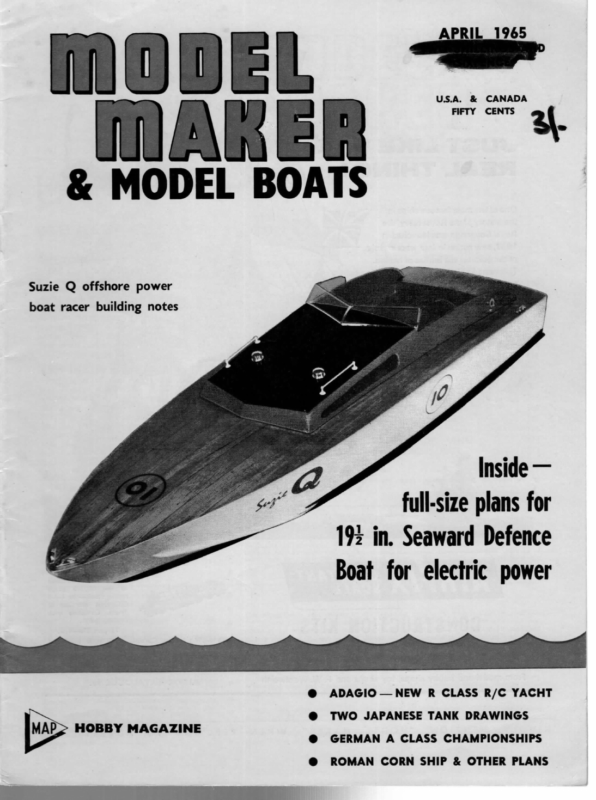
=a i (0) i) E J U.S.A. & FIFTY CANADA CENTS & MODEL BOATS Suzie Q offshore power boat racer building notes Inside — full-size plans for 19 in. Seaward Defence Boat for electric power ¥ ADAGIO — NEW R CLASS R/C YACHT TWO JAPANESE TANK DRAWINGS GERMAN A CLASS CHAMPIONSHIPS ROMAN CORN SHIP & OTHER PLANS
Udagi A well-balanced, carefully thought out design to the new ‘R’ Class rule, the first of this By Adagio is class H. E. available to be published Andrews as a half full-size lines drawing, plan MM821, price 7/- inc. post, from Model Maker Plans Service. S already announced in the January 1965 issue of Model Maker, the Model Yachting Association at its A.G.M. in November last recognised a medium sized Class of yachts for radio control racing. While the Rule was originally drafted to accommodate existing boats in the medium sized Classes now converted to radio control, it was hoped that a new Rule would stimulate new designs and, in consequence, new construction. The yacht here offered is confidently expected to produce this result in new building, and, by example, in new designs. In accordance with the well-proved precept that a good “big-un” will always beat a good “little-un” I have drawn this boat as long as the Rule allows and as heavy as it allows, leaving but a small allowance to account for possible variations in building weights ESTMATED and/or weight of the radio equipment. At the same time I have opted for nearly minimum beam on the waterline, obtaining the necessary displacement by a fairly deep section. This, by cutting wetted surface friction, will ensure a good light weather performance. To cope with heavier conditions she has been given more freeboard than is usual in this sized craft so that there is plenty of reserve buoyancy and little chance of disturbed waterflow lines over-running the loo’ard deck edge. In this design I have continued the general type of hull which has proved successful in earlier designs but have worked in a better degree of balance than is necessary or desirable in a vane-steered boat in the belief that when sailing to windward an R/C yacht should be helmed as little as possible, except when Co OF RAO B MOTORS CG BATTERIES ae alata -— ie ——S ee bee =e ee Ge eas ri ——— l wt EL 4 : as rit bn we = a thos cual onl tesieio ae — 2 aes = po es es aa me ee PE ae ijeng a 144 Ee aa
7 WW a —— ~Y amidships. I have drawn the boat with the overhangs dictated by modern concepts of what is needed in short-ended boats, so that she obtains the maximum heeled sailing length within the limits of her overall length. The rudder is on the large side compared with the normal “fin and skeg” boats and this, coupled with her moderate length of fin, should make her very i LWL manoeuvrable. While the Rule allows a rig of unlimited height it is thought desirable that for all-round performance a moderate aspect-ratio rig is best and thus a ratio of 34-1 has been chosen. Even with a mainsail of these proportions a firm kicking strap assembly should be fitted so as to avoid excessive mainsail twist. The mast and booms should be as light as is consistent with strength and as far as the mast is concerned it is recommended that one of the commercial tapered dural spars of 8 in. heel dia. should be used. The design calls for one pair of stays to the hounds and this should be adequate to hold such a LA L.O.A.: 65 in. L.W.L.: 49 in. Beam on I.w.|.: 10.6 in. Draught : 1965 tacking or manoeuvring. She should be so tuned that she sails a true course to windward with the helm \ SSE 4 eo ee Ae: / WAV Ce (as eats | APRIL mast rigid in the boat. 11.75 in. As the yacht is of normal shape any of the usual methods of building can be employed. FRP is also suitable as the hull has no tumblehome, but whatever method is used care must be taken not to exceed the stated schedule of weights. A 60 per cent ballast ratio has been worked into this boat to ensure good performance and any sacrifice of lead to make up for an excessive weight elsewhere is bound to affect Disp.: 29 Ib. her performance. actual Readers Write DEAR SIR, I was interested in Mr. Stollery’s remarks on the problems confronting the designer of a Marblehead Class yacht. May I suggest there is a line of development which may well help to overcome the problems inherent in a boat having a 50 in. L.W.L. with no overhangs, Mr, Peter Milne’s Fireball design appears to incorporate characteristics which would ‘fit the bill’. The following is an extract from the 1965 Yachting World Annual: “As the blunt skimming bow can, if used in conjunction with effective centreboards, be made to go well to windward it is an undoubted llround benefit for its virtues downwind are self-evident. It is a much safer bow form for waves and high winds. With much greater its great buoyancy it directional NORMAL by Mr. Milne. However, the positive advantages described can hardly be ignored when one is trying to pro- duce a boat which will go well to exceptional have yet windward planing performance down wind. The Fireball type of boat uses the ‘wave flattening’ principle. Rather than slicing through waves, it tends start some distance apart, they will much of the effect of a longer boat”’. A modern dinghy is obviously designed to be ‘sat out’ and a conversion to a keelboat is not always successful—this was pointed out to me in the S | HULL EFFECTIVE WATERLINE to flatten and then slide over them. The bow is full and flat with a large reserve of buoyancy to _ prevent diving. It incorporates a novel hull form using a sharply raked forward pram bow and a completely flat floor to the sections throughout the length of the hull. Basically it approximates a normal hard chine hull which has been split down the centre and then reformed by a flat strake between the two halves. stability. diverge at a smaller angle and have shown boat. will not bury and broach. It will run waves like a surfboard. It will give The foredeck becomes a_ securer, safer place for the spinnaker handlers and it is easier to build. ‘Finally, because the waterlines waterlines as diagram giving the effect of a longer (b) fa) Fig. (a) shows a normal hard chine hull and (b) shows the Fireball. The result is that the hull becomes an efficient planing hull when sailed upright and also produces a long planing surface to leeward when heeled to about 12 deg. Furthermore, the effective water- and aft of the lines extend for’d 145 MT i} mn The extra chine has an added advantage when sailing to windward as the leeward chine acts as a highly raked cutwater without altering the lifting characteristics of the bow. I have experimented with this set up on three boats, the last being a Marblehead which has yet to be tried. The 36 in. Plane Jane (to be described next month—Ed.) has proved to be very effective, and has been deliberately tested in full gale conditions, the result being spectacular! F. G. DRAPER. Hayes.
“ill 1964 German A-Class Championships British boats dominated this International meeting, reported (with apology for delay ) by D. Dewhurst HE 1964 German A-Class Model Yacht Championship was held from October 3rd to 7th, and as in previous years the venue was Hamburg and the sailing water the Alster. Picture sailing Below: aboye Klaus embarking the shows dinghies author for a using scene the Pollahn the carrying a the can trimming pontoon. out on lake jetty. be his boat Opposite check on One of in the seen on page: the the jetty Norman ‘Highlander’ full-size background, on prior Fish the to and 5 ft. wide pontoon. 162 The Alster is a large lake in the centre of Hamburg supporting a large population of yachts and dinghies and a fleet of water buses. These tend to intrude upon the course from time to time and_provide interesting interludes not normally met with in home sailing. The sailing area is in the form of a rectangle marked out with buoys, about 300 yards long by 100 yards wide. Wooden pontoons, moored at each end of the course, serve as a trimming and starting point. Boats and personnel are based at a lakeside boathouse which provides excellent refreshment of both the solid and liquid varieties. Each racing pair is ferried out to the first pontoon where the boats are trimmed and started in the normal manner. Skippers and mates then jump into small escort launches and chase off round the edge of the course. When a boat comes to the ‘bank’ (marked by the line of buoys) she is turned off by hand (or pole if desired) or stopped and retrimmed in the normal manner, from the escort boat. After crossing the finishing line the boats are retrieved and taken to the other pontoon where they are retrimmed for the return board. A racing pair at each pontoon, one or two pairs on the water, and a shuttle service to and from the lakeside allow racing to continue without undue delays. These do occur, however, the most interesting being the passage of a water-bus across the lake, with iis attendant heavy wash. This is even more interesting if you happen to be standing on the 5 ft. wide pontoon, trying to balance your A-boat in a stiff breeze. The fleet of 19 boats representing five countries and seven clubs presented a fairly comprehensive picture of the development of designs over the last 15 years, including as it did boats from Revanche I and Rapture, right up to Moonshine and Top Hat. Racing commenced at 11 o’clock on the Saturday morning with a Force 4 easterly breeze, giving reaching conditions, and a pleasant ‘settling-down’ period. The short reach was maintained over the next two days, with wind strength gradually fading until a flat calm on Monday afternoon forced O.O.D. Fritz Jacobsen to suspend racing for an hour. On Tuesday afternoon, the brilliant sunshine and light conditions gave way to rain with a strengthening wind veering south west to give a true beat and run.
APRIL 1965 ad gee The final day saw the big balloon spinnakers driving well in a brisk Force 5 breeze, and local boat Moonshine sailing home to a well-earned victory. —— =e4 Moonshine, owned and skippered by Klaus Pollahn of the Hamburg club, is the original boat built by Ken Jones of Birkenhead for the 1961 M.Y.A. Cham- pionship at Fleetwood, and was acquired by Klaus in 1963. On this showing, the Hamburg club should offer some healthy competition at Fleetwood in ’65. In second place was the Belgian boat Bingo Cat. She is built of glass fibre in strict conformity to the Highlander design as published in Model Maker. Her owner, builder and skipper, George van Hoorebeke, is keen to point out the saving in hull weight achieved by using glass fibre. In Model Maker, November 1961, Mr. Priest gave 11% lb. for the hull, deck and deck fittings of Highlander. For Bingo Cat the weight is 11.17 lb., the difference in weight being transferred to the keel in the form of additional lead. Mr. van Hoorebeke’s mate, Jan de Schryver, is now building from the same mould as Bingo Cat and hopes to make his debut as a skipper in the M.Y.A. Championships at Fleetwood this year. In third place was Highlander skippered by N. J. Fish of Fleetwood. Considering Mr. Fish’s first acquaintance with the boat was in heat one of this regatta, he must be congratulated on a very creditable performance, particularly as he led the fleet on easily to the light winds and, together with her flexible mast (shades of Dr. Lungstrom?) could account for Revanche’s performance in the light conditions. Apart from the Danish boats, only one other boat used this material—Moonshine, the winner. the first day. Probably the most remarkable aspect of this competition was the emergence of D.22, Revanche, 17 years old, and the oldest boat in the race. Skipper Jessen, a relative newcomer, led the fleet during the periods of light wind, and finished in a well-deserved fifth place. A remarkable performance, but perhaps more significant than remarkable. In common with the other Danish boats, Revanche used American “Dacron” for her sail material. This material is similar in appearance to the British Terylene used for dinghy sails, and is used by 99 per cent of the full-size yachts in Germany. This material bends Name of Yacht Bingo Cat Revanche Delfin Revanche II Rapture Highlander Patricia Konigin Never Mind Swantie Caribee Germania Maja Skorpion Name of Sailer G. van Hoorebeke Fr. Jessen H. Sorenson XK. Ipsen D. Dewhurst N. Fish H. Boussy R. Themar H. Themar K. Kuhl H. Kretschmann W. Kretschmann W. Niesen W. Meyer Detlef Hamburg Luna H. Witzke K. Harsheim U. Tiedemann Imme Moonshine R. Pollahn K. Pollahn RESULTS That modern hull forms have gained superiority over the more classic designs now seems to be accepted in most quarters, but many would still argue that this superiority is only marginal. A glance down the list of sail area, water-line and displacement data reveals that basic dimensions still maintain a remarkable consistency. Perhaps the real scope for new development lies not with hull design, but in the field of sails and rigging. This conjecture has been raised many times in these pages, and the results of this regatta certainly provide food for thought. The 1965 German Championships will be held during Whitsuntide, the venue again being Hamburg. For anyone seeking pre-Fleetwood competition, good company, and something different, this event can be thoroughly recommended. AND DETAILS SA Displacement LWL Nationality 54 ins. 1,546 52 lbs. Belgium Denmark 134.9 cm. 9,823 22.35 kg. 137.2 cm. 10,397 24.38 kg. » 53.16 ins. 1,555 49.5 lbs. As 527 sins. 1,555 47 lbs. England 54.6 ins. 1,519 52 tbs. of 54 ins. 1,559 52 lbs. France 562 sins. 1,503 59.6 Ibs. Germany 55.2 ins. 1,588 60.6 lbs. xs 55.5 ins. 1,570 63.25 lbs. 3 54 ins. 1,546 52 lbs. a 54.55 ins. 1,546 53.3 lbs. Fe — — —_— 5 53 ins. 1,714 604 lbs. af Sn ER < va He 57 ins. 57.44 ins. 54.6 ins. 55 ins. —_— Designer Priest Ipsen Ipsen Ipsen J. Alexander Priest Priest (Highlander) Priest (Saxon) Daniels (Jill 1) A. Hill (Jill 2) Priest (Highlander) Lewis (Mistral) Priest (Highlander) Nissen Naeve 1,564 61.3 lbs. Lewis (Moonshine) K. Jones 1,472 61.6 Ibs. Lewis 1,578 58 Ibs. 1,562 58% Ibs. —oa 163 (Moonshine) Owner es (Saxon Levison Levison (after Daniels) —_— Lewis (Top Hat) W. 64 54 35 60 36 Oe 44 2E 46 "45 50 35 34 35 Pos. 2 5 =15 4 14 3 10 17 8 9 6 =15 16 =15 9 15 22 31 38 3 13 25 30 39 7 21 29 33 43 13 12 11 Sa. Su. Builder 10 25 Owner 10 33 Ipsen 5 20 Ipsen 26 Ipsen 6 10 Owner Levison 1222 6 13 Boussy 9-8 Naeve 6 21 Levison Todt Levison Alexander 8 17 9 15 Owner 6 11 Boussy 9 16 Owner M. 38 41 25 41 14 oe 22 AS. 29 U2) 27 23 21 21 Tu. 54 46 33 54 24 ae 32 £8 44 32° 34 27 28 29 8 19 28 39 48 5 28 40 53 67 x( ak
d bee basic details of the four types of vane will t) es 0 e Or e now be described. It may involve jargon that may not be immediately understood but the terms will become clear in the next section, dealing with sailing with a vane gear. Dimensioned constructional details will follow that. Fig. 11 shows the basic Lassel type gear which is characterised by the fact that the feather, whether the gear is ‘fixed’ or ‘broken’ for self-tack purposes, is carried on the main vane pintle. This means that the same. scale can be used to compare the feather angles in the two conditions. Theoretically the gear cannot be balanced perfectly for both the fixed and broken conditions without altering the position of the counter-balance weight, but the out of balance encountered practically is probably so small as not to be noticeable. When broken lee helm is positive while weather helm is dependent on the weights of the feather and counterweight being on one side of e ovice the vane pintle brought about by the heel of the boat and a _ certain amount of locking action of the pin in the slot of the linkage. If the latter is too pronounced there is a_ prospect ac tsman that the gear will fail to self-tack when the boat is put about. (Something we have already experienced with this type of gear.) Because the weather helm is not positive it is preferable to use this gear with A. Wilcock describes the basic types the sail plan on a balanced hull set for neutral helm on the beating course which is when the gear is likely of vane gear and what they will do to be ‘broken’, i.e., the same sail plan setting as for a Braine gear with possibly a very slight setting back of the mast. Fig. 12 shows a basic Ballantyne gear where the characteristic is the tacking motion being given by two equal sized gears set equidistant about the main vane pintle. This gear is readily balanced in both the ‘fixed’ and ‘broken’ conditions. Like the Lassel it gives positive lee helm when ‘broken’ and weather helm is entirely dependent on the angle of the heel of the boat when beating and the fact that both the feather and the counterweight are on the leeward side of the main pintle in this condition. Because there is no additional locking action of a toggle linkage it pays to have the feather and counterweight on the heavy side with this type of gear and have the mast position set for neutral helm on the beat. Should the mast be back from this position which would demand some weather helm there is a prospect that due to the speed of the boat through the water the pressure on the rudder may take control over the gear with the effect that the boat is driven up into irons when the boat becomes more upright and the gear is even less effective. This gear by its nature gives less trouble in failing to tack when the boat is put about. The Fisher gear, Fig. 13, has a similar configuration to the Ballantyne except that the tack motion is obtained by a pin and slot linkage which is so proportioned that a degree of locking takes place in the ‘broken’ condition. This gear again is easily balanced for the ‘fixed’ and ‘broken’ condition. Because of the slight locking action it is suitable to apply a small amount of weather helm and since this is of some advantage, as will be discussed in the following section, the mast can be set back from the truly neutral position. Observation shows that at the present time there are probably more of this type of gear is use than any other, perhaps because many have been produced commercially and it is also the easiest tacking gear to make for oneself. The fourth type of self-tacking gear — the moving carriage —is illustrated in Fig. 14. It is the most 172
APRIL complicated and probably has too many parts to 1965 ADJUSTABLE PIN 8 SLOT LINKAGE make it a commercial proposition at a price that can be afforded, although it should not be beyond many model yachtsmen with some metal model-making experience. The self-tack motion is controlled by lines from the main boom and therefore is very reliable. As long as there is wind in the mainsail it gives positive weather and lee helm. It is very easily balanced. These are its attractive points. In addition, insofar as guying is ever a reliable or unreliable manoeuvre, its action in this respect is as satisfactory as any. The tacking action is attained by a sun and planet motion of two gears which may be equal or have some other ratio which will be discussed in giving av PIN & SLOF_LINKAGE > ~ ss Fig.13 constructional details later. What does Automatic Steering do for you ? We have now covered general sail trimming and sailing practice, we have also given some brief idea of the various types of steering systems that have been used and in particular, various kinds of Vane gears. It now seems time to ask the question at the head of this section and answer it, particularly as so many people are not conscious of the right answer. The answer so many would give is that it makes the boat go where you trim it, nominally from A to B. This may be the skipper’s hope. The right answer, and one that must really be absorbed, to avoid frequent frustration, is that a yacht with sails and automatic steering correctly set on a straight course will sail at a constant angle to the wind. If the wind is constant in direction, then a fine course should be sailed and the boat should go just where you want it. It is seldom that we have true winds on our model yachting ponds and lakes and therefore the courses sailed will deviate according to the “flukes” in the wind. Very often these show a sufficiently constant pattern that use can be made of them and this all adds to the interest of model yacht racing, although such conditions usually favour the local skippers. Readers of Francis Chichester’s single handed voyages when he has used vane steering will be aware that he records on more than one occasion waking after a “kip” to find he was on his way home again because of a 180 deg. wind shift, and that in mid Atlantic. Racing skippers are also not inexperienced in this phenomenon. We mention this because they supposedly know what they are doing. The less experienced think that their steering gear is not working properly and this is our reason for stressing just what automatic can do for you, and in a sense what it cannot. Braine and self-tacking vane steering gears, besides steering on a defined course relative to the wind (which if the sails are correctly set should give optimum speed and therefore the fastest time from “A” to “B”) are able to do three other things. (1) Guy. (2) Gybe; and (3) Tack by pole or hand without carrying out any adjustments. We see that four new terms have been mentioned and a little explanation would not be out of place. The first is the self-tacking vane. The Lassel, Ballantyne, Fisher and moving carriage gears briefly described in the last issue are all self-tacking. If you look at the steering compass (Fig. 5 in the February issue) you will see that when on a close port tack the vane feather makes an angle of 30 odd degrees to starboard relative to the axis of the boat. When on the starboard tack the feather requires to be at a similar angle, but on the port side. The non-self-tacking gear, Fig. 10, would require | WIND N y rN N, STARBOARD TACK * “ Fig.15 _ I) Fig.17
ODE a TIAWIER this movement of the feather to be carried out manually when the boat came to the bank and you wished to change it on to the opposite tack. Fig. 15 shows two boats in these positions just before coming to the bank and just after leaving. The self-tacking vane gear enables the feather to do this change of approximately 65 deg. automatically as the boat is “tacked” (turned on to the new or opposite tack) by pole or by hand. We thus see that we have not only defined (1) self-tacking gear but also tacking (4). Now for (2) Guying. Guying is the ability to make the boat intentionally change tack when away from the side of the lake. Where this takes place not far from the side from which it has left it is called a “short guy” and when a long way away, frequently nearly the other side of the lake, it is a “long guy”. How these are affected as well as those between will be dealt with later when we discuss the types of vane gears in more detail, but here the purpose of guying will be explained. Guying has two uses, the first is in racing where on the majority of waters it must be considered a vital necessity. Fig. 16 shows a fairly ideally proportioned lake for racing and the course taken by a boat with the wind in the direction shown. From this it will be seen that if a plain tack was made from position “X”, the course followed would be the dotted one to “Y” and then after changing tack once again to “Z”, whereas by quickly setting a short guy at “X” the course would be that of the solid line to “W” over the finishing line after a relatively few yards. If the course had brought the per word for each TRADE: ‘Minimum 18 words subsequent word, per word for each lander vane, Marblehead, sliding fibreglass rig, £16. 27 hull, W.8. BK D Terylene Pentland Road, sails, 2 in. x 8 in. motor, High- accessories. New. Cost £49. Accept £25. A. Lane, Road, High Lane, nr. Stockport. Tel.: Disley 2507. HIP PHOTOGRAPHS. Fine quality post-card 12/- per dozen. Write, with 3d. stamp, J. Mannering, River House, River, DOVER. ODEL MAKERS wanted: April 1962, for April, size and 110 ship Buxton list, September, March 1960; July 1959; February, May, 1958; July, November and December, 1957. G. Hughes, Gardens, Newtownabbey, Antrim, N.I. all pictures. interesting to 1961; January to 65 Armoy OAT KITS: Glass Fibre Hulls; Pre-cut parts; ‘Sunga’ 30 in., £4.19.11d. ‘R.M.2’ 42 in., £7.16.6d. and £8.14.0d. Bare Hull, £4,.14.5d. S.A.E. for illustrated leaflets. RYGLASS MOULDED PRODUCTS, 2 GORTON STREET, WAVERTREE, LIVERPOOL 15. REGLASS Sea Queen, servos, £45. Cartlidge, Didsbury, Manchester 20. Gannet, 3 all Ballbrook accessories, Court, Quadratone, Wilmslow Road, Mee WARSHIPS, 1:1200 scale quality castings by ‘‘Superior’’. 300 different types of various periods including both wars. Send 1/6d. for catalogue to: Mr. J. Holton, 15 Lymington Gardens, Stoneleigh, Surrey. KINDLY MENTION “MODEL MAKER” 3d. channel 3 colourful J. Duramites, Absolutely free for all who Discount Harman, 52 approvals. Earls Court perfect order, Satisfaction Road, £35, as new. London, completely Freeman, DEALER wishes to acquire model outboards and possibly model boats to go with them. Cash waiting for interesting specimens in good order. P. D. Allen, 99 High Street, Dymchurch, Kent. Phone: 2332. Bonnyrigg, countershaft, equally Oe Lines and full details. Sample lathe, 8 my Postage . » overhauled. 2 Unimite servos, £2 each, “The Mynd’’, Cliff Road, Sidmouth, Devon. and price list available from Norman Ough, 98 Charing Cross Road, London, W.C.2. (Temple Bar 3926). 3d. STAMP PLEASE. ILEXISPEED boat back again to course and get the sail back on to its proper side and driving again, i.e., it is a return or correcting gybe. This then is what our gear can do for us, as we shall see when describing the gears in more detail. Having described what the vane steering gear will do we can now turn our attention to how the vane gear works, which we will examine next month. request Midlothian. bE garde WARSHIP DRAWINGS. want our automatic steering gear to do is to turn the guaranteed. Box numbers are permissible, to count as six words when costing the advertisement. When addresses are included, these are chargeable at the same rate (4d, or 8d. per word) as the remainder of the advertisement. Copy and box number replies should be sent to the Classified Advertisement Department, IMMODEL MAKER, 38 Clarendon Road, Watford, Herts. Latest copy date for insertion in the ‘May issue is April 5th. ITCHCRAFT arise with the wind behind the boat, i.e., on the run, with the main boom well out over the side of the boat. If, due to over-steering or a fluke puff of wind, the boom and main sail are blown to the opposite side, it is said to have gybed. Unless the wind was previously dead behind the boat there will be a deviation of course as shown in Fig. 17. What we EE — 50 Gay Stamps of the World. PRIVATE: Minimum 18 words 6/- and 4d, subsequent word. 8d. be more correct to say the facility that the gear gives is the return or correcting gybe. These conditions ESTROYER, 52 in. Carved from solid teak. Stuart centre flue tube boiler. Sun engine. Twin screw. Superstructure American, would alter. Photo S.A.E. Mitchell, Lower Rixdale Farm, Dawlish. CLASSIFIED ADVERTISEMENTS 12/- and boat to “X1” then a longer guy to “W1” would still be better than to “Y1” and “Z1”. The other use of the guy is when sailing alone on a largish water and the wind is fairly straight down the length of it, effective long guys save a lot of walking or running round the water and add considerably to the enjoyment. The long guy also comes to its own in racing where the water is wide such as the Round Pond, Kensington Gardens, London. It is recognised here that when the wind “is down the pond” guying is the quicker way to get to the finishing line than tacking as would be done on a narrower water. Now we come to the third term, Gybing. It would Mr. ANTED TO PURCHASE model of 1939-45 ‘‘M’’ type destroyer about 2 to 3 ft. long. Interested model maker please contact P. B. Arthur, 37 Peter Avenue, Oxted, Surrey. (Oxted 2962). TAMPS. British Colonials. 14 days’ approvals. personal service guaranteed. Ashford, 31a Putney, London, S.W.15. Satsifaction Disraeli and Road, R SALE: 2 unused transistorised Musclemite actuators, each. 1 unused R.E.P. 10 channel relayless Rx, £10. W. Young, 241a High Street, Orpington, Kent. £5 R. nh MODEL YACHTS — Any stage of completion to any design by builder of many winners of Championships. Sails in Terylene also supplied. Arthur Levison, 80 Weydon Hill Road, Farnham, Surrey. XHANGE: Baxter, 1 New Glo-Chief 49, for new Frog 3.49 Court, Southey Road, Brixton, Cadmus R/C Marine. S.W.9. ILECTRIC MOTOR BARGAINS: j h.p. split-phase, 1,440 r.p.m., foot mtg., 240/250 volts, a.c., single-phase, £4. 1/6th h.p. capacitor start and run 1,440 r.p.m., foot mtg., 200/250 volt a.c., single-phase, £3. 1/20th capacitor start and run 2,850 r.p.m., foot mtg., 230/250 volt, a.c., single-phase, £2. 4 h.p. capacitor start, 1,440 r.p.m. foot mtg., 100/110 volt a.c. 50 cycles, £4. } h.p., splitphase, 960 r.p.m., foot mtg., 230/240 volt a.c., £3 Carriage and pkg. 7/6d. extra please. Shaded pole blower motors really robust manufacture, 2,880 r.p.m., 25 watts, 18/6d. As above with gears to reduce to 108 r.p.m., 28/6d. Carriage and pkg. 3/6d. extra please. All these are G.E.C. manufacture and brand new. — HUZLAID ELECTRICAL LTD., 68 Hurst Street, Birmingham 5. Telephone: Midland 3619. WHEN REPLYING TO ADVERTISEMENTS