- More NOTES FOR THE NOVICE MODEL YACHTSMAN by A. Wilcock, Gybing and Another Gear
- MODEL BOATING IN YUGOSLAVIA Peter Burkeljc describes the emerging pattern of boating in his country

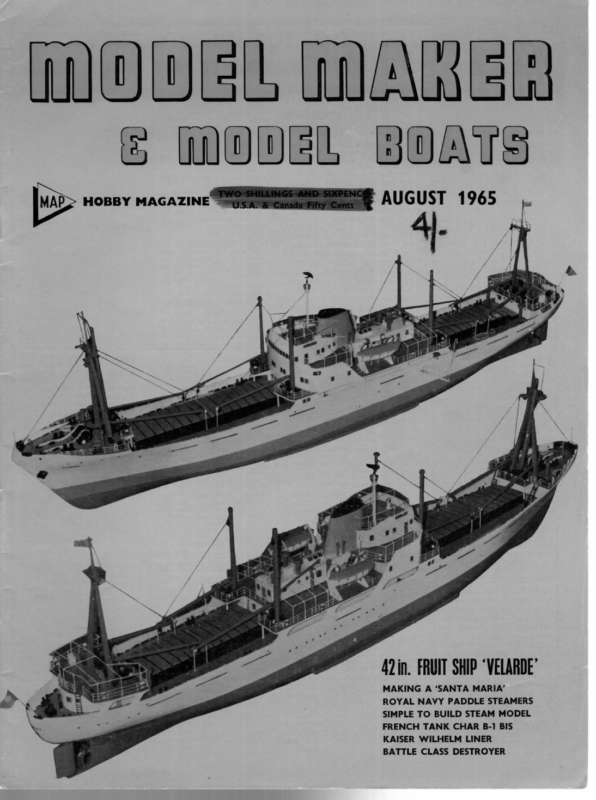
GO ETE} S WMOWEL BOATS HOBBY MAGAZINE EEE AUGUST 1965, at 42 in. FRUIT SHIP ‘VELARDE’ MAKING A ‘SANTA MARIA’ ROYAL NAVY PADDLE STEAMERS SIMPLE TO BUILD STEAM MODEL FRENCH TANK CHAR B-1 BIS KAISER WILHELM LINER BATTLE CLASS DESTROYER
mn STAKE OOGL NOVICE MODEL YACHTSMAN by A. Wilcock. This month, Gybing and Another Gear INCE the opportunity was taken to discuss guying at some length before describing the design principles of the second type of self-tacking gear, so will we digress to Gybing, again for the reason that one arrangement in the author’s opinion can be applied fairly universally. The vane mechanism itself is ineffective to correct a gybe for two reasons. The first is that it has least power on a running course. Reference back to the article on apparent winds shows that the force of the apparent wind is least on a full run, because it is that of the true wind speed less the boat speed. The second and more important is that the feather is in one of two ineffective positions to generate power to W effect a gybe, (a) if a spinnaker is being carried the feather will be very close to the full forward position and there is not likely to be sufficient deviation from course to generate any side pressure on the feather. The second case (b) is perhaps more interesting. It is that when running without a spinnaker, as explained earlier on sail trimming, when the wind comes from abaft the beam the mainsail “shades” the jib and it is necessary to apply weather helm to balance the boat. Again as was explained earlier, to generate a force to operate the rudder against the flow of the water it is necessary to offset the feather to present a face to the apparent wind. Fig. 26a shows the settings of the sails and feather relative to the wind on such a running course before a gybe. Fig. 26b shows the situation when the gybe has taken place in which it is immediately seen that the offset to the feather required on the original course and tack now weakens the power of the feather and leaves the boat sailing nearer a reach on the new tack. In fact for the vane to be at all effective a vane motion similar to the self-tack on the beat would be required, in which with the change of tack there is an appreciable change of the angle of the feather. No doubt this could be engineered but would be a further complication to the gear when there is a much simpler and neater solution which, having shown in what respects the vane fails, we shall now describe. The method recommended by the author and seen to be applied by the majority of racing skippers is really using the gybing “half” of the Braine steering gear and not using the steering “half”. It will have been noted on the various figures of gears so far illustrated that a quadrant on the rudder post has been shown. Fig. 27 shows in plan view the features of the running sheets with the gybing condition. The running sheet is double from the bowsie on the boom to the two sheet hooks. The form the sheet hook the horizontal working pull. Having the sheet double all the way from the bowsie avoids knots negotiating the metal ring on the boom at the point the sheets leave the boom, and sticking just when you are in a hurry. The two halves of the sheet must both be the same length. On the deck forward of the quadrant is the sheet anchor plate—or plates. The alternatives are shown in Fig. 27. A little geometry comes into the placing of this plate or plates. It is as follows: The working sheet, or half if you wish to look at it that way, is hooked into the anchor plate, while the other half is hooked into the quadrant. Now, if the bowsie on the boom is moved to a position so that the boom on the working side (pulling on the working sheet) is at an angle of say 70 deg. to the axis of the boat, then when we move the boom to the opposite side the gybing sheet, being anchored to the quadrant which is further away, will be pulled tight when the boom is only 40 or SO deg. over the gybing action, which as was explained in an earlier article, is a correcting action, starts early and is much more powerful and effective. Nevertheless, if the plates are put too far forward of the quadrant it may be found that the pull remains on the working sheet and is never transferred to the gybing sheet. You must experiment a little with positioning the plates before fixing them, but now you know the angles of the boom to work to it will not be found difficult. The position of the screw eyes or pulleys marked “A” in the drawing are also important. They should be as wide apart as possible, just inside the gunwales, and in such a position that the metal ring on the boom through which the running sheet passes will pass over them as the boom swings across from port to starboard. In turn this ring should be somewhere between half and two thirds the length of the boom from the gooseneck. These features are illustrated in Fig. 27. It may have seemed a long exposition on these proportions but the author is only too aware that while the racing skipper has found these proportions by his experience or from his club mates, the boats of unattached novices display the fixings at all the wrong places, perhaps the most common fault being the placing of the deck eyes or pulleys much too close to the centre line. The above com: ment of course is a good recommendation for the unattached to join a club if there is one near. POINT OF Fig.26 2 COURSE TAKEN, 7 ~~ a ,”% / RETURN. ~ | GYBE GYBE TAKING EFFECT WITH BOOM PARTLY OVER AFTER GYBING GYBE WITHOUT, SHEET takes is illustrated in the inset to the diagram and this shape is used to facilitate changing its position quickly and at the same time give a secure hold to [jy BEFORE GYBE BUT A More NOTES FOR THE
AUGUST Now to finalise and describe the gybing operation in detail. Fig. 27 shows all the adjustments for a run on the starboard tack, in which the working sheet passes through the eye on the starboard side of the deck and thence to the port side hole on the centre anchor plate or the port anchor plate. The gybing sheet passes through the eye on the port side of the deck and thence across the deck and is hooked into the outer hole on the starboard side of the quadrant. With the boom holding the working sheet tight the gybing sheet will be slack. Should the boom go over to starboard in the course of sailing as depicted in 26b, the power of the wind in the wrong side of the sail is transferred to the rudder as a very strong pull on the gybing sheet and the helm given causes the boat to turn sharply.to starboard to a sufficient extent to get the wind once more to the starboard side of the sail and blow the boom over to port. The strain is once more taken by the working sheet and the gybing sheet goes slack. The course followed is illustrated in Fig. 26c, in which it will be seen that, while under the action of the gybe, the course of the boat is much overcorrected to ensure that the boom returns to the right side and the true course is quickly restored under the control of the vane. Clearly if the wind is slightly from the port side all the settings are on the opposite side, a mirror image in fact. Now when do you put these settings on your boat? While on some waters the wind is so true that the local boys never need them, these conditions are the exception rather than the rule. It is therefore advisable to put them on for all courses with the wind within 30 deg. of either side of dead astern whether carrying a spinnaker or not. It should become a habit and if treated in this way it only takes a moment—nothing like so long as reading all these words to explain it! The Ballantyne Self-Tacking Gear Fig. 12 gave a simple impression of this type of gear. Fig. 28 gives an exploded view in much more detail as this gear after 20 years is worthy of detailed description. Mr. Priest’s Highlander gear described in the December 1962 Model Maker is his modern development of the type and is available from the 1965 cies ALTERNATIVE ANCHOR PLATES Model Maker Plans Service. We are here, however, concerned with principles and designs more within the capacity of the novice. The parts must now be becoming familiar. “A” is the rudder post surmounted by the quadrant and slotted tail, ‘“B’ the vane pintle, “C” the tubular stem carrying the main scale and pin arm to engage in the tiller slot. ““D” is the main body; vertically through the centre is a clearance hole to take the tubular stem and a friction hold is obtained with a tapered cotter. On each side of the body is a pintle, one for the vane assembly “E” and the other for the counterweight assembly “F”. The brackets on the front and back are for securing the top plate “G” which prevents the vane and counterweight assemblies being lifted off and the gears disengaging and gives a platform for a small scale to read the tack angle and mounting the locking lever and guying arm. The vane and counterweight assemblies are fairly self explanatory; they both have tubes with conical top bearings which sit on the body side pintles. Care must be taken to ensure that the gear segments are mounted so that with the appropriate teeth engaged the vane and counterweight arms are in line. Similar construction should be used for both so that their weights are the same which enables the weights of the vane and counterweight to be the same for balance. To facilitate making your first gear of this type, use gear wheels of § in. or # in. pitch circle diameter (they must be identical), and make the body side pintles | in. long. The other dimensions are easily worked out from these basic ones. .The two great advantages of the Ballantyne type of gear are (1) the simplicity of balancing the gear by basic construction and (2) the fact that the gears ensure that the angular movement of both the vane and counterweight is the same, which combined with equal weights and spacing of their pintles from the main vane pintle all facilities balancing, and balance. The main disadvantage of this design is that the gear linkage between the vane and counterweight arms gives no locking movement whatsoever when the gear is in the broken condition. As with the Lassel gear “lee” is positive by the wind driving the arm against the stop. To obtain the best performance with the Ballantyne gear the sail plan must have the mast in the balanced position or very slightly forward (see the March M.M.) and the gear tack angle adjusted very close to 30 deg. Careful adjustment of the guying elastic as described for the Lassel gear also helps considerably with the performance of this gear. Sailing on any course, gybing with the gear fixed and guying with it broken will all be clear by following the general details in the earlier articles. Mi
WO WEL IMIANKIE:R} MODEL BOATING IV YUGOSLAVIA |e Peter Burkeljc describes the emerging pattern of boating in his country MOREL boating first started in Yugoslavia immediately after the Second World War when the “Ljudska Technika” (freely, National Technical Society), an organisation taking in all the technical clubs in the country such as the Aero Club, AutoMotor Club, Radio and Photographic Clubs, etc., gave a first large annual donation to the sport. Up to 1959 a small number of enthusiasts built sailing models, but then technical lessons were intro- duced in the schools and marine and aeromodelling aroused lively interest among young people. In 1959, a milestone in Yugosalvia’s boat modelling history. “Mekanotechnika” a technical toy factory in Isola, Yugoslavia, put on the market a series of small electric motors and model boating began to spread. The factory marketed two types of motor at first, 3-6v. inboard and 3-6v. outboard motors. Prices were low, and the motors were compact and ran well. Thus, in 1959 the First Republic Championships were held with a good number of competitors, and in the following year about 200 modellers entered the Second Slovenia Championships (Slovenia is one of the six Republics of Yugoslavia). The greatest problem faced by the Yugoslavian modellers is the continual changing of the rules and this is handicapping the development of model boating, but there are always “teething troubles”. The greatest development in model boating is taking place in Slovenia, the northern republic of Yugoslavia, and enthusiasts are hoping that on entry to the European organisation, Naviga, they will solve the problem of rules and be able to expand quickly. There are two International classes in Yugoslavia, “G” and “H”, and three national classes, “Cutter”, “F-2” and “Pioneer”, the last being for competitors SUBMARINE [continued from opposite page] ning tower and the superstructure, however, is too much for the motors and she starts to surface, the bows breaking through first with the water draining under used : 17 years of age. The following models are FREE-RUNNING Boats. Thirty watt electric motors are used and the competition is in two parts. In a race pool of 20 x 2 metres the competitors have three timed runs. The second part is a steering competition, where in a 20 x 20 metre pool boats steer for a line of buoys, scoring 25 points if they run between the centre buoys, which are two metres apart. The next buoys each side (inners) score 15, the next 10, then 8, 5, 3, 2 and 1, the distance between the buoys being reduced over the centre pair. Each competitor has three runs and the total points gained are added together. Best placed competitor in both parts of the race is the winner. R/C Boats. The rules for these models are the vai as the Naviga rules for the 30w. class of electric oats. HyYDROPLANES. These models must be run on internal combustion engines of up to 2.5 c.c. and are airscrew driven. The best performances obtained with these models is about 85 km. (52 m.p.h.). The competitions are also divided into three age groups, pioneer for under 14 years, junior for 14-18 year olds and senior for those over 18 years. Community, district, republic and national championships are held. The best three competitors in the Community Championship go on to the District competition whose three top competitors enter the Republic Championships and from each Republic three entries are made to the National Championships. All competitors may enter R/C and hydroplane classes. It is hoped that in a year or two Yugoslavia will be taking part in the European Championships. from the deck—this is when you watch the faces of the other people round the pond! The model will then start to dive again after a short run to pick up speed. 336