- TOP HAT By JOHN LEWIS A development of the very successful ‘Moonshine’ design

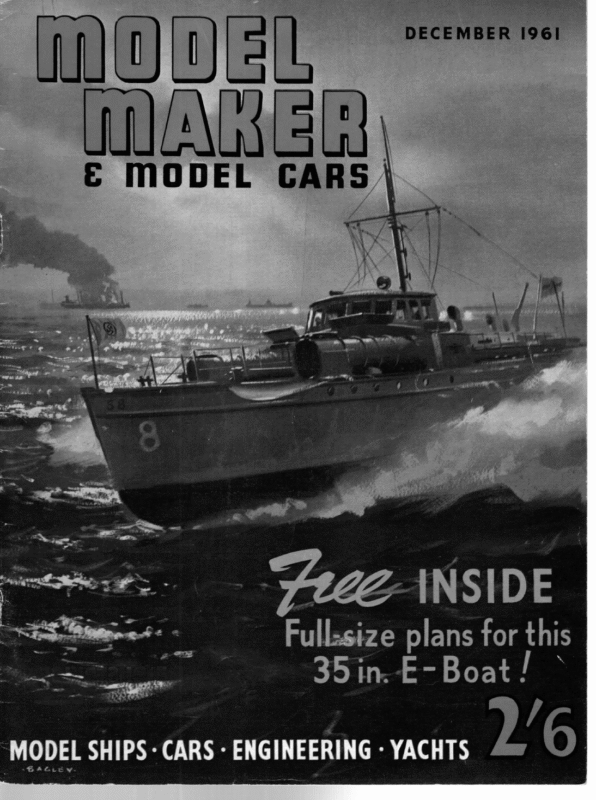
~ Fullssize plans for this 35 in. E-Boat! ° ODEL SHIPS – CARS – ENGINEERING – YACHTS 2 6 ~-BALce y-
WOW IMIANRIE!R) design is basically a good one. These two boats were superbly built by Ken Jones and once again it has been shown that to succeed in this class you must take the care to construct the hull carefully, fit it out with the best possible equipment — not necessarily the most elaborate—and tune the yacht up with great A development of the very successful design PUQNOUUUOAOUUUONONGQOQUUUOOOOOUUOOOAUOUUUOUAIE TVUQOQUUEOOAQQQQUOEAGQOUUOOOGOGUUOOOOOUCUUH ‘Moonshine’ BBE Fe HAT By JOHN LEWIS precision. All these things are not difficult, but merely absorb a little more time than a hastily prepared project and the result is vastly more satisfying. The designer’s contribution to success is relatively small, but it is important in that it is the foundation stone, Careful observation of various yachts and their performance under all weather conditions has led me to believe that there are three basic types of International A Class which can be successful under most conditions. Firstly, there is the type produced and sailed by B. H. Priest and which has won the ChamHere we have pionship on two occasions. 54 in. L.W.L. and minimum displacement. This gives a moderate sail area, but when a narrow hull with very rounded section is employed the yacht is easily driven and has At the recent National A Class Championship at Fleetwood I was very satisfied that two yachts to last year’s Moonshine design came in second and third places. As this was in a field of over forty boats, and in earlier races at Birkenhead they had also occupied the top places, the indications are that the TOP HAT John Lewis uw > — \ \ <— 2 3 MAST | 4 —— “ 6 5 Hi § Sage - 2 Ne = t ! 9 x ra =. a Ao Beas a el i vd 0S, — bSS Geen eee A . \ J A MAKER PLANS SERVICE MODEL 28. CLAREMDOM AD. WATFORD. HERTS Za NY LwWL 5 :0" LOA. 81-25" LWL BEAM. 14-25" : DISPLACEMENT 60°0 LBS. (46LBS. LEAD) ORAUGHT Yo OBL 2-2" 1-74" (1620 CU INS) 52:06" Av F 44" SA 40-03 S AREA \ ‘\ 1604 SO INS. , | & FULL SIZE BODY i PLAN 672 ae ae wow e- em
DECEMBER adequate power for heavy weather conditions. Secondly, there is the heavyweight job of 60/64 lbs. displacement on an L.W.L. of 52/54 ins. This type was promoted by the late Admiral Turner and has proved to be quite good under most conditions. The heavy displacement allows a large sail area and the relatively short hull is very powerful due to a large amount of ballast. There is something of the steam roller technique in this type which does not appeal to me, but nevertheless has a large following in the sport. The type’s greatest weakness is in sailing before the wind under fresh to strong conditions. Thirdly, there is a compromise type such as Moonshine and Top Hat, the displacement being in the region of 60 lbs., but with a slightly longer waterline. Naturally, the sail area suffers somewhat, but the hull is more easily driven than the second type mentioned as it is easier to dispose of the displacement without having a pot-bellied canoe body. In fact, several people have found it difficult to believe that Moonshine is nearly 60 Ibs. weight. Top Hat is a direct development of Moon- shine, based on what I have observed during 1961 this season’s racing. The depth of the canoe body has been very slightly increased and this has enabled me to deepen the forefoot and sharpen the waterline entry in the region of the garboards. This modification has increased the slope of the profile and therefore the overhangs are a little shorter. This will be of no disadvantage as it is only under extreme con- ditions that overhangs of over 14 in.. length can be usefully employed, although aesthetic- ally they are attractive. The displacement has gone up slightly and the small quarter beam penalty has been re- moved. These alterations have increased the sail area to 1,600 sq. inches and there should be no fear of poor light weather performance. The hull profile has been slightly modified mainly for aesthetic reasons, but there is an important modification at the extreme after-end of the garboard run. This I hope will have improved the flow of water at that point and lower the overall resistance. I am confident that Top Hat will be able to hold her own under most conditions likely to be met on any sailing water, and that she should win many prizes if well fitted out and carefully handled. SSSAIa VLSILISLSSSSALLADADLSDALSLSLIDALDILALDS A NOVEL DRIVE } 2 = | Is LW motor control! ist — 25-0" 2N0,3R0,4TH — 24-5" 1sT—20°5" 2ND,3R0,4TH —20°0" --" 4 -_—" CONTROL MECHANISM This photo from Franz Czerny shows a West Berlin model by Herr Steiner using a Ruppert Twin 8 cc. diesel. Note twin screw drive through worms and infinitely variable drive (full ahead to full astern) by means of a friction-driven disc. Two bracket-mounted Micromax motors adjust disc position by an axial spindle. Two R/C channels only needed for full SAIL PLAN va SCALE -4 RADIO ia 673