- Norma A NEW RELATIVELY LIGHTWEIGHT MARBLEHEAD DESIGN FEATURING AN UNUSUALLY DEEP DRAUGHT FROM THE BOARD OF S. WITTY

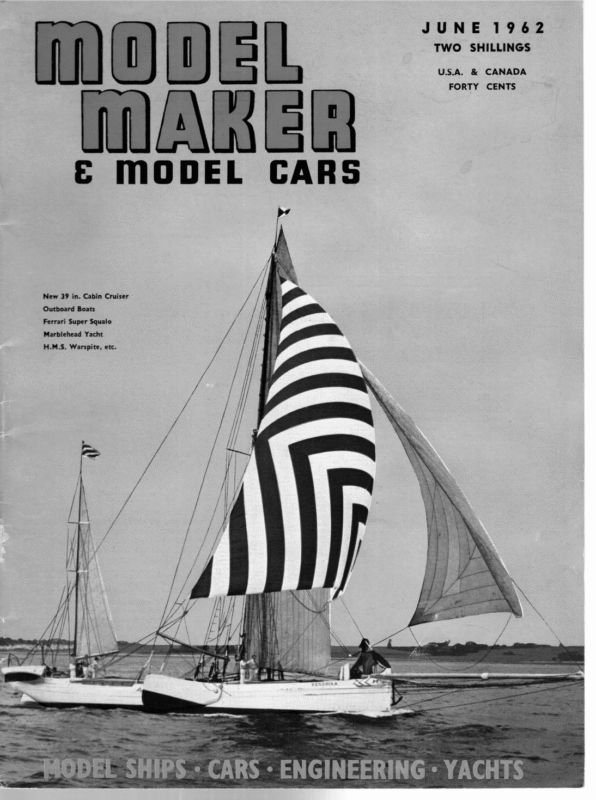
JUNE 1962 TWO SHILLINGS U.S.A. & FORTY CARS New 39 in. Cabin Cruiser Outboard Boats Ferrari Super Squalo Marblehead Yacht H.M.S. Warspite, etc. CANADA CENTS
MONE IMVA\KIE’R} iy often seems to the designer that the comparatively loose rating rules of the 1OR and “M” Class yachts tend to make things more difficult rather than easier as one might expect. If prospective builders would be satisfied with a design which could perform really well under one particular set of conditions the task would be greatly simplified. Unfortunately most skippers feel very much at a disadvantage if they are among the first to have to reduce sail during a blow. Largely because of this our “M” yachts tend to be on the heavy side, though most events held in light weather are won by designs of relatively low displacement. Even so, it is surprising that a more definite style of hull form has not emerged, but whether this is due to differ- ences in local conditions on our various waters or the vagaries of our climate is hard to say. Possibly we are approaching the performance limits of orthodox designs, so in future we may see more “freak” concepts topping the result lists, even though the rule tends to discourage anything really unusual by prohibiting metal fins and specifying garboards of at least one inch radius, etc. As a designer I am always particularly interested when an unusual type does really well and believe any new concept or variation provides a stimulus to the sport. The design shown, while being orthodox in general style and configuration, has rather more draught than is usual and some time and thought has been devoted to producing a fin which would carry the lead in a low position without appearing outlandish and yet allowing the root to be placed where it could not affect the dynamic balance adversely. It is sometimes mooted that a deep fin cannot pay in terms of stability because the centre of resistance is thereby also lowered. It seems rather a “Flat Earthist” point of view but certainly it is pointless to produce a deep fin and then spread the ballast along the forward edge almost up to the root. Apart from this the area must be reduced as much as possible and the sections pared down to the minimum thickness consistent with reasonable strength and rigidity. It must be remembered that the wood in the fin tends to float up when heeled, so that any reduction will help to increase the stability. When building, care should be taken to keep the aft edge as fine and sharp as possible since with the extra depth any rounding or thickness here could make an appreciable difference to the performance. Quite a few participants in the sport feel that variations in design do not matter greatly and that NORMA Cy MAKER PLANS SERVICE otscnee oF S.witty convaren? Om oe CLARERO £80. oF GATFORS. HERTS DATA LENGTH OA 50:25″ LENGTH WL 48-75″ 10-4″ DRAUGHT 2 SAIL AREA SQ INS. 796 DISPLACEMEN’ 20°65 LBs. 13°65 L8S 4-675″ ‘SECTIONS h__ 2 Se + LEAD 13 65 LBS 280 _—
JUNE 1962 it is mostly up to the individual to provide the dif- ference with skill and experience. This may seem so when yachts so widely differing in style and dimension can travel along together at the same speed and angle of beat. Nowa But I feel that this is often due to the performance curves happening to coincide under a particular set of conditions. Any increase or lessening in wind strength will usually separate two such apparently equal designs. Although it can be very impressive on occasion, planing performance is a secondary consideration in this class. Nevertheless, the ability to do so is the best possible safety valve in a squall and to facilitate this and to ease the lines, the hull has a transom stern of moderate width. Anything smaller would coarsen the lines and perhaps result in the bows driving under when running, whilst a broader stern tends to upset the balance, due mostly to the increase in windage when heeled. The sailplan as drawn is of moderate height, luff to foot ratio of the mainsail being approximately 3.5. Although the hull has the power to carry a taller rig it would cancel out the gain in stability afforded by the deep fin. The foresail has been given just enough clearance to allow an effective kick-strap to be fitted, yet low enough to suit those A NEW RELATIVELY LIGHTWEIGHT DESIGN FEATURING UNUSUALLY FROM MARBLEHEAD DEEP THE Ss. AN DRAUGHT BOARD OF WITTY who prefer the loose arrangement. There may be a little difference in the final position of the mast depending on which system is used. It seems strange that mast position varies so much in different designs, ranging from approximately 1.75 in. for’d. of the midsection in the Tucker Duck to 7.8 in. on Witchcraft. At least part of the answer lies in the different size of foresail carried. The most common fault with new designs, not excluding my own, is that mast positions are shown too far aft. Probably this is because a designer has to be an optimist at heart. Even so the position of the mast as shown on the plan should be within the normal one inch imits. surt_| ist _FORESAlL |1375″x435″x40″| 2ND | 1375 X355°x 32″| 3RO | 125″ x295°x255″) HST | _MAINSAIL One of the chief reasons which deter many from building a lightweight in this class is that with normal construction the average weight of hull minus the lead keel but including such items as sails, mast, vane-gear, etc., does not vary much in spite of differences in bulk and beam, the usual allowance being about 7 Ibs. so that anything in excess of this can be incorporated in the lead keel. This being so, the heavier yachts can afford to have an increased percentage of the total weight in the lead. This process can become something of a snare, however, since usually the extra ballast has to be carried too close to the hull to be really efficient. The choice of a comparatively easy form of midsection permits a long smooth curve of waterline from stem to stern and combined with her fine bow angle should enable her to perform well in the lighter airs, while with her power she will be able to match the |Ho8o 52” | i72Sx6I”xe25 | 56″ 44° | F25xSOxS2″ 37″ | 16″x42″x 44″ | 55” a7” heaviest of designs to windward. M.Y.A. Marblehead 6 metre wt 10-rater CHAMPIONSHIPS June 9-11 June 23/24 Aug. 12-19 Sept. 8/9 1962 Fleetwood. Bournville. Gosport. Hove. Closing dates for entries—M—May 12, 6m—May 26, A—July 14, 10r—Aug. 11. IMM 7 Ot 281