
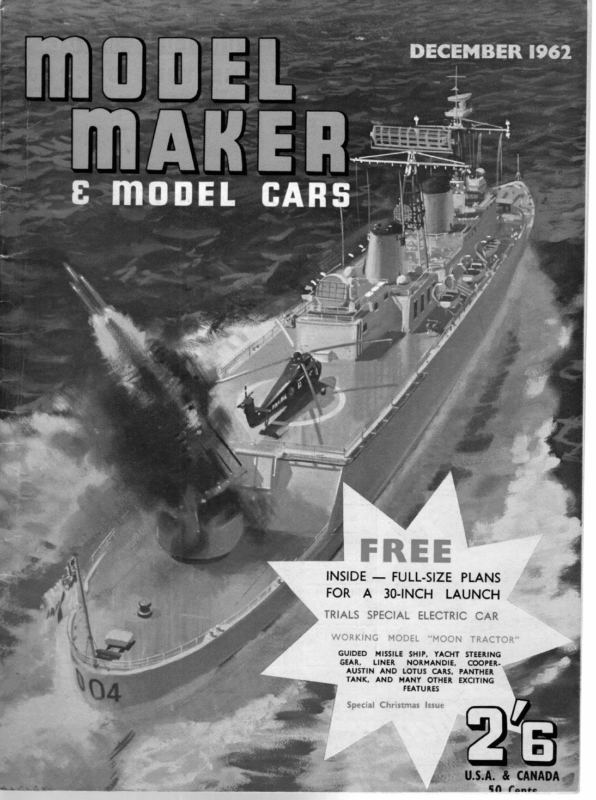
- Highlander Mk. Il Vane Gear B. H. Priest, M.I.Mar.E., describes this outstanding steering gear

a DECEMBER 1962 INSIDE — FULL-SIZE FOR A TRIALS 30-INCH SPECIAL PLANS LAUNCH ELECTRIC CAR TRAC GUIDED GEAR, MISSILE LINER AUSTIN TANK, AND AND SHIP, YACHT NORMANDIE, LOTUS MANY STEERING COOPER- CARS, PANTHER OTHER EXCITING FEATURES Special Christmas Issue CANADA. : 8M Cante g
WOWEL IMIANKIEIR} Highlander Mk. Il Vane Gear be able to be adjusted to a degree on either side to allow for any slight error in rudder or yacht. The degrees in question must also be actual degrees and not just so many marks; the reason for this is so that the yacht can be tuned to sail to windward with so many actual degrees of vane angle. It was shown that this can be calculated, and in practice, depending if one wants to tune the boat with no helm or a slight amount of weather helm, will lie between 30 and 35 degrees. It is further necessary to have actual degrees on the self-tacking part of the vane, so that one can transfer from, say 40 degrees on the fixed vane dial, which, of course, must also be B. H. Priest, M.I.Mar.E., describes this outstanding steering gear T has been felt for some time that this vane, which is one of two especially built for Highlander, should be put on paper for all to build. If one wants to build a 12 metre yacht, and is willing to spend £250,000 on it, the first thing one does is to hunt around until one finds the finest designer in the country to draw the lines. A really marked in actual degrees. Thirdly, the vane must be fully balanced and so delicate that one can blow on the vane gear when in position on the yacht from a distance of three feet and the rudder will move. It must be so designed that it will remain equally free when the yacht is top class builder is now required to turn the lines produced into a living yacht. Rigged and masted, a great deal of money and time is spent in equipping it with finest sails money can buy. The boat is now complete, but not quite, for what is now needed is the best helmsman in the country to get the maximum that the boat will give. What many model yachtsmen do not realise is that the vane is the helmsman on their yacht. At its best it is better than any helmsman alive, and at its worst the boat would be better off without it. This was realised at the time Highlander was being fitted out and as there appeared to be no vane gear on the market which seemed to fit all requirements, two new vanes were designed by the writer to fit heeled to rail down position. Lastly its gying device must give a positive result each time and the amount of adjustment allowed in the gear must be such that a range of gying is available from light to fresh winds and when a long or a short gye should be needed. The drawings show a vane that covers all these points. It has the advantage that it has been proved in the hardest competition, and as a point of interest it was lent to a competitor in the 1961 A Class championships who was having rather a lean spell and it was noticeable that his sailing improved 100 his needs. per cent at once. The writer will not admit to the gear being a The basic requirements for a good vane gear are as follows: it must be robust enough to withstand a hard smack from another boat, as there is nothing worse than a vane getting bent without one realising it, because the boat will be up on one tack and off on the other in the next race with the resultant loss of three valuable points. Even worse happens if the vane is smashed and has to be replaced in the middle of a championship. The harm to morale in this case simple one or for that matter easy to make, but this is a small cost to pay for as good a helmsman as there is in the country today. It is not doubted that better brains than his will alter various of the details and produce yet a better vane; to these people this will at least serve as a starting point. For those who have no desire to experiment further, then the vane can be built to these drawings with the knowledge that it will do all they will ever want to ask of a vane gear, and is almost certain to be better than is terrific. Secondly, as was pointed out in the series last the one they have at the moment. winter on Tuning and Racing Tactics, the vane must BUILD PERFORMANCE [continued from page 618] car on the track. Excessive arcing on the contact surface is a sign of poor contacts. 5. The Motor Don’t throw away that old clapped-out motor—it can be a race winner. It is beyond the capabilities of all but an expert to “soup-up” a standard motor to give better than new performance but anyone can restore an old motor to peak performance. We will assume that you have a Triang type which is well used and rather sad. Remove the brushes and brush gear and clean the motor thoroughly in paraffin or petrol. Examine the bearings and if there is any play replace. While the armature is out clean the commutator thoroughly with metal polish. Avoid files or emery of any sort and when the commutator is polished, clean out between the segments with a pin. Reassemble the motor and check that it spins freely and that the self aligning bearing is not rotating with the armature. Fit new brush spring and brushes. The next move is to locate someone with remagnetising equipment. Likely sources of this are garages who service tractors or automobile electric accessory service depots. It is useless to buy a new 596 magnet and fit into the motor because to obtain the maximum field strength the whole motor requires magnetising as a unit with the magnet in place. All that is necessary for doing this is to remove the brush gear and once the motor is remagnetised never remove the magnet. If you do the field is broken and will never recover its strength without proper remagnetisation. Finally tune the motor by adjusting brushes and spring tension for maximum revs. The result will be a motor as new. When you put your new car on the track you know that mechanically everything should now be correct to give you maximum speed possible, and only the handling of the car can affect performance. If this is not as it should be avoid the temptation to slap a bit of ballast in the car and experiment with different tyres. If it is non-steering, try the peg in different positions—; in. can make a surprising difference—and only use ballast as the very last resort. In general I have found that a slippery surface requires very soft tyres and a rough surface harder ones, and round section tyres give better cornering that flat section but are more prone to wheelspin. Examine your handling problems and try to effect a cure without weight addition.
1962 OESIGNED Pons —3′ sz x he’ stot Fi en — BY B.H. Priest. Mi mar €. COPYRIGHT MODEL MAKER 38 CLARENDON RO OF PLANS WATFORD WERTS SUITABLE SIZE FOR ® BOATS OR 10 RATERS. per ALL PARTS TO BE MADE IN STAINLESS STEEL OR CHROMIUM PLATED i ATTT T== SERVICE DWENSIONS AS FOR OTHER OTHERWISE AQJUSTER STATED, APER HOLE yesuit IN CHROMIUM PLATED BRASS VANE FEATHER ARM TO BE PHOSPHORUS BRONZE BALLome STAINLESS STEEL OR PHOSPHORUS nt ScALe Ted ow DRLL —\—Yse’SLOT GHONG ATTACHMENT THICKNESS Vise FIT TO CLIP & SILVER SOLDER ve’DlA PIN HOLE. 597 DECEMBER SETTINGS AT 5S°@ 10″ INTERVALS HIGHLANDER II VANE GEAR SCALE 11 SCALE V1 “Tas we SCALE 211 cad SCALE 2:1 %e on %2 DU