- Description of contents

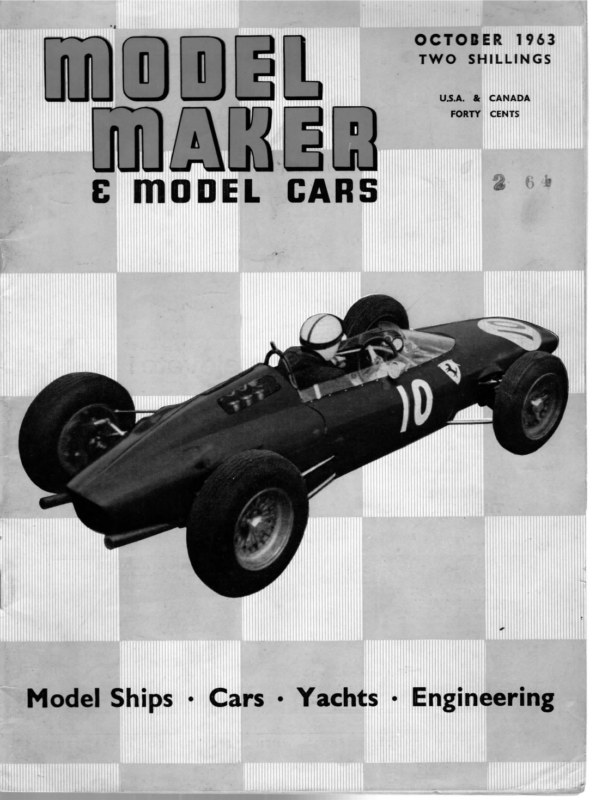
OCTOBER TWO U.S.A. 1963 SHILLINGS & FORTY CANADA CENTS Model Ships – Cars – Yachts – Engineering
Ma WODGEL IMIANKIER) An unusual new Marblehead which has been built and sailed to prove its practicality. VEGA By S. WITTY A has rules concerning the “Marblehead Class” are keelbolts holding together wood laminations neither take or distribute stresses very efficiently. With the deliberately framed to discourage the design of racing freaks. In particular, the restriction on the arrangement described keel bolts cannot be used, nor with good quality resin bonded ply are they necessary, resulting in a further reduction in use of metal fins helps to keep the draught within reasonable limits, since any undue extension of the normal type of fin causes an unacceptable increase in wetted area, etc. deadweight. Due to the difficulty in attaching the keel directly on to the fin, the bulb is divided and clamped either side using bolts or Allen screws. A split keel which completely encloses the fin extension is more tidy but rather harder to mould. At the time the rules were drawn up this kind of restriction may have been a reasonable deterrent, but today with the emergence of immensely strong resin bonded ply and of fibre-glass, such limitations no longer prevent progression away from the stereotyped form of fin-keeler. With the high A.R. of modern sail plans, some way of attaining good stability other than an all round increase in bulk and displacement must be sought. Having no miniature crewmen who can dangle dangerously to windward on a trapeze, the only alternatives left are either to use a stiffer, flat-bottomed hull section with increased beam, or to increase the pendulum stability. The former possibilities both lead to dynamic balance troubles and are not of a form easily driven in light airs, while with the usual type of fin keel, the latter possibility is also limited for the reasons already mentioned, plus the fact that any undue extension of this type merely lowers the centre of lateral resistance to a point where there is little, if any gain, when actually under sail. Such increases in draught are subject to the law of diminishing returns in very much the Whether or not the fin is made completely detachable will depend on your means of transport. If this is considered a necessity, it must be of the plug-in type. In most cases it is sufficient that the lead keel can be easily detached. This kind of bulb keel is by no means a new innovation, going back at least as far as the “Sibbic” Rater “Unorna” of 1894, far before Uffa Fox brought a similar arrangement into prominence with his famous “Flying” series of light keelboats. It is in fact logically the best arrangement combining maximum pendulum stability with a high centre of lateral resistance. Other advantages with this arrangement are reduced frontal area, while the high aspect ratio is conducive to an increase in efficiency. Interference losses at the root are reduced due to the short fin chord ; even though this is lessened by the necessity for a long skeg, the total base length of the appendages is reduced in comparison with same way as is the-height of the sail plan. The only logical way around this apparent impasse is to use a bulb keel, thus keeping ballast well down and the centre of lateral resistance reasonably high. Although this is not a perfect solution, creating as it does special difficulties peculiar to this arrangement, it seems to be the only alternative to be fully explored. Apart from variations in concept, the first consideration was to find whether a wood fin could carry 10 lb. of lead somewhat asymmetrically placed at the end. Until the strength was reasonably checked the design could not be finalised. For this a test fin was carved from ordinary three-eighths ply, clamped horizontally to the bench at the fin root, and loaded to breaking point from the C. of B. of the bulb keel. After loading to 42 Ib. in this manner the fin showed no sign of breaking although somewhat distorted. This simple test reproduces stresses that are in some respects more severe than would be found in practice, although only extensive sailing in all sorts of conditions over a period of at least a year can be regarded as a really adequate trial. Certainly quite a few conventional yachts might be permanently strained if held horizontally, since the usual more stereotyped concepts. At the lower end, tur- bulence losses due to the bulb keel are balanced by the fact that the bulb tends to prevent end spill. With this arrangement, although the draught is much greater than would be acceptable in a normal design, the centre of lateral resistance may in fact be higher, with consequent increase in stability. Most of the “Lift” is generated by the foil surfaces, but in squall conditions the inclined hull has considerable resistance to sudden lateral motion, particularly where the tumblehome presents a right angle to the lee surface. The hull needs a long based skeg in order to balance out the for’d position of the fin root, and to conserve the energy of the quarter wave when heeled. As it happens, this also increases stability by keeping the lateral area high. Even so, the skeg for’d edge must divert from the hull at a reasonably large angle; strip dorsal extensions are unable to contain pressure flow and can become a source of turbulence. The inclined rudder post helps to soften the sudden change in flow direction and besides being aesthetically pleasing allows a longer tiller arm. Total displacement of the design is 16.5 lb. but stability is equivalent to that of a normal design of 488
OCTOBER acceleration to take i 25 at this weight while : et approx. 221b. Rapid fF advantage of any the ability to carry i rs o* > a calm patch is 2) e greatly helped by i c i 5 PEEai and would probably qualify for At ZAP yo i ets nt oy term “easily driven”. Any new in- 7 ie 7 The hull itself is = of normal design ‘ ; 4 on zi limits. The finalised version shown in the drawing should be even better than the original and has an increase in fin area of about 15 per cent to en- sure adequate area } | in very light breezes while allowing a thicker and even stronger fin. Originally I exthe that pected concept would look at least 3 slightly untoward but actually the configuration has a certain functional beauty its own. of / ‘a a attempt too much in any new design. Finalising — the optimum position of the mast is always difficult in a new design and particularly so with a new concept. As the fin area is concentrated further forward than usual it follows that the S.A. should also be mounted well forward and at 7% in. should be withnormal the in or a¥ Pals ny – avoided, it being a good policy not to ugly + ik N novations in hull designs have been ae : that much maligned mw , i wetted area. | im , : 489 AA U low ee Vau ba it her way through her / aie gusts is very good 1963