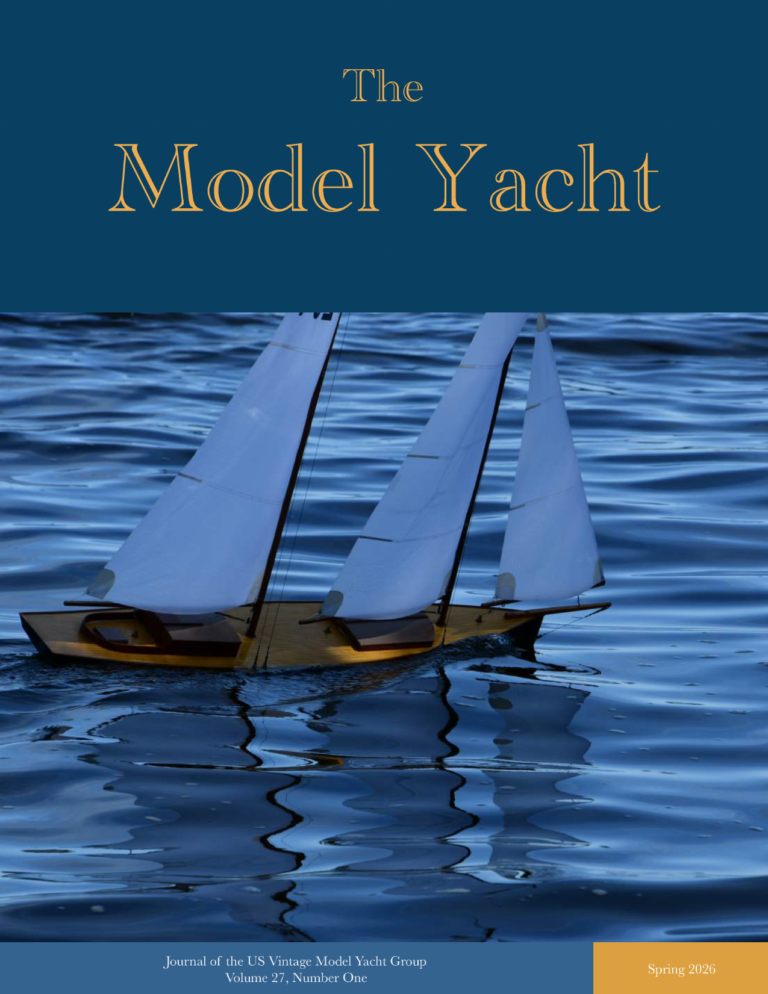
- Bewitched – Successor to Witchcraft
- Background: “Witchcraft” was a groundbreaking Marblehead design that dominated championships but had flaws—particularly diving under spinnaker and aesthetic issues.
- Design Evolution: “Bewitched” was created to address these shortcomings:
- Increased displacement (23.5 lbs) for better handling.
- More freeboard forward to prevent nose-diving.
- Slightly larger keel lateral area for improved balance.
- Retains family lines but with a cleaner, more attractive hull shape.
- Performance Goal: Designed to carry two top suits of sails for varying wind conditions, aiming to outperform Witchcraft while maintaining similar handling.
- Construction Note: Builders must ensure correct keel weight and center of gravity to achieve intended performance.

Model Ships – Cars – Yachts – Engineering
WMOWEL. MIANKIEIR After ‘Witchcraft’ and Things were not, however, quite as bad as they seemed. A few more boats were built to the design and by learning to fly the spinnaker with a somewhat slacker sheeting the nose was kept up. Coupled to this some builders found that the problem could be even more assisted by putting in a further half inch of freeboard at the bow. Once the problem had been overcome, all that the designer had strived for came to hand. The result is that “Witchcraft” has proved the most successful design ever produced to the class. Model Maker say that more designs have been produced and sold to these plans than any other they have so far had _ Boats to this plan have already won the National Championship of the class at least three times and also won just about every other important cup given for the class. ‘Witch’ Bewitched A new Marblehead by B. H. Priest, M.I.Mech.E. The boat has been so good that it has become bad for the class. The writer was told not so long ago about a certain club in which all the boats were to this design. This is not good. Fortunately there is also another design produced by a designer down south which is only let loose to a select few, and which has the reputation of being a faster machine. As the designer has not seen the boat in action he cannot agree or disagree, although knowing the people who have mentioned this fact he feels it could well be a true statement. OR some time the writer has been under pressure to produce a new Marblehead 50/800 design. This has been, in fact, easier said that done. The design of “Witchcraft” was produced some years ago as an experiment in the rating rule. The author had for a number of years sailed, with a varying amount of success, in both the “International A Class” and the “Ten Rater Class”. He had, however, never sailed or designed a boat to the “Marblehead” rule. Unlike his other designs, “Witchcraft” was designed for others to sail, for it How to better “Witchcraft” was the problem. By talk to various of the top line skippers who sailed boats to the design a fairly accurate and clear pattern of their wants emerged. These were fairly simple. A boat to beat “Witchcraft” and all others (simple to state but anything but easy to do!) A boat somewhat heavier but of the same type as the original design, so that she would handle in the same manner. A total displacement, because of what has been said, of between 23 and 23.5 Ibs. Somewhat more freeboard forward to assist the trend to dive under when under spinnaker in fresh winds. Finally, a few mentioned that they suspected that the seal flipper keel given to “Witchcraft” had a very slight lack of lateral area. They desired a boat that could carry two different top suits of sails, one for use in light weather and one for use when the wind got up to a moderate strength. must be remembered that all the other boats produced by the designer had been first sailed and proved by him, before putting them out for all and sundry to build. By this method he knew their strength and weakness, so that when a new design was contemplated the designer knew in just which points he had to alter or improve his original design to make a better boat. “Witchcraft” was produced after a study from a non-sailing position on the bank of various boats sailing to the rule. The prototype was built and entered for the “Model Maker Trophy” which in that year was to be sailed at the “Birkenhead Model Yacht Club”. The designer was there to watch the race. The Trophy was sailed under fresh conditions giving a beat and a run. The new creation won, but it must be noted that she appeared to be extremely well handled. She was untuned, and in the designer’s eyes, not so well equipped as she should have been. The main point was that this was her first appearance in a race of any sort, in fact it is probable that this was the first time she had ever been put in the water. Her designed mast position did not appear to be exactly right but at least it was near enough not to make a great deal of difference. As a result her windward work was quite impressive. This could not be said about her downwind work. Here when hard pressed she drove completely under. This process is usually fatal, but strange to relate in this case was not. She carried on at full speed with the deck at least three inches under water. It is not unknown in the “Marblehead” class for the boats to be driven under when hard pressed on the run under a big spinnaker. To overcome this fault, which is mainly caused by having no overhang forward to get lift from, the writer had given “Witchcraft” extremely flared bow sections. To do this he had forced the curve of his deck line forward into a most ugly curve. By this process he was confident that the usual fault found in the class would be eliminated. On the designer’s side there was a desire to make a better looking hull. “Witchcraft” on paper looks a pretty little machine. In the flesh this description can never be applied. Two things spoil her, and spoil her badly. The forced curve of the deck plan at the bow sections and the hard and what is sometimes called “the Priest bulge” in the quarter. In the case of this little boat the latter point was over great. “Bewitched” is the writer’s effort to apply the requirements noted to the best of his ability. It is believed that the ugly parts will have been made a little less ugly. A displacement of 23.5 lbs. has been attained without losing the family lines of the original design. It will also be noted that the lateral area of the keel has also been slightly increased. To one who has designed a number of boats one point usually applies and that is that if a design looks right it usually is so. The design of “Bewitched” looks right. Apart from this the same family line has been used and an endeavour has only been made to improve where improvement was felt to be needed. If, as the writer believes, he has done the correct things, then the design should be a winner and certainly a better boat than “Witch- In the very first race all that the designer had so confidently strived for had been proved in vain. 14
JANUARY 1964 SE —— or « MODEL MAKER WR CLAMEMBOM HD PLANS SERVICE SAT FONG meRTA a pound more or less, in which case the lead weight must be adjusted so that the total weight of the whole completed, rigged and painted boat is exactly 23.5 lbs. and furthermore that the C.G. of the lead craft”. He trusts that all who build her find her so. He adds but one word of warning. The keel is given a certain weight and position of its C.G. The former point must be adjusted as against how the owner builds. His hull and fittings might be half WHITE HEAT is in the designed position. In illustrating this model we are not attempting to provide a constructional article but merely giving power boat enthusiasts the opportunity of studying a successful design typical of the current American If, as we hope, our approach to R/C speed. [Continued from page 21] the amount of angular change which can be accommodated by the ball joint coupling the tail (drive) shaft to the stub prop-shaft, probably about 15 degrees maximum. At first we thought that this would give inadequate control for other than very wide, sweeping turns, but apparently, from talking to pene who’ve tried it, quite tight turns can be American cousins come into international competition, it seems likely that this type of model would have to undergo considerable modification to cope with the present international speed course, but time alone can tell. made. — within the —eall it what you will framework of the M.P.B.A. and all affiliated clubs, to promote model boat ; building for the sake of the model Readers Write perhaps then we could get back some fortune of the fun that a good few of the younger enthusiasts have never known. Such a body could become an exchange for information on prototypes and Never mind if it looks like all the award of the prototype cup, subject of year’’—ugh!! Fun You’re Missing DEAR SIR, chine gruntled but it is becoming increasingly apparent to me that R/C model power boats are today being built to fulfil a purpose rather than for the sake of the prototype or for the love of building. Ten years or so ago (O.K.! I know tempus fugits along) the talk at re- selling ’em by the yard! Perhaps I’m just getting old and dis- gattas was usually of full-size ships and boats, getting drawings from boatbuilders, scaling down details and suchlike ‘‘boaty’’ subjects. Nowadays —”J’ve fitted bigger spray-strips’’. “The so and so hull turns on a six- pence’, ‘The thingummy kit has plenty of room for servos’’, ‘‘Why not build a blank hull, it won at Poole last hard rest, cruiser. And everyone is a hard If I had a supply of chines it I turns could make sharply, it’s a fast, its got plenty of room for radio—that The type seems to be today’s theme. of competition run now forces us to build boats that will meet a known set of conditions, rather than because we like the prototype and to heck if it turns on a sixpence! Why all this? — Well, aren’t we missing a lot of the fun and sense of fulfilment that we used to enjoy, and which is still there if we look for it? This bit is strictly for chewing on: What about starting a club or society 15 could even become responsible for the course, to the approval of the M.P.B.A. An essential qualification for membership would be membership of a club affiliated to the M.P.B.A. Well, where do we go from here, or don’t we care about real models any more? Lastly, one of the greatest evils of today that breeds stereotyped models is the practice of awarding extra points if the course is completed before the time allowance expires and boats are allowed to continue until ‘‘time’’ is called. Bickley, Kent. G. O. CAIRD.