Design Philosophy The A‑Class rule uses a sliding scale linking displacement, size, and sail area, encouraging innovation while penalising extremes.
Hull Form & Hydrodynamics: The hull features orthodox canoe‑body lines with maximum beam slightly abaft midships.
Fin & Construction Practicality: The fin is shown full size to simplify construction and ensure accuracy.
Lead ballast is kept clear of the garboard turn, allowing a clean fin–hull junction and improved flow.
Performance Expectations: Heavier “Turner”‑style designs tend to excel in light airs, while shallower hulls perform better in strong winds.
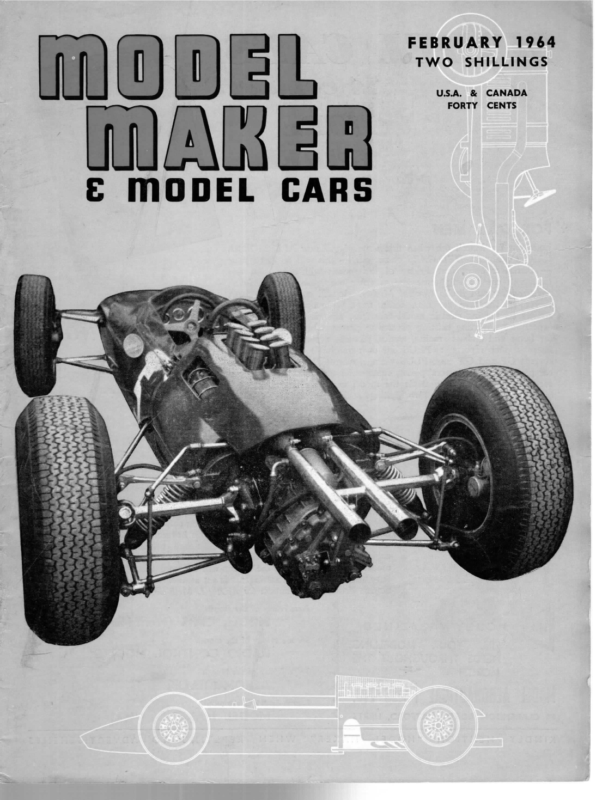
FEBRUARY TWO U.S.A. 1964 SHILLINGS & FORTY CANADA CENTS (OWE MIANRIEIR NOVA A new “A” Class design by 5S. Witty porated throughout most of the length in order to reduce windage and deck weight, while minimising the area affected by wave turbulence. Essentially this is a device to reduce the effects of the deck height requirement. Alt yachts designed to the “A” Class Rule require that the maximum displacement be contained within the optimum form of hull. In effect this provides the designer with a challenge of a kind not to be found under more rigid rules. As with other rules framed to allow a certain amount of latitude, they are based on a sliding scale, permitting an increase in size or sail area only in exchange for extra displacement. Any extremes above or below certain limits are discouraged by penalties severe enough to render such excursions unprofitable. While this brief description may seem over-simplified, the rules and regulations being in fact most subtly devised to prevent any grossly unfair liberties, nevertheless the general idea is not difficult to understand. In many contemporary yachts, the conflicting needs for large displacement, moderate beam and shallow angle overhangs often result in the turn of the hull at the garboards being too abrupt for optimum performance. The fact that the fin also joins the hull at this point does not help, but as those who design the “Metre” Yachts have dis- covered the flow can be improved by a a lifting section is used, having moderate beam and depth and which does not increase in draught when heeled at moderate angles. Tumblehome is incor- slight change in hull section abaft the mid-section. In effect this lowers the metacentre of the aft sections without changing the profile. The well rounded section also makes the most of the quarter-beam limitations, while allowing easy cross-flow over the centre-line, thus reducing turbulence at the rudder. To some extent this is a similar technique to bow-snubbing as used in the forward sections. The type of mid-section dictates the configuration of the hull to a large extent. In the design shown, The form of the canoe-body is quite orthodox, maximum beam occuring approximately 2.56 per cent abaft the mid-section. This seems a _ very modest figure when compared with a design such as the full size class winning Ondine. Derived after much tank testing, she has her maximum beam at 75 per cent of her water-line length. Ondine has a full keel, however, which tends to alter her balance characteristics both metacentric and dynamic compared with a short fin. It will be noted that any excess in the permitted quarter-beam measurement is divided and added to the water-line length. In effect this is extra sailing length at literally half the price and for this reason it is preferable for the Q.B.L. to be over or at least up to the amount allowed without penalty. The fin is shown actual size, since apart from inaccuracies inherent in scaling up, this is really an unnecessary chore for the builder and none to the designer as the fin must be drawn full size in any case. For ease of construction, care has been taken to ensure that the lead does not enter the garboard turn. It follows that the natural detach point for a fin concurs with the maximum height of the ead., Over the past few years it has become apparent that on the whole the “Turner” heavies have a distinct advantage in light weather, where as the shallow hull craft are faster in a blow. In intermediate conditions, vastly different concepts are often very equal in performance, proving just how sophisticated the rule is. Although not an extreme design, being just comfortably inside the minimum displacement, Nova should excel over a wide range of conditions.