- Model Yachting Magazine introduces a section on model power yachting.
- New Associate Editor: Sam S. Rabl, noted author and naval architect, joins to oversee power boating
- Radio Control Racing: Officially recognized as a racing class; growing interest in U.S. and abroad.
- International Interest: Inquiries from South Africa, Norway, and England for participation in championships.
- Vane Steering & Sliding Rig: Discusses dynamic balance and techniques for optimizing performance.
- Power Boating Principles: Explains forces affecting speed boats—buoyancy, thrust, torque, resistance—and design considerations for hulls, propellers, and drives.
- Hydro Models: Covers planning surfaces, weight distribution, and advanced features like hydrofoils.
- Shingle Boat Racing for Beginners: Simple, low-cost entry-level class for children under 12.

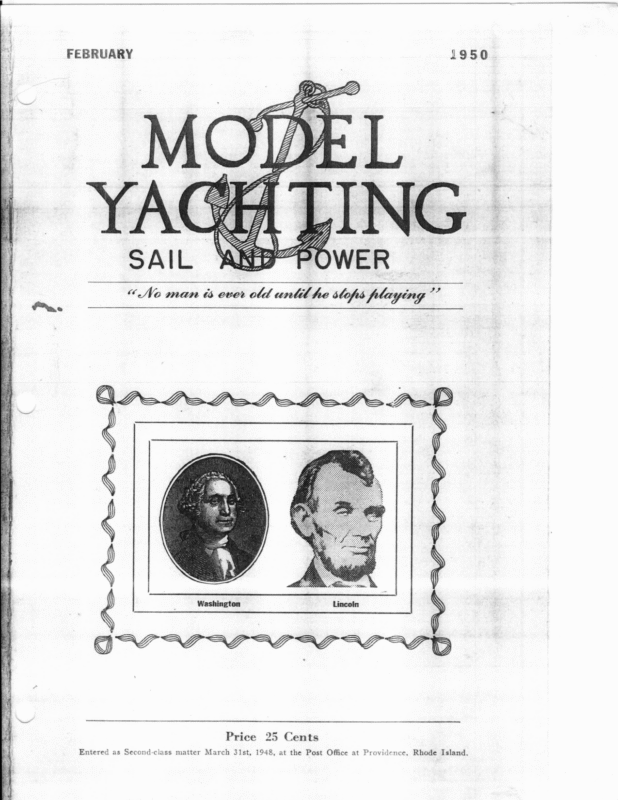
FEBRUARY 1950 Washington Price Lincoin 25 Cents Entered as Second-class matter March 3lst, 1948, at the Post Office at Providence, Rhode Island.
ANNOUNCEMENT We take a great deal of pride in presenting to Model Yachting readers a new department covering the tremendously interesting sport of model power yachting. . We have been most fortunate in procuring the noted author and magazine writer Mr. Sam S. Rabl, member of the Society of Naval Architects and Marine Engineers, and identified with the Bethlehem Ship Building Corporation, Baltimore, Maryland. Having written a number of books on the subject of power boating, based upon his years of practical experience, we believe thatin our new associate editor, the magazine will be enriched audiits readers wi’l be rewarded by the contributions appearing each month under the supervision of Mr. Rabl. We believe that a new family of readers will come to know about Model Yachting Magazine, and with a mutual interest in sail and power, the whole sport will profit from our expansion effort. Dr. Theodore W. Houk will continue as associate technical editor for the sailing division. Having two top flight men of the calibre we have assigned to handle the editorial matter appearing in futureissues of the greater magazine, little doubt shou’d remain in the heart or mind of anyone as to the progress of the publication. Please address all communications intended for the attention of either Dr. Houk or Mr. Rabl, care of this magazine. Prompt attention will be accorded all such mail. PHILIP BARR, Editor
and Lincoln Once in a century, possibly, a being is born who possess:s a transcendent insight, and him we call a “genius.”’ Shakespeare, for instance, to whom all knowl- edge lay open; Joan of Arc; the artist Turner; Swedenborg, the mystic—these are the men who know a royal road to geometry; but we may safely leave them out of account when we deal with the builders of a State, for among statesmen there are no geniuses. Nobody knows just what a genius is or what he may do next; he boils at an unknown temperature, and often explodes at a touch. He is uncertain and His best results are therefore unsafe. conjured forth, but no man has yet con- jured forth a Nation—it is all slow, patient, painstaking work along mathe- matical lines. Washington was a mathematician and therefore not a genius. We call him a great man, but his greatness was of that sort in which we all can share; his virtues were of a kind that, in degree, we too may possess. who succeeds in Any man a legitimate business works with the same tools that Wash- ington used. Washington was human. We know the man; we understood him; we comprehend how he succeeded, for with him there were no tricks, no legerdemain, no secrets. He is very near to us. Washington is indeed first hearts of his countrymen. has no detractors. in the Washington There may come a time when another will take first place in the affections of the people, but that time is not yet ripe. We know all of Washington we will ever know; there are no more documents to present, no partisan witnesses to exHis amine, no prejudices to remove. purity of purpose stands unimpeached; his steadfast earnestness and sterling honesty are our priceless examples. We love the man. We call him Father. —Bert Hubbard If Lincoln Should Return If Lincoln were to come again to earth, And view this land of plenty and yet know That countless of its people knew but dearth, And in their hearts was bitterness and woe, sorrowing Those whom he benefited, and neither class can forgive, for they are of clay. gaze, despair, But find new lamps to light the darkened ways. For only he who once walked hand in hand With poverty can feel for those whose lot It is to wear the stigma of the brand Of alms and doles that leaves an ugly blot— The heart that bled for everyone who knew Distress confused the Canine Education. “Lay down, pup; lay down,” ordered “Good doggie— lay down, | ““You’ll have to say, Lie down, mister,” memory with hearsay, has departed bab- declared bling to his rest. Boston terrier.” “hn irc L tinct atone nrm. know MGDEL YACHTING say.” who somehow —Margaret E. Bruner lived are gone; not one survives; even body-servant, would thing to do. the man. last his perhaps And though he faltered he would not But all those who lived when Washington the of An even more profound and troubled tween men who now live and the prizes carth eyes would wear Lincoln stood be- they coveted; thousands still tread the ooo yess Washington DS Sw SS CPS SS ee eee eh ere SQ OSes a small bystander. “That’s a
ee a ng Mo& ey adeMAGATINElFOR THEUcl BOsT LUNG novenere eti eee ~~ NGS SR SAIL AND POWER Copyright 1950 = = his objectives, reflects no discredit upon him or his efforts. We believe that he is a great man, occupying a thankless We propose to continue supposition. porting him, as we know that he will co- operate with us. Sometime by R. I. 8, the near future, the personal meeting, and out of that con- Publishers Providence in editor and Dr. Houk are going to have a THE LaROCQUE COMPANY 92 Douglas Ave., ST ference, something will emerge which will “ring the starting bell.” A good race will be PHILIP BARR, Editor on! We have taken over completely, and from now on, will do our utmost to pub- Associate Editors lish this magazine in a manner and form Sail: reflecting credit on the model yachting fraternity. DR. T. W. HOUK 6019 51st Ave., N. E. It is our purpose to give the “guy in Washington Seattle, the ranks’’ his long awaited turn to be understood, to be seen and to be heard. Power: The present management of the maga- MR. SAM S. RABL zine is 6 North East Ave. the Baltimore, Maryland 92 Douglas Ave., stalemate existing in for the M. Y. R. A. A. Address all communications to MODEL YACHTING not in any way responsible present Since the Creator made more MAGAZINE Providence 8, R. people belonging to the “lower crust”? (in which I. we like to be numbered) we hold firmly in the faith that good sportsmanship is SUBSCRIPTION RATES not Domestic, One Year…………..cccceeeeee $2.00 Foreign, One YeEa………..ccccscsecsesees $2.50 Vol. VI FEBRUARY, 1950 No. 61 something regulated by any layer or crust, but promoted by a willingness and honesty to play fair, according to the rules of life. In adding the “power boating’’ divi- sion of model sports, we believe a long felt need is being met. A Challenge! The true spirit of competitive sportsmanship should lend by Philip Barr, Editor considerable interest to both ‘“‘sail’’ and This expanded edition of the magazine is our answer to the spirit of defeatism clearly obvious during the past few weeks. Some flag.” “power.” Alright fellows! Here is your chance to show your colors. If you will place a paid subscription on the line against few would Not us. hoist the ‘“‘white We raise the standard of victory. Address all President Houk did everything within his power to get things going again the M. Y. R. A. A. encouraged him. our winning this race, you will be mighty glad that you lost—to us! in scriptions to correspondence publication and office, sub- Provi- dence. Not enough members That he thus failed in ——— TTCtCtCtCMOODEEL YACHTING Ai A ln nln tl An nn ss ae sale
Pwo THE COMMODORE’S SAA ABRAAREGE PDLDB-—BD GPP CORNER BY TED HOUK Radio Control as a recognized racing class has come at last. clubs are becoming England may part their in next New model yacht increasingly active. invite year. the R. C. Class. used for Walker’s personal yacht take is my original Humptulips II, an M. Gus Championships Lassel and other leaders Jean toward the foreigners National There are a variety of opinions on what class of yacht should be Inquiries to about Model X-Clags with the*name eDX- Class” sug- Yachting Magazine are coming from far gested. corners of the world. Helen-J have been advised. A class must A. may start a The M. Y. R. A. “blood pool.’ Mode] yacht ponds are a mecca for skaters as winter grips the countryside. the highlights world. of the These are model yachting All the other classes, including be chosen quickly by the Executive Committee so builders can start preparing for the 1950TM“R. -C. Chantpionship, SO send ’em yous i aaa For details, read on. Charles Heisterkamp as retiring Sec- retary of the M. Y. R. A. A. announced on January 6 that the Executive mittee had voted to accept the Walker Radio Race Trophy. Com- $500.00 The donor, Mr, Jim Walker, model plane manufacturer of 1166 N. E. 31st Ave., Portland 12, Oregon is receiving grateful letters from many interested model yachtsmen. The Deed of Gift reads, ‘‘This trophy, to be known as the Walker Radio Race Trophy, is hereby donated to the Model Yacht Racing Association of America it is to be awarded annually to the winner of a National Model Yacht race. tions governing Radio Controlled All rules and regulacompetition for this trophy shall be made by the Model Yacht Racing Association of America. It is recommended that one of the established classes be specified ferably the for this Marblehead, the event of no contest event, pre- or Class A. for a In period of MR. JIM WALKER three years, the trophy shall revert to it original donor.’’ ttl.
val Information on Radio Control can be officers, Commodore Dan Locke, obtained by writing Walker, reading the Commodore and model Adams Secretary-Treasurer airplane magazines, back issues and of Le Modele Reduit de Bateau, 74, rue Davis Bonaparte, the New Year: Paris (6), France or those are Measurer dedicated to Vice Remington C. O. these goals for references just dug up by M. Y. R.A. A. Treasurer, Leroy Gesbeck; Borden W. Clare in Science and Mechanics, October and December 1946, February and AprilMay 1947. Model Craftsman Magazine 1) Introduction of Model Yacht Building and Racing into the Everett School System. 2) of June 1940 has an article, and a good 25c booklet can be obtained from Radio Control Headquarters, mar, N. J.. U.S. A. Box 178, Bel- Yates Hickey, Jr., 3) Drive for 100% subscription to the monthly magazine. 4) 451 39th N., Seattle, Wash. has a R. C. Model sailboat and C. O. Davis, Registration of every sailboat model with the M. Y. R. A. A. for the 18th, energetic Secrctary of Everett M. benefit of the members and the national Y. treasury. C. can give you another R. C. fan. racing will be the address of It is expected that around a triangular oweiurse, using big boat rules. » 2113 Doubling Club Membership. Methods 5) Hold a full racing schedule for the year. ifr preventing interference between the radios of competing yachts have yet to be worked out. Club secretaries note: We made a post-card size mimeograph in about an ‘hour, from a pineapple can, a piece of flannel and three little 4% x % pieces of wood. notices. Just the thing for club Drop us a line and we’ll send you the plan. Got two lIctters from Yacht Racing Club. tary is Kearney, Berk Oregon Strowger, Portland Model Their new Secre- 10, 2434 Oregon. N. W. Walter W. Birtchet, 1939 S. E. Larch, Portland 14, Oregon wants to buy a good used Marblehead. He reports an active building program under way. John Roder, 138 Glenthorne Road, Rochester, New York sent some nice pictures of Seneca Pond where the races of Rochester Model Yacht Club will be held this year, and a shot of his “R” boat sailing on Maplewood Pond. up about the He is getting pepped M-Class yachts in John 6) Participation in inter club and Divisional competition. Lester Conner, Jr., good Commodore of Marblehead Fresh Pond Mass. sent Model Parkway, us two Yacht Club, 99 Cambridge bucks. He 38, wants Henry Van DePoele to get Model Yacht- ing Magazine at Soldier’s Hospital, Chelsea, Mass. From far away South Africa came a lett.r from F. H. Griffiths, 179 Hope Ridge Road, Hon. SecyTreas. of the Boat Club. Durban Yacht & Power He wants to see a copy of Model Yachting Magazine so all the local fans can see how good it is and send in their subs. Otto Gloersen, Chairman of Norsk Modelsielforening, Tollbodgaten 1 B, Oslo, Norway tells me that Norwegjlans can subscribe to Model Yachting Magazine through Narvensens Kiosk- kompani Norway. A/S. Stortingsgaten 2, Oslo, I hope they can read English as well as O. G. can write it. It is rumored that England will invite Black’s book “Yachting with Models.” foreigners to take part in all their National Championships this year. Official Everett Model Yacht Club has lofty aims for 1950, aims that might well be copied by every club in the U. S. New the M. Y. A., Chas. Seabrooke. 4444 44 te 4 news will be announced by Secretary of (Continued on Page 18) aetna ae a a a a ae ae a a a a
Editor’s George should attempt to do something Notes My colleague James Warrell was mighty kind to observe in his latest News Letter No. 6, page 4, that the magazine is “still alive.” Just what inspired someone to write to Gallagher in such a vcin as would call for Ains Ballantyne to submit the answer quoted, This issue is a seems a little obscure. factual answer to whoever is awaiting an official obituary report. This old cat has “nine lives” and going stronger than ever. eT ee eR TE er ee We were delightfully entertained at the annual meeting of the Boston Model Yacht Club January 20th. … Boys there are vigorous, and by their calm deliberations, and methods of handling matters, demonstrated that they have a full understanding of what ‘‘good sportsman- ship” is like. . . . It would be most inspiring to every yacht club in the M. Y. R. A. A., if it could become inoculated with a little of the spirit possessed by the aforesaid club. Commodore Pigeon proved himself a “grand war horse.” Retiring national secretary’s makes interesting reading. As the 1950 “Veep” he should be an exceedingly fin2 aide to President Houk. Because of the woeful lack of interest the subscription contest, looks like the: donor of the model yacht as a winning prize will have no takers. Perhaps difficult to reconcile the words “piker” and “sportsmanship.” Does anyone know how to do it? Beginning with this issue, all communications and all subscriptions per- taining to the magazine should be sent directly to the publication office in Providence. Dr. Houk has turned over to us his job of getting the “rank and file’ in line to help boost the magazine. He tried hard to help. Too many “pikers’”’ did a lot of “‘yapping.”’ Anyone ever try sailing a yacht without water? We propose to maintain the same policies inaugurated last September. While we admit that the “truth often hurts,’’ yet, we shall try to tell it without rancor, malice aforcthought, or exaggeration. We still believe in the general goodness From some of the letters coming to of model yachtsmen, we gather the idea that due much of which they to the same cause organizations, their stoves; namely, afflicting too spleens around but, it something when effective in complain is other many to doing remedying the It will pay you well in dividends. Don’t be surprised after all is said and done, we shall have the Race here ncxt summer. International Plans are un- der way to overcome the main difficulty that seemed to have postponed the event for another year. Watch for a report on the matter in a later issue. Have you ever little observed Pekingese a pup, “‘blue- barking lustily at a huge St. Bernard dog? Did you notice how unperturbed the big dog re-acted? What’s the point? too polite to publish the answer. it? Here is another Scotch Story. “How much are your peaches?”’ “Penny each, lady.” causes of their complaints, it is an old “T’ll have custom of “letting George do “Givin’ a party?” it.” If We Why not try a little of it toward your magazine. vent “pot-bellied comes human race. this cock-eyed world is the lack of kind- blooded”’ our desk, written by the “rank and file” of the repeat again, the greatest trouble with as the character Sherlock Holmes would say “Quick Watson, the needle!” it. right, and is consigned to the depths We find it very of Hades for trying. ness. report (Mr. Heisterkamp) for the year of 1949, in no matter how well he unachieve results, he is never to dertakes about one, please.” We’re Guess
—— the scrapped Letters Fo the Editor back in Rule operation Book put cun again. it They’ll right need 87 pages of the N. A. Y. R. U. Rules which Barr: Philip Dear can Yacht Don’t think much of model yachting us a competitive sport, no rime or reason to the competition. It never developes outboats or skippers, just local top standing notchers. “Bast is East and West is West and That is true never the twain shall meet.’’ Should be-—Eastern Champ, in our sport. Western Champ, Mid-West Champ should Instead, meet to find out who is on top. be Club attending the held there. we picked for up less at the than Bastern a ail now, New York dollar, while Division meeting And speaking of rules— when adapt remote control to models, we shall find the fourth factor as important as the present ——the three—the sails—and So I’ll sure to be waves seeing give ROOM. I way do you, my when I Remember but skipper—the mean boat ‘The Rules.’ lads, and eall Britannia America waves the whoever has the time and money gets to for be SEA rules the rules. JOE PATEY “National times most and big races Champs” are just the result of local com- I O’Deed at a National Champ petition. race where 6 boats of the same club fought it out. that was during the War. It is about time the sport got organized Excuse along “Competitive Sport’ lines. Notice REMINDER KREBS. ALL MODEL YACHT MEMBERS my tirade. WALTER TO 1. $1.00 Registration fee for all classes. Barr: Mr. Dear I hope you will hear what I have to say and not apply the gag too freely. I’m the free speech guy——and so I would sound off for the good of the Association. I hear that we are going to have radio controlled but for that, Hurrah classes. keep the cost down. Think of it, now you don’t need a mate, or a pool, or a skiff, or a lake or anything else but wind and water, salt, fresh or Meet brackish. sit on it’s wet, anywhere hook a your fanny, pair of binoculars on your head, grab the gadget and the race is on, and devil may take the the best boat win hindermost. and That the ‘devil take the hindermost”’ is deep sea stuff and carries no circles, but animosity is an whatever expression in sea denotiny fair play——and no quarter asked and no quarter given. From here in there’ll be no without recompense, and here is the breaker—skippers will have to fouls heart- learn the rules, and they can leave their poles home no need to rubber them half way up now. The fixing skiff sailor keep ean 50 boat. chance lot of Talk also 50 about of survival—this is it, new champions you’ll we’ll know” his advancement the breaks are eliminated. or from yards why, and own and a what a see as soon as They’ll sail now and Please do not send stamps. 3. Each registration must be accom- panied by an measurement original and certificate a duplicat2 properly filled out (Section G 7 General Rules) regardless if new or re-registered. 4. Members please register through your club officers. 5. Club officers please cooperate by sending in as many as possible at one time. 6. Registration fees without proper measurement certificates will be re= turned. Let’s all cooperate and make each other’s job as pleasant as possible. Emergencies such as have occurred will be cared for with as quick dispatch as I have tried to do in the past. yards out of the way and out of the wind of his competitor, 2. those who T’ll lean too, but let’s not all lean the Same way. Leroy C. Gesbeck, Treasurer and Registrar M. Y. R. A. A.
. ; on moving ahead with an increase in the wind. With the sliding rig, we keep on On Sailing With Vane Steering Gear and Sliding Rig, and Comments with a fixed mast position, we may set it to correspond to an 8-mile wind and use By A. R. LASSEL (All Rights Reserved) lee helm in a 6-mile wind to lie close, for instance: A vane steering gear is used to direct in sailing vessel of a the progress a predetermined direction with reference to the wind. Granting a reasonable adcquacy of the steering mechanism, dynamic balance, inherent in th2 design of the boat is of importance, in as much as lack of this quality might challenge This importthe adequacy of the helm. ance increases inversely with the angle of the wind over the deck, in other the closer the yacht lies to the wind, the more she needs balance. Most yachts are not so well balanced as advé¢rtised, and to supplement this deficiency the sliding rig has been offered. Either im- proved versatility of the vane gear or a A well-functioning lee helm is pre- dicted on sufficient steerage way, and,. if it is not forthcoming, the yacht strays off to leeward and may not get beck on Ona the course without outside help. prototype, a requirement of lee helm is dangerous, on a model, safe in small A lee helm is produced when the doses. angle of incidence of the feather with the wind is such that the feather is acting as a mizzen. This angle varies with the proximity and angle of backwash from the mainsail. On ponds beset with windnormally a up-drafts, shadows and weather helm seems best. When our seat – of – the near-perfection in balance will eliminate sailor encounters the need wind, the mast is again of sliding rig. vouchsafed Until we are either of these, the use of courses’? refers to compass a more pants than 8-mile the wrong in place; it is now abaft the optimum posi- tion. sliding rig makes sense in sailing. “Sailing but, mast, the of positions corre- with wind-force the following sponding As result, she wants to head up (ardency, it is called), and to counter- directions and not to lying close or sail- act it, the rational thing to do would be ing full-and-by. to step the mast ahead. In whatever direction That is incon- the yacht is sailing, the vanefeathcr is venient, so our skipper compromisés on set tipping so that its leading edge faces the the effective center of effort wind’s eye of the apparent wind, plus or ahead by sheeting in on the jib. minus the “‘lag’’ that the water demands some in yacht is nearly dead in the water, slides order to force. rotated, the give up sufficient by slipping the handler, and he for that purpose, ward steerag: To correct a course, the vane is of the is clutch, toward assumed to be, abaft and to the lee- In lying close, the common method is what we may eall: seat-of-the- these sideways, garroting heels excessively, skeg, and digs of the a large enough to bitions. turbulent keel on is a registering ways the “best getting the to mast sailing windward. is stepped position.” This By into , lace motion, The purpose obviate but in mast; just not, for the 6 or best Se 16-mile sailing variation position it is keeps hole in weather the side skipper’s am- of power consumed induced and is by by the side- nothing but parasitic. may be the optimum for an 8-mile wind, a the bury the solution of sometimes All this evidence of turbulence the induced drag, method, the through the space between the keel and pants-sailing, for it is more of an emotional bewilderment than a_ rational this squeezes, projects a column of water to windward way vane-spindle. of After in the slide of the sliding chore it of along rig stepping with (Continued on Page 22) is to the shrouds,
Power Boating by Fam F. Rall For of water that the boat displaces. every cubic inch of water-tight space What About Our Speed Boat Models within the hull, .56 ounces will be supported. If we look at our sailing models we will find a more or less standard hull based on principles laid down for sailing craft This is large and small over the ages. While it not so in our power models. is true that some of the hulls are marvels of efficiency executed with masterlike skill, it is not the general rule. Many freak designs have appeared, most of them showing nothing more than that their designers know little of the forces at work on their creations. When this type of boat shows a surprising burst of speed it can be traced to the brute force of the motor rather than to the efficiency of the hull. While the writer of this article does not wish to set him- The watertight support the contain three two hull chambers when flooded cubic inches to should for every ounces of the hull’s total weight. the direction of this force is upward. GRAVITY; the force tending to submerge the hull. It is the weight of the hull acting downward. It is equal and opposite to buoyancy. THRUST; motor acting the force exerted through push the boat ahead. the by propeller the to It acts along the line of the propeller shaft and is equal and opposite to the total resistance of the hull. self up as an authority on the matter, he is offering his experience so that a better TORQUE; the force tending to re- understanding of the forces at work on volve a power model will result. A good place to start would be a definition of these center. forces so we will dispense with the highly than the flywheel and in a small measure technical language of the naval architect and word them in language of every day use, the around its longitudinal It is caused by the reaction of the motor trying to turn the boat rather by the friction of the prop. Torque always tends to turn the boat in a direction opposite to that of the motor’s rotation. BUOYANCY; boat the force tending support the boat upon the water. to Itisa force equal to the weight of the volume hull It is more apparent in than in a heavy one. a light Some signers have counteracted this by de- mak- ing one planing surface larger than the
other. ing to planing It is taken advantage of in racmake the model ride on one surface. RESISTANCE; the total force tend- ing to retard the forward progress of the hull. It is composed of three forces, one tending to make waves, one the skin of the water rubbing on the surface of the hull and the other the force of the air tending to retard the friction hull. Skin friction is by far the greatest of these forces at present model speeds . classes bottom surfaces against the water which tend to raise the hull and thereby reduce the skin friction. The amount of this force at full planing speed is equal to the weight of the boat. At this latter point buoyancy ceases to exist. CENTERS; the points thro ugh which the concentrated forces act. The center of gravity is the point at whic h the boat will balance. is in most common many generally only models. seen found The in in use today the three suspended two on this type is point the intensity of forces acting over a certain dist ance and which are expressed in foot-pounds or inch ounces about a cert ain point. Example; ten ounces acting abo ut a point one inch away and one oun ce acting about a point ten inches away both have tho Same moment which is ten jnch–ounces. EQUILIBRIUM: a stat e of balance. The boat will not come to rest until the center of buoyan cy and are then in in one vertical equilibrium. that line. of gravity The The hull same is boat will not assume the proper trim until the forces of planing, thr ust and gravity are all properly aligned or in equilibrium reaction. hull to a We can compare this type of three legged stool which is always stable and on which the legs each take a part of the load appli ed to the This hull is by far the most stable and by that virtue the most widel y used. TYPES OF PROPELLERS Two types of propellers are eral use today. The in gen- submerged The hulls of models may be divided jn- In present day pra ctice the displacem ent hull has ceased to exist pro- peller, which is fast disappea ring from the racing model, works as an auger boring its way through the water. It is very rightly termed the screw propeller for that is just how it work s. to the first world Just prior war Albert Hickman invented a new type of propeller which This was used widely in conjunction with the sea sled hull, which was also an invention of that same man. It has the characteristic of running onl y half submerged. Just as the friction of the water against the hull retards its speed so does the friction of the water against the blades of a propeller retard the number of reyolutions per minute of the motor. The surface propeller, Working half in air, has much less fri ction than the sub – merged type and thus allows the motor to develop more rev s which in turn pro duces more power. As pitch the proper Shape of blade, the (the advance per rev olution) and other features of a propeller are con writer will hes itate to comment on the se items. to two classes, dis placement and pla ning. in the racing is planing surfaces forward and on either anoth er planing surface aft or on the propel ler troversial issues the TYPES OF HULLS is sus- the hull transverse is The what was termed the sur face propeller. MOMENTS; scale hull forms. termed In the planing diversified pension hull. seat. PLANING; the reaction of the boats and prototype TYPES OF DRIV ES Three types of dri ves are in genera l use. They will be listed in the order of their popularity.
Jn the articvlated or Pear AL oriye “he Ybrusr JOQ OSES the resistance i179 a ovrect Wwe. De iff Of Hhe YOO ard rhe Llane Q are opposed by Abe NIOMIMCII-S of gravity AC NAA __ 7 Si gee say ae ee THUS 7 pate ARJICLATED Let wa “ PLOP JCLACTIO. TION 2. , “RESISTANCE MANNING ACTION ) Beye/ Gears JHE FOOCES GLALLD OO? AT WCE CN A ARTICULATFOD AULL – bnbalanced Moments — en, FT Sesh Ses Jase LE WAL So ere 2 RIDER. spe | \ AN OF KE SIST PROP REACTION. FLAMIN AVION Liirec? Drive 1s goon ed” 40 xaliive on AAe Convensiorial puff fb GC1/00r7 Or PAC aa Wwerk/g po | ecause 7h Apar ox tes sroCe fer oS Yo rajse He Ie GIIY VCO ETS Hho Low LULET” DLV ON THE
{Stern : ee wrYbeur 77 (lo 4 |) CAP EOST| il Cffect __ TTT TT AERP _ | / KE STSTANCL- FLANING ACTION al”rered by mouae /enitier Lavleries GY ar by Pla 129 LallasK (re Stern, . | Lyrect Lrive may Le achieved by POVOG Ybe Spore Jer faces forward and the CG. afk By ¢p/s means the moment of tvs ‘Q”” 1s Sp |, ee oy G GOP Er moment ox gauwA THE LECT DRINL HYOPO Aluminum tube Struts. pay A xh Mahogany Midship Inverted Section. Yew of Bow. lo 40 F oz. Ballast — deck 7 ie ; ! ‘ Shafp [1nE 08 flak as 20 55121 ua ({NMOP Wigy OV Er ap TOE ee i ee . , { DIRECT -DRIVE-4YDR0~ : a { ae = 1. Ae iy re: a *- oe aa i | 5 ~Jank Under | i Deck . J C40″ Hard Aluminum Sheet
eeRe —~—w — ynweer — – ~~ ed ~— a —oe ee a with the as is as lightly constructed should be consistant The ARTICULATED DRIVE so far has been the most popular among the In this type of drive the racing fans. propeller shaft is set more or less level to the water surface and connected io re ae strength required. the motor with a drive shaft using one Many of the hulls which the writer has seen were grossly over strength and weight. Some fans claim that the hght This is hulls have a tendency to fly. the propeller thrust line may be directed and can be eliminated by proper design. caused In this drive or more universal joints. With to any desired direction and any overturning moment of the thrust counterIt is one of the writers pet acted. side thrust of the universal. against the fact still light hull remains that many feet in one minute. If the pounds are decreased the feet per minute increases for the same amount of power. and tearing off struts not to mention on bearings by the so peeves due to the weakness of universal A universal joint will eat up one per-cent of the power applied to it, for every degree of angular change. It has a weakness of shearing off pins strain thrown claims horse-power is so many pounds moved joints. the all considered, qualities aerodynamic their by FRONTAL AREA is another feature the of the model that should be kept at a Despite minimum. It is the cross section through this fact, all of the record breaking hy- the hull at its maximum and js the big dro models have had articulated drive. factor in causing wind resistance. telligent streamlining, provided The GEARED DRIVE has its In- it does not increase weight, is a factor not to shaft entirely within the hull until the strut is be neglected in the design of any hydro reached. model. Frontal area duced at carried From that point the power is down to the propeller shaft of of bevel drive gears. While eliminates the this of PLANING that their support has the same moment about the center of gravity as the upward thrust of the prop. the edition of that used in the man size racing hydros. The propeller is directly connected to the motor by a single slopup the least power in friction. of the properly designed. when the boat be square from aluminum shect much lighter than the conventional balsa sponson designs. set below the hull on supports and being motors It has the disadvant- gravity all edges of should Metal planing surfaces have advantage of keeping sharp edges the age of creating a moment which tends to This moment can be balanced out by an opposite acting of surfaces and provide a better break-away for the water flow. They may also be made depress the bow. moment planing and sharp. This drive has the advantage using SURFACES The area of these should be consistant The DIRECT DRIVE is a miniature of be re- transverse with the weight of the boat and so placed failure. ing shaft. of type resistance exposed shafts, the diameter of the propeller hub becomes rather large and the gears are subject to wear and mechanical should not expense stability. through another vertical shaft and two sets the fastened to it rather than built as part of the hull they are capable of being moved to adjust the running trim of the is It has been in con- hull. stant use by the writer with good results. HYDROFOILS SOME CONSIDERATIONS IN DESIGN WEIGHT siderations — en lili all is so cll ln one of the prime for this reason tl cn Ale acl i Dt the use con- while decided model speed boat. hull mist have not in general advantages for (Continued on Page 21) el ncn te tt the They are not new in kh tk —_ —_ » a a
SL ai ate alin i ain Ze A swivel shackle was inserted in an eye in the shore end of the overhead Running Hydro Models With Dry Feet wire were made by turning the cable around a wire rope thimble and wrap- The autumn leaves were already beginning to sprinkle the model lake, it was too cool for a bathing suit and we had no waders. We sat disconsolately on the dock with a new hydro that as yet had not had her bottom wet. In a flash of inspiration an idea was born. Why not stretch a wire across the lake and run her from that? The next week end saw us at the lake again and it was not long before the model was roaring her merry way around a regulation course while we had not even wet our feet. While the rig shown in the accompany- ing cut was made expressively to fit the conditions of the lake in Patterson Park, Baltimore, there is no reason why the idea can not be adopted to any locality. While we had a convenient hill across iron picket fence atop our line, there is no of the ends could not props and two sets of guys fitted. We secured enough %” galvanized steel cable 6 x 19 with a hemp core to stretch across the lake. This wire is sold as sash wire or tiller cable. One end of this was hooked to a tackle of 3/16” braided cord rove over small awning pullies three feet apart. Both of these were double sheaved and as these small fittings are not supplied with a ping the free end to the standing part This copper wire w:th copper wire. serving was then soldered. All eyes were made in this manner as this was much easier than making an eye-splice. A traveler with two eyes to fit over the overhead wire was then constructed. These eyes were four inches apart and the traveller was made of two %” rods wrapped with copper wire and brazed. This was too important a joint to trust to ordinary solder. The vertical rod was threaded on one end to take the line swivel and nut which will be described later. The traveler was then slipped on the overhead wire and the eye end a had wrapped pullies. to be and made of soldered copper to one wire of the We cut the cable fifty-six feet on it was discovered that the loose part of the outhaul would foul in retrieving a model and the leader ring was The outadded to the horizontal bar. haul was rove as a continuous line through the outhaul pulley and the two ends secured to the traveller. As the line was made of 3/16” braided cotton a splice was impossible so the line was doubled back on itself, wrapped linen shoe twine and shellacked. with It was later discovered that it was a lot easier to untangle the line from the overhead wire when setting up if it was cut and reef knotted at the shore end when the traveller was out at the Two spliced back pulley. %4” manila rope guys were eye- over about a brass eight ring feet to and carried brass hooks that fitted to cracks in the dock plank- from one end and fit a pulley as shown ing. in the sketch. also shackled to this brass ring. As the steel wire has a Later at the outhand pulley made up. becket to take the fast end of the tackle, this All of the eyes in the overhead wire. By SAM S. RABL the lake and an that to support reason why both be supported on Oe The shore end of the tackle was It was bad habit of twisting when stretched, a discovered on the first trial that the dock swivel arrangement had to be arranged so that this outhaul revolve around the end of would not low and overhead wire. Al] on pulley the too overhead wire much force the tackle to take of the fittings shown were bent up from of the overhead wire. %4” was diameter brass the joints. rod and brazed at by found and this a piece of 1” was was slightly required the catenary out A temporary prop was later aluminum replaced tubing.
CN Nn pn a en tr ee ee Wooden of plugs this serted tube in ver and a fitted ten the ccnter of in the penny each ends nail plug. in- This about two projection inches fitted to inside slipping. The end was cut off nail the on The brass the lower only a %” brass rod. Around this strap was brazed as shown. was bent down about 30 of the hole were then after and the burred over to line was made from hobby cars. 25 foot and shops for As this lengths soldered. it At running wire had each comes to be end a was made the regulation 48 feet A spe- cial reel was made to hold this wire when not in strap use to prevent its being kinked. The rig was set up and the models run degrees as follows. and a 3/32” hole drilled in its end 3” from the nippl2. The end of the swivel bar was then neatly rounded. traveler installed between the ends of the snaps. over was of No. 12 Ga. steel and after braz- ing in line nipple a The the large fishing swivel snap was fitted. The The line swivel was made from a piece fit the race spliced of 4%” pipe nipple about two inches long. to running in model on the dock planking. 17/64” of been stranded stainless steel wire such as is sold pointed to keep the prop from slipping to bar had safety the nut. %” from the wood and This was reamed swivel project. ring at the guys and prevented the prop from vertical end of the thread The top nail was cut off just under its head allowing the the The far end of the wire was carried around the lake and up the hill to a convenient spot on the iron picket The edges fence. also slightly counter- rail sunk to remove their sharp corners. A washer and nut were then inserted on Here it was fastened to the upper of the fence with a %” anchor shackle. The shackle was of the screw pin type and the pin was tightened with a Fence Jackle Overhead Peis Ovthau| — a Running ~The Hydro Rig » — Surface of Lake/ Line t i Overhead Wire Shackle ari 7 Outhau|] ; (ENC OF nf, Nt ain \\ ” ) : ae & Pi pe Nipple | — at Patterson Park~ Swivel Out haul Wire Pulley ; _—— aN ee G | Guys Pulley eager Ring “Swivel Bar SS “3 “wa Running lies Swive) Fishing ~*~, Snap.
INNI IN pair of pliers to keep RR rg the mischievous kiddies from cutting it loose. Tne dock —— te Ne a ae rr the reel set traveller up was at the carried far in end. to The the tackle end was then stretched and the guy hooks and temporarily fastened with a piece of tightened to the guys. cord. As much slack By then cranking the reel the as could be taken uv by hand was pulled whole rig was pulled across the lake and at wound up. this time. The tackle was then by this method the dock end brought in to play and the line stretched was the last on the reel and would be the as tight as possible with that. first end to come off when set up again. was then further inserted tightening under the The prop the line. tackle The out- haul pulley should be about three feet We have found that the rig may be set up in less than ten minutes and dis- mantled in about five. above the water when the overhead line is tight. As the models start from the port side it was decided to hook their bridles to the starboard lugs. This allows the This and That It was Bacon who said ‘‘God hangs the bridle to face the lake and prevents its greatest being tangled when the motor cord was wires.” pulled. As you might have guessed this course. When the model is started an assistant necessitates gently takes up a already clockwise the slack the running line with the outhaul. model is then carried edge and launched. assistant pulls the to the in The out to the outhaul pulley and snugs up tight before the model has made a half lap. As she approaches the dock for the first time all of the spectators will get heart failure for the perspective of the circle makes it appear that the model will crash tie dock. If the dimensions have been followed she will clear it by four feet. When the model is to be retrieved the traveler is brought in to the dock by tre outhaul When the line is reached the model is the dock it.. It line. with has running drawn to been found best to have the assistant take the slack of the running line out to the outhaul again as fast as the model is pulley being recovered, gling of the this prevents the tan- running line and renders it ready for immediate use again. A reel was made from an ordinary tin coffee can with. %” plywood sides and large enough: to take the entire rig. A frame around the ‘reel and a crank were added later. -To dismantle the upon the smallest far to observe the truth of that state- ment. Again, in our daily living we can see where Wendell when he said “One Phillips on was right God’s side is a majority.” water’s It is then that the traveler weights One does not have to look too rig the dock end connections were cut loose and Having more acquaintance than with a mere speaking the clergy, I rather appreciated the following story. The vicar, awarding prizes at the local dog show, tumes was scandalized worn by some at the members cos- of the younger fair sex. “Look at that youngster,” said he; “the one with cropped hair, the cigarette and breeches, holding two pups. Is it a boy or a girl?” “A girl,’’ said his companion. ‘She’s my daughter.”’ “My dear tered. have sir!” The vicar was “Do forgive me. been so flus- I would never outspoken had I known you were her father.” “I’m not,” said the other. “I’m her mother.” Hopeful. Boss: “Henry, you’re a liar. You took a day off to bury your mother-inlaw, and I met her in the park this morning.” Henry: “Oh, I didn’t say she was dead, sir. I just said her funeral.” I would like to go to
sili sili sli sian iin si il The Shingle Boat is the answer to a Shingle simple class for beginners. Boating is to adult Model Yachting as To Golf. to Shinny is prosper, any Sport must give careful nurture to its beginnings. The Shingle Boat skipper of today is the X-Class skipper of to- morrow. The future of the sport depends on the satisfaction he derives from racing his Shingle Boat. A number of cessful and popular. these races have been conducted by Seattle Model Yacht Club and _ the Seattl2 Y. M. A. Hundreds of the little ‘yachts’ have been built by Seattle Cub Packs, Girl Scouts, Rotary Boys Club The activity and Y. M. C. A. groups. has become so popular that requests for shingle boat designs have come from far and near. A news photo of the first Shingle Boat race sponsored by Seattle Model Yacht Club was reprinted Alaska to and. the appeared in in California December 1948 MODEL YACHTING MAGAZINE. The class is best adapted to the skills of the six to twelve year age group. The SHINGLE RULES are BOAT simple RATING but air tight: “SHINGLE BOAT CLASS: This class is limited to yachts built and sailed by boys and girls up to and including twelve years of age. piece, made shingle, Hull is limited to from an one ordinary house not over sixteen inches (16”) in length. Yachts must be propelled by the only. wind Any design of hull, sails, rudder, keel or ballast is acceptable. Yachts are to be sailed down wind.” Racing is conducted as follows: Yachts are started about six feet apart the windward end of the pond. i a a a i al ers. The remaining yachts are then collected and returned to their owners. Where there are a large number of entries each skipper is given an entry card. These may be divided by using an equal number of differently colored cards. The cards are issued in rotation, for instance: Continued March Issue. Shingle adult sponsored boat racing has proved to be very suc- newspapers from i line are retrieved by the judges, using boots or rowboat. They are brought to shore to be identified by their own- Informal Shingle Boat racing has been practiced by youngsters for years. Or- ganized and i The first three yachts to reach the finish HOUK TED i finish line is stretched across the pond about 100 to 200 feet from the start. The Shingle Boat By in from 9A cord COMMODORE’S CORNER Continued from Page 6 Championship venues for National 1950 announced by Secretary Heisterkamp are: M-Class—Seattle M. Y. C., A-Class—Detroit, X-Class—Mill Pond, Yachting International C., Y. M. C. The Y. M. Race—Boston Cup Monthly 6 Meter Class and Radio Control Class National Championships are still open. The Seattle race will be held Labor Day weekend. The model airplane boys suggest we hold all our National Championships in one place and get better attendance at all of them. What you theenk? Thousands of skaters are using Gold- en Gardens Basin in Seattle as local Park Superintendent Paul Brown promises to keep the big pool in tip top shape for the Nationals. Bet he would like a letter of thanks from some of the boys. A paralyzing blizzard caused the of the Jan. 15th Skipper’s cancelling race and the Jan. 20th meeting of Seattle M. Y. C. Our good friend Joe Patey, 14 Morrill Place, East Lynn, Mass. of the Lynn M. Y. C. suggest that we start a “Blood Pool.” Impetus: In December they were urgently Harvey calling for Barrenger of blood donors Irvington for Model eaeeeeeweeweewewewewewewewewewewewewewewewewuewwe eee eweuweweweweweaeeaasss*
Yacht Club. His good Doctor Ed. Willan Oe tells me Harvey is better, but Joe writes, “We” are a separated lot of people as our Hobby doesn’t leave much time for lodge activities or Fraternal enter- an ability to jump skin while close hauled. the out of her She is lauded as one to watch at Seattle on Labor Day. We learn that “Mill Pond is 1700 feet long and 600 feet wide and has a prise, so when we need blood we are a downdraft sort of forgotten lot. If we had a Pool Ains Ballantyne knows every one by its arrangement on one side. of our own supervised by our own M. first name, every one of the funnels of D.’s & operated through the Red Cross, downdraft, it might be a worth while project.’’ We are checking up on the possibilities through the American..Association of erainty of the sinusoidal undulations of Mill Pond be challenged?’’ Mill Pond M. Blood Banks. is a waiting list trying to get in, If enough of you skippers like the idea we’ll go further with it. Bill Speers, 716 Fifth Ave., Watervliet, of attracting membership Y. C. The several more in the club yachts is young Skiff into Deeper Hudson an under active one Eastern Championship, M. with construction hopes of running the X-Class men and Division Anderson Cup and Eastern Division M-Class Skiff Sailing Championship this year. Gus Gallagher, 18 Delano Ave., San 12, California is busy as a Francisco beaver lining up the duties of his new office as Pacific Division Secretary. Looks like the P. D. will have another active, successful year. “Harry Sweet, Unofficial Ambassador- at-Large of Mill Pond M. Y. C. is making quite a hit.in sunny Southern Cal. He trundled Gus Lassel off to San Diego where the boys did some New Year’s Eve sailing. According to Gus, Stuart Tucker’s M-Class “Lill Dippy’ demon- MODEL YACHT FITTINGS Complete sets or separate fittings, including Vane Type steering gear for 50-800, 6-me- ter, X-Class and Class A models. BLUEPRINTS SUNKISS, 50-800 SLIDING RIG by A. R. Lassel by A. R. Lassel CHEERIO 2 CHEERIO 3 KILTIE, 6-Meter BOSTONIA 7, Class A. $2.00 1.00 by John Black 2.00 by John Black 2.50 by John Black 4.00 by John Black 5.00 Send 25c for 40 page illustrated catalog of Ship and Yacht model Fittings. A. J FISHER 1002 Etowah Ave. Royal Oak, Mich. 944444444444 4 44 4s 4144s Y. I mean. Can Ain’s suz- C. has so many members that there we hear! Gus confirms our observation that N. Y. is interested in ways and means ee strated Ke the Tom Allens are wonderful hosts. Heine Free and George Benoit, R. C. experts from San Francisco M. Y. C. fired such complex questions about Radio Controlled sailboats at Gus that it had left us reeling. If you want to know anything about R. C. ask Heine and George. Leroy Gesbeck made us feel “glad all over‘ with the gift of a half-model of our original ‘“Humptulips.” 1941 M- Class National Champ, she was destroyed in an incendiary fire several years ago. Leroy had faithfully copied her original finish and fitted her out with beautifully carved sails. Mounted on a varnished hardwood shield, she sits in a place of honor on the mantle as a constant reminder of a great yacht and a great friend! Happy Model Iceboating. Ted Houk. A Reminder I rose and gave her my seat— I could not let her stand. She made me think of Mother, With that strap held in her hand. Eternal Feminine. Young Co-ed: “Oh, Dad, I’ve just discovered that the girl who sits next to me in Bio, has a hat exactly like mine.” Father: “So I suppose you want me to buy a new one?” Co-Ed: ‘‘Well, darling, that would be cheaper than changing schools.” ee a a a a a a a aa ae
LL DO D PO Racing Reports ce in An omit aati amtiian sain stn A I a il a a I No. 6 Station and will carry a Full keel 1/2” thick. At least something new has been added, and it will be interesting to see Annual Meeting of how this one behaves. Tre-Pol-Pen After the meeting a vcry nice lunch Model Yaeht Club was provided by Mrs. Fisher and members left feeling that their time was Annual meeting of Tre-Pol-Pen Model Yacht Club held at Mr. and Mrs. A. J. Fishers’ at 1002 Etowah Ave., Royal Oak, Mich., on Sunday, January 15, ‘ when following officers were elected for well spent at this meeting. Tom Williams, Sec. Seattle Model Yacht Club. 1950. John Tronjo, Commander, 13026 Wade, Follows the official results of the 1949 Pacific Division “M-Class. Championship Detroit, Mich. A. J. Fisher, Vice Commander, 1002 held at Seattle, Washington on Septem- ber 4th and 5th. The O. O. D. turned all the records over to me for publicity purposes and I have not returned thcm, Etowah, Royal Oak, Mich, Secretary-Treasurer, Williams, Tom 1722 Belle Ave., Flint 6, Micha “Don Williams, Measurer, 1722 Belle so I am at fault for the delay. Ave., Flint 6, Mich. Paul ing discussion it was suggested that clubs in this area would have a more interesting racing season if club races were dropped and inter: clubs run instead. A committee was instructed to contact other Yacht Clubs and get their views Pat Collett, BE, Hell’s Beils;-80:-= Sg 5 Ted Houk, Theo: Houk, Jr., SE, *Sun Wind, W. W. 75. Bishop, Jim Grizzel, SD, *Jo- Méelang, BE, janna III, 78. George This idea would increase the sailor turnout by quite a lot. Collett, Score Yacht Club Mate Skipper Seven members were present and dur- on this matter. a NT Atthowe, Arild Spray, 72. An interclub race will draw as many entrants Harold Pederson, Bill Johnson, SE, *TSir as a National Race if the Regatta is presented in the. proper spirit. George Saundry, SE, Teddy, 59. John, 68. Tom Allen, posa, Tre-Pol-Pen will not race for its Six Club Trophies this year but will Sverre use tas. two new 50-800 yachts are season. being the ‘‘Arrow,’’ Williams and.son 17. with a 5/8” 5 lbs. their Ballast, concave at No. 5000 14 lbs. _e t_t_ 1 Spectators. O. O. D., Leon Sayer; Starter, Frances station. Manfrida, Manfrida, ttt Don Hogan, Calkins, Jim Ohge; Regatta Chairman, Edgar Cen. Bouyancy is at 4 SE, Joy, Grizzell and Dale Steen; Umpires, Carl “tation is 6.5” blending aft into a well tt _t__t_ Givens, Winds, Strong, N. E. The Deck Flare at No. rounded after body. SE, *Lassel built models. own This craft is fine forward Straight Stem. Bockelie, William Knoepfel, E, Patsy, 32. calls for a description. 50” W. L. 10” Beam Disp. John Dave Santo, Bob Houk, SE, Penny, 25. The latter Yacht being radical, Draught 12”. Bockelie, Dan Locke, E, Three Sisters, 38. designed by Donald, *Mari- 48. Ted Blackmore, John being Ains Ballantyne and one by Skipper T. design. SD, One by Skipper E. Landmesser and son Robert. This Pederson, *Goldie, 47. these racing dates for Interclub Regatreadied for the 1950 Gail Bob Committee Corning. Ted Houk, S. M. Y. C. ttt 20 t t e t
——E SS HYDRO MODELS Detroit M.Y.€. The iast race of the season at (Continued from Page 14) De- troit was for the “M” class Inter Club championship cup. The weather was ideal and a brisk south wind made sailing : good. Eight boats made close race to the finish. cion of the round this a very At the comple- robin and the score a 2 : fe ee eS he Me 6a ates brie ealinn eas eanlige = atin ae a erg cat ail or was tallied it was found that a tie for first resulted between George E. Stienbrecher, sail Sr. and off to Bill break the Williams. tie In the Stienbrecher nosed out Williams by a matter of inches. Officer of the day yachtsman was veteran model Clarence Schaitberger. the field of naval architecture having been experimented with by none other tzan Professor Alexander Graham Bell on the Bras d’Or lakes in Nova Scotia as early as 1920. surface and after surfaces area. with developed both in the ‘“‘M”’ class and the “‘A”’ class. He has held many titles and trophys in Among his boats that have won many of his titles are: Comanchile, Detroiters 1 and 2, and Rockett. Back in circulation around the sailing pond is Louis F. Senick who dropped from the game in 1937 due to illness, and with him are his 2 sons Louis, Jr. Let this be a warning to you yachtsmen that the very little frontal for model boating but offer 1922 and he has built quite a number of boats and Lawrence. their They have not, as yet, been fully great possibilities. those years. done on the water’s surface and become plan- year aS a model yachtsman, and at the interest in model yachts began in having work of lifting the hull they break out age of 75 is a very active skipper. His For their | size they have tremendous amount of litt compared to the regulation planing ing This was George E. Stienbrechers 27th These foils are much like those in use on an airplane. Senick trio kave ideas to make things pretty rugged ior you. Louis Senick, Sr. is a former Commodore of the Detroit Model Yacht Club. Louis Senick MODEL YACHT FITTINGS } HULL CONSTRUCTION The writer has experimented with many types of hull construction and has found the simple box cross section for the hull to be any tried. superior in strength to The planking of this type has been 1/6” aircraft spruce three ply material with longitudinal The 4%” square stringers fastenings have in mahogany the been corners. No. 2 flat head brass screws spaced on 2” centers. These should be 4” long in the stringers Which should also be joined to the ply- wood with either Cascophen Ambroid Cement. Glue best made from hard aluminum alloy angles .080” thick which in turn should be set on cross members of %” square mahogany at their ends. These cross members carry the motor strains in KITS PLANS [established Tel. 4sA. 3-4141 1832 JAMES BLISS & CO., INC. 220-222 State St., Boston, Mass. or The motor beds are to the sides of the boat which then act as the longitudinal girders. Completed boats weighing 3 lb. – 5 oz. have been built by this method. Experiences with racing models, both power and Michael sail, Angelo’s still tend famous to bear saying out “The little things make perfection which is no little thing.”
i a i i i i in i a i i i as i i i i i i and system: of a i, i i i i ee ee el ee sliding rig into which the standing p2art (Continued from Page 9) stays, i bowsering of the mainsheet is secured. the Irom t re sheets; it moves noting but the center the sheet is rove through a fairleader on of effort and that quickly. th boom, equidistant from the mast as chronous bowser 55 The ‘‘syn- simultanously is the standing part. op- rove to the Thence the sheet erates the two sheets moving the sails, is with the same angular speed, (except for through a small differential) and this system is essential in preserving inviolate the relation of the set of the sails. After due mast and through the soul-searching on the part of the skip- through the per to find this relation, the ‘“‘vernier’ through the eye of the port antenna to a synchronous fairleader on the close bowser abaft mast-plate. the The jib sheet is rove from the common bows¢r starboard “antenna’”’ fairleader on cye, the club, setting of the jib must assume a super- the “‘vernier.’’ The distance of the fair- seding fixity over other adjustments. leader club That is the sliding rig sailing, and the method is the only acceptable way absolute and comparative quality of balance in tests of dynamic on the to the tack-swivel might as well be half that of the boom of arrangement, plus one-half inch. the That rosults in slowing up the angular spec: sense. of the jib as compared with that of the This may be defined as a balance of all main, and better aerodynamics. moments acting on a yacht a-sailing so The procedure of getting ac. uaint d that little or no steering effect is needed with the sct-up is to take position on the to pond so that a tacking passage would be keep a close-hauled relation with the wind. indicated. As a criterion for measuring the qual- Set the vane for tacking, _lide the rig near the aft end of its scope ity of balance has been suggested the if the wind is light; near the forward inverse end, value in inches traversed by if strong. Haul mast on a sliding rig in compensation chronous for winds ranging between zero and 20 snugly amidships. mph., while the same relation sails have been maintained. of Here the are of Sun-Kiss: seal-flipper, 10, vertical leading edge, 15; FFK, 25 plus (most likely close to 100). Of the X- fingers. wind not full vicissitudes on reeving the the *..4.4.A_4.4.4.4.4._4. 44 4 dh A te %”; if the leave and by instead of eclose-hauled. inch. If there is a tendency to go into e. g. to sail closer than is war- the jib sheet, The obhaul paralleling the in logic of liquidating the goose at the head of the golden egg production line. One synchronous 4 bowser per, irons, on sheets may be of interest to those unfamiliar with the system. There is a jamming device on the aft end of the > 16 ranted, the rig is too far aft. vious thing seems to be to steering force that the helm could not deliver for lack of wind. Notes common blows Chances are that the rig is too far forward and should go aft, say, half an be placed needing is The jib club should Send the yacht on her way and observe her behavior. If the sails stay filled at all times, she is likely to be sailing of lee helm, the nominal weather helm has a good point in as much as, when the yacht enters a blanketed area, the therefore, syn- boom the settings. the tests. and, the as it. Of course there are adjustments in betwecn purposedly to establish the index while a regular weather helm is used throughout right on the Next, if the wind is light, ease up on the class, Colonel Allen’s “Alex” yields an index of 100, while she uses a moderate lee helm, but changes are contemplated effort is likely to in that then be free to travel outboard from the some approximations of indices of three center of so mast the width of threc fingers or 214’, in the case of an “M”’; with an X, four types Aside from avoiding the sheets out of twenty skippers can resist that urge and just slide the rig ahead. (Continued te he te De lll March ll ltl Issue) thins the sll ln thy thn htm dle hn
ee ee ee ea eee eee eae a ae ae eee ee a ee le ee ee a ee iae x eiguamyennetliition Cas Bee OR Sia te us ee ompliments of apt seta tect A Friend .
41 Osborne St Mass JAMES J. CORBETT former heavyweight champion of the world — an athlete with limited physical equipment but with great competitive spirit, said; “Fight one more round.” When your feet are so tired that you have to shuffle back to the center of the ring fight one more round! When your arms are so tired that you can barely lift your hands to come on guard fight one more round! ‘When nose is bleeding and your eyes are black and you’re so tired that you wish your opponent would crack you one on the jaw and put you to sleep Don’t Quit—Fight One More Round!!! When things go wrong, as they sometimes will When the road you’re trudging seems all uphill, When the funds are low cad the debts are high And you want to smile, but you have to sigh, When care ts pressing you down a bit, Rest if you must — BUT NEVER QUIT, Life is queer, with its twists and turns, As everyone of us sometimes learns, And many a failure turns about SBINPNINIINIINIIN IN DIIN AD PAD PAD PDA PADPA PA PAP PD BOPP BABAR Ex >S&YPS\heTasc“AysaBPVsers PQA LIDIA LDA BRRABAAARERARAEEARAIEEaSSBASEE ADA DALTILE BBO OBB OOOO Peabody, When he might have won if he’d stuck it out; Stick to your task, though the pace seems slow— You may succeed with one more blow. Success ts failure turned inside out— The silver tint of the clouds of doubt— And you never can tell how close you are, It may be near when it seems afar; So stick to the fight when you’re HARDEST HIT— It’s when things seem worst that You Musn’t Quit!!! —Author Unknown. PRRARRAPAAAA RDEAA BAR RA B P NPN PSP PPP LLL