- Title. Author. Summary

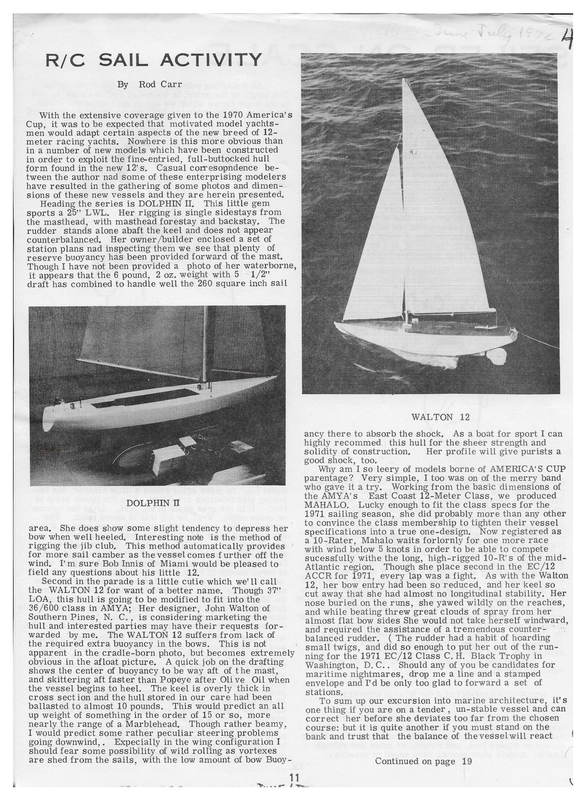
R/C SAIL ACTIVITY By Rod Carr With the extensive coverage given to the 1970 America’s Cup, it was to be expected that motivated model yachtsmen would adapt certain aspects of the new breed of 12meter racing yachts. Nowhere is this more obvious than in a number of new models which have been constructed in order to exploit the fine-entried, full-buttocked hull form found in the new 12’s. Casual corresopndence be- tween the author nad some of these enterprising modelers have resulted in the gathering of some photos and dimensions of these new vessels and they are herein presented. Heading the series is DOLPHIN II. This little gem sports a 25” LWL. Her rigging is single sidestays from the masthead, with masthead forestay and backstay, The rudder stands alone abaft the keel and does not appear counterbalanced, Her owner/builder enclosed a set of station plans nad inspecting them we see that plenty of reserve buoyancy has been provided forward of the mast. Though I have not been provided a_ photo of her waterborne, it appears that the 6 pound, 2 oz. weight with 5 ~1/2″ draft has combined to handle well the 260 square inch sail WALTON 12 ancy there to absorb the shock, As a boat for sport I can highly recommed: this hull for the sheer strength and solidity of construction, Her profile will give purists a good shock, too. Why am I so leery of models borne of AMERICA’S CUP parentage? Very simple, I too was on of the merry band DOLPHIN I area, She does show some slight tendency to depress her bow when well heeled, Interesting note is the method of rigging the jib club. This method automatically provides for more sail camber as the vessel comes further off the wind, I’m sure Bob Innis of Miami would be pleased to field any questions about his little 12. Second in the parade is a little cutie which we’ll call the WALTON 12 for want of a better name. Though 37″ LOA, this hull is going to be modified to fit into the 36/600 class in AMYA; Her designer, John Walton of Southern Pines, N. C., is considering marketing the hull and interested parties may have their requests forwarded by me. The WALTON 12 suffers from lack of the required extra buoyancy inthe bows. Thisis not _ apparent in the cradle-born photo, but becomes extremely obvious in the afloat picture, A quick job on the drafting shows the center of buoyancy to be way aft of the mast, and skittering aft faster than Popeye after Olive Oil when the vessel begins to heel. The keel is overly thick in cross section and the hull stored in our care had been ballasted to almost 10 pounds. This would predict an all up weight of something in the order of 15 or so, more nearly the range of a Marblehead. Though rather beamy, I would predict some rather peculiar steering problems going downwind,. Expecially in the wing configuration I should fear some possibility of wild rolling as vortexes are shed from the sails, with the low amount of bow Buoy- who gave itatry. Working from the basic dimensions of the AMYA’s -East Coast 12-Meter Class, we produced MAHALO, Lucky enough to fit the class specs for the 1971 sailing season, she did probably more than any other to convince the class membership to tighten their vessel specifications into a true one-design. Now registered as a 10-Rater, Mahalo waits forlornly for one more race with wind below 5 knots in order to be able to compete sucessfully withe the long, high-rigged 10-R’s of the mid- Atlantic region, Though she place second in the EC/12 | ACCR for 1971, every lap was a fight. As with the Walton 12, her bow entry had been so reduced, and her keel so cut away that she had almost no longitudinal stability. Her nose buried on the runs, she yawed wildly on the reaches, and while beating threw great clouds of spray from her almost flat bow sides She would not take herself windward, and required the assistance of a tremendous counter- — balanced rudder. ( The rudder had a habit of hoarding small twigs, and did so enough to put her out of the run- ning for the 1971 EC/12 Class C.H. Black Trophy in Washington, D.C.. Should any of you be candidates for maritime nightmares, drop me a line and a stamped envelope and I’d be only too glad to forward a set of stations, To sum up our excursion into marine architecture, it’s one thing if you are on a tender, un-stable vessel and can correct her before she deviates too far from the chosen course: but it is quite another if you must stand on the bank and trust that the balance of thevessel will react Continued on page 19
MAHALO ON THE SEVERN RIVER OPPOSITE THE U.S. NAVAL ACADEMY. HER FLAT DECK, AND LOW FORWARD SHEER COMBINED TO MAKE HER A WET SAILER. smoothly and predictably to wind and wave. Every hard right rudder movement you give your boat will cost you half a boat length against a competitor. Boat speed is too precious to waste by continual rudder movement, and coming in second is to me too big a price to pay for the advances I tried to make with MAHALO. Lest I sound of the voice of doom—-if I had it to do all over, —I would. I’m looking forward to answering questions from the sailing skippers around the country, and will do my best to act as a clearinghouse for R/C yachting information. Write to me, ship me your negatives for printing in this column: Rod Carr, 2713 Blaine Drive, Chevy Chase, Md, 20015, SEND YOUR APPLICATION FOR MEMBERSHIP IN ) AMYA ( AMERICAN MODEL YACHTING ASSOCIATION FO; William W. MacLaughlin 3197 Toby Lane Memphis, Tenn. 38111 Phone: 1-901 323-7832 Annual dues are $3.65 Vessel registration $1.00 MAHALO, EC/12 BEING SET UP BY ROD CARR. SEE PAGE 11 FOR THE COMPLETE STORY.