- Title. Author. Summary

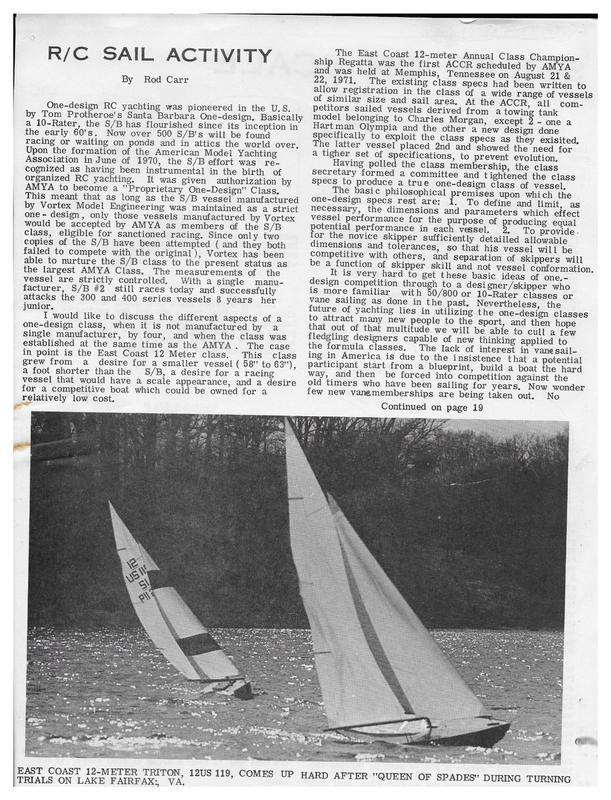
R/C SAIL ACTIVITY By Rod Carr One-design RC yachting was pioneered in the U.S. by Tom Protheroe’s Santa Barbara One-design., Basically a 10-Rater, the S/B has flourished since its inception in the early 60’s. Now over 500 S/B’s will be found racing or waiting on ponds and in attics the world over, Upon the formation of the American Model Yac hting Association in June of 1970, the S/B effort was re- cognized as having been instrumental in the bir th of organized RC yachting, It was given authorization by AMYA to become a “Proprietary On e-Design” Class, This meant that as long as the S/B vessel manufactured by Vortex Model Engineering was maintaine d as a strict one ~ design, only those vessels manufactu red by Vortex would be accepted by AMYA as member s of the S/B class, eligible for sanctioned racing, Sin ce only two copies of the S/B have been attempted ( and they both failed to compete with the original), Vortex has been able to nurture the S/B class to the present sta tus as the largest AMYA Class, The measurements of the vessel are strictly controlled. facturer, S/B #2 With a Single manu- still races today and successfully attacks the 300 and 400 series vessels 8 years junior. a tigher set of specificatio ns, to prevent evolution. Having polled the class memb ership, the class secretary formed a commit tee and tightened the clas s specs to produce a true one-design class of vessel , The basic philosophical prem ises upon which the one-design specs rest are: 1. To define and limit, as ne cessary, and a desire for a competitive boat which could be owned for a relatively low cost. the dimensions and parameters which effe ct vessel performance for the purpose of produciig equal potential performance in each vessel. To provideor the novice skipper suffic iently detailled allowable dimensions and tolerances, competitive with others, so that his vessel will be and separation of skippe rs will be a function of skipper skil l and not vessel conformation , It is very hard to get these basic ideas of one,design competition through to a desi ener /skipper who is more familiar vane her I would like to discuss the different aspects of a one-design class, when it is not manufactured by a single manufacturer, by four, and when the class was established at the same time as the AMYA. The case in point is the East Coast 12 Meter class. This class grew from a desire for a smaller vessel ( 58″ to 63″). a foot shorter than the S/B, a desire for a racing vessel that would have a scale appearance, The East Coast 12-meter An nual Class Championfirst ACCR scheduled by AMYA and was held at Memphis, Te nnessee on August 21 & The existing class specs ha d been written to allow registration in the clas s of a wide range of vessels of similar size and sail area , At the ACCR, all. with 50/800 or Sailing as done in the past , 10-Rater classes or Nevertheless, th e future of yachting lies in utiliz ing the one-design classes to attract many new people to the sport, and then hope that out of that multitude we wi ll be able to cull a few fledgling desipners capable of ne w thinking applied to the formula classes. The lack of interest in vane sailing in America is due to the in sistence that a potential participant start from a bluepr int, build a boat the hard way, and then be forced into competition agai nst the old timers who have been Sailin g for years, Now wonder few new vanememberships are be ing taken out. No Continued on page 19 tte See (hur EAST COAST 12-METER TRITON, 12US 119, CO MES TRIALS ON LAKE FAIRFAX: VA, UP HARD AFTER “QUEEN OF SPADES ” DURING TURNING
provisions is being made to attract the beginner, Onedesign RC yachting should address itself directly to the novice, and court him with seriousness, Some confussion exists as to the reasoning behind each specification in a O-Dclass. Using the present EC/12 class specs as an example (as published in the AMYA Quarterly, Fall 71), let us explore some of the more controversial, The numbers are those in the specs, 1, Hull- One-Design racing requires that each hull be the same. All EC/12 hulls are Ist or 2nd generation descendents of the original Morgan ized manufacturers are allowed, plug. Only author- Prices start at $25 for a bare hull and range upward to a complete kit. The class secretary is empowered to authorize new manufacturers, but is guided by common sense and the class population statistics. 2, LOA- This was chosen to allow an EC/12 to ride on the back seat or in the trunk of a standard sedan, Since extra transom length is not immersed, it may be docked to reach the LOA required, A motion is pending, to be voted on in Aug. of 72, to allow LOA to be 58-63″, hull, BWL LWL – Since the EC/i2 is a displacement her forward speed in knots is limited by the load water line length to be 1.36 LWL (ft) or about 2,5 knots. Hence the maximum LWL of 42.5″ LWL is a function of imaximum beam (11to12″), The fatter boat will be heavier, but will have: 1. More wetted surface, 2, Slower acceleration, and 3. Be slightly less tender,. The LWL is measured in a float tank, as it is the primary control on maximum potential speed, 4, Maximum displacement is set at 26.5 lbs ready to sail this basically is to guide the beginner to build a 21-22 pound boat and then add easily moveable ballast bags to bring his vessel to the max. LWL of 42.9″, 5. Max. mast height- to preserve scale a appearance and to keep the sail plan low (since the EC/12 is not a heavy weather vessel and excessively ). will heel The 66” main luff fits well on a 72″ mast with 3” on either end for fittings, etc. Masts must be of wood to prevent hot-shots from using ultralight fiberglass tubes or expensive aluminum extrusions. Remember, low cost was one of the desires in the EC/12 class as well as non obsolescence. 6. The only running riggis allowed is sheets and jib twitchers ( or J.C. straps as big boaters call them). This will keep inventors from filling their hulls with running back stay winches, be shroud slackers, and other goodies which sailors think up on the way home from the lake, This is done to assure that the vessels are in fact one-design. 7. The rudder’s maximum dimensions are controlled for tacking a 12 is more than just “hard-right-rudder”. Too much rudder area will cause so much speed loss that violent tacking allows the vessel to fall into irons. To protect the novice, we don’t allow his rudder to get so big that it is a disadvantage. 8. Sail plan maximum dimensions are controlled, Measurement of sail plan by checking each side of the triangle can be accompolished at lakeside with the rig on the boat using a ”go-no go” measuring board. maximum chord, Area of reach is controlled by So we see that the dimensions set for the EC/12 do have a sound, logical basis. Rather than making the builder’s job harder, care will assure AMYA contests, it assures him that adequate a vessel immediatly competitive in Anyone wishing further information on AMYA, the East Coast 12- class, or other aspects of R/C yachting should write to me at: Rod A. Chevy Chase, Md. 20015, Carr, 2713 Blaine Drive, Next month I will cover tuning and set up of R/C yacht masts and will have some comments on the setting of sails, their care and feeding. AMYA dues are $3.65 and may be sent to me for forwarding to the AMYA Sec. /Treas. Vessel registration is $1.00 and need only be done once,