- A Fast 50-800 Yacht. By K. Von Ersten
- Hull Geometry: The hull uses a “hollow garboard” design to prevent the beam from widening when the yacht heels, ensuring that the increased waterline length isn’t offset by extra drag.
- Aerodynamic Rigging: Von Ersten advocated for high, narrow sails instead of the “old-fashioned” wide ones to achieve better aerodynamic action. The jib can be adjusted vertically on its stay to fine-tune the center of effort.
- Construction Methods:
- The “Lift” System: For builders without planking experience, he recommended the “lift system” (stacking horizontal layers of wood) to create a competitive hull.
- Keel Attachment: The keel is made from a single plank, screwed and glued into the bottom “lift” with waterproof glue.
- Reinforced Rigging: Shroud eyes are led through small pipes in the deck directly to the keel to distribute tension and avoid hull distortion.

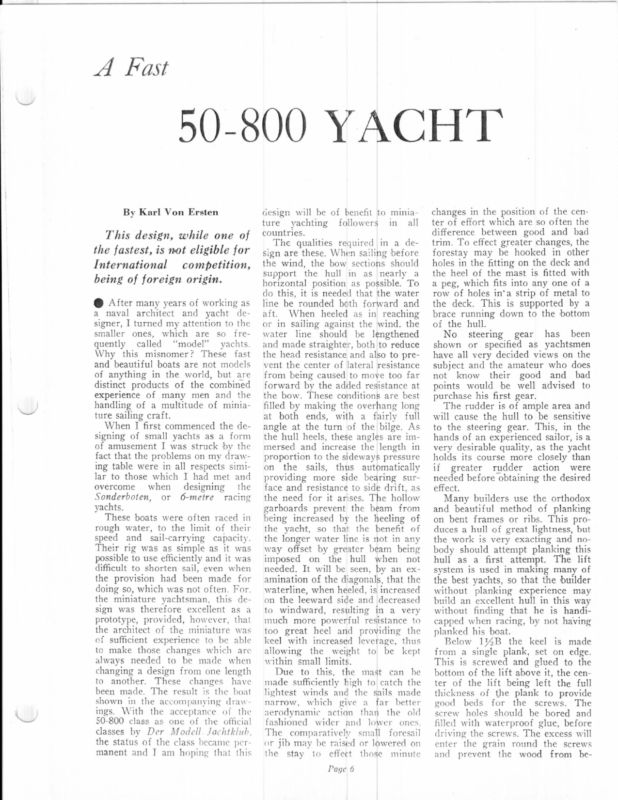
A Fast 50-800 YACHT By Karl Von Ersten This design, while one of the fastest, is not eligible for International competition, being of foreign origin. @ After many years of working as a naval architect and yacht designer, I turned my attention to the smaller ones, which are so frequently called “model” yachts. Why this misnomer? These fast and beautiful boats are not models of anything in the world, but are distinct products of the combined experience of many men and the handling of a multitude of miniature sailing craft. When I first commenced the designing of small yachts as a form of amusement I was struck by the fact that the problems on my draw- ing table were in all respects similar to those which JI had met and overcome when designing the Sonderboten, or O6-metre racing yachts. These boats were often raced in rough water, to the limit of their speed and sail-carrying capacity. Their rig was as simple as it was possible to use efficiently and it was difficult to shorten sail, even when the provision had been made for doing so, which was not often. For. the miniature yachtsman, this de- sign was therefore excellent as a prototype, provided, however, that the architect of the miniature was of sufficient experience to be able tec make those changes which are always needed to be made when changing a design from one length to another. These changes have been made. The result is the boat shown in the accompanying drawings. With the acceptance of the 50-800 class as one of the official classes by Der Modell. Jachtkiub, the status of the class became permanent and J] am hoping that this aesign will be of benefit to miniature yachting followers in all countries. The qualities required in a design are these. When sailing before the wind, the bow sections should support the hull in as nearly a horizontal position as possible. To do this, it is needed that the water line be rounded both forward and aft. When heeled as in reaching or in Sailing against the wind. the water line should be lengthened and made straighter, both to reduce the head resistance and also to prevent the center of lateral resistance from being caused to move too far forward by the added resistance at the bow. These conditions are best filled by making the overhang long at both ends, with a fairly full angle at the turn of the bilge. As the hull heels, these angles are immersed and increase the length in proportion to the sideways pressure on the sails, thus automatically providing more side bearing surface and resistance to side drift, as the need for it arises. The hollow garboards prevent the beam from being increased by the heeling of the yacht, so that the benefit of the longer water line is not in any way offset by greater beam being imposed on the hull when not needed. It will be seen, by an ex- amination of the diagonals, that the waterline, when heeled, is increased on the leeward side and decreased to windward, resulting in a very much more powerful resistance to too great heel and providing the keel with increased levetage, thus allowing the weight to be kept within small limits. Due to this, the mast can be made sufficiently high to catch the lightest winds and the sails made narrow, which give a far better aerodynamic action than the old fashioned wider and lower ones. The comparatively small foresail or jib may be raised or lowered on the stay to effect those minute Page 6 changes in the position of the center of effort which are so often the difference between good and bad trim. To effect greater changes, the forestay may be hooked in other holes in the fitting on the deck and the heel of the mast is fitted with a peg, which fits into any one of a row of holes in’a strip of metal to the deck. This is supported by a brace running down to the bottom of the hull. No steering gear has_ been shown or specified as yachtsmen have all very decided views on the subject and the amateur who does not know their good and _ bad points would be well advised to purchase his first gear. The rudder is of ample area and will cause the hull to be sensitive to the steering gear. This, in the hands of an experienced sailor, is a very desirable quality, as the yacht holds its course more closely than if greater rudder action were needed before obtaining the desired effect. Many builders use the orthodox and beautiful method of planking on bent frames or ribs. This produces a hull of great lightness, but the work is very exacting and no- body should attempt planking this hull as a first attempt. The lift system is used in making many of the best yachts, so that the builder without planking experience may build an excellent hull in this way without finding that he is handicapped when racing, by not having planked his boat. Below 1%4B the keel is made from a single plank, set on edge. This is screwed and glued to the bottom of the lift above it, the center of the lift being left the full thickness of the plank to provide good beds for the screws. The screw holes should be bored and filled with waterproof glue, before driving the screws. The excess will enter the grain round the screws and prevent the wood from _ be-
MODEL CRAFTSMAN, The Home Mechanic’s Magazine for August, 1936 “ : | | i ia _— : b. z||| ‘ the upper edge along the sheer line, at which point they are 34” thick for a depth of 14” to provide a seat for the beams which support the deck. The deck beams will be cut any firm grained wood and fastened in place by screws driven through the sides. The screws are countersunk to a depth of %” and a small disc or eu 7} cur coming broken by the threads. The sides of the hull will be gouged out to 1%” thick except at from an 7 plug of the same wood as the hull is glued in the hole, This gives a continuous sur- face on the sides and prevents the finish from becoming cracked. Putty has the tendency to fall out after long use. The deck should be made of thin wood and glued and_ fastened down, The method of fastening may be either screws or thin wooden pegs. In each case, they must be dipped in glue. The shrouds eyes’ are continued through the deck in smal! pipes and then led inwards to the keel or center. This method of construction does away with the strains which come from attaching the shrouds directly to the sides or to the deck. It has been used for many years on light 6-metre yachts where the usual fastenings have been found unsatisfactory. The best material for shrouds is phosphor bronze cable, which may be purchased at any good _ hardware store. If this material cannot be had, any strong wire will be satisfactory, but two factors must be guarded against: stretching and rust. The first may be obviated by using only materials of high ten-
ioe) MODEL CRAFTSMAN, The Home Mechanic’s Magazine for August, 1936 Past Lint 4% BeLow LW.L. ar ge og — og —t— op A a pop a EO fs / i | / eer I Lele—_—_——— SSS a 4-—- a | _—_, oo i = |eae | di an | ine ee ee See et a || d3 a | sile strength and the second by avoiding those which rust, but if steel is used—which makes an excellent shroud—it should be wiped making them flat or triangular, but, as far as my experience goes, there seems to be no great advantage in occasionally with a greasy rag. The mast may be made hollow, if the these forms in such small sizes. If light straight-grained wood is used, the spars will not be unduly heavy. builder desires to save every outice The shrouds should be fastened of overhead weight. This process is not as difficult as might be imagined. Two straight sticks are selected, each being 3%” x 34”. The to a light brass band, slipped over the masthead. Wire rings or hooks can be bent up and soldered to this ring making a much better piece of Outline of the mast is which will ter 1s then wall about work than a heavy brazed job, and far stronger than screw eyes set the vertical section of marked out on the sides form the joint. The cenhollowed out, leaving a 4%” thick with a joint surface of 3/16”. The mast is then glued together and tightly wrapped with thread to hold the halves in position until dry. A solid length is left for about 2” at each end. The boom is shown as_ being round, There is now a fashion of directly into the mast. The angle to which the forestay is fastened should be made from 18 ga. sheet brass or aluminum. It is strongly advised that the holding screws be set into a piece of 14” hardwood glued to the underside of the deck and reaching from the. bow to as far as the after end of the mast step plate. This strip need not be more than oe 1%” wide and = a4 aie should be set into the deck beams and screwed and glued to them. If the yacht is to be raced in club competition, it is likely that most of from the its races home will waters. be away As this naturally means that all kinds of pond banks will be encountered, from mud to concrete, some protection is necessary. An oak strip, half round, may with advantage be run round the hull at the deck line. This should be tapered to a feather end fore and aft. As this strip will bear any rough usage which may occur, it should be securely screwed and glued at intervals of not less than 3”, A half round brass strip should be fastened down the stem to protect the hull from contact with concrete and rocks. This strip need not be more than 14” wide but should be fastened securely by fine
9 VIODEL CRAFTSMAN, The Home Mechanic’s Magazine for August, 1936 Ps * ! on Cor Mast » = oe – ot” +2 33 + oF” 46″: ° 4* 3% 1> oe© — 228 i i e = oe BoaATSes Pee eer ee) Se\ae he eee SS RABBET LINE FOR PLANKED ae oe El ssa care (am SS Se Senee nn (nn a ee } 4 | ies in — d e a epee — screws, not less than 34” long. The transom should be covered with a piece of thin veneer, for the best effect. This is a piece of work calling for considerable skill and may well be omitted by a beginner. In making the hatch, the hole should be lined with cork or a piece of thin rubber cemented to the underside of the deck, with an opening slightly less than the size of the bottom of the hatch. This leaves a projection of the rubber of about 1/16” all round, which not only holds the hatch securely, but prevents water from entering. The finishing process is the most important part of the work—apart from the following of the design. No trouble or time should be spared to make the underwater surface as smooth and unbroken as possible. To leave the paint or vamish in anything but the very highest state of smoothness is to be compared with cutting down the amount of sail. To be fast the hull must slide through the water with the least possible resistance. The first step is to sand the entire surface till the wood shines. Then obtain some wood filler and apply it as directed on the container in which it comes. If you cannot get wood filler, mix shellac with four times its bullx of alcohol and give the hull a coat as follows: Start at the ends, where the end grain is and paint towards the cen- ter as rapidly as possible. Use a brush about 1” to 14%4” wide, so as to cover the surface fast. By the time that you have reached the center from both ends, the end grain will be dry as it soaks shellac faster. Then give grain only another fast shellac and let everything up the the endl coat of dry for a few hours. Don’t be surprised if all the shellac goes into the wood, as the object is not to coat the hull but to harden the surface so that it may be sanded without getting full of rough splinters, which would still be attached to the wood. Now take a piece of fine sandpaper—preferably the waterproof kind, which is used wet— and go over the surface lightly. Wipe off with a damp cloth and then sand again, till the entire surface is smooth and shiny. Then give the hull a coat of var- nish being careful not to leave bubbles on the surface. When the entire boat has been covered, work crosswise with the brush, to work the varnish into the thin places and make it more even. Let it dry 12 hours and sand only just enough to take off the shiny skin.
HANDLING MODEL YACHTS By Louis Kemp This is for the beginner and not for the racing man. @ Right at the start, let me say that you can no more learn to sail with- it goes sideways more than forwards, and though it travels fast through the water, it takes longer to reach a given point than if the boat were at a greater angle to the wind. As racing consists of reaching the other end as soon as out a yacht, than you can learn to fly while seated in an armchair. The idea behind this article is this; there are a lot of people who > would build a model yacht, if they had any idea of how the darn thing worked when in the water. This sailing against the wind may be simple, but it has to be done to find out how simple it is. So I am going to stand on the bank and watch the the owner get his feet wet, while | shout at him and tell him what to do! That is the part of sailing any lazy man likes best. Did you ever squeeze on orange seed between your fingers and see it gather speed and sail away? This is exactly what happens to your yacht when sailing on any course except with the wind. When you squeeze the seed, one finger puts on side pressure and your thumb stops it from Consequently, sloping side, moving sideways. as the seed has a it shoots forward. Now, the water holds the side of the boat in much the same manner, and the wind puts pressure on the other side, through the sails. As the sails are at a slight angle to the center line of the boat, the pressure forces the boat ahead, The more grip the boat has on the water, the flatter the angle of the sails can be made and the nearer the boat can sail into “the eye of the wind.” Actually, the best angle for most boats is not closer grees to the course than of 45 the de- wind. Most boats can sail all right when headed closer into the wind than r \~e WIN D Ne “Skipper.” as much Once you on_ the know how you set the sails—in a general way —there is no royal road to learning, you just have to get mud on your shoes, that’s all! Let us suppose that you want to sail round a triangle with three equal sides. The three sides will be called A-B, B-C, C-D. We shall sail round the course in alphabetical order, A-B-C-A. The wind is blowing square across the side B-C towards the angle at A. Draw yourself this triangle and let’s sail round it! We start from A. The wind is at fairly sharp angle to the boat, so we let out the mainsail to about a half the angle between the center of the the boat wind. and the direction of (This is in a new and unknown boat.) Ag the boat has to head up pretty well into the wind, this, but the side pressure caused the jib must be made. slightly tighter than the, mainsail. Now. cause too by ably the wind is great enough to the boat to travel consider- to leeward—in other words, turn her loose. If the boat makes much “leeway”’—drifts sideways—let out the mainsail a little. Page 22 rect position is found. If the boat falls away from the course, (and the wind) the steering gear is not adjusted so that the rudder does its work. Experiment with this gear till you find out for yourself just what the adjustments mean. Try one thing at a time, till you can sail from A to B with a fair amount of certainty that you will not land up somewhere nearer to G Now we have to reach C from B. The wind is square across the which depends upon the boat itself about travel, let out the jib till the cor- course so we shall “Reach” down possible, the art of doing so consists of finding the angle at which the boat makes the best speed in that direction. This is something and If the bow of the boat seems tq be taking charge of the direction of the lake. This is the term for sailing with the wind across the beam. Haul in the mailsail to about half of what was necessary for the A-B course and tighten up the jib so that it is at a very slight angle. Turn her loose and see what happens. If the bow falls away loosen the jib or tighten up the mainsail. In other words, the wind is getting in too much work on the jib as compared to the mainsail and the bow is being pushed around. Trim the sails until you find that the boat stays on whatever course it is headed. Then make a note of this setting for future use. As this B-C course may be sailed back and forth across more runs, the wind, try a few you find the best til combination. Then get back to C and we shall sail the last leg to A, the finish. Loosen the mainsail to about 45 degrees with the center. The jib will probably be slightly tighter, but this must be found out. After all, you had your boat in the water before I came along, and I don’t know what kind of an underbody she has, Turn the boat loose and see how she heads. If she swings across the wind, tighten the jib. lf she falls away a little and tends (Continued on page 43)
~ MODEL YACHTING By C. O. Brook This month Mr. Brook gives us a little of the history of ee Lee ee 2 Pee oO model yachting, and extends an invitation to the Deeper Hudson M.Y.C. Regatta. they receive, will last many years. In the older clubs, there was no serious the races. On some occasions a steamer was chartered by the clubs, and starting at the club farthest from the sailing grounds, the ship would stop at each club, pick up the members and their craft, and proceed to the place where the races were to be held. One of the stopping points for racing was off Communipaw, New Jersey. Models were taken ashore, row-boats hired, and the races got- classify to models; members built according to their own. ideas, therefore schooner and sloop, large and small, raced together, often as equals, although in some clubs on a handicap boats @ Model Yacht Clubs have been in existence in America for more than half a century. In the early days, New York boasted of the American M.Y.C., but soon found competition in the Wave Crest M.Y.C., the Bowery Bay M.Y.C., and another club which stood where the present Columbia Yacht Club has its home. There was little or no pond sailing as we know it today; skippers had to know the water, and a faint heart had no place in attempt the were basis. Many fairly accurate of the proto- types, and for that reason rather difficult to handle. They lacked automatic steering and were handicapped with cabins and_ hatches that protruded above deck to “hook” the sheets. As the sport grew, very slowly, then practically died out for a number of years, no attempt was made in this country to stimulate any particular class or type of model; but after 1920, because of the talk of classes in bigger yachts, model yachtsmen began seriously to consider racing in class models only. From one extreme to another, there were 36” models, the 450 (sail area) class, the Star class, some 39” L..0.A., and the “B” class of later years, for which the used. During this time, the Interna- tional “A” class was taking a strong hold on the clubs which were steadily forming throughout the country. My personal conten- tion is that for sheer beauty, for similarity to the bigger yachts, and for a real thrill in handling, the class “A” boat is the finest model ever conceived. However, the rule by which it is measured makes it a very difficult model to construct, even with plans from which to build. The rules were evolved for the purpose of making each model, no matter what the designer’s ideas of perfection, as nearly equal to the others as humanly possible. The man who feels that the heavy displacement boat is the fastest must sacrifice sail area to gain weight and waterline length; the man who in practices of the newer clubs who, by the way, copied from a few handling, plus sprinkling of luck. a_ liberal The most popular model yacht is members of the older clubs, and built skiffs for the sole purpose of handling the models. These skiffs are built light, and of various sizes, although the Model Yacht Racing Association of America and its divisions are trying to standardize the so-called Marblehead 50-800 class. The rules are so simple, the restrictions so few, and the boats so easy to build and transport, that they have done more to promote the sport than any other single fac- tor. It is estimated that there are more than 1,000 now in use in America alone. Personally, from the many letters [ receive from the size and type. The recommended dimensions are: 11 feet 7 of them displaced close to 100 pounds, and carried more than 3,000 inches of sail. A few of them are still in existence around Boston, although they are rarely if ever feels that the light displacement this type of row boat, but they ~ seem to be falling in line with the worthy, and, for the amount of use very attractive cup. These last boats were “man-killers” in any~ thing but strictly pond sailing; some boat is best finds himself in trouble when a heavy wind blows, so that, all in all, no man has all the advantage at all races. Success depends upon a_ well-formed. hull, simple fittings, good sails, and skill ten under way. Some of the present clubs still sail on open water with long, with an extreme beam of 40” and a waterline beam of 32”. The boats are built of 34” material, with light stem and transom, and batten seamed. They are sca- Brooklyn Daily Lagle put up a One of the largest racing model yachts in the country, Class A “Olympic” owned by Moss, Milwaukee, Page 33 Walter Wisconsin K. clubs all over the country, T would say that the estimate was conserva- tive, if not absolutely low. This (Continued on page 42)
MIODEL CRAFTSMAN, The Lome Mechanic’s Magazine for August, 1936 42 (Continued from page 33) note ot the sport; the dance hall becomes a show-place for model yachts, as it is a special point made boat has become so popular that clubs which have been dormant for years have suddenly come to new bring their models to the dance, where they are ranged around the wall, making a colorful display that MODEL YACHTING by this club that all contestants have been formed that the task of cannot help but warm the hearts of all present, It is not a costly affair, erned has become ioo great a task elaborate display; every expense is kept to the minimum. life, while so many other clubs controlling them and making new rules by which they inav be gov- for a single National organization, and Eastern and Western Divisions have been formed. A few years ago there were only a few smal] regattas; now there are regattas of large proportions nearly every week, in some part of the country. Former regatias drew perhaps 20 to 40 guests from out of town; now 150 guests ure common at many of these events. The regatta held by the Deeper Hudson M.Y.C. in 1933 “started the ball rolling’ for large attendance. Through the efforts of Mr. Arthur Brown of Melrose Highlands, Mass., and the fine support of such clubs as the Marblehead (Mass.), Staten Island (N. Y.), Red Bank (N. J.), and one or two others, we had 115 guests at the banquet table. In 1934 Staten Island and Marblehead had some 150 guests, while this club had 160. In 1935 this number increased for the Deeper Hudson and _ the Marblehead Clubs, and the Red Bank club had more than 150 present. This club will doubtless have many more guests this year because of the eagerness of skippers to take the Heisler Cup from Mr. Frank Anderson, who has won it twice in succession against a heavy field. This cup, when won three times, not necessarily in succession, by one man, becomes his property, and there will be a great many skippers competing to insure that this famous trophy does not go out of circulation. ; The so-called ‘social event of the season,” the Deeper Hudson M.Y.C. Regatta will bring the largest gathering of model yachts- men and their families ever to gather for such an event. The reason is, | believe, that it is the one regatta in which every skipper, be he tyro or “old timer,” can have two good days of racing in addition to a whale of a good time. The banquet is a festive board where everyone present is as one huge family; making merry, jesting, and throwing care to the winds. Tables and hall are decorated with every as is often the case with such an There is a program of events attractively gotten up for the oc- casion. Unlike so many similar programs, the number of adver- tisements is limited, and these deal chiefly with merchants who wish to reach the model yachtsmen. The sportsmanship of the members of the club and its auxiliary is famed, and so great has become the attrac- tion to the public that cars loaded with spectators not in any way connected with the hobby come from many distant cities and states. This August 8th and 9th promise to be epoch-making for the sport, inasmuch as unaffiliated clubs, as well as those model yachtsmen who are not connected with any club, are wholeheartedly welcome. This invitation will undoubtedly bring in many model yachtsmen who would like to learn the sport and organize a club. This was our purpose in securing permission to make this announcement from H. J. Stout of Philadelphia, Pa., President of the Eastern Division. This is the only event of a divisional nature where such a rule has been permitted, and through the pages of MopeLt CRrarrsMAN, the Deeper Hudson Model Yacht Club extends its warmest invitation to any skipper in or out of the sport. All you are asked to do is to send your name and address to me as soon as possible, stating whether you wish to come as skipper or guest, what club you belong to, if any, and that in accepting this invitation you take it in the spirit of sincere sportsmanship in which it is tendered. Remember, the regatta is for the 50-800 class only. CLUBS (Continued from page 34) 34” scale are now in process of construction. An 0-gauge circle is in operation at present and 00 and HO tracks are under construction. At the annual meeting it was de- cided to build an outdoor loop, 1000’ in circumference, for both 14” and 34” scale live steamers. The site has been presented to the Society by the President, Mr. O. A. Realizing that live Andresen. steamers are as much out of place in a house as is a bicycle rider, the coal burners of this district have long been wanting a loop track of sizeable proportions, in order to save wear and tear on their reverse gears. The Club is open to receive applications for membership from those who are interested in model building. [Everyone is invited to visit Our meetings or get in touch with the Secretary, Mr. P. W. Ross, 30 Brackenbury St., Malden, Mass. The September issue will contain a complete report of the elimination trials for Classs A and 50-800 class yachts, held at Detroit. al th T in W VW CO ( S( mM) h: Ci Brooklyn Railroad Club A series of unlucky incideits has dogged the steps of this club for the past several months. While the Dunwood Western Lines are flourishing, being in better shape than ever before, the membership list has shrunk considerably. This is not from voluntary resignations but from the fact that a number of the more active members have gone to other parts. [Even the Vice- President, G. T. Coleman, elected only a month ago, has been ordered away by the doctor’s orders. The club will be shut down during July and August and it is hoped that the membership will W th be f« di de bi di 1S to CC have grown by Fall. The Summer Fare- well Party was held on June 27th in the Clubrooms at 338 74th Street, Brooklyn, N. Y. Mm) th to C. O. Brook, Secretary, astern Division of Model Yacht Racing Association of America; Corresponding Secretary, Deeper Hudson Model Yacht Club, 912 Broadway, Rensselaer, New York, mM pl GRINDING COPPER Ordinarily, copper should-not be used against a grinding wheel, because it will clog the pores of the wheel and make it useless. How- Ww oO: nv In e\ ever, if tallow is rubbed into the th wheel before grinding copper, this operation can be performed suc- ci cessfully. 1) di
THE DOCK YARD (Continwed from page /) Roat Club; Golden Model Gate éngineers Guild, Power Boat Sec- tion; North New Jersey Model Power Boat Association. In addi- me from writing to thank them and saying how much [| appreciate their response to my request. This apples both to those who have already sent in pictures and also to the others who | hope will do so in the future. In the Fall [ shall tion a number of individual power boat owners have joined the Asso- get out a special illustrated Dockyard, showing the work which has ing the formation of new clubs. rine mode] ciation and several are contemplat- Hudson County Model Power Boat Club This organization is still young but has some good ideas. The best one is that whereby some of the more fortunately situated members turn out engines at low cost for those who have not working space. This helps to keep up the interest been done during the year by mabuilders, so | can use plenty of material. [ plan to show every good picture | receive, with a short description of each. [ am calling on the shipmodellers for information. This department aims to give as much informtaion as can be squeezed into the space available, and so it is necessary to have some detailed information about what is most needed. How in racing, as active members are what are needed and many men would be racing today, if they TRUSSES Robert Graham, Sec’y. 127 Cottage Street, Jersey City, N. J. Now for a little personal matter. A few months ago I[ asked the readers of this department to send me pictures of their boats. I hoped that they would respond sufficiently to enable me to publish one or two photographs each issue. Apparently I had not estimated the interest which is taken in the power boat game. I am now up to my neck in photographs and more come by every’ mail. This is not a complaint ut an appreciation. However, __aere are limits to the amount of correspondence I can handle in addition to my routine work, so I must ask all my friends to excuse experimenting with a new the beginner shguld select a piece of water across which a steady breeze is blowing. It is diffcult to judge the effect of varying adjustments if the wind is gusty or does not blow steadily on the same direction. Bear in mind that the whole theory of boat sailing is this; the hull goes forwards in proportion to the amount of the wind thrust on the sails, unless this pressure is at such an angle that the hull is creases as the speed increases. In other words, you sometimes take a lot longer to get to the other end chroeder of West New York. to the two boats he already has in In boat, the drift to leeward generally de- by heading close into the wind, whereas, by sailing several courses across the wind at a greater angle, your speed will increase sufficiently to compensate for the greater dis- ‘— Mr. Adolph Bosshardt, Jr., a well known racing man and Mr. commission. one change at a time, you will soon find out what each means and the effect of the different adjustments. pressure by changing the angle of the sails to the wind and the speed will increase. With the same wind, cializing the club. The Secretary would like to hear from Messrs. Fred and Edwin Edwin Erickson, an old timer in the boat building game, have both become members. Mr. R. Barrett, formerly of the British Navy, is doing experimental work on new developments. Mr. Rubinsky is building a 48” hull with a 4 cylinder steam engine and Mr. Graham is starting a new boat, to be run by a semi-flash plant, in addition to go dead before the wind, loosen both sails till she heads the way she is intended to go. By making forward pressure and the boat will go forwards. Increase the forward LOWER YARDS sonable rate from fellow members. As this is a non-advertised arrangement, for members only, it can hardly be considered as commer- (Continued from page 22) forced sideways. Keep the angle of the sails such that there is a slight . FOR could obtain their engines at a rea- HANDLING YACHTS many people want some item of information badly enough to write me a postcard, mentioning what it is they need? Please remember that plans of ships, in sufficient detail to be useful in building a complete model, are hard to obtain and often much has to be assumed from the type of rigging, etc., used on similar vessels of the same nation, tance traveled. WIRE MESH SHELVES One of the biggest nuisances in the home shop is a drawer or shelf which is constantly getting full of chips, turnings, and sawdust. By making the bottoms from wire BUT don’t expect that everything will be in the next issue, as this department seems to be pretty popular and the space is limited. x WOODEN FRAME Trusses In most sailing ships, the lower yards were not movable up and down the mast. They were carried by trusses which were really swivelling brackets, permitting the yard to be swung in to almost any position. The two trusses shown are the types fitted on the more modern sailing ships such as the later clippers and the steel square riggers used in the China and Australian trade. The lower truss, with the double bands round the yards, was used with the heaviest spars. MODEL CRAFTSMAN, The Home Mechanic’s Magazine for August, 1936 mesh, as suggested in the drawing, this trouble can eliminated. The be permanently kind of heavy square mesh known as “hardware cloth” is most suitable for the purpose. 43
YACHTING By C. O. BROOK, Sec’y Eastern District, M.Y.R.A.A, HE 1936 National Champion- | ship Races for the Marble- head 50-800 Class marked a s distinct advance in the progresof this popular model. The great interest of the spectators, the desire expressed by many of them to become participants in the sport, and the outspoken resolve of a number of competitors to build boats similar mL = SE aes = 2 LES Ee ten eee x og Sie ea aE ee * to those which finished near the top, showed that the next season will be the greatest yet in model yacht racing. To the writer, this is a healthy sign, as the result will be seen in a much larger number of models, as the previous ones will be given to acquaintances who show interest in the sport, there being at present no profitable market for boats. The weather previous to the time of starting was not favorable either to the boats or contestants. Fourteen hours rain had made the banks slippery and the wind dropped to almost nothing. In fact, the officer of the Day, Mr. Carrol Sweet (Marblehead M.Y.C.) found it advisable to postpone the first start until 11:45 A. M. instead of 9 o’clock, as originally intended. At the time when the first pair started, a light S.W. breeze was blowing, at 9 A. M. with the wind varying from 6 to 15° miles per hour throughout the day. Several times his score to the original 20 points made on the first day. This unfortunate accident was greatly regretted by everyone, as Mr. Chapman legs, but the general direction remained S.W. during the time of racing. The weather conditions were ideal; the air was clear and warm. of our most successful skippers. Mr. H. Kolb, Vice President of the _M.Y.R.A.A. and Mr. John Black, President of the International Model Yacht Racing Union, received the International 50-800 Class Championship Trophy, presented by MopEL CraFTSMAN MacAZINE for this event, which the M.Y.R.A.A. plan to hold in 1937. a sudden shift of the wind made a retrim necessary on the windward Five re-sails were necessary and there was but one disqualification, the writer’s boat, when a re-trim was not effected on a windward leg. This resulted in a loss of 3 points to Gray Goose. The poor showing of this boat was caused by the sails having been washed and ironed the night before, rendering them almost useless for racing. The moral is to leave a good set of sails alone, even if they are a little soiled. At the close of the second day’s racing, that veteran Skipper, Joe Weaver, still clinging to his faithful pipe, was the winner and now National Champion. The score for the event was: J. Weaver W. Hassert A. Link H. C. G. E. P. which brought heavy clouds with it. The Staten Island entry drop- W. Malacrea ped out, due to trouble with his model, making 13 entries and necessitating a BY for each of the re- maining starters. The lineup by Clubs was as fol- lows, the score at the end of the first day’s sailing being given. Sunday’s racing started promptly Name W. Hassert J. Weaver A. Curry E. Goodwin C. Schaitberger G. Bedford T. Morrison A.. Link W. Malacrea P. Dezendorf E. Johnson B. Chapman C. Brook Curry Schaitberger Bedford Goodwin Dezendorf T. Morrison E. Johnson C. Brook 82 80 75 69 65 63 56 46 during the Saturday race and _injured himself so that he was unable to sail on Sunday, which held Yacht Jersey City Central Park Muriel Mill Pond Skippy Marblehead Detroit Clove Lake Chic pat Rock’Em Patsy Dove Red Bank Philadelphia South Jersey Warinaco Glenelg Mary J. Gypsy Long Island Invader Lynn Deeper Hudson Bebe 3rd. Question Gray Goose Page 44 The presentation caused a great deal of enthusiasm among the Yachtsmen present and will doubtless cause many an indifferent skipper to put his best into future trials. The entire sport of Model Yachting, both here and abroad, are grateful to the MopeL CraFTSMAN for their generosity. After the awarding of the prizes and the “crowning” Score 48 43 40 35 31 28 28 28 25 24 cl 20 10 of the new Champion, a Special Meeting of the Eastern Division was called for Sunday evening, an account of which is appended. . The hospitality of the Warinaco M.Y.C., the successful work of Mr. Sweet as Officer of the Day, and the fine work of his Staff of Judges and the Racing Committee, were greatly appreciated. 45 45 39 26 Unfortunately, Ben Chapman, of the Lynn M. Y. C. slipped and fell, Club is a veteran of many events and one No effort was spared on the part of the Host Club to make the stay of Skippers, Mates and spectator guests a happy one. The City Officials of Elizabeth and the Park Commissioners have given their support and have pledged their continued Yachting efforts a to their Civic program. step make permanent forward in the Model fixture on This is a long progress of Model Yachting. THE Lone IsLanp M.Y.C. REGATTA OctToBeER 18, 1936. Mr. Herbert Kolb, Sr. was appointed Officer of the Day. Eight Clubs were present with 24 boats of the 50-800 Class. The weather was clear but cool and the wind was spotty, varying from 3 to 12 miles per hour. The west side of the pool was aimed at by every starter, as the opposite side was a nightmare to be caught near. Trees on that side broke the (Continued on page 51)
Model Crafisman SOUTH BEND 9”’x 3/ International LESS MOTOR DRIVE $6.50 A Month 50-800 AN IDEAL XMAS GIFT A BACK GEARED | ¥ SCREW CUTTING LATHE | 320 Ibs. #\ “em No. 415-YA 94” swing by 3’ bed Workshop Bench Lathe with Horizontal Motor Drive, 4 H.P. Reversing Motor, Switch and belt tension countershaft as shown above ($28 Down, $7 a month for 12 months) ……+ee+ee0 cision Lathe with Twin Gear reverse to screw, Ball Thrust Bearing 103 in America’s finest industries. Sold on easy payments—a small amount down and the balancein 12 months. The New 9” Workshop Lathe is a Prelead – on Spindle, Longitudinal Screw Feed to Car- WRITE FOR CATALOG 15 riage, Precision Lead Screw for cutting screw threads, and scores of other important features. Used for the most exacting tool room and manufacturing work orrowe = Weight i Describesin detail this new 1936 Workshop Lathein 8 different drives and 4 bed lengths. Sent Postpaid Free! SOUTH BEND LATHE WORKS, 793 East Madison Street, South Bend. Indiana. U.S.A HE IMPETUS given to the Marblehead 50-800 Class by the backing of the Model Yacht Racing Association of America and by the formation of the International Yacht Racing Union with John Black as President has impressed the publishers of MopEL BENE owrr- eee SOUTH IDEAL 24 in. Model Clipper Ship BEAUTIFUL CLEAR DIRECT FROM LOUD TONE POCKET rte No 9 Dangi Pangting Earphones *o Both on unit — jost 18 lice ke the big sets, but weighs only pocket easily, “Take it with you — listenFits to i ee calls, and al A sereq! mere en- » tubes or uired. Anyone Can Use it — Works | ty CUTTY SARK Build a perfect and beautiful Model of this famous Clipper Ship. The IDEAL Con- Struction Kit contains diately CRAFTSMAN with the necessity for 2° necessary for ° Hite a Trophy compatible with the importance of the Class. @¢ cast broad should last for years. Super smooth tuning only moving part. = complete, yenay to stent ions for use in cam: home, hotel, ond take t itGal BSOLUTELY with th 5von sia sf kseen Byspin auto, or It is shown herewith, has been accepted by the M.Y.R.A.A. and will henceforth be raced for as an Postman only $2.99 and wa ives Brown, Black.White,Blue).wan Meal eit. Sak Amnocvtartrinae, Cast Metal DEAD EYES New Low Prices} 3/32 in. 10 doz. Ore ” ways. 4 a es metal), Chains, Masts and + Spars, Sail Cloth, Rigging, Comet Colored Lacquer, Sandpaper. jincluding Full Size Plans. plete Kit ¥(Ask rect.) Your Dealer, or Com: $2.00. Order Di- Send 5c for Catalog Model Ships, Fittings, Materials, THE ect Giant Radio Co., 3959 Lincoln Ave.. Dept. 2001, Chicago International Challenge Trophy, aeapeeennte -Fully Carved Wood, Hull, Stamped Balsa Decks. Lifeboats, Anchors, . Bitts, Chocks, Steering Wheel (all Hesatifal reception, selectivity abd volume. SG Eabab = IDEAL Supplies, COMPANY 19-21 W. 18th St., New York small replica being given to the winner each year, while the original will be held by the Club to which the winner belongs. Now The rules and is the time conditions, of course, will be in ac- MARBLEHEAD In presenting this Trophy to the M.Y.R.A.A., Mopet Easy feeling of appreciation the make your own CLASS popular RACING YACHT Pct yacht. It’s the latest design from the easy to follow with full size lines an d body sections Includes fully dimensioned spar and sail plans. Price $2.50 moulds. t Rudder 1 Ba post of 3/16” in end iorelsiprereronnte miecsieve: cisions .50 2 fairleader: .35 2 shoulder cleats .75 1.60 -50 1.00 ………..c0.ceceeeeee tarmbuckles: special stay hooks goosenecks—96” & 1 adjustable mast-step and ferrules ….. S.travelers—3/7| x 2! on cciciewsewe vaca wawcte swivel ‘swivel 4 2 35 jib-club AM] 8 . corwarswsiseinremews von srracs 1 be published in MopEL CrarrsMAN drilled quadrant 34” with hooks and rubber.. RWiVOL DIGOKE: 6:5 cseSdieanaecs aie wnceremew 2 5/16 metal locks Further in- rod for pintle; %” rudder tube; pintle PDE tre acelsftscrelteleatercia nrajettacreiersayettiomte sit BEAD -rACK,. 1 2 ey ocisie ois sasicsqe sewers ve 1.05 ……………….. IQ” civcccccvcccece strut for jenny-stay …………ece0. * %” turnbuckles for jenny-stay ……. ey BD upon by the Racing Committee of The Hobby Craft Stores, Inc. -40 -70 “15 .50 nd 374 ry- 20 yut sscssecciccecessccserereceses oe ………. 6 shroud seizing sleeves 5: 56 | rite! Bowsers: |. ccccnccswsaces cscs Here is your chance to make your model of this famous yacht at reduced kits will save you money. Order now while they last. Supply limited. at such times as they are decided © of FITTINGS formation and the racing rules will the M.Y.R.A.A, Enjoy the thrill of building this Plans are complete, Naval Architects. make. for their work in organizing the sport of model yachting on a stable basis and thus enabling the model yachtsmen of the entire country to race upon an equal footing. to Board of from which you can CRAFTSMAN wishes to express a deep model 30/800 cordance with the decision of the American Association, as holders of the Trophy. to start building your cost. These 75 +15 -05 -25 special ok. 00 112 West 42nd St., New York rut. ind be { When writing to advertisers please mention MopEL CRAFTSMAN -50 45