- Excalibur – A Dual Class Racing Yacht. By C. A. Farley.
- Described as the most up-to-date sailing model in existence.
- Dual-Class Utility: Designed primarily for X-Class racing but adaptable as a Ten Rater with increased sail area.
- Popularity: Gaining traction due to skippers preferring models that handle like full-sized yachts.
- Simplicity: Minimal measurement requirements; utilizes only a tape measure and a two-inch disc for compliance.
- Prohibited “Gadgets”: Forbids sliding rigs and vane steering gears to ensure manual skill in sailing.
- Design Freedom: Lack of restrictions on beam or load-water-line (LWL) allows for creative hull forms while discouraging “freaks” through minor restrictions (e.g., garboard hollows).

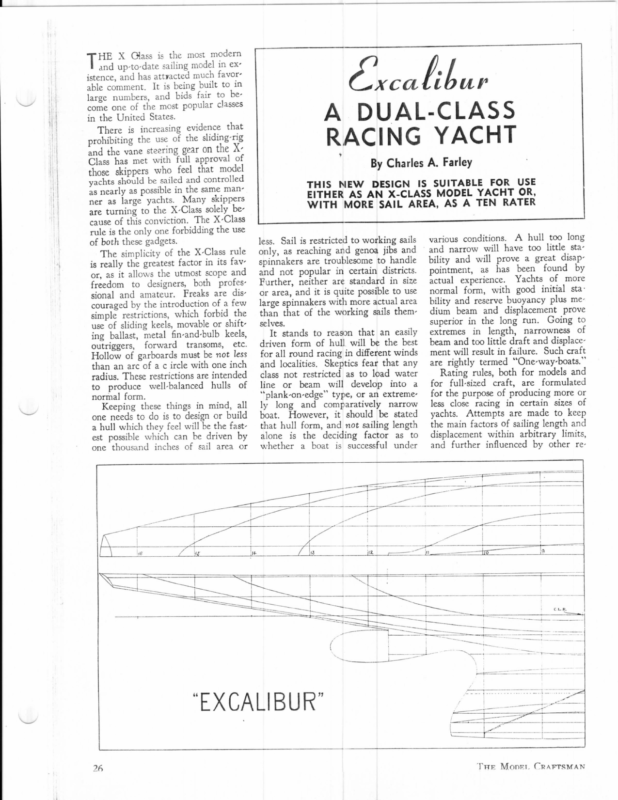
HE X Glass is the most modern Excalibur and up-to-date sailing model in existence, and has attracted much favorable comment. It is being built to in large numbers, and bids fair to become one of the most popular classes A DUAL-CLASS RACING YACHT in the United States. There is increasing evidence that prohibiting the use of the sliding-rig Xand the vane steering gear on the Class has met with full approval of those skippers who feel that model By Charles A. Farley yachts should be sailed and controlled THIS NEW DESIGN IS SUITABLE FOR USE EITHER AS AN X-CLASS MODEL YACHT OR, as nearly as possible in the same manner as large yachts. Many skippers WITH MORE SAIL AREA, AS A TEN RATER are turning to the X-Class solely because of this conviction. The X-Class rule is the only one forbidding the use The simplicity of the X-Class rule is really the greatest factor in its favor, as it allows the utmost scope and freedom to designers, both profes: sional and amateur. Freaks are discouraged by the introduction of a few forward transoms, It stands to reason that an easily driven form of hull will be the best for all round racing in different winds and localities. Skeptics fear that any class not restricted as to load water etc. line or beam will develop into a ‘plank-on-edgeTM type, or an extremely long and comparatively narrow normal form. Keeping these things in mind, all one needs to do is to design or build that hull form, and not sailing length alone is the deciding factor as to whether a boat is successful under one thousand inches of sail area or a (ie ~~ — | al Te le ie for the purpose of producing more or less close racing in certain sizes of yachts. Attempts are made to keep the main factors of sailing length and displacement within arbitrary limits, and further influenced by other re- However, it should be stated boat. a hull which they feel will be the fastest possible which can be driven by Tt dium beam and displacement prove superior in the long run. Going to extremes in length, narrowness of beam and too little draft and displacement will result in failure. Such craft are rightly termed “One-way-boats.” Rating rules, both for models and for full-sized craft, are formulated selves. Hollow of garboards must be not less than an arc of ac ircle with one inch radius. These restrictions are intended to produce well-balanced hulls of _ aa bility and reserve buoyancy plus me- than that of the working sails them- simple restrictions, which forbid the use of sliding keels, movable or shifting ballast, metal fin-and-bulb keels, outriggers, various conditions. A hull too long and narrow will have too little stability and will prove a great disappointment, as has been found by actual experience. Yachts of more normal form, with good initial sta- less. Sail is restricted to working sails only, as reaching and genoa jibs and spinnakers are troublesome to handle and not popular in certain districts. Further, neither are standard in size or area, and it is quite possible to use large spinnakers with more actual area of both these gadgets. ee | Cc. | | = = a | } — = — _ ee = — ees! cL — —— = a a — ae fe { ee| aS 26 ill = aeee S = — — a ———_ Neceoniaiiabiciesiaiaa ‘ e a “EXCALIBUR” ——— ——_ a n. ae = as a oe | | } a= = | at : — ae —_ t Tre Monrr CRAFTSMAN
quirements such as beam, draft, freeboard, load-water-line, length over all, quartet-beam-length, girth, etc., etc. These restrictions, although generally allowing much latitude in hull form, produce certain characteristics, hence the I.Y.R.U. rule develops full- all the requirements and regulations Thus, if L.W.L. is restricted, hol- placement, and the Swedish square: mensional or weight limits being set, bodied boats with rather high freeboard and comparatively heavy dis- metre rule encourages longer and leaner craft, quite as fast as the I.Y.- R.U. yachts, but approximately one- half the displacement of the latter. Designers are always on the look- out for loopholes in the rules, and if any exist, they find them sooner or later. All sorts of devices are emlong le stadisapd by ployed to evade the rules, which calls for still more restrictions, until finally it takes a small booklet to set forth prove ing to ess of isplace- h craft “boats.” ls and ulated ore € ~* keep gth and limits, her re- signer takes the limit for his L.W.L., and the result is a plumb-ended ugly craft, and so on, ad infinitum. In the case of the X-Class, no di- there is no incentive to try and beat the rule, hence a fine form of hull naturally results. One-design classes are less amenable to rule cheating, as they must be as near alike as possible in every respect to rate in. They are often built on the same moulds at the same yard, and the sails made from standard patterns. In the case of models, cortect production of either hull or sails would be too much variation in boats built by different people, either skilled or mediocre workmen. Hundreds of skippers want a larger boat than the M Class, but one with equally simple rules. The X-Class fills this demand. The entire absence of such requirements as L.W.L., girth or quarter-beam measurement, free- board, etc. automatically does away with multitudinous other require- ments, including marks on hull. Marks on deck and spars are also unneces- sary because of the elimination of fore-triangle measurement and limits of hoist and extending of sails. Only a tape measure and a two-inch disc are required to complete all measurements for the X-Class. Excalibur, the accompanying design, shows a sturdy yacht, with plenty of initial stability and reserve more ial stalus me- lows in the profile are introduced, or excessively long overhangs indulged in. If an overall limit is set, the de- would scarcely be practical, as there SPECIFICATIONS OF “EXCALIBUR” L.O.A. L.W.L. W.L.B. EX. B. DRAFT DISPL. AV. F. Estimated weights: 79,75″ 52.0 12.0 Butt. G W.L. space 13.6 10.15 26 Ibs. (full size) full size { 156” 13/16” half size SAIL AREA For X Class: 3.66″ M.S. JIB 20 X 70.5 = 7050” 12 * 48 = 288 9930” Total HULL 725 tb, | FOIDR: LEAD 18.0 RIG 4.8” Stations spaced am” MS. 22K 74 BIA | Total ~| 11390” buoyancy, and will be very fast, especially to windward in moderate to heavy weather. Her speed will com- pare favorably with the better AClass models. Although designed primarily for the X-Class, Excalibur will also make a very good Ten-Rater, with the additional sail area as allowed. A smaller and shorter length-over-all X-Class design will appear later in MODEL CRAFTSMAN. In the case of light displacement models of large size, care should be taken to build the hull as light as pos(Continued on page 43) MODEL RACING YACHT —X”CLASS or 10*RATER DESIGNED TFTSMAN January, 1940 BY C.H FARLEY, 27
Hull Sections Sail plan keel sections 28 THE MopEL CRAFTSMAN
SCALE-MODEL AERONCA (Continued from page 9) upper ends of the front wing mount are therefore bent slightly so they are vertical, then bound to the center ribs of the wing with silk thread. The wing should have 1%” incidence, as shown in the drawing. The trailing edge of the wing is mounted right on top of the fuselage. The landing gear seems complicated, but is really easy to build. Of course, you could simplify it still more, and make it considerably lighter, but there is a certain satisfaction in making this part of the model work just like the real thing, and of course, a full spring-action landing gear like this will protect the plane in many a hard landing. Two sizes of aluminum tubing are used, of such wall thick- ness that they telescope within each other freely, yet without too much play. The 3/16” tubing is flattened at the upper end, and drilled so it can be pivoted to the bulkhead in the position shown. The %” tubes are similarly treated, except that the flattened portion is bent at an angle to bring it parallel to the wheels. The braces to the bottom of the fuselage are 1/16” piano wire, and one of them is extended to serve as the axle, passing through the hole in the 1%” tubing. motor should be run in an inverted This hole should be slightly position in this outfit. The coil and oversize to give some play when the landing gear takes up the shock of If you are handy at doing such things, wind the coil spring from .01” condenser are mounted on bulkhead B, where they are accessible in the open cockpit. Batteries are on the floor at bulkhad C. By sliding them for- But a much easier way is to go to an “trim” that may be necessary can be striking the ground. ward and back, any slight changes in piano wire as shown in the drawing. made, Two fountain-pen cells were electric-motor repair shop and ask for some small brush springs, small enough to fit in the tube. I found none available that were long enough, so used two in each tube or four in employed for current. Ready to fly, she should weigh about 1134 ounces. Happy Landings! RACING YACHT all. The upper ends of the tube are filled with balsa as illustrated. Use 2” pneumatic wheels, and keep them on the axles by soldering a washer on the outside, allowing enough end play for free movement. (Continued from page 27) sible, so that the lead ballast may be sufficiently heavy in comparison with the weight of hull and rig. It should be almost unnecessary to say that before construction begins, a full-size drawing should be prepated from the ones accompanying this article. This can most easily be done on a sheet of ordinary wrapping paper. For those who do not have the facilities for preparing this drawing, a set of blue- Once your landing gear is mounted, it will be No sturdy. exceptionally found amount of hard landing can dislodge it. Tissue was used for covering my original model. It is plenty strong for a plane this size. The wing and elevator are painted solid red, while the fuselage and rudder are yellow, with decorations in red as indicated in the drawing and photograph. A_ black stripe separates the yellow and red prints is available. Articles and plans of the International A-Class, Six-Metre, and the California 40-700 Class will follow. Also articles and plans of the latest types of vane steering gears and slid- areas. Any of the extremely small gas ing rigs are in preparation by experts in their manufacture and use, and will be presented shortly. engines can be used successfully in this plane. You will have to make the Of course, the motor mounts to fit. me _ PACIFIC FRUIT EXPRESS ENTIH ATED CARY: REFRIGERATOR FERS Sud00LNS 6 Wo LOAMT S2To0Las WEL OUN Meer sae WEN SIR Be PR La BWELLZIN LT ASY BA2H0 Las? NI ee, This is the Most Beautiful Model Rector The Colors Are Lithographed on Yet, Sound impossible? brand the Kit’s Only $7.25 and You Can Buy Plan in the big, new 1940 Catalog. And read, too, how you can start building any Lobaugh locomotive for $10. See the three new locomotives, the 15 new freights, and the 85 other famous Lobaugh cars and Lobaugh Institute of Model In Two Parts! OBAUG photographs of Lobaugh locomotives, cars and model railroading equipment. New features! New models! Only 25c IMCROMETED MECISION Railroading, 1177 1940 Catalog Now! An entirely new catalog from stem to stern. Sixty-four pages packed with 110 a copy to readers of Model Craftsman locomotives. The It Send for New Read all about the new Split-Kit Ever Built! Pressed Metal Magazine. Send Howard Street, San When writing to advertisers please mention MopeL CRAFTSMAN for January, 1940 for your copy Francisco, now. Calif. 43
7 av | % « Pt . Y ns |é \ & ODEL YACHTING By R. P, DEZENDORF T HE sport of model yachting is some- times mixed up with the sailing of the common homemade or “toy boat” variety uf sailing, where the proud parent whittles out a small boat from a shingle or a piece of scrap wood that is lying around the cellar collecting dust. The majority of these are poorly designed and turned out. They may be the finest of craftsmanship, and the people take the model to the lake where “Junior” sits on the shore while “Daddy” tries to sail the boat. Now there is nothing wrong with this type of model yachting, and soon another proud parent comes along with his offspring, and the two get together and start a race to see which toy is the fastest. Then the parents get together to see if they can pool their ideas and also gather information about the sport. About this time a model yachtsman comes along with his racing model. They all get together and that is the start of a club or if there is a club already, there is a new member. It takes a certain amount of mental exertion to properly design a successful model yacht, and considerable time, pa- tience and skill to build it according to the plan, and last but most important it takes stamina and self-restraint to sail in competition or to win a race. The designer must have a knowledge of the rules governing the class he has picked for his yacht. This seems complicated to the layman. He must understand the fundamentals of naval architecture and how to calculate displacement, centers of buoyancy and gravity, center of lateral resist: ance and position of the sail plan. These were described in detail in Mr. Farley’s article in the last issue. Of course every skipper does not design his own boat, but builds to the plans of some accredited designer who may be a designer of full sized boats, or of one who specializes in sailing models. Some of the models are built by “eye’ or “rule of thumb” and in many instances have proved very capable and able boats. In some clubs models are sailed from skiffs, over a triangular course, varying in length from 1500 feet to 4 miles. In these 44 P~t ’ races it is to try to give the model a beat, a reach and a run, the same as the large boats use. The models perform in a manner that would be a credit to their larger sisters, and the skippers chasing them in a fair breeze realize that this game is not child’s play. Often the ut most in endurance is required by the skipper. In pond sailing, the physical exertions of the contestants are somewhat reduced, as compared with skiff sailing, but many miles are covered in the course of a re- gatta. Lifting the heavy A Class boat weighing about fifty pounds, in and out of the water after each leg of the board, helps to keep the back limbered up. Plenty of real exercise is obtained, and the skippers and mates cheerfully endure hardships of all kinds, such as sloshing in the rain and mud, or baking in the hot sun, carrying on, rain or shine, sometimes outclassed and often suffering from cold or hunger rather than quit a race once started. It is no sport for a person who can’t take it, this model yacht racing, and one must be on his toes continually to keep up with the fellow who is an expert. So the models sail on in the rain, snow, sleet, and sunshine. It is one of the sports where the interest never lags as there is always something to learn. New ideas are seen at every regatta and Model Yacht skippers are always building a new “winner.” News is a little slow in arriving, but here is the latest on officers for 1940. Long Island M.Y.C., H. Avery, com: modore; F. Bennett, vice commodore; D. Harriman, rear commodore; Tex Foster, secretary, 113-13 Atlantic Ave., Richmond Hill, L. I, N. Y.; G. Bett, treasurer; and Staten Island A. Seaman, measurer. M.Y.C.: A. Brassington, commodore; H. Kolb, vice commodore; Alex S. Sellar, 29 Kingsley Ave., Westerleigh, Staten Island; N. Y. secretary and treasurer; Avrid Anderson, measurer. May we wish the new officers a very successful term of office. The annual exhibit of model yachts will be held in conjunction with the Sportsman’s Show, February 17 to February 25, 1940 at the Grand Central Palace, 45 Street and Lexington Avenue, New York City. We expect to have about seventy yachts on exhibition. Some of the exhibits will deal with the different methods of construction. Some will be all ready to put overboard. Mr. GC. O. Brook who was formerly the correspondent for this column has joined the Long Island M.Y.C. and is the new publicity department. (You can’t keep a good man down. Ed.) As we enter a new year of Model Yachting let us all resolve to put the sport above our personal interest, as we believe there is nothing that gives a person more for such a small outlay than the healthy competition we find in the sailing and racing of a model yacht. Model Yachting In Cincinnati Starting some five years ago the Public Recreation Commission of Cincinnati gave the writer carte blanc to form an adult club or guild for the promulgation of information concerning model yacht design, building and sailing together with a shop to work in. At first we did our work in the pattern shops of several High schools, but eventually we obtained from the Recreation Commission our own shop and we then became the Ship Craft & Model Engineering Guild. The name was to encompass the fact that we were in- structing in the building of old time ship models, furniture models, topographical models, power-boat models and their power plants and other mechanical models. However, as we went along there were discovered a few members who favored some sailing models. Feeling that a 36” model with plenty of sail area on a rather sturdy hull would fill the bill, a 36” model was designed to displace twelve pounds and carry 1,000 square inches of sail area. Six of these boats were built in our adult class or guild and proved very satisfactory from the sailor’s point of view and that of the “gallery” who gath- ered to see them sail. Our sailing facilities were not so good at first either, inasmuch as we had to use a pond which existed a long time before we started sailing and of course was not (Continued on page 61) THe MopeL CRAFTSMAN
VALVE TIMING (Continued from page 59) starting a son some valves a diameter cotail Dealers little difficult. For this reabuilders prefer to open their little later. The base circle should not be less than irectory ~/16” for a 15 c.c. engine, and is pre- ably 34” or 7/16”. The radius at ~the peak may be 1/32” or 1/16”. Great care must be taken to make the cam outline as accurate as possible. Any irregularities will cause valve closing points will be very different YES SIR! from what the designer intended. anism is laid out and made, the results will be disappointing if the cylinder and head are not well finned. The fins should be spaced 1%” to 3/16” for a 15 c.c., and about 14” for a 30 c.c. For high-speed work, it is necessary to use strong valve springs. A tension of five to eight pounds when the valve is closed will be about right for the average 15 c.c. job. When properly cooled, these small cylinders can stand high compression ratios. Ratios of seven or eight to one are common, and up to twelve may be used with high-octane fuels. MODEL YACHTS MODEL RAILROAD If you have been disappointed by other shops, try It’s 10 to | we will have what you want. us. THE MODEL RAILROAD SHOP Dunellen, (W. 7th St.) “Serving Model Railroaders Since ae 292 Vail Ave. prove satisfactory from a model sailor’s nint of view. We suggested to the “wecreation Commission that they place a concrete curb around this pond for us and deepen it a little; this was done some time later, and we had a sailing pond; but How- HOBBY LOBBY, INC. 371 Main Street, Hackensack, N. }. Complete Line Railroad Supplies All Gauges—All Makes Gas Engines, Kits, Boats, Race Gars class were run in Irvington, N. }. Model Railroading in all Gauges ime Payments Arranged – ArcheryandSupplies — AirplaneMagazines Boat Railroad Catalogs governing rules, which are, to bring out a boat 50” long which carries 800 square inches of sail area. Eight of these boats have been built of frame-andplank construction or are in process of finishing. Those that have been sailed re stable and fast. An alternate rig was __also designed to meet our own light air conditions, which has a sail area of 1,421 square inches; this rig is just to get the (Continued on page 62) kinds of all Racing Cars and all on TELEPHONE: Parkside 5794 BUFFALO’S only Hobby Shop, operated by Model Railroader for Model Railroaders. a Whatever may be your needs, call on us, we can supply you promptly. Open evenings until 9 P. M, except Monday and Thursday. MT. VERNON, N. Y. Sundays to | P.M. Open 9 to 9 MODEL Complete ES. SUPPLIES stock of AND model HANDCRAFT railroad supplies and equipment; model ships and fittings; modgl air planes, gas engines, tools, ete. Built up and in kit form. Also leathercraft and handicraft supplies. 758 SPRINGFIELD AVE. 2-6211 HOBBY CRAFT STORES, Inc. 23 PATERSON, N. J. NORTH JERSEY’S HOBBY CENTER Model craftsmen will find here a complete stock of model railroad equipment in O, OO, HO, and CD gauge. Also airplane sup- plies, gas motors, boats and kits of all sorts. Established over 52 years in the Haréware, East Second St. Mt. Vernon, N. Y. Patronize the dealer whose advertisement appears in this section. His store is pledged to fair prices, good service, merchandising principles. and honest NEW YORK CITY, N. Y. Sporting Goods and Toy Trade. H. M. ASH COMPANY Paterson, N. J. 180 Market St. Central Jersey Models —Hobby Store— Kits and Supplies for Railroads, Boats and Airplanes PHONE: WESTFIELD 2-2232 Westfield, N. J. Mr. Retail Dealer: Your ad in this space will keep your name group of active model before the builders community—the readers of Model Rates are surprisingly low. man. Pins, Rings, Wristlets, Lamps, Airplane and Book Ship IRCRAFTERS —NEW — 135 Elm St. EVERYTHING FOR THE AIR-MINDED AND THE NAUTICAL-MINDED Emblems, Ends, Gift Items, Goggles, Models, Motors. Supplies. WESTFIELD, N. J. many roughly, Airplanes, Will make repairs miniature motors. makes of trains at special prices. Model other cities. With this in mind, the writer designed another new boat to meet the Trains in all makes and gauge, Boats, 511 E. Winspear Ave., Buffalo, N. Y. Ave.) Between 22nd St. & Ellis Ave. this N. Y. BROOKLYN, Open till 9 P.M. every night K & K HOBBY SHOP In the meantime, the Park Department rebuilt a former Iris Dell into a concrete lined and curbed sailing pond in Cin- effect on the Ship Craft & Model Engineering Guild was a loud clamor for more sailing models. The Marblehead or Mc-class 50-800 boats were considered very popular and AVE. 259 WILSON BUFFALO, N. Y. We carry a large stock of new and used scule and Tinplate Model Railroad Equipment at all one of these days. Largest A Department for everyone having a Hobby! IRVINGTON, N. J. times. HOBBY LOVERS Visit the and Come HOBBY NOOK in BROOKLYN THE RIDGEWOOD HOBBY NOOK Hobbies and Crafts THE HOBBY SHOP place for the small boy or girl and their parents, as guests, to sail small boats. Its Brooklyn, N. Y. Foxcroft 9-4895 Opposite Y.M.C.A. (near Sanford Tel: BEachview 8-0231 8223 Fifth Ave. ATTENTION! ever we made the best of it, feeling that a sizable sailing pond might be wangled cinnati’s Eden Park and then it was seen that many people, previously unsuspected, were model-boat minded. A great many new boats appeared, both power and sail and most of them were very good pieces of work. Also, it provided a recreation Model Airplanes, Model Boats, Model Railroads, Kits & Supplies HACKENSACK, N. J. 1288 Springfield Ave. of a shape, size nor location which would for J. Madison Cycle Company (Continued from page 44) races THE FIRE PLACE CRAFTS & HOBBIES, INC. We’ve got what it takes to build a— However carefully the valve mech- with a fountain in the middle of it. BROOKLYN, N. Y. DUNELLEN, N. J. bounce, and the actual opening and in largest your Crafts- IVhen writing to advertisers please mention Move CraFTSMAN for January, 1940 1206 Second Ave. Tel. Between 63rd & 64th Sts. New York City Regent 4-3510 AUTHENTIC MODEL SUPPLY CO. 142 E. 45th St. Tel. VAnderbilt 6-4084 RAILROAD—AIl Gauges—Walthers, Varney, Knapp, American Flyer, Nason, Mantua. MARINE—Gordon Hulls Marine Built, Grant, Ships Engines AIRPLANE—Peerless. _ Ideal tors, Accessories, Ideal _ Rigged to Kits, Fittings, Tools. Kits. order. Mo- 61
MODEL YACHTS (Continued from page 61) Retail Daaton Directory most out of the hull for our own pleasure when not racing in the class. These boats when using the large rig with its seven-foot mast make an impressive sight in action and are already influencing the public in their request for a regulation sailing pond that should be about 250 feet wide by 800 to 1,000 feet long, located in a place where there are few trees (CONTINUED) if any, and to have a cat walk of plank NEW YORK CITY (Con’t.) PHILADELPHIA (Con’t.) around its edge and a permanent shelter NOBBY HOBBY SHOP We have just had word that a pond is being constructed at our Lunken Air Port, part of which may be made available for NEW YORK’S COMPLETEST THE POLK’S MODEL ‘CRAFFT CENTER 0-00 – 429 Seventh Ave. (Bet, 33rd & 34th N. Y. C. St.) HO New York equipment, gas model engines, kits and supplies, ship models and fittings. 3925 N, BROAD Come in and see Other displays. 120 W. Jefferson St. Syracuse, N.Y. PHILADELPHIA, PA. 522 630 & ALLEGHENY AVENUE, PHILA, PA. MODEL SHOP MODEL BUILDERS KITS SUPPLIES PARTS FOR HO Railroads—Ships—Airplanes also many a time when a reputable Pa manufacturers, There is race has to be sailed in rain and gusty winds, which in turn developes sturdiness and “‘stick-toitiveness.” matter in the magazine Recreation for July by saying that if we are given a suitable sailing pond we will fill it with models. We hope anyone reading this article and at all interested in a substantial, healthy and interesting sport that develops brains, brawn Market Street and you can depend on him for honest value, and business, will interest to the Public mission of Cincinnati the Visiting write of their Recreation or to the sailing pond model sailors Com- writer be com- would spend money in our city for housing and food and we would feel much better in visiting out of town ponds if we had a place to invite the friends we make when out of town. Wm. Richards, Craft & Model Engineering Guild, Public Recre- Director, PITTSBURGH, PA. ation Ship Commission, Cincinnati, Ohio. TRI-STATE HEADQUARTERS FOR MODEL BUILDERS FITTING SIDE RODS KITS AND SUPPLIES “HO” – “OO” . “O” GAUGE RAILROA D AIRPLANE KITS – GAS ENGINES Complete stock of small parts Nationally Advertised Lines CAMERADIO CO. PITTSBURGH, PA, — WHEELING, W. VA. CINCINNATI, OHIO PHILA., PA. CINCINNATI HOBBY SERVICE 1016 name _ before At last!!! Stocks Cars, Stop of a Airplanes, Balsa, in Cincinnati and Dope see & 9 P.M. Store Boats, Carrying Gas Complete Motors, Racing Supplies. our large pPPCFER fitting of all side rod bearings on 6 & 8 Wheelers i quite a task and I have heard some very discouraging remarks from en- thusiastic builders as to the fit of same and then admit that they finally made bearings loose enough to overcome tight spots and consequently it is a very noisy set-up when in opera- tion and not workmanlike to have backlash on a job that has just been Walnut St. Open till hobby audience with a monthly listing in this directory. Rates are excep- the pond out in the open air. Dr. Charles E. North aptly phases the Buy all your model supplies from HO-Gauge Railroad Buildings in Kits 62 layout—also the dealer whose name appears in this list. He carries the products The Model Shop’s Own Design tionally low. HO ment, splendid companionship and keen observation while racing, to say nothing of the healthful exercise in chasing along pleted. COMPLETE SERVICE TO biggest our operating in its building phase, both wood and metal working; and requires poise, good judg- recommending Quaker City Model R. R. Shop community’s PA. So, 52nd St. Phila., PHILA’S MODEL R.R. SHOP your velopes the highest type of craftsmanship HERBACH & RADEMAN. INC. of Have You ver your factors in skill and craftsmanship and is an outlet for several very important urges; it is creative in its designing phase; de- Modelers’ tools and accessories. Kits – Parts HOBBY SHOP, INC. Put It must be remembered that model yachting calls for several very important HOBBY CENTER “A Complete Line of Hobby Supplies” Dealers: PHILADELPHIA, If this sailing pond can be ac- complished, we can invite Chicago, Detroit and the eastern and western clubs here to sail with us in the most fascinating of all sports. We carry a complete line of supplies for all mode! builders. Railroads, ships and RAILROAD – BOATS – AIRPLANES 6025 OCONTZ AVE, PA.. Railroads — Airplanes —. Racing Cars — Boats airplanes. THE Mic 3430 West Philadelphia Model Shop SYRACUSE, N. Y. SYRACUSE ST., 711 892 Clinton Ave., South Hulls Phone PHILA., M. B. SPOTTS THE HOBBY SHOP O and HO Shaped our use. Gauges WEST PHILA’S ONLY COMPLETE MODEL SHOP Hobby Center of Western New York, carrying complete lines of all popular makes railroad OO BERKELEY – IDEAL – SCIENTIFIC Inc. ROCHESTER, N. Y. of – O – DENNYMITE GAS MODELS DOOLING RACE CARS HO os TRAINS – BUILDINGS – SIGNALS AIRPLANE KITS – BOAT MODELS WE STOCK BROWN JR. MOTORS We carry everything for the model builders. Come in and look around. Street IN PHILADELPHIA RAILROAD GERMANTOWN, ment, Also model ships, racing yachts, and all types of boats, finished and in kit form. Fittings and parts, Best selection of airplane supplies, steam and gas engines; machinery and tools. West 42nd MODEL AEROPLANES – BOATS – RACING CARS SUPPLIES FOR THE MODEL BUILDER We carry a aha line of model railroad equipment in O, OO and HO gauges and C-D equip- 112 EXCLUSIVE 4407 Germantown Ave. Phone LOngacre 5-3523 HOBBY CRAFT STORES, ONLY house for the models and visitors. and complete stock finished or overhauled. First be sure all drive pins are equal distance to center of drive wheel This pin also must be in plane with When writing to advertisers please mention Move. CRAFTSMAN for January, 1940