The Model Engineer and Amateur Electrician: 1900

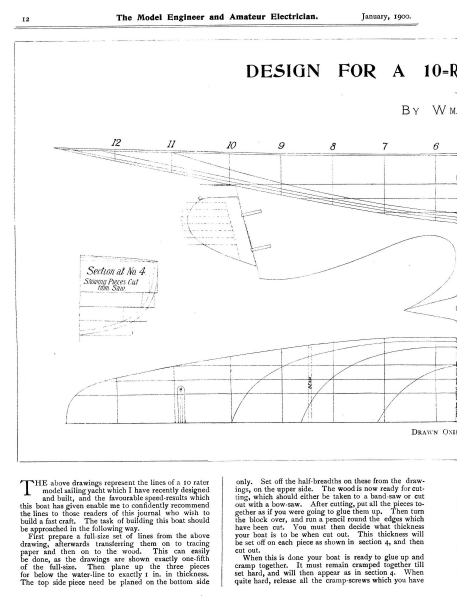
  • Technical Design and Construction: It provides a detailed guide for building a 10-rater model yacht. It explains the “bread and butter” method, where three 1-inch thick wooden planks are planed, marked at one-fifth scale, cut with a bow-saw, and glued together to form the hull.
  • The Measurement Rule Debate: A significant portion is dedicated to the “vexed question” of how to measure model yachts for competition. Mr. W. F. Behenna and other contributors debate the merits of the L & SA / 6000 rule (Length and Sail Area) versus linear rating, seeking a unified “British Model Yacht Measurement Rule.”
  • Obituary of a Veteran: The text honors Mr. Isaiah Tansley, who passed away at age 82. He is noted as perhaps the oldest model yachtsman of his time, having built and sailed models for 69 years, dating back to 1831.
  • Club News and Racing Results
The Model Engineer and Amateur Electrician. 12 January, 1900. FOR A jee ; Section al No 4. | ~ Shounng Pieces Cut Lm Saw pe / { | Pa eee aac i a i@) |i | £ | L ity Hi pale! DRAWN ONE HE above drawings represent the lines of a 10 rater aseae yacht which I have recently designed t, and the favourable speed-results which The task a Bailine this boat should w be approachedin the following way. First prepare a full-size set of lines from the above drawing, afterwards transferring them on . tracing can easily This paper and then on to the woo e done , as the drawings are shown exactly one-fifth * the es Then plane up the three pieces ater-line to exactly 1 in. in thickness. The top ‘a piece need be planed on the bottom side only. Set off the half-breadths on these from the drawodis now ready for cutings, on the upperside. The woo ting, which should either be taken to a band-saw or cut After cutting, put all the pieces toout with a bow-saw. eel as *f you were going to glue them up, Then turn he block over, and run a pencil round the edges which _— been cut. You must then decide what thickness is thickness will your boat is to be when cut out. be set off on each piece as shownin section 4, and then cut out. When thisis done your boat is ready to glue up and er. It must remain cramped together till en set hard, and will then appear as in section q. quite hard, release all the cramp-screws which you have Mebananyy | 5-1 in. diam, slightly tapered seway, and the only vemmmeni spars—thejib and main booms—may be of pine or spruce. The Model Engineer and Amateur Electrician. March, 1900. Model Yachtin g Notes. (The Editor will be glad if the Secretaries of Model Yacht Clubs will keep hin miata’ 4 ‘a all doings of interest suitable for lasertion in this E have justee the list of fixtures of the Sur- biton M.Y.C. for the 1900 season. These extend rom February 3rd to November 24th, an include the Commodore’s Challenge Cup fixtures for 10- and: 20-raters, an Inter-Club Challenge Cup race for meee: February and ay the starts at 2 p.m. ; ing April to August, a! are iened. to take part in the races should communicate without delay to the Editor of the Strand, London » W. Cc races promoted by the Surbiton Club will be held on Easter ey and Whit-Monday, the starts being fixed Yachktsman, 143, The Yachting Exhibition, held = the Royal Aquarium * uring February, contained mber of interesting exhibits of boats, Cae eet camp equipments, y well known firms being mpceteL including . E. Messum and The Monarch Motor The Mac racing i mbe- Didone ,and No Laat eg at2 jub water is the Rick Pondin the Home Park. “The ee rule iis the S. Ax L.W. Lee+ 6000 = rating. he first eg races for the Inter- Club Challenge Cup Portable Electric Boat Propeller, which has before the boating public for some five years, with apparently very satisfactory results. Model Yachting Correspondence. Inter-Club Racing Rules. 0} each club, however, being limited to two representatives. Any club winningthe cup twice in each year is entitled to hold it till the close of the following season, and any club thus winning it for three years is entitled to retain the cup as being won out and out. The competing models must be Io raters under the Y.R.A. 1887 Rule. 65 pastime os should bring about some very keenly contested r We would suggest that those clubs who The hon. secretary of the Surbiton M.Y.C., Mr. R. M. Boniwell, ‘‘ Barrymore,” Surbiton, will be pleased to send full rules and ye eee of this fixture to any club wishing to enter for the t . The Model Yacht Sailing Association of ienelugten were last year’s To THE EDITOR oF Zhe Model Engineer. Si1r,—There has been much written advocating this and that rule; “ad a lot of it has been of no use, for the simple reason that no reasonable evidence has been given to support. a majority there has been a desire to give and take, as it were, so as to obtain finality, in order to make a start. (See Mr. Smith’s letter, and ve the Newsham Club, Decemberissue.) It, therefore, seems to me a thousand pities after the advance we were apparently With regard to the vexed measurement questicn, Mr. making, through the aid of your journal, that any idea should come forth again, suggesting the adoption of the old (dead in the yachting world) 6000 Rule. The very fact that it has been in existence with certain model yacht clubs, and will not be adopted by others, is surely ample and strong enough evidence that it is not acceptable for best for all purposes. They therefore propose to adhere toit as the official clubrule. The water-line is taken with the heaviest rudder and the largest suit of sails all aboard. have been exhibited to thoughtful readersin your issues, winners, Boniwell Sites that the pe yee of his club have discussed the various met of measuring models, and have come to the cones: that the Y.R.A. Ruleis the * * * Mr. A. C. Slater, of ‘‘ Hafod,” Llandudno, writes: “*Tt is my intention to start a model yachtclub here as soon as the pondis finished whereon to sail the models. Years ago there was a clubin ‘active service’ here, but owing, I fancy, to insufficiency of rules and also in- adequacy of same, the boats got so very large that the man ve: had the biggest boat captured all the prizes, and so sport was ruined, for the a lost all its ee and existed in name only. * S&S Rule works out, I am of opinion that this is a good rule when not carried to excess. We do not propose to allow any 5-rater to be more than 36ins. L.W.L. with the sail area allowed to bring herfea to 5, and the same rule with 24- raters none of them to have more than 30 ins. L.W.L.” Mr. ee will be pleased to hear from readersin his district ho would be agreeable to help in the formation of the niepocelleclub. An Inter- Club Model Yacht er race has recently been proposedin the columns of the Yachtsman, and several letters on the subject havebeen published in that well-known journal. We understand that Captain a ue yee: ofthe J Ss a pri t has been tet, and classes of boats 1 fancy we shall ae are a 5-rater das and a 24-rater class. As the ie XS anting; some of and showing that it is not good enough when something much more desirable can be had. (See what Mr. Cubbin says about it in the latter part of his December letter.) Exactly; and it always will be so, where sail area is brought in like that. Model yacht sail area is an entirely different matter to real yacht. For one thing, we should never think of trusting our lives at sea in the like of such things as I have seen h given £5 und for this contest, and wehope that he Pipes will Be successfully carried throuugh. It cer- tainly should do much to arouse fresh interest in the time keep up the speed, therefore let a model yachtsman be freein this respect and let him use his judgment as to the power of the wind, and as to what his yacht likes best at the time of racing, which, in itself, is an interesting study; and all will find that an over-canvassed yacht is certainly no good-es racing. ae about this poi Read what Mr. Flockhart Taking a surveyoF the correspondence on this subject, I cannot find any practical or scientific reasonAaa taking S.A. into a rule; but t e y for not doing so, yet showing how theypower of a modl, can be readily ascertained, and checked by simple methods without waste labour, can be understood, and applied by all members, and not by one or two officials of the club only. I therefore have much pleasure in supporting and advocating the adoption of the rule suggested by the Newsham Club, viz. :—3-5 L. + B. 4 D. Yours faithfully Cardiff. 85 The Model Engineer and Amateur Electrician. April, 1900. i | The 10=-Rater “ Zebra,’’ and How It iss being Built. | | next worked and put into place as shownin sketch (D). It is seetally worked out of a piece of mahogany 5 in. of tim , andis ae “iuilt by set off Pigdde of the oldest members of the Port of Y.R.A oe L. and S.A. long and about 9 ins. wide and 1 in. thick, and fastened to it with two 2-in. slight iron screws. A centre lineis put on the board; the centre of each mouldis kept to it, and square to the board, as in sketch (B). The stem is By A. J. MITCHELMORE, HE Zebrais Lee for an open aa 10-rater, under the 4 ft. gvjins. moulds are then placed on a board about thick and about I in. wide, and sharpened as shown ; ne paler es being two brass screws one each end of She f. The rabbet bene cut, as shown in sections, the Mr. Vickers, one ‘OTTO NK fea LLBIESSS CNS reas LEAD — BULB / fOvss. iz 10-RATER MODEL YACHT ‘© ZEBRA.” Plymouth M.Y.C., also an old member of Kingston and Hull clubs. Sheis being built in the following manner. A lineis drawn parallel to the L.W.L., as shownin sheer plan (A, Fig. 1). This gives the depth of all the moulds di i in the usual way, ‘4 in. deal board urpose ; each mould should have a score taken out of it to receive the keel, % in. wide and \% in. deep. The keelis bent round and halved into transom, as shownin A piece of yellow pine, % in. wide sketch (E, Fig. 3). and 4 in. thick, will do for keel. If the scores are taken out of the moulds nicely, the keelis sure to be straight. The timbers are then bent around the moulds, as shown in sketch (C, Fig. 2). They are of American elm, }{ in. by ¥ in., let into the keel, and fastened with ¥ in. brass screw; the head being fastened with a 34-in. slightiron 86 The Model Engineer and Amateur Electrician. screw, as shown at section(C). boiled iin a canister The timbers can easily be gu of one and yellow pine 7% in. thick, fastened n April, 1900. Model Yaentin g Notes. e timbers are 3 ins. apart. (The Editor will be glad if the Secretaries of Model will keep Vacht Clubs hin advised of all doings of interest suitable for insertion in this colunin.} R. CHARLES E. HANCOCK, of Cardiff, writes: “*T just write these lines to snares that during the present year clubs pent = t least give a trial the ureeted rule of 3-5ths L.W.L. + Beam+ Draught a measurement of ‘linear Spee giving a handicap of half on per inch rating per minute of the time occupied in fi ome mi this kind might very well be follo ae in races for large with two or three coats of varnish. Before working off the outside planks, a small gunholeis worked 3-16thsin. square, to take the beams er dec! yachts; but such a proposition ei perhaps, too reasonable to find acceptance at the hands of those who govern the sport of real vessels. The trials I refer to above might be carried out, without any interference with the rule adopted by any given club, on such occasions as could be found aplice oap and at the end of the season reports could to prevent it be made of the result. the only way to from twisting, and be dded into the keel The boat without lead bulb, should with Ste lead. there ZEBRA 10 RATER are nara advantageous, and experience rule which left D Seats 2in- |Foor I should also like to add my support to the ee that your eo should come out oftener. If th of your subscribers who wish it well, ae to copies – eachissue and ped one to a friend, it Fic. 4.—Sai_ PLan or *Zepra.” not weigh over 6 lbs, her displacement being about 16 lbs. Sheis called Zebra, because sheis heing planked with dark and light wood alternately. I have avoided all technicality in this description, so that the amateur builder can understand it, and shall be pleased to afford any information required by your readers, THE PRorosED INTER-CLUB CHAMPIONSHIP.—With regard to the proposed model. yacht inter- = Sse ship referred to in our last issue, we are sorry to learn from Zhe Yachktsman ae this has euckel ‘bat little promise of suppo It is not encouraging to those who have intimated their wilioga ess to contribute to the prize-fund and to generally help the matter forward, and we are afraid the matter will drop through unless model yachting clubs show a more active interest in the scheme. that feature which ii s, I think, the backbone of every successful paper * Since the death of the late Mr. Isaiah Tansley, of Lowestoft, referred to in our February issue, South yachtsman in England. The gentlemanin question, Mr. is n Kyle, who lives in pale Street, has spent the whole of his agelife—84 y in the town. Mr. T: Mr. Kyle is immensely proud of the silver cup he won in 1873 from Mr. William Swinburn. The holder of the cup was then in a rather peculiar position, for he was subject to being challenged not mo c Pp er ownership ae the trophy, and out of all the races which The Model Engineer and Amateur Electrician. 210 The 2%-Rater Model Yacht – & Sunbeam.” September, 1900, between the pie or, rather, to draw the plates fopel ee A round-faced hammer closes the edges first, as at whereas, by using a flat hammer, the first blows tie the whole rivet eral both in the stalk near the head and the in E have pleasure photon) of the “2h. rater model yacht, Su M model has been made by L. Thompstone, Es ill be known to many of our beam. readers by reason of ‘his excellent model steam and ciently to shear? neglected. The thickness of his rivets must not be Let him read Unwin on ‘‘ Machine Design,” and he will find proper proportions for rivets. Trusting this will be explicit and useful to your numerous correspondents.—Yours truly, ** Egor.” Steam Turbine. To THE EDITOR OF The Model Engineer. Dear Sir,—As I intend making a 2 h.-p. generator and turbine, I should be glad if any of your readers could give me information as to size, correct heating-surface of generator, also best working pressure, size, diameter, length, size ofinner drum, size of blades, number, angle, and increase in size of same, and anythin that your readers know of leading turbines, preferably Parson’s, of Newcastle. If any of your readers have drawings on the subject—I have designed drawing of a 3-ft. model yacht, fiddle bow, solid built, not a racing boat but one which is perfectly reliablein almost any weather; I have made one to the same drawing,and am more than satisfied with her—I shall be pleased to exchange same temporarily.— Yours truly, Gro. T. RICHARDS. Woodstock, West Didsbury, Manchester. A Moper Yacur “ SuNBEAM.” electric paras which we have described in previous wnbeam has an overall length of 40 ins., issues. breadth of bea 6ins., and depth 84 ins. Her sailing qualities have proved to be exceptionally good. Thrust Block with Ball Bearings. To THE EDITOR OF The Model Engineer. Dear SiR,—Being about to build a combined engine and dynamo, I should like a few hints from readers as to construction of engine to get a high speed. Will “Zodiac” please give further details of his engine, and Practical Letters from Our Readers. the ful The Editor invites readers to makeuse of this olan‘nalforinterest. eee though shee des intended for publication. Rivetting. To THE EDITOR OF Zhe es Engineer. M,(Clapham), I am Degar Sir,—In answer to first of.ail too hard, and can be rivets are, of opinionbyhisheating to a blood- red heat and throwing softened and, if possible, a small drift put through, rendering the holes more like the sketch (az). The riv a should be just to fit, and well held against by a hammer made first blows by a flat-faced hammer fill the holes, and chen the formation of the head after tends to tighten the joint say what changes he made in his second engine and the result ? I enclose a sketch of a thrust block with (cycle) ball bearings, which has much less friction than usual, and is splendid for launch work. The parts must be made of steel and hardened —Yours truly, “STERN TUBE.” The Model Engineer and Amateur Electrician. length, 30 ins. ; beam, 6 to is] or ow Q We are glad to see that model > pe =] ° ° 3 o 2 invitation of Mr. similarly interested, will respond to theissue, a successful x, H. Rooke, expressed in our last jecti o the Qu over a depth, 7 to 9 ins.’ cement, and the cork pushed in until the top is flush with the top of the collar. A small washer of i October I, 1900. we sail, we tance from the city of the water on which go in for large cannot, owing to difficulties of transport, boats, such as are mentioned from time to time in your paper. We find our boats very handy. The approximate 7 ins. 5 of various on the inside end of 4-in. pieces of brass tube an diameters), and a piece of glass tubing 4 ins. long, is pushed large enough to admit the brass rod on the plate, the through in. 1 protrudes it until through the hole neck the to fitted is collar brass A cork. the of bottom < 230 —— club will soon be inaugurated. * of the Manchester Model Yacht Club The eighth race when two season took place on Saturday, August 11th, Hugh Avery) boats contested for the hon. sec.’s (Mr.from the north_ There was a very light breeze; in the deciding and The jar, when covered, should be ng west and good scoring was difficultbeating Lapwing. eat, Mr. G. E. Ost’s Luna easily prize that Lava This makes the fourth consecutive firstindefatigably, her has won this year ; her owner sails her and one five firsts, one second, record this year being third out of eight races, of which she has only taken part in seven. * * * of the H.M.S. Mr. W. F. Behenna, hon. secretary Will you kindly M.Y.C., writes as follows :—**‘ .S. Fic. ‘ o Curagoa will be, for the future, known as that our officers and men, and I may add our 10. All little fleet of models, have been transferred to the C/co- put aside and not handled until the glue has set. Meantime the base should be fitted with two pieces of 4-in. brass rod, terminating in small brass beads soldered to their upperends. These are placed diametrically opposite each other at a distance of 134 ins. from the centre. In avoid tearing. The base should now be polished on the i outside, and the brass lacquered. cork, and having cut two strips of gold leaf 2 ins. long and % in. wide, rub the merest trace of gum on the flat sides of the rod and hold the breath for a moment, whilst the strips are taken up on a needle point and set in place The strips may be cut by placing the gold base, and all is complete. If properly made, this electroscope will be very sensitive, and shculd possess an excellent appearance. Model Yachting Notes. Model Yacht Clubs [The Editor will be glad if the Secretariesofofinterest suitable for Z will u keep hiim advised of all doings insertion in this column E have received the following letter from ‘‘ Skipper” with reference to the roposed model yacht club for Sheffield :—‘‘I was pleased to issue for August the letter from ‘Maha went to Brixparty from the ship, with three 20-raters, West of England ham on Bank Holiday to compete for thecompetitors —two Challenge Cup. There were fourteen three Plymouth, from Fowey M.Y.C., three Dartmouth,Unfortunately, the Brixham. three Curacoa, and three an rained and aspect, November weather put on a 29th, a gale, so the race has been put off until September go when the Cleopatra is due at Dartmouth, and we shall for better weather. to Brixham, 5 miles distant, and hopethe v . entertained although Mr. Hanwhich would take some beating, andyour last issue) is so cock, of the Cardiff M.Y.C. (vide he wow much against our rule, I am sure While entered. models surprised at the splendid i the that ing the old ‘defence’ an agr ement by the beam and depth, I would welcome 600c Rule, S.A. and L. the using clubs of number large Model Yacht We are pleased to hear that the Bootlehas alrea: Club, though only founded this season, membership of eighteen ordinary, and and the following members. Captain Rice is president, Conrad, form the committee—viz., Messrs, Sergeant, Mr. Drury. and McCabe, Captain Evans, McEachern, treasurer, and Mr. A. P. W. B. Cumming, jun., is hon. Bootle, is hon. Liverpool, Road, Foden, 109, Gloucester Waterand Area Sail the adopted club secretary. ‘The : : A. x L.W.L., _ . line Rule—viz., ——¢o00. and it has given every m satisfied with the yawl’s per- Lam well valuable paper. _ _formances—she is both fast and stiff. Owing to the dis- The majority of the models satisfaction to the members. two are of the fin-keel type. are keel boats, though one or every 5 up to 30-raters. The smallest class is 5, advancing 256 The Model Engineer and Amateur Electrician. October 15, 1900. tion together with a key, which gained a bronze medal nd a first-class certificate of merit at the Grantham Model Yachting Correspondence. Ja esay [ “he Editor invites readers to make use of this conte hg the full discussion of mai Industrial and Fine Art Exhibition, held at Grantham iin 1898. Since then I have ma c time each quarter of an hour on eight bells, andI fase also just completed two more 8-day timepieces with 12-in. dials and dead beat escapements. ave a 3 in. Britannialathe, a hand lathe, and also a small German lathe specially made for clockmaking. My 3-in. lathe I have fitted with a division plate, and am now able t my o heels he pinions I make fi pinion wire, being hardened and tempered before being placed in the ks. I have pleasure in more especially the last one, which deals very Taliwith Seeing connected with clockwork in a ala a sive anner. ese ole are entitled —‘* The Clock Jobbers’ m. ‘ull name and address of the sender should ‘invariably be “attached,though mot necessarily in sa oe Model Yachting: icatie A Biigeestion: THE EDITOR oF Zhe Model Engz DEAR ‘siIR,—Iam temerariousenough aeto attempt to one upon a subject that igee wholly foreign to me—viz., model yachting. I ve, indeed, ‘‘read-up” about anheentiy to be just fon, on a level of absolute neea but only then, I fear,in sealdon to justify mya scion, three notches down, of a long since vanished Solent pilot. i fanbook,” by P. N. Hasluck; and ‘‘ The Watch and Clockmakers! Lintabvok, Dictionary and Guide,” by F. . Britt 2 EXPLANATION OF KEy. The plates are cast brass, 4% in. thick, filed smoothed with several grades of emery cloth, polished, the edges insite and out Pee great wheels, 43ins. diam, in flat, sailed. Is the idea a new one, or one impossible of ion? w many are there, I wonder, who would sail a and burnished. Two to a collet by three screws, and runs between the great wheels and centre eel, which is 2% ins. diam., and ount Nn a pinio! 12 leaves, about ins. lon it, not every club can offer the advantage of a boat-house to its members. 0 very many would-be yachtsmen are blessed with manual skill equal to building a successful 5- or 10-rater, nor with es wherewithal inp patronise a builder, but who yet ma’ craft, or, =Neale would not be te sapnllet to try theit hands ther Of m adel‘yachting clubs my idealis one in which some respectable sortof countenance is given to the ‘‘ small DECI superior gentlemen with peaked ca, 20-raters anda vocabulary to match, make that unfortunate—or, rerhis, fortunate—individual bashful, and cause him to entertain thoughts of a ey or an equally light but studious pastime in preference to attempting to reach such a high e barrel and great wheel arbours go; the’ ins. diam., with sixteen grooves in each, one ae right and the supporters might be the salvation of ‘‘rocky” societies. But, if this were not feasible, then there could be a new club or clubs inaugurated principally for miniature yacht racing. Were this done, other left hand, so that while the cord on one is coming towards the front a the clock, the when the clockis goi other is receding ffe every ee ad would be given to assume proportions Brobdingnagi t How etogs for example, wo uld be a race for Y-raters—not toys, but scientific and_skilfully-handled little vessels—for the ‘‘Commodore’s Cup,” of silver, or even gold, standing, it might be, no more than two or basa inches high! There would be literally scores of entri and starters, with all the sport, all the skill sania, and, doubtless, all the excitement that goes to make u h the ordinary yachtsman, but minus any coolie-like slavery in the way of heavy porterage. Up to, and including size, then ground to powder iin mills, he Anil Bend, yachts of 1 rating, measured by the rule aE > CatciuM carbide is now made by fusing 100 parts ef lime and 70 parts of coke in an electric furnace. to The then e mixture is then introduced into the ee faeces, and fused under the electric arc. When cold and broken into pieces, carbide has the appearance of granite, ergsis equal to it in hardness. A temperature of 2,700 degs. C. is retadied for its formation.— The Mechanical World. S.A os ” should be the motto of a ‘* Lilliputian Yacht Club,” and then would be seen pe las contests between the tiniest ‘“ white wings ” conceiv: Personally—and it is what has pee me to write, if the truth must be told—I know exquisite little ship, formed as nearly as possible on theWie: of the huge 306 The Model Engineer and Amateur Electrician. Model Yachting Correspondence. Co {The Editor invites readersto make use of this column for the full discussion of matters of DEBE al and mutual interest. Letters may be siz eee a nom-de-plume 7/ desired, but the name and address of the se:enter should invvariably be attached, though not necessarily icati Le Z Miniature Model inte: sed ‘or publication. ‘de of the paper only.) November 15, 1900. To THE EpDITOR oF Zhe Model Engineer. DgAR S1R,—I am very pleased to see the letter on Miniature Model Yachting in your last issue b “D.W.G.” It is the first time I have heard an expression in favour of miniature models. As an old model yachtsman of some twenty years standing I take a great present I have little time Yachting. To THE EDITOR OF The Model Engineer. Dear Si1R,—-I must apologise for encroaching on your ‘valuable space5 but I would like ‘*D. W. G.” to know that there is at least one who agrees with him re small model yachts. There are man: a. small boats, but do not care to attempt to make as large .a one as most of the model yachting clubs sail. I enclose respondent that sailing the large sizes is very fatiguing on such waters as are usually available at inland districts. To chase even a 5 rater round a pond in a stiff breeze is no light job, and if the sides are shallow, she grounds so far out that it is very awkward to trim sail. Probably, in large harbours the big modelis the best, but I recol- lect one of our members, I think in 1879, taking the Magic, a 3-rater cutter, to Guernsey, time racing with herin the harbour ther having a good This raises another point in favour ee the miniature model. At various seaside towns, as well as inland, small sailing lakes exist (there used to be one at Ryde), and itis easy to pack a small model yacht in one’s luggage when holiday-making, so that a cruise or match may be enjoyed with local craft. With small models,in my opinion, there is more interest, when racing on limited waters, than with large models. With large boats the one which gets off the mark first is almost sure to win the heat, as the distanceis too short to enable a boat to recover lost ground; fouls are much more likely to occur. With the miniature yacht thereis plenty of opportunity for exciting racing during a heat, as the speed is comparatively low. I wish ‘‘D. W. G.” every success in the campaign he has started; it should considerably help to spread = ee exciting, and enjo At the , 1 wil i skimming-dish, builtin imitation of machines. It is sur the modern racing i models of cruising yachts, topsail schooners, yawls, cutters; and I suggest that a class be made in which all competing yachts have more than one mast, fin keels and centreboards being barred. In conclusion,I wish to personally thank ‘*D. W. G.” for his letter, which has raised some of my old enthusiasm, and pleasant eae ries of the Long Pond at Clapham with the a os Y.C —Yours — truly, THE MINIATURE MODEL YACHT ‘ ZEPHYR.” ‘photo of a small cutter, the sia which I designed ‘and made. Her dimensions are ee on deck % » water- line Depth of bull am ” ae sy . va ose 19%ins. 17. sy 2, ” 5% ” She sails aaa veel antl, in tofact,speed. she completely passed, ba expectations with regard Brixton A Model Yacht Club for Sheffield. To THE EDITOR OF The Model Engineer. DEAR Srr, —With reference to Mr. Rooke’s letter in your September issue, I see that he proposes model yachtists shouldjoin the Cyiekof Model Engineers i{ n Sheffield. I think that if Mr. 4While I am writing, I would like to say a few words about founding a model yacht club for South Manchester. There are a few young gentlemen I know who would be only too glad to join such a club if formed. There isa sheet of water where we sail our yachts in Whitwork Park, but unfortunately it contains two islands, which take the wind and also form a resting- neg? a a good: many of the boats which run aground on Trusting that this letter ao do something to promote model arene!in this district—I remain, yours, Manches’! §°Q. B.D.” Rooke put it before his Hoping ee will come about,—I remain, yours truly, Sheffield. M. C.- To THE EpiTor oF The Model Engineer. Dear S1r,—I, for one, should be pleased to become a member of the model yacht club, and trust that others will follow up the idea suggested by “* Maha Chakrkri.” —Yours truly, Sheffield. “ VACHTER. THE MINIATURE MODEL YACHT ‘*f ZEPHYR.” The Model Eagineer and amateur Electrician. December 1, 1900. Model Yachting Correspondence. [The E.gir sneites readers to rakeuse of this column for the fuli discu. of matters of practical and mutual full name and addre. interest. he re ‘de of the paper only.) The 20-rater Model Yacht ‘‘ Zora.’’ Sir,—I enclose herewith a snapshot Zora. E. of my 20-rater Parsons, of Plym myself. I took herin hand in te spring of 1898, cel We had a fair wind and an ienematch, which resultedin another victory for the N.\ The above races were run under the tournament system, which we find the fairest and best. We also find ~ inter-| ee not only creates a greater interest i e spor and faster VaGl a He A also encourages better S. JOHNSON, Hon. Sec., Newsham M.Y VC. Anfield. To THE Epivor oF Zhe Model Engineer. 329 We also had a visit from the Bootle Model Yacht Club, on October 27th, with four Io-raters. Some Points in Model Yacht Design. To THE EDITOR OF The Model Engineer. DEAR Sir,—I should like to see a few ‘Practical Letters” in your magazine about model yachts. Four years ago I built a aeae keeler, and stepped her mast at two-fifths L.W.L., in real cutters. Both when: reaching and beating oie “sailed freerin the puffs thanin the lulls. I moved the mast into the bows, altered head= and Saeed found that she luffedin the puffs, and fell way in the calms. I have since found, by careful watch- i and _cxperimenting, that this is true of all models, keel or fin. ere is, in most boats, one position for the mast—such that the boat will neither luff nor fall off with Cutting away the forefoot does not usually affect the neutral point. The pee amount of head sail has nothing to do with i which are much deeper aft Then sous ips, neutral points well forward, and too muc a large effect. Of course, hull designis ap India-rubber jib sheets may oe be importa cae as a las My aepeHece: is Ponsaed ers, as these are not used rig behave in the varying wind pressures, as these rigs. are so different from those with headsail. ake his‘‘ Manual of Yacht and Boat Sailing,” Kemp states that yachts are liable to Tue ‘ Zora.” her in trim, and she won four first prizes that year, one of which was the premier honour in the West of Engand, viz., *« The West of England Challenge Cup” (this as a boat of the Port of Plymouth Model Yacht Club). I brought the boat — me in H.M.S. Curagoa in 1899, but no races ofany importance wereie, except with thea s models, |in which she di dw T nsail is in one piece—a «split spreet 7 ”— half: on oe side of the 4r Eeing used to set it.— ae truly, W. HENNA, Hon. Sec. H.M.S. Cleopatra MVC. run eee helm” in a breeze, and attributes this Me ieenformation ofa wave trough under the weather quai No one seems to have noticed the above relation, ‘Fewest mastoo. shape of keel, and bebaviour in thee varying b —Yours, e’ tice, ‘ tavernas! E recent che Yneluded a amie Newsham M.YC. tch for 20-raters, for which seven of the Serpentine Model Yacht boats entered. After on hours’ hard racing, Mr. Lewis’s. Home Star was first and Mr. Wiggs’ Zebra second. On Saturday, October 6.h, a 10-rater match took place, and resultedin some exceedingly close finishes. On some of the boards, a distance of 180 yards was sailedin 1 min. Model Yachting at Liverpool. 52 secs., and1 min. 57 secs. To THE EpiTor oF Zhe Model Engineer. IR,—On October 7th we had a race with the The final ieee Le Mr. Wiggs’ Ada first with 14 points, Mr. } s Mun Nicer second weh 13 points, and Mr. oom. Pe third with 11 point: We ad a very stiff breeze and a good race, wien, rescited i} n a victory for the N.M.Y.C n October 13th we had a visit from the Stanley Park Model Yacht Club, with three yachts of the 10-tonner class, resulting in a victory for the home club. THE ‘liagom M.Y.C. (Junior Section) has decided to do away with the 234-rater class, and to substitute in its lass. ommodore for the indsay, and the Hon. Sec. and West, Glasgow Rk Fleck, 24, Cumberland Street The Model Engineer and Amateur Electrician. Amateurs’ _Supplies. (The Editor will be pleased to receive for ing only a inate current. revie this ing, samples and pearticulars of new tools, ae ee and materials for amateur use.) December 1, 1900, Those who want small Slecthie lamps to mo ane or as aight:-lights, &c., cannot do bees ~ Whiiting as above, Speclying A oheiker or 6-volt lamp 4is required. The firsttakes ‘15a and the Eecond size ‘2 amp. on! ‘Yy: Trade enquiries are invite s and Spa r Model Yachts, se of our readers interested in the construction of mode! boats e glad to know that they ce Excellent Models. Th ill a couple of models of a high- class appearance Syhichh will appeal to readers of this journal. They some departures in di 10 rthy character which aives thei a freshness ohn lacking in the desiens offered for appreciate good style in their engineering work. The fest ‘llestration (Fig. 1) is of a tandem nde can obtain complete sets of masts and spars at very reasonable prices from Stevens’s Model‘Dockyard, both show m makers, of these sets. They 22, Aldgate, Fondon. made;in setseonietls ie cutters fom 15 ins. to 42 ins., and for tore and aft schooners fr 5 ins. Odd spars can be obtained separately if desired, and all kinds of boat fittin ngss and dl rigging detail are keptin stock. A price list of es Catalogues Received. Fic. compound Lancashire aed engine, deer bed bythe makers of the model, The ‘‘T’on” Com Manchester, as e:) their Manchesster prize ne odel is toscale, the H.P. cylinders being 134ins.andnieins.‘hore, respectively, by ins. stroke. Fig.2 shows a \% b.h.p. gas engine, whosespecial R. W. Parks, Seaside Road Works, Eastbourne.—A ase illus- trated list of English- made model steam engines 7 7 hand from this firm and hibitsa considerable varietyof locomotives, vertical, lve and oscillating ‘eylinder engines and boilers. e prices range from the very cheapestupwards, so th: can find something to cS su:fd his. purse. ready for fitting together, are supplied, also model el and _Ss. © suit them should write, enclosing iaa mentio: oning THe Moper ENGINEER, i 25 “Arundel Street, Hindley,near att silustraradee list of electric bells, accessories.Wigan cele accumu. lators, amesane othe: a) us SES atters. i i stamp, and mentioning Ty are m’s “Cy:clectric_ List,” ry including s of a great variety a dlecwieal Ee B ° i] ee 5 s & Yr: e o iB mos, fea: fe) e = a ut 3 “Poster, Gibson i Co., 6, Victoria Street, Leeds. —f su = teriiinals , pushes, screws, lamps, Sy aematutesan and field–magnet stampings, motors amongst the more important electrical goods shown and 4poiceds whilst the second partvark the list gives details of and came: non-magnetic anehes e e lamps and burners, bicycles, andaH kinds of acce and fitting s. Thisnse is sent to readers of TH Mop. ENGINEErR for two penny sta: Notices. e Editor invites.correspondence and original contributions on x mechani intended for publication should be only, and should invariably bear tlthes should be distfinetly’ 8 ated, whe expect ed or not, engine is adaptable for working by si engines of this type, but the general appeae The motion is in an enclosed box, and to 1000 revolutions a minu te. vat the former speed the h.Avand 34 at the higher eed. Kit nan ould be ace appointment in advance. verticallyot Harlasatally, and can be Se ee from one to the either other ut six bolts an bed. miodificatioa of the valves inutes fp Se: amped addre:sed Anis for return in event 7 “Readers desiring to see the Editor personallythe can only do Fic. 2 S are numero’ eof the paper and address. It sending contributions, whether y at from : ce nt to anyseade? of I P: an ¢ incandescent amps supplied by et, London, E.C., des good This journale will be sent post free to any acces for 6s. annum, payablein advance. ade by Po: tal Order. eotoueen. rates may be had on application to the Advertisement Man: How s LETTERS atioe6 the Hietary.portion of the paper, and all new ap;perenne andprice lists, &c., view, to be addressed to ae Err R, ‘‘The Model Reginecn6!“Faringdon Avenue, Lon rt ccrtespondence relating to advertisements to be addressed . All correspondence rela the BDVERTISEMENT Man. don Avenue, Lon: R, ‘‘’ The Model Engineer,” 6, Farrin All subscriptions ain correspondence relating to sales of the paper o be addressed to t publisher ers, Dawbarn & Harinedon? venue, London, E. & Ward, Limited, Sole Agents forUnited States, Canada,a, an Mexico: Spon and crameera 12, Cort!Handt Street, New Yoork, U.S.A., to whom all d be addressed,