
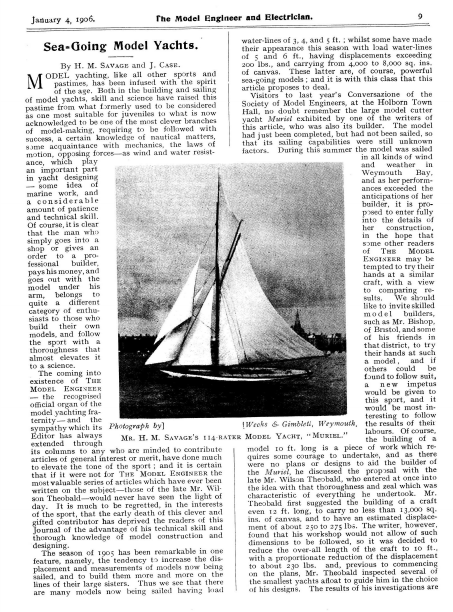
- The Shift to “Sea-Going” Models. The authors, H.M. Savage and John Case, note a 1905 trend toward massive, high-displacement models designed to mimic the physics of full-sized vessels. These yachts moved away from small pond-sailers to craft with water-lines of 3 to 5 feet, requiring deep knowledge of nautical laws, motion, and wind resistance.
- The 114-Rater “Muriel”. A primary focus is the Muriel, a 10-foot long model yacht built by Savage and designed by the late W.H. Wilson-Theobald.
- Scale and Mass: Originally conceived as a 13-foot giant with 230 lbs of displacement, it was scaled down to a 120-inch (10 ft) overall length.
- Sail Area: It carries a massive 8,784 square inches of canvas.
- The 45-Rater “Imogen”. The second part of the feature details John Case’s “Imogen,” focusing heavily on the mechanical “innards” and rigging:
- Rigging Materials: It utilizes 7-strand steel wire for shrouds and stays, fastened with brass tightening screws (turnbuckles).
- Innovative Halyards: A unique slot-and-ring system allowed for the jackyard topsail to be lowered easily while under sail—a significant feat for a model.
- Steering Gear: It employed a modified “Rhodes” steering system featuring an annular flange and recess design to maintain rudder control under high pressure.

9 fhe Model Engineer and Electrician. January 4, 1906. water-lines of 3, 4, and 5 ft.; whilst some have made their appearance this season with load water-lines Sea-Going Model Yachts. 5 By H. M. Savace and J. Case. and 6 ODEL yachting, like all other sports and b i haveraisedt Visitors to last ‘year’s Conversazione of t of model yachts, skill and science be considered what formerly used toto whatis now pastime from suitable for juveniles as one most one of the most clever toamiies acknowledged to be requiring to be followed with ae no doubt r some acquaintance with mechanics, the laws of motion, opposing forces—as wind and water resist- factors. of model-‘making, Holborn Tea acht Muriel exhibited by one of the writers of ho was also its builder. The model knowledge of nautical matters, During this summer is m and ance, an important part in yacht sestening weather in meennt and a considerable amount of patience and qeohnical skill. shop or order fessional posed to enter fully into the details of her construction, in the hope that some other readers of THE MopEL giv pro- ENGINEER builder, like to invite skilled model _ builders, such as Mr. Bishop, of Bristol, and some of his friends in that district, to try their hands at such category of enthusiasts to those who thoroughness that eee seen it a model, and athena could The commit into toas if be found to follow suit, existence of THE MopEL ENGINEER recognised he impetus be given to wo this sport, and it ost inbi would official organ of the model yachting a sympathy which its Photograph by] ternity—and may tempted to try their t ter the results of thei {Weeks & Gimbleti, Weymouth, Mr. H. M. Savace’s 114-RATER MopEL Yacut, ‘‘MuRIEL.” Editor has always who are minded to Senet u model 10 ft. long is a piece of work which reaires some courage to undertake, and as there no plans or designs to aid the builder of i* Muriel, he discussed the proposal with the late Mr. Wilson Theobald, who entered at once into was the idea with that thoroughness and zeal which characteristic of everything he undertook. Mr. Theobald ‘—~ suggested the building of a craft no less than 13 Journal of the advantage of his technical skill and tee knowledge of model construction an sq. ong, to carry ins. of canwas, andto have an estimateddisplace to) in one he 2See of 1905 has been remarkablethe dis- reduce the over-all length of the craft to 10 ft., Thus we see that there lines of their large sisters.being sailed having load of his designs. The results of his inveatigatiens are designi ely, the tendency t9 increase are many models now of the displacement with a proportionate reduction previous to comm: encing to about 230 lbs. and, on the plans, Mr. Theobald inspeete’ several of the smallest yachts afloat to guide him in the choice
[Weeks & Gimbleti, Weymouth, Photograph by) MODEL YACHT, ‘ MURIEL.”’ 114-RATER SAVAGE’S M. Mr. H. a a Ba . . – Ae,
January 4, 1906. The Model Engineer and Electrician. Designed by THe Late W. H. Wi1son-THEOBALD,\M.A. “A MovEL Yacut, REACH DOWN “Mouriev.’’ Built by Mr. H. M. SAVAGE WEYMOUTH BAY.” (Overall length, 120ins.; Sail area, 8,784 sq. ins.)
biog ee om , nee See SS one –
12 BI » __ | | | Top | \ :| i arms fo be |il! | i These rivetled lo body |i. | 3 . ia of rudder : End of main kee/ = pee WLy post 1s of an Stern angle of 5° with LWL. | 7 | 9 70 mn Fic. 1.—SHEER PLAN r Cons of } +_—_—__—_—— – | Floor ; i Szczee |}. —_- ee _ W.L.2 | C i Fic. 8.—METHOD OF | 4 FrxinGc RuDDER Post, boord _ f Fic. 3.—HALF SECTION AT No. 6, SHOWING FLOORS. | | | TIFT hd del et a pcos lalf- round brass wire Deck may be Hat or convex = Strakes |” wide Fic. 4. e amidships CONSTRUCTION rass angles e ae e ; OF = Bui_p1nc-MOovuLpDs. —== FIG For description] ; MR. H. M. SAVAGE’S ul. © DESIGNED BY THE LATEW. H r | January 4, 1906. The Model Engineer and Electrician. 12
The Model Engineer and Electrician. January 4, 1906. [ and DONSROTERTONE oF KEEL. | | 5 | Most WL. f wee This le edge must be of a depth slightly larger Than Thickness of planking used End of main keel Loose p/ale | ue). Cf Fixed — 7 7—METHOD OF ATTACHING Fic. FIAL-YARDS TO TOPSAILYARD, D JACKYARD. PLATES, SHOWING STEERING GEAR ANNULAR FLANGE AND RECESS, o Fic. 9.—SECTION THROUGH EDGE OF ‘ +— | \ . 14 Area 10-6 sg-fi} s All dimensions are of sails allowance must be made for yf . Ay Spars. Area 4-43 sq: tT: | \ – x ea 5 33-58 sq fli – Ps e . ae a aq” Sy . ” yor S61 sq: ff 76” va a ¥ ‘ ea\ 2% 6-55 sq > Area 28-2 sg tt =\2 SN ger onsen 80 OF * —~- 288 — , ———— BY THE LATE Fic. serge PLAN AS DESIGNED ALD. 1G. 5.—AcTUAL SAIL PLAN As DESIGNED BY MR . H. WiLson-THEOB Mr. H. M. Sava foot.) 1 = inch 4 (Scale: 1 MO. | CUTTER YACHT, “MURIEL.” > My’. H. WILSON-THEOBALD, M.A. a_i re 7 [see pege 9.
32 The Model Engineer and Electrician. January 11, 1906. 1 inch = 1 fool. By H. M. Savace and J. Case. (Continued from page 10.) except the port runners which are of hem The main and bawsprit shrouds, forestays and bobstay are 14 sone = the topmast stays and backsta Wyky All these steel stays are fitted with, brass siuhtenind screws with right-handed thread one end and lefthanded the other, and the back stays are attached to the hull by el i so as to be readily undone Scale : is of be Se steel (7-“strand), The standing rigging and starboard runners and topmast, Fic. 10.—SHEER PLAN. ; Rigging.—The topmast and other spars are of [see page 34. ‘Sea-Going Model Yachts. main and sib-sheets, Maite h are cotton. The of ae except the On the ents of ae halyards are fixed small pieces of brass wire + in. diameter by +iin. long, having a small hole in the centre, through which the rope most ae es to carry out in this class of boa Steering Geay.—The steering gear used is that X 7 s under sail, which is, perhaps, the jackyard top:sail to be taken down with ease whilst “T1222 for the Hilda. The easiest way of attaching the steel rope to hooks, etc., is to bend it round, whip it firmly, and the varnish, the splicing 7-strand steel rope is very difficult indeed. The running tackle is almost identical with that of the Hilda, but the new improved method of making fast the topsail pea and jackyard to their respective halyards, as already described, enabled the large f9 latter running through a treble block, as Mencd 6 fi slots on their respective spars. At one end of the slot, overlapping it by about 4 in. is a fixed brass ring, and on the other end a sliding one. In order i secure the halyards to the spars, the piece of wire is placed in the slot with one end under the fixed ring, and then the loose ring slid over the opposite end to keep it in position. There are two oe ape ae the jackyard, and three for the topsail yard, in the drawing. This piece may be made as follows : Select from the scrap heap a piece of brass or gunmetal; and cut a piece of 1} ins. by 1} ims. by 3 in. thick; from one edge saw out a piece 1 in. long by ¢ in. wide. We have thena piece thus | |, the arms of which are i slotted longitudinally to receive the rudder, so that the edge of the latter fits close to the body of the U-piece. The latter is Fic. 11.—BopDy PLAN. having an annular recess round the edge of t lower or fixed disc, and a corresponding flange on WrLly devis2d by Mr. Rhodes, and used on the Hilda, but with two modifications. he first consists in For description] MR. JOHN CASE’S 45-RATER MODEL YACHT, ‘IMOGEN.” method of attaching the halyards tg “ths a yards ae cme? is worthy of note, and to be recommended. is shown ae y in the drawings.
January 11, now drilled portion may 1906. The Model Engineer and Electrician. ony through, and then the centre be turned up between the centres, after which isses is filed square, which is rather a tediousse gg Galvanised Lan wire, small brass cleats, zinc ith a eosiel of such dimensions and dis- for fin, brass sheet; bolts, nuts, and or.—Messrs. Co., 144, Bishopsgate Street, E.C., who spare themselves no trouble f a e onstruct a special fox moving her about, which could at the same time Carriage Brass be used for taking her into the water. ing photograph will in supplying the article required. sla —Messrs. NEY! Needicss to ay that w by rail, the fin, bulb, and rudder should be Young ae & rehouse, Sun Street, Metal Walon Messe Challoner & Finsbur Co., Clerkentwell ad, shipped 33 Hopton & Sons, George Street, Euston Road, London, who keep all kinds of hardwood, and can bend to any shape. FE. un- Having now described the structure and salient aes of this boat, in order to facilitate anyone who may be tempted to build one of this kind, we give the names of the firms through whom the items may be bought without difficulty, various 4 NI i. | All st of sarls – may be pote to 2 know that if Mr. Theo- bale’ s design and plan had been carried out, the = or m ACHTS, is Allowance must be Fic. 1 3.—CRADLE FOR CARRYING THE MODEL ore displacement ae Elnabel would have worked out at SF” Area about 200 lbs., whilst the actual “She following are partienians of fhe various L. weights N increased to 6 : eight |of hull 9” aa 64 5) we ST 9″ L.. Wels Area 546 sg:in 476 sq.ins? or = | F-— ~ 6000 » “=~ and who will know 3 inch exactly what = 1 to supply on yas En actual staees under the most favour condit: was t 7:40 miles per hour, lehought ‘it may be said that it was not deemed advisable to let her go too free, owing to pe fear of not being able to overtake her. This speed, when actually estimated, is a very foot. demand :— Oak for keel, stem-piece, etc. ; lancewood for spars, masts, etc.; and American elm for timbers, etc. — Messrs, George Ay This model as above described is probably as large as can be sailed with any facility, unless accompanied by a motor launch. The able Fic. 12.—Satt PLAN OF THE “ IMOGEN.”’ Scale: ,, 16 ,, Total, ws. s« ‘ 233 lbs. Rating.—This worked out under Area 2 18 97 4, Spars, rigging, and tackle — Area 2267 sq:ins: = 102 lbs, Two lead bulbss (484 ‘Ibs, each) 2 ye t. 61 : Rudder and fin > Ns displacement was 233]Ibs., including all tackle and ee stougl 281 sqims high one ‘for a model, but the great sat eliclion of – sailing a boat of this kind is that neither wae nor water wil’ stop her if her course be set properly. with e yacht was generally left afloat, aehored a 5-lb, anchor, obtained through Messrs.
Fic, 13.—CRADLE FOR CARRYING THE MODEL YACHTS,
The Model Engineer and Electrician. 34 Nurse & Co. With about 4o ft. of line she rode without any difficulty a spell of nasty rough weather and high seas, — caused the local sailing craft s to be hauled upon will the (1) or _ from windward when any tattle or sails require alteration, or when “eat E o the to to Three golden rules are worth remembering when SeaSie a large model from a rowing boat or launch carriage would be about ley 208s., Say about showns=Mizs up ree work the sails, alter the sheets, and aan to the fast to the mast and thencarried forward, passin through a lead attached to the bowsprit near to the stem. In conclusion, it must be stated that the actual cost of the material for her constr ae worked out at about £8 or fo; the c of building the model 1906. sailing. When riding at ae the line should be made £10 in all. The third January 11, have his work cut out in ee model, leaving the yachtsm is (2) After completion of necessary, pass her whatever operation aft before letting go Imogen—is very similar to the Hilda; in fact, the hull and (3) Follow her keel are identical, both in design and construction. to leeward. Unless these rules are followed a disaster is The only difference lies in ie sail-plan, the Imogen having a lar spread of al- canvas than the Hilda; in plete slightly too large, as it is only in light weather she can carry a jackyarder, but her sailthe next before prettier of the two, and year a few alterations will ails. eser with ash spars, which are rat but these will be repliced by a set m of spruce, and possibly a hollow spruce mast from oreover, as her eps the centre of aluminium only 15 bronze will be substituted, as being much ‘lighteer, offering less ra ance, and enabling heavier bulbs to be fitted. Another mistake lay in the tana hatch, as this originally weighed 6} Ibs. It has since been reduced thus defeating their object. to 2k Ibs. These alu- obtained from St. Helens, Photo by] .W., who also did the left- hand screw& for ing the of painted outside with Peacock & Buchan’s White Yacht Ja es which set ith an excellent surface, and spars varnished with their yacht varnish. Should anyone build such a model, the builder screws caps and goose and will be very Sraakedlos lend them to anyone desiring to use cies A [Weeks & Gimbleti, Weymouth. Mr. CaseE’s 45-RATER MODEL YAacutT, ‘““ IMOGEN.” builder. ords in conclusion may not be out of place with£ releronte to the best locality for sailing such models with ease and safety. If possible, a large bay, such as Weymouth or Sandown Bayshould be chosen. ‘These possess the advantage of having little currents, and are naturally protected from strong gales the contour land. Itis not only impossible, but dangerous to work suc Is in a se ’s self, and a good oarsman should always be in the boat, who most certain, either occupants o to the model itself or to rowing boat. the Given that the yachtsman has some idea of sailing there is no difficulty in making models like these keep on almost any course, provided the wind is constant. It was found that in a fair breeze the Muriel, when close hauled, pointed higher than an 18 ft. open sailing boat, cee kept a true course within four points of the The photogrsehot the Imogen shows very close to the wind these mo:lels to be sailec nly practice eras what can be and the Rhodes’ gear a fair more enables ee can, however, Er sailing a sea-going model yacht. be obtained than
Photo by) [Weeks & Gimbleti, Mr. CASE’s 45-RATER MODEL YAcuT, Weymouth. ‘‘ IMOGEN.”
January 11, 1906. The Model Engineer and Electrician. 35 TABLE OF “OFFSELS” FOR MR. SAVAGE’S MODEL YACHT “MURIEL.” Hacer BREADTHS. Sections} (e) I 2 3 4 5 6 7 8 9 10 Il 12 Ss W.L’ 4°44 1°62 6°50 8:10 9°60 10°80 1×1°§2 12°28 12°20 4°92 7°32 9°34 10°62 11°40 12°28 12°20 W.L.” ~— L.W.L. Wilh. : th oe 3°30 6°42 8°82 10°44 11°28 12°00 12°00 11°58 11°58 10°86 | 10°68 | 10°20 7°32 9°00 9°72 6°00 8°16 ca _— 6°00 8°70 — _ — | | | | Heicuts & DepTus. ———e 7 Deck. | | | | 12°00 | 12°00 | 11°76 1i-s2 | 1¥*qoO | 11°04 —_ 4°98 8°16 9°36 10°92 W.L: aa — 10°20 | 7°2 — 7°38 —_ vee _ ~ — — — 0°72 — 5°38 a 8°70 | G*o0 9°30. 7°94 | 2° 10°44 | 8°24 | 3°48 10°86 | 9°00 | 3°84 11°34 9°96 _ —_ =_ — —_ — —_ _ 8-40 7°80 7°56 7°26 +7 °02 6°72 6°42 6°30 — 1°68 3°00 4°14 4°68 4°98 4°98 6°06 6*12 6°36 6°48 End of bow me, 12°25”. » Sections are 7}” a part Water-lines are 1}” apart. Buttocks are spaced 1}”. W.L” is 6-4 ” W,L,is 7:2” W,L, is 6-6” W,L,is » Sect. 12 to Sect. S = 8:275″. 1°50 | 1°44 | 1°32 | 1°20 0°09 | 0°24 | 0°54 _ 2°34 | 2°04.| 2°28 | 2*52 4°38 | 4°40 4°68 | 5°10 TIONS. fe) Deck | W.L! | W.1.” 2°-r7 | 1°OS e 5 » I 3 4 » » » » W.L’ is 4:38” ie 12 WL, is 1:8” a 7 W.L” is 4-56” W,L, is +72” WAL, is 5-22” | — _ —- 5°21 2°31 —— —_ — Deck 7 7 i It 10 8 CASE’S “IMOGEN.” Burrocks. HTS ie S DERTHS. HEICH L.W.L. | WL… | Wel — 2°90 2°40 002 2°10 3°48 4°08 4°26 4°38 Aft fe) , 5 55 -9 Har BREADTHS. [= | | | | | | | (measuring aft). io TABLE OF “ OFFSETS” FOR MR. SAVAGE’S “HILDA” AND MR. ECs | 1°26 | G06 | 2’52 | 3°72 | 4°32 | 4°50 | 4°80 is 13”from Section o — End of Stern is 6” from Section S W.L’ is 11-64” » » » 0°48 | 1°38 | 2°82 | 3°96 | 4°56 | 4°80 | 4°80 3°96 | 3°90 | 3°78 | 3°60 2°82 | 2°g7O | 2°52 | 2°34 6°12 6°00 — —_— ee Fore Beam of L.W.L., 11- 58”. iC B. A. 1.80 | 2°88 | 4°44 | 8°40 (measuring forward). LO.A. =114}”; L.W.L. =72”. Burrocks. i seit at| Keel. W:L:. | (Me:eek Gunwale). B. G, D. _ 6°00 1°87 | 3°90 | — _— = -— 500 2°75 | 2°34 | 1°50 | 0°42 | 0°96 W.L: moe — — | 0°90 | 3:24) 1°45 | 0°96 | O’00 | 1°50 | — 5°67 5°35 _ — A Keel. Se aan I 2 4°22 | 3.40 | 2°15 5°83 | 5°30 | 4°50 4 5 7°96 | 7°87 | 7°62 8°64 | 8°64 | 8°40 6°75 8-00 — ‘oo | 1°62 6°50 | 3°57 | 1°57 4°62 4°40 3°66 | 3°36 | 2°52 | 1°83 | 0°84 4°28 | 3°90 | 3°30 | 2°64 | 1°98 7 8°85 | 8°95 | 8°95 8°70 7°60 | 4°50 | 2°07 4°00 4°30 | 4°14 | 3°72 | 3°00 | 2°40 9 8:25 | 8°25 | 8°17 7°61 g°16 —_— ial 3°77 2°58 | 2°40 | 2°10 | 2°34 | 1°08 It 6°61 | G52 | 5°56 _— — — — 3°79 3 7°14 | 6°87 | 6°36 © 6 | 9°00 | g*12 | 9°00 8°58 8 | 8:67 | 8°74 | 8°74 | 8°40 | 7°04 | 3°05 to § 7 +68 “38 | 7°26 4°24 | 3°80 | — 5°88 = 87”; L.W.L. = 60” L.O.A. Beam of L.W.L 217 40”. extreme, 1 » Sections o—11 are 6″ apart. — Water-lines W.L’ to W,L, =1°50”. Water-lines WL, toW,L, =0-75” Buttocks are 1 50″ a Sect. 11 to Sect. c – —_ ie — 4°50 | 4°14 | 3°72 | 3°50 | 2°40 4°16 7°42 | 4°50 | 2°33 3°58 | 3°48 | 3°0 | 2°70 | 2°04 3°85 = 3°66 1°34 | 1°18 | O’9g0 | 0°55 | 0°07 0 measuring forward). _ from Section o End of bow is 6” » WL.L’ is 2-88” » WwW. iisa 74” » fe) ” 5 is ot at Section 2 » W,L wo Waie is7 74” from Sect. 4 » WGL, is 5-70 o-19 | 0°46 —_ 1°92 | 2°00 | 2°45 3°87 = ‘Ol | 1°93 — = Aft (measuring aft). End of oF is 6” from Section S is 4-0 7 ; Ss 6-48” 7 Wie isis 5-10 re » Il W,L,is§-70” _,, 7 » W,Ly » WL, is 4:20″ » a 9 8
January 11, The Model Engineer and Electrician. Model Yachting Correspondence. The Editor invites readers to make use of this column forthe full discussion of mattrs of acta and ‘mutual interest. may te signed with a name and addr. – ike dee-plui [Attention he especially and no Letters if desired, but the full der Nee invariably be attached, though not iecessasby intended for publication.] Winner of Model Yacht Regatta. Race, 1906. Queries and Replies. 4 Queries on subjects Bosham | directed to the first conaisor given below notice will be taken o, No other matters but those relating to the Queries wuld be enclosed in the same on ope. within he scope of this journal are replied to To THE EpitTor or The Model Engineer. Dear Sir,—Thinking it might be of interest to eae whi I 90 as the could a e winner prize in the model yacht race a’ of I ee sg ham), not send the Mo dow. he has only recently retried. of the first Bosham Regatta, particulars (Mr. before, James Bryant, Mediterranean, The person and shown he to Poppin’s Court, Fleet Street, London, iC.) The jatowing es ‘selected from the Queries which have been replied lo recently :— [15, 227) Steams Engine Proportions. A.M. (South Yarra) would ie leassed if you wouldgive e the exact size ports, ep, writes: building and lead for cylinder, small 2-i horizontal y 3-in. steam engine an stroke; also what siz boiler and pressure would be ee to driveit. 3with reference to the work you desire the ehatte to do. 24-in. ve boiler will run the eeline, ‘bal be expected from it. A better baller would be 22 ins. centre flue, or else an 40 ins, 18-in “PY 30-in. multitubular boiler, ao not give any parce with iz: a a , and the exhaust o& 4 = 7 Ee & © a Seace rar Sacer OF Hacvanros. = / . ‘N r \ ter NL Fic. 9.—FIFE / Fig. 10 —Simpk-LicGHr Boarp. (Scale: RatL. DETAILS OF FITTINGS B y Mr. E. FOR MODEL M. Murpuy. two-thirds full size.) YACHT.
The Model Engineer and Electrician. 254 in Figs. 2 to 10 etc., detail sketches of which are given of tackling ive. Someamateurs might be scared the same size. blocks where many had to be made my I had never made two blocks alike before, as rigged “‘ standing,” small racing models were mostly and a small drill, added ith a set of small files to a little patience, block-making comes quite easy. 2) () LLItit oy \ Scale 10 | IS | add. But, alas! I have no one to race against ; 20 J ws of inches. Fic. 11.—Sai~ PLran or MopEvL wire, but All standing gear is of hemp. I tried to manipulate, and capable easier cord found hemp eyes oO of neater treatment. for anything. obtained locall Of course, splicing as, h materials except the sail cloth. The yacht is rd March 15, 1906. a crimson lake finished with white top sides and underbody, and the deck and spars are, of course, and I am times, several out Dawn I have had , though she could delighted with her performancewhich I am going to do with a little more ballast, Racinc Yacut, “ DAWN. is not it is the greatest pity that more interest taken in model yachting in this part of the world, particularly as we have Kingstown and Howt ” ideal places for sport, harbours so near, and they are THE MoDEL ENGINEER and with such an organ as easily obtainable here for the interchange of ideas and information. There must be very many points in this ship open
March 15, 1906. The Model Engineer and Electrician. to criticism, for design is a very weak point with me. So, if any readers think it worth their while to show “ me my errors, I shall only be too delighted to hear from them through these columns, am anxious to learn. or may add direct, that I for got a great deal of practical information from THE MODEL to start on a model of this size, ” THE VALVE-GEAR OF MARINE ENGINES. Under this heading, Mr. A. E. Seaton, M.Inst.C.E., is contributing to the Marine Engineer a series of highly interesting articles. The mo No. IV, contains some instructive matter bearing IEENGINEER handbook on this fascinating subject. For the information of those who may be inclined cipal 255 tion is to be enforced in the future. It is even said f as ordered by the powers that be as a test of what reliance could be placed upon editorial discretion. I append the prin- dimensions of my craft :—L.O.A., 50 ins. ; L.W.L., 39 ins.; beam, 10-5 ins.; depth of body, 5 ins. ; draught, 9-5 ins. ; mast from deck to lower Cap, 30 ins. ; masthead, 4:5 ins. ; topmast, 25 ins. ; boom, 36 ins.; gaff, 26-5 ins.; bowsprit outboard, 9 ins.; ditto total, 5 ins.; jackyard, 12 ins. ; topsail yard, 26 ins.; sail area, 1,918 sq. ins. ; total cost of materials and a few tools, £1 10s. fo) udslay’s, introduced into the n Vy a method of working the Vv ithout eccentrics or link- motion, which w. genious and effective. It © most marine engineers is a very serious drawback, viz., four-toothed wheels which were liable to a considerable amount of wear and tear, bu Marine Engineering and Shipbuilding Notes. By Cuas. S. LaxkeE. Tur “ DREADNOUGHT ” AND THE PREss. We are all acquainted with the fact that liberty of the Press is recognised as one of the fundamental principles of national life in this country. Nowhere Fic. 2 Qs om a] : crank for each valve, and a rod connecting it to the i on the main shaft. 12.—SHEER PLAN. Va:} \ r (4.15 Me valve. e small cranks were set at angles of 120 degrees, the same as the cranks i On each of these crank shafts 49 20. 94 an as a_| “Kale Fic.§13. Mipsuip Fic. For description] S 14.—Hatr Deck Pian. 4h es hy a Mr. E. M. Morpuy’s 50-1n. Mover Yacut “;DAwn.” Scole /0 Section. 1s 1 20 j of inches [see page 252. was fixed a spur wheel of equal size, and carried on a frame were two other spur wheels geared into one another, gear nought, recently launched by th mouth. It is not a sweeping assertion that they make, the protest applying to a few papers, thenames of which are not mentioned. course, whatever in the design n into and the frame so set in guides as to the wheels on the 8 lower wheel to move in a circle whose centre was that of the main crank shaft and the axis of the upper wheel to move i going ahead. The frame being raised up, the lower wheel in it revolved round the caused the auxiliary shaft to be moved round so that its cranks came in the right position for going
278 The Model Engineer and Electrician. of compound cy inders. igh-pressure cylin: i oW-pressure the forward wheels, and the steam pipes and Hig other hear.) They entered into possession of it about ge are designed for flexibility, as is usual these engir hic re intended for aAigibitg and on_‘ines Seaunaiby in curves. The engine mstructed on the March 22, 1906. entered the new premises kindly given them by the County Council. They were very proud of their new club house and he thought they now had the finest club house in London (Hear, grade Mallet- Rimrott system for the metre (3 ft. 33 ins. ) gauge, and = e cipal dimensions are as follows p. cylinders diameter, 13 ins. Len i Piston stroke, 22 ins. Diameter of wheels, 3 ft. deficiency. certain 1egulations, they of London ; but in the autumn of 1905, they determined to make a radical change, and to come into Wheelbase (each bowte), 4 te.‘ ins. total), 17 ft. 41 Steam pressure, 170 lbs. baa an in. Grate area, 14°8 sc Heating surface, total,ae sq. ft. Weight empty, 37 t to were unable to bake part in contests in other parts 19 ins. line with other clubs. Subsequent justified the change, and as a first carried away a trophy — Highgate al events ha result they A Model Steam Plant. working order, 45 tons. Smallest radius of curves 78 yess By T.. Extreme length, 4 HEA Discs oro niolomraehs show a model damay be of interest to some readers. nt which I completed some years The Alexandra Model Yacht Althongn eee of a somewhat similar kind have appeared Club in THE MopeL ENGINEER from HE first annual dinner of the Alexandra Model Yacht Club took place recently at the Plough Mile End Road, when some eighty members and friends of both sexes were present. time to built ‘up from two pieces all po catpetore sweating together, thus saving a lot of trouble drilled from solid, this aed rather a tough j pistons are brass rod filed a the method described in your paper. The slide-valves are worked by the usual eccen- trics, which are _made per- r i a hardened steel template, then brazed i position on shaft. Two side Fic. 1.—Mr. T. H. Heatu’s MopEL Stream Cound theHon. Secretary (Mi. W. G. Brittain) n proposing the toast of “ The London County said that their Club had a record of over fifty years. In its earlier days, the Club er name, In 1904 they left their old premises and PLANT. straps. The cross-heads, connecting, and eccen- tric rods are of best steel, with the usual brasses mn end cut through, filed up on the faces, ‘and held sogerhes
April 5, 1906. more The Model Engineer and.Electrician.. magnetising power to be expended than. if they were comparatively free to movetthat is, had not been so. tightly compressed. The first case may be considered to apply to hard iron, the second to soft iron. Hence, if very soft iron is used there is less hysteresis, and consequently less wasted energy in the transformer Very for great care is ta ken i select suitable iron transformer cores. losses, over and above the current which it must balance the current taken from the Electrical energy being measured in this means that you must put receive to secondary. watts, or supply y mains 323 to which s which can be connected, suit the lamps, motors, or other apparatus to which the current is to be supplied. Referring to Fig. 3, the voltage produced the coil of wire will depend ne the number of.inturns primary and secondary coils will depend the number of turns in the respective coils, strength of the Magnetism flowing to flow | reverse—that this output it would be necessary to put, say, A Design for watts into representing the the primary energy coil, required the to 50 would be in the core, and in the at required to ee the remainder full load. the to supply The ratio the loss the the the rate of N the following pages (3 24 and 325) a design losses the between upon a 10o-Rater Model Yacht. watts supply is, (To _ continued.) losses in the transformer; about one half of these coils be of wire in the coil, the strength of the magnet, and the rapidity with which the magnet is thrust it or withdrawn from the ae Therefore, in a transformer the voltage produced respectively in the alternation of the current. watts to rimar obtained from the secondary coil without unduc heating. A transformer from which 1,000 watts could be takenin continued working – would be called “1,000 watt” or kilowatt’ To obtain 50 is the rapidity y 1,050 it for a to-rater model yacht is given, for which rr RP. is Phe watts supplied to the primary coil and the watts designer has ae oo ‘completed ‘a model from efficiency of the transformer. The losses in the core remain prac tically the saine whether the secondary coil is giving full output sions, given out by the secondary coil shows the maximum or is on open the output. circuit ; the coil loss will vary with It follows aor this that the efficiency is lowered at no load orlight load. Good transformers of all sizes have a high maximum efficienc cy, avera, aging about 95 per cent. It is im portant to recognise the fact that you must pu greater ur this design, of we give _ Principal dimen- the hull built of pin Length. overzails LWels «4s s¢ence0%2 444 esmeus syssexewlg bases 4 atone Ins. 54°5 37° 2 osay 11’s Beam CXtLEME « «1s eveemmn ons a6 Rem 7 Walls seewammy ¢ 19s ewes Draught of hull…. 00.2.2… Overhang (fore) …… 0.0… ec eee eee rn (aft) oo… eee eee ee watts into the primary coil than you can 11’9 2°5 8:0 9°3 . 37°2 X 1612 Rating = ~—€o00 = 999 Sail area, Y.R.A. 1612. 9 be explained later)it possible more cme energy out of thee isseuoudary For th the Bookshelf. coil thanis put into the primary coil. We have so far considered eth primary and SeuoR any coils to be each wound with an equal umber of turns of wire of similar gauge, [Any book revtewed nae thts heading Wee be ge trom THE their use would be very limited. | however, permissible to vary the relative number of turns THE Lesosontd HANDBOOK oF USEFUL MEMorR- but if Pen seen would only work under these conditions and gauges of wire of which secondary are composed, and the primary thereby Moprr ENGINEE ANDA AND Data. and lishing Co. to produce ween the The i ae and, — is ppin’s London: Locomotive Pub- Price rs. net, posta e 2 title of this excellent handbook does not convey to one et the rnat e of its contents, i practical i; epariment, Fleet Street, London, E.C., by rembiting “he. Publiched priceCourt, and the cost of pos age.) refore, some eevianation would appear The book is a reprint “ of a omotive series Running” poss the eel coil higher or lower than the voltage which is applied to the primary coil. “he reader will remember that a voltage is produced in both primary and eae coils— that be in the nearly primary equal to coil the being a bac wrimary coil voltage of the alternator atains use trains, ne apes and finding tractive power of locomotives, and a chapter on the national code of headlights. We can heartily recommend this book to all who have anything to do with railway locomotives, as we interested in the very fascinating ‘subject. –
April 5, 1906. The Model Engineer and Electrician. 324 1.- lic. ee of es ~ en off f I B —————«- Top of 5 sle. oN Bellen, at Vial— a. = > LWL. Sa Scer Fic. 2.—Hatr END ELEVATIONS, 2 ; Lea H. B DE F § = As aa { Las an NR ee > aa i ee OWE: 0 i toate! |f 4 {ot3 2= | y fl i | 8 9 Win {of} ti 2 ee +7 Lt oT of kee/ Top of rebbet plank off q i eee Half breodth [ao Bostom of rabbet P onk on ~ i re j eer DESIGN For description] FOR A _ | 10-RATER By R. P. KitcHINc
April 5, 1906. Fic. 1.—LONGITUDINAL The Model Engineer and Electrician. SECTION. Kitchingman ’s qT = 325 , (aoe — tie ee we | z ee sleering geor 5 Se a Fic. 3.—Ha.r CRoss-SECTION In- wate Planks nol fo exceed Bia width Heels of tromes morticed inlo feed ond foslened wilh glue and a NO Brass screw. 1 _a RATER MODEL KITCHINGMAN. peg, 4. Har Phan. YACHT. [see page 323.
344 The Model Engineer and Electrician. A Model Sailing Yacht. The By H. Guy. HE me ae are a few particulars of my small model yacht, the general appearance of April 12, 1906. Latest in Tests of Large Shaft Bearings.—At a recent meeting of the pressures varying from 25 to 50 house motor was employed was taken to make 15 # lway reat Ww. Engineering. tons. A ing- care then screwed in through the top of the keel, which was then permanently fixed with three 2-in. screws from the inside. in,, o*008 in. an All the bearings were flooded seth oil, r even with that the speeds greatly in required to excess those erdiuarily adopted. It was found power of drive of other conditio uch as : Be the shaft was very nearly proportional to the speed of the irae a independently load, final how the s eed remained constant and loads varied, the power required to drive did not change. Quadricycles. — The French gauges mast step was ie fixed 84 ins. from with small brass screws. The spars were made of pine (with the oe of ¢t mast, which is of oak), and are of the following dimensions :—Mast, 2 ft. 3} ins. long (3} ins. below deck) ; main boom, 18 ins. long; gaff, 10} ins. long; top- sail yard, 9 ins. long; jib-boom, 16 ins. long; and bowsprit, 12 ins. long (2 ins. inboar The sails are of fine linen and aye no special saints, except the mainsail, the1 tances apart, through which twine is laced round the mast passed and The boat is painted white above the water-line, and light blue below, and pe varnished. The t nished. I have two swing nucete which are not shownin the photograph. ing railway lines of Paris, and in the neighbour- departments. The World’s Largest Ships. –The following table may be of interest, taken from the Glasgow Herald, giving the dimensions of the world’s ten largest ships, eitherin course of construction or already running :— Lusitania . Mauritania . Ste 1C- lOVTA wean Types 4-Sc. 4-Sc. T.s.s. Adriatic …. T.s.s. BANE 64 wxmwes T.s.s. Amerika … Cedric ….. Celtte w..0.. Caronia …. tur. tur. Length. Breadth. ho 1.H.-P. 787-6 787-6 88-0 88:0 } The on the main lines of H. Guy’s Mopev .Yacut. a Mr. 60-6 33,200 33,200 727°6 77° 54:0 727-6 727°6 25,000 75:6 75°60 74:6 75:6. 75:6 726 -49:0 49°90 53-0 49:0 49:0 43-9 25,000 23,875 22,250 21,035 20,904 19,594 T.S.S. .©90:0 T.s.s. T.s.s. T.S.s 7000 700°0 475 Carmania » 2” SC, tur! sepsccr 72-6, £439 19,524
April 12, 1906, The Model Engineer and Electrician. 354 this, which must be, to all true lovers of the sport, Model Yachting Correspondence. a deplorable state of affairs, there should be consti- thts column forhe futl [The Edtior tnvties readers to make use of mutual Interest. erate igHo practcal and discusstonof become affiliated, whose first ao would wil may ‘be stgned the name and address aIntended for public though not necessartly ‘‘ Central Conreaence Board”’ A Proposed and ‘‘National Challenge Trophy.’ m the Editor of THE MoDEL ENGINEER. Sir,—May I, through the medium of your the following general valued columns, co message to our colleagues of the various model yacht clubs in London and the provinces, whom we are unable to reach otherwise, on a matter of vital interest to our sport. hich the clubs ea u be latitude to m exigencies g eae1 clubs. he present state of things is but tem porary, tee eee must arrive a time, “if the present nterest endures and increases, when practically all towns of importance will have their essary to Tt ” “ yachting create this authority a central La pnaged of power, with the executive placed under the control of a we may hope for the abandonment president, when of some of the evils peculiar to Aiscrganisaltan and Tue ALEXANDRA MopEL YACHT CLUB, VICTORIA PARK, LONDON. the contagion of a eal of rules. a grown, actical This endeavour to and is growing, antenenitely we have no “‘ controlling authority ” and there is immediate necessity for this ‘authoriity. There should be no deviation from a recognised and accepted standard. ; ave no body to enforce uniformity T each clubis apparently going its own way, without cohesion, without organisation, and to remedy effort, and ee anges a = constant tendency favours must derive its Model hot oe ‘like the State,adherents, and. it a gradual evolu force from its own subjects and
THE ALEXANDRA MopEL Yacut CLuB, VicToRIA PARK, LONDON.
The Model Engineer and Electrician. April 12, 1906. is true to say that the sport is strong in properfion ach to the number of men who believe in it. members should decide club or communi what function it ought to perform ; and efficiency is best secured by causing all orders ‘and regulations 355 Visit.—On Saturday, April 21st, a visit will be made to the Old Kent Road Works of the South Metropolitan Gas Company, at 3 o’clock. The party is limited to about thirty members, and those wishing to be present are Scan to give intimation to the Secretary before April 16th.—HERBERT RIDDLE, Hon. Secretary, 37, Minard Road, Hither Green, Practical Letters able to culties, distance which I em. I readily admit that there are diffi all. the most serious being, perhaps, that of ; but when I me n that in this club sane the honour to represent, we have a man, whose duty calls him at times to “distant parts of the kingdom—en- thusiastic enough to make a journey from Liverpool, Manchester, and Glasgow, even to in join our igh Soot week-end matches, and then to return n time for the work of the following week, I have strong faithin, and do not despaic of, the enthusiasm of our fellow sportsmen a the provinces, if we can provide a worthy incentiv In this connection, efforts should be made to from our Readers. (The Editor invites readersto make use of this cole for the full as discussion of matters oFPraca and mutual interest. Letter: & mde plumif desived, bub the full ay be signe wih y uest invariably be attached though nob pecascapily intended ee publication. name and addr Sof the 5 A Mercury Break. To THE Epitor or The Model Engineer. Dear Sir,—The following may possibly be of interest to some of your readers who have induc- as coils :— pater time ago I made a mercury break for my spark coil, similar to that described in 3-in. Vt jg screw Fo clamp hal] -~x 4 ” Bf) & Bross Eat [4 \Sadite not without hope that this will be ensure the vided that we can 2 A Mercury BREAK. MopEL of our fellow yac en and their participation stituted. I shall be pleased in to the hear ENGINEER Handbook ” No, 11, contest when inprivately, or was necessary. with fitted a piece of steel wire (A 5) as shownin sketch, of THE MopEL ENGINEER, from the representatives slide with a hole drilled through it, so that it mightshould your permission, Mr. Editor, through the columns of model yacht clubs, concerning any matter in relation to the Central otisenge and initiation of a National grateful for Challenge Tro and should feel a) a small brass ball about } in. diameter, and made on AB. A small screw (about 1-16th in.) be fixed in the ball in order toclamp it in any de- sired position. It is therefore obvious that by sons aaa positions different rates sliding the ball in. d. Yourstruly, . G. Brittatn (Hon. Sec.) Alexandra Model Yacht Club, Victoria Park, London, E. March 24th, 1 906. 81, Clinton Road, Grove Road, Bow, E. The Society of Mode’ Engineers. [Reports of smcetings should be sent to the offices of THE MoprnL delay, and will be inserted in any par- ticular nisste if received @ clear nine days before its usual date of publication.) London. Future Merrtinecs.—Tuesday, May Ist.a aisa tical Aenprstcat ions and lecturettes bym ers ; also a special demonstration of autigenoks parry ing and welding with the oxy-acetylene flame by Messrs. Brins Oxygen Company. Wednesday, May 23rd: Model Making Competition. Dulwich, S.E CHNEIDER. A Small Water Motor. To THE Epitor oF The Model Engineer. DEAR SirR,—A description of my small water motor may interest those readers of THE MopEL who, like myself, are not possessors of —= are as follows :-— . The chief meee ins.; Height over-all, 114 in ; length over-all, 14pulley, diameter of water- wheel, 8 ins. ; diameter ofwheel is ; height of bearings, 2k ins. The 8 ins. in diameter, and carries eight cups or buckets, which are made of thick tinplate; two discs of thick
514 The Model Engineer and Electrician. experience may be expressed of space, then thus: If a certain quantity . Sys silk-covered wire takes up § ins. same quantity of single cotton will take 6 ins. TM will be seen, therefore, that if cotton-covered is used a fifth more space must be provided; in other words, the specification must modified to ae unless, of course, cotton-covered is‘indicated t# her The word‘apeace’’ used above must be under- stood to refer to length of secondary bobbin, not to its thickness. It is far better to lengthen the as described by the writer in THE MODEL ENGINEER ELEcTRICIAN for ovember 26th, 1903; April 28th, 1904; May sth, 1904, etc. It was discovered very early in the manufacture . oe rk coils that the necessary insulation could nly be obtained by winding in vertical sections— Pesily by subdivision of the space to be filled into in large coils, frequently 1-16th_ in. To wind a number of thin sections of wire is the easiest task, but the connecting them Ne afterwards nd on the ebonite tube upon which they are to be built proved a very tedious business. The author, indeed, never built a coil in any other than the method treated here, as,sey Houcht out beforehand, it seemed impossible to imagine a better wayof securing efficient. insulation close Total ee i 8 May 31, 1906. of the fifty double sections, 12 Ibs. Total wena of the insulating b.p. discs, 2 lbs. 9 ozs,. Length ofsecondary between the two ebonite checks, 12 ins. (if single siJk had been used this space would have Eee reduced to about Io ins.). Number of turns of wire on the secondary, 40,000 oon * Condenser, to be described. Total cost of above, including winding apparatus (but not the former discs), under £5. A reasonable modification of the above would be to provide a single ebonite tube, 16 ins. long, 13 ins. inside diameter, and } in. thick; the outside diameter being 2} ins. We m e with the short ebonite tubes;“this will be referred to in the chapter dealing with the winding of the secondar (To be continued.) A 42-ft. Rater Model Cutter. “Ben Hour.” HE model 42-rater here described is built to the lines furnished me m and designed by a in correspondence by the very kindly offices of THE DEL ENGINEER. This gentleman, who been most assiduous in his efforts to instruct me in the highly intarestitig and scientific sport of small, well soldered, and insulated, the number model yachting, surprised me one day by sending along to me two designs for cutters, wich the information that one of them was a club cup one section to its fellow (forming a pair) was best articles of them is practically wa: S consequently felt made while the of no importance ; and it that the joint sections were bein nd, that no loose wire and joint has to be tucked into ihe small a tio ye space between the tube and one writer puts it, the SPECIFICATION OF THE SPARK Colt (Fic. 3). Core, 13 ins. by 1} ins., perfectly straight iron wires, and put together| Primary, two layers, ‘No. 14 D.S.c. wire, about 3 lbs.; 290 turns Ebonite tube, 15 ins. long, 2 ins. outside diameter, in. thick; inside diameter therefore 1} ins. Ebonite Sane for aad of coil (two pieces), 3hiins. long, 4 in. thick; inside diameter, 24ins. study acht of those excellent Construction and as 3 ins. diameter. re- auiedled a close “ Model sec- ‘“‘ having made thin and “sinall a joint as possible, when soldered it must be carefully pushed just between the insulating paraffin paper discs and covered with raffi The directions are the more difficult to carry o eC: e paraffined paper discs the specification refer t ave a central ns.,and are to ‘‘ slide over’ a tube 0. 22 8 gauge, as to be descri y, Design ”’ be the late Mr. Wilson Theobald had not 2 ins. ; outside, ca deep gratitude and appreciation to THE MopeL ENGINEER, the secretary of the club in question, and, last but by no means least, this manner, and whose letters to me, if published in THE MopEL ENGINEER, would, I am sure, have ith the 42-ft. linear rater; and since the rma one of the heads of the best club in comes from England, it will be agreed that it is not to be ignored, pare! as it will be remembered that Mr. heobald strongly advised the oS of this aks, of boat, and most MopEL ENGINEER readers will agree that he was well quratitiea to speak on the subject. The Loat I have built has certainly shown herself to be an excellent one sailing to windward ; and it Ebonite discs, bobbins, to form the checks of secondary } in. aie 6 ins. diameter, central aperture, 2} in. apa wire, 10the of No. 36 S.W.G., s.c. in fifty double sections ; hick- eeapee of waxed blotting paper between each disc of wire, and ill-shaped pond, I made a balance rudder for running; ae‘i “doula be quite out of
515 The Model Engineer and Electrician. May 31, 1906. the field with them at times. I findthat she is rabbeted for the reception of the planking. The half-deck plan, the half sections, pee stern post, and medion all being now marked on the board in is used to sucha way that any twist in the ea sections, etc., the advantage of the bends in the the board was then taken to a band a who in order to produce two org anise“half-deck cut all the pieces out in a very few min very complimentary remarks from a_bystan who was in the habit a watching all the naa ow, half-sections, club meetings on that pon Having, perhaps, now oe sted the patience bought an oak board, a full inch thick by 5 ft.ee 9 ins., for the ribs, gunwale, of exactly similar half eectioti I do not know if this is a common practice, but I am indebted to a friend for the hint, and think it is muchto be commended. Fic. 9.—Part Loneirupinat Section. stem, sternpost, and keelson. anne the board —black face down- down of the said carbon paper, weighting them with flat irons, I carefully went over the half-deck plan—or rather, I shou Id made, say, a new line I had . tnside’ the half-deck plan—with a blackiend pencil, thus producing on the board the carbon line of the outside of the gunwale, the } in. allowance being the thickness of the planking. n paper, another The forward sections were then nfo or chamfered off towards (Scale: 4th full size.) the stem, and the after sections sloped off towards aft, as described in Mr eobald’s article in THE MopEL ENGINEER in Augunet, IgOl. The stem and pager ee having been rabbeted and shaped, and the keelson also sloped down on the sides to + in. less on its bottom edge than the width of top of the lead keel, the whole were then slotted and halved ready for fixing togethe Care should be taken, in marking off ‘for this slotting and halving the sections into the keelson and gunwale, to first of all prop up the fore end of the keelson to the required elevation an x it as firmly as possible on a level bench, and then to hold the sections in a perfectly vertical position, not at right angles to the keelson, whilst marking off. The whole were then glued and _ screwed aa marine glue being used for the purpose. some Venetian blind laths were ee stem and sternpost, however, required no such allowance, for, as will be seen in the drawings, they are ata soe yard, and planed down to +in. thick, for planking; these were cut into strips about I in. wide, ‘and laid on in the usual way, using
The Model Engineer and Electrician. 516, tiny iron. ae for. the purpose. The sections being space ins. apart, and the oak ribs only May 31, 1906. The deck, which is slightly turtle backed, after being Since centeally: over the , portions ee in the sheer plan, i s found necessary to insert transom are of inlA Ogaaiy smart appearance. The de precisely as instructed in Mr. Theobald” garticls on“ Fitt for Model Yachts”’ in February, 1902, and in order to save time foranybody wishing to build to these lines I give the dimensions herewith : fainmast.—} in. all way up. Topmast. + in. bare, tapered all the way to gin Boom. ae t top. two- thirds of the way out- from after the cracks hed been filled in with marine ue. .The deck, of whitewood, was next fitted, and, after two coats of varnish on the underneath side, was screwed down, marine glue first being laid on to the clew, where it is 9-16ths Gaff.—z in. at jaws, tapering to } in. a the peak. MENDED SAIL aa A round the joints. in the ORIGINAL SAIL PLAN, 42-FT. KATER MODEL Next some longcloth was soaked marine glue, and the hull painted with t a time as the longcloth was pressed on a ver at [tbhoom.—+}in. tapered both ends. brass tubes, and cold lacquered, sized and varnished two coats. 5 ain and knocking about. ime to time, whilst proceeding with powder and water, until seven coats had been laid ou, finishing with white above water-line auc ey a in, rown below the deck ; cou as the latter, inasmuch as the topmast can be unshipped, and the appearance is enhanced by the fid. first dressing the last coat down. mice stone the spars being Thi with the is parts of the boat, I would give the hull ~a coat of paint, outer Topsail Yard. sehsgin. tapered both ends. : on coming out of the water, and there has never een any blistering of the surface; an additional advantage being that a boat so treated will stand a CUTTER. Bowsprit.—} in. at stem, tapering to 7-16ths in. y. A narrow gold runs from stem to F | i | | keel was now taken in hand, as, whilst making the sereening. the Keen’s cement mouid had been drying in a well-aired place for some weeks. Of course a wooden pattern of the keel had been made and placed bottom upwards in a long box,
The Model Engineer.and Electrician. $17 ‘SNOILVAGT «aoHNag, Ag V‘14-7 UALVYTACOW‘MAL NO gia s Raneyaes] JIVENUYaLS May 31, 1906. [uodsaop 40.7
order ie keep her on a sufficiently even keel, more her ballast had to be added, thereby eee no pond, which is surrounded with shrubbery, —a admitting the wind to the font of the sa the edge of the a ae at—_ is as follows : sail, 1,172 sq. .; topsail, 333 ims.; ney 565 tis, Or, measuring the fore Fle according to Y.R.A. 437 sq. ins. Tpateiite the total area of ual rules—not up to the truck however—fore Pa canvas is 1,874 s me or with the fore ena measurement 1,942 Sq. i Thus it will be seen, onn calculating all her dimen- Fig. 2, is larger, and I am proceeding with this on in order to see what she will do with less top mper. Her C.E. will be just twice the distance forward of C.L.R. of that in Fig. 1, and no doubt I should — connned myself strictly to 1,942 sq. keel, 17 lbs. Mt ting +o mao mo Ng 7 Ho eoarn mona Nm t+ tttdyemaa wt [tere ERE since, unfortunately, ag is ey ng to measure u of havin dist: i ] | | | | HAA MPAMO NODA 10 br Transom il the bowsprit inboard, thus shortening the fore triangle, and of course stepping the mast in the required new position Sections. Deck. chance e difference of 95 sq. ins. between te two eal ” W.L.| : a S’eo wnoo foes) Oe | | HA gL.W.L. aft of stem = 19-2 ins. Ben Hur IT was built to the lines of Mr. Vheobald rgot, and, while she is an extremely pretty tight, of putting too much white lead in the cracks, and not rubbing the paint —_ sufficiently, the consequence being too heavy hull; and, in D. at ‘6 distance along L.W.L. aft of stem =”6in, and I. L.Q.A. = 56 ins. L.W.L. = 40 ins. Beam extreme = 10 ins. Beam on L.W.L. 9-4 ins. made etc., Half Breadths. toggles, Deck. hooks, fitted, and the jib sheet adjusting block fixed forward the mast; and finally she made her debut in public, being christened Ben Hur Dz. ‘ position; brass CG. Small eyelets ee ave s of the sails for Keel. e placedin the eg lacing to the spais, and this left very little else to gand running gear were all properly spliced ; stout brass screw eyes screwed into TABLE OF OFF-SETS FOR 42 Fr. Y.R.A. MODEL CUTTER, BEN HUR II. s (aa next taken in hand, and made a ble aes best striped sail cloth. Heights and Depths. had to be ape to the keel before she rode precisely on her L.W Buttocks from A spaced 1 in. apart. Weight, sailing, 24 lbs. 6. W.L.| successful, and after scraping and finishing was screwed to the hull. Then, having distributed weights equivalent to the top hamper about on deck, she was taken down. to the water and tested, when it was found that a good deal morescraping ‘Girth at-6 W.L.| wele Sections spaced 5 ins. apart. Water lines below L.W.L., 1 in. apart. W.L. this had been taken adrift, ~~ the pattern eased 8. set Ti When 5. top. W.L.:) in B. poured A. cement held the keel to the hull. Having made the mould hot, the lead was now poured into it, and in about ten minutes the casting was taken out. This had to be twice run down again, as it came out too ongy. The third casting was, however, more in May 31, 1906, The Model Engineer and Electrician. the Buttock | Buttock | Buttock} Buttock 518 and
522 The Model Engineer and Electrician. is in an exposed once! say the side of the house wall, or roof of workshop, it should terminate in the form of a qoee large bend,Plage ooo pong downwards, or at least slightly May 31, 1906, gear and cam keys, where necessary. etc., and adjustments made The tension of the valve springs will affect the downwards, Grae 2 prevent as far as possible i eeeie the The nd of foundation for such an engine as this is a matter which mee ae settled to suit individual s no hard ast rule to e re as and air; the timing of the firing of the charge; the nicety of adjustment of the governor (which also determines exhaust TNE): the opening and oe of the are matters which most of our readers a + ne capable of cee with on exim e remembered— more solid it is, hy more readily one can tell by nes although if any (To be continued.) the sound whether the engine is running satisfactorily or not. This remark suggests a few notes on the general mechanical details of engine. themselves, o doubt the Editor will be pleased to give the matter his consideration with a view to its further discussionin these pages. Model Yachting Correspondence. At first the probabilityis she will run stiff, even if everything is quite in line and perfectly true. The piston eee be fitted to aies so that when [The roeinottes readers to make use of this calienteie the full juos fall rare being, in fact, aer sliding fit. s, of course, without the rings. Then when the Lae are fitted, and agitpene started running, the piston will warm up, actapeal expand such an extent that” aiihoaale a charge An Amateur’s ede Yacht. inserted in the latter and allow o drop it will discussion of matters of practical and 4 may besigned with a nom-de-plume, mutual 7; name and address of the sender MOT invariably be attached ion.) To THE Epitor oF The Model Engineer. Dear SIR,— ou a photograph of m model yacht Sherbrooke, that I made in my Poster holidays. Sheis 2ft. long by 5-ins. beam by 3} ins. on the governor), a little later on it may be noticed that the power acquired when running lightieS se ienigs He stops alto; until she slows down and ally On such a small engine it is quite oe that no knock will be audible simultaneously with this occurrence, but the cause— if things turn out as suggested above—will almost invariably be found to be a tight piston. remedy is perfectly.obvious. and examine it for “ hard The Take the piston out places,’ and ease them temperature is reached, and then it may be a case of taking piston out once again and easing. One very simple and expeditious way of attaining easy running is by the use of Turkey powder, hi ing it will very soon bring about desiredresults. The oil can should not gine be spared ; but only special gas engine oil should be used. As soon as these preliminaries are over the engine should be braked down to make her fire every fo is standing by the whole time itis possible toregulate the ce so that it is ke unless it has gone through Mr. J. Puitip’s MoDEL Yacut. axim inuously. good run under “he vat severe cont ae possible will do the engine a lot of name in fact, no engine, however small it may be, intended to do useful work should be passed as os ee such “ uu s this all the working parts should be again examined —valve settings, etc., flywheel, side shaft screw deep. nou As I did not have piece of 2-in. : a piece of wood deep ee ‘w pine wa the following manner ils pieces, 5 ins. by 2 ft., then ona of these pieces was sawn in two, tin. and thiins. thick ba ata The $ in. piece was planed down for the deck. The two pieces, 2 ins. by 1} ins. thick, were screwed together from the top. After the boat was shaped, the
Mr. J. Puivcte’s MoDEet YaAcnHrt.
The Mode: Engineer and Electrician. May 31, 1906, 1}-in. piece was screwed on from the outside and the boat oe out. The keel is made of zinc. A piece 14ins. by 5} ins. was first procured and cut to the correct ee and lead moulded on. The boat was then sawn down the middle to the correct length, the keel inserted and screwed down fr the inside; the joint was packed with wool and putty. The deck is lined to represent planking. The spars were all made of pine. Mast, 2 ft. ; topmast, 6} ins.; boom, 17} ins.; gaff, 10 ins. ; bowsprit, 11} ins. (7 ins. on dec A coping was put round the deck 5-16ths in. nigh and screwed in with i screws. Sails were ma of fine linen. I hav ade a small deck-house a8 sho The fittings. are all made of brass wire, 523 Practical Letters from our Readers. {The Editor tnvites readersto make use of thts discussion of matters of beh may be sien we maine and address a column for the full tes and mutual interest. deplume, tf desired, of the 5 Letters ler ustinvariably be attached ough not necessarily intended for publ An Electric Clock. To THE Epiror or The Model Engineer. Dear Si1r,—With reference to the description of my electric ‘clock which appeared in the issue for and the boat is painted white all over, spars and deck being varnished.—Yourstruly, J. PHILip. M.Y.C. Wanted. To THE Epitor oF The Model Engineer. DEAR Sir,—Can an r readers let me know the name of the nearest Model Yacht Club— and the Secretary’s name and address, if possible— to King’s Norton, Birmingham? The Edgbaston M.Y.C. is not now in existence.—Yours faithfully, Glenleigh, ri Station Road, aetasins’s Norton. W. E. Britron. The Society of Model Engineers. London. SPECIAL NoticE.—On 7th and 14th the members of this Society, together with the Junior Institution of Engineers, de been ae! a . R. Pz r end to the Finsbury Technical College, Leonard Street, City Road, E.C., on the evenings of pe dates, the lectures commencing at 7 p.m. ery member who can do so should make a iescial point of attending these lectures, which will be fully illustrated by experiments conducted with th e most sia and power- ful electrical apparatus eonsteiy ted.–HERBERT G. RIpDLz, Hon. Secretary, 37, Mina Road, Hither Green, S.E. merican Society. New York. AMS Society held its second me ing atthe Berkeley Lyceum, 19, West Forty- cand Street, New York, on Wednesday evening, May 2nd. There was a better attendance than at the previous meeting, and several new members were enrolled. Constitution and bye-laws were read and accepted. Mr. Barclay gave a half-hour’s talk on shop work with lathe and shop tools. This was followed by a discussion of various lees especially onae cage of the locomotive slide valve. Mr. Sto ave clear and concise supination of the loractiene of the —— quested t slide-valv: Mr. E. Cottier FLETCHER’S ELECTRIC CLOCK. of the Aaished ralbaks ae that some readers May17th, you a photograph Is— like also i rales a correction regardvot Any herewith will be interestedin seeil anada wishing to join the as should correspond with the Secretary, Mr. E. Spon, 123, Liberty Street, New York City.?” 5-32nds in. shown diameter in Fig. 4. (not This should be 3-32nds, as given on page 462), the ends aereduced to 3-32nds in,— Yours faithfully, Manchester. E. CoLLieER FLETCHER.
The Model Engineer and Electrician. June 21, 1906. Arrange the piston-rods in uch a wa 595 whilst the other has one has just finished its stroke The best way to reverse Model Yachting Correspondence. finished its stroke, whilst the other has only pa be signed with a nom-de-plume, tf desired,bad the full only completed a fourth. one piston-rod so it his engine will be just carpeted three–—Yours truly, W. Kingston Hill, Surr B. has Leak. (The Hatter. tnvites readers to to make use of this elainejer the name a ess of the sender must inv riably be attached though not necessarily intended for publication.J Model Yacht Building. To THE EpiToR oF The Model Engineer. Strange Electrical Effect. To tHE Epitor oF The Model Engineer. DEAR S1r,—With reference to the above, it would seem from Mr. W. Black’s letter that when a belt Dear Sir,—I am sending you a photograph of hulls of fone model yachts, designed, built, and sailed by my: the Cambria, L.W.L., 174 ins. ), S. class boat, 36 2,70 Lady Hamiltonis ‘an old length 12 ins. beam, ins. oo 45 ins. L.O.A., ins. draught keel, 23 lbs. 84 displacement“(alb s. of which keel), S.A. about d seed ins. Castanet, a 10-rater, 35 L.&S.A., 14 ins. beam, ins. ins. L.W.L., Py 1ofins. draught keel, 18 Ibs. displacement (of which 13 lbs. is in lead keel), S.A. 1,700 ins. Sunshine is a sm all bo at, 33 ins. L.W.L., 9 ins. beam n: draught 39 ins. L : 134 i b L.O.A., 9 the draught keel displacement, a 6 \bs. rod keel, S.A. 1,640ins. I at building a 1o-rater fromie de- sign, in THE MoDEL HAGUE? Kitchingman, and I should tise few weeks a ago, by pleased to see ae designer’s orry to see Mopet Yacut HULLs. a gives off electrostatic discharges that it is indicative to copper rivets fastening the belt, but this is not so. The phenomenon 1s often noticed on leatherlaced belts, and is due to the slip of the belt on the pulley; this causes friction, and produces a negative charge on the pulley and a positive charge to the belt, and is of fairly high potential. If the hand is held near the belt, sparks can be drawn from it, giving a noise similar to the crackling of a spark coil, and can be increased if the hand is . G. S. Bass. earthed.—Yours truly. Minehead. o to windward properly when pressed. When sailing bolt i hast roman well; thatis the time the old 10-rateris out of it. And why do they beat the old 10-rater? Because they are so much bigger. Whoever saw a 10-rater of 40 ins, L.W.L. with 1,940 ins. S.A. and 24 lbs. displace- A 36 linear-rater is 8 ee the size of a 10, and would be beaten every time, but by a boat not much bigger and certainly of no greater displacement. A 42 it garboards than “Ben Hur would increase her girth with the same draught, which would be decreased, and consequently she would almost turn over unless deck fittings, spars, sails, Ri , were SO en 42-L.R as to be of little use. I hav boats with 19 lbs. of lead keel, as al:as could be.
MopEL YACHT HULLS.
596 The Model Engineer and Electrician. Of course they beat the 10 before the wind, but give a 4o ins. L.W.L. 1o-rater, goo ins. S.A. in excess of her allowance and she will always beat the 42-L.R.—Yours truly, Leyton. “ Rep ROVER.’ June 21, 1906. You wiin find an sxedlent article on the sublect ofpcilver soldering —whichis a kind of bra: ing, the “ solder” ich is a silver instead of a copper alloy—-in our fesuci of Apri oe 1903. The heat requiredis a cherry-red ; therefore you will see that a solder- ing iron is quite useless. er a gas blowpipe, which, for small work can be worked by the mouth, or a petroleum or benzoline blowlampis required. (16,131) Windings for 2 kilowatt Avery Dynamo. E. S. M. (Preston) writes: A BC of Re Model 42-ft Rater. the To tHE Epiror or The Model pe aa DzaR Sir,—Your correspondent, has made a slight mistake 2 calculatinges rating B in beam taken at any poia of his 42-ft. rater. .W.L., so De his boat can only have inches of s. 1,832 sq. lotio-+igatog-tare4 kilowatt dynamo described in Dyn:‘amo Design,” what alteration will be zeauited windings 220 volts 909 a: I, In the 2 if altered from 100 Thee windings fr 2 kilowatt machine described by Mr. Avery in his book, “ C. 0: yaame esign,” for an output of 220 volts 9 amps., au be: cea! drum armature, ins, diameter of core dis. +32 2 driv! 26 conductors 18 Gus 29 turns per slot aathree ayers leep. Fields willNo, require ‘20 Ibs. of No. 22 S.W.G. e on each bobbin, connected in series with each other andin shunt to the armature. [16,110] Battery for Small Blectric er Boat. (Aintree) writes: If possible, I want bichromate battery of the following aes 3os by 24 ins. by 4 in., or as near this as possible. 2:1 ver tisers who say I have inquired of several of your ad- u. L+B+-75 G+4D+4ys =Nonks came Manningtree. about three-quarters of an hour, the whole Jet to be used for driving a model boat? (Sketch 1not reproduc . B. NicHots. o not know of any particular firm supplying this, special : 4 i wn to requiredi dimensions. Battery should give about fs pmpe= vessels is none too large. Use a si woundto suit veltage of Dartery whichwe Queries and Replies. thatis, if you couple up the four in series. presume is 8 volts— [15,479] bee nlanity. of Speed of Motor for Mill Work. “ TRREGU: : Is it practicable to get a regular speed from irr { Alientton oepectally girected Jo the first condtiton given below and no notice will os ken of Quertes not complying wtih the ied. Letas.fomatninme Quer les mts b marked on the 1p.— hand of the elope ‘‘ Query Department.” No other mattersre bia | those relasing to the Quertes of spinnin les, the turbine is subject! load, and therefore an irregular speed told that it is the result. is possible to get a regular spe an irregular I have been motor er should be enclosed tn the same envelope. Quertes on subjects within the scope of thts fournal wel replted to by post under the following condtttons :—(1) ertes dealing with distinct subjects should be writen on dterent slips, on one side of soribea the paper “ ‘ee the sei on the back. ) Quertes “s name be T be tn- vever possthle, wtth jay aimenstoned sketches, and – ondents are rpommenae iedkeep veference. (3) imped Hows“tnoarably ng mwenana oupon oo oud ac accompanted, e= thelr Quertes for (not very much obliged if you could clear up esd points for me, as I must get a regular speed for one particular art of the mill. Opeepends upon the extent to which the dynaing speed fluctuates and the character of the fluctuation. 6, elapse before the Reply can be published. The insertion of replies tn this column cannoi be guaranteed. (6) shoul a jdresse jo Ti ditor, THE MopEL oppin’s Court, Fieet Street. , Lo:ndon, E.C.) The aare re sdlected from the Quertes whitch have been replied [16,144] Solder jane (Hetton-le-Hole) wri Flux for Aluminium. — F. I have a pair of house telephones aa % nm to existingPell: pes). Could you pleasefavourme with diagrams showing how the: rung from A to with the dynamo may be a solution of the ques 4) Milli Readings. milliamperes. with three will be unsatisfactory. ant at I am in doubt as an ammeter in an emergency,? the winding necessary Ifs hs ow ? s the result of a and See page 64, of soldering. Lc. (Basingstoke) Can ae solderi: eine |be donewith a copper bit? a 0, in writes: whatt way? ‘or a water-tube locomotive oiler, 2} ins, diameter: how should he joints be ive oldered after tiveting? As I know nothin silver soldering, and manner of using, to ake it sensitive enough? (2) Could a voltmeter be adapted s most, I shall be glad if you can tell me anything ot may help,such as flux used, lamp required, etc., ; Usin D. W. (Kerry) writes : (1) Can you give me any nd vice erinpaes bell being aeeach end? If August rst, gor, is:— Silver attery of accumulators worsed in conjunction reply as this. ust be connected up so as to be possible, I should like to work them 154] of from the the ey can belrmataed, (5 All A shunt-wound motor post-card) September 15th, 1904, page2.
The Model Engineer and Electrician. June 28, (906. and joes with a small steel bolt and nut = ound this method much lighter and worked ak 615 The Society of Model Engineers. of THz MopEb saat of meetings should be en to the offices will be inserted inany parNGINEER withoué delay, ae 4ssue 4f recetved a pets nine days before ts usuab date of publicatton.] London. N the evenings of June 7th and 1 4th of this Society — partyof theinmembers conjunction with the members 5 ° ze entertained, H 5} ins. MopEL ENGINEER series, ‘‘ Mode Steamer Machinery.” A Model Cutter-Rigged Yacht. i Howgrave-Graham at Mr P. demonstrations to a most interesting series of oscillatory and of the pl coils, high tension discharges from Tesla and other of electric explanations of the character and uses R. ves, a st useful and detailed information By A. J. H. TT:photograph et herewith is of the T he model I owne a model of £ Teuneserttati on of the yacht y type, square forecastle. The of h quartering. were of holly, and the bow- sprit bitts, masthead yoke, and _foreI made all the hatch of walnut. blocks of hany, and the sidelight screens, chainplates, masthead cap, Before ae on he t e heele d over far she filled and sank. very strong which had carrying tend to ripe, be counteracted by enormous jib, as will oon a os pene os San after constructed building Storeysteel All the ship. of e man Fra a A Mopet CuTreR-RIGGED YACHT. fi fifteen- walls are According to the Ivon Tie ma eteel to beit will be the ce building of its kind in the Age, world. was seconded by the Chairman of the Society, and with the iauhy of the lecturer the proceedings n. Secretary, terminated.— 37, Minard Heed, Hither Green, S.E.
A Mopet CuttTer-RicGeED YACHT
44 The Model Engineer Model Yachting Correspondence. and Ne a Club. L.w QT ke Edtior tnvties tenders to make use of thts column for the full @tscusston of of practical and ~utual interest. Letiers may be stgned wih @ nom-de-plume, ¢f destred, bud the full mame and address of the sender must tnvartably be attached, though not necessarily tntended for publtcation.] A North Country Mo lel. be THE EpiTor oF The Model Engineer. were is a north country model, which is made R Str,—The model yacht Nancy, here illus- under the 1730 rule, giving July 12, 1906. Electrician. and got hold of a tga | idea as to the rule of fie The ru F Ug. 43 ins. This restriction was introduced to prevent teak boats of abnormal draught, and also on account of the shallowness of the water at two sides of the pond. The dimensions : ae model : of L.0.A , 30; B., 8 ins.; the Draught, 43; L.W.L., 24 ins. S. A, 500 ; which phe the L.W.L. + 6,0 00 following at 2 ratin, gs. out by A model built ‘oui the dimensions given F. G. H. would only work out at ‘49, or practically us a finer a also West Hartlepool; and Special for the best finished the Club. distinguished races, which She has also herself at the club hold the s respectively above deck a ee 4 ft. 2 ins. ; gafts, 1 ft. 5 ins., 5 ft. 2 ins., 6 ins., 1 6 ins 1 ft. 3 ins.; main booms, 3 ft. 6 ins., 3 ft. 3 ins., and 3 ft. I should like to see yachts appearing in ODEL ENGINEER, as there is a great interest taken in model yacht ne in and around Durham. — Yours truly, J. W. Naytor. West Hartlepool. Mr. J. W. Naytor’s MopEL a }-rater. Rules for Model Raters To THE Epiror oF The Model Engineer. DEaR Sir,—In reply to on the Queriesand Replies | F. G. H. (Darwen) age of June 28th issue ; he seems to have been nMeuitoited by someone Yacurt. Owing to the size of the water we are w shall no doubt have some 24 linear raters cr 5-raters, or perhaps larger still. The writer is of the opinion that owing | a the limited draught, that a boat of 22 L.W.L. 8 ins. B
Mr. |]. W. NAYLOR’S MODEL YACHT.
The Model Engineer and Electrician. July 12, 1906. with a hollow bottom would be a more constant performer than a fin-keel boat, but up to now n> boats of this type have turned up. If F. G. H. will give us a call at the next club match we Shall be glad to go into the eae with him.—Yours Queries and Replies. Attention ts espectally directed t1o the fifirst condition given below and no notice will be taken THE ComMoDoRE.” truly, 45 of Quertes eer complying with the of 4 ne uerses must be elope ‘* Query matt?aaU7 jose Vise tothe Queries st under the following conditions : a) Sight-Feed Lubricator Applied to Small Vertical Engine. By T. W. Geary. si HIS photograph is of a small vertical engine I e about two years ago. The castings I bought with cylinder bored and ports drilled be out. Having no lathe, everything had to done with a file and emery cloth. For cut- 26-29, Poppin’s Court, Fleet Street, London, E C.J The fling R,are are selected trom the Queries which have been replied to (16, pal. Flash Boiler. R. J. writes: I have made in. Stuart vertical engine, ii should Ee obliged if youa r-in could tell me the length and diameteer of steel tube necessary to construct a: boiler similar to that described by Mr.“Nicole, ‘Oo mainain 4 pressure of100 lbs. per sq. in. with engine working at full load at about 1,000 r.p.m. centre cf coil. Boiler to be fired by coke fire placed in At full load a Stuart 1 in. by 1 in.s eailizes a boiler which will evaporate about 5 to 6 cub. ins. of water per minute. this in the ordinary way a vertical boifer, of copper of the size given To do Main sleam pipe Fic 2.—DEeralILs oF THE SIGHT-FEED LUBRICATOR, on page 34 of our handbook, ‘* Model Boiler Making” (Fig. ro), would be necessary, or a steel v ertical boiler of the same ie measuring about 12 evaporate the same amount of water with the flash genecator; and as far as wi the same, perhaps a with the ou heating surface required will be little less, as the engine theated steam ash wil no wasteful boiler suppli e t can get, with a thickness of wall of at least 4 in., you ought to Fig t«.—Me. LT. W. Geary’s SMALL VERTICAL E ve eccentric strap, do very well. [16,238] etc., I used a P 2. oR a fretsaw, and filed an ordinary cut nail for key. The sight-feed lubricator I made just recently, an ‘The sketch (Fig. 2) I think i ° advice about 40 ft. of tube, in a series Oil Burner. 7 ondon) writes: I should be fretsaw, I also cut keyway out in the flywheel with i We wou of mat-like coils about 1 The dimensions of 2) smallest size I have bo: ld allow. seen gives a much gunaller ty: W e inched in at the sirt ’ large! my fire- I believe the size is called No. 4, measuring 2k or 2 ns, actor the dish. What I want to knowis, if thereis a you to employ a No. 4 2}-in. ns. You will find that this burner will, Primus burn with a good draught, burn splendidly. .For further details, Model Loc tive,” reenly, price 6s. net, see “ Th st fr and 1). These are non-silent, however, and not so powerful.
The Model Engineer and Electrician. August 9, 1906. 244] H. S. T. Model Yacht Design and Building. (Tunbridge Wells) writes: I should be very glad if you will explain I 141 hand pump, $ in. diameter by § in, stroke. fitted with some water tubes gqttOe 387] Si a“ es ,DUrnerss J: FB; (Stourbridge) Write us’ is ae to take ratory. of an ordinary Bunsen. — Spiri petroleum lamps I have been able Ww more th he design; therefore, put i d. on enclosed sketch, and it has made that affect thequery is—How does se keel as per thick lines Now, my all the difference. .; the boat sails now the place and usual work Please ay are expensive, and all the y deposit soot on the test e the foresail as well asiau could possilsibly be wanted. to, but, theoretically, the °6 in. in the case of 22-in. but takiing.‘a longer boat, it would make a good difference. I am think: The firebox should be they always require Spit for lighting them, and are e they noiseless or do they “ blow ”Jik inter’s burning-off lamp ? The burner could be used for this purpose, but woould Fequite to be kept in first-class werking o ow straight tch is only to ay, cxplaiieed and easily followed, but thee foregoing ned since my mind, and I dele rag, € [16,260] Diff feel I should like it to be quite The design in ee is cut away forward to the last — and as you appear to have cut even more off, this would account ang Cells in Series and ia Parallel. H.S. (Norwich) retest: Will youki formation on the ‘following, as mentione ° t certai f the first query I intended to put, as I wa: L.W.L. irrespective of L. centre L. is exactly the if * is has made it clear to me it is, and I conclude that ove) .is to the first thing to do in designinga boat to a given L ten sections, and shall be glad if you will W.L, ii divide confirm that for me. e wh of the boat and sails (cutter are ver: book, which rig) have been work:‘ed outfrom dessigns in your 3 dis; am not (1) If en accumulators having a that it will take a time to charge the lot. (2) If in parallel, the volts equal to one cell, but if I make the amps. total of all _the sf ‘\é 1s WS J LIF 4O°LWL Query 16244 F “Sections MopEL YacuT DESIGN AND BUILDING. for the trouble. Your right course is to put more on the foretoot, tl ‘6 more forwar ae tha ay, if charging rates (which are all different), what I am not certain —wi L.W.L. mn =t3 2 ins. aft from the fore end of L e i ., : 431
The Model Engineer and Electrician. 452 Model Yachting Correspondence November 8, 1906. It would be no use makin g up by our clubin 1905. reasons stated before, : Why Not Model Full-Rigged Ships? To tHE Epiror oF The Model Engineer. DEAR S1R,—Permit me to briefly reply to your correspondent’s letter in THE MoDEL ENGINEER of October 11th, ve “ Model Full-rigged Ships.” As a lover 3 a eee shipping, I heartily n he saysthat agree with W. model- beautiful vessels. makers are le ote these view I think the oldan artistic point of rule. There is one thing I like about Nancy, and that is her sail plan, which is a very payee |and effective one.—Yours faithfully, The Society of Model Engineers. ee frigate or Indiaman of about 1800 is, “London. a lover of things nautical, a positive delight that is the eye. Itis in these Sane creations not a mere me and of th one sees a ship deserving the bottom of saucer with a bulb of lead dangling atcases, equal to a fin, the depth of which is, in many aethird asthe length of the boat. W. H. T. may have seen in THEMODEL ENGINEER of March 4th, 1904, an admirable little article on “ Sailing Ships, dating from the Fifteenth Century,” erhaps we might be byMr. Frank H. Mason. “ RED RovER PARTY of members, numbering twenty-one, eh ‘ visit on Saturday afternoon, October 27th, to the London County Council’s station at Greenich,One the electrical energy for running Council’s system of electric tram- of the the whole is ways, Wi north and South of bytheMrThames, alker, generated. the ch The party was met er, and conducted over every favoured with more information regarding these ed ages vessels by this gentleman, whose kno ledge of detail is very apparent by the drawings and photographs of his models. m at present busy on the model of a 52-gun frigate, about 3 ft. long, which enees rather well. in my The greatest difficulty is, case, to din obtain sufficiently reliable information reeanrclass, details, accuracy es in a ship of this absolutely essential. Square-rigged sailing ships would not, in my opinion, be fou = suitable for sailing purposes, owing to the complicated mass of riggings an deck ae ae ‘boats, portholes, etc. Then, again, which willshe course, soften on contact with water. glue is alm cessity in the construction, INTERESTED.” —Yours faithfully Rating Rules. To THE Epitor oF The Model Engineer. Dear Sir,—I am sorry Mr. Naylor has iaks® in the dark as ever as aad his model canI ae a can offence at my remarks = Nancy. am as ro-rater. 10-tonner, 1,730 it ves by pines controlled by a tan he arge motor-driven centrifugal pum co sacs. with its system of rails aid electric cranes and locomotives for hauling the coal wagons, a large electric crane to lift were inspected, and 30 tons was examined with much interest. The method of feeding the coal bunkers was then seen, and the party adjourned to the boiler-house, where a large number of Stirling boilers were generating steam. The plant for filtering the feed free it from grease.and oil, and the large ey ram pumps for feeding the boilers were exam , the latter being driven by a very slow speedect: current motor with worm gear, the pumps making from 9 to 19 r.p.m. only. The party then walked through a tunnel below the main engine room so as to get a good idea of the large proportions of the present installed; the lower four alternators at halves of these omen projecting into apertures fr unn quite see she is a 1 1730 niles10, and I know that rule allowed unlimited S.A. But if she is a 1o-tonner, The rating rules have —to be a 10-mee as the term is generally understood with 474-in L.W.L.— Taking measurements from her phatopranh, ‘T find she has about 2,100 s$q.“ins. which is nearly 840 ins. too a = a 10–rater,wand if she is to bé allowed her rating is over 16}. Therein lies i“puzzle, My boat is 38 ins. L.W.L. x1,578 should have 1,263 sq. sq. ins. S.A.+6,000= 10. have 10}-in draught fins, with 7} lbs. lead, to Nancy’s 13-in. draught fin, with 104 lbs. As to the 1 ,730 rule—which ey Mr. Naylor knows is years out of date, being -R.A. tule for 1883—making a finer (?) and faster yacht than our southern boats, I think it S proved in 1889-90 that the L. & S.A. models were the faster, for they beat all the 1,730 boats off the London waters. I have sailed ae built under the 1,730 rule, the rule, 200 rule, and I can give Mr. Naylor the punticalazs of each rule. Also, the length class rule, which was given thirty-two poles, and generating current at o compound steam engines fitted w. and the lowhigh-pressure cylinder a vertical, to the same crank. pressure horizontal, driving on The party was permitted to ascend to the top of the engines, from which a fine view of the very extensive “plant wes gallery claimed much attention, he and the party completed the tour by inspecting the static and rotary transformers and some very fine machinery of all ey in the workshop and stores. Future Visits.—The tramway car sheds and gente at New Cross will be visited on Saturday, November 17th. Members wishing to go should inform the Secretary at once, as the party is limited. Future MeEEtINcs.—The Annual General Meeting will be held at the Cripplegate Institute on Tuesday, November 2oth, at 7 p.m., at which all 0 so are expected to be members who are a present.—Full particulars as to the Society and
466 November 15, 1906. The Model Engineer and Electrician. NEw TURRET STEAMERS. On Saturday, September 22nd, Messrs. Wm. Doxford & Sons, Ltd., launched from their yard A Model Racing Cutter. at Pallion the s.s, Ryall, for Messrs. Stephens, Sutton & Stephens, Newcastle, who are alread owners and managers of the turret type of vessel. The dimensions are: Length, 365 ft.; breadth, 1 ft.; moulded depth, 273 ft. The deadwei;ght of cargo and bunkers carriedis 7,000 tons. ‘The vessel has received the highest classification of the Bureau Veritas Registry. a above firmis also supplying the engines and boi n October 3rd, Royal Sepive, another turret steamer, built by the same firm, was successfully She pe been built to the order of James L. Knott, Esq., Newcastle. The vessel is of their new alan hold type, one of the latest By E. M. Murpuy (Dublin). INCE the eee particulars were published y last model March, cutter I have engaged o:n another of iesame tein ee but emen cally different in design ter of fact, Dawn can hardly be said to have beenvqegigned al Before starting on this boat, however, I read up all the information I could find on the subject of model yacht designing, and the sented for your readers’ criticism is Dusk, the lines of which appear on the opposite page. The drawings took me the best part of two months’ spare time. When they were finished, I got- my timber (California holes all over them to facilitate scooping. nm working by the centre lines proceeded glue them one on top of the other with ordinary glue. hen the glue was thoroughly hardened the next to start work might consider all this striking out tedious, but when you come to shape the hull, and scoop the inside, the enormous advantage of the layer plan over the block model is at once apparent. The shaping in- side and out being finished, I went over every joint = put in ect screws of vario everrwners I hold for one. There are no ribs at all, but even after the severest tests in the open Fic 3.—THeE ‘“ARAGUAYA’S”’ STOKE-HOLE. developmentsin turret construction, and in sees proportions resembles a large number tu breadth, 50 ft.; moulded depth, 26} ft. weight of 6,600 tons will be carried on a draught of 21 ft. ins. The Bureau Veritas Registry has assigned its highest classification to the vessel. sea there The deck is no sign is made of any of the joints going. ballast required, I moe the boat beri putting on the deck and loaded her up with lead which I afterwards carefully weighed. nstead of allowing for the THE MaRGEWooD Locx.—We oe yaaa r the leve lock which are embodied in the “ ——wood ” lock, and are the inventions of Mr. Marshall Wood, of 41, Gray’s Inn Road, London, W.C. The special feature of the lock is the combined _ and levers, which operate over a stump fixed double bearing in the jeer asing, thereby entering it more secure against picking. lead maou then melted and a the amount of rs decided on—ro lbs. The next step was to cut iowa the keel to take the lead, and to fit the keel bolts. A piece of isin. ee plate was fitted and screwed to the keel, awere allowed to hang downwards, the heads being recessed into the keel. The lead was slipped
November 15, 1905 The Model Engineer and Electrician. up R ~ Fic. 2. x a 3 i HALF-BREADTH PLAN. = these 467 and secured by four pin-hole nuts. The advantage of this method is that the lead can be taken off at any time if the boat has to be packed and sent any distance and readily replaced. On testing the boat with the lead ballast fixed, I found she “sat down” rather too much aft. To over- Qa ¢ on come this I cut out a piece of the lead and replaced it with a wood packing, and put the bit of lead cut out, inside the boat rather forward of the keel. She now floats as designed. All the spars are of the very best yellow pine, and there is nothing special about them except the 3 a mast. g I had been admiring some hollow spars exhibited here lately, and determined to make one in miniature. Mast and topmast are all in one, j in. diam, at deck and tapering slightly to the hounds, where lo nN Scale of inches vv t 3 cy SO ‘ NS | = 38 2 Sse) pint Round hole n ls ee awa rs z < a8 "Q) Oo fe) a) Wood packing 32 a3 mast. I have no lathe nor anything that “ goes 8 RESET 7)" é 7? M I if WL Fy < 3 SP | 8 \ 3 WL.2 Ww.3 WL.F Y Fic. 3.—-Bopy Pran. Ee i} oe aa] glue ; then treating them as one stick I shaped my M. di vit OF MR. | ! 1 LINES fo MURPHY’S MODEL RACING CU i TITER. J = oO round,” so this had to be done entirely by hand. With care it turned out as true as a billiard cue. When the shaping was done I damped the two al rove on ‘wo brass rings at the ends, which are left solid for about an inch. After a few days’ suspense, while the glue was I subjected the spar to various bending twisting strains, and the results were most satisfactory. I believe this is the first application setting, and of hollow spars other than bamboo to a model. The other spars are solid, being too small in diameter to make it worth the labour to hollow them. The gaff jaws are of brass and swivelling as on the most modern boats; the arrangement will be easily seen in Fig. 5. The sails are of the C.M.D. Co.’s brown!striped sail cloth, which is excellent stuff for the purpose. I also got some rigging screws from the same firm, which I could not make myself for want of a lathe or screwing tackle. he falls of halyards, etc., are all belayed on cleats on the mast, and nothing is made fast to the deck except the standing rigging and sheets. When
468 The Model Engineer and Electrician. and reset, i all st i i ew minutes. November 15, 1906.. bands so as to be normally amidships. The main sheetis made fast to the tiller, and carr ied through the latter are cast off and the shrouds, etc. unhooked, the mast, sails, and alt can be taken out The Tatesale, sheet, and tack are fitted with 1 hooks so that the sail can be taken off and 0 oS ELietid pid 10 ts ppd 1S tia ppb 20 pp 25 Scale of taches Uprrer Part oF Fic. 6.—Sait PLAN oF reset quickly, The mainsail is cut straight-footed and laced to the boom I have fitted an automatic steering arrangement ae I a out for myself. idea ew, still” of forward, and is CUTTER. pulls, and acting on es tiller keeps her awa lull in the wind, an rudder Though I believe ave the merit o « independantraiser.” The tiller is carried aft instead MopEL RacinG yoked by two rubber may be varied according to the strength of the wind. The standing rigging is of hemp, and the running
The Model Engineer and Electrician. November 15, 1906. gear of white waterline. In place of blocks, where they were absolutely necessary, I used small bone Notes on Sheet Metal Work. Having taken the sharp edges off the hole di countersink and By ‘“Tupar Cain JUNIOR.” HY should the name “ tinker” be used as term of o u Yet it hy and even their purpose excellently. They have the padidional advantage of not swelling when wet The model is finishedin white above the waterline and green below, enamel being used. Th mahogany deck is oiled and polished and all fittings are of brass. I have had Dusk out in the open sea, and the only fault was that the fin was too far aft, so that she did not point very close. I corrected this by shormo the bowsprit and reducing the Mare sails considerably. She is very fast and lays set course perfec ove taens :—L.0.A., 50” Her dimensions L.W.L., 36"; are as beam 4€9 his pages oa — Tt has Sie occurred to the writer many of his amateur friends, in speaking of a “beastly tinkering job,” were by the amateur engineer, not to mention possibly not uninfluenced by the private knowledge that the particular job in question was just a little beyond them. There is no branch of model engineering where lamentable failure is written large so often as in the cause is generally carelessness. o not mean deliberate carelessness, but that the worker has failed to grasp that the same conditions apply to the thinnest sheet of metal as to the thickest, possibly with a slight difference in favour of the thin. What we mean is, that both are governed by the same as to tension, compression, elasticity, permanent set, etc., althouugh these maoi their effects visible more quickly in the thin shee the worker will use his apc: aa while even on the humble sheet of tinplate, it will not be long before the “whilom i beastly at work, sh _a will be a pleasure to look at. So much for generalities. I have been asked to put Lager, for the benefit of the readers of Tur MopeEL ENGINEER, a few notes on the working of The cardinal principle to be remem- bered has been alluded to above, gig eee is not different because it is sheet. that the the form of The workeris indeed so a A to the good, inasmuch as he starts with two faces of the piece parallel, and fairly flat. If the sheet be not flat, it is because certain internal stresses have been s up, the effects ie removal of which are dealt with in pet later e metals whieh are, asarule, foundin the work- what is known in. Thisis really a sheet of iron or steel, coated foes a very thin layer of tin. Most tinplat from very 1mild ste el, only the highest quality metal oe peaaieiiie, nothing else giving a satisfactory resu Fic. 7.—Mr. E. M. Murpny’ssoe RACING Cutrer, ‘Dawn. 36”; gaff, 22:5”; —‘10- 25", bowsprit Topsail yard, 12: ay ; sail area, 1,790 Sq. ins I ‘have great hopes for the yachting in and about Dublin. vessel meant to contain water, or which will be exposed to moisture. (extreme), 10 es draught (aft), 8-2 5”; mast (deck crosstree), 29:5”; mast (total), 56”. Boom, re) total, t is a very useful son but should never be used for any (outboard), 22”; future as jackyard, of model I have got one or two men to build, and next season may see a Club here. little The tin coating will apparently protect it for a time, but finally the underlying metal is gee through minute pinholes in. the tin, Should ordinary on and t solderin uu a care tin, solution forms on the han Sheet copper is a valuable material in the work- shop. Its softness and enormous on A Brass and METAL Po.isH.-—A correspondent sends the following recipe for a brass and metal att which may not be already known to some of ur readers :—Put the contents large tin of Globe polish into suitable bottle, and pour in 6 to 8 ozs. of turpentine. stick and shake well. Before applying, stir with a This softening should at intervals when w be repeate iece = h the hammer ; otherwbecomes oo hard ages and minute cracks form, which quickly spre Sheet a can be purchased either hard or
7.—Mr. E. M. Murpuy’s Monet Cutter, ‘‘ Dawn.” RAcING
The Model Engineer and Electrician. © November? 15, :19.6. A Model Steant’ Plant. Model Yacht Race’ for CoronaHon ;Shield, By A. Morrison. Oe: secompanging photograph shows a model eae plant I.haverecently completed. he alle? is of steel, 10 ins. diameter, fire tubes, and is suitwith eet firebox orandcoalsixpitta ng. ble for either coke The boiler is tested to 140 per square inch hydraulic pressure, with a w eukirig pressure of 80 lbs. per square inch. The castings for engine were made from patterns HIS trophy was sailed for at the Rick Pond, n Court, on Saturday, October 27th, under the auspices of the Surbiton Model Yacht Club. Six clubs entered and sailed, namely, Model Yacht Sailing Association, Surbiton Model t Club, Ilford Model Yacht Club, Forest Gate Model Yacht Club, Highgate Model Yacht Club, and Alexandra Model Yacht Club. The race was sailed in a light and variable wind, and such was the closeness of the racing that the result entirely depended on the _=board e end of the first sailed to leeward. round the Highgate boat led by "ee points, Surbiton and Forest Gate level tor second place. after When, lunch, the match was re- sumed, the wind had gone very light and had resolved itself into a beat and run, and about half-way through the second boat, ee had = round, the Surbiton footing in t the lead, with "aiiate these marvellously laa in the rear. The last heat happened o be between the two leaders, and it was necessary for the Highgate boat to beat the Surbiton boat both to windward and to leeward to win the matc The Surbiton boat used the square sail for the run, whereas the owner of the Highgate es doffed his working magnificent silk head sail and spinnaker enn well forward, head sails allowing sence entirely unhampered; e ab- it to work this proved‘ good for it filled and drew ‘from the very policy, start to finish. The boats started; and the Highgate boat commenced to pull away, and at half distance had alead of twenty yards, which she increased. a fifty by the time the winning The winning yacht was built ched. at a local foundry. The principal dimensions of ke, 3 ins. ; carries éhe ones suit ofs — rophy, which Tas now been up for mpetition since 1902, is the property and the Highgate of the eoiiien Model Yacht Club,of the five that it Club has won three times out The inscriptions on it are has been sailed for. as follov 1902 ear. 1903 1904 1905 1906 engine went a a terrific rate, steam to give the engine about 400 r.p.m., but by this time the eagine ran fully half an hour,I then attached a pipe steam was down to 10 lbs. to mouth of bellows and in below furnace, and I found that by a slight touch of the wind I could keep steam to run engine steady unloaded; but for any further purpose the boiler was too small, W. J. Daniels, of the Highard of W. J. Richards, has a wonderfully light rig and Esq. Mr. A. Morrison’s MODEL STEAM PLANT. Model. lub. .. Mr. Gaiteh. M.Y.S.A. .. Magdaien Mosquito . Mr. Richards. wner. Highgate Mr. Bonniwell . Surbiton .. Rose .. Mr. Vine. . eee .. Ivene Mr. Daniels. XPDNC Highga ighgat An illuminated camaente is each year presented to the winner. p's Coat Propuction.—The latest Tu statistics available of the coal production of the
524 The Model Engineer and Electrician. ‘Walthamstow District Council at eee tow. containing rn station is e of the largest gas engine driven plants in England, The party will be made up of those who have notified the Secretary of their boat would then be accurately known, and each builderwould be at liberty to adopt whatever measurements ership can be obtained fro HERBERT IDDLE, Hon. Sec., 37, teal Road, — Green, S.E. Hither Rating Rules. To THE Epitor oF The Model Engineer. | with pleasure the reply of ‘‘ Red letter of October 18th, in which I sail area he pleases.—Yours ALBERT WILLAN. Prize Competition. Competition No. 42.—A Prize of Two Guineas will be awarded a to the reader sending the best model marine boiler to suit a racing boat measuring 5 ft. 5 Model Yachting Correspondence Sir,—I note Rover’”’ to my replied to his and faithfully, York. . O'Neill will lecture and demonstrate art of moulding and casting.—Full par- e ticular of the Society and forms ofig tate for November 29, 1906. each maximum beam of 6 ins. 74 to 7 ins nines and nine arrangements should also be included. e f the necessary pipe SENERAL CONDITIONS. All articles nie be written in ink on one slae - the paper only. What litt misunderstanding of each other’s fortunately, appears in a fair way to be cleared up, which goes to prove the value of a ee ae ae Let me explain that the term— Ss not convey the same 2. Any draee which may be oe should be in good black ink on white Bristol board. a lines or washes-should be used. The d ings should be full = for the model, details double full s 3. and No small The copyright “of a photographs entered in conection with any competition must be the er’s Own property, oa a a signed statement to this effect must accompan The copyright of fhe ates articles to be the property of the proprietor of Taz MopEL ENGINEER, the decision of the Editor to fe accepted as 5. “The Editor reserves the right to print the whole or any portion of an successful article which he may — worthy of sins ogc uponthe at the Editor’s Segeton in a a te. sthegiven length and ae of the matter use All competitions i be addressed to hie to the fact that we found the yachts of Tynemouth and Shields Clubs (1,730 rule) were finer and faster, Editor, THE M marked outside with the number of the Competition for which they are intended. A synped age Se shou all envelope their return in eh event of being aoe All of the 6,o0o rule yachts, as while readily accepting the statement that the limited sail area yachts are faster now than in 1890, we in the North claim equal credit for being progressive, and have certainly improved our yachts within the lasae few years.— Yours truly, J. . NAYLor. West Hartlepool. To THE Epitox oF or The Model Engineer. Dear Sir,—As MSS. and drawings should bear t t he sender’s full name and adress on the back. The ‘ Model1 Engineer” Speed Boat Competition, 1906. General Conditions. HE entries for this Competition will be divided the object of “ Rating Rules” is to arrive at = approximate tonnage of a boat, or,.in other words, at its “ displa cement, ad as there is no other way to arrive 12 this in ike case large yacht complicated rul ecessit ut as but urement, m f by tesurevieat floating body various ecome a displaces its exact weight of water, I should be weight. The exact eee or tonnage, of g classed according to their not les: ing each rip, power must be turn on, the engine started an d kept Yunning for‘at least fifteen seconds before the boat is released. The interval between each of the successive trips must be as short as
The Model Engineer and Electrician. December 13, 1906. 569 Model Yachting Correspondence. Model Full-rigged Ships To ture Eprror or The Model Engineer. Sir,—When I wrote the original letter ve above, I feared I had laid myself open to the ridicule of all lovers of other model ship sailing; instead spondents seem to agree with me. This result is as gratifying as unexpected. Even ‘‘ Naiad ’’--who seems to be sailed on his pond; certainly it w ould not interfere so much with the other account of li amu because of his On the other hand, Mr. T. E. Hardy absolutely agrees with me, and admits that ‘‘the great draw: 1 : Ship,” anit I think I am justified R in saying ca be called an absolutely aa a arti Russell sends an interest- S liner ingae practically agreeing with i 5 i i s I am pleased that this correspondent has proved that a three-masted properly rigged model was a success. Mr. H. S. Phillips again, writing of a full-rigged model, testifies to the ‘appearance of the model, both when satling and when laid up at home When very young indeed, I remember left, I have never e people having a able to trace her since, although I have often tried. n the issue for November 8th, °
The Model Engineer and Elgg¢trician. 579° December 13, 1906. ee and at present owned by the Earl of “Interested,” although thinking that square-rigged pa ford. She carries a crew of seventy” men; fl !a-jot of trouble over, but have ‘be : through lack of reliable information. He would, ‘ doubtless, welcome the proposed article. the courtesy of Messrs. Hughes & Son, 59, , South: t 5 parted with her because of the difficultiesin getting 2 . models are, unfit. for sailing purposes, evidently heartily amr with. me that they are worth taking Oi dlobemis of Macquarie and one of Valhalla, ok sea (1), am enabled to show our readers two which, I believe, no finer examples of ship pho graphs (under sail) exist in this country. The Macquarie was, until recently, commanded by Captain -Corner, R %., and was used as a training ship for lads under tond Brassey’s scheme, and engaged in a general carrying trade to Australia. a pea Corner seemed totake a grcat interest in the vessel, as he has personally taken views of her in eEY position possible, and in various latitudes. The Valhalla is an auxiliary screw steamer, built ormer owner, in fact, Captain F. J. Laycoc a large crew to sign on for such protracted voyages as he wished to make. a has been several times ev ; I believe principally under sail. round the world H | ver, the Valhall The publication of these pope 1, I pad to trust, lead to e swan green with envy. May t that time soon come.—Yours truly, W. 4H. T. Reading. sitet STEAMBOAT.—The OLD EST THE pepe now plying on the Hudson River, has bee operation since 1836. vessel afioat. She is the oldest sean
ze oe =" +% be “4
December 13, 1906. The. Model Engineer and Electrician. 570
ma ae 2% Fi tas