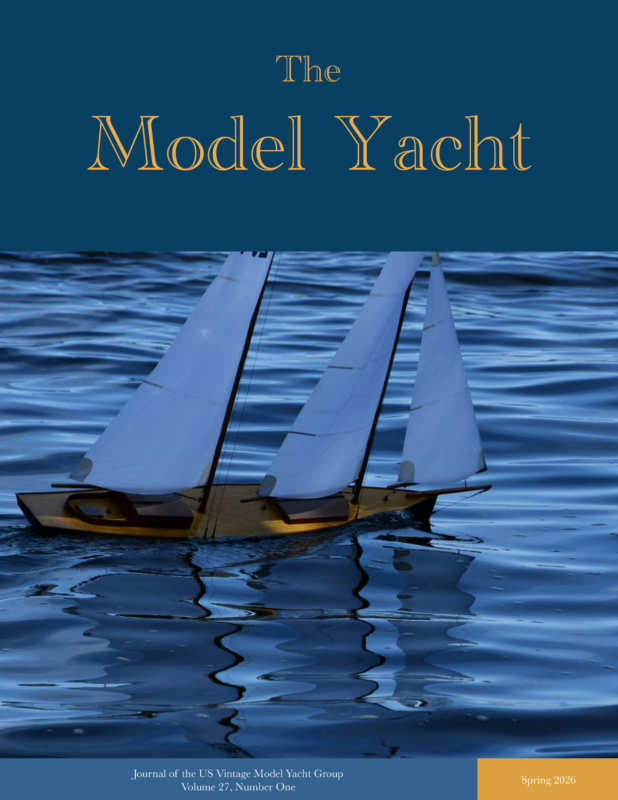
The Model Yacht is a published three times a year by the US Vintage Model Yacht Group
- The Layline. by John Y. Stoudt. The president’s update covering organizational progress, membership growth, financial status, and plans for upcoming regattas and initiatives within the US VMYG.
- 2025 Treasury & Membership Report. by Chuck Lage. A financial and membership overview highlighting revenue growth, website investment impacts, and overall membership trends for the year.
- Eight Bells for Ken Young. by Jeff Gros and Ashley Mishler. A tribute honoring Ken Young’s life, contributions to model yachting, and the personal impact he had on fellow sailors and students
- “It Followed Me Home. Can I Keep It?” by Ken Young. A personal and humorous account of developing a passion for R/C schooners, chronicling acquisitions, experiences, and the joy of collecting and sailing them.
- How To Make a Wooden Mast. by John Henderson and John Stoudt. A practical, step-by-step guide to selecting materials, tools, and techniques for constructing strong and effective wooden masts for model yachts.
- Structural Mechanics of Wooden Masts. by John Henderson and Victor Stango. A technical exploration of mast design, explaining the engineering principles—such as buckling and material properties—that determine mast strength and performance.
- Introduction to the Beginning Model Yachting Series. by Jeffrey Beck. An overview of a new educational article series aimed at helping newcomers enter the hobby, outlining its scope and “choose-your-own-path” approach.
- The Blind Skipper and Boats for Generations. by Don Wigent Jr and Don Wigent III. A multi-generational story of perseverance and passion, following a blind model yachtsman’s lifelong involvement in the hobby and the restoration of one of his boats.

‘Lhe < Journal of the US Vintage Model Yacht Group Volume 27, Number One <
‘The Model Yacht Spring 2026 US VMYG Leadership President: John Y. Stoudt*, jstoUdt309 @gmail.cOM.........ccccccccccscessssssesesnscaeeeeeeeeeeeeeeeeeeeeeeeeeeseeeeeeeaas (610) 316-8695 President Emeritus: John Snow, jSNOWjJ@COMCASE.NEL............ccccccccccccececceeeeeeceeeeeeessaesssseesseseeeeeeeseeeeeess (978) 594-8521 Treasurer: Chuck Lage*TM, USVMYSt@PMaAil.COM.............ccccccsessessseeccccececceeeeeeeseseeseeseeseesessesseeeeeeeeeeeeeeeeees (484) 682-3091 Secretary: Richard McOrmondTM, Mcormondrc@gmMail.cOM..........cccscssessssessescssssessesesssscesssessueseseesesssseaeaeeceseesees (610) 717-8285 Journal Editor: Jeff Beck*, beck. jeff@gimail.COM...........cccccccccccceeeseeeeeeeseseeseeesssssseeseeeeeeeeeeeeeeeeeeeessaaaaas (240) 252-0236 Journal Art Director: Bruce Richter, richterbruce@gMail.COM...............ccccseessesceeccececeeeeeeeceseseeeeeeseeeeees (917) 575-2221 Editorial Staff: John Henderson, jgnhenderson@gmail.cOM............:.ccccscssseeeseecceeeceeceeeeeeesseeeeeeeseeseesees (443) 282-0277 Jim Kandler, Mc.scow. 2098 @gMail.COM.........ccccccceceecceccseeeeeeeeeeeeeeaaaaaseesssseseeeeeeeseeeeeees (262) 325-9564 Membership: Chuck Lage*,to USVMYySt@gMail.COM...........ccccccccccscccccceceeeeeeeeseseeseeeeeasssaseesseseeeeeeeeeeeess (484) 682-3091 Regatta Coordinator: Nick Mortgu, MOrtQZU@COMCASt.NET......ccccccccccccceeeeeeeeseseeeeeeeseessseeaaeeeeeeeeeeeees (609) 820-0509 Archivist: Chuck LageTM, to USVMYyZt@gMail.COM.............cccceeessssssssceeeeeeeceeeeeeeeeeeeeeessssssaseesseseeeeeeeeeeeeeeess (484) 682-3091 Awards Coordinator: Rob Dutton, edwin653@aol.com.mortgu@comMCast.net.........ccccccesccceseeeseeeeeees (703) 608-8812 Resources Coordinator: John Y. Stoudt, jstoudt309 @gmail.cOM...........ccccccccccccecceeeeeeeseeeeseeeeeseeeeeeseees (610) 316-8695 Plans Coordinator: Stanton Smith, stantonesMmithS6@gMail.cOM.........ccccccccccccccsseeeeeesssssssssssssseeeeeeeees (443) 629-4202 Historian: Earl Boebert, Doebert@Swap.COM........ccccccccccsccccccccceeeeeeeseeeeeeeesseseessssseseeeeeeeeeeeeeeeeeeeeeeeaaaas (505) 823-1046 Boat Identification: Earl Boebert, boebert @SwWap.COM..........ccccccccscsccccccceceeeeeeessseeeeeeeesssasssseseseeeeeeeeees (505) 823-1046 Boat Yard Coordinator: Cliff Martin, Cliff-MartinQ@Ccomcast.net........cccccccccssssssssssssssssceeseeeeeeeeeeeeeeeeeeees (508) 533-5971 Construction Advice: John Henderson, jgnhenderson@gmail.cOM.............cccsssssssssssseseeeeseeeeeeeeeeeeeeees (443) 282-0277 Jeff Gros, Jeffreygros48 @gmail.cOM..........cccccccccccccceeeeeeeceeseeeeeeesssessssssseeeeeeeeeees (630) 673-2201 Social Media: Chuck Lage, to USVMYyEt@gMaAil.COM.........ccccccccccceeeceeceeeeseeeesssessssseeseeseeeeeeeeeeeeeeeeeeesaaaaas (484) 682-3091 Class Coordinators Free Sailed: John Fisher, jfisher577@gimail.cOM..............cccccceessssssescccecceeeeeeeeeeseeeeeeeseeaeseessssseseeeeeseeeees (719) 651-0762 Intl A Boat: Tom Kiley, kileyhillS@Me.cOM.......cccccccccccccccsssseceeeeceeeeeeccceeccceesesesssaeesaeeeeeeeeeeeeeeeeeeeeseeeas (207) 701-1661 Schooner: Kyle Russell, russellkr@yahOO.COM.......ccccccccccccecceceeeesaeseesseesesesseeeseeeeeeeeeeeeeseeeeeesessaseageaaaages (443) 975-1331 Skipjack: John Henderson, jgnhendersOn@gmMail.cOM............cccsscesssssesseeeeeeeeeeeeeeeeeeseeeeeeeesseseeneeesaaaes (443) 282-0277 Unrestricted: John Henderson, jgnhenderson@gmail.cOM.........cccccccccssssssssesssesseseeeeseeceeeeeeeeeeeeeasaaaaas (443) 282-0277 Vintage 10-Rater: Jeff Beck, V1Orclass@gmail.COM..........ccccccccccccceeseseeeeeeeeeeeeessssssseeeseeeeeeeeeeeeseeeeeeeeaaaas (240) 252-0236 Vintage 36: Rob Dutton, CEdwin653 @aol.cOM...........ccccsssesssssssseeeeeescceecececeeeeeeeseeeeeesseesseseeesssseeeeeeeeaeeeess (703) 608-8812 Vintage Marblehead: Colin Parker, captcparker@yahOo.COM............ccccsccccceeeeseeneneeeeeeeeeeseneaaeeeeeeeseeaes (410) 404-3093 Vintage Power: Peter Kelley, pdkelley@SyMpaticO.Cd......ccccccsssssccsscscccseccceeceeesseeeeesesssesessaaaaaeeeseeeeeeess (905) 301-9977 Regional Coordinators AUStIALIAL ce cccsccecesssessecessesseecoesesaesacecsesesaescoesusassaescoesaaasaescoesuaaessaesuaaessessaesaaesaes sasessassaeseessasessesaeessasecesseasanens Currently Open CANA! u..cecsecssccesssecsecesssecseaesconsessaecesaeecsesesasecseseesesessaecssasecaesssasecseaeecesesesesesassseesssaeesseaeesesesasecssaseseesessaeessasesanes Currently Open EUPOPGAN CONTINGNK!......cccccccceccccseeceneeeeeseeeee ee eeee An EEA EA EEAAAEEAA;IA;;;AAEE;;A AE S;;;E;;;AIEA;;IEE;;;HES;A;EESAEE A SEEE AE SAE BEERS Currently Open Mid Atlantic: George Schuld, gschuld @MhotMail.COM.........cccccccssssssecsccessesssecsesssaesesecesesseecaesssaesnrecaesseaeeaes (732) 966-7981 North Cent rals.c...ccccccccccccccccccceeeeeeessessssssssseeeeeeeeeeeeeeeeeeeeeeeeeeseeeeeeeeeseeeeeeeeeeeeeeeeeeeeeeeeeeeesesssaaeaaaaaaaaseeeeseess Currently Open North East: Cliff Martin, Cliff-MartinQ@ comcast.net ........ccccccccsssssssecssssaessseceecesseecaessecesaeecaesseaescaesseessanessaes (508) 533-5971 North West: Brian Schneider, schneiderS56O@gmail.cOM..............:ccccccsssssssssescccccceeceeeeeeeseeeeeeeeesesesaeees (207) 715-2644 South Central: Jeff Beck, beck.jefF@gMail.cOM .......cccccecssccsscesssssecssceseecsecesaeeeeeceecssaeseeecesssaeeseesssassneesesaas (240) 252-0236 S10] 0100 at; |S) eee Currently Open South West: Ernie Mortensen, USVMYZSW@EMaAII.COM...........cccccccccceceeceeeeeeeceeeeeeesaaaassseassseseeeeeeseseeeess (858) 525-5217 United Kingdom: Graham Reeves, graham@reevesmail.cO.UK............cccsssssesssssseseeeeeeeeeeeeeeeeeeeeeeeaas +44 151 936 1140 *Denotes US VMYG board members
Spring 2026 The Model Yacht is published three times per year by the US HE LAY LI | \ EL, Vintage Model Yacht Group. Copyright 1989 to 2026 by the Article by John Y. Stoudt permitted; all other rights 9025 REGATTA IMAGES US VMYG. Reproduction for noncommercial purposes reserved. Other copyrights are maintained by the original holders, and such material is used here under the fair use Pictures and videos from last year's regatta can be found here: Photos - provisions of the relevant https://drive.google.com/drive/folders/11EUNNvUKczsglVefX3bkAYAXQufivia2? copyright acts for nonprofit usp=drive link research and educational purposes. Videos httos://usvmyg.org/category/archives/videos/2025-national-championship-regatta/ Editorial Address: John Stoudt 309 Sundance Drive Chester Springs, PA 19425 regatta there were 35 On the Cover: John Stoudt's skippers and with 85 Tomfoolery was resurrected to sail in the various Terrapin Sharpie schooner from the sinking in Chicago (2024) and sailed to second Last year at the national model yachts registered . series. place in the 2025 National Championship regatta in Toms River, NJ. Photo: Judy Bonanno. Membership Renewals: Membership is managed ona , ; rolling 12-month period. The 2026 REGATTA The Chester Springs Model Yacht Club is pleased to announce that it will host the 2026 National Championship Regatta at its home lake on the Tel Hai Camp and Retreat in Honey Brook, PA. The dates are September 25-27, 2026. annual membership fee will be The NOR is available: https://usvmyg.org/wp-content/uploads/2026/03/ due on the anniversary of your USVMYG2026NOR. pdf last payment. You will receive an email notification leading up to your due date. Please see the BUDGET/MEMBERSHIP “Membership” page at https:// Your board of directors works very hard to maintain a financially stable memberships/ for more organization. We also work to increase our membership. You will find a budget information. and membership report on page 4. usvmyg.org/memberplans/ Requesting a sail number: You can get a new Sail number or transfer a registration from a previous owner here:https:// usvmyg.org/registration-2/ Select the class to open the a. , oy gs Notable Items for 2025 are: « Our revenue increased by 14% « Our membership increased by 7% e Our membership retention went from 76% to 82%. correct form. There is a $10.00 fee for new registrations but no charge for transfers. The class coordinator will contact you to You may have been contacted by Chuck who has been reaching out to members to tighten up our membership records, find individuals who may be willing to j ; J ; ; confirm your registration and help with a piece of our work, and to just engage members in a conversation. If sail number. you would like to provide input to the board, you may do so with this form: The US VMYG is a 501(c)3 corporation. httos://usvmyg.org/about-us/contact-us/ 1
Spring 2026 Y Inside STRATEGIC OBJECTIVES You will remember that the board approved three strategic objectives. BEGINNER SERIES The Leadership Team............000 When this was just a concept, we had no idea what it meant. During the preliminary discussions it appeared as though this would be a simple task. The Laylin@.......cccssssesecsrteseeeeeees 1 As the discussion lengthened, we realized that this would be an undertaking of major significance. It is likely hundreds of articles will surface addressing all aspects of beginning model yachting, not just what a beginner needs to NSIDC... ccescscsesceccsescscsescscseecseseeess 2 know but much more than that. There are articles that are being written and many more to write. See the introduction to the series on page 23. 2025 Treasury & Membership BEGINNER V36 KIT REPOFti scescecscsscssessesseeetsteeeeeees 4 The first kit has been laser cut, reviewed and sent out toa Eight Bells for Ken Young........... 5 a It Followed Me Home. (Cali 1 2G )9 tte” cancooncacsncnoaccaroncasa0 6 J . member for the first build. A few errors were found which have been corrected in the digital files. An outline of the manual has | a (io =) ona a St el | _ uw OK en } a —} wi ( )/ SL i Z Le been started, and the committee has started to flesh out building steps. The committee is meeting biweekly to get more of the manual and the construction process worked out. How To Make a Wooden DIGITAL ARCHIVE NES txescecoccaencdo5cse0c000000c0CHo533Se5c000 11 Thus far our team has posted over 1,000 documents. More are being posted every week. We are trying to fill holes where we are missing items. Ken Young Memorial Vintage Regatta........ccceeee 15 Browse the Digital Archive at: https://usvmyg.org/digital-archive/ UPCOMING ARTICLES The editorial team is always searching for Structural Mechanics of Wooden Mast6........:ccccceeceees 16 content for The Model Yacht. |f we see Yacht SEri@S........ccccccseessseseceeeeees 23 ~~ 2. something interesting, we ask, and you Many of the articles that have been published are reworked and posted on the website for ease of access. Upcoming bore < Is there a rig? > write. Keep the content coming! We have a lot of good material in the queue. Intro to the Beginning Model ~~ No Yoo A 50 you haves. “all hardare?~ N\ Pl a e articles will come from the beginner series and many other sources. A group of The Blind Skipper and Boats articles will be ready soon as part of the beginner series, entitled “The Rig”. We for GeneratiOns…….cccecceseseees 25 constantly search the archives to see if there is an “older” article that should be republished. There is one that we will publish soon to complement the two mast building articles in this issue. 2
Spring 2026 UK CONNECTION The US VMYG modeled itself after the VMYG in 1994. Recently, the US VMYG THE VINTAGE MODEL initiated a virtual meeting with our British \ ACHT GROUP counterpart. Martin Bandey, VMYG fe y_} fi * | _——— Chairman, and I spoke at length about what each of our organizations has been doing. The purpose of the meeting was to share and learn from each other and to move forward with a common cause. A second meeting was scheduled with members of our leadership teams to discuss more detailed sharing between our groups. The agenda of the second meeting led us through discussions about common purpose, website development, budgetary issues, and other items. GOING DOWN THE RABBIT HOLE As more items are added to the digital archive it becomes more robust. It is fun to do a search on a particular topic. | liken it to going down a rabbit hole. All you have to do is click on the magnifying glass to the right of the words “Account” or “Join Us” in the upper right of each page, enter your search topic, and click again. And away you go! The search lists every item within the archive ina chronological list of items that reference that word. So, pull up your chair with a cup of coffee and have some fun. ADDING MORE ITEMS Speaking of adding more items, our work on the archives has led to conversations around the world. Chuck Lage has been in communication with individuals in Australia, New Zealand, the United Kingdom, France, Norway, and Italy. Why go international when we are the US VMYG? We have begun to see our organization as the repository of all things vintage model yachts. If you have or know of someone who has vintage materials, please have them contact Chuck at usvmygt@gmail.com. PRICE INCREASES We have not increased pricing of items on the website for many years. The price of some items will be going up slightly beginning April 1, 2026. We will also be increasing the cost to register a boat/acquire a sail number to $10.00. These increases help us with the website maintenance and yearly cost for the various website plug-in subscriptions. oe
Spring 2026 2025 TREASURY AND MEMBERSHIP REPORT Statement of Activity STATEMENT OF ACTIVITY January-December, 2025 INCOME STATEMENT) Revenue Total It was another good year with revenue growing 14%. This E00 OR rane grateful for a surge in donations late in the year. Thank you! 4200 Products and Services Total for 4200 Products and Services $ 1,944.00 Our expenses were comparable to 2024 except for a 4300 PayPal Sales $ (38.00) significant $6,500 investment in our website, which Total for 4400 Donations & 2s6240 4700 Investment income $ 1,009.70 | was driven by strong membership growth, and we are Tot foe 100 Marner included a new ecommerce platform. Our increase in revenue did not completely cover the one- = 545066 Total Revenue time investment in our new website resulting in a net loss $ 10,750.46 Total for 5100 Program Expenses of $1,848 in 2025. $ 4,260.18 Gross Profit $ 6,490.28 Total for 8000 General Administrative Expenditures $ 8,317.24 Net Income $ (1,847.96) Statement of Financial Position As of December 31, 2025 STATEMENT OF FINANCIAL POSITION 31-Dec-25 31-Dec-24 Total for Bank Accounts $ $ 3,896 Total for Other Current Assets $ 25,186 $ 26,656 $ 28.704/$ 30,552 $ 28,704 $ 30,552 $ 28,704)$ 30,552 $ 28,704 30,552 Assets (BALANCE SHEET) Current Assets Our total equity decreased to $28,704 due to the $1,848 loss from our website investment. Total for Current Assets Total for Assets 3,518 Liabilities and Equity Total for Liabilities Total for Equity Total for Liabilities and Equity 2025 Year-End Change Membership Statistics – 2025 vs. 2024 “3% 12% MEMBERSHIP REPORT 236 Total Actual Members (No Complimentary) It was a good year with 47 new members and an 83% retention rate of our paying members. Our 68 167 Life members Members (Paying) year-end total was 236 members. 47 13 4 $ New Members in 2025 Complimentary Memberships 7% 31% 0%
The Model Yacht Spring 2026 Fight Bells for Ken Young Article by Jeff Gros and Ashley Mishler From the days of tall ships, Kight Bells signified the end of a sailor’s watch. ‘Time for the sailor to rest. — Ed. en Young passed away unexpectedly on September 24, 2025. He has been a member of the US VMYG Board since it was formed and represented the class and regional coordinators. He is the reason that we are sailing so many vintage boats in the North Central region. He worked with the other coordinators to increase membership and encourage regattas at the regional level. Ken’s easy manner brought people together for the fun of sailing. He communicated with new members, making them feel welcome to the US VMYG. Ken loved his schooners and collected them with great enthusiasm. When | was asked to write an introduction to Ken’s article on his schooners, | was worried. Worried because | didn’t think | would do him the justice he deserves. What do you say about the man who was your best friend and sailing partner? We had many adventures together whether it was traveling across the country to pick up boats, attend a regatta, or go to a fellow sailor’s memorial. | could always count on Ken for the encouraging “Let’s go ‘”. | asked my granddaughter, who was one of his students, to write something, and | believe she says it perfectly. I’ll miss this man more than words can say. Rest in peace Ken, may the wind be always at your back.
Spring 2026 The Model Yacht kK seemed to carry light with him wherever he en Young was one of those rare people who went. His sudden passing has left a hole in so stay curious about the world around us. His passion for teaching was contagious, and it changed the way | saw everything that came after. many hearts—students, friends, family, and the countless people who were lucky enough to have As | got older, | had the privilege of knowing him known him. beyond the classroom. Mr. Young was a lifelong friend of my grandfather’s, and I’d often see them together | first knew him as Mr. Young, my junior high social before heading out on sailing trips. Their laughter and studies teacher—and, without question, my favorite easy camaraderie spoke volumes about the kind of teacher of all time. He was the first person who made man he was—kind, steady, and full of life. me truly care about the world beyond myself. In his classroom, history wasn’t just a list of dates or events; He will be deeply missed, but his influence lives on in it was alive, full of human stories and meaning. He every student whose curiosity he sparked and in every taught us to ask questions, to think critically, and to life he quietly touched with his warmth and wisdom. “It Followed Me Home Honey. Can | Keep It?” My addiction to two-masted R/C sailboats. Article by Ken Young I’m not exactly sure when my love affair with R/C schooners began. I’ve always enjoyed pictures and videos of full-sized schooners. Their stateliness as they cruised across the waves and their absolute power as they muscle their way through rough water make them seem alive. | found R/C schooners to be the same. Just sitting and watching them is a treat for me. iL
Spring 2026 | was talking to John Stoudt again (which sometimes takes a different turn). | volunteered to help with anything the Vintage Group might need. So | began the process of writing an index for every issue of The Model Yacht since it began publishing in 1997. At that point it was about 25 years worth. Along the way | discovered a series of articles called “Windling World” written by Mark Steele in New Zealand. It had originally been a separate publication, but was then absorbed into The Model Yacht for the next 12 issues. Mark’s definition of “windling” was “just sailing around.” The articles were full of pictures of R/C schooners, cutters, barges, and almost any sort of sailboat you could think of, and they just sailed around. There was an occasional race and many interesting excursions. All of those issues have been scanned, thanks to Andrew Charters in the US and Graham Tuck in Australia who lent us the issues, The Gloucesterman. Photo by Debbie Young which are on our website. | think the first photos and videos were on Facebook. It was a Vintage Group NCR at Mystic Seaport. Incredible! Andrew Charters’s and Alan Suydam’s boats seemed to be in a lot of pictures, surrounded by other two-masters that were the envy of this new schooner lover’s eyes. Their size, their lines, their soeed, and their simple beauty going through the water convinced me | should have one of those. And so it began. | joined the US Vintage Yacht Group since they sail so many cool boats, especially schooners. | was talking with John Stoudt and told him | was looking for a schooner if he knew of anybody who SS Se Valmore Il. Photo by Larry Kmiecik was parting with one. As luck would have it, Alan In 2019 | attended my first Vintage Group National Suydam was thinning his fleet and was willing to Championship Regatta in Chester Springs, PA. With part with his 50-in Gloucesterman. Talk about the group’s more laid back approach to racing, | was starting at the top. Alan was an instructor at the really looking forward to this. | wasn’t disappointed. WoodenBoat School, and this Gloucesterman had Sailing my Gloucesterman with all of those other won the Craftsmanship Award at the National schooners was really fun. | found myself admiring Championships. The first time | sailed it at my the other boats and forgetting to sail my own. Just club, one of the guys asked me to put him in my before the regatta | had found out that Butch will and leave him the boat. It sailed beautifully. Guerrin was selling his 50-in Valmore with a full keel
Spring 2026 that had been designed by Alan Suydam, and was located right on my way home to Chicago. How could | say no? This was not to be the last time | would come home from a regatta with more boats than | left with and get the wife’s side eye. Valmore ill. Photo by Larry Kmiecik of Valmore, a 50-in fin and bulb model, was available. So | hopped back in the SUV and drove back to Pennsylvania to pick it up, even though it was December and snowing. At this point | was wondering if | had some sort of physical, or mental, condition that caused me to be obsessed with schooners. Now| figured | had four of them, and that would be enough. Not a chance. Now John Stoudt decided it was time to thin his fleet. Naturally, he had another version of Valmore that Alan designed and built. This one is 70 in long with a full keel, and one of the I’m on much too good terms with the owner of my local R/C hobby shop. He called me up and told me he had something | should come and see. Uh oh. It turned out he had picked up a partially completed Robbe Atlantis at an estate sale, and hopefully all of the parts and sails were there. Naturally, that turned out to not be the case. So with a few modifications | finished building that one and absolutely love it. show stoppers at the NCR. | actually debated with myself about that one. | thought to myself, “Self, does a guy in his seventh decade with two bad shoulders and an ankle full of screws really need a schooner that big?” Of course he does! So the big blue boat went into Jeff Gros’s trailer, and again | came home with more boats than | left with. With a fleet of five, including all three versions of After not sailing the next year due to Covid, the NCR Alan’s Valmore, two of which were built by Alan was held the following year back at Chester Springs. | himself, | figured | was living the dream and | sailed the Valmore in that one. Just walking around couldn’t possibly find another one like the ones | looking at all the boats rigged on shore during Craftsmanship Award voting can make a grown man drool. Another great regatta. A couple of days after | already had. Wrong again. | found three. Maybe | need professional help. got home John said that Alan was going to spend | had gotten to know Andrew Charters in South more time on his big boat and was drastically Carolina through correspondence as he was writing reducing the size of his R/C fleet. His second version an article for The Model Yacht. | had been drooling
The Model Yacht Spring 2026 over the pictures and videos of his fleet on Facebook for a long time. Dave Querin was a builder of some renown in Ohio. Unfortunately Dave passed away a few years ago, leaving his family, as so often happens, to find a future for his eight boats. Dave and Andrew had been friends, so Dave’s family turned to Andrew for help. Andrew then turned to me to help with the process of getting them listed on The Boat Yard on the Vintage website. | was more than happy to help. Dave’s son, Jeff, sent Andrew a group picture of all the boats, which he forwarded to me. As soon as | opened it my schooner senses started tingling. There were three hulls that each had two mast steps. Schooners! And truly beautiful schooners _ = ay Prospero and her tender. see Photo by Debbie You ng. they were! There was a 50-in double ender Sharpie, time deciding which one, but Jeff gave me a price for a 60-in Carolina Oyster Sharpie, and a 60-in gaff- all three that | couldn’t turn down. The only catch was rigged Prospero with SIX Sails. | was having a hard the boats were in South Carolina and | was in Chicago. Not a problem. Into the SUV | went and did a 3 %-day spin to pick them up. One of the best parts of the trip Prospero. Photo by Debbie Young. Adriana a 60-in double-ended sharpie. Photo by Debbie Young
Spring 2026 was getting to spend an afternoon with Andrew in his workshop talking schooners. The weather was no good for sailing, so he regaled me with his incredible knowledge of historical schooners and the — workings of his fleet of five ~/ | schooners and a cutter. Now| think my fleet is complete, but I’ve thought Ae that before. | now have eight, but | didn’t build any of them, mainly because that’s a skill set | haven’t mastered yet. | did build one model of Bluenose. | met some guys at the pond for her inaugural sail, and she promptly sank. Really! San Juan double-ended sharpie. Photo by Joe Richmond Fortunately, Joe Richmond was there, and he proved to be fairly proficient at hooking a sunken sailboat and dragging it ashore. | gave it away. That’s the story of my schooner addiction. | always let other people sail them, hoping to spread this affliction. Check out the pictures and videos on the Vintage Group Facebook page. There are some absolutely beautiful boats there. Valmore Ill and Valmore T onan upwind leg at a National CiChampionship Regatta, Photo by Larry Kmiecik 10 So come and join me in Schooner Land. You’ll never sail a prettier boat.
Spring 2026 How to Make a Wooden Mast Article by John Henderson and John Stoudt it uses the wood efficiently. Quarter sawn lumber There are many types of model yachts that may need a new mast. A wooden mast may be a can be ordered, although you will note that some of dowel, a single piece of wood cut to shape, ora the plain sawn boards (horizontal boards near the glued-up mast of two or more pieces of wood. center of the log) will have grain patterns close to Your mast choice will be based on the model and quarter sawn. Quarter sawn wood is desirable, anticipated use. The topics discussed in this article probably because of improved humidity stability, will help you develop a plan and to make your but it is not necessary in model masts. mast. Fig. 2. CHOOSING THE WOOD A square cross-section that You want straight-grained, clear, and lightweight would be suitable for mast wood. construction. STRAIGHI-GRAINED Fig. 2 shows a square cross-section that might well Straight-grained means that, if you look at the wood be suitable for a mast. Note the fairly straight grain surface, the grain lines should run parallel to the on the vertical face. It is not perfect, but there is little edges. In the real world, perfect grain is very rare, “run-out” of the grain at the upper face. Note the but you want the grain to run for long distances grain pattern on the upper surface. Referring to the before it crosses an edge. This visible grain pattern plain-sawn wood in Fig. 1, it can be seen that this can be complicated by how the wood was sawn piece came from near the top or bottom of the log. (e.g., “quarter-sawn”, “plain-sawn”) and where on The grain rings are relatively far apart on this upper the log your particular plank came from. Straight surface, indicating that the grain on the vertical grain should be visible on at least two edges. PLAIN SAWN QUARTER SAWN surface runs nearly parallel to the top surface. RIFT SAWN CLEAR Clear means free of knots. Small, tight knots may be unavoidable in full-size boat masts but they are not acceptable for model yacht masts. Fig. 1. Cross-sections of a log showing how it can be Even small knots are sawn into planks. a large percentage Fig. 1 shows cross-sections of a log and the ways in of the diameter which it can be sawn into planks. Note the of a mast fora model yacht. orientation of the grain (i.e., the growth rings) Knots are relative to the saw cuts. Plain sawn is the most weak points. common in lumberyards—it is simplest to cut, and 11 Fig. 3. A square crosssection that would NOT be suitable for mast construction. Note the knot.
Spring 2026 Fig. 3 shows a piece that would NOT be suitable for a using a hand plane, practice first on scrap wood. There mast. Note the effect on the grain lines of the knot at are many on-line sources that teach how to sharpen the top of the photo. This is a weak spot, and it will and adjust a hand plane. cause much regret. Your table saw must be set up properly: blade perpendicular to the table, rip fence parallel to the blade, push sticks at the ready, and splitter and anti- Fig. 4. Three boards showing a range of kickback devices in place. Use feather boards suitability as mast stock horizontally and vertically. If any of these terms is from a good candidate at unfamiliar to you, on-line woodworking sources are the top to unsuitable at plentiful. the bottom. Fig. 4 shows three pieces of wood of varying degrees A plane with a longer shoe is almost always better for of suitability. The top piece is the obvious choice. shaping a mast, but you probably won’t need a full-on The edge of the knot visible in the bottom piece “jointer” plane. A plane with a 14-in shoe is usually renders it unsuitable. The middle piece is a “maybe.” fine, and a 9-in shoe will work if you pay attention to keeping the surface free of low spots. LIGHT WEIGHT Light weight means exactly what it says, but the term Note that each piece of wood will have a preferred is relative and species-dependent. Sitka spruce is the direction of planing. You can generally guess this gold standard for wooden masts in full-size boats, direction by noting the direction in which the especially for yachts and racing boats; its stiffness (imperfectly straight) grain exits at the edge of the and relatively light weight are vital. Full-size plank. It is important to plane in this “exit” direction. workboats often used pine or fir, depending on local If you try to plane in availability. These are generally heavier than Sitka the other direction, spruce. The grain may not be as straight, but the cost you’ll learn your error is lower. quickly. Don’t blame the plane. For model boat masts, western red cedar is often a good choice. It is lighter than Sitka spruce and can be found in clear, straight-grained lengths. You will need Fig. 5. Note where the to search through the wood at your lumber yard to grain runs into the edge of the boards at find a good piece. Clear white pine is a decent second the arrows. Plane choice, but it is harder to find really straight-grained these edges from left to right to avoid pieces. Note, however, that western red cedar is chipping out the grain. usually weaker and less stiff than Sitka spruce or pine, so it may require more care in selection and building Look at the grain pattern in Fig. 5. Note that the and also in how stays and shrouds are placed. grain “runs out” on the edges close to the front of TOOLS AND ‘TOOL USE the image. Planing from left to right on these edges You will need a table saw, a good hand plane, anda would likely be successful, but planing in the other flat and sturdy work surface that accommodates the direction (i.e., “against the grain”) could be full length of your mast. If you are not comfortable problematic. Learn to cooperate with the wood. 12
Spring 2026 the mast. Scarfing shorter pieces together MAKING THE MAST requires considerable skill and accuracy. The scarf SIMPLE should be at least 8:1, preferably 12:1. If you are The simplest mast is a cylindrical shape of unsure of the meaning and implications of these constant cross-sectional size. On your table saw, statements, don’t try scarfing until you have cut a full-length piece of your chosen wood to a gained experience. An excellent, perfectly aligned perfectly square cross-section (each side face is joint is essential to an effective result. exactly the same dimension as the others). Cut the cross section faces slightly larger than the MODERATELY MORE COMPLEX AND A intended finish dimension to allow for planing BIT STRONGER smooth. Plane to a smooth square cross-sectional A mast can be laminated of multiple, thin, full- shape. The mast needs to be clamped to a flat length pieces. Done thoughtfully and carefully, surface for this planing operation. You can also this can result in a stronger mast of the same have a lumber yard with a mill shop prepare the cross-sectional size. wood for you. The simplest laminated mast is made byjoining You should plan ahead for where fittings will be two pieces lengthwise. Start with a square (or attached to the mast, because it is much easier rectangular) blank that is at least % in bigger in and more accurate to drill holes while the blank cross-section than the final intent and that is is square. Locations should be planned and several inches longer. Cut this blank in half drilled to support the gooseneck, vang, spreaders, lengthwise (the extra ~% inch is to allow for this tangs to attach the shrouds, masthead crane, jib saw kerf), and then glue it back together with a stay, etc. lengthwise offset of a couple of inches. The intent is that, if there are any weak spots in the Now you will make the mast round, or whatever blank, they will not line up because of the cross-sectional shape you wish. With the mast offset. You will need to make these longer than clamped to the flat surface, plane each of the four the mast length to accommodate the offset. corners at 45 degrees, turning the mast blank into Keep the orientation of the blanks the same an eight-sided section. For full-size boats, you’d (DON’T end-for-end them), so that the favored probably now make it 16-sided, but for models direction for planing will be the same for both you can probably start sanding when you have halves. reached eight sides. Sand the blank until it is round. An easy trick is to Plane to four-sided and then eight-sided, and take an old, broken belt from a belt sander, wrap it sand as above. half-way round the mast, and sand by pulling the ends of the belt back and forth. Note, after the More complex laminations could involve three mast is shaped round, you must finish-sand in the or more layers. Sometimes a thin layer of harder direction of the grain. and stiffer (and probably heavier) wood could be sandwiched between the lighter cedar. Or Unless your woodworking skills are quite good, perhaps the forward and/or aft faces of the you should start with a piece of wood as long as mast could be thin layers of stiffer wood. 13
Spring 2026 TAPER Most masts taper over their lengths so that the top has a smaller cross-section than the bottom. This saves a little weight aloft, and it arguably makes the mast look better. Plane the taper into the mast blank while it is four-sided. Mark the desired taper on two opposing sides and plane to the line. Then do the other two sides. Once you Fig. 6. Two views of laminated have a four-sided tapered blank, make it eight- mast stock with stiffer and heavier woods sandwiched between lighter woods. sided and sand as above. Note that the mast always must be supported over its full length while Fig. 6 shows two different mast laminations. Each uses planing these tapers. thin sections of a harder, heavier, and stronger wood sandwiched between lighter pieces. Orient the stronger HOLLOW MASK inserts based on the expected mast stiffness and Hollow masts can be lighter than solid masts, but strength requirements. The section on the left is the difference may not be worth the trouble. Full- unusual because it has two inserts in a cross pattern. size mast builders are justifiably proud of their tricks to make multiple tapered staves, with proper This mast is intended for a model that will have no stays beveled angles. This might be a delightful project for or shrouds. The hardwood inserts add strength in both a model, but it is not suitable for your first or even directions and provide a harder bearing surface where second attempt. the mast passes through the deck. A simple hollow mast would have a rectangular Note that the mast does not have to be round. Often, a cross-section with four sides of relatively thin planks rectangular cross-section with rounded corners is easier, (~% in) glued together carefully. You can even plane or lighter, or a better match to available materials. taper into these side planks. It is necessary, however, that the mast be solid wherever fittings GLUING AND CLAMPING will be attached or where there would be local A critical part of making the mast is getting the blank stresses (e.g., the gooseneck and vang). straight— whether you do that with your selection of a straight piece of wood as your blank or you glue straight MAST CROSS-SECTION SIZE pieces of wood together to get your blank. If you are Size is dependent on wood species (stiffness), sail gluing up a mast blank, you must use weight and/or area to be supported, how carefully the mast was clamps while doing the assembly on a dead flat surface. built, and (to a lesser extent) boat weight. No model mast will survive being slammed in a car door. Size The other important part is the glue joint(s). Do not recommendations also assume that the mast is starve the joint of glue. The glue is spread best using a properly supported by shrouds and stays. This credit card, making sure the entire surface has a good usually means a pair of upper shrouds leading from coat of glue. Either weight and clamp your assembly somewhere near the point on the mast where the together or clamp your assembly to the work surface jib stay attaches down through spreaders to the making sure the pieces align. It is best to work on wax deck, plus a pair of lower shrouds attached at the paper. spreaders, plus a backstay and forestay (jib stay). 14
Spring 2026 The arrangement may vary depending on the height rounded corners) of %- by %-in cross-section of the jib attachment point. Shrouds and stays are (tapered at the top). topics for another article. The mast is hollow, being glued up with %-in thick For purposes of this essay (except for the criss-cross pieces forming the rectangle. The mast has solid example in Fig. 6), it is also assumed that the mast is internal blocks where fittings are attached. It hasn’t deck-stepped rather than keel-stepped. Stepping the broken yet in wind gusts over 20 knots. You should mast on deck avoids damage that could occur where always consult class rules for dimensional a keel-stepped mast presses against the hard edge of information about masts and other spars. the deck. This whole process requires about 2 hours of Built and supported according to the working time (plus whatever it takes for the glue to recommendations above, a %-in round mast should dry—TiteBond II (blue cap) works well, and you get be strong enough for models up to Marblehead size to make wood shavings, which is always fun. (800 in2 sail area). If you have doubts about your wood quality or building skill, make it a bit larger While this article is about mast construction, the (probably no more than % in). A rectangular cross- same discussion, materials, and construction section of % by % inch with rounded corners would techniques can be applied to the booms and any work for Marblehead-sized sails. Smaller boats might other spars that will be needed for the boat you are get away with % by % inch. /f you are building a mast working on. The construction technique described in to go ona boat ina particular class, make sure you the article is but one way to build and shape a mast. check the class rule for dimensional information. There are others that will work just as well. Larger boats should get bigger mast cross sections. For more detailed discussion of the engineering of For example, there is an “existence proof” of a wooden masts—solid and hollow, stayed and Vintage 10-Rater with 1350 in2 of sail area supported unstayed—see “Structural Mechanics of Wooden by a rectangular cedar mast (with Masts” on pages 16-22 of this issue. CAN’T BEAT A SCHOONER! KEN YOUNG MEMORIAL VINTAGE REGATTA July 11, 2026 KEN YOUNG Century Park, Vernon Hills, IL Hosted by the Chicago R/C Model Yacht Club Sailing Vintage Schooners, Vintage 36, and Vintage Marbleheads Skippers Meeting 9:30 am Please Come — No Registration Needed
Spring 2026 Structural Mechanics of Wooden Masts Article by John Henderson and Victor Stango In an accompanying article on page 11, there are CALCULATING THE CRITICAL discussions of woodworking techniques for BUCKLING LOAD making a wooden mast and some general guidelines to achieve adequate stiffness and In 1750, a mathematician and theoretical physicist strength. Generally, common sense and the named Leonhard Euler developed a formula for specifications in class rules deliver an adequately calculating this critical buckling load: strong mast. However, we can define the ni’ EI engineering considerations for creating long c= Tz slender masts to support our sail plans. We will first present the relevant general principles and where then demonstrate their application to example P. = critical buckling load mast designs. n =a factor determined by how the ends of the column are restrained Most of our models have masts supported by E = Modulus of Elasticity stays: sidestays, forestays, and backstays. These I= moment of inertia stays keep the mast in a straight column. The L = unbraced length of column geometrical constraints of the boat’s relatively narrow beam compared with the tall mast Modulus of Elasticity, E, is a measure of material determine how forces are generated and applied stiffness or resistance to deformation. Note that to the mast. stiffness is not the same as breaking strength. Note also that the critical buckling load depends The distance from deck to the height of the on stiffness, not ultimate strength. This has some attachment points of the stays on the mast is consequences for the choice of wood species. much greater than the distance from the base of the mast to the stay attachment points on deck. E is a property of the material—the wood species The wind forces push the mast sideways. This in this case. Tables that give the Modulus of force is resisted by the stays, and we can see this Elasticity for different wood species are available as tension of the stays. This tension is along the online and are discussed later in this article. axis of the stays—meaning that it runs in the Strength is usually associated with density, but nearly vertical direction of the stays, and so it is stiffness—especially stiffness per weight—may be primarily a force in the vertical direction. It exerts available with lighter-weight species. This is why a downward force: compression on the mast that spruce is a favored choice for masts in full-size the mast must be stiff and strong enough to boats. Models can often use even lighter-weight resist. cedar. The key point is that a stayed mast is a slender column that is loaded in compression. Such The moment of inertia, J, is related to the cross- columns fail by buckling when their “critical load” sectional shape of the column and varies as the 4th is exceeded. power of diameter for a solid circular section. 16
Spring 2026 F F The determination of 2 in the equation has v practical implications for model construction. ¥ LA VLLLEL YSSSS 77. Usually, our masts are deck-stepped and supported at or near the top by stays. For such a condition, 2 = 1. Model masts could also be Wind stepped on the keel and supported both at the keel and where they pass through the deck as well as by stays. For this circumstance, where the lower part of the mast is “fixed”, 1 << 2. lf masts are unstayed, j.e., cantilevered, bending stresses dominate because there are no stays to cause compression or buckling. In these cases, attention must also be paid to the shear forces where the mast passes through Deck x Keel the deck and at the step. n=1 Fig. 1 shows, in schematic and exaggerated Daok- Stepped 1sns2 Unstayed No soe nen Buckling Fig. 1. Mast configuration and n values. form, the buckled mast shapes and values of n associated with these different mast F is mounting configurations. v Sidestays, including lower stays and spreaders, are “braces” that reduce L1 buckling force. This is probably intuitive, but it can be quantified by the above formula. Fig. 2 shows >< Land thus enable a larger critical i 8 8 a mast rigged with sidestays, spreaders, a backstay, and a jib stay. The buckling modes—side-toside and fore-and-aft—are y Waterline NT ee indicated. Fig. 2. Buckled shapes for stayed masts. This analysis applies to a solid mast and to any mast diameter should be sufficient. Using the practical hollow wooden mast. A hollow mast would minimum diameter would be more conservative. be “glued-up”, and the necessary gluing surfaces would make the walls thick enough that any problems It is instructive to compare the mechanical associated with thin-walled, hollow-tube columns properties of some of the wood species that are would not apply. popular for making model boats. Table 1 lists some example species and gives their Specific Gravity, Modulus of Elasticity, and Modulus of Detailed calculations for a tapered mast are a bit more Rupture. complicated; for our modeling purposes an “average” 17
Spring 2026 manufactured material, and the properties Table 1. Mechanical properties of selected wood species. Species Specific Gravity oa. ; . Modulusof Modulus of of individual pieces piece may vary . . (MOE; psi) (MOR; psi) “typical.” Try to find a lumberyard that Elasticity Rupture considerably. The numbers in Table 1 are Basswood 0.37 1,040,000 8,700 allows you to pick through their selection for Fir 0.48 1,950,000 12,400 the lightest, straightest, or clearest pieces. White Pine 0.35 1,240,000 8,600 Western Red Cedar 0.32 1,111,000 Sitka Spruce 0.40 1,570,000 10,200 Maple 0.54 2,200,000 13,400 Walnut 0.55 1,680,000 14,600 Atlantic White Cedar White Oak 0.32 7,500 930,000 0.64 6,800 4,030,000 CALCULATING MINIMUM MAST DIAMETER 10,300 Armed d with with thi hanical ; ; this mechanical engineering knowledge and with the knowledge of wood properties, we can now calculate the required minimum mast diameter for e Specific Gravity is the ratio of the wood species’ an example model with the following density to the density of water—essentially an relevant characteristics: indication of its weight. e Modulus of Elasticity (MOE or E) has been 6 = half-beam = 0.5 ft (boat beam = 1 defined above and is a measure of stiffness. ft) H = Mast height above LWL = 6 ft e Modulus of Rupture (MOR) is a measure of K = Draft = 1 ft breaking strength during a bending test. B = Ballast weight = 10 Ib For mast making, the importance of the Modulus of Elasticity D = Displacement = 16 Ib LWL = 4 ft is established by Euler’s equation. Light weight is important Center of Effort (CE) of sail plan = 1/3 of for the boat’s stability by reducing weight aloft. Table 1 mast height indicates that western red cedar, white pine, and Sitka spruce W = wind force on sails (to be are desirable for masts. This assumes, of course, that the determined) sample being used is clear and has straight grain. For those of us without direct access to a sawmill, western red cedar is Allowing for the nice round numbers, this is often the most readily available choice. But wood is not a remarkably similar to a Vintage Marblehead. a 7) Ls] z 4 W x > ‘ LWL @ 90° Righting Moment=BxK Wind Force = W Fig. 3. Mast qeometry—upwind. 18 Compression Force =F Wx H/3=Fxb
Spring 2026 Consider first the mast requirements imposed Fig. 3 diagrams the upwind situation, by side-to-side heeling forces (upwind sailing): showing a cross-sectional view of the We need to estimate W, the force on the sail. We suggest a simplified approach based on the righting moment of the fin- hull. Defining additional symbols that we will use: F= the force on the base of the and-ballast keel rather trying to calculate the wind force on mast the sail directly. (Such a calculation would depend on wind z =the distance between the speed and projected sail area, which depends on some center of buoyancy (LCB) and the assumed heel angle, so there would be some messy center of gravity (LCG) assumptions.) But the maximum heeling force is determined y = the distance between the mast by the available righting moment, which is determined by the and the backstay ballast and the draft. When the boat is knocked flat (90-deg heel angle), the wind force on the sails is whatever is required d to lift the ballast bulb to the surface. So, in our example, for a which is what we seek model with a 10-lb bulb at the end of a 1-ft fin, the maximum righting torque would be 10 ft-lb—assuming, for simplicity, that the boat rotates about the waterline. (We recognize that =the minimum mast diameter, W is a sideways force on the mast, and it causes a heeling moment coupling between the chainplate and A/3. This this is not strictly true, but it is a reasonable approximation force pushes the mast sideways, or since we do not have lines drawings of the boat.) clockwise rotation in the drawing. To counter this, there must be a force This righting moment is countering exactly the heeling pushing upwards on the base of the moment generated by the wind on the sails. If, per our mast, rotating it counter-clockwise. example, the sail plan had a peak height of 6 ft, and the center of effort (CE) of the sail plan were ~1/3 of this height (i.e., 2 ft above the LWL), then the force on the sail would be 5 lb at that center of effort in order to generate the same 10 ft-lb of torque as the ballast. We need not specify the actual wind speed or sail area. Instead, we can use these righting moment This force is F, to be compared with Pe (critical buckling load) in Euler’s equation. When the heeling and righting forces are in equilibrium, H observations to calculate the force of the wind on the sail. This is one of the key simplifications in our approach. Plugging in the data for our example Restating these concepts as an equation for equilibrium, when the righting moment equals the heeling moment, BxXK= H XW Euler’s equation except for the Moment BxK of Inertia, I. For a solid circular section, And so the force of the wind on the sail is f= _ 10 Ib x 1ft 7 = 20 Ib We now have all the ingredients for wi = ss ftlb x2ft 0.5 ft or W poat, mx d* 64 2 ft where d is the mast diameter we seek to W =5lb calculate. 19
Spring 2026 2) e We will assume a deck-stepped mast, so m = 1. Class rules may require a larger mast diameter. Class rules may also limit the e We will use western red cedar, with an MOE maximum diameter. (or E) of 1,111,000 psi. 3) e We will assume a single set of spreaders The example computations above were located midway up the mast, and therefore made on a hypothetical boat with H1/2 is the denominator in Euler’s equation. dimensions (deliberately) similar to a Vintage Marblehead. The VM class We can use Euler’s equation to solve for d by setting specifies a maximum wooden mast P., = F. Note that we should express the mast diameter of 0.75 in. The minimum height, H, in inches to keep the units consistent in diameters calculated above point to the prudence of using a single pair of the equation below. spreaders, as most VM modelers do. Expanding Euler’s equation gives: mexE CONSIDER NOW THE DOWNWIND FORCES ON «x d* THE MAST: Hy? 6h (5) Solving for d: d? ,_ = For virtually any practical sloop model, a mast designed per the arithmetic above to withstand the Hx? Fx (=) x 64 our upwind forces will not buckle downwind. The model will pitch-pole before the wind force can break the = 0.048 mast. This assertion will be defended in the sidebar, but this is not necessary reading for determining and thus model mast diameter. d = 0.47 in for the example boat described above The simple “righting moment” method that we used with a single pair of side-stays with a to estimate the force on the sail for upwind is not single pair of spreaders. applicable in the downwind case. Downwind forces on the sail cause pitch changes (the bow goes lf we compute d for the same boat but braced only down), but there is usually considerable buoyancy by the backstay for buckling in that direction, forward, and this buoyancy supplements the ballast at to resist the pitch changes. Unlike the upwind case, L= H, d= 0.66 in. Because the mast has only the backstay to brace it in that direction, the larger the small pitch angle means that the projected sail computed d (mast diameter) would be required. area is not much reduced. The boat’s resistance to pitching depends on hull shape—long forward Note the necessity to take the 4th root, which overhangs (think Vintage 10-Raters) provide requires a scientific calculator, but this is the same considerable “reserve” buoyancy to resist pitch as taking two square roots, which most calculators changes, whereas boats without much overhang can do. (think Vintage Marbleheads with LWL = LOA) have little reserve buoyancy, and so they “submarine.” Caveats: 1) There is no safety factor in these Said more quantitatively, the forces countering calculations, so a slightly larger diameter downward pitching of the bow result from the would be prudent. coupling torque between the Longitudinal Center 20
Spring 2026 of Buoyancy (LCB) and the Center of Gravity (LCG). Plans normally show the location of the LCB (LCB is to flotation COMPARISON OF THE what the LCG is to weight). At rest, floating on the DOWNWIND BEHAVIOR OF PULL-SIZE AND designed waterline, the fore-aft positions of LCG and LCB MODEL BOATS. will coincide. However, the LCB will shift forward, possibly dramatically, in response to a downwind gust. Compared with full-size boats, models (We made a simplifying approximation to ignore the usually have a much higher ratio of ballast sideways shift of buoyancy in the upwind case because it to displacement. Combining the higher is smaller for most hull shapes.) We cannot, however, ballast ratio with a model’s typically deeper- calculate the shifted location of the LCB without lines than-scale draft means that models almost drawings for the particular boat. So we will approximate. always have a relatively much stronger righting moment than full-size boats: a Fig. 4 diagrams the situation. According to the model ratio of ballast/displacement is often definitions of symbols listed above and noting that, at 60% or greater, where full-size might be equilibrium, the clockwise rotation forces must equal more like 40% or less. the counter-clockwise stabilizing forces. Because we used righting moment to Fxy=Dxz or calculate the upwind mast requirements, models are likely to have relatively stronger Dxz masts. This strength may prove useful a downwind. Going downwind in overpowering and extreme conditions, a We can derive another expression for F full-size boat could either pitch-pole or by relating the moments of F and b to break its mast, and we might arguably the ballast righting moment: prefer the “safety fuse” of a broken mast (recognizing that a pitch-pole would likely 7 BXK #B break the mast anyway). For a model, however, we’d much rather tolerate a pitch- pole or broach from which the model will Mast – recover rather than break the mast. Poe xY=DxZ Pitched LCB Pitched Waterline Design Waterline Fig. 4. Mast geometry—do wnwind. 21
Spring 2026 We can perform some algebraic rearrangement of The situation for multi-mast boats (e.g., schooners) terms to obtain z, the amount by which the LCB will is somewhat more complicated. The mainmast is shift forward of the LCG: farther from the bow, and so more buoyancy is _BxKxy 2″ available forward of the mainmast. This means that ~Dxb the boat is less likely to pitch-pole, so the force on Applying the assumed specifications of our example boat from above, the mast could be greater. In the case of schooners, especially gaff-rigged schooners, there is often no permanent backstay. Extra sidestays can perform a Kke=12 in “backstay” function, but the compression forces on B/D = 0.6 (i.e., 60% ballast ratio) the mast are increased as the extra stays get closer 6=6in to the mast. In addition, the mainmast often and assume that the mast is 30 in forward of the backstay. provides “backstay” support for the foremast with its jibs. These many variables defy casual analysis. An extra Therefore, z= 0.6 x 12in x 30in 6in margin of mast diameter is warranted for schooner = 36in This is the distance that a mast of the strength required for upwind sailing would be able to move the LCB forward without breaking. Note that, in this mainmasts. REFERENCES AND SOURCES 1) “Euler Column Buckling”: https:// example, this new position would be forward of the www.engineeringtoolbox.com/euler- bow, which guarantees a pitch-pole. Therefore, we column-formula-d_1813.html have shown that the mast strength is capable of 2) “Mast Mechanics: Solid versus Hollow”, surviving wind forces downwind that would Richard Jagels. WoodenBoat magazine, overwhelm the boat. The exact values would vary issue #306 (September/October 2025), depending on the buoyancy in the bow of the boat, pp. 88-89. but the general conclusion is sound. This method of 3) Mechanical Properties of Wood: https:// analyzing downwind mast requirements is another www.fpl.fs.usda.gov/documnts/folgtr/ key simplification in our approach. fpl_ gtr190.pdf 2026 NATIONAL CHAMPIONSHIP REGATTA SERIES September 25-27, 2026 ‘Tel Hai Gamp and Retreat Lake, 1101 Beaver Dam Road, Honey Brook, PA 19344 ‘The Notice of Race can be found here! https://usvmyg.org/wp-content/uploads/2026/03/USVMYG2026NOR.pdf
Spring 2026 The Model Yacht introduction to the | indy ————— s you have read about in The Layline over 1. the past few issues, one of our Strategic 2. Build your boat. Planning Projects was to create a series of 3. Get your sails. articles to help people interested in Vintage 4. Rig your boat. Model Yachting get started in the sport. Getting 5. Sail! new people involved was one of the primary goals of the group of members who helped form the Strategic Objectives, and this is especially important in a group with a core membership that is quickly becoming “more experienced.” As the editor of The Model Yacht and webmaster of usvmyg.org, | agreed to take on this project—| was going to have to be involved in getting the articles published in the journal and represented on the website anyway. This was a simple enough project and one to score me a good bit of Model Yachting Karma. Also, it tied in nicely with the Digital Archive project because we knew we could reuse articles that were previously published that described how to do things a beginning vintage model yachtsperson would need to do—like build Select your boat. . Article by Jeffrey Beck But as the committee started talking through what should be included in a series of articles for beginners, the topics exploded. And we realized that this is not a simple linear progression like numbers 1-5 above. Because beginners would be starting in many different situations and would make different choices along the way, we realized that beginning in model yachting was not a simple step-by-step but more of a “Choose your own adventure” story. We created the flowchart shown in Fig. 1, which is available on the website at https://usvmyg.org/articles/ bmys/beginning-model-yachting-series-flowchart/, that shows the options. Diamonds are decisions or choices, and the yellow shaded shapes are articles or article series. Note that each step explodes into a whole series of articles a plank-on-frame hull. In my mind the series was —and as we have found out working through the first a simple set of steps/articles that we would need series on rigging—a set of reference documents that will to write or find in the archives. be on the website. 23
Spring 2026 We will be posting original content to the website, | anticipate that in the next issue we will publish the publishing new articles in The Model Yacht, and article on choosing a boat and the introduction to referencing older articles from the Digital Archive. the rigging series. Please send ideas, comments, and The two mast articles in this issue will be included offers to help build this resource to me at in the series. usvmyg@gmail.com. ; peice le ) og C1 know what boat I> a want YES . Article: nning MY He . . Buying a boat <—s -_ Sailir Ne) restoration? Restoration NO { Is therea rig? >—jg—> NO apt crta Key xX C_) Start GG End ( Step 2 Decision Do you have all fittings? [-] article YES : | : Article Series io you have Sails?>——-n Fig. 1. Flowchart of the Beginning Model Yachting Series available on the website 24
The Model Yacht Spring 2026 BLIN.D—— \ ih = – abil : ——— BOATS GENER, These days, medical care would have saved his eyes; but.not in-1945.Don WigentIr(b1945 )isdblindsbut-hasichasedthewindshis whole life, and he sails even now at 80 years old. Now Don Ill (b1968) has restored one of his oldest pond yachts to sail again after 70 years. The gaff-rigged cutter back Wie young Don’s doctors were busy Growing up in Detroit, his mother and father didn’t teachers were teaching him to read braille, They took him out to Belle Isle where there were both knowing that his sight would be gone by full and model yacht clubs and a basin for the pond the time he was 5 years old. Don Jr was yachts. Any chance to talk to a skipper was prized. His more crafty than most. About the time his father guided restoration of abandoned old boats, and sight had gone, he was shaping tiny solid his mother sewed sails from curtains and charmed the planning surgeries to remove his eyes, his have much, but they helped him with his passion. wood hulls, mounting sails, insisting on Commodore of the Detroit Yacht Club into taking the proper keels, and casting off for points young blind boy out to sail on an L class 28-ft sloop, unknown (across the bathtub). wetting the cheeks and the appetite… permanently. “
The Model Yacht Spring 2026 Over 80 years, that little blind kid attended the Michigan School for the Blind, learned to tune and repair pianos, and raised three boys, teaching them both to sail and about all things mechanical. At about 7 years old, Don Jr’s first “real” pond yacht was an abandoned Detroit Public Schools 24-in that he received with only the bread-and- butter hull roughly shaped. He finished the fairing work and built the frames and deck. His father took him to AJ Fisher in Royal Oak, MI to buy the needed brass and canvas to rig it. He learned to trim sails with a Braine sheet-to-tiller gear and sailed that 24- The gaff-rigged cutter before its second restoration. in boat at the Belle Isle model yacht basin with a pinwheel spinning at the mast head (so that strangers could spot the blind kid’s boat as he followed the boardwalk around the far side of the basin). He also was given a larger 49-in LOA gaff-rigged cutter with the story that it was found by his grandmother abandoned in the attic of a house she purchased in 1915. The 40-in LOD boat remained unidentified, and Don Jr does not recall the details of its origin as well as he remembers the work he did as a child restoring it back in 1952. Even in 1952, the gaff-rigged boat was very old, with sails long rotten into brittle ghosts. His mother sewed sails for it from some patterned table cloth or pillow cases. By the time Don III took it off the mantel and restored Between restorations, this aft view shows the Braine gear and the radio access made in the 1980s. 26 it a second time in 2024, those pillow cases had aged 70 years.
Spring 2026 The Model Yacht 2024 RESTORATION As a young man in the 1980s, Don Ill In the 1980s, Don III had intended to put a radio in the old was trained as a piano tech. Don Jr gaff boat, but got only as far as sanding off the paint and sometimes repaired cracked cutting a hole in the deck for radio access. In 2024, Don Ill soundboards in pianos using what he decided to make good on the gift from his father. The called “wire clamps”, which were L- boat was in pretty good shape all told. While the sails shaped pieces of old pin block made in the 1950s were barely there, most of the spars laminates with tuning pins in them (1950s or original?) were intact, and most or all of the that act as winches. A tiny (0.015-in) fittings were present. hole was drilled through the separating layers, piano wire was passed through the hole, a small plate was attached to the interior end, and then the wire was tightened using the tuning pin. Epoxy was pressed into the seam from the outside using a duct tape blister as a tiny infusion pump of sorts. The wire was withdrawn after the epoxy cured, and the tiny hole was filled with epoxy. The remaining bits of white and green paint were removed and slight fairing done by sanding. The wood and the bread-and-butter construction were left exposed. Six cycles of epoxy and fairing were done a to the hull and deck. A view of the foredeck. The one-piece deck had suffered a crack as it shrank away from the cut made in the 1980s. The hull survived with only a few small dings and one slight opening of a joint between two lifts just aft of the rudderpost. The rudderpost appeared to have been soldered into place. The prospect of the cracked deck coming apart further during removal required careful » . “Wi silat, AN “ attention because there was no access to the aft end of the boat. 27
The Model Yacht Spring 2026 The deck crack was cleaned and filled with epoxy, but the deck was left in place, because only one of the deck beams appeared to be damaged. The “original” spars were reproduced in spruce to avoid some risk of breaking. The finished deck. Note the filled crack on the starboard side in the foreground. na w Using the original pillowcase sails as patterns for new sails. The “pillow case” sails were copied in cardboard. Drawings and specifications from sailing yacht Reliance were used to fill in gaps in the sail plan and to lay out the deck house and rig elements. The first set of cotton sails with mast and gaff hoops added was hand-sewn following Gary Webb’s method. The hang test looked reasonable, so Don III took Don out to the nearest pond. New sails on the boat. 28
Spring 2026 LAUNCH AND FREESAILING Given Pop’s history using the Braine set, we decided to freesail it, so the first launch came before the addition of the R/C. Pops performed a pre-launch inspection on the dock. Then, finally, after 70 years, Pops laid down and put his boat back in the water. Launching. The pre-launch inspection. The wind was a baby’s breath; this was good given that the sails looked too big. Gorgeous but definitely overcanvased. Still, Pops had fun chasing it in the DIY “yakamaran” (a story for another day).
Spring 2026 CANVAS REDUCTION AND RADIO Given the excessive weather helm, and general sail overload, the main was cut down 3 inches on the foot and leech. The entire rig was lowered by 4 inches to lower the center of effort. Then we installed the radio. The radio allowed more subtle testing of balance at various wind states and sail configurations. Balance was improved. Shrouds and stays need adjustments, but weather helm was reduced. Even the tiny antique brass rudder was adequate to the task. ew ROCs Sees j * Sailing free again! Balance was decent at low wind speeds under Radio gear added after the sea trials, Note the drum | winch working the Braine gear. full canvas, but as the wind rose and we stowed We would love to hear from anyone who might the topsails, heavy weather helm became know about this boat, but for now, we need a apparent. The Braine gear held course, but the name. Perhaps Belle. rudder angle was high. On the upside, the old girl was bone dry even after a few hours laid See the YouTube Video: https:// over with the boom in the water. www.youtube.com/watch ?>v=Ma2G1D112-I