- Building Your Own Model Yacht. The building and sailing of model Yachts is an instructive as well as fascinating pastime.

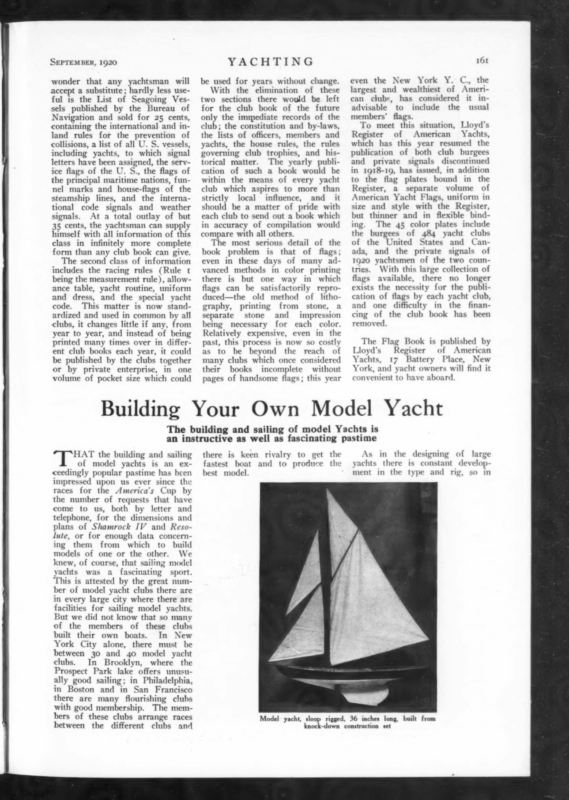
161 YACHTING SEPTEMBER, 1920 wonder that any yachtsman will accept a substitute; hardly less useful is the List of Seagoing Vessels published by the Bureau of Navigation and sold for 25 cents, containing the international. and inland rules for the prevention of collisions, a list of all U. S. vessels, including yachts, to which signal letters have been assigned, the service flags of the U. S., the flags of the principal maritime nations, funnel marks and house-flags of the steamship lines, and the international code signals and weather signals. At a total outlay of but 35 cents, the yachtsman can supply himself with all information of this class in infinitely more complete form than any club book can give. The second class of information includes the racing rules (Rule 1 being the measurement rule), allowance table, yacht routine, uniform and dress, and the special yacht code. This matter is now standardized and used in common by all clubs, it changes little if any, from year to year, and instead of being printed many times over in different club books each year, it could be published by the clubs together or by private enterprise, in one volume of pocket size which could be used for years without change. With the elimination of these two sections there would be left for the club book of the future only the immediate records of the club; the constitution and by-laws, the lists of officers, members and yachts, the house rules, the rules governing club trophies, and _historical matter. The yearly publication of such a book would be within the means of every yacht club which aspires to more than strictly local influence, and_ it should be a matter of pride with each club to send out a book which in accuracy of compilation would compare with all others. The most serious detail of the book problem is that of flags; even in these days of many advanced methods in color printing there is but one way in which flags can be satisfactorily reproduced—the old method of lithography, printing from stone, a separate stone and _ impression being necessary for each color. Relatively expensive, even in the past, this process is now so costly as to be beyond the reach of many clubs which once considered their books incomplete without pages of handsome flags; this year even the New York Y. C., the largest and wealthiest of American clubs, has considered it inadvisable to include the usual members’ flags. To meet this situation, Lloyd’s Yachts, American of Register which has this year resumed the publication of both club burgees and private signals discontinued in 1918-19, has issued, in addition to the flag plates bound in the Register, a separate volume of American Yacht Flags, uniform in size and style with the Register, but thinner and in flexible binding. The 45 color plates include the burgees of 484 yacht clubs of the United States and Can- ada, and the private signals of 1920 yachtsmen of the two countries. With this large collection of flags available, there no longer exists the necessity for the publication of flags by each yacht club, and one difficulty in the financing of the club book has been removed. The Flag Book is published by Lloyd’s Register of American Yachts, 17 Battery Place, New York, and yacht owners will find it convenient to have aboard. Building Your Own Model Yacht The building and sailing of model Yachts is an instructive as well as fascinating pastime HAT the building and sailing of model yachts is an exceedingly popular pastime has been impressed upon us ever since the races for the America’s Cup by the number of requests that have come to us, both by letter and telephone, for the dimensions and plans of Shamrock IV and Resolute, or for enough data concern- there is keen rivalry to get fastest boat and to produce best model. the the As in the designing of Jarge yachts there is constant development in the type and rig, so in ing them from which to build models of one or the other. We knew, of course, that sailing model yachts was a_ fascinating sport. This is attested by the great number of model yacht clubs there are in every large city where there are facilities for sailing model yachts. But we did not know that so many of the members of these clubs built their own boats. In New York City alone, there must be between 30 and 40 model yacht clubs. In Brooklyn, where the Prospect Park lake offers unusually good sailing; in Philadelphia, in Boston and in San Francisco there are many flourishing clubs with good membership. The members of these clubs arrange races between the different clubs and Model yacht, sloop rigged, 36 inches long, built from knock-down construction set
YACHTING ~ SEPTEMBER, 1920 Cup defender Resolute. This boat has proved very fast against other model yachts of her size and weight, and such modifications as model yacht experience showed were desirable were incorporated in her. Gilliams Service Fitting a single-cylinder steam engine in a V-bottom model power boat 2 inches long model yachts each club, or each individual, is always striving to produce a better or faster boat. Of course, the same proportions, and the ratio of sail area to length and weight do not hold in boats built full size and in model yachts. In other words, a model built from the plans of a full sized yacht could not be scaled down to size, and produce the best results. But knowing the proper proportions for model yachts of, say, from 30 to 50 inches in length, and making allowances for them, the other elements that make for speed in the large boat can often be incorporated in the model to advantage. The work of making a complete model from blocks is considerable. It may amount to several months’ time, or it may take all Winter, working only evenings and during one’s spare time. It is interesting work, however, and many ardent model boat practice. One model yacht maker has found a way of simplifying the work of model yacht building, and yet not taking away the pleasant part of the work, by doing the difficult parts, such as the shaping, the hollowing of the hull, the fitting of the deck and the like. These various parts can then be put together and the model rigged, by even a novice, without much diffhculty or labor, The complete parts of the boat, with spars, fittings, sails and ballast, can’ be purchased and put together, just as large vessels or motor boats may be built, the parts shipped to where the vessel is to be used, and set up there. Among the models developed in these construction sets is one that follows closely the model of the + pate SIR. sailors, or regular yachtsmen, get a lot of fun from building a new model every year or so. Deck, sail and rigging fittings can be bought and this saves lots of work if one is building himself. If one is building from the drawn_ lines, considerable difficulty may be experienced in reproducing the shape accurately unless one knows how, as moulds cannot be made to build the boat over, as in boat building As to actual speed, a model 36 or 40 inches in length can be made to sail from 3 to 4% miles per hour, depending, of course, on the strength of the wind and the point of sailing. The foregoing applies to model sailing yachts; but there is nearly, if not quite, as much interest in model power yachts as well. This is especially so in England, where model power yachting has great vogue. In this case the model hulls are powered with some mechanical, steam or electric plant, complete in every detail. Surprising speeds are often made with these model power yachts and considerable data of value are sometimes obtained from them. The work of making a power plant for a model yacht is both diffcult and delicate. As a rule the amateur builder does not tackle this part of the job himself, as complete power plants can be bought which he can install in the model himself. Sectional models of power’ boats can also be purchased in sets, which can be set up by the amateur, in a variety of sizes from 24 inches to 36 inches. While the same rule applies to power models as to sail, that full size boats built to the same scale as the model do not perform satisfactorily, it is interesting to note that two boats from a small V-bottom model 36 inches long were built in Japan to a length of 37 feet by 8 feet 6 inches beam, and with a 100 H .P. Van Blerck motor made a speed of 27 miles per hour. It is a fascinating game, model yachting. According to those who have taken it up it is every bit as absorbing as sailing a real yacht. On the Pacific Coast model yachting is very popular, as this picture of 40 boats belonging to the members of the San Francisco Model Yacht Club shows. The Marconi rig is much in evidence ,