- How To Take Lines Off A Model. CD Mower. I was once called upon to take the lines off of a collection of half models in one of the yacht clubs and the number of models to be taken off made it necessary to devise some means of doing the work quickly as well as accurately.
- Are Model Yachts Overcanvassed?.
- The M.Y.R.A. Acquires a New Member.

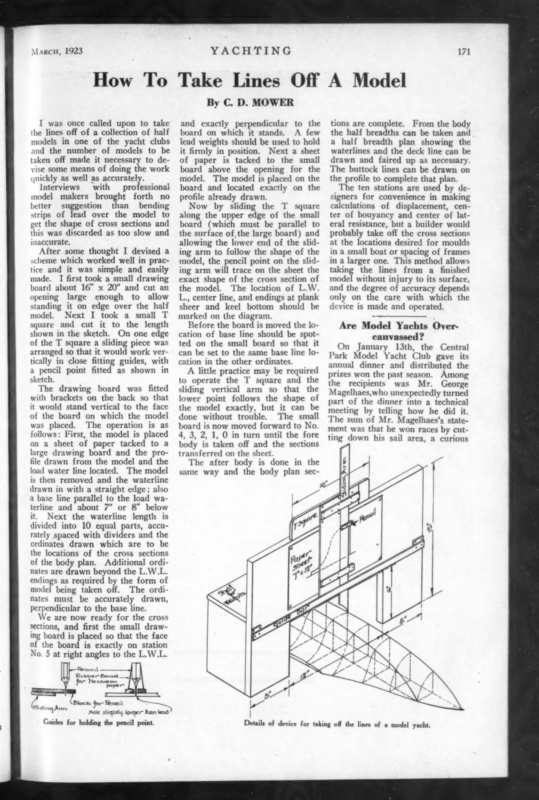
YACHTING Marcu, 1923 171 How To Take Lines Off A Model By C. D. MOWER I was once called upon to take the lines off of a collection of half models in one of the yacht clubs and the number of models to be taken off made it necessary to devise some means of doing the work quickly as well as accurately. Interviews with professional model makers brought forth no better suggestion than bending strips of lead over the model to get the shape of cross sections and this was discarded as too slow and inaccurate, After some thought I devised a scheme which worked well in practice and it was simple and easily made. I first took a small drawing board about 16” x 20” and cut an opening large enough to allow standing it on edge over the half model. Next I took a small T square and cut it to the length shown in the sketch. On one edge of the T square a sliding piece was arranged so that it would work vertically in close fitting guides, with a pencil point fitted as shown in sketch, The drawing board was fitted with brackets on the back so that it would stand vertical to the face of the board on which the model was placed. The operation is as follows: First, the model is placed on a sheet of paper tacked to a large drawing board and the profile drawn from the model and the load water line located. The model is then removed and the waterline drawn in with a straight edge; also a base line parallel to the load waterline and about 7” or 8” below it. Next the waterline length is tions are complete. From the body the half breadths can be taken and a half breadth plan showing the waterlines and the deck line can be drawn and faired up as necessary. The buttock lines can be drawn on the profile to complete that plan. The ten stations are used by designers for convenience in making calculations of displacement, center of bouyancy and center of lateral resistance, but a builder would probably take off the cross sections at the locations desired for moulds in a small boat or spacing of frames in a larger one. This method allows taking the lines from a_ finished model without injury to its surface, and exactly perpendicular to the A few lead weights should be used to hold it firmly in position. Next a sheet of paper is tacked to the small board above the opening for the model. The model is placed on the board and located exactly on the profile already drawn. Now by sliding the T square along the upper edge of the small board (which must be parallel to the surface of, the large board) and allowing the lower end of the sliding arm to follow the shape of the model, the pencil point on the sliding arm will trace on the sheet the board on which it stands. exact shape of the cross section of the model. The location of L.W. L., center line, and endings at plank sheer and keel bottom should be and the degree of accuracy depends only on the care with which the device is made and operated. marked on the diagram. Before the board is moved the location of base line should be spotted on the small board so that it can be set to the same base line location in the other ordinates. Are Model Yachts Overcanvassed? On A little practice may be required to operate the T square and the sliding vertical arm so that the lower point follows the shape of the model exactly, but it can be done without trouble. The small board is now moved forward to No. 4, 3, 2, 1, 0 in turn until the fore body is taken off and the sections transferred on the sheet. ‘ ordinates drawn which are to be the locations of the cross sections ; o 4. ) ‘ f i / Ps 4 ie ° / 2 9 YL i” lA No. 5 at right angles to the L.W.L. Bhocic fer Frac) , Mole slightly jerger Susman? Guides for holding the pencil point. Central | The after body is done in the same way and the body plan sec- rately spaced with dividers and the We are now ready for the cross sections, and first the small drawing board is placed so that the face of the board is exactly on station 13th, the part of the dinner into a technical meeting by telling how he did it. The sum of Mr. Magelhaes’s statement was that he won races by cutting down his sail area, a curious divided into 10 equal parts, accu- of the body plan. Additional ordinates are drawn beyond the L.W.L. endings as required by the form of model being taken off. The ordinates must be accurately drawn, perpendicular to the base line. January Park Model Yacht Club gave its annual dinner and distributed the prizes won the past season. Among the recipients was Mr. George Magelhaes,who unexpectedly turned Details of device for taking off the lines of a model yacht.
YACHTING 172 Marcu, 1923 remark at first, though, but readily understandable on analysis, on much the same theory that it is possible to over-power a motor boat. In large boats the area of the sail is practically limited by the amount of heel which is safe or comfortable, but in the model this requirement does not obtain, and more and more sail has been crowded on until the boats are generally in the condition expressed as “lugging it.” One sees often in the fishermen, and occasionally in Corinthian races, boats pressed with canvas, the water over half the deck, in a mistaken effort to get speed, when it is morally certain that the boat would travel easier and faster with less sail, coming more to her proper sailing lines. In watching the models it is not unusual in a puffy wind to see them lie down almost on their beam ends, head up into it, stand up again and finally fall off and start on their course. With less sail the model will not heel so quickly and have time to-start moving, balance her centers and keep more closely to her course. The sailor is better able to know where his boat is going and to be there himself. In other words, she is more manageable, is just as fast and travels in the right direction a greater proportion of the time. There is another factor in this idea, due to the present classifications f the M.Y.R.A. Many class “B” boats have been built with hulls a little small and sail crowded on to put them up in the class, but still leaving them about the middle. It is possible in most of these boats to bring them into the top of the next lower class by a reduction in sail area, and while losing practically nothing in speed, they have a much better chance of winning. There is considerable food for thought here, either in designing a new boat or in overhauling the old one and model yachtsmen will do. well to go further into such an investig tion for themselves. The M.Y.R.A. Acquires a New Member The Model Yacht Racing Association uses the word “America” in its broader geographical meaning and makes it possible for clubs in Canada_and Mexico to participate in the advantages of the organization, The Montreal Model Yacht Club is the first club outside of the States to come in, being elected a member recently. This club has an enthusiastic membership and is planning an interesting season, aside from the international race mentioned elsewhere. Model of 40-foot over all schooner in which W. W. Nutting expects to cross the Atlantic this summer in a race against the Duke of Leinster. At its last meeting the M.Y.R.A. appointed a committee to prepare a president of the American Power Association. Mr. Judson had ap- report on a standardized set of sail- parently ing rules. This report will soon be ready and when adopted will be given in full in these columns. The Trans-Atlantic Race The Plans for the race across the Atlantic this Summer between W. W. Nutting and the Duke of Leinster have been practically com- pleted and the two boats for this event are building at the Port Jefferson Marine Railway, Port Jefferson, Long Island. A model of these boats was seen at the New York Motor Boat Show. They were designed by William Atkin and are 40 feet in length over all. The two hulls are identical, one be- ing rigged as a schooner with a jibheaded mainsail and the other as a ketch. Boats will be auxiliaries, the Duke planning to use a Scripps engine and Nutting a Sterling motor. Each boat will carry a stipulated amount of fuel, to be used when and where judgment dictates. The boats plan to get away early in July. At that season of the year, when the winds are mostlly S. W. and W., a good passage is likely. ———SSSSSE SSS SS A, L. Judson SSS Yachtsmen throughout the United States will hear with a feeling of personal loss of the sudden death on February 16 of A. L. Judson, been in good health. but died on the train while on a trip to Albany, New York. For many years Mr. Judson has been head of the American. Power Boat Association and has probably done more than any other man in this country to build up that organization and to make it the factor that it has been in power boat racing. He has always worked hard for the sport and stood for the very best in racing ethics. It is through his efforts that many of the successful Gold Cup races have been run -and he has given his time freely in the development of the high speed racing power boat. In appreciation of what he has done the American Power Boat Association, at a recent meeting, voted to put up a cup to be known as the Judson Memorial Trophy which is to be subscribed to by all those yachtsmen who knew Mr. Judson and believed in what he stood for. Red Bank Builds Both Kinds It is reported that the Red Bank Boat Works of Red Bank, New Jersey, have in their yard three speedy craft which, it is rumored, are to join the ever growing fleet of fast bootleggers when they are finished. By a strange coincidence in the same shop and right alongside of them the Red Bank people are building six boats for the revenue service to catch the first three they are turning out We worder who will win the race.