- A Champion Model Yacht of Class B. The lines and sail plan here illustrated are those of the model yacht Mary, owned and built by Philip Pile, of the Central Park Model Yacht Club.
- Simplified Building by the Lift Method. Editor YACHTING: I am very much interested in the articles devoted to Model Yachting. The recent article on making a hull by a method of lifts, prompts me to describe the method I use.

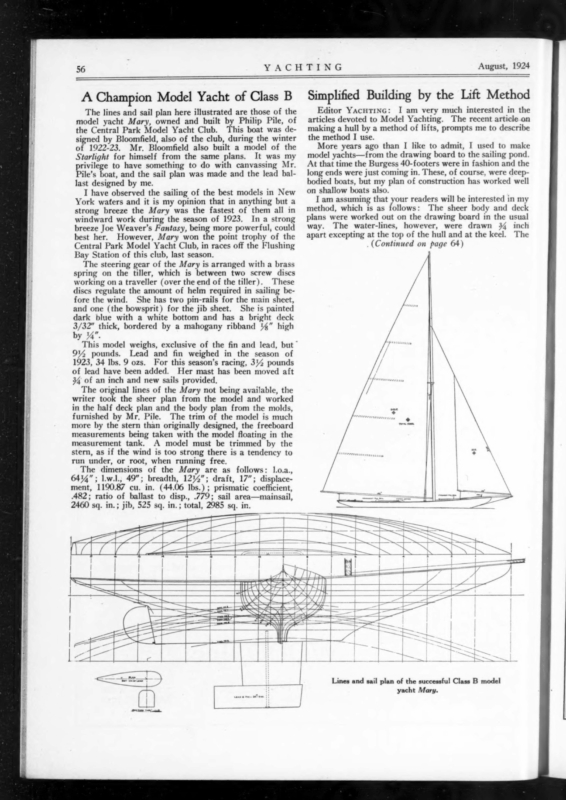
56 YACHTING August, 1924 A Champion Model Yacht of Class B Simplified Building by the Lift Method The lines and sail plan here illustrated are those of the model yacht Mary, owned and built by Philip Pile, of the Central Park Model Yacht Club. This boat was designed by Bloomfield, also of the club, during the winter of 1922-23. Mr. Bloomfield also built a model of the Starlight for himself from the same plans. It was my privilege to have something to do with canvassing Mr. Pile’s boat, and the sail plan was made and the lead bal- Editor YACHTING: I am very much interested in the articles devoted to Model Yachting. The recent article on making a hull by a method of lifts, prompts me to describe last designed by me. I have observed the sailing of the best models in New York waters and it is my opinion that in anything but a strong breeze the Mary was the fastest of them all in windward work during the season of 1923. In a strong breeze Joe Weaver’s Fantasy, being more powerful, could best her. However, Mary won the point trophy of the Central Park Model Yacht Club, in races off the Flushing Bay Station of this club, last season. The steering gear of the Mary is arranged with a brass spring on the tiller, which is between two screw discs working on a traveller (over the end of the tiller). These discs regulate the amount of helm required in sailing before the wind. She has two pin-rails for the main sheet, and one (the bowsprit) for the jib sheet. She is painted dark blue with a white bottom and has a bright deck 3/32” thick, bordered by a mahogany ribband %” high the method I use. More years ago than I like to admit, | used to make model yachts—from the drawing board to the sailing pond. At that time the Burgess 40-footers were in fashion and the long ends were just coming in. These, of course, were deepbodied boats, but my plan of construction has worked well on shallow boats also. I am assuming that your readers will be interested in my method, which is as follows: The sheer body and deck plans were worked out on the drawing board in the usual way. The water-lines, however, were drawn 34 inch apart excepting at the top of the hull and at the keel. The . (Continued on page 64) | by 4”. This model weighs, exclusive of the fin and lead, but” 9% pounds. Lead and fin weighed in the season of 1923, 34 lbs. 9 ozs. For this season’s racing, 314 pounds of lead have been added. Her mast has been moved aft 34 of an inch and new sails provided. The original lines of the Mary not being available, the writer took the sheer plan from the model and worked in the half deck plan and the body plan from the molds, furnished by Mr, Pile. The trim of the model is much more by the stern than originally designed, the freeboard measurements being taken with the model floating in the measurement tank. A model must be trimmed by the stern, as if the wind is too strong there is a tendency to run under, or root, when running free. The dimensions of the Mary are as follows: 1.o.a., 6414”; l.w.L, 49”; breadth, 1214”; draft, 17”; displacement, 1190.87 cu. in. (44.06 lbs.); prismatic coefficient, 482; ratio of ballast to disp., .779; sail area—mainsail, 2460 sq. in.; jib, 525 sq. in.; total, 2985 sq. in. Lines and sail plan of the successful Class B model yacht Mary.
YACHTING August, 1924 Simplified Building by the Lift Method SOPURA THE REAL SALT WATER SOAP Will help to conserve your supply of fresh water, as it lathers and cleans equally well in either salt or fresh, hard or soft water. Mr. Robert N. Bavier, owner and master of the “Memory,” winner of the 1924 Bermuda Race, writes us: “It was used very effectively for cleaning paint work, washing dishes and for our daily salt water bath and had much to do with conserving our fresh water supply. “It is the only salt water soap that I have come cleansing lather, yet across that produces a good, has no harmtul or irritating effect on the skin. IN 10c. CAKES Special Cruising Packages of 50 and 100 Cakes If not obtainable at your dealers it may be secured direct from SOPURA SOAP COMPANY, Inc. New Rochelle, N. Y. 1l Rose Street Dealers’ and Distributors’ correspondence solicited (Continued from page 56) object of the 34 inch water-lines was to enable the use of % inch clear pine boards and allow % for planing, with a long-jointed plane to get a true and level surface and a fit between lifts without forcing or twisting. With 34 inch stock and % inch water-lines it was a simple matter to draw a center line on each piece for a lift and then pick off on the wood the contour of the water-line on each side of the center line, directly from the drawing. The various lifts were then roughly cut to shape outside the line of prick marks and fastened together by screws in the dead-wood, bow and stern. The hull was then worked down until the prick marks began to show, making an accurate guide to work on. By pricking the water-line on the top of each lift, and pricking deep, % inch or so, the prick marks would appear early in the work and could be nearly cut out, their final disappearance coming at the sandpapering stage. This method | found very accurate and quick, and reduced the number of body plan templates to one or two, for use near the bow and stern. The top lift, of course, was a thicker one, to allow for the sheer and difference in the height of bow and stern. And the bottom lift generally was thicker to allow of its being used as a pattern for the lead keel. When the outside of the keel was in shape, all but the sandpapering, it was taken apart and the inside of each lift cut out with a coping saw. The lifts were then carefully glued together under pressure, the screws in the dead-wood being again put in, and when dry the inside was hollowed out to the limit and the outside finished. On models 36 inches long I used to hollow out until I could see light through the end grain—bow and stern—and to about an 1/8 to 3/16 elsewhere. Generally, I fastened in two or three brass ribs, leaving the wood slightly thicker for that purpose in a ridge inside running from deck to keel. C. F. A. SrepHor. The Watch Hill Yacht Club (Continued from page 43) SHIPMATE RANGES Smallest Size Body 18% inches long. Largest Size No limit to length. Sea-faring folk are, as a rule, blunt, honest, and outspoken. We are not afraid to ask the skippers of the various craft that carry our ranges what they think of the SHIPMATE, nor are we afraid to have any one hear their answers. The SHIPMATE has a long record of good seagoing qualities. Made by The Stamford Foundry Company Established 1830 Stamford, Conn. noon to revive the weary mariners, and to the cottage colony gathered to see the finish of the races. That same summer eleven enthusiastic members ordered from Herreshoff a class of smart little boats, twenty-five feet over all—an improved Buzzard Bay type with higher topsides and Marconi, or leg-of-mutton rig. This class has been very successful, the entire fleet turning out in most of the fourteen races of the 1923 season. They proved to be able little ships, for they were well tested in several races in stiff breezes. In one race on Fisher’s Island Sound, a heavy squall, with hail, dismasted one when under jib alone and swamped four, but eight finished under their own sail. That they were wonderfully alike is evidenced by the fact that one afternoon the boat with the poorest record, in the hands of Trimingham, of Bermuda, finally nosed out the boat that had had the best luck of the season, in a closely contested race over an eight-mile outside course. Another class, that will probably consist of an Alden design, is now proposed. Doesn’t Like 50-50 Auxiliary (Continued from page 54) It seems to me that the modern 90-10 auxiliary comes very near the 100-25 mark for efficiency, while the 50-50 is really a 40-60. I could contemplate owning nearly anything from the Lloyd W. Berry to the hydro Margaret IIT with considerable pleasure, but craft like Jean or the recent “motor-sailor” designed by Howard M. Smith seemed to me to have combined to near perfection all the disadvantages of both sail and power, with the exception of the one quality of great seaworthiness and ability. H. S. Haines, IT.