- How the International Model Yacht Race Was Sailed: British Defender Crusader Beats American Slipper. HB Tucker. The Elimination Trials to pick a defender to meet he American challenger Slipper, representing the Model Yacht Racing Association of America, were started in a full gale of wind on July 27th.

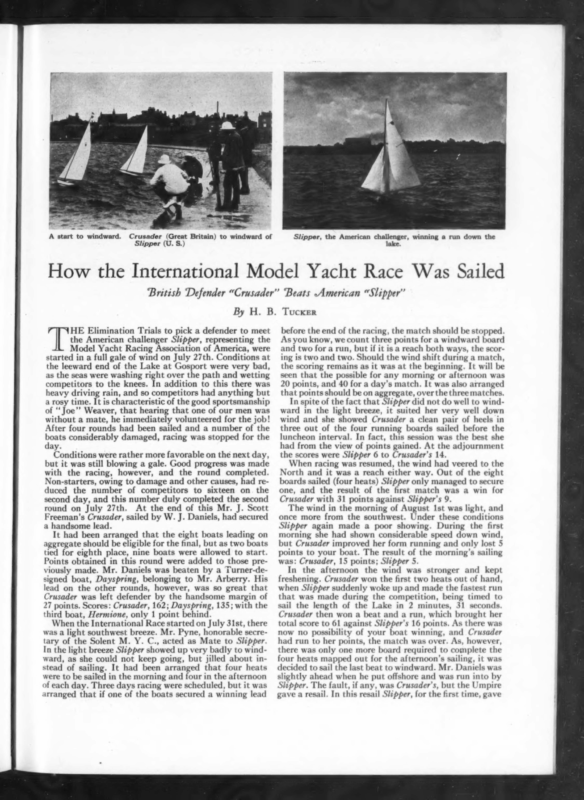
A start windward. Crusader (Great Britain) to windward of Slipper (U. S.) Slipper, the American = winning a run down the ake. How the International Model Yacht Race Was Sailed British ‘Defender “Crusader” Beats American “Slipper” By H. B. TUCKER ke Elimination Trials to pick a defender to meet the American challenger Slipper, representing the Model Yacht Racing Association of America, were started in a full gale of wind on July 27th. Conditions at the leeward end of the Lake at Gosport were very bad, as the seas were washing right over the path and wetting competitors to the knees. In addition to this there was heavy driving rain, and so competitors had anything but a rosy time. It is characteristic of the good sportsmanship of ‘ Joe’’ Weaver, that hearing that one of our men was without a mate, he immediately volunteered for the job! After four rounds had been sailed and a number of the — considerably damaged, racing was stopped for the ay. Conditions were rather more favorable on the next day, but it was still blowing a gale. Good progress was made with the racing, however, and the round completed. Non-starters, owing to damage and other causes, had reduced the number of competitors to sixteen on the second day, and this number duly completed the second round on July 27th. At the end of this Mr. J. Scott Freeman’s Crusader, sailed by W. J. Daniels, had secured a handsome lead. It had been arranged that the eight boats leading on aggregate should be eligible for the final, but as two boats tied for eighth place, nine boats were allowed to start. Points obtained in this round were added to those previously made. Mr. Daniels was beaten by a Turner-designed boat, Dayspring, belonging to Mr. Arberry. His lead on the other rounds, however, was so great that Crusader was left defender by the handsome margin of 27 points. Scores: Crusader, 162; Dayspring, 135; with the third boat, Hermione, only 1 point behind. When the International Race started on July 31st, there was a light southwest breeze. Mr. Pyne, honorable secretary of the Solent M. Y. C., acted as Mate to Slipper. In the light breeze Slipper showed up very badly to windward, as she could not keep going, but jilled about instead of sailing. It had been arranged that four heats were to be sailed in the morning and four in the afternoon of each day. Three days racing were scheduled, but it was arranged that if one of the boats secured a winning lead before the end of the racing, the match should be stopped. As you know, we count three points for a windward board and two for a run, but if it is a reach both ways, the scoring is two and two. Should the wind shift during a match, the scoring remains as it was at the beginning. It will be seen that the possible for any morning or afternoon was 20 points, and 40 for a day’s match. It was also arranged that points should be on aggregate, over the three matches. In spite of the fact that Slipper did not do well to windward in the light breeze, it suited her very well down wind and she showed Crusader a clean pair of heels in three out of the four running boards sailed before the luncheon interval. In fact, this session was the best she had from the view of points gained. At the adjournment the scores were Slipper 6 to Crusader’s 14. When racing was resumed, the wind had veered to the North and it was a reach either way. Out of the eight boards sailed (four heats) Slipper only managed to secure one, and the result of the first match was a win for Crusader with 31 points against Slipper’s 9. The wind in the morning of August 1st was light, and once more from the southwest. Under these conditions Slipper again made a poor showing. During the first morning she had shown considerable speed down wind, but Crusader improved her form running and only lost 5 points to your boat. The result of the morning’s sailing was: Crusader, 15 points; Slipper 5. In the afternoon the wind was stronger and kept freshening. Crusader won the first two heats out of hand, when Slipper suddenly woke up and made the fastest run that was made during the competition, being timed to sail the length of the Lake in 2 minutes, 31 seconds. Crusader then won a beat and a run, which brought her total score to 61 against Slipper’s 16 points. As there was now no possibility of your boat winning, and Crusader had run to her points, the match was over. As, however, there was only one more board required to complete the four heats mapped out for the afternoon’s sailing, it was decided to sail the last beat to windward. Mr. Daniels was slightly ahead when he put offshore and was run into by Shpper. The fault, if any, was Crusader’s, but the Umpire gave a resail. In this resail Slipper, for the first time, gave
YACHTING ae a The rival skippers. Left to right, H. C. Whetstone, mate Crusader, Joseph Weaver, J. S. Freeman and W. J. Daniels, owner and skipper of Crusader. us a taste of her quality.. It. was now blowing a second suit breeze and Crusader was overcanvassed. Slipper however carried her sail and won handsomely. It is only fair to say that had Crusader had less sail, she would have done far better; also that both her horses had been carried away in the collision and that she was sailing under a lash-up and all her trims were out in consequence. This made the score: Crusader, 61; Slipper, 19. Owing to the Challenger having been beaten, there was no use in sailing the third match of the International, and it was therefore abandoned. In its place a Consolation Race was held, open to all competitors and mates, who had not won a prize. Crusader did not start in this, but Slipper was entered and sailed by Mr. Pyne, her mate. Of the eleven boats entered she finished eighth with a score of 16 against the winner’s 40. Now that the match is over, the first comment that must be made is to congratulate you on your Challenger’s skipper. Throughout the Meet he showed himself that prince of sportsmen, the perfect loser. His cheery demeanor and good sportsmanship did the States far more credit than if he had merely annexed the cup. Moreover ‘“‘Joe’’ Weaver is a good sailor, and if he had had the right boat, would have set us a tough proposition. He made us all his firm friends and we hope that he will come next year to have another “‘shot.’’ We have been promised a challenge from France, and we also hope to induce our old friend, the Royal Danish Yacht Club, to come in once more, so sport should be good. Frankly, though we were delighted with your skipper, we thought your boat very disappointing. Slipper is not good enough for Lake sailing. The boat has a very powerful entrance and her stern is weak and she squats. She showed a lamentable lack of balance and was either jilling about head to wind or else fell away. She pointed very high, but did not travel. Crusader beat her because she forereached so fast and always found her head. Whilst your boat was jammed up into the wind, Crusader sailed fast, following the wind about and making headway all the time. To apply ‘‘Joe’’ Weaver’s own expression, Crusader was a busy boat; Slipper was far from it. Candidly, I think that the whole of your trouble arose from the fact that you sail from skiffs. This is not nearly so searching a test of either boat or man as Lake sailing. The reason that it is such a test for the man is that he must get his trims right before he starts or else he is lost. In a skiff, trim can be corrected, and moreover, sailing October, 1925 from a skiff probably encourages pinching a boat unduly, as if she comes head to wind, she can be put off on her tack again. The reason Lake sailing is a better test of the boat is that to do any good a boat must have a balanced hull and be perfect in every respect. If she has not, she will not hold a good enough course to win. Another necessity is that a boat must be able to find her own head immediately. The guy is also the finest test possible of a boat’s ability in stays. Therefore, when I saw that your Elimination Races had been held in open water from skiffs, I felt that you had thrown away points. As you know, Slipper took a heavy penalty on lack of freeboard, and this, together with her lack of balance, put her completely out of the running. Admittedly she was up against a tough customer, for Crusader, or in fact any of our leading boats, are good, and Mr. Daniels (even if he did not make much of a show at sailing from skiffs) is a past master at Lake handling. And in fairness to our other men who brought their boats up to the final, there are others. At the same time we were extremely sorry that you did not do better. May I say that I do hope that you will challenge again, and that Mr. Weaver will once more be selected. Baby Bootlegger Keeps the Gold Cup (Continued from page 24) in any one heat. It was a gift to Baby Bootlegger, which won all four heats in speeds below what she was forced to do in the Gold Cup Race. Baby Shadow was out with a new engine, but it had not been worn in and she only ran two heats. She is a beautiful running boat in smooth water, but a bit of a sea bothers her, whereas Baby Bootlegger seemed to revel in a chop, and was not apparently slowed down by it at all. If the two major events did not prove everything that the owners of the boats hoped for, there were other classes that did. The Miami Beach One-Design Class gave the spectators a real thrill every time the boats turned out for one of the four heats, and gave the owners and drivers a run for their money. Here was a class of little 18-footers, all identical and each with the same engine, a 6-cylinder Scripps, presumably adjusted to the same speed. When they jumped away at the crack of the starter’s gun, all in a bunch, they tore up the waters of Manhasset Bay as if a Gulf Stream squall had swept them. There were ten of these little beggars and they ran the 12-mile heats at better than 38 miles per hour. Running as smoothly as if she were out only on a practice spin Teaser with her big Wright-Aero engines kept dropping the miles behind her in the 105-mile International race. She was nearly two-thirds of a lap ahead of Miss Palm Beach when she flashed across the finish line a winner. we Sg A weather board. Crusader to windward of Slipper.