- Reducing the Sail Area of Model Yachts to Meet Varying Wind Velocities. Frank Nichols. As a result of many years of experience with model yachts and yachting, the writer is convinced that to obtain the best results in sailing a model to windward ‘or on a reach (and this is also true of her larger sisters), it is imperative to keep her decks out of water as much as possible.
- John Black Heads Model Yacht Racing Association of America. At a special meeting of the Model Yacht Racing Association of America, held in New York, March 16th, John Black, of the Boston Model Yacht Club, was elected President.
- British Model Yachtsmen Entertain American Yachtsman. During a visit of F. D. Trapp, President of the American Model Yacht Racing Association, to England in February, British model yachtsmen honored him by arranging a race, although it was the off season, and entertaining him at dinner London.. Author. Summary

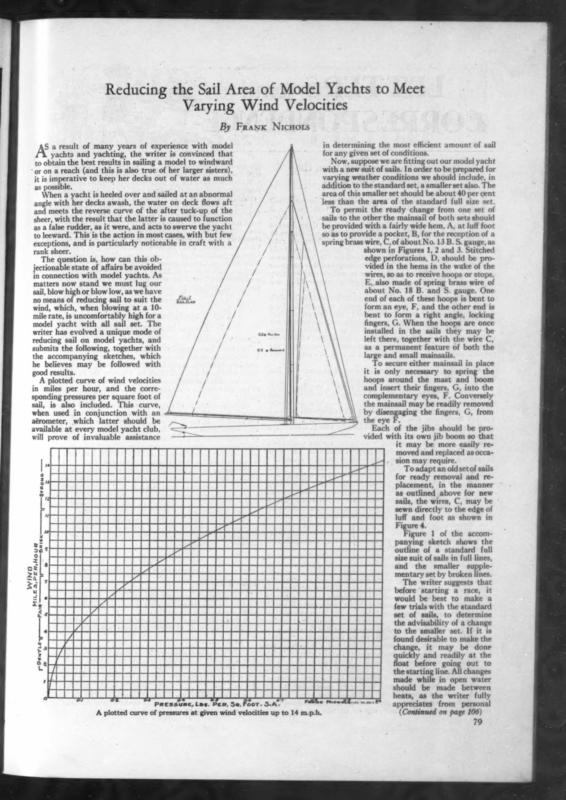
Reducing the Sail Area of Model Yachts to Meet Varying Wind Velocities By Frank NicHots in determining the most efficient amount of sail for any given set of conditions. Now, suppose we are fitting out our model yacht S a result of many years of experience with model yachts and yachting, the writer is convinced that to obtain the best results in sailing a model to windward ‘or on a reach (and this is also true of her larger sisters), it is imperative to keep her decks out of water as much with a new suit of sails. In order to be prepared for varying weather conditions we should include, in addition to the standard set, a smaller set also. The area of this smaller set should be about 40 per cent less than the area of the standard full size set. To permit the ready change from one set of sails to the other the mainsail of both sets should be provided with a fairly wide hem, A, at luff foot so as to provide a pocket, B, for the reception of a spring brass wire, C, of about No. 13 B.S. gauge, as as possible. When a yacht is heeled over and sailed at an abnormal angle with her decks awash, the water on deck flows aft and meets the reverse curve of the after tuck-up of the sheer, with the result that the latter is caused to function as a false rudder, as it were, and acts to swerve the yacht to leeward. This is the action in most cases, with but few exceptions, and is particularly noticeable in craft with a shown in Figures 1, 2 and 3. Stitched edge perforations, D, should be provided in the hems in the wake of the wires, 80 as to receive hoops or stops, E, also made of spring brass wire of about No. 18 B. and S. gauge. One end of each of these hoops is bent to form an eye, F, and the other end is bent to form a right angle, locking fingers, G. When the hoops are once installed in the sails they may be left there, together with the wire C, as a permanent feature of both the large and small mainsails. rank sheer. The question is, how can this objectionable state of affairs be avoided in connection with model yachts. As matters now stand we must lug our sail, blow high or blow low, as we have no means of reducing sail to suit the f¢., submits the following, together with / wind, which, when blowing at a 10mile rate, is uncomfortably high for a model yacht with all sail set. The writer has evolved a unique mode of reducing sail on model yachts, and the accompanying sketches, which he believes may be followed with good results. / To secure either mainsail in place it is only necessary to spring the hoops around the mast and boom and insert their fingers, G, into the complementary eyes, F. Conversely the mainsail may be readily removed by disengaging the fingers, G, from the eye F. Each of the jibs should be provided with its own jib boom so that it may be more easily removed and replaced as occa- A plotted curve of wind velocities in miles per hour, and the corre- sponding pressures per square foot of sail, is also included. This curve, when used in conjunction with an aérometer, which latter should be available at every model yacht club, will prove of invaluable assistance < ay = = \ \ . o i ‘ a & pr Gantieesp———Faia mM ~ > Pressure, Loe. PER, Se, Foor. S.A. for ready removal and re- sails, the wires, C, may be sewn directly to the edge of luff and foot as shown in Figure 4. Figure 1 of the accompanying sketch shows the outline of a standard full size suit of sails in full lines, and the smaller supplementary set by broken lines. The writer suggests that before starting a race, it would be best to make a few trials with the standard set of sails, to determine the advisability of a change to the smaller set. If it is found desirable to make the change, it may be done uickly and readily at the fe oF sion may require. To adapt an oldsetof sails placement, in the manner as outlined above for new = WIND MILE S,PER,HOUR – * hriex————— St Rone —— i s = = _–4,. ae a Membrane no. 9 ¢ A plotted curve of pressures at given wind velocities up to 14 m.p.h. t before going out to the starting line. All changes made while in open water should be made between heats, as the writer fully appreciates from personal (Continued on page 106) 79
May, 1927 106 — Reducing Sail Area of Model Yachts »(cee ( come ( cso { ee yee) ee) a) ) =)« owas)came \, eee \ eee 1 eS \—)—}—)—) (Continued from page 79) experience what it means in a jump of a sea to get a balky model under control, let alone making any changes in her tophamper. It takes an acrobat and equilibrist to stand up ina skiff and “monkey” with something that will not stay put, with the possibility of a spill in the briny. However, with a little perseverance things can be accomplished, A ao ( cose ( coe. ( TRADE MARK s REO. U.S. PAT. OFF. te ToL Reliable-Economical—Compact Electric Light and Power John Black Heads Model Yacht Racing Association of America for your boat, camp, A! a special meeting of the Model Yacht Racing Association of or home America, held in New York, March 16th, John Black, of the Boston Model Yacht Club, was elected President, vice F. D. Trapp, resigned, and Wellington Rindge, also of Boston, was chosen to act as Secretary of the association, succeeding E. F. Judd, who has held that position for several years. Mr. Trapp’s resignation was made necessary by reason of an anticipated two years’ absence in Australia. It will be remembered that John Black represented the association in England last summer when he sailed his Bostonia in the international races at Gosport for the Yachting Monthly Cup, For sure, dependable lighting under all conditions, and ample power for grills, toasters and other appliances, HOMELITE is supreme in its field. Compact and efficient, it requires a minimum of space. Operating on gasbline or kerosene it is economical. Safe and trouble proof. Over 10,000 in use in all parts of the world. finishing in second place. The other officers of the Association, elected at the annual meeting in December are: Herbert L. Stone, Vice President, E. A. Ask your dealer or write us for Ball See) pounds. bearing throughout. Engine: Single cylinder, aircooled. Carburetor: Adjustable to various types of fuel. High tension BoschMagneto1700R.P.M. Generator: Six pole, shunt- wound. Output, direct current. 600 watts, URING a visit of F. D. Trapp, President of the American ne generally, and H. B. Tucker, J. G. Feltwell, and W. J. Daniels ( ee { comm ( com. { o(cme +(coe ( (cm { cm {5 5Cece (came, (osu { British Model Yachtsmen Entertain American Yachtsman Operates: With or without batteries. Will light 40 lights Voltage: 32 or 110 volts. Control: Automatic electric continuously, appliancessuch astoasters,grills,electricfans, irons, etc. or machinery up to HOMELITE CORPORATION Port Chester, New York MARINE DISTRIBUTORS: Smith-Meeker Engineering Co.,New York Ci Fellows & Stewart, Wilmington, Calif. Marine Motor Co., Toronto, Canada Wm. M. Ragan & Sons, Wutinges, D. C” A. M. Deering, Chicago, III. jamin Hogg, Jensen, Fi i . Walter H. Moreton Corp., Boston, Mass. Hector Mac Rac, , Md. V.E. Lacy, Rochester, N. Y. Bull, Prospect Park Model Yacht Club, Treasurer. The active clubs in the association are: Central’ Park Model Yacht Club, Prospect Park Model Yacht Club, Montclair Model Yacht Club, Boston Model Yacht Club, Rhode Island Miniature Yacht Club, Washington Model Yacht Club, Detroit Model Yacht Club and Ogden Park Model Yacht Club, Chicago. Model Yacht Racing Association, to England in February, British model yachtsmen honored him by arranging a race, although it was the off season, and entertaining him at dinner London. Trapp was greatly impressed with the models themselves and in the way they were sailed. Although during one of the races governor. $225 F.O.B. Port Chester y\) 110 14”, as Weight: width em) SPECIFICATIONS Length 21”, height 21”. oe)2 full details. Dept. Y 5. Hoffar-Beeching Shipyard d., Vancouver, B.C. the wind was blowing at 30 m.p.h., a large fleet was out. We want to take this occasion of thanking our British cousifs, particular, for their courtesy to one of our most ardent mode yachtsmen, and assure them of the appreciation of all those who sail model yachts here. Mr. Trapp brought back with him plans of :nodels designed by J. G. Feltwell and Daniels, to the Yachling a Cup rule, which will appear in YACHTING in the néeaf uture. On February 15th the Model Yacht Racing Association of America cabled a challenge for the Yachting Monthly Cup, to be sailed at Gosport, July 31st to August 4th. Eliminations to select the American representative will be held in June, the date place to be announced later.