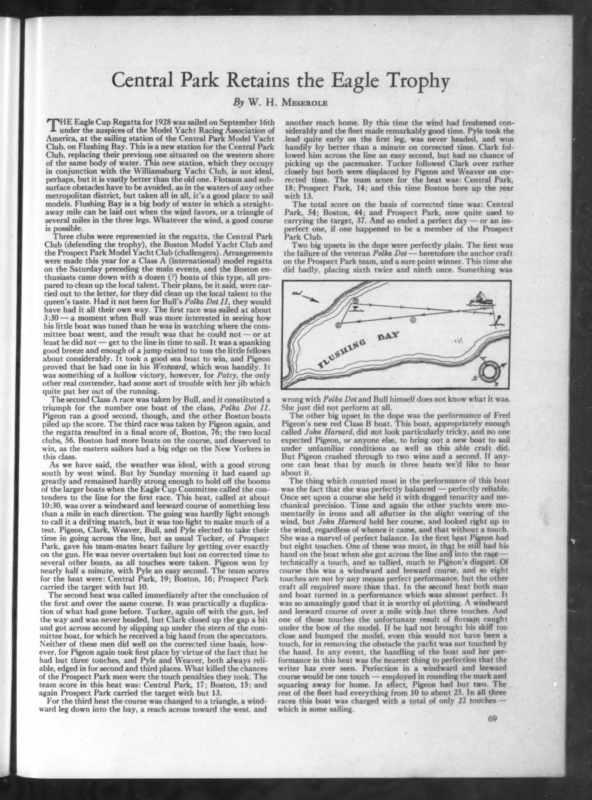
- Central Park Retains the Eagle Trophy. WH Meserore. The Eagle Cup Regatta for 1928 was sailed on September 16th under the auspices of the Model Yacht Racing jiation of America, at the sailing station of the Central Park Model Yacht Club, on Flushing Bay.

Central Park Retains the Eagle Trophy By W. H. Megszrore “= Eagle Cup Regatta for 1928 was sailed on September 16th under the auspices of the Model Yacht Racing jiation of America, at the sailing station of the Central Park Model Yacht Club, on Flushing Bay. This is a new station for the Central Park Club, replacing their previous one situated on the western shore of the same body of water. This new station, which they occupy in conjunction with the Williamsburg Yacht Club, is not ideal, perhaps, but it is vastly better than the old one. Flotsam and subsurface obstacles have to be avoided, as in the waters of any other metropolitan district, but taken all in all, it’s a good place to sail models. Flushing Bay is a big body of water in which a straightaway mile can be laid out when the wind favors, or a triangle of several miles in the three legs. Whatever the wind, a good course is possible. Three clubs were represented in the regatta, the Central Park Club (defending the trophy), the Boston Model Yacht Club and the Prospect Park Model Yacht Club (challengers). Arrangements were made this year for a Class A (international) model regatta on the Saturday preceding the main events, and the Boston enthusiasts came down with a dozen (?) boats of this type, all prepared to clean up the local talent. Their plans, be it said, were carried out to the letter, for they did clean up the local talent to the queen’s taste. Had it not been for Bull’s Polka Dot IJ, they would have had it all their own way. The first race was sailed at about another reach home. By this time the wind had freshened considerably and the fleet made remarkably good time. Pyle took the lead- quite early on the first leg, was never headed, and won handily by better than a minute on corrected time. Clark followed him across the line an easy second, but had no chance of picking up the pacemaker. Tucker followed Clark over rather closely but both were displaced by Pigeon and Weaver on corrected time. The team score for the heat was: Central Park, 1 6 ga Park, 14; and this time Boston bore up the rear with 13. The total score on the basis of corrected time was: Central Park, 54; Boston, 44; and Prospect Park, now quite used to carrying the target, 37. And so ended a perfect day — or an imperfect one, if one happened to be a member of the Prospect Park Club. Two big upsets in the dope were perfectly plain. The first was the failure of the veteran Polka Dot — heretofore the anchor craft on the Prospect Park team, and a sure point winner. This time she did badly, placing sixth twice and ninth once. Something was 3:30 — a moment when Bull was more interested in seeing how his little boat was tuned than he was in watching where the committee boat went, and the result was that he could not — or at least he did not — get to the line in time to sail. It was a spanking good breeze and enough of a jump existed to toss the little fellows about considerably. It took a good sea boat to win, and Pigeon proved that he had one in his Westward, which won handily. It was something of a hollow victory, however, for Patsy, the only The second Class A race was taken by Bull, and it constituted a triumph for the number one boat of the class, Polka Dot II. Pigeon ran a good second, though, and the other Boston boats piled up the score. The third race was taken by Pigeon again, and the regatta resulted in a final score of, Boston, 76; the two local clubs, 56. Boston had more boats on the course, and deserved to win, as the eastern sailors had a big edge on the New Yorkers in this class. As we have said, the weather was ideal, with a good strong south by west wind. But by Sunday morning it had eased up greatly and remained hardly strong enough to hold off the booms of the larger boats when the Eagle Cup Committee called the contenders to the line for the first race. This heat, called at about 10:30, was over a windward and leeward course of something less than a mile in each direction. The going was hardly light enough to call it a drifting match, but it was too light to make much of a test. Pigeon, Clark, Weaver, Bull, and Pyle elected to take their time in going across the line, but as usual Tucker, of Prospect Park, gave his team-mates heart failure by getting over exactly on the gun. He was never overtaken but lost on corrected time to several other boats, as all touches were taken. Pigeon won by nearly half a minute, with Pyle an easy second. The team scores for the heat were: Central Park, 19; Boston, 16; Prospect Park carried the target with but 10. The second heat was called immediately after the conclusion of the first and over the same course. It was practically a duplication of what had gone before. Tucker, again off with the gun, led the way and was never headed, but Clark closed up the gapa bit and got across second by slipping up under the stern of the committee boat, for which he received a big hand from the spectators. Neither of these men did well on the corrected time basis, however, for Pigeon again took first place by virtue of the fact that he had but three touches, and Pyle and Weaver, both always reliable, edged in for second and third places. What killed the chances of the Prospect Park men were the touch penalties they took. The team score in this heat was: Central Park, 17; Boston, 15; and again Prospect Park carried the target with but 13. For the third heat the course was changed to a triangle, a windward leg down into the bay, a reach across toward the west, and wrong with Polka Dot and Bull himself does not know what it was. She just did not perform at all. The other big upset in the dope was the performance of Fred Pigeon’s new red Class B boat. This boat, appropriately enough called John Harvard, did not look particularly tricky, and no one expected Pigeon, or anyone else, to bring out a new boat to sail under unfamiliar conditions as well as this able craft did. But Pigeon crashed through to two wins and a second. If anyone can beat that by much in three heats we’d like to hear about it . The thing which counted most in the performance of this boat was the fact that she was perfectly balanced — perfectly reliable. Once set upon a course she held it with dogged tenacity and mechanical precision. Time and again the other yachts were momentarily in irons and all aflutter in the slight veering of the wind, but John Harvard held her course, and looked right up to the wind, regardless of whence it came, and that without a touch. She was a marvel of perfect balance. In the first heat Pigeon had but eight touches. One of these was moot, in that he still had his hand on the boat when she got across the line and into the rage — technically a touch, and so tallied, much to Pigeon’s disgust. Of course this was a windward arid leeward course, and so eight touches are not by any means perfect performance, but the other craft all required more than that. In the second heat both man and boat turned in a performance which was almost perfect. It was so amazingly good that it is worthy of plotting. A windward and leeward course of over a mile with but three touches. And one of those touches the unfortunate result of flotsam caught under the bow of the model. If he had not brought his skiff too close and bumped the model, even this would not have been a touch, for in removing the obstacle the yacht was not touched by the hand. In any event, the handling of the boat and her performance in this heat was the fiearest thing to perfection that the writer has ever seen. Perfection in a windward and leeward course would be one touch — employed in rounding the mark and squaring away for home. In effect, Pigeon had but two. The rest of the fleet had everything from 10 to about 25. In all three races this boat was charged with a total of only 22 touches — which is some sailing. 69 ad other real contender, had some sort of trouble with her jib which quite put her out of the running.