- Great Britain Wins International Race for Model Yachts. The 1930 International Model Yacht Races were held at Gosport, England, August 1st, 3rd and 4th. The United States again had to be satisfied with second place, the position she has consistently taken since first entering this competition in 1925.

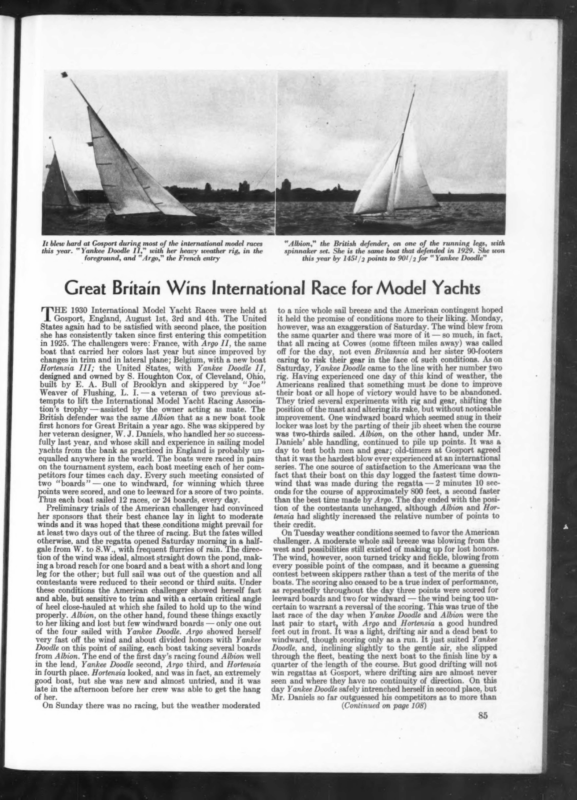
It blew hard at Gosport a most of the international model races this year. “ Yankee Doodle II,” with her heavy weather rig, in the foreground, and “Argo,” the French entry “Albion,” the British defender, on one of the running legs, with spinnaker set. She is the same boat that defended in 1929. She won this year by 1451/2 points to 901 /2 for “ Yankee Doodle” Great Britain Wins International Race for Model Yachts HE 1930 International Model Yacht Races were held at Gosport, England, August Ist, 3rd and 4th. The United States again had to be satisfied with second place, the position she has consistently taken since first entering this competition in 1925. The challengers were: France, with Argo IJ, the same boat that carried her colors last year but since improved by changes in trim and in lateral plane; Belgium, with a new boat Hortensia III; the United States, with Yankee Doodle II, designed and owned by S. Houghton Cox, of Cleveland, Ohio, built by E. A. Bull of Brooklyn and skippered by “Joe” Weaver of Flushing, L. I.—a veteran of two previous attempts to lift the International Model Yacht Racing Association’s trophy — assisted by the owner acting as mate. The British defender was the same Albion that as a new boat took first honors for Great Britain a year ago. She was skippered by her veteran designer, W. J. Daniels, who handled her so successfully last year, and whose skill and experience in sailing model yachts from the bank as practiced in England is probably unequalled anywhere in the world. The boats were raced in pairs on the tournament system, each boat meeting each of her competitors four times each day. Every such meeting consisted of two “boards’”’— one to windward, for winning which three points were scored, and one to leeward for a score of two points. Thus each boat sailed 12 races, or 24 boards, every day. Preliminary trials of the American challenger had convinced her sponsors that their best chance lay in light to moderate winds and it was hoped that these conditions might prevail for at least two days out of the three of racing. But the fates willed otherwise, and the regatta opened Saturday morning in a halfgale from W. to 8.W., with frequent flurries of rain. The direction of the wind was ideal, almost straight down the pond, making a broad reach for one board and a beat with a short and long leg for the other; but full sail was out of the question and all contestants were reduced to their second or third suits. Under these conditions the American challenger showed herself fast and able, but sensitive to trim and with a certain critical angle of heel close-hauled at which she failed to hold up to the wind properly. Albion, on the other hand, found these things exactly to her liking and lost but few windward boards — only one out of the four sailed with Yankee Doodle. Argo showed herself very fast off the wind and about divided honors with Yankee Doodle on this point of sailing, each boat taking several boards from Albion. The end of the first day’s racing found Albion well in the lead, Yankee Doodle second, Argo third, and Hortensia in fourth place. Hortensia looked, and was in fact, an extremely good boat, but she was new and almost untried, and it was late in the afternoon before her crew was able to get the hang of her. On Sunday there was no racing, but the weather moderated to a nice whole sail breeze and the American contingent hoped it held the promise of conditions more to their liking. Monday, however, was an exaggeration of Saturday. The wind blew from the same quarter and there was more of it — so much, in fact, that all racing at Cowes (some fifteen miles away) was called off for the day, not even Britannia and her sister 90-footers caring to risk their gear in the face of such conditions. As on Saturday, Yankee Doodle came to the line with her number two rig. Having experienced one day of this kind of weather, the Americans realized that something must be done to improve their boat or all hope of victory would have to be abandoned. They tried several experiments with rig and gear, shifting the position of the mast and altering its rake, but without noticeable improvement. One windward board which seemed snug in their locker was lost by the parting of their jib sheet when the course was two-thirds sailed. Albion, on the other hand, under Mr. Daniels’ able handling, continued to pile up points. It was a day to test both men and gear; old-timers at Gosport agreed that it was the hardest blow ever experienced at an international series. The one source of satisfaction to the Americans was the fact that their boat on this day logged the fastest time downwind that was made during the regatta — 2 minutes 10 seconds for the course of approximately 800 feet, a second faster than the best time made by Argo. The day ended with the position of the contestants unchanged, although Albion and Hortensia had slightly increased the relative number of points to their credit. On Tuesday weather conditions seemed to favor the American challenger. A moderate whole sail breeze was blowing from the west and possibilities still existed of making up for lost honors. The wind, however, soon turned tricky and fickle, blowing from every possible point of the compass, and it became a guessing contest between skippers rather than a test of the merits of the boats. The scoring also ceased to be a true index of performance, as repeatedly throughout the day three points were scored for leeward boards and two for windward — the wind being too uncertain to warrant a reversal of the scoring. This was true of the last race of the day when Yankee Doodle and Albion were the last pair to start, with Argo and Hortensia a good hundred feet out in front. It was a light, drifting air and a dead beat to windward, though scoring only as a run. It just suited Yankee Doodle, and, inclining slightly to the gentle air, she slipped through the fleet, beating the next boat to the finish line by a quarter of the length of the course. But good drifting will not win regattas at Gosport, where drifting airs are almost never seen and where they have no continuity of direction. On this day Yankee Doodle safely intrenched herself in second place, but Mr. Daniels so far outguessed his competitors as to more than (Continued on page 108) 85
November, 1930 Yachting Da — m2 — DD Down the Atlantie Seaboard and through the Gulf from Maine to Mexico sweeps the demonstration eruise of the Master Marbleheads 2 _I> ——_p Great Britain Wins International Race for Model Yachts (Continued from page 85) maintain the substantial lead he had piled up in the first two days of racing. The regatta was brought to a close with two resails yet to be run, but as these could not affect the relative positions of the contestants and a heavy squall was threatening, it was mutually agreed to divide the points involved. This caused the fractional points which appear in the final scores as follows: Albion, Ist, 14514 points; Yankee Doodle, 2nd, 901% points; Argo, 3rd, 731% points and Hortensia, 4th, 511% points. As a possible score for any boat for the three days would have been 180 points, the following are the respective percentages: =” 80%; Yankee Doodle, 50%; Argo, 40%, and Hortensia, ‘O° What are the lessons, if any, to be drawn from this year’s regatta? Is Albion an unbeatable boat? To the second question I would reply with an emphatic negative. So far Mr. Daniels and Albion have proved invincible, but that formidable combination won the British elimination races by just one point! Cresset was undoubtedly a better boat than Albion in the heavy weather that prevailed and but for one or two lucky breaks in Mr. Daniels’ favor not even he could have defeated her. With her 50 inch w.l. length, 15.2” w.l. beam, 50 lbs. of displacement and 1823 square inches of sail, Cresset, designed by Captain Nine? at This Marblehead Cabin Cruiser will be accompanied on the demonstration cruise by a Marblehead Guide Boat especially designed for use in Florida fishing waters. >_> ——__2 S a pre-announcement of its 1931 line of Marblehead Cabin Cruisers, Newport De Luxe Commuters and Florida Guide Boats, Staples, Johnson & Co. sounds the opening n with a performance demonstration cruise from iddeford, Maine to Matamoros, Mexico. Two sturdy Marblehead 1931 Models left Maine October 15th. bor are making ports of call at prin- cipal coast cities of the Carolinas, feo ia and Florida, and are due to arrive at Miami about December 15. Alfred Turner, R.N., is undoubtedly the most powerful craft ever built to the Class A rule. In spite of her great displacement she is a sweet, clean craft, and judging from what I saw of her performance, should give an excellent account of herself even in moderate weather. The chief thing that America needs to better her showing at Gosport is, in the opinion of this writer, adequate facilities for testing and racing models under conditions approximating those at Gosport. Boats that will make an excellent showing when handled from skiffs will not necessarily duplicate that performance when sailed from the bank, where steadiness and reliability are at least as important as speed. Recent experience convinces me that there is nothing like bank-sailing with reasonably steady winds to bring out defects of balance, if any, in a design. The Reflecting Pool at Washington seems to be the only lake in this country at present adapted to this type of sailing, but the wind there is so unreliable by reason of various obstructions that it has proved far from satisfactory. There are rumors, I am glad to say, that a suitable pool is planned for Boston, and that ground has already been broken for one on the unobstructed lake front in Chicago. Let us hope that within another year one or both of these lakes will be available. These pioneer Marbleheads will be open for inspection at yacht clubs and dealers’ moorings at each port. Watch for newspaper announcements of arrival. The Cruise Commander extends to you a cordial invitation to visit him aboard and view the amazing features of these Master Marbleheads, Unique and luxurious cabin accommodations for six. New ideas in convenience and control. Complete safety —all fill pipes, ventilation, wiring, etc., worked out under supervision of marine underwriters inspector. New motors of mighty power. Your choice of speed. Low cost of building boats in Maine is re- flected in new popular prices. Truly, the Master Marblehead is Queen of the Sea. Proud the skipper who owns her in 1931. Watch your chance to inspect her in the South this winter — or defer your purchase of a cruiser ‘til you’ve learned all about the Master Marblehead. Advance information is yours for the asking. STAPLES, JOHNSON & CO. 600 POOL (Continued from page 97) state. But many other industries have contributed to the fame of Massachusetts on the sea. She has for years been preéminent in shipbuilding. The first schooners were built there and sailed the seas with cargoes of fish, lumber, and provisions, many of them losing everything to pirates but many bringing fortunes to their owners. And, best of all, an operating cost of but 7c per mile! BIDDEFORD Massachusetts on the Sea STREET – = = MAINE It costs less to build better boats in Maine. 2 -——__2) —_yp> 4408 The great whaling industry was established, trading in hides flourished, and a large ice trade developed, great quantities of the latter commodity being sent from New England ponds to South America and the East. Then came the brilliant era of the clipper ship: It was im Massachusetts that Donald McKay developed his famous work, coming there from Nova Scotia. His swift and beautiful clippers brought glory to his own name and that of Massachusetts. Today the very names of his clippers are symbols of speed and beauty. Shipbuilding is still one of the most important industries of Massachusetts, though the clipper ship is no more and the shipyards concern themselves with producing such vessels as the U. 8. 8. Lexington, an airplane carrier, completed in 1927 at the Fore River Shipyards, in Quincy. The book contains, also, a description of the work of the Humane Society of Massachusetts which established the first life boat in America; a list of the interesting historical exhibits to be seen in the state; and a full history of the famous old ship Constitution.