- Title. Author. Summary
- Title. Author. Summary
- Title. Author. Summary
- Title. Author. Summary
- Title. Author. Summary

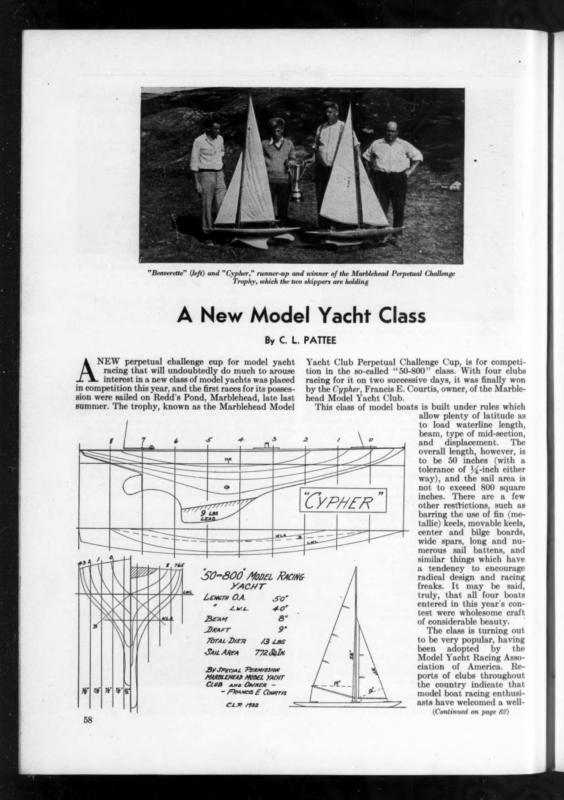
“Beaverette” (left) and “Cypher,” runner-up and winner of the Marblehead Perpetual Challenge Trophy, which the two skippers are holding A New Model Yacht Class By C. L. PATTEE b NEW perpetual challenge cup for model yacht racing that will undoubtedly do much to arouse interest in a new class of model yachts was placed in competition this year, and the first races for its possession were sailed on Redd’s Pond, Marblehead, late last summer. The trophy, known as the Marblehead Model Yacht Club Perpetual Challenge Cup, is for competition in the so-called ‘‘50-800” class. With four clubs racing for it on two successive days, it was finally won by the Cypher, Francis E. Courtis, owner, of the Marblehead Model Yacht Club. This class of model boats is built under rules which allow plenty of latitude as to load waterline length, beam, type of mid-section, and displacement. The overall length, however, is to be 50 inches (with a tolerance of 44-inch either way), and the sail area is not to exceed 800 square inches. There are a few other restrictions, such as | barring the use of fin (metallic) keels, movable keels, center and bilge boards, wide spars, long and numerous sail battens, and similar things which have a tendency to encourage radical design and racing freaks. It may be said, ZA CVPHER © 5 ~ 50-800 Mone. Rae XACHT Lewetw QA. 50° Lwe. “ #o° BEAM 8” DRAFT 9° Fora. DisR SAL AREA 43 Las 772 Soin BY SPECIAL PERMISSION MARBLEHEAD MODEL YACHT CLUB ane OWNER — – FRANCS F CouRTIsS CLP /932 truly, that all four boats entered in this year’s contest were wholesome craft of considerable beauty. _ The class is turning out to be very popular, having been adopted by the Model Yacht Racing Association of America. Reports of clubs throughout the country indicate that model boat racing enthusiasts have welcomed a well(Continued on page 82)
January, 1933 Navigation Simplified GAR WOOD KNOWS HIS VARNISHES cscos: SMITHS AQUATITE Gar Wood— speed king of the boating world, and himself a builder of superb motor boats —writes “, . ..we are happy to say that Smith’s Aquatite Varnish used in the finish of all Gar Wood stock boats has been very satisfactory” AR WOOD also knows well Aquatite’s speed-making qual- ities—he specified it for Miss America X, the 1932 (Continued from page 42) of the ship subtracted from 90 degrees gives the third side ‘“‘ VP.” In the formula, however, we did not subtract the observed altitude or latitude from 90 degrees because the construction of the formula automatically takes care of this. : The above explanation is, perhaps, not particularly lucid, but anyone interested in the theory can delve into Bowditch for more complete information on solving the spherical triangle. In short, we have a triangle and can measure its three sides; then, by employing a formula, we can solve the triangle to determine the angle “{” which is the ship’s local hour angle, or sun time. This completes a series of three articles, and it is hoped that with them pasted in your hat, and with a Bowditch under one arm and a Nautical Almanac under the other, you can grasp the subject and get down to the practical business of locating your position at sea. _ Once a man can find his position at sea he will be stimulated to study the more technical books and can learn the various short methods employing the line of position. Harmsworth Trophy defender. Such testimony has long been the proud possession of Edward Smith. Since 1827 Edward Smith paints and var- nishes have been traditional on fine yachts and all sorts A New Model Yacht Class of water craft. Every American cup defender since 1851 has been trimmer and faster from using Smith paints and varnishes. The reason for Edward Smith super-quality is simple: None but quality gums and first grade oils ever find their way into the manufacture of Smith marine finishes. Painstaking care is always used in blending these superior ingredients, and they are aged for months to uphold the century-old Smith quality. Be wise, be economical, be sure of results. Always specify | Edward Smith finishes—inside and out—on whatsoever water craft it is your good fortune to own. EDWARD SMITH & CO. LONG ISLAND CITY, N. Y. You will find a Smith distributor in all important American ports, and many abroad (Continued from page 58) behaved boat, of dimensions which make transportation an easy problem. Three clubs sent their selections to Marblehead in an attempt to lift the coveted trophy for the first time. The first challenge was received from the Boston Model Yacht Club and, in rapid succession, two more came in from the Staten Island and Prospect Park Model Yacht Clubs, of New York and Brooklyn, respectively. Boston sent the Beaverette, owned and designed by Fred L. Pidgeon, and raced in his absence by Robert Paterson and William H. Rich. Staten Island sent the Maybe, owned and sailed by Arvid Anderson, with Charles Francis as mate. Prospect Park chose the Minz, owned, designed and sailed by Gilbert H. Hoppin, with the assistance of Daniel Manning of the local club. Marblehead defended with the Cypher, from the board of her skipper-owner, Francis E. Courtis. John H. Tatterfield acted as mate. All three challengers were particularly adapted to open-water sailing from skiffs, and the light fluky airs found during the series at Redd’s Pond, coupled with the sailing of a comparatively short two-mark course, gave these boats some concern. All used some form of Braine steering gear, which seemed quite difficult of adjustment, while the defender used a simple limiting- screw device, without rubber bands or spring tension of any sort. How skilfully the visitors handled their craft, may be judged from the fact that after sailing thirty races (five rounds each), the score in points stood: Marblehead 23, Boston 23, Staten Island 22, and Prospect Park 13. The Prospect Park boat was disabled early in the final round, and was withdrawn after it was found that the necessary repairs would consume more time than was available. The tie for first place was decided by a three-race sail-off, in which the Marblehead boat won the first two, straight, thus settling the matter. All three clubs stated their intention of challenging again next year, and Marblehead agreed that had one of the visitors lifted the cup in this series, they would have gone after it another year themselves.