- Notes on the International Twelve Metre Class Yacht By John Lewis
- Veteran model on show
- 1964 NATIONAL MARBLEHEAD CHAMPIONSHIP By R. P. Simpson

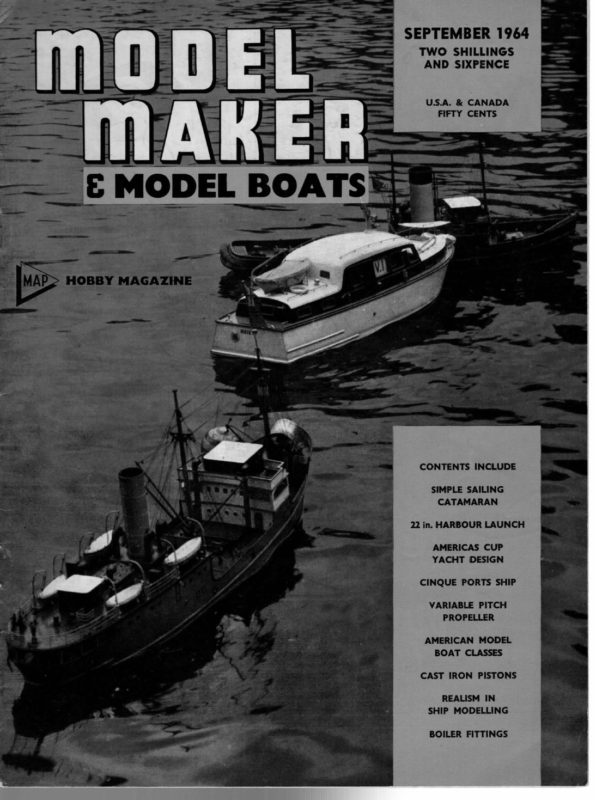
SEPTEMBER 1964 TWO SHILLINGS AND SIXPENCE U.S.A. & CANADA FIFTY CENTS CONTENTS INCLUDE SIMPLE SAILING CATAMARAN 22 in. HARBOUR LAUNCH AMERICAS CUP YACHT DESIGN CINQUE PORTS SHIP VARIABLE PITCH PROPELLER AMERICAN MODEL BOAT CLASSES CAST IRON PISTONS REALISM IN SHIP MODELLING BOILER FITTINGS
a figure is substracted twice the vertical height from Notes on the International Twelve Metre Class Yacht By John Lewis AS it is intended that there will be a challenge for the Americas Cup by Britain this year it might be interesting to examine the 12-metre class rule and see what goes into one of these yachts from a design point of view. There will be much publicity about crews, sails and tuning up races, but little is ever mentioned about the rule to which these yachts are designed and the problems which face the designer. The rule itself, whilst tying the designer down to produce what might be called a normal type yacht, allows much subtle variation in hull shape. After the primary dimensions have been fixed these variations in shape are usually subjected to intensive tank testing, or should be, before the final design is agreed. The draughting and building of a series of models together with the testing procedures is one of the main reasons that such a project is extremely expensive and the cost of this alone can exceed the contract price of the actual yacht. The rule is based on the following formula: L+2d+ VS-F = Rating 2.37 where L = Length, d = Girth difference, S= Sail area, F = Freeboard. The formula is simple enough but its application is somewhat tricky and it has a crafty way of preventing the designer from going to excesses in order to obtain extra speed by rule cheating. Firstly the length measurement is neither the L.W.L. nor L.O.A. but is measured at a height of 1.5 per cent of the class rating above the L.W.L. This immediately controls the angle at which the profile of the hull emerges above water It is not possible to have long, low overhangs to increase the effective L.W.L. when sailing heeled. Furthermore, no hollows are allowed in the surface of the hull between L.W.L. and the sheer line. It is obvious that any increase in the L measurement will reduce sail area and the designer will try and get as long a L.W.L. as he dare and as short an L measurement as he can. This particular way of measuring L is not completely effective in preventing undesirable overhang shapes so the rule makers add to this L measurement girth measurements taken at the bow and stern endings of L. The points where the girth measurements are taken are indicated on the design illustrating these notes by dotted lines at bow and stern. At the bow ending of L the length around the skin of the hull is measured from a point 5 per cent of the rating above L each side of the hull and from this 430 L to these points. This difference is then multiplied by 1.5 and added to the L measurement. The effect of this is to prevent a cross section of U shape in character and forces the designer into a rather narrow V section for the bows. The penalty of long full overhangs is too severe in terms of lost sail area and the rule can be criticised in this respect in the light of modern knowledge. However, in order to prevent extremely narrow bows and peculiar shapes in order to cheat the rule a minimum girth difference 30 per cent of twice the vertical height measurement is written into the rule. At the stern ending of L a somewhat similar measurement is taken but its effect is not so severe and greater latitude is permitted the designer. Here the vertical height is taken from L to the covering board and one third of the difference is added to L. In the design shown, although the L.W.L. is 45 ft. 6 in., the L for rating purposes is 53.62. Not content with controlling the ends of the hull, the rule makers limit the designer’s scope by influencing the type of midship cross-section, and this is done by the 2d figure in the formula. This is another girth difference measurement and is taken in a transverse plane at 0.55 L.W.L. from the fore end and is the difference between the girth around the skin of the hull and what is called the chain girth, taken from the covering board down to a point 12.5 per cent of the rating below L.W.L. The chain girth is the length that would be produced if a piece of string were stretched between the two points of measurement rather than following the surface of the hull. The resulting girth difference is doubled and added in effect to L. It should be obvious that a hull of scow type will suffer a severe penalty due to this restriction whereas a deep V type hull will have practically no penalty. Now, if a rule encourages a V type hull, the designer in order to get the best possible speed will make it as narrow as possible, so once again the rule prevents excesses by imposing a minimum beam of 11.8 feet. Other restrictions affecting the actual hull design directly are: (a) A maximum draught of 16 per cent of L.W.L. (b) Average freeboard, which is used as a minus quantity in the formula, of not greater than 0.08 multipled by the rating plus 0.25 metres. (c) The tumblehome must not exceed 2 per cent of the extreme beam. : (d) The minimum displacement shall not be less than (0.2 L.W.L. + 0.5)* cubic feet. If any of the above figures are exceeded or otherwise not complied with the penalties are so severe that it would be quite foolish of the designer not to comply. From all this one might think that the rule will produce almost a one design hull but that is far from the truth. First and foremost the most important dimension of all is free, i.e., L.W.L., and over the years this figure has increased slowly until the normal length is now 45 to 46 feet. In my opinion if enough of these yachts are built it will still increase as more is learnt about sails and their driving power. The design shown as an example is my interpreta- tion of what a good 12 metre should look like but I must make it clear that this design is not intended to be a good model 12 metre as that would be quite dif- ferent. A lot of people do not realise that designing
1964 SEPTEMBER This 12 metre example shows a hull which does e not collect any penalties on draught, freeboard, or amounts shown in the interest of getting a full flat counter and a not too narrow bow. NX The hull is not balanced as it would be for a SEAS a nat ara} further aft than usual due to the displacement of NN +7) forward than the average 12 and is also more vertical than in the past. These two features reduce wetted surface and improve rudder efficiency, and therefore 7 sad in such a boat. The full keel is chosen because I think it is the natural thing to have on a deep, narrow hull of this kind. The rudder post is further d) a model and the resulting dissimilarity of the ends inhibits excessive pitching which can be so harmful N ere rh mee thy Seow a the ends could be made less but I would accept the ae AVA Sa me cant 2d addition. The girth difference penalties at iD 7) Z\Z displacement, and is of average length on_ the L.W.L. The beam is close on the minimum and the displacement, which is greater than the rule minimum, produces a midship section with an insignifi- Z -——=: SST ZL sail carrying power. = 77 x differences being in hull balance requirements and raw, laws of naval architecture are the same, the principal SAIS F models is so different from full-size, although the its area, respectively. In common with my model designs the waterlines are rather slack aft of midships but the C of B is the full keel. The stern overhang is as short as practicable in order to save weight aft, and the sheer | t| Yau line as flat as possible also to save weight in the ends and at the same time give as much freeboard as possible midships. The rule requires the sheer to be a fair continuous concave curve so that reverse N N sheer cannot be exploited. This design was evolved Z y A early last year after a great deal of examination of all published information of existing 12 metre yachts. Despite the secrecy which generally surrounds such that there is plenty of scope for experiment and development. This particular design is what one might call pretty safe but if I were given the chance to take a real gamble on a 12 metre I would produce something quite different. For example, it would have at least 15 ft. beam, ignoring the minimum beam figure in the rule. This would provide a much improved sheeting base for the big overlapping jib and the penalties of big beam would probably be more than compensated for by the greater driving . force obtained. One American design, Nefertiti, has moved in that direction but probably the designer X a ] —— 5 | en Oe \ has not gone far enough for the benefit to be apparent. There would be other modifications too but even I would like to keep something up my sleeve! + \ 7 5 Ke | The 12 metre rule not only deals with the hull shape but also very fully influences the contents of the hull. This part of the rule ensures that the Fi yacht shall be useful and not merely a racing shell. 7 | For example, height of the cabin is controlled, the breadth of the floor has a minimum, the number and size of the berths is specified. Even the capacity of the cupboards is controlled. In fact a 12 metre EL / can make a superb cruising yacht when fitted with a modified sail plan. ih So that no unfair advantage can be taken by the misuse of equipment for racing purposes various re- H strictions are placed on such things as the quantity of water in more than the tanks, and batteries must not be 200 lb. in weight if stowed € deduced a result that the out and ——— yachts it is surprising how much can be from photographs and published data. As of this examination I feel pretty certain rule is still a long way from being played below the F 431
oa OIDEL STAKE cabin floor. The rule makers are so careful to avoid one of these yachts. In fact no amount of refinement in hull design can offset an inferior sail or the wrong choice of sail to suit the conditions of the particular day. The sail area is measured in much the same way as with the model 6 metre, 10 rater and A class rules. The mast of a 12 metre will stand some 85 ft. high and the supporting of such a spar requires careful design. The rules specify minimum diameters, minimum weight and the position of the centre of gravity but the actual method of staying is not determined. It is interesting to see that these fairly large yachts are now using a luff groove on the mast similar to that used in small craft. It has been found that about 5 per cent improvement in distance made good to windward results if the gap between the luff of the sail and the mast is closed. This is almost half the discrepancy between Sceptre and Columbia in the last British Challenge. In fact, Sceptre is by unmeasured ballast being put into the hull that con- sumable stores must not exceed 150 Ib. when racing! However, it is all part of the fun for designers to try and find loopholes in the rules and this was done in the case of Sceptre. She was given a large racing cockpit in the manner of the 6 metre class and this might have given her a distinct advantage over the usual flush decked designers if other things had not set her back. It has since been decided that this layout is undesirable and a new restriction on deck openings was introduced in November, 1958. For boats registered after 15th November, 1958, the area of deck openings other than skylights and hatches must not exceed 60 sq. ft. and must not extend further forward than 12 ft. abaft the 55 per cent girth station. That puts paid to large cockpits and of course does ensure that the boat can have satisfactory accommodations, Again to make certain that the boats are sound and will have a long life they are required to be constructed to the scantling Lloyds Register of Shipping. rules published no means as bad a boat as the popular Press would have us believe. I am rather surprised that more model yachtsmen do not go for this luff groove arrangement when there is so much to gain but I suppose a simple dural tube is too convenient to abandon easily. All in all the 12 metre makes an ideal yacht for match racing as a superlative yacht cannot be produced by design or rule cheating alone. The major responsibility lies with the sailmaker and the crew and this is just as it should be. by I have not said anything about the sail plans as here these boats are almost identical with only small variation in measured area. On the other hand the sails are of the greatest importance and the manufacture and choice of suitable materials and cut plays a major role in the success or otherwise of BOATING IN CALIFORNIA [Continued from Miscellaneous materials and easy to obtain at present but page 429] hardware it has not are fairly been long ago when most hobby dealers carried only a skeleton supply of boating equipment. There is getting to be a large selection of good props, but even so it usually takes something a little different for the best possible performance. Anyone wishing more detailed information may write to the author and I will attempt to answer as many as my time permits. Power plants used in gas boats are mostly model airplane types with water jackets pressed on. The brands used most are K & B, Super Tigre, McCoy, and several marine type engines. The electric boats use Pittman and many special motors and for batteries most electric boats use war surplus _nickelcadmium alkaline cells. Veteran model on show WE are reminded by G. Butcher of New Eltham that the Metropolitan Ship Model Society’s Exhibition for 1964 will be held on September 1926th at Charlton House, London, S.E.7, when, among the exhibits of ship models, will be the veteran boat with quite a history, pictured here. Built as long ago as 1902 by Harry Morey of New Eltham, this scale model depicts one of the famous “Americas Cup” challengers of the day, King Edward’s Britannia. It is the second model of this fine prototype by Mr. Morey; the first was admired so much by Sir Harry North, son of Colonel North of Avery Hill, Eltham, that he later acquired her, leaving her builder with the task of constructing a second model for himself. The second boat proved to be just as good as the first, and, when Mr. Morey emigrated with his family to Australia in 1912, it was passed on to N. Gibbons who owns her to this day. All restoration work performed on the boat is due to the fine efforts of G. Butcher who got her back into a sailing condition and ready for this exhibition. Britannia was completely refitted from truck to keel and now represents the full size Britannia exactly as she must have been when, together with boats with such romantic names as Navahoe, Valdora and Brynhild, she battled to ‘bring the “Americas Cup” to these shores. 432
1964 NATIONAL MARBLEHEAD CHAMPIONSHIP By R. P. Simpson (photos by J. Pendred) HE 1964 National Marblehead Championship was held on the Poole Model Yacht Club’s water in Poole Park, Dorset, on July 11th and 12th. Twenty-eight boats entered from widely dispersed clubs, The club entries were as follows: 2 Birkenhead, 5 Bournville, 4 Clapham, 1 Gosport, 1 Highgate, 5 Hove & Brighton, 1 Leeds & Bradford, 1 Southgate, 2 Southampton, and 6 Poole. The O.0.D. appointed by the Model Yacht Association was Mr. H. E. Andrews, and the Scorer was that great veteran of model yachting, Bill Long from Gosport. The O.0.D. decided it necessary to run the race off in two divisions of 14 boats each, then to make up a final from the three leading boats from each division. The weather was fine, but very windy for the two days. A West by South wind of near gale force blew on the Saturday, and continued on the Sunday, but slightly backed to the West. To indicate the strength of the wind, five full sized sailing dinghies capsized in the main boating lake, tipping their crews into the drink. Consequently the model yachts were charging down the 760 feet of the model pond like express trains, till poor Mr. Scorer, Bill Long, pleaded for a slow up, so that he could sort out ‘t’other from which’, with some accur- acy. To have at least 12 boats on the water all crossing the finishing line within split seconds was a bit much, so Mr. Andrews regulated the number on the water at one time to give reasonable recognition. After a few heats the skill of the skippers and the fast boats were picked out and made a challenge for the rest of the competitors. the Poole club to have a nautical mayor during the year of ‘our national’. The mayor was very interested in the mechanism of the vane gear, and as a sailorman himself, very intrigued to hear that the single handed Atlantic yachtsmen used a similar steering gear while they pinched forty winks, but the design was ‘borrowed’ from the model yachtsmen. In his speech, the mayor congratulated the model yachtsmen on the clever work they did, and said it was no mean feat to keep a true course in a high wind like we had had for the last two days. He hoped everyone had enjoyed their visit to Poole, and he would be glad to welcome them again if they will come another year to sail on this lovely stretch of water. He then handed over to the mayoress, Mrs. Sherrin, who presented the trophy to Mr. Roger Stollery, and a prize to each of the other five competitors in the final. DIVISIONAL RESULTS To start, the outstanding boat in ‘A’ division was D. W. Reed’s Araba and C. Dick’s Tin Pot was going very nicely thank you in ‘B’ division. The ultimate winner of the final, Roger Stollery, did not seem to find the right trim all Saturday morning. It was always very fast, but the navigation was faulty in this strong reaching wind. After lunch Roger corrected his trim and seemed to nail the wind to his mast, till in the A’? Yacht Araba Brandy Snap Reg. G. Wyeth E. Gorsh Southampton Clapham Misty Gannet IT 1297 1256 Viper 26 244 Bournville 1418 Norah IT Poole Poole I. W. Cooke Sylvia IL It was very lucky for Pts. 55 51 S. Rawnsley J. Saunders J. H. Radford A.C. Marquis E. J. Holt As Commodore it was my pleasure to introduce our very popular Mayor, Lt. Cdr. T. Sherrin, to the com- petitors at the end of the contest. Club Hove & Brighton Hove & Brighton Leeds & Bradford Clapham 1405 1234 1355 1380 422 end his consistent sailing made no doubt of the new Mimi Boo Boo Skipper D. W. Reed R. Stollery No. 973 1317 Carioca Carina Cracker Tamerara Solitaire holder of the Marblehead Trophy. DIVISION R. Dehon P. Chaldicott 1237 1375 V. Crean 695 1217 M. Smith “BRB”? Reg. Bournville Highgate Birkenhead Poole 424 42 37 35 32 22 17 16 10 Hove & Brighton Scr, DIVISION Yvonne No, 1246 1159 778 Skipper C. Dicks D. Bateup D.H.Hardewicke Club Clapham Hove & Brighton Bournville Pts. 53 49 48 Hallowe’en 1366 R.J. Burton Clapham 454 Poole 30 Yacht Tin Pot Hyperon Kay Fandango Meld Black Swan Doris H. Puffin 1345 1353. F. Purdy K.E. Roberts 971 EE. Hunt 224 J. Tabor 1399S. Harrod Southgate Birkenhead Hove & Brighton Poole 47 47 44 28 883 T. A. Geeson Bournville 24 The Saint 1414. C. Edmundson Southampton 224 Javelin 1169 T. Moss Gosport Tweedle Dee Telstar 726 1396 M.G. Widdows M. Grey Bournville Poole 23 19 6 FINALS A. 2. 3. 4. Ss Pts. 39 36 30 R. Stollery F, Purdy D. W. Reed 19 C. Dicks D.J. Hardewicke 26 D. Bateup ‘Brandy Snap’ : : ‘Araba’ Hove & Brighton Southgate Hove & Brighton ‘Tin Pot’ ‘Yvonne’ Clapham Bournville ‘Hyperon’ Hove & Brighton