- BOREAS A NEW HEAVYWEIGHT ‘A’ CLASS DESIGN BY JOHN LEWIS

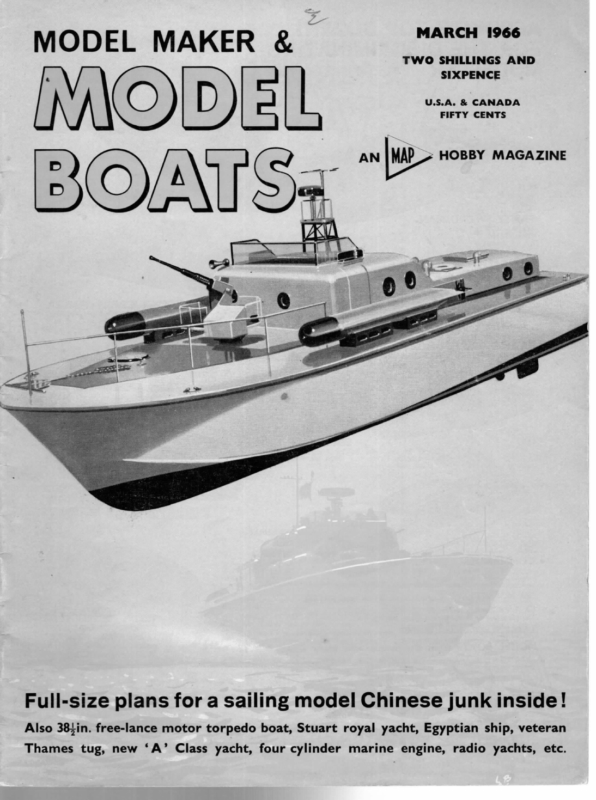
– MODEL MAKER @ MARCH 1966 TWO SHILLINGS AND SIXPENCE [) U.S.A. & CANADA ) HOBBY MAGAZINE Full-size plans for a sailing model Chinese junk inside! Also 38tin. free-lance motor torpedo boat, Stuart royal yacht, Egyptian ship, veteran Thames tug, new ‘A’ Class yacht, four cylinder marine engine, radio yachts, etc.
BOmKAS HIS new design is the result of a close look at all my previous ““A’’ boat drawings, a visit to last year’s National Championships at Fleetwood, and experience gained in some model development work for a new full size yacht. I have probably spent more hours on the drawing board developing these lines than on any previous design and have achieved some new objectives. As a result I] am delighted with the design and am full of confidence that she will be successful. First and foremost, the question of size had to be settled and my last essay into this class produced the 60 in. L.W.L. heavyweight Moby Dick. We have yet to find out how she will perform but the prototype is being built by Ken Jones at Birkenhead and should be sailing concerned. The keel or fin has received a great deal of careful thought. In the full size yachting world there is the current fashion of easily flowing soft curves to the profile without any tendency to show a “‘toe’’. This has always been a characteristic of Olin Stephens and Robert Clark and the success of the 12 metre Constellation in the last America’s Cup races has really stimulated this shape. No doubt extensive tank testing confirmed that this profile is a good thing, but we do not know how many alternatives were also tested. Furthermore is it not reasonable to suggest that this profile is most suited to deep bodied hulls of narrow beam which the 12 metre class have and also the deep, heavy displacement ocean racers? I cannot see why the same shape should automatically be best for our shallow, narrow, flat-floored has been constructed in the Midlands. At the time that Moby Dick was designed I had been trying to produce a new heavyweight based on the lines of Vital Spark. In other words a narrow, shallow round bilged type. This I was unable to do and so decided to break away to a longer waterline extra heavy design. S. It seems reasonable therefore to use 57 in. L.W.L. as the basic L.W.L. as measured on salt water so that the new boat will have a higher potential speed. In order to use the type of hull employed in Vital Spark it is obvious that the displacement must be near the minimum allowed without penalty, i.e. 61-01 lbs. approximately. Mersey Beat is the prototype of Vital Spark and has been raced very successfully by Ken Jones during the last two years. As a result of his observations and my own at this year’s Championships, we decided that, as good as she is, she would be better by being a bit bigger all round. Vital Spark is 54 in. L.W.L. and about 53 Ibs. displacement. The new design therefore settled at 57 in. L.W.L., 61 Ibs. displacement and 14:25 L.W.L. beam (same as Moonshine). Before drawing the preliminary lines I also decided to adopt a keel without any deadwood so that there would be the minimum of displacement in the fin and at the same time the lateral area should be reduced as compared with either of the two earlier boats. This meant that, relatively speaking, the canoe body should carry a greater proportion of the total displacement and I knew that this was going to be difficult if I were to use the Vital Spark type of hull form. To my delight, I found that using the basic waterline shapes of an ocean racer design that I had been trying to develop, I could just get the displacement required. Although the new design looks at first to be quite similar to some of my previous ones there are in fact important differences, whilst at the same time retaining the characteristics that have always pleased me. The main difference is in the shape of the waterlines in the after part of the hull, in that they are much more rounded than is usual in my designs. At the same time the entry is a little finer and this should help light weather performance. BY JOHN LEWIS The profile has a deeper chest forward and a flatter run aft than I have before been able to achieve without losing “balance”? when heeled. This is a feature which has particularly pleased me and the balance is almost perfect. It has been possible to maintain tumblehome throughout the length of the hull and this should produce a very sightly yacht. All in all, I think I have made a distinct advance on my previous designs as far as canoe body is next season, although I have heard that a modified version But the past twelve months have enabled me to find a solution to the problem. As Moonshine has been so consistently winning races, I felt that her basic dimensions could not be far wrong. She is sailing on an L.W.L. a far short of 57 in. and has a displacement of 60-5 A NEW HEAVYWEIGHT ‘A’ CLASS DESIGN “A” boats and one may say that with this type of hull a distinctly independent approach to keel shape should be pursued. I have now been involved in the design of five models and one fullsize yacht all of which have vertical leading edges to their keels and in no instance has there been any evidence that this form is a disadvantage. All however are exceptionally good to windward. Therefore, in Boreas 1 have not been swayed by fashion or technical development in other dissimilar yachts and am prepared to let the leading edge of the keel be just as steep as necessary to satisfy other factors. One thing I have always felt fairly strongly about is that the thickest part of the keel should coincide with the deepest point of the canoe body. I do not see how otherwise it is possible to obtain a really good fairing of keel into the hull. In Boreas this point has been carefully studied and the shape of the garboards is to my eye very good indeed. Some years ago, I experimented with thick keels in the hope that displacement could be carried this way and thus enable the hull lines to be eased. None of the experiments produced any improvement in performance and usually it seemed that some penalty going to windward resulted. Therefore, I now feel that there should be the minimum displacement in the keel and that it should be as thin as practical considerations of containing the lead will allow. This does not mean that I advocate the reversion to the old fashioned plate and bulb type which became obsolete long ago. This form is being used again in some light displacement keel yachts in order to obtain stability. In one design classes it does not matter if some windward efficiency is lost as the penalty is the same for all. In the model world it is not only desirable to have a low C.G. of the lead but heavy total displacement is also important. A low C.G. does not substitute for a higher displacement, what we require is both for preference and I would 112
MARCH 1966 prefer to sacrifice some raising of the C.G. of the ballast rather than give away any displacement. There will be less of that turbulent boil so often seen in i models when going fast to windward. The horizontal sections of the fin show a very easy entry and the shape is one which should promote a good i #329 deal of laminar flow. The steep leading edge has made this possible and furthermore, it has been possible to make = the keel progressively thinner as the deepest draught is approached. By this means, I hope that the eddy making from the bottom of the keel will be reduced. Although the keel has a fine entry, it is important to note that the actual leading edge is slightly rounded. This prevents the early setting up of eddies and breaking down of flow over the keel at normal angles of incidence. There is a largish rudder with a very small skeg and the result should be quite effective in controlling the boat. The rudder follows the contour of the hull for a little way in order to fair out the thickness of the rudder post and so avoid the nasty eddies which otherwise form at this point. The drawings show the centre line of the deck with the maximum round allowed by rule. As the rule does not say anything about whether the camber should be up or down, the first part is up in order to raise the points of measurement of the sail plan and the after part of the deck is dished inwards to lower the weight of the deck and vane gear a little. It looks good as well as helping to lower the C.G. There is nothing very exceptional in the sail plan except that the reduction of area compared with Vital Spark has been taken solely from the mainsail. This gives a foot of main and base of fore triangle measurement almost equal. The luff of the mainsail is as long as reasonable and the rather curious shape to the leach does gain a few square inches unmeasured sail area. The leach of the jib has an overlap on the mast and mainsail and this is quite in order providing battens are not used on this sail. They are not really necessary these days anyway. It may well be worthwhile having two top suit mainsails, one with the foot cut at the length shown on the plans and the other with a very considerable flow for light weather use. With this sail the foot would be cut longer than the measured length marked on the boom but the sail would not be used extended beyond the boom black band. There is no point in giving away sail area, by easing the foot in light weather, just when you need every square inch. You can pick up the equivalent of at least 12 sq. inches by cutting the sail with an overlong foot. I do not think there is need for me to make much comment on building, but I think that a special carrying case should be made for the keel. The after edge will be vulnerable to damage as lead is so soft and a distortion of the keel casting would ruin the performance of the yacht. Well, there she is! Good luck to those who build her. 113 OBMDIEZO sv3408 AMOiWAgOD saver ‘oo In the Boreas design I have not let the position of the C.G. in a vertical plane disturb the profile or the horizontal sections of the keel from the shape I want for hydrodynamic efficiency. The leading edge is steep in order to place the C.G. in the correct position fore and aft and the after edge of the keel sweeps up into the hull in a way which I hope will produce an extremely clean delivery. Au section. It also “stalls” sooner. 40 SAMI “OVALE “ORIN “LEIMLS RDOWE G8 lower. Furthermore, a flat plate has a higher resistance at a given angle of incidence than a thin aerofoil type of 3DIAN3S SNVId Y3xVN 1300W 5 The ocean racer fraternity are realising that heavy displacements are an advantage and that at the same time a higher ballast ratio is possible. It is better to have a lot of lead reasonably low down than less lead slightly i a Vea = 6 bs g pre 58 : (Al