- Changes to the 10-RATER RULES
- Starting in Model Yachting C. Jackson found that information was hard to find till you knew where to look. These notes may help others.
- MARK-TOO C. S. Gould describes two scaled-down ‘China Boy’ sailing models

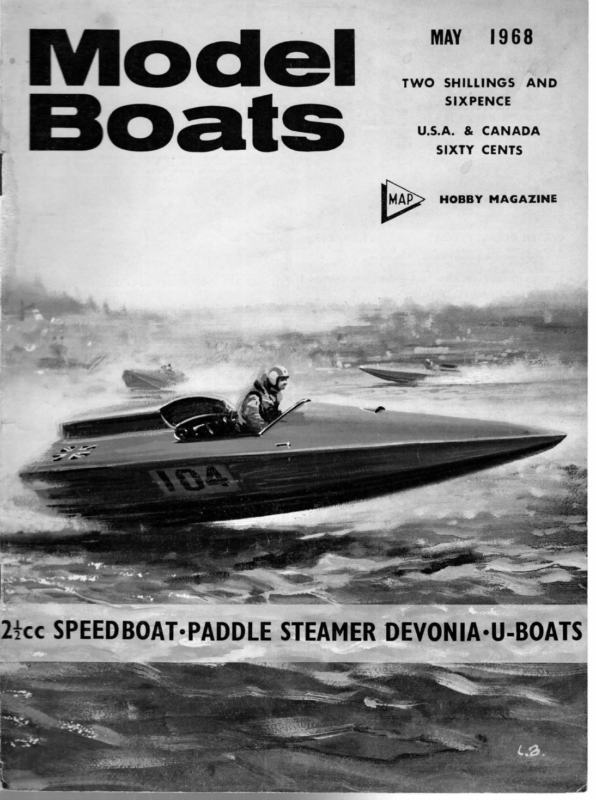
MAY TWO 1968 SHILLINGS AND SIXPENCE U.S.A. & CANADA SIXTY CENTS HOBBY MAGAZINE
MAY N the last two or three years the inadequacy of the 1968 Changes to the 10 rater rules in controlling sail area has become evident. For about ten years up to this period there was no serious attempt to exploit the rules fully as far as rig area was concerned; a typical rig of this period would be about 72 in. on the luff and would carry a 3 in. roach measured to the outside of the 1 in. headboard. In this situation several 60 in. lwl boats with this basically standard type of rig showed that they could just be competitive with the 55 in. lwl boat with the same type of rig. This basically stable situation was broken in 1966 by the successful use of a large wing mast in the national championships. The M.Y.A. made a hurried attempt at controlling the unlimited area that one could gain by such a mast. The unmeasured area was reduced to a 1} in. 10o-RATER RULES masts form part of the aerofoil section of the mainsail, they should be measured whatever their shape. Apart from the booms, which are limited in depth to ? in., it is width and the whole area of any mast larger than “this had to be measured. What was overlooked at this time was the exploitation of the area in the roach. At least two boats at the 1966 proposed that the true area of everything above the deck iS measured. The vane feather is, of course, excluded from nationals were using far larger roaches than the 3 in. used by the rest of the competitors. This exploitation of the roach area was almost as great in area as that of the wing mast and yet nothing was done about it. This was to have important repercussions, because it was seen that 60in. Iwl boats could easily be made successful by the use of these large roaches. In modern sail materials these were quite practical for the light conditions for which they were necessary. By the 1967 championships there were eight 60in. lwl boats present and they filled the first six places. These six were all using rigs that gained area eitherin a 14in. mast or in a large roach or both. By such methods these boats outclassed the 55 in. lwl boats which made up the rest of the fleet. It was not that these other boats were not up to the same tricks as the 60 in. Ilwl boys, because some of the 55 in. lwl boats had just as much area in the roach, but they hadn’t the waterline length to make full use of it. One might think that these problems are confined to those few who are keen enough to attend national championships, but thisis not the case. These top skippers for the main part of the season participate in club racing and the difference between new and old is even more apparent than in national competition. An M.Y.A. committee of designers and skippers studied this problem in great depth last year and has produced recommendations which have the intention of providing a fair means of measuring sail area. These recommendations have passed through the M.Y.A. council and the proposed rules have been circulated through the districts to the clubs for their comment. Anyone interested in the precise wording of the rules themselves should contact their local club secretary. The main element that has caused this upheavalin the 10 rater ruleis the roach. Excessively Jarge roaches have caused this problem and therefore roaches must be limited in some way, in order to solve it. Either the width of the roach must be restricted or the area must be measured. To restrict the width of the roach is not enough, because there can still be a great difference in area between a tall and a low rig, because the length of the roach can vary. This difference in area might be equivalent to several inches in waterline length in extreme cases and this is obviously not satisfactory. After much deliberation the committee decided that measurement of the actual area was a much fairer method of restricting the area. Actually, this is exactly as the original rater rules were drafted 80 years ago. The rule limiting the area of the mast is, at present, un- satisfactory because it gives an unfair advantage to those who use the 14in. wide mast and by doing so it discourages the use of the conventional round mast and a this. The actual area of a rig that is typical of the preexploitation era breaks down as follows: Area of 3 in. roach to outside of hdbd. Area of triangle under hdbd. Area of $ in. mast . .. 150sq. in. = 49 sq. in. .. Area of jib in excess of fore triangle .. te 5c ai Total area in excess of measured area ls .. 37 sq. in. 10 sq. in. 246sq Therefore, the actual area carried by a 60 in. iwi boat of this period would be 1,246sq. in. and 1,335 sq. in. for a 55 in. Iwl boat. If these areas are computed in this way and the figures are applied to the present rating formula, it would mean that all the existing 10 raters would be grossly under area. This situation would be ridiculous and therefore the M.Y.A. propose that the constant 6,000 is altered so that this method of measuring sail will work without very much basic change in existing boats. Much time has been spent on deciding the new constant and, although not ideal, 7,500 is the best compromise that can be made in this difficult situation. It may be thought that the change from 6,000 to 7,500 will lead to more difficult calculation, but this is not so, because one used the rating formula by dividing the lwl into 6,000 x 10 to find the sail area that a boat can carry. Therefore, the simplicity of the calculation depends on the Iwl and not on the constant. If one uses this new constant to determine the areas for a 60 in. and 55 in. Iw] boat one arrives at 1,250 and 1,363 sq. in. respectively. The proposed situation therefore benefits the 55in. Iwl boat and will mean drastic cuts in the large roaches now used on 60 in. Iw] boats. Measuring all the area of the sail plan eliminates the need for restrictions on batten lengths, headboards, and masts other than any which influence the profile of the sail plan. Thus, it allows the great freedomin the choice of the sail plan which one would expect from a basically experimental class like the 10 rater. The method of measuring the spinnaker at present precludes the use of the una rig on a competitive basis, because since there is no fore triangle there is no spinnaker. In an experimental class it is a poor rule that cannot allow such a rig to be used competitively. Further, boats with a large fore triangle have a downwind area advantage over those with a small one. The downwind area (half spinnaker area plus mainsail area)in the existing rule varies between one x rated SA for a single sail behind the mast and two x rated SA for a single sail (jib) in front of the mast. It is felt that the area downwind (Continued on opposite page) wing mast of decent width. It was thought that since all 193 Tima
MODEL BOATS Maximum bhp: 0.27 at 12,700 rpm. Specific output: 111 bhp/litre. Power/weight ratio: 0.36 bhp/Ib. Manufacturer: Useful diecast aluminium marine engine mount made by Fein und Modell Technik of Berlin, manufacturer of Webra engines. Engine shown installed is 3.5 cc Webra Glo-Star. Silencer: Dimensions: Not supplied but collector ring has % in. o.d. outlet for connection to suitable extension pipe or silencer. Overall height: 3.25 in. (approx. including compression screw). Height above bearers: 2.10 in. (less compression screw.) Overall length: 3.05 in. Overall width: 3.20 in. (approx. including needle-valve and exhaust collector outlet.) Crankcase width below mounting lugs: 1.130 in. John Oliver (Engineering), ‘Four Acres’, 248 Ringwood Road, Ferndown, Dorset. Two well-known Australians, Keith Hearn (centre) of Hearns Hobbies and Tony Farnan (right) with Shigeo Ogawa, manufacturer of OS engines and radio equipment, at Lake Biwa, Japan. The two R/C express cruisers, owned by Mr. Ogawa, are, naturally OS equipped and powered. Photo was taken in 1965 during development of the 10 cc OS Max 60 engine. Below, engine compartment of Mr. Ogawa’s 48 inch fibreglass hulled cruiser used as a test bed for OS marine products. Engine is a watercooled Max-R 60 unit, prototype of the present Max-H 60, and is equipped with recoil starter. The water outlet is fed into the exhaust expansion chamber to cool the exhaust and aid silencing. See ‘ TEST DATA Performance figures obtained with watercooled, worksmodified version, following one hour running-in period and using a fuel mixture consisting of 50 per cent Kerosene, 30 per cent ICI Technical Ether, 20 per cent Duckhams Racing Castor Oil, plus 1 per cent Amylnitrate. Atmospheric temperature: 45 deg.F. Barometric pressure: 30.40 in.Hg. 10 RATER-RULES (from opposite page) should be constant in relation to the rated SA and it is proposed that this should be 14x rated SA. Therefore, if one has a big main, one has a small spinnaker, and vice versa, but always the total area downwind is the constant 14 SA. This is a continuation of the original rater principle to downwind area. It would allow both a una-rigged boat to compete and would provide a fairer basis for measuring the standard situation. In order to allow a choice in the shape of the spinnaker (tall and thin, or short and fat) it is suggested that the hoist and boom length are the controlling factors and that the product of these two lengths plus the mainsail and mast area equals 14 SA. om it is suggested that the fore triangle no longer determines the spinnaker, it is thought that the job should be measured directly. The original idea of the 85 per cent. fore triangle was to simplify the measurement of the several items of sail that were set in front of the mast; since this complex situation no longer exists it is not necessary to stick to this rather crude approximation which tends to lead to unsatisfactory jib arrangements. The measuring of areas in these proposals is imple192 mented by defining the basic triangle and measuring the ‘edges’ around it, i.e. mast and roach on the main. Curved areas are calculated using the base multiplied by the perpendicular width multiplied by a constant (2/3 in the case of a fair even curve, etc.). The M.Y.A. is confident that these proposals will solve the basic problem of unfair sail areas and will restore to some extent 55 in. lwl boats to a competitive state. It is realised that these proposals are not perfect; they are a compromise, and this compromise has been carefully thought out. It will not please everyone but it is intended to help those who have been most affected in recent seasons. It implies a change and this is never popular, but change is necessary now to rid the class of the unfair measuring and these proposals will benefit the class considerably in the long run. If the 10 rater class is to make any contribution to design knowledge, it must have the freedom that it hasn’t had in recent years. Could one under the present rules honestly consider using full battens? Or a una rig? Under the new proposals no one type of rig is favoured and the best rig will emerge, not because its arrangement gains a few more square inches of sail, but because it is the best arrangement for that area.
MobEL BOATS Starting in Model Yachting | Bhan ea last year the writer decided to change from model aircraft contest flying and have a go at model yachting, something that had always fascinated me since I first saw such contests on our local Danson Lake some years ago. Several visits there this year drew a blank, the largest model being a 12 in plastic boat, not quite what I was after, and not until I visited the Round Pond did I find anyone who could put me on the right road. These notes are written in the hope that others who want to try this side of modelling will be encouraged to make a start. Types of Racing Most model yacht racing are of American tournament types, i.e., each boat races all the others, in pairs, up and down the lake and the boat with most points at the end wins. The boats are controlled by vane steering gear which is pre-set. Radio control is still very much a minority following. Venues There are a surprising number of centres throughout Great Britain, e.g. four in London alone, where regular meetings are held. The best way to find your nearest club is to write to the Model Yacht Assn. Hon. Secretary Mr. G. W. Clark, 30 Carston Close, Lee, S.E.12 en- closing a s.a.e. He will give you this, plus where known the usual sailing water and times. So you can go along and have a look. To race in any events you must belong toa MYA club and the boats are all measured and numbered. Classes of Yachts The MYA recognises four vane steered classes, 36 in R, Marblehead, 10 Rater and ‘A’ and two radio classes, one for converted ‘A boats, the other a new rule. Unfortunately the smallest class, restricted to 36 in length, is not popular because the unlimited sail area it produces makes it rather difficult to sail boats. This is a pity because the smaller boat would be within the younger modeller’s handling capability and encourage more TEST BENCH (from opposite page) wide choice for main motors for boats from very tiny to, say, a 36 in destroyer or similar slim hull. Naturally, with inexpensive motors such as these the current consumption is a shade higher than one would expect from a £3-£4 job, but even if one buys batteries a little more frequently it still represents very cheap boating. For the many ancillary functions, where running is not continual, the battery life difference is even less marked. The new range appears to us more robust and more solidly built than the old, and some simple tests suggest considerably more power for the same consumption. Also in the photograph, and shown separately, are two new motors for larger models, the Super Orbit 705 and 805 at 39s 6d and 49s 6d. To get some practical idea of performance, we lashed an 805 into a convenient 27 in x 10 in hull, fitted a 14 in Ripmax two-blade prop, and stuck in a partly used 6v dry battery. A quick trip across the road in near-zero temperature surprised us with a speed of nearly 5 mph. Since the motor is for 12v working we believe that this could be the easy answer to sprightly performance in electric steering etc. and we shall be con- 208 C. Jackson found that information was hard to find till you knew where to look. These notes may help others. junior members. Perhaps this may change (the 1 metre boat recently in MM or even a catamaran might be just the job) but in the meantime the Marblehead, 50 in long, is by far the most popular boat numerically. It is easy to handle, goes in the boot of a car, and produces close racing, all highly desirable features. The experts favour the bigger 10 Raters and A boats, but both these are heavier, and the ‘A’ in particular really needs two people to handle and storage near the sailing water as they may weigh up to 50/60 lb. Construction The thought of building a boat from scratch before youncan even try your hand at sailing puts more people off than anything else, but you can get round this problem in several ways. Most clubs have old boats knocking around and a keen enquirer may be able to borrow one to try out his skill. Failing this you can assist, or ‘mate’, a skipper sailing his own boat and learn a little this way. When it comes to building your own, most clubs-have their own sources of lead castings for keels, fittings and vane gears, and Model Boats carries adverts from sail- makers, and just recently at least one maker of glass-fibre hulls. You can race a boat that you bought complete, so a second-hand boat might be the answer for some, and a reasonable M class boat can be had for between £10/20 depending on its age and design. Reading Back numbers of Model Maker and Model Boats contain information on all aspects of racing, particularly a series by A. Wilcock on vane gears and their workings, and a booklet on trimming up by D. A. McDonald. I have also found the MAP book Model Racing Yachts by Priest and Lewis extremely interesting when I can get my friends to stop reading it and give it back. In addition there are many books on full size yachts in your local library. For the technically minded, Sailing Theory and Practice by C. A. Marchaj, published by Adlard Coles Ltd., will provide hours of solid reading. ducting some further tests with great optimism. The 805 is 1} in dia. and 2-3/8 in long, weighing 5 ozs; it is simply a cylinder and thus needs a mounting to be built for it. The 705, on the other hand, has a mounting ready fitted; this is 1-3/8 in dia. and 2 in long, and also weighs 5 ozs. A very useful and promising pair of motors. Ripmax Ltd, 80 Highgate Road, London, NWS. For the luxury class modeller — and that doesn’t exclude everyone, as clubs could consider it — the recently introduced and redesigned Burgess BBS20 bandsaw is a highly desirable piece of workshop equipment. Overall size is 24 in long, 22 in high, and 14 in wide, weight 33 Ibs. It doesn’t have to be fixed down, and is so quiet running that an illuminated switch is fitted. For model boat work most of the cutting would be 1/8 in or so ply and timbers up to 1 in thick, which it handles with almost contemptuous ease. Maximum thickness of cut is 3 in—even in metals, though 1 in mild steel is mentioned as a limit — and the depth of throat is 12 ins. A table 14 in x 12 in is fitted, and can be tilted up to 45 deg. Blades are available in various grades at 9s 6d. It takes the hard work out of sawing, speeds building (thus giving more time for operation!) and is an investment at £27 5s. Burgess Products Co. Ltd, Sapcote, Leics.
T OO ——— a ———— ee el a MAY Readers may be interested in a project recently completed, namely the building of two Miniature Marbleheads. Although knowing that this class as far as the MYA are concerned is a ‘dead duck’, it was decided to scale down my ‘M’ class China Boy which although now some six years old has a fin and bulb keel, which seems to be the latest wear for ‘Ms’ of modern design. It is also, being of chine design, quite easy for a beginner to build, as my colleague found out — after all it was he who started this idea, as he wanted to build a small yacht for his sons. After setting up the moulds etc. on the building board this was duly handed over to him for the construction of the hull, this to be of 1/16 in. marine ply. My side of the job 1968 C. S. Gould describes two scaled-down ‘China Boy’ sailing models MARK- TOO was to manufacture the fittings, mast, booms, vane gear etc. Some calculations were required when it came to the bulb keel, as we were working backwards knowing only where the LWL should be. However, the final displacement turned out to be 3 Ibs. 13 ozs. All fittings are as normal full ‘M’ practice and a very simple non-self-tacking vane gear was devised; a ratio of 13 to 1 was found to be the most suitable. A sail plan was devised after some calculation and these were made by Mr. Levison. KICKING STRAP FITTING SECTION TANDEM CYCLE SPOKE ~~ BRASS WIRE BELLED AND SOLDERED IN END OF LAMP FITTING INTERNAL SPRING IN FITTING | = ELECTRIC LAMP SOCKET FITTING, WITH WIRE FITTING FILED OFF. SIMPLE VANE (NON SELF TACKING) BRASS BLOCK FILED SQUARE FOR EASE OF ADIL SHENT. 1/4″ SQ, ALUMINIUM CARRIAGE NOT TO SCALE POINTER BALANCE WEIGHT VANE FEATHER AND 3/16″ DIA, ALUM, ROD FLATTENED AT END TO FORM FRICTION LOCK REINFORCING PIECES i ON TUBE SPINDLE WHEN BOLTED UP — LINKAGE PIN TO =| TILLER ARM – | | 7 OLD WATCH DIAL SWEATED tJ 1/8″ BORE BRASS TUBE WITH TOP BLANKED OFF, TO BRASS HOUR MARKS GIVE 30° POSITIONS BRASS MOUNTING SPINDLE —= STRIP AND TUBE. This boat is finished in red with a white water line, white deck with black king plank and deck capping strip, After the initial tuning up trials at Blackheath, the little boat performs remarkably well, having the same docile qualities of the parent. It, of course, follows that the next step was to build one for myself in order to engage in friendly competition. This I have called Marktoo, incorporating some slight mods. Aiming for lightness, the hull and deck was made from 1/32 in. marine ply, which brought the weight ofthe hull, deck, complete with fin and skeg, painted and varnished, to 104 ozs. The total displacement of Marktoo is the same as 3 lbs. 13 ozs., but it carries 8 ozs. more lead in the bulb. The mast is $ in. television aerial tubing with a 6 in. wood topmast and fittings follow the standard pattern of the other boat except that they are from brass curtain rail whereas the first boat’s were plastic. The kicking strap is made from an electric lamp socket fitting drilled out, with a small piece of brass wire belled and sweated in one end. The
Ci BOATS other end, of solid brass, is already drilled and tapped to receive a tandem cycle spoke, so you have a free rotating spring-loaded adjustment. Backstay and mast fittings are cut from solid aluminium. The boat is finished in powder blue with a red WL, as are my ‘M’ and ‘10R’. The deck is white, and king plank and deck capping maroon. The SOUTHERN May Sth RC, ST, SP & SR Bradford MES May Sth RC, ST, SP. Birkenhead, Gautby Road 11 a.m. Fee 2/6. May 12th RC, ST & Multi, SR. Ossett and Horbury, 11 a.m. Crow Nest Park, Dewsbury, Fee 2/6 per boat. May 12th RC, ST & SP. Liverpool MPBC, 2 p.m. Walton Hall Park. May 19th RC,ST & SP. Leeds MBS, 10 a.m. Waterloo Lake, Roundhay Park, Fee 2/- per boat per event. May 26th RC, ST, SP and Multi. Hull MPBS, 11 a.m. East Park, Fee 2/-. May 26th NORTHERN SR & NOM. CHAMPS & HYDROPLANES, Birkenhead. MIDLAND May 12th RC Wulfruna MBC West Park Pool, 11.00 a.m. Wolverhampton. Fee 2/6 for the day. RCSTG and Pairs. May 19th RC Bournville MY and PBC 11.00 a.m. Valley Pool, Bournville Fee 4/-. RCSP and RC Pairs (Pairs up to 6 cc) CLASSIFIED ADVERTISEMENTS Trade 8d. per word (min. 12/-) MILES SPECIAL: 20 cc (Glow) Marine racing engine. Top condition. £18 10s. Od. O.N.O. 20 Leasowe Road, Wallasey. Tel: 7169 Q. AEROKITS P/T boat, R/C. Leicester. Immaculate, MacGregor radio, £15 O.N.O. Apply Kinematic servo, Veco Apex Craft, Church 19 638483. . Crossways, Bayleys Hill, Sevenoaks, Ross! 60 chrome bore W/C _Q. ‘The Hobby Shop’, 28 Arundel Q./B. in glass Ultimat Hull new cost over £40. Price £22. Also Selecta unimat lathe, tools, good condition £14, buyer collect. R. Bleakley, 19 Hulton Avenue, Little Hulton, Worsley, Manchester. ; UNEINISHED Aerokits P.T.B. (Half converted). Merco 49, servos. £20 O.N.O. Details and offers: M. G. Leander, Taylor’s, Radley College, Abingdon, Berks, ceuyer arranges coltvers please). ; BERTRAM V F/Glass Hull with Gannet 15 cc O.H.V. petrol Bonner servos, coil etc. Handsome steering boat over 40 prizes won. £35. Evenings ELT 2959. : OR SALE Sea Commander with modified ‘Motor Yacht’ superstructure. Frog 3.5 cc. Mainly ‘Web’ fittings. R.C.S. 6 Tx Rx, motor and steering servos. £45 O.N.O. Blackstaff 01-504 5227. Q. MATADOR/MIDAS Mk. Ill. 3 S/N servos 2 trim servos. DEACs complete. Mint condition. £65 O.N.O. Newman, 184 Magpie Hall Lane, Bromley BR 2 8JE, Kent. FoR SALE—Bermuda Princess 42 in. fibre glass hull complete with Electric motor and accessories. Ideal for R/C. £40 O.N.O. 89 Oakington Manor Drive, Wembley. , ODEL Racing Yacht Sails. All classes—stamped addressed envelope for prices. Arthur Levison, 80 Weydon Hill Road, mame Surrey. : FoR SALE—Pirana with mahogany superstructure and electric power. £7 10s..0d. Swordsman, ex Gannet fitted with 2 B.A. tube, £8. 46 in. Crash Tender with E.D. Viking installed £18. All three are in excellent condition. Wanted—Braine type steering ear for a Marblehead. Letters only please to: Smith, Glebe Farm, Sterraton Drew, Nr. Bristol. RC May 12th RC May 12th SP May 19th RC May 26th RC May 26th SR Mid-Essex Modellers, 11.00 a.m. Doctors Pond, Dunmow. No fee. MYA REGATTAS May May May May 4th ‘A’ Knowles Cup 5th ‘M’ Gamage Cup 12th ‘M’ Northern Dist. Champs 18th 10R MacDonald Trophy Witton, Birmingham Norwich Leeds and Bradford Witton, Birmingham May 19th 10R Mid. and Dist. Champs Witton, Birmingham May 19th 10R Mayoral Cup Fleetwood May 26th ‘M’ Met. and South. Dist. Champs Hove May 26th ‘M’ Mere Cup Scarborough ELS 15 cc magneto four stroke engine, brand new, silencer, £20, 6 Rosslyn Avenue, Shoreham, Sussex. Shoreham 3706. – WANTED petrol, Marine glow, Engines or diesel. in good Dible, condition, Creek 8 cc Cottage, and larger, Abbotsbrook, Bourne End, Bucks. Q. WORKING Paddle Steamer 39 in., £48. Realistically detailed. Also fal Pein Steamer 43 in., £43. Details: 19 Beck Road, Panes sland. ; . Q. Kent. R/C new mounted May Sth Nth. London SME Victoria, 10.30 a.m. Park, E8. No fee. (Naviga course). Hounslow M C, RCST & RCSP, 10 a.m. Felix Lane, Shepperton, Fee 2/6 each event. Cygnets, Mote Park, Maidstone, 11.00 a.m. RCSP, RCST and Concours. & SR Swindon MPB and EC, 11.00 a.m. Cheyney Manor LK. Fee 1/-. St. Albans MES Lake Verulamium, 11.0 a.m. Fee 2/6, RCSTG. Southend MPBC Southchurch Pk. No fee. RC and RCSP. man (wave spray and runners) £6 10s. Od.; 60 in. x 17 in. M.T.B. £9 2s. 6d.; 60 in. x 12 in. E. Boat £8 18s. 6d.; 60 in x 14 in. Swift £9 2s. 6d., decking to suit Swift £5 5s. 9d. Colours to customer’s ROBIN THWAITES will part exchange good condition used Marine Motors for Model Boat, Aircraft, Train, or Car goods. Open all week to personal callers only please. Street, Portsmouth. SR . BEAVER 10 cc, Otter 15 cc Marine Engine castings now available. S.A.E. for details to: Otter Model Engineering, 11A Whinfield Avenue, Chorley, Lancs. ; ANTED Model Makers from June 1956 to June 1958. Good price Allan, May Sth GLASSFIBRE HULLS expertly moulded using latest techniques. All hulls have deck mounting flange. 344 in. x 94 in. crash tender Gate, FoR SALE—Grundig 8 Tx with 2 Rx 4 filters, 4 mixed servos, 4 accumulators and charger, volt-meter iind Field Monitor. Cost £70 lot. Walker, 406 Idle Road, Bradford 2, Yorks. Tel: £140 new, paid. regatta. REGATTAS NORTHERN Private 4d. per word (min. 6/-) vane feather is also 1/32 in. ply, varnished and polished, and sails were again supplied by Mr. Levison. Considerable interest has been aroused by these boats and it is expected that at least two more will be coming off the building jig later on, almost enough to hold a ‘one design’ Q. 218 £2 15s. Od.; 463 in x 144 in. Sea Own requirements. Trade Queen £5 17s. éa.; 42 in. Hunts- enquiries welcomed. S.A.E. for full list. SHERVILLE REINFORCED PLASTICS, London Road, Welwyn, Herts. Welwyn 5513. TyCe NAVAL BOOKS. Wide selection of interesting illustrated books on warships and naval matters available. Many items for modellers. Latest list—two 4d. stamps. K. B. Hindly, 37 Christchurch Road, Oxton, Birkenhead, Cheshire. P:O:R: PLANs! Schooner yacht ‘CREOLE’, 5 sheets authentic model sized, lovely 3 masted vessel. Scale suits proprietary fitting 76 in./ 58 in. x 13 in. (smaller available). Working or showcase, 75/- set. CWO, or S.A.E. details. Rhodes, 22 Barnes View, Sunderland. P.Q. GLASSFIBRE HULLS, Marbleheads, (7), 10 Raters, (2), and ‘A’ Class Dambuster. Designs by Lewis, Stollery, Witty. Latest additions Lewis High Tension, and Witty Typhoon. Also 36 in. Trimaran/Catamaran Hulls for the new Met. Sth. Dist. class 42 in. and 23 in. motor cruiser hulls. Pretty 24 in. cabin yacht with moulded deck. Have that oa old model reproduced in glass. 6d. stamp for list from Blick, 23 Bray Road, Guildford, Surrey. TAG. ADIO Control! Supplies, largest stockists, of R/C equipment, engines and accessories in the country. H.P., Part Exchange Transistor equipment only. Call, write or phone, ISL 0473. Radio Control Supplies, 581 London Road, Isleworth, Middlesex, and at 52a London Road _ Leicester. GC; gAlus for Model Yachts. Perfect cut and finish in coloured Terylene sailcloth. Price list of racing suits from Nylet Ltd., Park Road, Fordingbridge, Hampshire. L.Q. 10 PAGE illustrated catalogue No. 17 of Government and manufacturers electronic and mechanical surplus, also a complete new section of the latest semi-conductors and miniature components, includes a credit voucher for 2s. 6d. Send for your copy now. Price 3s. Od., post free. Arthur Sallis (Radio Control) Ltd., 93 North Road, Brighton. . ; T/C. Wis PHOTOGRAPHS. Fine quality post-card size ship pictures. 1s. 6d., each. Write with 4d. stamp for interesting lists to J. Mannering, River House, River, Dover. LAG: oO Tinplate Warships Motor Cars. Ron W.1. 01-734 5287. and Liners McCrindell, wanted, ‘Grapes’, also tin trains Carnaby Street, and London, O.P.Q.