- Racing Model Yacht Construction – GRP Hull Completion (C. Griffin) — A practical guide to finishing racing yacht hulls using glass‑reinforced plastic shells, covering both one‑piece and two‑piece hull types, with detailed methods for fitting fins, skegs, chainplates, decks, and internal bracing.
- 10‑Rater National Championship Report (Hove) — Describes competitive racing conditions, evolving yacht designs, and the strong performance of modern lightweight hulls, with detailed race results and observations on rig choices and tactics.
- Metropolitan & Southern District Team Race (10R) — Summarizes a closely contested team event showcasing tactical sailing, improving competition standards, and the impact of new designs on race performance.
- Design & Construction Notes for Racing Yachts — Provides insights into materials, structural reinforcement, and evolving hull construction techniques aimed at improving strength, durability, and performance.Description of contents

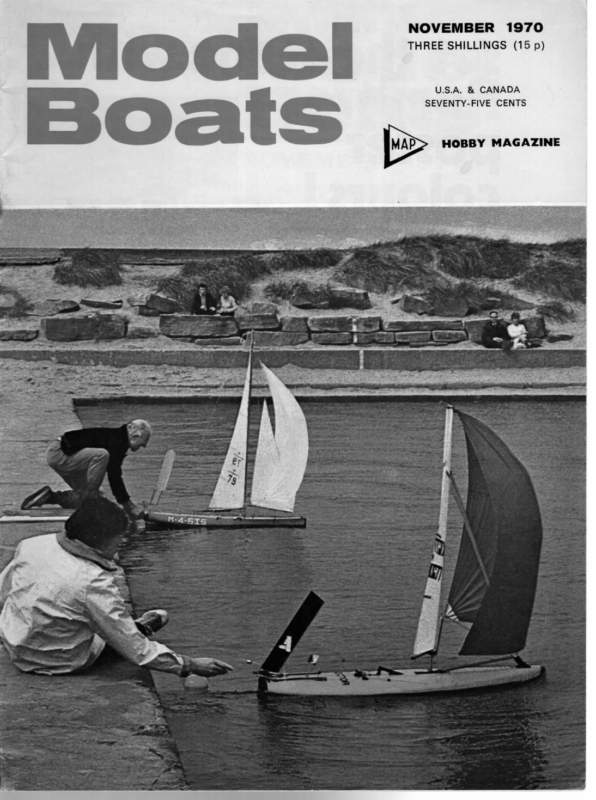
NOVEMBER 1970 THREE SHILLINGS (15 p) U.S.A. & CANADA SEVENTY-FIVE CENTS HOBBY MAGAZINE J = secsaetoo! sees aE
MODEL BOATS RACING MODEL YACHT CONSTRUCTION Type 4 FIG. 34 ONE-PIECE GRP SHELL — glass-fibre hull completion FIG. 35 TWO-PIECE GRP SHELL PPHuE glass fibre hull shell can be either formed in a mould taken from a plug (see previous articles) or purchased from a recognised supplier (see advertisements in Model Boats). The advantage of moulding a hull shell is that it is possible to have an original design capable of easy reproduction. On the other hand, buying a shell means that the difficult part of building a racing yacht has already been done. This puts the modern racing yacht within the reach of anyone who possesses a reasonable amount of skill and patience. G.R.P. shells can be either in one piece, Fig. 34, or in two parts, Fig. 35. The building method depends to a large extent on which of these two types of shell is used. G.R.P. Shell Type A Reference to Fig. 34 will show that building a yacht from this type of shell follows closely the lines of the construction methods described in previous articles. To illustrate the construction method assume that a Stollery Daredevil or a Witty Wasp design shell has been purchased; these are both single part shells which have a flat, wooden deck. Prior to ordering the shell obtain the plans of the chosen design, decide on the type of mast heel fitting, carrying handle and other internal features. Sketch on to the plan the desired fittings, Fig. 36. Cut the fin from either } in. marine ply or 5/16 in. thick Tufnol, shape to the designed chord, leaving a flat surface, at the bottom of the fin, to which the bulb keel will be fitted. Laminate the skeg from two pieces of } in. thick mahogany with the grain reversed. The rudder tube edge of each piece is chamfered prior to joining to provide a recess for the rudder tube, Fig. 37. The chainplates are cut from 20 gauge stainless steel plate, L-shaped in cross section as shown in Fig. 38. The shell is checked for accuracy of length and height of freeboard on either side of the shell. The FIG. 36 DETAILS OF FIN & SKEG CG Lead By C. GRIFFIN centre-line of the shell is drawn and the slots for the fin and skeg are drawn and cut. The transom piece is fashioned from ? in. thick marine ply and is made a reasonably good fit into the open transom of the shell. A cutaway transom is achieved by placing the transom piece approximately + in. from the edge of the transom. The cutaway transom has the benefit of reducing the drag effect produced by the stern wave curling back, because eddies cannot form around the sharp edge of the transom. Fix the transom piece in position by running a resin-impregnated glass fibre cloth fillet around the internal face of the transom piece, Fig. 39. Fit an athwartships beam to the transom, notched to accept the inwales and kingplank. Fashion a bow block to fit into the bow with notches to accept the inwales and the kingplank. Fix bow block in place using Bostik 777 glue. The inwales are laminated in position from three layers of } in. thick by } in. wide spruce. The initial layer which contacts the shell is glued into position using Bostik 777 glue, whilst the two remaining layers are glued using Aerolite 306. The strength of the inwales can be improved if each layer is of continuous length (achieved by half-jointing two e that the joints do not co— ensuring pieces of spruc incide). Before glueing the initial lamination of the inwale into position, cut a recess to locate the chainplates. Each lamination can be held in place by the use of clothes pegs whilst the glue is drying. If an inlaid deck is desired make the necessary allowance below the top of the shell when constructing the inwales. In the light of recent experience, it would be advantageous to either screw the shell to the inwales, especially in the vicinity of the chainplates, or to run a resin impregnated glass fibre cloth fillet around the underside of the inwales, Figs. 40 and 40A. Furthermore, if the cross brace beams are screwed as well as glued to the inwales the chances of the shroud pulling the inwales away from the shell are considerably reduced. Cut the desired kingplank, either a continuous straight plank half-jointed into the bow block and transom cross beam, or a fabricated kingplank of the type described in an earlier article. Fit the fin through the slot in the shell and locate the upper end into the kingplank. Glue the upper end using Aerolite 306 glue and run a resin-impregnated glass fibre cloth fillet around the fin on the inside of the shell. Fit the skeg and rudder post tube in a similar manner. Fit cross braces to take the strain of the shrouds, for details see previous articles. Cut all deck beams from 4 in. thick spruce approx. 454
NOVEMBER 13870 FIG. 37 SKEG ——— 3/8″ O.D. Brass FIG. 40A DETAIL OF RESIN REINFORCED INWALE rudder tube. aLLELA @) 9 FIG. 39 TRANSOM PIECE \ Resin and glass-fibre cloth fillet FIG. 38 CHAINPLATE /4″ Mahogany = in. wide and notch them into the inwales at the predetermined positions. Give all interior woodwork two coats of varnish to prevent warping. Cut the deck from 1/16 in. thick or .8 mm. marine plywood to fit either inlaid or full deck plan size. Should a sliding jib rack of the type shown in Fig. 41 be envisaged, this is best achieved by fitting a separate forepeak portion of the deck using 1/16 in. thick marine plywood with a reinforcing plate of 1/16 in. thick Tufnol as indicated. This portion of the deck will need to terminate at the mid-position of the second deck beam, which should be of wider section than the rest of the deck beams. Fix this portion of the deck in place using Bostik 777 or Araldite and # in. No. 1 countersunk headed brass screws, after coating the underside with varnish. Fit the remaining portion of the deck, or the whole deck, and drill 1/16 in. holes approximately 2 in. apart around the edges. Give the underside of the deck two coats of varnish, allow to dry and apply a further coat. Whilst the third coat of varnish is still wet fix the deck into position using } in. by No. 1. Laminate the garboards using 4 in. thick obeche profiles, filed and sanded to shape. Alternatively, build up the garboards with Plastic Padding and shape to the correct contours when hard. G.R.P. Shell Type B This type of shell is made in two parts, usually joined along the line of maximum beam. From Fig. 35 it will be seen that the lower half of the shell has a flange which facilitates the joining of the two halves. The Stollery designed Marbleheads White Rabbit, March Hare and Mad Hatter are made on this principle. A great advantage of this type of shell construction is that few parts are needed to complete the hull and consequently the total time needed to build a competitive boat is considerably reduced. Sketch on to the plan all details of fittings required, see Fig. 42, and cut the fin from either # in. marine ply or } in. Tufnol. Shape the fin to the designed chord leaving the lower part of the fin flat to form a locating surface for the lead bulb. Laminate the skeg from two pieces of ¢ in. thick mahogany joined, as before, with the grain of the wood reversed. Chamfer the rudder post tube edge before assembly as this provides a location for the rudder post tube. Glue tube to skeg with Bostik 777. Cut the slots in the lower half shell to receive the fin and skeg and a slot in the upper half to locate the handle. Glue two pieces of $ in. square spruce FIG, 43 DETAIL OF FINAND CROSS BRACING FIG. 41 DETAIL OF SLIDING JIB RACK Flange & JIB FITTING 16G. sia Steel wire hooks elEgon Marine plywood red lo 2 ; N 3 V)\* U4 Yi oe 3/8″ Square Spruce Chainplate I/16″ Tufnol pi 3/8″ Transom r som piece 7ZZZZ Ys . Yff ; FIG. 42 DETAILS OF FIN & SKEG fr Hendle fs Se \/4″ Mahogany ae /4″ Tofnel fin skeg S oe © ee a FIG. 44 CHAINPLATE 20 GAUGE STAINLESS STEEL Flat surface for lead bulb keel — 455
MODEL BOATS 5/16 in. either side of the centre-line of the upper half shell to locate the front part of the fin extension. Similarly, glue two pieces of 5/16 in. square spruce 1 in. either side of the centre-line to locate the skeg extension, see Fig. 43. Wooden blocks are glued under the upper half shell if any deck fittings are to be screwed into place-—later articles on the various fittings should clarify this point. Glue the fin into the upper half shell, locating the handle in the slot, and run a small fillet of Bostik 777 around the handle on the outside of the shell. Cut the chainplates from 20 gauge stainless steel plate and bend to the shape shown in Fig. 44. Alternatively, the chainplates can be silver soldered to the shape. Pop-rivet the chain plates into position. Inset a piece of small diameter brass tube into the root of the fin, then, using 16 gauge stainless steel wire, connect the two chainplates via the brass tube. Cross brace beams, 5/16 in. by 3 in. spruce, run from the strainer wire to the handle locating pieces to complete the bracing of the hull, Fig. 43. Should a wire hook jib rack be desired, it must be fitted before the two halves are joined, and Fig. 45 gives details of such a fitting. Similarly, semicircular deck eyes can be made from 16 gauge stainless steel wire and fitted by bending and glueing with Bostik 777. H.M. BRIG (continued from page 461) sary part of the equipment of the vessel, to replace those carried away by bad weather or enemy action. It was a regular evolution in the Royal Navy to change the regular spars with spares and intense rivalry would arise if a number of ships were practising the evolution in company to complete the drill first. H.M.S. Queen in 1850 sent up lower yards, top masts and crossed top gallant yards in 4 minutes 45 seconds. The hull and all fittings completed, the masts and spars were commenced. A piece of pine with very little grain was split into a number of lengths, being allowed to crack naturally. The lengths were then squared up to the necessary sizes for the different masts and spars, shaped octagonal, and_ finally rounded and tapered. By this method warping at a later stage is avoided and greater strength results with the grain running parallel to the length of the spar. At this period a mixture of metal and wood fittings were being used in masting. These were made from box for the wood and brass and copper wire and strip for the metal fittings. As much work as possible, including fitting of blocks, was done before fitting to the model. Blocks were made from box, and given a coat of button polish before fitting. Linen fishing line and thread in various thicknesses was used for rigging. All standing rigging was dyed black with shoe dye. The foremost shroud of each mast and eyes of stays were served with black thread before fitting, all ends being secured with a dab of glue as with all seizings. The running rigging was all fitted before belaying any, to allow for adjusting. All ropes were well rubbed through cobbler’s wax and stretched before using. When reeving the running rigging through the blocks, if the end is rubbed with a quick drying glue and allowed to dry, threading will be found much easier. The remaining boat to be fitted from the wooden davits at the stern is a twenty-eight foot carvel-built yawl. This was made again over a former but this 456 Cut a 3 in. diameter hole at the correct position in the upper half shell to receive the rudder post tube. Glue the skeg complete with rudder post tube into the lower half shell, using Bostik 777 or resin. Fit the two halves together and check for alignment of fin and skeg. Shape the transom piece from ¢ in. thick marine plywood to be a reasonably good fit inside the shell at approximately 4+ in. from the edge of the transom. If under-deck vane gearing is envisaged put the transom piece further forward at No. 9 section station. Glue the transom piece into the lower half shell, running a small resin fillet around the outer face and a resin-impregnated glass fibre cloth fillet around the inner face. When all the necessary deck fittings have been fixed in position, see later articles on types of fittings, roughen the contacting surfaces of the lower half shell flange and the upper half shell with a rasp. Coat the flange and the upper edge of the transom piece with Bostik 777, then fit the two half-shells together. Pop rivet at 3 in. intervals around the joint. Run a small fillet of Bostik 777 around the upper outer face of the transom piece to complete the watertight integrity of the hull. Divide a piece of 1 in. square obeche by a diagonal saw-cut across the end. Shape a garboard piece from each half and glue into position with Bostik 777 or polyester resin. File and sand to the correct shape. time damp tissue paper was laid over the former first, then the wood keel stem piece and stern were fitted into the slot and brown gummed paper strips — short lengths — first wound completely round the former at right-angles to the keel, and then laid in strips parallel to the keel, feathering the edges down carefully between layers with fine glass paper. When the required thickness was achieved the hull was cut carefully round the top with a razor blade and a screw in the top of the former helped to remove it. It was then completed in the normal method. The outside of the hull is finished matt black with a white band at main deck level. The insides of the bulwarks are yellow ochre, as are the hatches, lower mast and bowsprit. All spars are black, and the upper mast and stun’sail booms varnished (button polish). The boats are black outside with pale green interiors. The gilded works were first painted matt yellow, then finished with gold leaf powder mixed in clear polish. I regret this was not a named vessel. I received advice for the building of the model from the late Mr. H. A. Underhill, Mr. M. Garnett of Bristol and the National Maritime Museum. Plymouth Trawler — Erycina This model was made from plans obtained from MacGregor Plans. I decided to build it in the cutter rig as first built, although later in this vessel’s life, she was converted to a ketch. The hull is plank on frame, obeche being used, and the deck being scale planked. The sails were made by my wife from washed tracing linen and dyed with a mixture of two shades of fast colour dye to obtain the tanned shade. All sails are roped. Building time was three months. Consulting ‘Sailing Trawlers’ by Edgar March was a great help. This was made while awaiting plans from the National Maritime Museum of H.M. Gunboat Foxhound. The hull and coppering are now nearing completion…
MODEL BOATS from the clubhouse end, very faintly at first, but it did get strong enough for a slight ruffling of the lake. The yachts tended to fall away at the start of the run because of the bridge, and for the same reason they could get into a tricky position at the finish, the wind getting a bit blanketed. Die Valkyrie, the Bill Perry design, found the conditions well to her liking, the only boat there with polythene sails. Philippa, Arthur Levison’s old Jill, also sailed well, and she was slightly ahead until the 8th heat, when she encountered Die Valkyrie, and was beaten both ways. At the end of the 9th heat the O.0.D., Mr. Ken Jones, called it a day, except for essential resails. It turned out that most of the resails were essential, and for an hour more the top boats sailed up and down the lake, causing more not less confusion to the scores, Derek Armitage’s aptly named boat, Confusion, causing the most. Die Valkyrie made sure of first place with 37 points, but Derek could still make 36 with all his points. He had three attempts at a run with Ken Roberts’ Shenandoah, but he finally lost, so the last beat did not have to be taken, much to the relief of the officials. The final scores show successes for the older boats — perhaps because their skippers knew their ways in the prevailing wind conditions. Confusion, a Highlander, has definitely improved during the Rawnsley’s and showed 1. 2. 3. 4. 5. 6. 7. 8. past new two boat promise. Die Valkyrie W. Perry Philippa G. Carter Confusion D. Armitage is a years. Stan Highlander, Birkenhead 37 Fleetwood 36 Birkenhead 32 + R W. Poole Birkenhead 29 R. Norton Endeavour S. Rawnsley Shenandoah K. Roberts Bradford 24 Bradford 24 Birkenhead 22 Fleetwood 16 Fleetwood 16 Blenheim Kubernetes Black Empress E. Latham 9. Tiger Cat C. Mitchell 10. Tabatha 11. Blue Knight P. Nash Carousel 12. E. Smith E. Leach event will result on the much smaller, sheltered water at Clapham Common Fleetwood 15 Fleetwood 12 +R Fleetwood 2 Metropolitan and Southern District 10R Team Race The third event of this type for 10R was held at the Hove Lagoon on 28th June under the pennant of the Guildford Club. Six clubs — Clapham, M.Y.S.A., Hove, Highgate, Guildford and Forest Gate from the Eastern District — were welcomed by the 7 and racing started at 10.25 a.m. Wind was light, south south west, giving a close and broad reach, for the opening board. During the morning freshening wind caused most skippers to reduce sail and with the swing to W.S.W., out came the spinnakers and racing became very keen. By lunch time five heats and outstanding resails had been completed; the position at the break being Clapham 40, Guildford 34, Hove 30 and M.Y.S.A. 26. During lunch the wind increased to Hove 18-20 m.p.h., giving a typical ‘chop’ at the leeward end, with waves breaking over the pond edge. Guildford were quickly into the fight, catching Clapham after one further heat. After the seventh heat scores were still level, but with two heats to go, Clapham sailed a Guildford maximum 10 points’ with ‘anged from 35 Ib. for the High TenS/ons to 19 Ib. for the Stollery/ Shepherd lightweights. Once again this form of racing with the way, giving good sport for all skippers and a lively time for the scorers and officials who kept things moving all day. ; Boat Points Position crucial Club Clapham heat, C. Guildford This 60 in. W.L. seems to be generally favoured, no less than eight of the boats being on this W.L. from five different designs. Their displacements held on to their lead to win by 9 points. This was the first time that Clapham had won this event, and it will be interesting to see how this the 3. Glass fibre and wood were equally shared in the building of the 12 boats, but a good range of designs were represented. Apart from the new Clapham boats, Pisces, by Fred Shepherd, made her debut with Phil Dunkling, M.Y.S.A. This is a 60 in. W.L. boat with short overhangs and carried an unusually large roach on the main sail, which did not seem too happy in the stronger winds of the afternoon. 10 points at stake each heat, proved to be only year. proved to scoring next Probably the outstanding thing about the event this year was the performance of the new Clapham twins, Imshallah and Meshallah, designed by Chris Dicks and sailed by him and Tommy Knott. Their ability to windward was quite something in the prevailing conditions, and it will be interesting to watch their progress under other conditions, particularly in light airs. With 673 in. W.L. they only carry about 1,100 sq. in. of sail on a 70 in. masthead rig. Displacement is approx. 26 |b. and a conventionally decked glass fibre hull is used. and Skipper Dicks Highgate Imshallah Meshallah F. F. C. C. P. A. Zebedee Mata Hari Wardance Vixen Pisces High Tide Shepherd Jennings Colsell Dunkling Dunkling Marquis E. Ross E. Carter G. Sheward Forest Gate be T. Knott R. Stollery Hove & Brighton M.Y.S.A. : Clapham Mr. Rusty Twizzle Buccaneer Blue Moon exciting and 38 44 38 35 25 28 26 19 16 16 6 9 closely contested all 1st 2nd 3rd 4th 5th 6th 1970 National 1or Championships, Hove, Sept. 5-6 Rep. by G. Sheward ALTHOUGH this year’s Championship attracted one of the smallest entries for a number of years—there being none from the North with the — neverexception of one from Leeds and Bradford theless, the fleet was an interesting and varied one and included some of the best boats in the country. Last year’s winner Bill Sykes was present with Stroller and Fred Shepherd and Roger Stollery were present to put their well-known Roundabouts through their paces. Fresh from winning the Metropolitan and Southern District team race were Tommy Knott and Chris Dicks with their 67 inch L.W.C.’s Meshallah and Imshallah. Two unusual designs were Geoff Sheward’s and Graham Bartock’s prognathous bulb-keel sharpies. More conventional were Harold Dovey and Chris Edmondson’s High Tensions, Ernie Kent’s Mata Hari and Eric Carter’s Red Herring. Calling the skippers and mates together before the commencement of racing, the O.0.D., Mr. F. Jennings, announced that he had examined the rating certificates and found that there were a number of inaccuracies and omissions and hoped that these would be put right before long by those concerned. The wind was a moderate top suit sou’ wester and in order to allow a smooth flow of air onto the lake 478 a large rectangular area behind the starter buoys was roped-off and the waiting boats kept to the lee of it. This was particularly useful in avoiding bad starts and reducing the number of time-wasting resails. Racing commenced at 10.30 a.m. in a moderate top suit wind. First pair off were Tommy Knott and Chris Dicks, Tommy going straight down the lake to win, whilst Chris sailed straight into the bay on the north side of the lake. Tommy later lost the beat to Chris, who had weather mark, and, as it turned out, this was to be the only beat he lost throughout the Championship. The wind gradually increased in strength and after two or three heats a number of skippers changed down to second suit. There was now bright sunshine and racing proved close and thoroughly enjoyable throughout the day. The wind favoured the carrying of spinnakers and most boats carried them on the run. Though fairly constant in strength the wind constantly varied in direction over an arc of about 15 degrees. This made beating to windward very interesting; .a pair would flog their way right up the middle of.the lake and would be followed by another pair that would come to shore only half-way down.
NOVEMBER 1970 Position 1 2 No. 1776 1775 3 4 AdAZ. 1737 5 5 1754 1736 Yacht Meshallah Imshallah Wardance Mr. Rusty Skipper T. Knott C. Ricks C. Colsell R. Stollery Stroller Zebedee Club Clapham Clapham Hove and Brighton Guildford Points 75 72 Forest Gate Clapham Hove and Brighton 48 40 344 33 32 27 25 C. Sykes F. Shephered Bournville Guildford H. Godfrey Guildford 59 55 52 52 7 8 9 1727 1762 1550 Seorchy Javelin Mata Hari E. Carter R. Seager E. Hurst 11 1741 Vagabond M. Smith 1723 1757 Joker Blue Moon C. Edmondson G. Sheward Southampton Forest Gate 1785 1778 1788 Alumina Pisces Aquarius G. Bartock P. Dunkling C. Dunkling Harwich and District Court M.Y.S.A. M.Y.S.A. 10 1780 IZ 1747 13 14 14 1761 16 17 18 Min E Ha Ha Rowena Frances Hove and Brighton H. Dovey Bournville H. Atkinson The next pair would more or less get it right with perhaps a quick gye over the finishing line. Naturally, everybody was trying to sail the fastest course of making it in one leg and coming into the bank immediately after crossing the line but trimming for it was by no means as easy as it looked. An unfortunate incident occurred during the last heat of the day. C. Dunkling’s Aquarius collided with the bank at the leeward end of the lake at the completion of a spinnaker run and the plate and bulb was snapped off from the hull. It was not possible to effect repairs overnight and she had to be withdrawn. When the O.O.D. called a halt at 5.30 nine heats had been completed. Tommy Knott was in the lead with 42 points, followed closely by Chris Dicks with 39. Fred Shepherd’s Zebedee had 35, Roger Stollery and Clive Colsell were next with 31 each, followed by Bill Sykes and Eric Carter with 29 each. Racing resumed at 10.30 on Sunday morning with conditions similar to the preceding day, if a little sunnier and a shade less breezy. Entertainments provided free included Jimmy Saville chattering into a microphone about 200 yards away as he welcomed the London to Brighton walkers. Pop music broadcast through loud speakers provided an interesting, if not entirely melodic, accompaniment to him. Both Tommy Knott and Chris Dicks continued to romp ahead of the rest of the fleet. Clive Colsell really got Wardance moving up the lists, as did Roger Stollery with Mr. Rusty. Zebedee dropped back a fraction, whilst Stroller and Scorchy managed to maintain similar positions to the previous day. The winds in the afternoon were perhaps the lightest of any point in the Championship and every- 234 Leeds/ Bradford 234 143 14 Withdrawn body carried top suit. It was interesting to note that neither of the 67 inch L.W.L.’s Meshallah and Imshallah seemed at a disadvantage. The Championship was concluded soon after 4.30. Tommy Knott, with Meshallah, was outright winner with 75 out of a possible 80 points; a very good score indeed. As already mentioned, she lost a beat to Chris Dicks and lost the other two on the run with Scorchy. Chris Dick’s Imshallah took second place with 72 points, which is also a very good score. Clive Colsell sailed Wardance into third place, finishing with 59 points; his performance is all the more noteworthy as he was without a mate throughout the event. However, he was able to take home two prizes instead of one so this no doubt made up for the extra effort! In fourth place, with 55 points, was Roger Stollery with Mr. Rusty. Joint fifth places were taken by Fred Shepherd’s Zebedee and Bill Sykes’ Stroller, both with 52 points each, and seventh Eric Carter’s Scorchy, 48 points. After the prizes had been presented to the top four skippers and mates, Mr. Harry Atkinson proposed a round of applause for the O.0.D., Mr Jennings. The meeting then dispersed as the visitors began their journeys home. SHIPPING AND CRAFT byE. w. COOKE 65 engraved plates of British Naval, Deep Sea and Coastal Craft. First Published in 1829. This facsimile edition with descriptive notes on each plate by Roger Finch now makes this famous collection of fascinating illustrations available to everyone. The book is 113?” x 93”, full bound in buckram with aslip case. Price 95s. Packing and postage 5s. Obtainable from: MASTHEAD Ref. 6, 138 GLOUCESTER PLACE, LONDON, N.W.1 or from your bookseller. O&R ENGINE USERS If you possess one of these world famous, adaptable, aircooled engines, HANCOX provide specialist knowledge and prompt servicing — plus full stocks of the complete range of spares Phone WOOD LANE, AUTHENTIC SCALE SHIP PLANS Norman A. Ough’s Drawings of Warships. 50 titles of sailing ships, fishing boats, sailing warships. Agent for American Sea Gull, Sumrall and Wiswesser plans. Send 1/- for list. Earlswood 386/401/742. J. H. HANCOX LTD. EARLSWOOD, SOLIHULL, WARWICKSHIRE DAWID MacGREGOR & 99 Lonsdale Road, London, S.W.13 LIQUID RUBBER type compound — skin colour : JUST MELT AND POUR Sets stiff but flexible. Makes all kinds of objects or perfect moulds for reproduction. Generous sample posted to you in solid form with full instructions for 30/— inc. post and packing. Post now: — THE POODLE SHOP (Dept. M.B.2) 24 Derby Lane, Liverpool 13 MODEL WARSHIP ACCESSORIES Sft.-1” metal kits 40 mm. Bofors 20 mm. Oerlikon 4” Mark XIX Compisted 10/-— 6/8/- Watertight Doors 1/— each Please add 1/- for postage and packing 30/- 12/6 15/- Overseas 3/- R. M. WARD, Box No. 346 (Kent), Model Boats Offices, Hemel Hempstead, Herts