- Another Proportional Sail Winch for R/C yachts
- This neat and different approach avoids corrosion-prone wipers. Sent in by C. I. Redhill of the East Rand M.B.C., South Africa.
- TANK TESTS OF MODEL YACHT HULLS by Graham Bantock
- Readers Write…
- GOSLING Part 4 of this extremely popular yacht, which fits the 36 in. Restricted class, yet is easy and cheap to build. BY VIC SMEED
- 1973 36 in. Restricted Championships Reported by 14-year-old Tom Armour

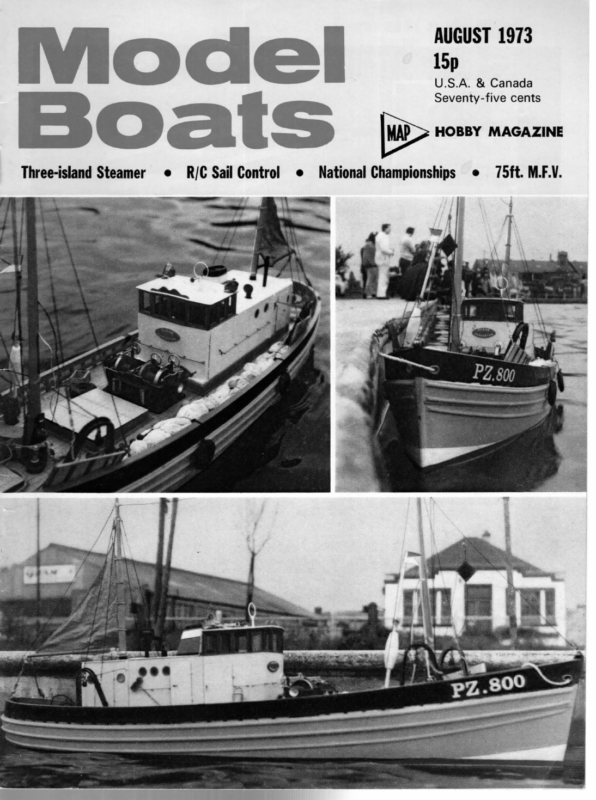
odel Three-island Steamer e R/C Sail Control e AUGUST 1973 =: U.S.A. & Canada Seventy-five cents National Championships e¢ 75ft. M.F.V.
MODEL BOATS TOP VIEW PILE MOTOR SE ir BRONZE different approach CO . TTEOTTTTTTTTETT TTT TTT ae avoids corrosion- — WINCH DRUM. Pr. ) SUITABLE SUPPORT NORMALLY OPEN a MICRO SWiTcA NORMALLY CLOSED Another BLOCK ‘ / This neat and THREADED BRASS ROD ie ITCHES JEFF vi TOC prone wipers. ROD – ei ae! Bet C. |. Redhill SLO 7 Za of the LUG OF PLATE MICRO SWITCHESE LOCK. SLIDING BASES=s LJ Hoe jie East Rand M.B.C., South Africa. eeta (NOT DRAWN TOSCALE) — GUIDE RAIL. Proportional Sail Winth so:2/c yecrs I HAVE been reading with great interest the various, articles published by you recently on sail winches and was most taken with the proportional winch described in your March issue by T. B. Rose; in fact I had already spent some hours on my version of it when our club Chairman Bill Reynolds told me to ‘hold it’ as it was, in his opinion, capable of being greatly simplified. His objection to the winch was the ‘wiper-arm’ contacts which could possibly give trouble, so that after giving considerable thought to the problem he eventually uttered the proverbial ‘Eureka’ and passed over several sheets of hieroglyphics which resolved themselves into something like the sketch. The idea is simplicity itself. Two micro-switches (I use Burgess 19A) are attached side by side to a plate to the underside of which two }” I.D. brass pipes are soldered parallel to each other.“This is then motnted on two 4” rods so that it is able to slide along them when operated by the servo. A winch drum of suitable diameter is attached at one end to a motor, in this instance a Monoperm Special super pile motor 90:1, and at its other end to a }” threaded brass rod (BSW) approximately 34” long. On the rod is a drilled and threaded block, slotted on its underside so that it is able to travel on a guide rail when the motor is turning. The width of the block depends upon the distance which the micro-switch buttons are apart, and should be a shade less than the distance between the centres of the buttons. ONE MAN’S MODELS (from preceding page) quite easy to compress this spring and remove the coupling shaft. The two propellers are 2 in. in dia. When one has boats like these, especially the one with the water cooled engine, a pool in the garden is very useful for testing. A simple one is illustrated, made of wood about 7 ft. long by 6 in. deep and 2 ft. wide covered with a plastic sheet. I have four electric boats and different props can be tried on them by hooking a spring balance on the stern and an amp. meter in circuit. The prop that 320 The distance between the buttons must not be less than the operative travel of the sliding base. The wiring is so arranged that when the servo moves the sliding micro-switches, the block, now making contact with one or other of the switches, starts the motor and the rotation of the motor, winch drum and threaded rod is such that the block is moved in the direction of the other switch button. Rotation will obviously stop when the neutral position between buttons is reached. My servo is attached immediately below the lug of the plate so that the movement of the plate is 0.375” (2”) from full left to full right. Using }” threaded brass rod (BSW) means 20 threads per inch so that 0.375” travel is 7+ turns of the drum (0 375 x 20). It is therefore quite simple to determine from this the required drum diameter, knowing the length of sheeting to be let out. For example if 9” of sheeting is to be let out over 74 turns, the calculation would be:— circumference x 74 = 9” or mx diameter x 74 = 9” or + KVR Therefore = 19% 9 Yi 3.1439 x7.5 = 0.382 in. The wiring of the motor and switches is as the second sketch, and the whole unit works beautifully. gives the greatest thrust for the lowest current consumption can be found. I have had a great deal of pleasure in making and running these boats and all six of them are radio controlled. The weight of the two large ones is now something of a problem. The cruiser is 22 lbs. weight and I am not as young as I used to be, to lift them in and out of the water. The photographs give a good idea of the boats and if any reader requires any further information a letter c/o the Editor will receive prompt attention.
AUGUST 1973 TANK TESTS OF MODEL YACHT HULLS by Graham Bantock Lt year use of the towing tank at Southampton University was made available to me as a Ship Science student and, thanks to the generosity of Roger Stollery and Peter Shaw, I was able to run resistance tests on Clockwork Orange and Scorchy, a well-made example of John Lewis’ Red Herring design. Most model yachts- men will recognise Red Herring as being a now outdated 10 Rater design but more important is its distinct dimensional similarity with the ‘A’ boat. The tests were done some time before all the controversy concerning CWO and the A class blew up, and the idea was to see whether there was some real worth in the design or any distinct differences in resistance values as one might be led to expect from the vastly different hull forms. Red Herring at 34.4 Ib. and 55-inch L.W.L., com- pared with CWO at 36.5 lb. and 55-inch L.W.L. and same draught and beam, provided an excellent com- parison, and it even looks like a yacht! Red Herring Displacement Y (Displaced volume) V 2/3 L(L.W.L.) V/ Lf (L.W.L. in feet) A (Wetted area) Cp (Canoe body) T B_ oe r cy he ‘ eet dar 7 res Tear ealen) ks Lil 1565″ > Ke 0.01565 M3 0.0625 M2 1.40 2.14 0.507 0.518 M Ft4 M2 Clockwork Orange 16.6 Kg 0.0166 M3 0.065 M2 140 2.14 0.545 0.575 M Ftt M2 Hull depth Waterline beam Vk Boat speed in knots “1-1 VV Boat speed in Metres/Sec. ig Acceleration due to gravity in Metres/sec2 P_ Density of Water in Kg/M3 Cf Skin friction coefficient In order to study the wavemaking aspect of the hull forms it is assumed that the total measured resistance, RT, is equal to the sum of the skin frictional resistance, RF, and the wavemaking resistance, RW. In reality it is a more complex problem than this but the assumption holds well. The skin friction was calculated using the formula st rE LAV?2 Cf where Cf is the skin friction coefficient which is a variable || eo ee depending on the speed and length of the hull. Clearly, if RF is calculated for the speeds at which the ~) tests were run, RW may be found by deducting RF from RT. The value of RW in grams has little significance but a useful coefficient of wavemaking resistance, CW, may be found from the following relationship. 2/3V2 RW =2.¥23V2CW The value of CW for both boats is plotted against VK//Lf in Fig. 1. This is because two geometrically similar hulls of different lengths produce the same wave pattern, and have the same CW, when VK/1/Lf is the same for both boats. Both the bow and the stern of a boat produce waves when in motion and it is when the crests of a bow wave coincide with the crests of the stern waves that an increase of CW occurs. On the other hand, when the crests of the bow waves coincide with the troughs of the stern – waves a drop of CW occurs. Bearing this in mind and knowing that the effective wavemaking length of the hull 325
MODEL BOATS can be found experimentally, it is possible to find an optimum Prismatic Coefficient(1), Cp, for any given VK/+/Lf, where Cp is the displaced volume of the canoe body divided by the product of the LWL and the maximum section area(2). Cp P = V (Canoe body) LWL x Max. Sect. Area (Fig. 2) Most model and full-size yacht hulls have values of Cp between 0.52 and 0.56. However, for CWO with its very full bustle stern Cp is 0.575. The main idea behind increasing Cp is to push the displacement towards the ends of the hull and in this way increase the boat’s suitability for higher speeds, by effectively increasing the wavemaking length of the hull. There is a catch of course, which is that CW is increased around VK/1/Lf =I for CWO, whereas Red Herring with a Cp of 0.518 is better suited for this speed and hence its wavemaking characteristics are superior to CWO around this speed. The Red Herring had the laminar flow fin it was de signed with, but if this is replaced with a fin and bulb the stability of the boat with a wing mast rig is only 4% less than that of CWO at 20° heel, the angle at which the heeled runs were made. The difference in resistance with this keel configuration would probably be insignificant and, in fact, the wetted area could be reduced by 10 sq. in. and still retain the same fin area/per sail area ratio as CWO, a necessary criterion if the boat is not to make more leeway and increase the induced drag of the keel. By increasing the freeboard of Red Herring in order to conform to the rules it can have 1008 sq. in. of measured sail which with the 400-500 or so sq. in. of free area, allows it to carry the same rig as CWO and hence produce the same drive in light winds and onlya little less up to 30° heel. In stronger winds, when it would be necessary to change down, the lesser stability of Red Herring might lower the drive by something less than 4%. Partly because of the bustle CWO suffers from extra wetted area and as a result of this, Red Herring should prove 3% faster in light and ghosting conditions when wave drag is minimal. (Fig. 3.) — if Unfortunately, it is impossible to test effect of realistic Dear Sir, | have been concerned to read comments in the model Press regarding possible changes to the International A Class rules. It is natural that the motives behind as yet unspecified changes and their effect on the class be queried, and at times emotions can run ahead of the true situation. It is understandable when Roger Stollery proved that Clockwork Orange was a fully competitive yacht that there would be a number of people who feel that the type does not represent their image of what an A class yacht should be. | have talked at length with a considerable number of A class enthusiasts in England and abroad and with one or two exceptions they do not seek to inhibit development of design in the A class. In February there was a formal meeting of the IMYRU Rules Committee which, for the occasion, was enlarged to enable a broad range of views to be expressed. This Committee was the most Internationallyrepresentative gathering for the purpose that has been held for many years. The A class rules were discussed in detail and | did my best to ensure that the motives behind either asking for, or resisting change were disclosed. As a result,a proposal is being put to the IMYRU Annual General Meeting, this summer, for consideration. In my view it would be unwise of the waves on the models and it is more likely that any rea difference in performance, apart from that caused by the skipper, is likely to be from just this effect. When the boat speed is 2 knots plus, wind-blown waves on ponds become apparent and here the curves of RW and CW are more of theoretical than practical value. From the values of resistance obtained, and bearing in mind that when sailing to windward a significant proportion of the total drag is provided by the induced drag of the keel and rudder and the wind resistance of the hull and rigging, there appears to be very little difference between these boats in spite of ten years or so between their formulation and their distinctly different hull forms. In conclusion, the curves of resistance suggest that Red Herring would be 2-3 % faster in light winds on all courses and by a similar amount downwind up to 1.3 M/S (about 24 knots) after which there would be little difference. To windward CWO would begin to prove superior above 1 M/S or 2 knots, due to its better stability and also because its resistance decreases on heeling, whereas Red Herring’s resistance increases. It would perhaps have been a better idea to run tests on a heavyweight or midweight ‘A’ class as a comparison to CWO, but because of the vast differences in stability, which cannot easily be equated with the drive produced by the sails, it would have been difficult to arrive at any conclusions. It is one up for the ‘A’ class rule as it stands that a Red Herring measured to the rule would perform sufficiently well to be competitive, especially as it was not even designed to the rule, and had CWO been designed 10 years ago it probably would have made a good 10 Rater. It is obvious that whoever devised ‘the ‘A’ class rule knew what he was doing; and it is more than just good fortune and luck that it works, but based on the factors which control or limit the performance of a boat. Before there are any radical changes in the rules, whether resulting from Roger Stollery’s experiments or not, may I make a plea for a truce to enable any amendments to the rule to be a well thought out and engineered as the basic rule itself. IMYRU to ratify the changes without first referring back to the member nations the nature of the proposals, together with a complete explanation of the reasoning behind them. The approval of the proposal, with possible amendments, should be deferred until 1974. Comments about action behind locked doors is stuff to stir the emotions but the procedural mechanisms of our organisation must be allowed to function. Open debate is good, but let the committees get on with their work and the debates be based on fact, not on conjecture. | am confident that proper decisions will be taken and that the proposed changes will not be as inhibiting to development as many people fear. It is my desire to see Model Yachting again lead the world of yacht design. We have status in the yachting world because of our past ability to demonstrate technical advance and this is something we must maintain. To those who wish to retain a static image in any particular class, let me advise them to look at the full-size yachts and see how they have changed in recent years. The rigs are different, flush decks are in, tumblehome is increasing and the underwater hull shape is quite different. It is only a small step to turtle decks and wing masts on boats whose crews only see the light of day before and after the race. Fifteen years 326 ago | designed a 40-ft., turtle-decked ocean racer and this was not unique even then. As new materials and techniques are developed, changes in appearance must happen and it would be a sad commentary if our model racing yachts were seen only as imitations of a past age. With the International rules coming under pressure, it is important we retain our democratic procedures to bring about modifications as necessary. These procedures are going to be severely tested during the next year or two, and themselves may show need for alteration. We must guard against difficulty compounding difficulty and over-strong feeling in any One sector, combined with impatience, could lead to chaos. | make a strong plea for tolerance of another person’s point of view. The MYA must act in its most responsible manner and whilst continuing to look after the interests of model yachting in Great Britain, must accept a major role in contributing to the success of International Model Yachting. The views of all nations involved, no matter how small, must be respected and considered. Let us have no situation, for example, where a rule change may be agreed for application in MYA events alone, in the absence of International agreement. President, M.Y.A. J. A. Lewis
AUGUST —————— =. A NUMBER of captured Spanish line-of-battle ships SPANISH were brought into the Royal Navy, though this was a more frequent occurrence in the frigate classes. These battleships included the Salvador del Mundo (112), the San Nicolas (80), the San Ysidro (80), the San Damaso (74) and the San Josef (112). The San Nicolas was 1942 tuns, builders measurement, and was 180 feet long and 49} feet wide. She was captured at Cape St. Vincent in February 1797, served as a prison ship in 1800, and was sold out of the service in 1814. The San Ysidro and the San Damaso had a similar history but the San Josef, on which the present drawing is based, served in the Royal Navy for a much longer period. She became a gunnery training ship in 1837 and was eventually broken up at Devonport in 1849 (Colledge, 1969). This ship was 2,457 tuns by builders measurement and was 195 feet long and 54 feet wide. Brenton ( 1823) stated that the ‘“San Josef was long admired in the British navy, uniting all the superior qualities of a ship of the line, with the sailing of the fastest frigate: her lower-deck ports were higher out of the water with all her sea stores in, than was ever known in any other ship of the line; and she could carry her guns run-out, when few British ships would have ventured to open a port. It was supposed, that by removing her foremast aft, she would have been im- Readers Write… HEADACHES Dear Sir, There are two items in the June edition of Model Boats on which | should like to comment. First, in ‘Round the Regattas’ it is said that the Midland District 10R Championship venue had to be hastily changed ‘due to a last minute change by the power boat club who share the lake’. . . . This is not true. The yachtsmen have the lake on Saturdays and the North Birmingham M.P.B.C. have it on Sundays. The yachtsmen have several regattas during the year that occupy two or three consecutive days and for this purpose my Club lets them have five or six Sundays. In return, we have some Saturdays for practice or putting out courses, particularly for Records Day and to get the water level lowered. In this case the yachtsmen had made their arrangements before my Club’s agreement had been obtained — or sought. | hope, that this year, we shall have better liaison because | am sure that neither club wishes to get in the other’s way when arranging regattas. The other item is Philip Connolly’s report of the Midland Area 3icc multi-boat Championship. In it he criticises the rules under which the event was run on the grounds of lack of simplicity, that luck played too large a part since all five races counted and that the method of scoring, which gave points for places according to the number of entrants in each race, was awkward. | agree with Philip that the rules were not wholly satisfactory, although | have different reasons for thinking so but, using them, the championship was decided and | doubt if anyone would quarrel with the result, even though it might have been a different one under different rules. The ‘certain amount of trouble’ in determining the positions was, | think, due more to the extremely unpleasant conditions of weather in which the officials had been working all THREE-DECKER, 1797 Drawn by P. E. King proved in sailing and working; but when this alteration was effected, it was discovered that those good qualities, far from being improved, were much deteriorated”. According to this writer she was found to be rotten by 1823 and was laid up in ordinary. Spanish ships of this period had a more pronounced tumblehome than either French or British ships. The shape of the bow was also characteristic, being more regularly curved upwards from the keel, Information regarding rigging is hard to come by, but old prints suggest that the proportions of the spars were nearer to the French manner than to the British. The colour of the sides of the ships varied, but a frequent combination was strakes of red along the gun ports with bands of black between them. 1 some ships the red strakes were edged with thin white ines, day, than to anything nherent in the rules. ff The Coventry Club lads who were officiating | (for the first time in any event, | believe)| stuck it well and organised matters very, |! creditably. I f The first thing to say about these rules is } that they were argued over and agreed at an open meeting attended by 24 Midland Area members. They were for a completely, new competition — an individual champion-)’ ship to replace the former inter-club event. q If we have produced a camel then it is not . surprising since that is what committees if traditionally do! \\ Although simplicity in rules is a desirable a aim | would not rate it above fairness even | though the latter is impossible to achieve in | of an equal number of races we had a tall, order. | would say that it is impossible to fulfil all these conditions. There was a lengthy discussion on the duration of the event (laps or time) and on the manner of scoring to determine the champion (points per place or total laps or most laps in one race). Opinion divided sharply on both items. Eventually, it was decided to have 10-lap races, all to count, with the best time to be used in case of a tie and the points system described by Philip. On the day there were only 17 entrants and the programme provided five races each. There were three 6-boat, eight 5-boat -and four 4-boat races. The result table reads: 1st 2nd 3rd 4th 5th Total Best Time 1st Philip Connolly 5+5+5 5+4 24 4m 39s 2nd Brian Pulham 6+6 44+4+4 24 5m 30s 3rd_ Fred Goff 4+4 3 4 2 7 4m 28s 4th Len Wilson 6 4+4 2 1 7 4m 56s 7th lan Smith 5+5+5 15 4m 19s 8th John Benfold 5+4 4 2 15 4m 56s Four others each won one race. 5th and 6th did not win a race. absolute terms and in all circumstances. Certainly, the meeting was more concerned with producing a set of rules that would fairly cover all foreseeable situations than with simplicity. The members were opposed to pre-entry because they were afraid of the refusal of certain entries if there were too many on the same colour. They were oppos- ed to the use of pace boats (dubbed ‘fun runs’ by one member) on the grounds that one of these might knock out a scoring boat and, more importantly, because there could be no guarantee that enough boats could be found on the right frequencies to make up and maintain to the end a programme of six-boat races. But members were clearly of the opinion that it is easier to win a race with (say) four boats in it, than with six. So we were left to devise a system that would give the least inequitable result for an event with an unknown number of entrants, with an unknown frequency spread and, therefore, an unknown number of races. Since members also wanted as many races as possible, each with the same number of boats and everyone to have the opportunity 333 1973 (Total Laps) 40.3 43.4 37.9 29.9 29.1 33.5 Speaking personally, the faults with the rules seemed to be that some points were too easily won because: A, the winner re- ceived the points appropriate to the number of entrants and commonly not all the boats got started, e.g. in the first race the winner got six points but only two boats actually started; B, the rule under which the race ended and the positions counted if all entrants had stopped (or failed to start) before the 10 laps were completed, e.g. in the 3rd race the winner got five points for 1.3 laps; and C, it is theoretically possible for the champion to be someone who has not won a single race. | am not bothered whether all races count or only the best three or four, but | am strongly of the opinion that the championship should be decided.on races won. No doubt there will be more argument at the next Area meeting but | would venture that whatever rules are used will suit some and cause dissatisfaction to others. Fred Goff Hon. Sec., North B’ham M.P.B.C., Hon. Sec., Midland Area M.P.B.A.
MODEL GOSLING Part 4 of this extremely popular yacht, which fits the 36 in. Restricted class, yet is easy and cheap to build. BY VIC SMEED so 1} Ibs. would be a reasonable maximum, unless a few ounces are taken off the lead. The fin top between B3 and B4 can be cut away to FULL-SIZE DETAILED INGS ARE ABLE, FULLY DRAWAVAIL- MM1164, PRICE 65p_ INCLUSIVE, FROM MODEL MAKER PLANS SER- STEAD, HERTS SEE. HP1 This is how’ you need your sails — note the similarity of curve and twist, obtained by adjustment of the boom kicking straps. Bowsies. Our knuckles have been rapped for a slip on the drawing; there is something of a conventional way of showing a bowsie in a drawing so that it is obvious what it is, but doesn’t perhaps interfere with other detail. It means drawing it wrongly threaded, but since we were showing a correctly-threaded one elsewhere, we followed convention. And what did we do? To put the record straight this is how bowsies should be threaded to give the required grip: FLAT ROUND ag Vane Steering. The original model is fitted with a small breakback vane of the Lance type which was commercially available some years ago (no longer) and perhaps the nearest to this is the reasonably simple vane drawn on page 48 of our book Boat Modelling (try your public library). The ultra-simple non-self-tacking vane in our July 1972 issue would be suitable for non-competitive sailing, or the even simpler two-gearwheel system shown in Plans Handbook No. 2 could be used. The smallest vane gear to our knowledge commercially available is for a Marblehead and this is really a bit too heavy. Radio. As mentioned, single-channel, rudder-only radio will provide many pleasant hours of sailing and light, two-function equipment could be installed: One pound weight will sink the hull just over 4 in. deeper in the water 336 accommodate a single food box (of the airtight lid variety) and this is obviously better done before fitting the fin. However, two smaller boxes mounted each side could be used, provided their contents are reasonably balanced. A further method would be to sink a box through the deck, having cut a slot so that the fin projects into the box; it can be sealed with silicone ‘bathtub caulk’, available at hardware shops. It does not seem worth using an under-deck tiller and push-rod on a model this size, so the rudder servo can be mounted on the box lid, using a ply panel to stiffen the lid over the mounting area; the lid should be of the softish type of plastic which ensures a good seal over the bead of the box edge. Disposition of the other contents of the box should have regard to the balance point of the model, though since the box is near enough over the C.G. this is not too critical. Several lightweight sail winch ideas have been published in recent issues, to which the attention of those wanting sail control is directed. Bear in mind that the lighter the R/C installation is, the better the boat will be, and keep water away from not only the equipment, but all wiring joints, etc. Tuning. Individual boats can vary by unexpected margins and the fact that we were lucky in that the prototype required no basic alterations, does not necessarily mean that any boat built to the drawing will automatically be the same. Differences in weight or sail cut, etc., could mean as much as # in. difference in mast position. However, the prototype set-up is a reasonable place to start and here the foreside of the mast heel is 144 in. from the extreme bow and the foreside at the mast top, at the extreme tip, measures 533 in. from the tip of the bow. This gives an approximate check on mast rake. One advantage of this boat is that with working rig it can be slipped fully rigged into the back of any but a small car, so that no time is lost in rigging up at the pondside. If taken to the water derigged, it only takes three or four minutes to step the mast and bend on the sails, at least once you’ve had a little practice. For tuning, you may like to use brass split-pins to position the mast and jib fitting, which enables quick adjustment to be made, rather than fiddling with a couple of 8BA nuts and bolts. A steady 5-6 m.p.h. breeze is ideal and you need to be on the leeward (downwind) bank of the lake. Check that the mast is straight, that it is vertical when looked at from ahead or astern, that the jibstay is taut and that the sail luffs (fore edges) are hauled up reasonably hard, but not so hard as to stretch them. Slide the main bowsie forward so that the sails make an angle of about 15 degrees to the centre line and check that both booms are at the same angle. Hold the boat level at about 30 or so degrees to the wind, or have someone else hold her, and check when the sails are filled that the leaches (after edges) both form similar curves. Adjust the kicking straps until they do. The amount of flow in the sails, that is the depth of curve in the foot, should be nearly maxi-
AUGUST mum in this amount of breeze; you should be able to push the centre of the mainsail foot gently to one side a distance of about three inches from the boom centre-line and a proportionate amount for the jib. Before putting the boat in the water, remove the vane feather (if fitted) and push a piece of expanded polystyrene under the tiller to lock the rudder central. If radio is fitted the servo will hold the rudder amidships; operating the radio should be avoided as it will confuse you although, of course, if you cannot get all round your pond, after a test run the R/C can be used to retrieve the model. Check that the boat floats level in the water and try the effect of an ounce of ballast taped on the bow or stern. Now you can set the boat off on its first test, releasing it at about 45 deg. to the wind. What we are trying to do is to find a mast position with which, without use of the rudder, the boat will slowly work into the wind until the sails cease to drive. The boat should then fall off (turn away from the wind) and as the sails fill again, sail forward once more in a very gentle curve until it again loses its drive and repeats the process. This is the condition in which the boat will sail at its most efficient when the vane is working. For radio, the mast should be moved forward one hole (4 in.) once the above position has been found. The boat will now sail efficiently on the wind, but will tack without delay when the rudder is applied. What happens if we do not get this series of crescents on the early tests? Well, the model will either persistently turn into wind and sometimes through it on to the other tack, or it will bear off in a curve, away from the wind In Readers Write… MULTI ORGANISATION Dear Sir, | would like to add a few comments and support Mr. |. Boyle’s letter in ‘Readers Write’, July 1973. A number of times this season competitors have travelled long distances only to find that a steering or speed event has taken up most of the time allocated for a two-event regatta and that the multi heats have been Cut to a very short duration in order to finish the event fairly early. It would be a lot easier on the competitor who travels long distances, if the regatta organisers could give some indication as to the intended duration of the multi heats. If the heats are to be, say, of six minutes’ duration one could make up one’s mind whether or not to travel so far for such a short time on the water. Some regattas have been run with each competitor getting two short duration heats in each class, | feel sure that most multi racers would prefer one 20-minute rather than two 10-minute ones. If one is able to run a boat in each class at one of these short heat events, it can mean five changes of radio equipment and, although this is not a major task, organisers are usually kept waiting at the start of a heat for someone, plus the fact that whilst changing equipment one is usually missing some good racing in another heat in progress. Organisation at multi events is now becoming very complicated; the number of competitors has doubled since last season. With the number of model boaters increasing it is going to be very difficult to please everyone. the first case, we move the mast forward one step at a time until the desired result is achieved; in the second case, bearing off the wind, we move the mast aft. The reasons for this are fairly self-evident, but were discussed in slightly more detail in the September 1972 issue. Experiment with the boat to note if there are differences on either tack or with the sheets slightly eased or hardened in before unlocking the tiller. Patience while tuning will pay off in better performance on every subsequent outing. Check the sails for stretch and adjust as necessary periodically during the first few hours of use. Once satisfied, with the vane feather replaced or the radio in action, experiment with sheeting to find how hard you can sheet in for beating and the correct sail positions for reaching (across wind) and running (downwind). If you are sailing on your own, mentally fix a mark on the bank and practise trimming the model so that it sails to the mark or, in a steady wind, time the model on various courses and note the difference in times with different trims. The only real way of knowing if you are getting the best possible trims is to race — don’t be hesitant in approaching your nearest club, who will welcome you. If there is no convenient club, it is well worth making the effort of travelling to one, since you will learn more in an afternoon at a club than in six months of sailing on your own. The best way is to sail as mate to an experienced skipper and then apply what you have learned to your own boat; the main snag is that this is a sure way to get bitten by the sailing bug which, when it bites, bites hard! Next month, in conclusion, how to make a spinnaker. Your comment in the ‘Tideway’ regarding speed events, was quite interesting. Some of the boats being raced this season would, | am sure, turn in some fast times on the ‘Triangle’, but it lacks the excitement of six of these boats being raced in a multi heat. The time has surely come for an organising body to draw up a set of rules for multi race events; this would help in the organisation of regattas. An ‘index of performance’, etc., as proposed by Mr. J. Stidwill in his letter to ‘Readers Write’, July 1972, would also help. John did, in fact, state that then any heat under 20 minutes’ duration should not count. To conclude, it all comes down to Organisation. At a recent ‘Cygnets’ open regatta there were 108 competitors. The organisers ran steering and multi with 15minute heats; the regatta started at 11 a.m. and finished at 6.30 p.m., and everyone was satisfied with their time on the water. Trevor Skinner Wood Green SPEED FALL OFF Dear Sir, My overall impression of the R/C speed scene so far this year has been very disappointing. The attendance at both ‘straight’ fuel meetings — at Southampton on 6th May and the Speed Eliminators at Maidstone — was very low, in fact my friend Sam Grasse and myself were the only representatives for the |.C. speed classes at Southampton. It seems as if most of the ‘experts’ are shying away from the new rules — believing that good times are not possible with a quiet engine running on ‘straight’ fuel. THIS 1S JUST NOT SO, as my experiences so far have shown me. On 22nd April, at Mayesbrook, | did the fastest time of the day in the FI-V15 speed class, around the standard Naviga course, in 20.4 seconds using 4:1 337 1973 fuel. This is not exceptional, except that | was using an H.P.40 engine and a radio control set which was merrily glitching away, due to what | later discovered was salt water left in the receiver from Brighton the previous week-end, where my boat nearly sank! Then, on 6th May, at Southampton, | was the first person in Britain to officially ‘tank up’ with 3:1 straight fuel, with my plainbearing, much tweaked OS Max-S30 R/C engine, to turn an official time (three stop watches) of 22.0 seconds. Later on in the day | unofficially timed Sam Grasse around the same course with a Rossi 60, in 19.2 seconds (4:1 fuel this time). Two weeks later, on a very rough Mote Park lake at the Speed Eliminators, again with the OS 30 engine but this time with an extra silencer on the end of the tuned pipe to reduce the noise to a quiet hum — 70 DBs or so, | recorded a time of around the 25 seconds mark, while Sam did a 21 seconds time, again near 80 DBs. That day | also saw several other fast boats on straight fuel, so we are not the only people to be moderately successful. At both regattas, the fuel supplied was first class stuff, so the various people who were moaning about the possibility of ‘bad’ fuel have nothing to worry about. The actual method used for obtaining these results were the same as those for the old rules — trial, error, meditate, more trial and more error, the only thing one has to do different is to alter the engine to make it sing, not shove in nitromethane (compression ratio raising is the best method). One last thought — do not try the nitro fiddle — Mr. J. Cundell is on the war-path, with several bottles of chemicals sensitive enough to detect even 1% nitro! More bravery, you speed fiends! Mark Law (Written immediately before the Speed Finals. — Ed.)
MODEL BOATS 1973 36 in. Restricted Championships and the O.0.D. called a halt because people would want Reported by 14-year-old Tom Armour Gi era year the Leeds and Bradford MRYC were the hosts for the 1973 36R National Championship. 14 boats entered, one from Birkenhead, two from Southgate, three each from Clapham, Cleethorpes and Bournville; disappointingly only two boats were entered by the host club. The day was nice and sunny but unfortunately the wind was west and coming through the factories, splitting up around the pond. Described by various skippers as “a bit tricky”, “‘terrible’’, diabolical” etc. After everyone had rigged up and had a practice and a cup of tea, the O.0.D. Mr. H. Atkinson called up the Skippers and Mates. The race started at 10.30 and immediately the wind began to cause problems, it came in gusts and many skippers found their boats screwing up on to the factory bank and into a dead patch. By dinner three heats had been completed and the score sheet read Ariel 15 pts., Puddle Thumper 13 pts., Pink Panther 10 pts. The westerly wind stayed and racing resumed as normal after dinner. The weather was now perfect with plenty of sun. Mickey, still a good old boat, began to pick points up, and Ariel was going extremely well again, gaining 20 pts. in a row. The most interesting and amusing race happened on the beat between Ariel and Curlew; twice Curlew came within inches of the line, with Arie/ helpless down the lake, but turned back on both occasions. In the end Ariel got some wind, turned round and sped up the lake and over the line. Everyone (except Sid Cook!!) was very amused. The O.0.D. called a tea break after 7 heats, the position now being Ariel 30, Pink Panther 23, Puddle Thumper 23, Mickey, Missphit and Markswun all with 19 pts. The next round changed things. Mickey beat Ariel both ways, and Pink Panther lost to Sparky. This made the race even more exciting, and with the wind as it was anything could happen. Ariel, which was sailed beautifully, won the last five pts. and deservedly won the National. Nine heats had been taken, it was fairly late M.S. COLUMBIALAND to get home. Markswun could make second if he won both his resails, one against his dad and one against Curlew. This Chris Dicks did and gained second place after a faltering start. Puddle Thumper kept his position throughout most of the race and sailed well to come third. Ariel was the oldest boat there; it is also the Northern District champion! Considering the awful wind Walter Jones and his mate Bill Poole sailed with much skill and deserved to win. Markswun is an unusual double ended hard chine boat, using Permatrace sails. Mickey (nicknamed the Ark) is about 40 years old but is still capable of beating any other boat. Mickey Finn is built beauti- fully from a glass fibre mould from Mickey, sports a bulb keel and can carry very large sails. Humbug is from a mould off Curlew. Made by my dad, and can go well (at times). Pink Panther is a scaled down March Hare with a large fin and is a very gay boat. Hard Lines is Derek Priestley’s new boat, made by Dave Knowles and sailed by him because Derek didn’t arrive due to his car break- ing down (hard lines?) Missphit is a beautifully made mini-Witchcraft. Sparky is a J. Gilmore own design and went consistently throughout the race. Piglet, a Puddle Thumper design, after sailing so well in the N.D.C. never really got going in the tiresome wind. Shooting Star, a very interesting and unusual boat, and Green Ginger, a hard chine one, also found the curly conditions not to their liking. After the prize giving the O.0.D. wished all the visitors a safe journey home and thanked the canteen ladies. A vote of thanks was made to the hard worked O.0.D. and to the officials and club for making the race possible and a lot of fun. Reg. No. 234 1084 1069 372 Position 1 2 3 4 1089 1081 1077 1092 5 6 7 8 1085 1079 1087 535 1093 10 11__— 12 13. 14 1044 8 Name Skipper Ariel Markswun Puddle Thumper Mickey W. Jones C. Dicks H. Briggs G. Danks Pts. 35 31 28 26 Mickey Finn Hum Bug Pink Panther Hard Lines A. Sinar K. Armour I. Taylor D. Knowles 25 24 23 22 Sparky Piglet Shooting Star Curlew Green Ginger J. Gilmour G. Griffin G. Daniels S. Cook G. Taylor 20 17 16 15 11 Missphit W. Dicks 22 Club Birkenhead Clapham Cleethorpes Bournville Bournville Leeds & Brad. Southgate Bournville Clapham Clapham Cleethorpes Southgate Leeds & Brad. Cleethorpes timber to Europe and few of the older and smaller con- ventional ships can now find work in this trade. The use Another ‘simplified’ 100 ft.-1 in. miniature by R. Carpenter Ree carriers are now in service carrying cargoes of over 150,000 tons. They normally work on longterm charter between ports with shore handling equipment and as often as not have been specifically designed for work between specific ports. The bulk of the trade is therefore still carried by much smaller ships, but even such vessels as the Columbialand, which can carry up to 25,000 tons of cargo have certain restrictions in service. The Columbialand has been designed to carry bulk cargoes such as coal, grain and ores, but in addition she has been fitted to carry packaged timber in bulk. Because timber is not a particularly heavy cargo and because it provides buoyancy within the ship it is possible to stack timber on deck up to a height of about 15 ft. In order to reduce obstructions and to preserve paying deck space the cranes have been mounted high on pillars. Ships such as the Columbialand regularly bring British Columbian 338 of bigger ships has necessitated considerable reorganisation in the timber industry and special quays have been built to receive the enormous tonnages which one ship can discharge in a short space of time. In British Columbia the ships no longer follow the practice of visiting several ports to load parcels of timber; the timber is brought to a receiving port which has the depth of water needed to accommodate the ocean carrier. The Columbialand is operated by Scanscot Freighters, a consortium of the Brostré6m Group, of which A/B August Leffler is a member, Thorerederierna, A/S Haanes Rederi and a member of the J. and J. Denholm Group of Glasgow. The Columbialand has a speed of 154 knots and is powered by a 11,400 bhp Gotaverken diesel. The main engine is controlled from the bridge and the engine room can be left unattended periodically. Each of the Higg- lund hydraulically-operated deck cranes can lift 10-12 tons and the hydraulic derrick on the forecastle has a capacity of 8 tons. Turning devices on the cranes make it possible to handle packaged timber without the use of guy ropes.
i laps. 6.6cc Up: Ist, G. Beadman (Leeds), 45 laps; 2nd, P. Kirk (Manchester), 41 laps. Junior Prize: I. Hole (S.S.M.S.), 38 laps. Class B, 16 years. Index of performance, P. Lockwood (S.S.M.S.). Southend Silver Jubilee — 17th June Southchurch Park attracted 67 boats, 40 of which were free runners and 27 tethered models from seven clubs. Top speeds and prize winners were: 30cc Hydroplane — John Benson (Blackheath), 54 mph. 10cc Hydroplane — Arthur Wall (N. Birmingham), 87 mph. Scc Hydroplane —Ted Blacknell (Welwyn), 55 mph. 2.5cc (airscrew) Hydroplane — P. Hough (Welwyn), 89 mph. Steering Class — Ist, Mr. Broad (Victoria), 15 points; 2nd, L. Mundy; 3rd, J. Free. Nomination — Ist, Len Lara (Victoria), Nil error. Knockout — Ist, A. Willet (Victoria). The Southend Club very specially wishes to thank all who attended their Open Regatta in this, their Silver Anniversary year. They hope to be still welcoming their friends from M.P.B.A. clubs in another 25 years! 10-Rater Championship — 26th-28th May Birmingham Club staged the 1973 10-Rater Championship, the first time it has been held on an inland lake since 1964. The entry was slightly disappointing with only 20 boats, although they covered a good selection of clubs, and with three days to sail it was decided to try to get in two rounds. There was ample time for this with a little co-operation from the wind, but alas a very light and variable wind made progress slow. Skippers waiting to sail were actually changing their trims while waiting their turn and often had to change them again on the water. Only seven heats and re-sails had been completed in the first day’s sailing. However, Radio Birmingham had visited the lake in the afternoon and this resulted in useful publicity. Leaders were X Calibre 29, Krakatoa 28 and Jmshallah, Mr. Rusty and E. L. Wisty (now re-named Red Alert) all on 24. Sunday again saw a light wind but straight down the lake most of the time which, due to the width of the lake, caused difficult sailing and most skippers preferred to sail in a series of gyes along the north bank. With varying winds and closelymatched boats, there was a considerable number of re-sails, making life especially difficult for skippers without mates. By the end of the day it became clear that there was no hope of completing the full two rounds since only one round was finished by Sunday evening. The leaders at this point were Krakatoa 75, Imshallah 73, Mr. Rusty 69 and Sabre moving up from sixth to fourth with 66. ; ) Monday saw the wind still light and variable, dying completely in mid-morning for an hour or so. O.0.D. John Allen decided to sail eight heats and declare a result on this (the statutory two-thirds of the scheduled number of heats), and the racing was very keen with no one willing to yield points, but everyone hoping to pick up one or two extra. Re-sails after the eight heats suffered from the light conditions and even when completed, results had to be worked into a per- centage due to the withdrawal of a boat at the beginning of Top, the winner sailing Plus 10, Centre, a family matter, X Calibre versus Sabre, which placed 4th and 5th respectively; and bottom, Poppet (look at where the -sane is!) against Flicka. Water level was high enough to cool skippers’ toes. Posn. 1 2 3 4 5 6 7 8E 8E 10 11 12 13 14 15 16 17 18 19 20 No. 1838 775 1737 1836 1816 1811 1802 185 1813 1803 1776 1804 1812 1780 1758 1839 1767 1786 1823 1835 Boat Krakatoa Imshallah Mr. Rusty XCalibre Sabre Odanata Poppet Plus 10 Mustang Countdown Avenger Red Alert Overture Mini-Ha-Ha Jondon Flicka Kintaro Snoopy Cowal Lass Joseph Skipper M. Harris C. Dicks R. Stollery K. Armour Mrs. S. Armour R. Seager H. Dovey W. Jones P. Latham D. Knowles E. Carter V. Bellerson C. Colsell H. Godfrey J. Bush D. Copsey J. Curtis K. Underwood J. Gilmour H. Atkinson the second round. Prizes were presented by Ken Jones, and — a pleasant touch — recognition was made to the officials and the canteen ladies. Club (More regattas on pages 331, 338) Bournville Clapham Guildford Leeds Leeds Clapham Bournville Birkenhead Fleetwood Birmingham Y.M.6m.0.A. Bournville 100 98 86 89 85 80 74 AZ 72 71 66 61 Dovercourt 33 30 26 25 WDN Hove & Brighton Guildford Leeds Bournville Nottingham Clapham Leeds 342 52 49 43 Designer & Design Lewis Cracker Dicks Shallah Stollery Lewis Cracker Lewis Cracker Seager H. Dovey Jones Lewis Cracker Dicks Shallah Dicks Shallah Dicks Shallah Stollery Stollery Warlord Lewis Cracker Witty Windwing Witty Clipper Gilmour Lewis Cracker o 76.92 75.38 68.80 68.46 68.00 64.00 56.92 55.38 55.38 54.61 50.77 48.80 41.60 37.69 33.07 26.40 23.07 20.80 20.00