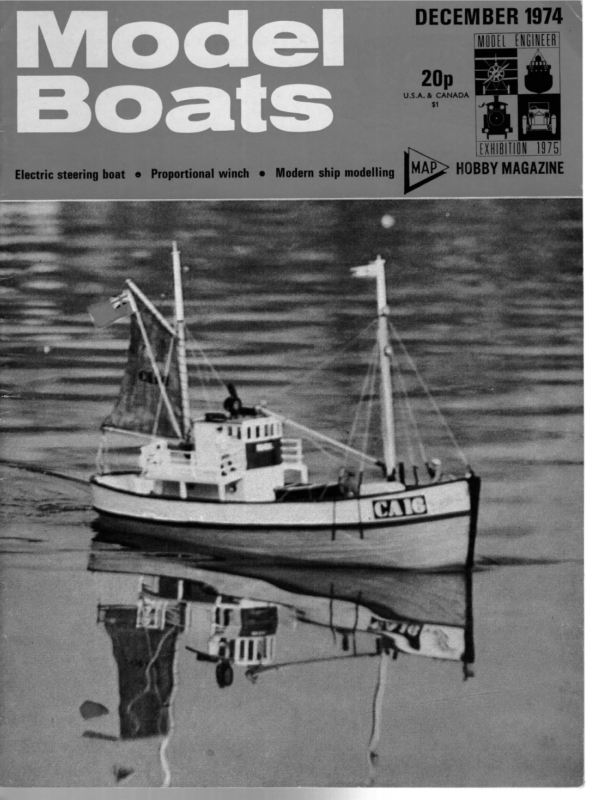
- The MM Class Miniature Racing Yachts Roger Hatfield recounts his experiences with a 20-year old idea
- MODERATION A 54.75in. w.|. 52.5 Ib. ‘A’ Class design by G. K. Collyer
- Round the Regattas

DECEMBER 1974 MOUEL_ ENGINEER 20p U.S.A. & CANADA $1 Electric steering boat © Proportional winch e Modern ship modelling J EXHIBITION 1975 HOBBY MAGAZINE
DECEMBER 1974 The MM Class Te years ago this month, the Editor of this magazine introduced in what was then the Model Maker magazine a small model racing yacht class, the MM class. Its basis was a half-size Marblehead and the rules were to be in general accordance with the M-class but Miniature Racing Yachts scaled accordingly. At that time the Editor thought that novices of all ages needed something smaller than 36 in. on which to start; smaller boats could be built simply, cheaply and quickly and, most important, raced on equal terms. Also they can act as a stepping stone to the larger yachts. The immediate interest produced four designs, two by Vic Smeed, one by D. A. MacDonald and a West Country design by P. G. Dalton. Published designs beyond that period virtually ceased but interest was maintained as can be measured by the number of plans issued and sail numbers allocated. My interests have varied over the years but I wish to relate five years experience with three boats built to the class. The boats were registered as follows:—MM 268 to Drake, MM 284 to Sea Urchin and MM 292 to Hammer, half scale. The Drake design was chosen for simplicity and ease of construction. And so it proved to be. The resulting hull was very light even when skinned with +; in. ply on hardwood inwales and chines. The mast was glass-fibre (ex fishing rod). The rod seemed an ideal solution as it is tapered, but the taper is too great and results in whip at the masthead. As for other detail fittings, I was working very much in the dark apart from the fittings shown on the Vic Smeed designs, and adapting available materials Roger Hatfield recounts his experiences with a 20-year old idea vertical and athwartships on solid balsa frames. Experience of seeing other boats led to improved rigging from that on my first boat. The mast was 4 in. OD alloy tube 20 swg., Terylene dinghy cloth was used for the sails and the foot of each sail was clamped in its boom. A simple vane gear was fitted, as in the Plans Handbook, and synchronous sheeting was also used. This boat proved a steady sailer. Comparison of this early design is interesting. Maximum beam is at 49% length from the bow, max. hull depth at 39% length and, of course, it had a keel of fairly constant cross-section. It looks odd alongside present day designs but its shape prevented the bows from dipping in strong winds and with the long tapering aft section little wake was left. Boat number three used a little more of the experience and knowledge gained. Stan Witty’s Hammer was re- duced to half-size and the weights recalculated to allow for lightweight construction. By using + in. balsa planking on + in. balsa frames and a ¢ in. ply elevation silhouette including fin and skeg and backbone, and strengthening the hull with doped glider fabric, the weight of the hull before painting was only 74 ounces. Using a fabric deck and similar rigging to the previous boat I was able to hang 30 ounces of lead on the fin with an all-up weight of 42 oz. With the large righting moment available I felt confident of balancing 14 square feet of sail on a 424 in. mast and 6 in. booms. Sail aspect ratio is 6.5:1. The model was illustrated on the front cover of Model Boats September 1973 but the angle is deceiving. The boat is magnificent in anything up to a good breeze and accelerates rapidly at the slightest puff of wind. She followed two full-size Marbleheads down the length of Bournville pool, running before a light breeze and lost only ten yards over the distance. Theoretically to suit. Two mistakes were made on this, my first sailing model. I did not have enough ballast on the keel and the shroud plates were not screwed down, relying only on Araldite. These proved my undoing at the MM Regatta held at Hove, Autumn Bank Holiday 1971. The conditions that day were bleak. It drizzled and rained for the major part of the day and the wind made the water extremely choppy for the small boats. During practice in the morning session the Araldite surrendered to the force of the wind at the end of a long, slow but successful beat the full length of the Lagoon. I was too proud of the finish of my boat to perform emergency repairs and withdrew from the actual racing which was held across the width of the Lagoon. The Drake design proved to be a very rugged design and having a wide beam, stable. I have been tempted to build a second possibly with vane steering but to an all-up the gap should have been far greater. Of the three boats only the last is still in my possession and still gives pleasure. weight of 53 ounces. To would-be beginners, possibly ex-aeromodellers, I would suggest a hard-chine boat and balsa construction stiffened with doped tissue. For those frightened of selfsteering Drake can be used as per plan and performance then depends on the accuracy of build. Those desiring a self-steering gear should follow either of the ideas in the The day’s racing did reveal interesting points worth recording for future constructors. (1) Keep the hull watertight. Allow no hatches. Step the mast on the deck or box-in a keel step so that little water is shipped. The skipper then has a chance of his yacht reaching the other side of the pool. One yacht was rescued just before it sank! (2) Model yacht design has taken major strides in the twenty years. The most modern design present, based on Stollery designs, was of lightweight construction owing much to model aircraft techniques. It used also a simple non-tacking vane steering as in Plans Handbook. Other hints include reading this magazine on how other yacht modellers solve rigging problems and, best of all, find other modellers with boats for comparison. What of the future of this class? It is one step up from a toy boat. The size is convenient for handling and transporting. For those people with limited storage room, it takes up little. And it does provide enormous enjoyment. the Plans Handbook. I left the regatta intent on building a second model, preferably round bilge. I chose Water Baby B, but when attempting to fit the gunwales to the frames, they did not take up a graceful curve. Inspection of model and a check of the plans found the fault. (With respects to the metrical!) This disappointment led me away from round Ed’s note. Surprisingly, something over 20,000 plans for these models have been sold since their introduction, but only a few over 300 have bothered to request a sail number. Interest has dwindled as people accept the idea that a 36 in. yacht is not particularly large, and the designs will be considered for deletion in the next Plans Hand- The hull was of +4- in. mahogany, planked with grain (continued opposite ) Editor, the frames on my dye-line print were not symbilges to Sea Urchin. 539 aaa
Ht HO lleri ! (LL! lb Decks were finished with matt polyurethane varnish and look, to me, like scrubbed teak, while the hull received three coats of thinned-out gloss polyurethane varnish above the waterline and Humbrol hull red below. Gloss finishes on working boats may meet with the dis- approval of some but it does help when a 22 in. long vessel is 200 yards away on a crowded pond ona sunny day! Anyhow, I think it looks nice. The only holes for water to penetrate are the point aft of the deckhouse from which the steering rod emerges and the pinhole for the radio aerial, which is probably watertight anyway and is, in addition, on the wheelhouse roof. A ‘scale’ aerial is fitted, as nothing looks worse to my mind than a scale model with a great length of piano wire sticking out of it. I have had no trouble with the MacGregor | + 1 gear fitted, even at ‘out-of-sight’ range. So much for Nigel — I am now engaged on a Clyde puffer to the same scale of # in./1 ft. but built on the bread-and-butter principle using polyurethane foam instead of wood. Unfortunately, the saving in labour — would you believe two hours for the hull, excluding glue drying time? — is somewhat offset by the cost of the lead through the deck, inside the two strongbacks. The sides of the structure go right down to the hull planking and are glued to it, making a very strong job at the turn of the bilge. As the bulkheads have been hacked out since the boat was finished, to accommodate radio gear, this was a good move! The deck is laid in balsa strips, +4 in. thick again, with pve tape between each plank to represent the caulking. The effect is excellent, to my eyes (see pictures) and unlike so many models one sees — even at the ME Exhibition — which have the planks drawn on and the grain of the ply deck showing through. The bridge deck is planked in the same way, on a sub-deck of 0.8 mm. ply. Polyester was poured in again, and the hull inverted to spread it around the underside of the deck — this time, however, none leaked through. In any case, experience has shown that even in rough water, the deck stays dry and any water that does get in comes through the stern tube if it hasn’t been packed properly. In fact, only once has any bilge water been found — and that was after nearly four hours running. The finished hull was given a couple of coats of sanding sealer, then rubbed down. The mahogany rubbing strake was made from a single length of veneer sold in d-i-y shops for trimming the edges of blockboard and the like and treated with a hot-melt adhesive. It was cut to width and ironed on to the hull, then sanding sealed like the rest. R/C YACHTS but there is one very big snag with that idea — starting it if it stops, or is stopped, in the middle of the pond. I’m working on it! One or two further thoughts . . . Some time ago, an article headed ‘Don’t man the boats!’ appeared in Model Boats. At the time I agreed with most of what was written therein but, then, I had not discovered Britain’s figures. The zoo keeper in this $ in.1 ft. series wears a peaked cap and carries a broom in one hand —a little repainting and the removal of the broom makes a good skipper, as the photographs show. The raised fist which once clutched the broom is now, on Nigel, being waved at the idle crew, but could be turned to be threatening any passing (model) warship which goes past too close and too fast! The broom has been presented to a Britain’s farmer, who has lost his gun but, like the zoo keeper/skipper, retained his wellies. He is the figure on the starboard side. The other member of the crew is dressed in jeans and shirt — see those plug-together cowboys in your local toyshop. He’s lost his six-shooter, however, and acquired blond hair and a suntan. These figures can be modified in position by boiling them but too much alteration distorts the limb lengths, so care is called for. (from page 536) the boat. In other words, it becomes an elevator rather than a rudder, and at extreme degrees of heel it becomes impossible to turn the boat. If the sail area is reduced, the same total projected area will be presented at a lesser degree of heel, so that the boat will still have virtually the same driving force, but it will retain rudder control. The “virtually”? comes in there because the righting couple of the lead is slightly less at lower angles of heel and therefore there might be infinitesimal difference in projected area and hence thrust (or driving force); on the other hand, if the boat MM CLASS which will be needed to get her somewhere near the designed waterline. It looks as if over 10 Ib. will be needed as the hull weighs less than 12 oz., the batteries 32 OZ., and the calculated displacement is 14 Ib.! That leaves a bit for the radio and motor, and that scales very little. I had thought of fitting a single cylinder steam engine, (from opposite page) is heading in the right direction and can be turned at will, it is likely to get round the course faster! It is therefore essential to be able to reduce sail as the wind strength increases, and in models this means having alternative sails. Ideally, for competition four suits are needed—high aspect, for very light winds, top working, for say 4-10 m.p.h. (it depends on the individual boat), second, for say 10-16 m.p.h., and third for a real blow. At the least, if you’re prepared to throw a few races away, a top working and a second suit about 15° smal- ler should be provided. have been those that show all the construction and fitting details. Strange that no-one else has mentioned asymmetrical frames in view of the number built; in those days we had a tracer who would never turn a curve book. They are a bit dated in being cod’s headed etc. but they have introduced a lot of people to model sailing, quite a few of whom have passed on to regular class yachts. The best sailer was Husky, the D. A. MacDonald design on circular arc principles, but the popular ones over, one reason why we changed to showing only half- frames! 538
yp “i MODEL BOATS MODERATION A 54? in. w.|. 524 Ib. ‘A’ Class design ” Boy E39 34+ 3955 eV wss 2 i. HIS design, as its name implies, cr ” a4. i © 1 33 5478+ -4 + ib3s. by G. K. Collyer 2 ot y 3, Beye : dei is intended to be moderate in § displacement etc. as compared with the 60 pounders of recent ; years, while avoiding, or only just coming into, a displacement penalty. The minimum D for a 54.75 in. waterline is 11.35, and the actual for the design is 11.34, so a penalty of only 0.01 is incurred and the allowable sail area is a useful 1547 sq. in. For those unfamiliar with the A Class rule, D is the cube root of the displacement expressed in cubic inches. A rather more V’d section is used in this boat than with the two most recently published designs in the same displacement region, and this means rather less wetted area for similar sail area, the benefit of which should be evident in lighter airs. The other two, John Lewis’ Challenge and the Australian design Kia Kia, have strong similarities of shape despite differences in measure- ments, and a comparison of the basic figures is of interest. L.o.a. L.w.1. Moderation 72.30 54.75 L.w.l. beam Draught Displacement 14.32 12.00 52.64 Sail area 1547.35 Challenge 74.00 56.00 14.00 Kia Kia 74.00 54.00 14.00 12.46 57.82 1514.00 12.10 55.00 1599.00 Full-size copies of the drawing shown are available, reference MM 1196, price 80p, including VAT and post, from Model Maker Plans Service, P.O. Box 35, Hemel Hempstead, Herts. HP! 1EE. Note that hull lines are V drawn half size throughout and sail plan 1/8 size. 540
DECEMBER 1974 A Class Midland District Championship Thirteen boats entered at Witton on Oct. 5, representing seven clubs, including visitors from the N, E, and S & M Districts. A light southerly wind kept the race moving and the local skippers managed to hold the visitors down in the middle of the results list. The winner, Graham Webb, managed once again to pull something out of the bag at the right time to shatter some of the best skippers in the country, but as the first three scores indicate, it was a hard-fought race. Top six: 1. G. Webb Birmingham Caprice 444 2. 3. 4. 6. H. Dovey M. Harris C. Williams Bournville Bournville Norwich D. Priestley Fleetwood T. Armour Little Portugal Cup Leeds Kami Sami Big Brother Mandator 43 42 Longshot 32 33 Piggy Malone 33 This cup (presented in 1957 by Senor J. P. de Freitas of Portugal) is for A boats, and is confined to crews who have never won the A Champs. or Y.M. Cup. It was raced for at, Witton on Oct. 6, all but one of the previous Round the Regattas day’s skippers entering, plus two more to bring the number to 14. Wind was fresher (and wetter) and from the S.W. which, to people who know Witton, means over the boathouse, creating some interesting starts on the run but, once out of the wind shadow, a good downwind leg. Fluctuations in the wind often meant extra poling to make the last few yards to windward. From the 7th board the leader, Big Brother, began to draw away to build a solid lead, leaving three boats battling for 2nd and 3rd places. Five points covered these boats (Spartacus, Geronimo, and Kami Sami) for four boards before Geronimo slipped, leaving the other two to struggle on to a tie for 2nd, won by Spartacus in a sail-off (to M.Y.A. rules!). The previous day’s winner, Caprice, made an indifferent start and, though his consistency returned, managed only 8th; such is life. Thanks go to the officials who endured the rain (especially scorer Bob Beattie) and to Mrs. Allen in the kitchen, plus, of course, the skippers. Top six: 1. 2. 3. 4. 5. 6. M. Harris D. Lippett H. Dovey Bournville Bournville Bournville E. Carter Y.M.6 D. Priestley Fleetwood Mrs.S. Armour Leeds Big Brother Spartacus Kami Sami Geronimo Longshot Spinaway 57 46 46 41 38 37 Sunderland M.E.S. A revival of the marine section of Sunderland M.E.S. began in 1973, led by Bob Batty sufficiently effectively to have won all the major trophies in N.E. regattas and to have travelled over 2000 miles to compete in places such as Dunbar, Bradford, and St. Albans. Thirteen Ist, 2nds, and 3rds in eight regattas were achieved, including the coveted N. E. Coast Flag, won by Sunderland after 41 years of unsuccessful attempts. In S.R. events in the first half of the ’74 season the successes continued — Bradford, Ist. Susan Spain, Tynemouth R.N.L.I. Ist. Brian Spain, Heaton and Tynemouth 2-day Ist Eric Spain (father of above) 2nd Jack Cook (President) and 3rd Tom Husband, Heaton R.N.L.L, Ist Eric Spain, N.E.C.A., 2nd Susan Spain, and Liverpool, nomination, Ist Bob Batty. The Spain boats are ‘flying wedges’, straight sides and flat-bottomed, and the other boats are more conventional but all from the same mould, all using ‘lawn-mower’ engines. Lots of new boats are on the go, including a Wide-a-wake and three 50 in. steam pinnaces. Acton/Ealing Scale Boat Group The group were invited, by the Council Parks Division, to take part in the Southall Show on August Monday (26th). The Southall show is an annual affair, and quite large, occupying the entire area of Southall Park. A 25 ft. swimming pool was erected for the Club’s benefit, fencedoff areas made for displaying the boats, and a small marquee put up which was found ideal for doing running repairs, parking valuables (radios, cameras, etc.). The day started with heavy rain and a depressing weather report. However, every man-jack in the Club turned up, toting every possible boat to be found, from Mrs. Rusty Wiseman’s 14 in. Vosper MTB to Norman Huggett’s huge six-foot-plus steam trawler! By 11 a.m. the clouds were breaking up and sun appearing, eventually ( please turn to page 543) Little Portugal photographs by Chris Williams. Top, Big Brother collects 3 from Spinaway, centre, John Beattie, Dave Knowles, and Harry Briggs in a spot of grounding bother, bottom, Maritime the 1st and Longshot off on a run. 541 IMI
DECEMBER 1974 of grain filler before painting with Humbrol enamel. Motor is the Richard II driving 14 in. propellor at six to one reduction, giving a near scale speed in calm conditions. Two six volt lead acid accumulators provide the power and also act as ballast. Radio is Gem 1 + | providing proportional rudder, two forward speeds and reverse using the rotary switcher described in Model Boats June 1971. The model gained second prize in the boat section of the Stafford Model Engineering Exhibition 1973, giving a satisfactory conclusion to almost a year’s work. Current project is a quarter inch scale model of S.S. Armora from Mr. Thomas’ plan. of obechi strip sanded to section and stained. Most fittings were home made from the contents of the junk box helped along by the use of two old clocks. Benches on the promenade deck were made from teak veneer strips and ply. The hull and fittings were given two coats ROUND THE REGATTAS continued local council are ready and willing to offer more facilities. A lesson here for other Clubs? turning into a brilliantly hot day, and once the crowds started entering the Park, the Club members didn’t get a moment’s rest, the pond and display stands being permanently surrounded by people from six to 60, bombarding us with questions . . . what did it cost, how does it work, Dublin Radio Boat Club Though interest has dwindled in the last few months, a hard core of power boat enthusiasts remains; problems of supply are a major obstacle. The club held a multi-race regatta on July 28th in Blackrock Park, with support from the Cork and Belfast clubs. A square course, hand held start, and two minutes starting time set the pattern, and though entries in the smaller classes were lacking, a full schedule was run. They have speed and cabin classes, and 34 cc. cabin was won by P. Finn (Cork) with a Sea Otter in a torpedo boat hull; 2nd was D. Killian (Dublin), Wave Rider and O.S.15. Speed 0-34 produced a four-boat final, Ist R. Waugh (Dublin), Blue Streak, Webra 19, 2nd P. Finn with the boat mentioned. Cork dominated the 5 cc. due to absence of other entries, and P. Finn won both speed and cabin with T. Cronin runner-up in both, the former with an etc. Undoubtedly the biggest hit, with both children and adults, was the balloon-busting sequences, with moored balloons being attacked by craft with sewing-needles mounted in the bows . . . the sight of Dave Wiseman’s huge Missouri jockeying with John Robinson’s Zwarte Zee in order to bust a balloon had members in hysterics! The greatest fascination by a single craft, though, was caused by Norman Huggett’s massive steam trawler, winner of many awards and medals, and a familiar sight on Kensington Round Pond. This magnificent model churned steadily round the pool, tooting cheerfully, with its winches puffing and hauling away, much to everybody’s great delight. The Missouri was turned loose for children to steer, by Dave Wiseman. Surprisingly, the damage only amounted to one smashed stern gun-drum! Dave’s new 64 ft. D-Class destroyer caused much interest, but was finished only externally, no radio having yet been fitted, and its only advent into the water was to show off the towing capabilities of Billings’ Zwarte Zee. The Mayor was thrown somewhat behind schedule in visiting various stands, by being utterly fascinated by our display and spending more time there than was expected. The Parks Committee officials commended us highly on a good show, and promised even more facilities than the very extensive ones enjoyed by the Club, granted by them. All in all, a very satisfactory day for the Club, with everybody clapped-out by 6 p.m. when the displays finished. E.D. Viking Whirlwind and the latter with a Viking O/D. Most of the 10 cc. cabin boats were Thundercruiser and Swordsman hulls with HP and Webra 61s and racing was quite hairy with fast boats in a confined space. P. Finn (again) won cabin (Thundercruiser, Webra 61) with R. Waugh (Swordsman, HP61) 2nd and J. Balloch (Belfast) 3rd (Swordsman, Webra). Frequency clashes marred the final of the 10 cc. speed race which ultimately had to be a timed run by each of two boats. J. Balloch won by 3 secs. from R. Waugh’s K&B 40R Saturn, with P. Finn 3rd. Next year, interchangeability! Any readers within reach might like to note the sec’s address — R. Waugh, 92 Sandford Road, Ranelagh, Dublin 6. However, all worthwhile in that an already co-operative (continued overleaf ) 543